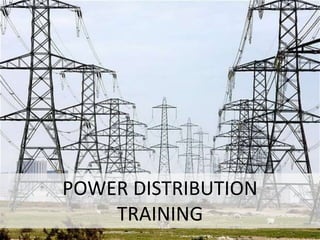
POWER DISTRIBUTION
TRAINING
GOALS OF TRAINING
Electrical Distribution Equipment
Transformers, Switch Gear, Gen., Breakers)
One-line Diagram Interpretation
•Hands-on Application
•Restoring Power
What is a Transformer?
NO YES
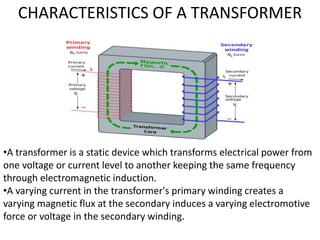
CHARACTERISTICS OF A TRANSFORMER
•A transformer is a static device which transforms electrical power from
one voltage or current level to another keeping the same frequency
through electromagnetic induction.
•A varying current in the transformer's primary winding creates a
varying magnetic flux at the secondary induces a varying electromotive
force or voltage in the secondary winding.
High Voltage Transformers Characteristics
•Steps primary voltage (28KV) down on the secondary voltage (4160V)
•Oil inside of these transformers acts as a cooling agent to reduce heat
•Nitrogen is applied to transformers to remove oxygen and water
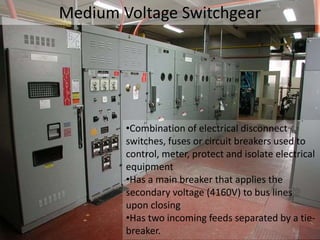
Medium Voltage Switchgear
•Combination of electrical disconnect
switches, fuses or circuit breakers used to
control, meter, protect and isolate electrical
equipment
•Has a main breaker that applies the
secondary voltage (4160V) to bus lines
upon closing
•Has two incoming feeds separated by a tie-
breaker.
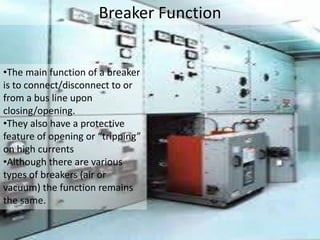
Breaker Function
•The main function of a breaker
is to connect/disconnect to or
from a bus line upon
closing/opening.
•They also have a protective
feature of opening or “tripping”
on high currents
•Although there are various
types of breakers (air or
vacuum) the function remains
the same.
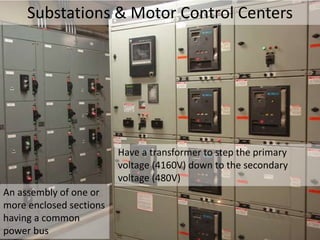
Substations & Motor Control Centers
Have a transformer to step the primary
voltage (4160V) down to the secondary
voltage (480V)
An assembly of one or
more enclosed sections
having a common
power bus
Emergency Generators
•Diesel powered systems that generate their own power to be applied
to switchgear automatically in the event of full power loss
•Have a peak shaving component that aids in power consumption
reduction
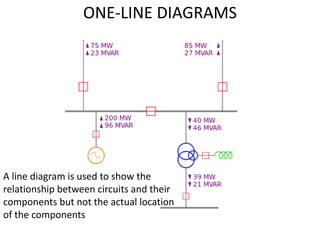
ONE-LINE DIAGRAMS
A line diagram is used to show the
relationship between circuits and their
components but not the actual location
of the components
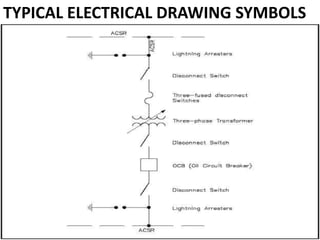
TYPICAL ELECTRICAL DRAWING SYMBOLS
Simple One-Line Diagram
Schematic
Loss of Power Scenarios
Scenario: A plant with 2 transformers has the
motor load evenly distributed. No bus ties are

closed.
There is a loss of power on transformer 1. What
happens?
There is a power loss on 1 and 2
transformers. What happens?
The breaker feeding one side of
the substation fails open. What
happens?
Controlled Shutdown
In the event of an scheduled shutdown of one or
more primary transformers, what are some of
the procedures that need to be followed?
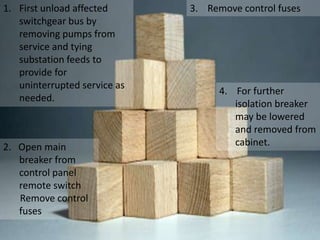
1. First unload affected
switchgear bus by
removing pumps from
service and tying
substation feeds to
provide for
uninterrupted service as
needed.
3. Remove control fuses
2. Open main
breaker from
control panel
remote switch
Remove control
fuses
4. For further
isolation breaker
may be lowered
and removed from
cabinet.
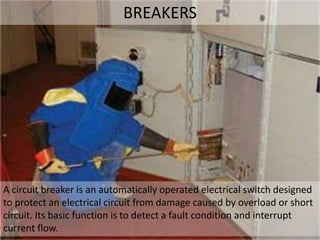
BREAKERS
A circuit breaker is an automatically operated electrical switch designed
to protect an electrical circuit from damage caused by overload or short
circuit. Its basic function is to detect a fault condition and interrupt
current flow.
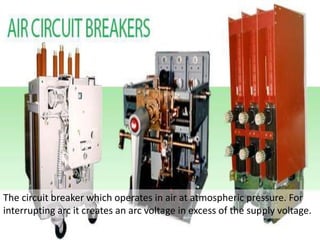
The circuit breaker which operates in air at atmospheric pressure. For
interrupting arc it creates an arc voltage in excess of the supply voltage.
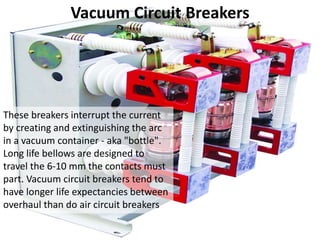
Vacuum Circuit Breakers
These breakers interrupt the current
by creating and extinguishing the arc
in a vacuum container - aka "bottle".
Long life bellows are designed to
travel the 6-10 mm the contacts must
part. Vacuum circuit breakers tend to
have longer life expectancies between
overhaul than do air circuit breakers
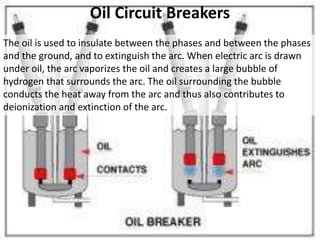
Oil Circuit Breakers
The oil is used to insulate between the phases and between the phases
and the ground, and to extinguish the arc. When electric arc is drawn
under oil, the arc vaporizes the oil and creates a large bubble of
hydrogen that surrounds the arc. The oil surrounding the bubble
conducts the heat away from the arc and thus also contributes to
deionization and extinction of the arc.
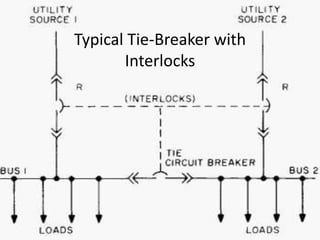
Purpose of Main/Tie Breakers/Interlocks
The tie breaker system is designed only to have one transformer
operating when the tie breakers are closed, or in other words the
system is not intended to run with the utility transformer paralleled.
Interlock systems are in place to ensure that the ties and both mains are
never all closed at once putting transformers in parallel.
Typical Tie-Breaker with
Interlocks
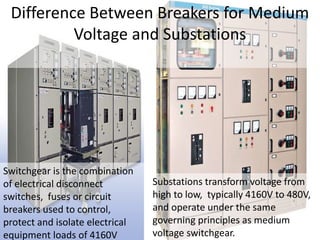
Difference Between Breakers for Medium
Voltage and Substations
Substations transform voltage from
high to low, typically 4160V to 480V,
and operate under the same
governing principles as medium
voltage switchgear.
Switchgear is the combination
of electrical disconnect
switches, fuses or circuit
breakers used to control,
protect and isolate electrical
equipment loads of 4160V
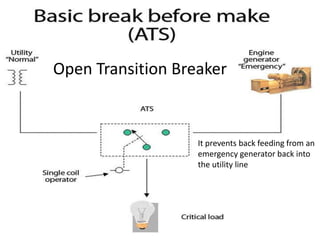
Open Transition Breaker
It prevents back feeding from an
emergency generator back into
the utility line
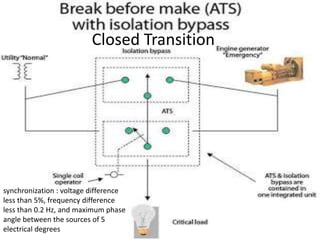
Closed Transition
synchronization : voltage difference
less than 5%, frequency difference
less than 0.2 Hz, and maximum phase
angle between the sources of 5
electrical degrees
Raking in and out of Breakers
Racking provides a method of
isolating a high-voltage
metal-clad circuit breaker
from its supply and load
circuits, and/or to provide
grounding. Before racking,
the circuit breaker must be
opened, and this is usually
ensured using an interlock
system.
RESTORING POWER
1. Knowledge of Procedure
2. Response Time
3. Contacting Effected
Parties
4. Investigating the Cause
5. Waiting for Stability
Restoring Power Scenarios
There is a loss of power on
transformer 1. How do you restore
power?
There is a power loss on 1 and 2
transformers. How do you
restore power?
The breaker feeding one side of
substation 1 fails open. How
do you restore power?
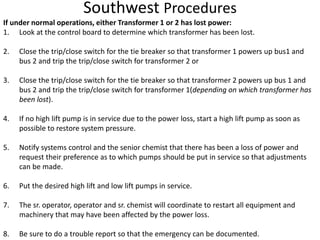
Southwest Procedures
If under normal operations, either Transformer 1 or 2 has lost power:
1. Look at the control board to determine which transformer has been lost.
2. Close the trip/close switch for the tie breaker so that transformer 1 powers up bus1 and
bus 2 and trip the trip/close switch for transformer 2 or
3. Close the trip/close switch for the tie breaker so that transformer 2 powers up bus 1 and
bus 2 and trip the trip/close switch for transformer 1(depending on which transformer has
been lost).
4. If no high lift pump is in service due to the power loss, start a high lift pump as soon as
possible to restore system pressure.
5. Notify systems control and the senior chemist that there has been a loss of power and
request their preference as to which pumps should be put in service so that adjustments
can be made.
6. Put the desired high lift and low lift pumps in service.
7. The sr. operator, operator and sr. chemist will coordinate to restart all equipment and
machinery that may have been affected by the power loss.
8. Be sure to do a trouble report so that the emergency can be documented.
Response Time
It is critical to react safely, competently
and quickly to power loss events. Being
aware of what power source is
supplying equipment in service, and
relying on your team (Water Techs,
Chemist, SCC) to provide information in
cause of an loss is essential.
If possible, starting another pump to
restore system pressure is the priority
over restoring loss power.
Contacting DTE/SCC/Management
Notification of power loss and the current
status is crucial during a power loss event.
Contact numbers for SCC and DTE should be
posted or readily available.
Notification of management and detailed
documentation of what occurred and the steps
taken to restore power are also important.
Troubleshooting Power Loss
After restoring system
pressure and establishing a
power source, the next step is
to investigate the potential
causes of the power loss.
Although you are not an electrician, detailed notes of what has taken
place during the event are necessary for the maintenance crew to find
the cause and repair or replace any damaged equipment.
Following Proper Procedures/Waiting for
Stability
Before normal power
distribution operation
can be restored, a high
probability of stability
must be known.
Helps to avoid a repeat
of the power loss.
Working with DTE or
the maintenance crew
to establish cause will
provide insight
You are the first line of
defense in protecting
the public.
Test Time

POWER DISTRIBUTION 2.docx

  • 1.
  • 2.
    GOALS OF TRAINING ElectricalDistribution Equipment Transformers, Switch Gear, Gen., Breakers) One-line Diagram Interpretation •Hands-on Application •Restoring Power
  • 3.
    What is aTransformer? NO YES
  • 4.
    CHARACTERISTICS OF ATRANSFORMER •A transformer is a static device which transforms electrical power from one voltage or current level to another keeping the same frequency through electromagnetic induction. •A varying current in the transformer's primary winding creates a varying magnetic flux at the secondary induces a varying electromotive force or voltage in the secondary winding.
  • 5.
    High Voltage TransformersCharacteristics •Steps primary voltage (28KV) down on the secondary voltage (4160V) •Oil inside of these transformers acts as a cooling agent to reduce heat •Nitrogen is applied to transformers to remove oxygen and water
  • 6.
    Medium Voltage Switchgear •Combinationof electrical disconnect switches, fuses or circuit breakers used to control, meter, protect and isolate electrical equipment •Has a main breaker that applies the secondary voltage (4160V) to bus lines upon closing •Has two incoming feeds separated by a tie- breaker.
  • 7.
    Breaker Function •The mainfunction of a breaker is to connect/disconnect to or from a bus line upon closing/opening. •They also have a protective feature of opening or “tripping” on high currents •Although there are various types of breakers (air or vacuum) the function remains the same.
  • 8.
    Substations & MotorControl Centers Have a transformer to step the primary voltage (4160V) down to the secondary voltage (480V) An assembly of one or more enclosed sections having a common power bus
  • 9.
    Emergency Generators •Diesel poweredsystems that generate their own power to be applied to switchgear automatically in the event of full power loss •Have a peak shaving component that aids in power consumption reduction
  • 10.
    ONE-LINE DIAGRAMS A linediagram is used to show the relationship between circuits and their components but not the actual location of the components
  • 11.
  • 13.
  • 14.
    Loss of PowerScenarios Scenario: A plant with 2 transformers has the motor load evenly distributed. No bus ties are closed.
  • 15.
    There is aloss of power on transformer 1. What happens? There is a power loss on 1 and 2 transformers. What happens? The breaker feeding one side of the substation fails open. What happens?
  • 16.
    Controlled Shutdown In theevent of an scheduled shutdown of one or more primary transformers, what are some of the procedures that need to be followed?
  • 17.
    1. First unloadaffected switchgear bus by removing pumps from service and tying substation feeds to provide for uninterrupted service as needed. 3. Remove control fuses 2. Open main breaker from control panel remote switch Remove control fuses 4. For further isolation breaker may be lowered and removed from cabinet.
  • 18.
    BREAKERS A circuit breakeris an automatically operated electrical switch designed to protect an electrical circuit from damage caused by overload or short circuit. Its basic function is to detect a fault condition and interrupt current flow.
  • 19.
    The circuit breakerwhich operates in air at atmospheric pressure. For interrupting arc it creates an arc voltage in excess of the supply voltage.
  • 20.
    Vacuum Circuit Breakers Thesebreakers interrupt the current by creating and extinguishing the arc in a vacuum container - aka "bottle". Long life bellows are designed to travel the 6-10 mm the contacts must part. Vacuum circuit breakers tend to have longer life expectancies between overhaul than do air circuit breakers
  • 21.
    Oil Circuit Breakers Theoil is used to insulate between the phases and between the phases and the ground, and to extinguish the arc. When electric arc is drawn under oil, the arc vaporizes the oil and creates a large bubble of hydrogen that surrounds the arc. The oil surrounding the bubble conducts the heat away from the arc and thus also contributes to deionization and extinction of the arc.
  • 22.
    Purpose of Main/TieBreakers/Interlocks The tie breaker system is designed only to have one transformer operating when the tie breakers are closed, or in other words the system is not intended to run with the utility transformer paralleled. Interlock systems are in place to ensure that the ties and both mains are never all closed at once putting transformers in parallel.
  • 23.
  • 24.
    Difference Between Breakersfor Medium Voltage and Substations Substations transform voltage from high to low, typically 4160V to 480V, and operate under the same governing principles as medium voltage switchgear. Switchgear is the combination of electrical disconnect switches, fuses or circuit breakers used to control, protect and isolate electrical equipment loads of 4160V
  • 25.
    Open Transition Breaker Itprevents back feeding from an emergency generator back into the utility line
  • 26.
    Closed Transition synchronization :voltage difference less than 5%, frequency difference less than 0.2 Hz, and maximum phase angle between the sources of 5 electrical degrees
  • 27.
    Raking in andout of Breakers Racking provides a method of isolating a high-voltage metal-clad circuit breaker from its supply and load circuits, and/or to provide grounding. Before racking, the circuit breaker must be opened, and this is usually ensured using an interlock system.
  • 29.
    RESTORING POWER 1. Knowledgeof Procedure 2. Response Time 3. Contacting Effected Parties 4. Investigating the Cause 5. Waiting for Stability
  • 30.
    Restoring Power Scenarios Thereis a loss of power on transformer 1. How do you restore power? There is a power loss on 1 and 2 transformers. How do you restore power? The breaker feeding one side of substation 1 fails open. How do you restore power?
  • 31.
    Southwest Procedures If undernormal operations, either Transformer 1 or 2 has lost power: 1. Look at the control board to determine which transformer has been lost. 2. Close the trip/close switch for the tie breaker so that transformer 1 powers up bus1 and bus 2 and trip the trip/close switch for transformer 2 or 3. Close the trip/close switch for the tie breaker so that transformer 2 powers up bus 1 and bus 2 and trip the trip/close switch for transformer 1(depending on which transformer has been lost). 4. If no high lift pump is in service due to the power loss, start a high lift pump as soon as possible to restore system pressure. 5. Notify systems control and the senior chemist that there has been a loss of power and request their preference as to which pumps should be put in service so that adjustments can be made. 6. Put the desired high lift and low lift pumps in service. 7. The sr. operator, operator and sr. chemist will coordinate to restart all equipment and machinery that may have been affected by the power loss. 8. Be sure to do a trouble report so that the emergency can be documented.
  • 32.
    Response Time It iscritical to react safely, competently and quickly to power loss events. Being aware of what power source is supplying equipment in service, and relying on your team (Water Techs, Chemist, SCC) to provide information in cause of an loss is essential. If possible, starting another pump to restore system pressure is the priority over restoring loss power.
  • 33.
    Contacting DTE/SCC/Management Notification ofpower loss and the current status is crucial during a power loss event. Contact numbers for SCC and DTE should be posted or readily available. Notification of management and detailed documentation of what occurred and the steps taken to restore power are also important.
  • 34.
    Troubleshooting Power Loss Afterrestoring system pressure and establishing a power source, the next step is to investigate the potential causes of the power loss. Although you are not an electrician, detailed notes of what has taken place during the event are necessary for the maintenance crew to find the cause and repair or replace any damaged equipment.
  • 36.
    Following Proper Procedures/Waitingfor Stability Before normal power distribution operation can be restored, a high probability of stability must be known. Helps to avoid a repeat of the power loss. Working with DTE or the maintenance crew to establish cause will provide insight You are the first line of defense in protecting the public.
  • 37.