7-1

Design of Work Systems

McGraw-Hill Ryerson

Operations Management, 2nd Canadian Edition, by Stevenson & Hojati
Copyright © 2004 by The McGraw-Hill Companies, Inc. All rights reserved.
7-2

Design of Work Systems

Chapter 7

Design of
Work Systems

McGraw-Hill Ryerson

Operations Management, 2nd Canadian Edition, by Stevenson & Hojati
Copyright © 2004 by The McGraw-Hill Companies, Inc. All rights reserved.
7-3

Design of Work Systems

Job Design
• Job design involves specifying the
content and methods of job
– What will be done
– Who will do the job
– How the job will bob will be done
– Where the job will be done
– Ergonomics

McGraw-Hill Ryerson

Operations Management, 2nd Canadian Edition, by Stevenson & Hojati
Copyright © 2004 by The McGraw-Hill Companies, Inc. All rights reserved.
7-4

Design of Work Systems

Design of Work Systems
• Specialization
• Behavioural Approaches to Job Design
• Teams
• Methods Analysis
• Motions Study
• Working conditions

McGraw-Hill Ryerson

Operations Management, 2nd Canadian Edition, by Stevenson & Hojati
Copyright © 2004 by The McGraw-Hill Companies, Inc. All rights reserved.
7-5

Design of Work Systems

Job Design Success
Successful Job Design must be:
• Carried out by experienced personnel with
the necessary training and background
• Consistent with the goals of the
organization
• In written form
• Understood and agreed to by both
management and employees

McGraw-Hill Ryerson

Operations Management, 2nd Canadian Edition, by Stevenson & Hojati
Copyright © 2004 by The McGraw-Hill Companies, Inc. All rights reserved.
7-6

Design of Work Systems

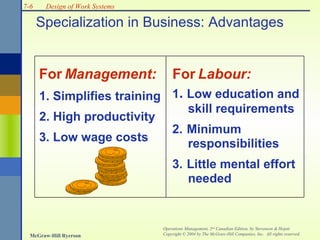
Specialization in Business: Advantages

For Management:

For Labour:
1. Simplifies training 1. Low education and
2. High productivity
3. Low wage costs

skill requirements

2. Minimum
responsibilities
3. Little mental effort
needed

McGraw-Hill Ryerson

Operations Management, 2nd Canadian Edition, by Stevenson & Hojati
Copyright © 2004 by The McGraw-Hill Companies, Inc. All rights reserved.
7-7

Design of Work Systems

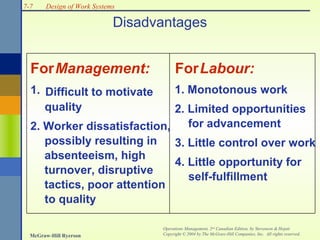
Disadvantages

For Management:

For Labour:

1. Difficult to motivate
quality

1. Monotonous work

2. Limited opportunities
for advancement
2. Worker dissatisfaction,
possibly resulting in
3. Little control over work
absenteeism, high
4. Little opportunity for
turnover, disruptive
self-fulfillment
tactics, poor attention
to quality
McGraw-Hill Ryerson

Operations Management, 2nd Canadian Edition, by Stevenson & Hojati
Copyright © 2004 by The McGraw-Hill Companies, Inc. All rights reserved.
7-8

Design of Work Systems

Behavioural Approaches to Job Design
• Job Enlargement
– Giving a worker a larger portion of the
total task by horizontal loading

• Job Rotation
– Workers periodically exchange jobs

• Job Enrichment
– Increasing responsibility for planning and
coordination tasks, by vertical loading

McGraw-Hill Ryerson

Operations Management, 2nd Canadian Edition, by Stevenson & Hojati
Copyright © 2004 by The McGraw-Hill Companies, Inc. All rights reserved.
7-9

Design of Work Systems

Methods Analysis
The need for methods analysis can come
from a number of different sources:
• Changes in tools and equipment
• Changes in product design
or new products
• Changes in materials or procedures
• Other factors (e.g. accidents, quality
problems)
McGraw-Hill Ryerson

Operations Management, 2nd Canadian Edition, by Stevenson & Hojati
Copyright © 2004 by The McGraw-Hill Companies, Inc. All rights reserved.
7-10

Design of Work Systems

ge
Stor
a

De l
ay

n
ect
io

e nt

Ins
p

Details of Method

vem

ANALYST PAGE
Job Requisition of petty cash D. Kolb 1 of 2

Mo

FLOW PROCESS CHART

Op
era
tion

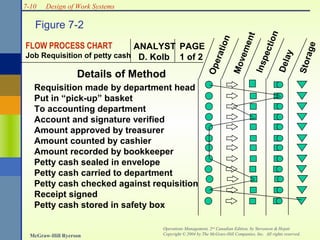
Figure 7-2

Requisition made by department head
Put in “pick-up” basket
To accounting department
Account and signature verified
Amount approved by treasurer
Amount counted by cashier
Amount recorded by bookkeeper
Petty cash sealed in envelope
Petty cash carried to department
Petty cash checked against requisition
Receipt signed
Petty cash stored in safety box

McGraw-Hill Ryerson

Operations Management, 2nd Canadian Edition, by Stevenson & Hojati
Copyright © 2004 by The McGraw-Hill Companies, Inc. All rights reserved.
7-11

Design of Work Systems

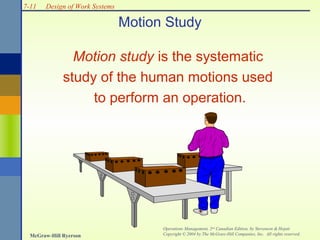
Motion Study
Motion study is the systematic
study of the human motions used
to perform an operation.

McGraw-Hill Ryerson

Operations Management, 2nd Canadian Edition, by Stevenson & Hojati
Copyright © 2004 by The McGraw-Hill Companies, Inc. All rights reserved.
7-12

Design of Work Systems

Motion Study Techniques
• Motion study principles - guidelines for
designing motion-efficient work procedures
• Analysis of therbligs - basic elemental
motions into which a job can be broken
down
• Micromotion study - use of motion pictures
and slow motion to study motions that
otherwise would be too rapid to analyze
• Charts

McGraw-Hill Ryerson

Operations Management, 2nd Canadian Edition, by Stevenson & Hojati
Copyright © 2004 by The McGraw-Hill Companies, Inc. All rights reserved.
7-13

Design of Work Systems

Developing Work Methods
•
•
•
•

Eliminate unnecessary motions
Combine activities
Reduce fatigue
Improve the arrangement of the
workplace
• Improve the design of tools and
equipment

McGraw-Hill Ryerson

Operations Management, 2nd Canadian Edition, by Stevenson & Hojati
Copyright © 2004 by The McGraw-Hill Companies, Inc. All rights reserved.
7-14

Design of Work Systems

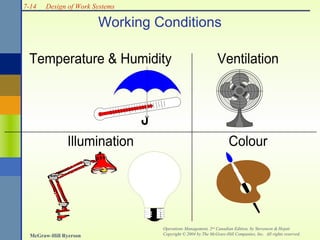
Working Conditions
Temperature & Humidity

Ventilation

Illumination

Colour

McGraw-Hill Ryerson

Operations Management, 2nd Canadian Edition, by Stevenson & Hojati
Copyright © 2004 by The McGraw-Hill Companies, Inc. All rights reserved.
7-15

Design of Work Systems

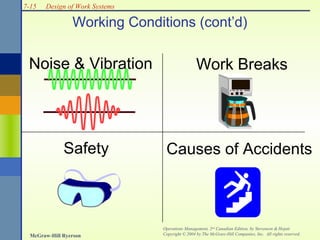
Working Conditions (cont’d)

Noise & Vibration

Work Breaks

Safety

Causes of Accidents

McGraw-Hill Ryerson

Operations Management, 2nd Canadian Edition, by Stevenson & Hojati
Copyright © 2004 by The McGraw-Hill Companies, Inc. All rights reserved.
7-16

Design of Work Systems

Work Measurement
• Stopwatch Time Study
• Standard Elemental Times
• Predetermined Time
Standards
• Work Sampling

McGraw-Hill Ryerson

Operations Management, 2nd Canadian Edition, by Stevenson & Hojati
Copyright © 2004 by The McGraw-Hill Companies, Inc. All rights reserved.
7-17

Design of Work Systems

Compensation
• Individual Incentive Plans
• Group Incentive Plans
• Knowledge-Based Pay
System
• Management
Compensation

McGraw-Hill Ryerson

Operations Management, 2nd Canadian Edition, by Stevenson & Hojati
Copyright © 2004 by The McGraw-Hill Companies, Inc. All rights reserved.
7-18

Design of Work Systems

Form of Incentive Plan
• Accurate
• Easy to apply
• Consistent
• Easy to understand
• Fair

McGraw-Hill Ryerson

Operations Management, 2nd Canadian Edition, by Stevenson & Hojati
Copyright © 2004 by The McGraw-Hill Companies, Inc. All rights reserved.
7-19

Design of Work Systems

Group Incentive Plans
• Scanlon Plan
– Encourage reductions in labour costs

• Kaiser Plan
– Committees suggest ways of reducing
costs

• Lincoln Plan
– Profit sharing, job enlargement, and
participative management

• Kodak Plan
– Wages/bonus related to profits

McGraw-Hill Ryerson

Operations Management, 2nd Canadian Edition, by Stevenson & Hojati
Copyright © 2004 by The McGraw-Hill Companies, Inc. All rights reserved.

3 design of work system.ppt 2

  • 1.
    7-1 Design of WorkSystems McGraw-Hill Ryerson Operations Management, 2nd Canadian Edition, by Stevenson & Hojati Copyright © 2004 by The McGraw-Hill Companies, Inc. All rights reserved.
  • 2.
    7-2 Design of WorkSystems Chapter 7 Design of Work Systems McGraw-Hill Ryerson Operations Management, 2nd Canadian Edition, by Stevenson & Hojati Copyright © 2004 by The McGraw-Hill Companies, Inc. All rights reserved.
  • 3.
    7-3 Design of WorkSystems Job Design • Job design involves specifying the content and methods of job – What will be done – Who will do the job – How the job will bob will be done – Where the job will be done – Ergonomics McGraw-Hill Ryerson Operations Management, 2nd Canadian Edition, by Stevenson & Hojati Copyright © 2004 by The McGraw-Hill Companies, Inc. All rights reserved.
  • 4.
    7-4 Design of WorkSystems Design of Work Systems • Specialization • Behavioural Approaches to Job Design • Teams • Methods Analysis • Motions Study • Working conditions McGraw-Hill Ryerson Operations Management, 2nd Canadian Edition, by Stevenson & Hojati Copyright © 2004 by The McGraw-Hill Companies, Inc. All rights reserved.
  • 5.
    7-5 Design of WorkSystems Job Design Success Successful Job Design must be: • Carried out by experienced personnel with the necessary training and background • Consistent with the goals of the organization • In written form • Understood and agreed to by both management and employees McGraw-Hill Ryerson Operations Management, 2nd Canadian Edition, by Stevenson & Hojati Copyright © 2004 by The McGraw-Hill Companies, Inc. All rights reserved.
  • 6.
    7-6 Design of WorkSystems Specialization in Business: Advantages For Management: For Labour: 1. Simplifies training 1. Low education and 2. High productivity 3. Low wage costs skill requirements 2. Minimum responsibilities 3. Little mental effort needed McGraw-Hill Ryerson Operations Management, 2nd Canadian Edition, by Stevenson & Hojati Copyright © 2004 by The McGraw-Hill Companies, Inc. All rights reserved.
  • 7.
    7-7 Design of WorkSystems Disadvantages For Management: For Labour: 1. Difficult to motivate quality 1. Monotonous work 2. Limited opportunities for advancement 2. Worker dissatisfaction, possibly resulting in 3. Little control over work absenteeism, high 4. Little opportunity for turnover, disruptive self-fulfillment tactics, poor attention to quality McGraw-Hill Ryerson Operations Management, 2nd Canadian Edition, by Stevenson & Hojati Copyright © 2004 by The McGraw-Hill Companies, Inc. All rights reserved.
  • 8.
    7-8 Design of WorkSystems Behavioural Approaches to Job Design • Job Enlargement – Giving a worker a larger portion of the total task by horizontal loading • Job Rotation – Workers periodically exchange jobs • Job Enrichment – Increasing responsibility for planning and coordination tasks, by vertical loading McGraw-Hill Ryerson Operations Management, 2nd Canadian Edition, by Stevenson & Hojati Copyright © 2004 by The McGraw-Hill Companies, Inc. All rights reserved.
  • 9.
    7-9 Design of WorkSystems Methods Analysis The need for methods analysis can come from a number of different sources: • Changes in tools and equipment • Changes in product design or new products • Changes in materials or procedures • Other factors (e.g. accidents, quality problems) McGraw-Hill Ryerson Operations Management, 2nd Canadian Edition, by Stevenson & Hojati Copyright © 2004 by The McGraw-Hill Companies, Inc. All rights reserved.
  • 10.
    7-10 Design of WorkSystems ge Stor a De l ay n ect io e nt Ins p Details of Method vem ANALYST PAGE Job Requisition of petty cash D. Kolb 1 of 2 Mo FLOW PROCESS CHART Op era tion Figure 7-2 Requisition made by department head Put in “pick-up” basket To accounting department Account and signature verified Amount approved by treasurer Amount counted by cashier Amount recorded by bookkeeper Petty cash sealed in envelope Petty cash carried to department Petty cash checked against requisition Receipt signed Petty cash stored in safety box McGraw-Hill Ryerson Operations Management, 2nd Canadian Edition, by Stevenson & Hojati Copyright © 2004 by The McGraw-Hill Companies, Inc. All rights reserved.
  • 11.
    7-11 Design of WorkSystems Motion Study Motion study is the systematic study of the human motions used to perform an operation. McGraw-Hill Ryerson Operations Management, 2nd Canadian Edition, by Stevenson & Hojati Copyright © 2004 by The McGraw-Hill Companies, Inc. All rights reserved.
  • 12.
    7-12 Design of WorkSystems Motion Study Techniques • Motion study principles - guidelines for designing motion-efficient work procedures • Analysis of therbligs - basic elemental motions into which a job can be broken down • Micromotion study - use of motion pictures and slow motion to study motions that otherwise would be too rapid to analyze • Charts McGraw-Hill Ryerson Operations Management, 2nd Canadian Edition, by Stevenson & Hojati Copyright © 2004 by The McGraw-Hill Companies, Inc. All rights reserved.
  • 13.
    7-13 Design of WorkSystems Developing Work Methods • • • • Eliminate unnecessary motions Combine activities Reduce fatigue Improve the arrangement of the workplace • Improve the design of tools and equipment McGraw-Hill Ryerson Operations Management, 2nd Canadian Edition, by Stevenson & Hojati Copyright © 2004 by The McGraw-Hill Companies, Inc. All rights reserved.
  • 14.
    7-14 Design of WorkSystems Working Conditions Temperature & Humidity Ventilation Illumination Colour McGraw-Hill Ryerson Operations Management, 2nd Canadian Edition, by Stevenson & Hojati Copyright © 2004 by The McGraw-Hill Companies, Inc. All rights reserved.
  • 15.
    7-15 Design of WorkSystems Working Conditions (cont’d) Noise & Vibration Work Breaks Safety Causes of Accidents McGraw-Hill Ryerson Operations Management, 2nd Canadian Edition, by Stevenson & Hojati Copyright © 2004 by The McGraw-Hill Companies, Inc. All rights reserved.
  • 16.
    7-16 Design of WorkSystems Work Measurement • Stopwatch Time Study • Standard Elemental Times • Predetermined Time Standards • Work Sampling McGraw-Hill Ryerson Operations Management, 2nd Canadian Edition, by Stevenson & Hojati Copyright © 2004 by The McGraw-Hill Companies, Inc. All rights reserved.
  • 17.
    7-17 Design of WorkSystems Compensation • Individual Incentive Plans • Group Incentive Plans • Knowledge-Based Pay System • Management Compensation McGraw-Hill Ryerson Operations Management, 2nd Canadian Edition, by Stevenson & Hojati Copyright © 2004 by The McGraw-Hill Companies, Inc. All rights reserved.
  • 18.
    7-18 Design of WorkSystems Form of Incentive Plan • Accurate • Easy to apply • Consistent • Easy to understand • Fair McGraw-Hill Ryerson Operations Management, 2nd Canadian Edition, by Stevenson & Hojati Copyright © 2004 by The McGraw-Hill Companies, Inc. All rights reserved.
  • 19.
    7-19 Design of WorkSystems Group Incentive Plans • Scanlon Plan – Encourage reductions in labour costs • Kaiser Plan – Committees suggest ways of reducing costs • Lincoln Plan – Profit sharing, job enlargement, and participative management • Kodak Plan – Wages/bonus related to profits McGraw-Hill Ryerson Operations Management, 2nd Canadian Edition, by Stevenson & Hojati Copyright © 2004 by The McGraw-Hill Companies, Inc. All rights reserved.