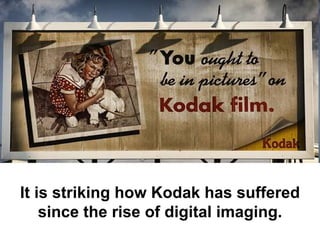
It is striking how Kodak has suffered
    since the rise of digital imaging.
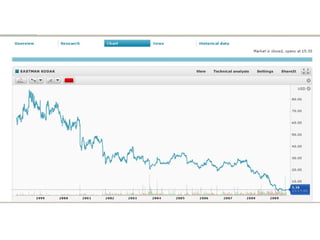
The stock declined from around 80
dollars to 3 USD in less than ten years.
The company employed 140 000 people
    in 1988 – today around 20 000.
I have argued before that much of this decline was
 inevitable and that Kodak did more than many other
film companies in order to meet the digital challenge
                   (read more here).
But surely, they must have made
     some mistakes, right?
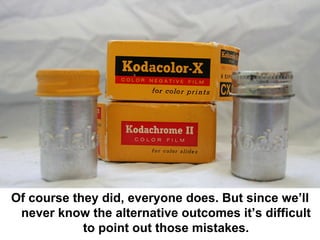
Of course they did, everyone does. But since we’ll
 never know the alternative outcomes it’s difficult
            to point out those mistakes.
Nevertheless, I will
provide a few highly
unscientific thoughts
  about this issue.
The wild
diversifications that
  took place in the
1980s put Kodak in a
     lot of debt.
One consequence of
 leveraged heydays
    was that less
   resources were
available to fight the
   global film war
     against Fuji.
This in turn implied
that the company was
  financially weaker
 once the revolution
  came into motion.
But that’s not
directly related
  to the firm’s
      digital
    strategy.
     Kodak’s
   attempts at
     various
     ’hybrid’
cameras might
also have been
   a mistake.
While Kodak
    invested
   heavily in
      digital
 development,
 the company
also sought to
     launch
products which
   were both
  digital and
   analogue.
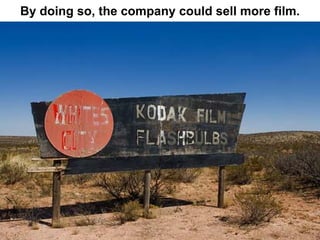
By doing so, the company could sell more film.
And film generated profits.
Historically,
  Kodak had for
 many decades
 only developed
  and launched
 new cameras in
order to generate
  more sales of
       film.
To some extent it
    seems that the
   company tried to
     make digital
  technology a new
  way of generating
higher film revenues.
This way of thinking
   may help us to
understand why the
CEO Dan Carp made
 the following over-
optimistic statement
       in 2000:
"Kodak is convinced
 that there has never
 been a better time to
   be in the picture
  business…. Digital
 can change the way
 people take and use
  pictures. Suddenly
      there are no
  boundaries to how
  often you can take
pictures because cost
and availability are no
    longer issues."
Let’s take a look
 at the various
hybrid initiatives
Kodak launched
 in the 1990s…
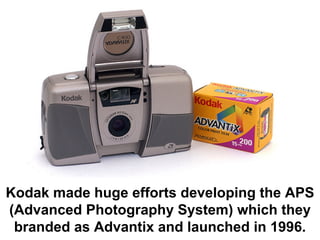
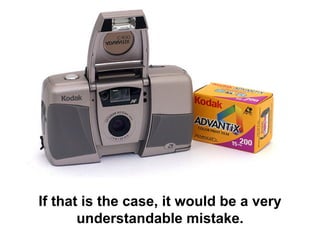
Kodak made huge efforts developing the APS
(Advanced Photography System) which they
 branded as Advantix and launched in 1996.
The system was essentially a hybrid which
could transfer film into digital image files.
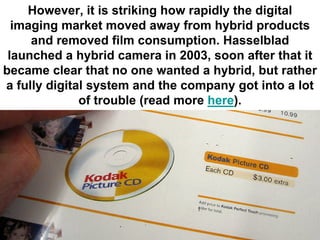
The Picture CD was launched in 1998 and
enabled transfer of images captured with film
            to digital image files.
’You’ve got pictures’ was co-developed
  with AOL and launched in 1998. This
system gave consumers the opportunity
  to drop film rolls off and have them
 delivered to their AOL email address.
PhotoNet was another initiative that can
      be considered similar to
        ’You’ve got pictures’.
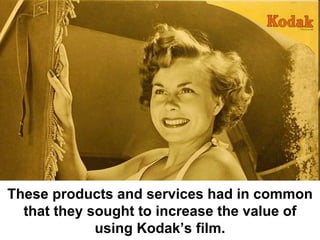
These products and services had in common
  that they sought to increase the value of
             using Kodak’s film.
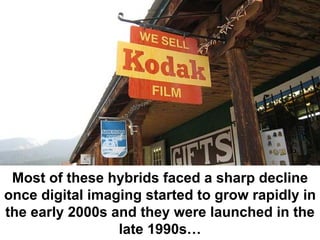
Most of these hybrids faced a sharp decline
once digital imaging started to grow rapidly in
the early 2000s and they were launched in the
                 late 1990s…
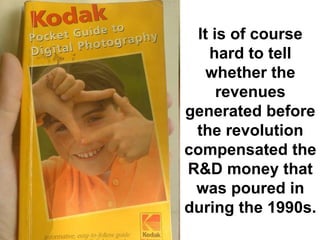
It is of course
   hard to tell
   whether the
     revenues
generated before
 the revolution
compensated the
R&D money that
 was poured in
during the 1990s.
And it’s hard
to say whether
 spending that
money on pure
    digital
   products
  would have
 been a wiser
   decision.
However, it is striking how rapidly the digital
  imaging market moved away from hybrid products
     and removed film consumption. Hasselblad
 launched a hybrid camera in 2003, soon after that it
became clear that no one wanted a hybrid, but rather
a fully digital system and the company got into a lot
              of trouble (read more here).
Bearing this in mind, along with all R&D that
was spent on hybrid cameras, this might have
     been a strategic mistake by Kodak.
If that is the case, it would be a very
       understandable mistake.
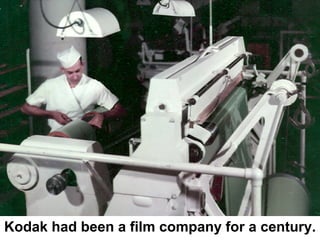
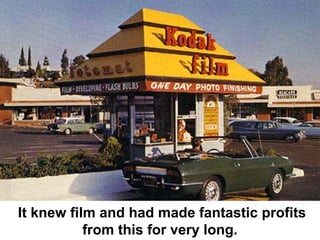
Kodak had been a film company for a century.
It knew film and had made fantastic profits
           from this for very long.
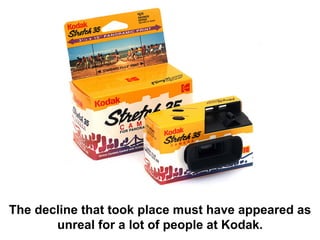
The decline that took place must have appeared as
       unreal for a lot of people at Kodak.
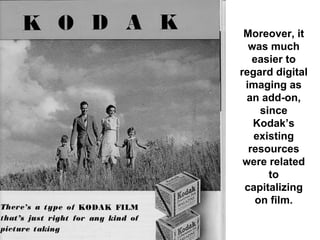
Moreover, it
  was much
   easier to
regard digital
 imaging as
  an add-on,
     since
   Kodak’s
   existing
  resources
 were related
       to
 capitalizing
    on film.
Those resources lost virtually all their
    value in less than a decade.
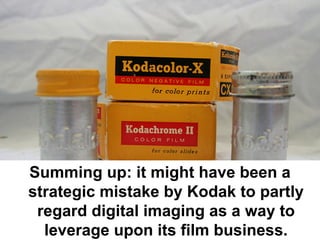
Summing up: it might have been a
strategic mistake by Kodak to partly
 regard digital imaging as a way to
  leverage upon its film business.
Image attributions
Christian Sandström is a
                  PhD student at Chalmers
                 University of Technology in
                 Gothenburg, Sweden. He
                  writes and speaks about
                  disruptive innovation and
                    technological change.


   www.christiansandstrom.org
christian.sandstrom at chalmers.se

Digital Imaging and Kodak's Strategic Mistake

  • 2.
    It is strikinghow Kodak has suffered since the rise of digital imaging.
  • 3.
    The stock declinedfrom around 80 dollars to 3 USD in less than ten years. The company employed 140 000 people in 1988 – today around 20 000.
  • 5.
    I have arguedbefore that much of this decline was inevitable and that Kodak did more than many other film companies in order to meet the digital challenge (read more here).
  • 6.
    But surely, theymust have made some mistakes, right?
  • 7.
    Of course theydid, everyone does. But since we’ll never know the alternative outcomes it’s difficult to point out those mistakes.
  • 8.
    Nevertheless, I will providea few highly unscientific thoughts about this issue.
  • 9.
    The wild diversifications that took place in the 1980s put Kodak in a lot of debt.
  • 10.
    One consequence of leveraged heydays was that less resources were available to fight the global film war against Fuji.
  • 11.
    This in turnimplied that the company was financially weaker once the revolution came into motion.
  • 12.
    But that’s not directlyrelated to the firm’s digital strategy. Kodak’s attempts at various ’hybrid’ cameras might also have been a mistake.
  • 13.
    While Kodak invested heavily in digital development, the company also sought to launch products which were both digital and analogue.
  • 14.
    By doing so,the company could sell more film.
  • 15.
  • 16.
    Historically, Kodakhad for many decades only developed and launched new cameras in order to generate more sales of film.
  • 17.
    To some extentit seems that the company tried to make digital technology a new way of generating higher film revenues.
  • 18.
    This way ofthinking may help us to understand why the CEO Dan Carp made the following over- optimistic statement in 2000:
  • 19.
    "Kodak is convinced that there has never been a better time to be in the picture business…. Digital can change the way people take and use pictures. Suddenly there are no boundaries to how often you can take pictures because cost and availability are no longer issues."
  • 20.
    Let’s take alook at the various hybrid initiatives Kodak launched in the 1990s…
  • 21.
    Kodak made hugeefforts developing the APS (Advanced Photography System) which they branded as Advantix and launched in 1996.
  • 22.
    The system wasessentially a hybrid which could transfer film into digital image files.
  • 23.
    The Picture CDwas launched in 1998 and enabled transfer of images captured with film to digital image files.
  • 24.
    ’You’ve got pictures’was co-developed with AOL and launched in 1998. This system gave consumers the opportunity to drop film rolls off and have them delivered to their AOL email address.
  • 25.
    PhotoNet was anotherinitiative that can be considered similar to ’You’ve got pictures’.
  • 26.
    These products andservices had in common that they sought to increase the value of using Kodak’s film.
  • 27.
    Most of thesehybrids faced a sharp decline once digital imaging started to grow rapidly in the early 2000s and they were launched in the late 1990s…
  • 28.
    It is ofcourse hard to tell whether the revenues generated before the revolution compensated the R&D money that was poured in during the 1990s.
  • 29.
    And it’s hard tosay whether spending that money on pure digital products would have been a wiser decision.
  • 30.
    However, it isstriking how rapidly the digital imaging market moved away from hybrid products and removed film consumption. Hasselblad launched a hybrid camera in 2003, soon after that it became clear that no one wanted a hybrid, but rather a fully digital system and the company got into a lot of trouble (read more here).
  • 31.
    Bearing this inmind, along with all R&D that was spent on hybrid cameras, this might have been a strategic mistake by Kodak.
  • 32.
    If that isthe case, it would be a very understandable mistake.
  • 33.
    Kodak had beena film company for a century.
  • 34.
    It knew filmand had made fantastic profits from this for very long.
  • 35.
    The decline thattook place must have appeared as unreal for a lot of people at Kodak.
  • 36.
    Moreover, it was much easier to regard digital imaging as an add-on, since Kodak’s existing resources were related to capitalizing on film.
  • 38.
    Those resources lostvirtually all their value in less than a decade.
  • 42.
    Summing up: itmight have been a strategic mistake by Kodak to partly regard digital imaging as a way to leverage upon its film business.
  • 43.
  • 44.
    Christian Sandström isa PhD student at Chalmers University of Technology in Gothenburg, Sweden. He writes and speaks about disruptive innovation and technological change. www.christiansandstrom.org christian.sandstrom at chalmers.se