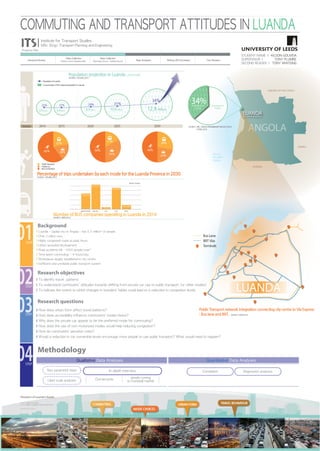
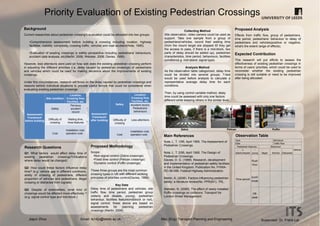
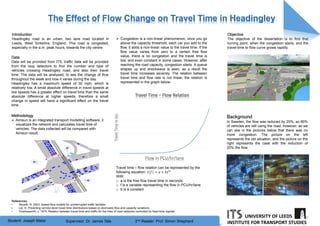
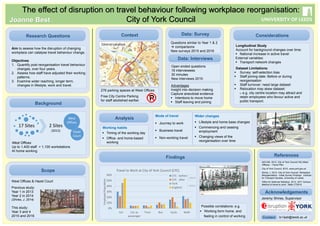
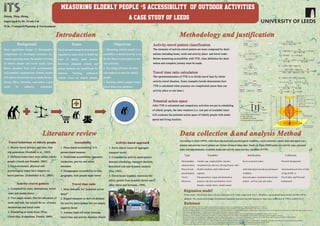
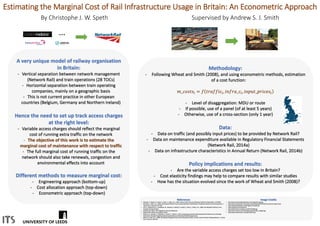
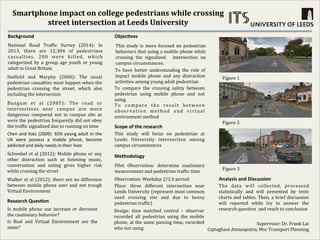
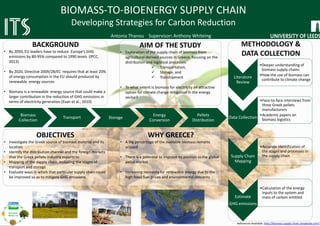
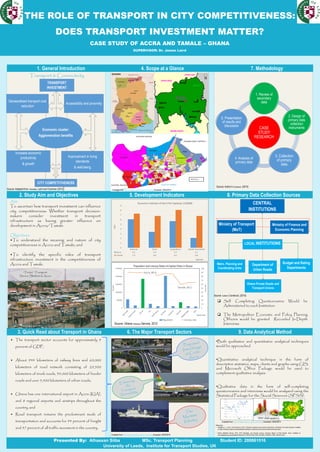
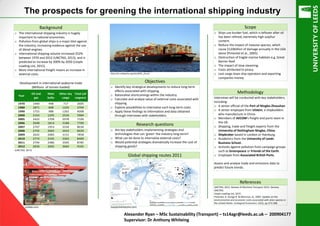
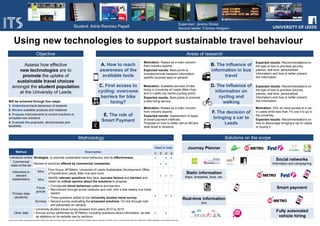
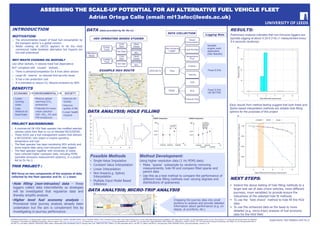
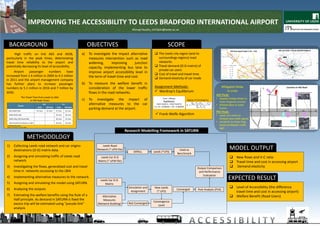
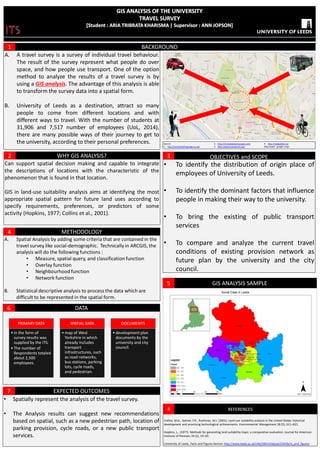
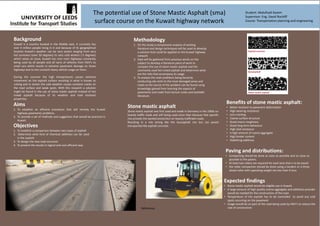
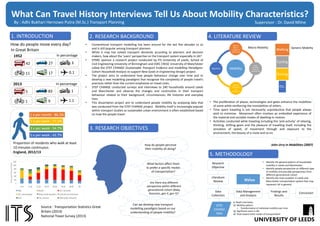
1. Introduction and Background
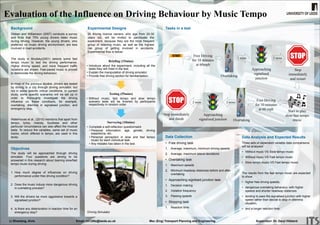
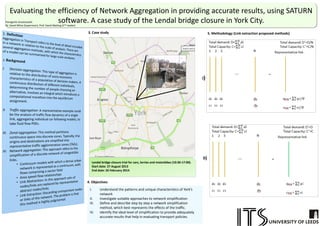
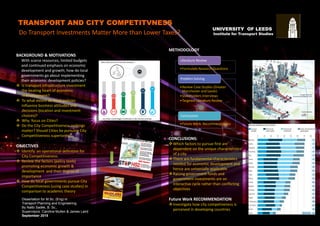
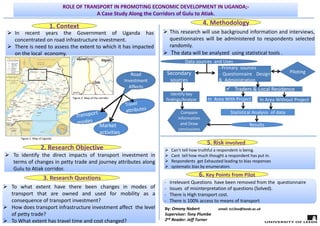
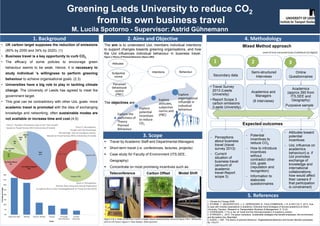
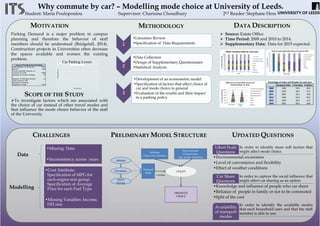
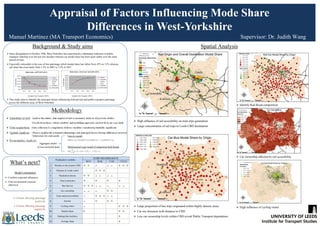
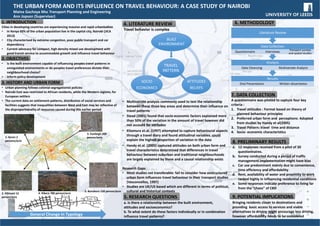
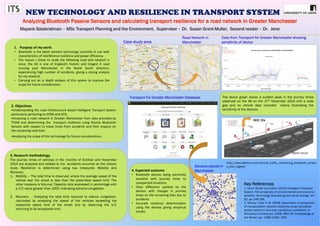
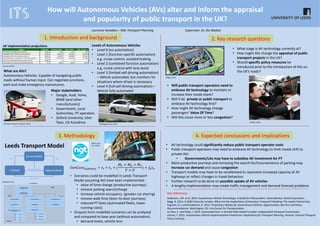
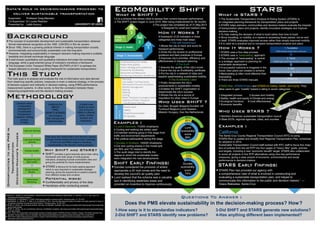
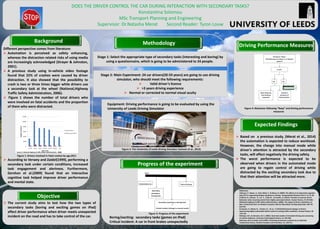
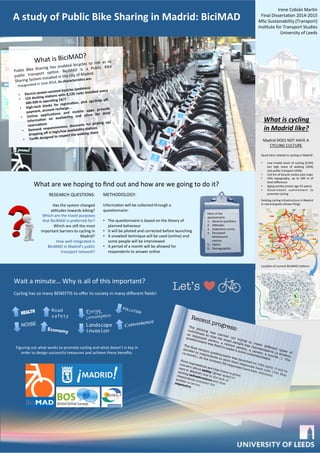
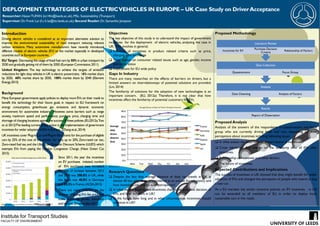
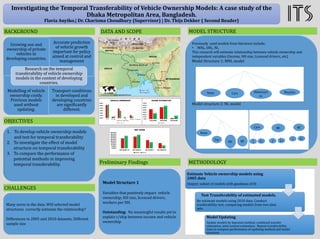
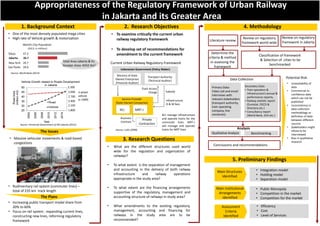
• Driver performance can be influenced by surrounding vehicle. “It is well known that
the surrounding roads and traffic environment influences driver’s behaviour; for
example, the road environment (surrounding landscape, road characteristics), traffic
composition (cars and heavy vehicles) affects driver’s desired speed, lane changing
behaviour, lateral positioning, and overtaking behaviour” (Antonson, H., 2009;
Olstam, J. 2009; Moridpour, S et al., 2010).
• There is also substantial research about other influencing factors such as distraction,
fatigue, and personality on driving performance, but could something as simple as the
lane position of another vehicle influence your performance.
1.1. Aims & Objectives
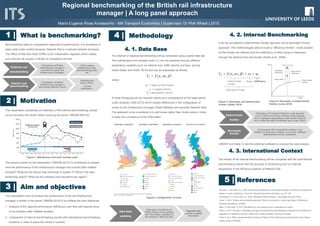
AIM: To investigate the interaction between surrounding driver behaviours and driving
controls.
OBJECTIVES: are to determine:
1. The extent to which a lead driver’s behaviour influences driving performance and
vehicle control of a following driver on (Rural roads)
2. Which lead vehicle type has greater influence on drivers’ performance and vehicle
control? (Car vs HGV)
3. Who is likely to be more affected by lead vehicle aggressive driving behaviour? (Male
driver vs female driver)
4. Research Methodology
Simulator Validity
• Ideally this study will require the simulator validity to be closely related to real
world driving in order to consider the simulator as an adequate tool.
• Selection of simulator is based on trade-off between (validity and controllability)
Participant Sample
• Findings show that young drivers aged 17-25 are particularly prone to have
relatively more accidents than other driver (Clarke, D et al., 2006). The
characteristics of young driver accidents includes: accidents on single carriageway
rural roads; loss of control; excess speeding; accident during darkness (Clarke, D et
al., 2006).
• Male drivers have more accidents compared to their female counterpart (Clarke, D
et al., 2006; Jiménez-Mejías, E et al., 2014).
• 20 young drivers (10 males and 10 females) will be recruited for this study. This
sample size was informed by a similar driving simulator study on the comparison of
driving styles (Pampel, S. M., et al., 2015).
3. Literature Review
The idea behind this study is connected to earlier road safety paradigm and research
carried out between 1950 and 1970 which tried to establish the cause of accidents
as being “Road user, or the vehicle, or the road” (Hagenzieker, M.P et al., 2014).
References
 Antonson, H., Mårdh, S., Wiklund, M., & Blomqvist, G. (2009). Effect of surrounding landscape on driving behaviour: A driving simulator study. Journal of Environmental
Psychology, 29(4), 493-502.
 Bella, F. (2005). Validation of a driving simulator for work zone design. Transportation Research Record: Journal of the Transportation Research Board, 1937(1), 136-144.
 Clarke, D. D., Ward, P., Bartle, C., & Truman, W. (2006). Young driver accidents in the UK: The influence of age, experience, and time of day. Accident Analysis & Prevention,
38(5), 871-878.
 Hagenzieker, M. P., Commandeur, J. J., & Bijleveld, F. D. (2014). The history of road safety research: A quantitative approach. Transportation research part F: traffic
psychology and behaviour, 25, 150-162.
 Jiménez-Mejías, E., Prieto, C. A., Martínez-Ruiz, V., del Castillo, J. D. D. L., Lardelli-Claret, P., & Jimenez-Moleon, J. J. (2014). Gender-related differences in distances travelled,
driving behaviour and traffic accidents among university students. Transportation research part F: traffic psychology and behaviour, 27, 81-89.
 Moridpour, S., Rose, G., & Sarvi, M. (2010). Effect of surrounding traffic characteristics on lane changing behavior. Journal of Transportation Engineering, 136(11), 973-985.
 Olstam, J. (2009). Simulation of surrounding vehicles in driving simulators.
 Pampel, S. M., Jamson, S. L., Hibberd, D. L., & Barnard, Y. (2015). How I reduce fuel consumption: An experimental study on mental models of eco-driving. Transportation
Research Part C: Emerging Technologies.
IS VEHICLE CONTROL AFFECTED BY SURROUNDING VEHICLES? (A DRIVER SAFETY PERSPECTIVE)
Name: Adesina AdelusiName: Adesina Adelusi
MSc (Eng) Transport Planning & Engineering
Email: ts14aoa@leeds. ac.uk
Supervisor: Dr Daryl Hibberd
Road type Lead vehicle type Following vehicle driver
Rural road Car Male
Heavy vehicle Female
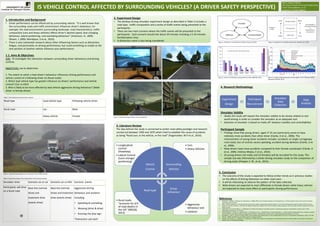
2. Experiment Design
• The desktop driving simulator experiment design as described in Table 2 includes a
road type, traffic composition and a series of traffic events being presented to the
participants.
• There are two main scenario where the traffic events will be presented to the
participants . Each scenario should last about 20 minutes including a 5-10 minutes
familiarization time.
• A distraction event is also being considered.
Simulator drive Scenario car vs car Scenario car vs HGV Scenario Events
Participants will drive
on a Rural road
Base line (normal
drive) and
treatment drive
(events drive)
Base line (normal
drive) and treatment
drive (events drive)
Aggressive driving
behaviour and violation
including:
• Speeding & overtaking,
• Weaving (drink & drive)
• Running the stop sign.
*Distraction sub task?
5. Conclusion
• The outcome of this study is expected to follow similar trends as in previous studies
on the effects of driving behaviour on other road users.
• It will be interesting to observe the pattern of the data collected.
• Male drivers are expected to react differently to female drivers while heavy vehicles
are expected to have more effect on participants driving performance.
• Aggressive
behaviour and
• violation
• Rural roads
“accounts for 2/3
of road deaths in
the UK” (RRCGB,
2013)
• Cars
• Heavy Vehicles
• Longitudinal
control
(Headway)
• Lateral Control
(Lane change/
positioning)
Vehicle
Control
Surrounding
Vehicles
Driver
behaviour
Road type
Figure 5, Factors contributing to young drivers accident (RRCGB, 2011). Figure 6, Accident involving young car drivers aged 17-24 in 2012 per million
population (RRCGB, 2012)
Figure 3, Interaction contributing to accident cause (Lai, 2014). Figure 4, Comparison of available experiment methods (Lai, 2014).
Figure 2, Desktop driving simulator and its capabilities
Figure 1, Typical driving situation on a rural road in the UK (Riley, 2014).
Table 1: The fundamental basis for this research
Table 2: Experiment design to be implemented in the driving simulator
Experiment
Design
Participant
Recruitment
Simulator
Data
Collection
Data
Analysis
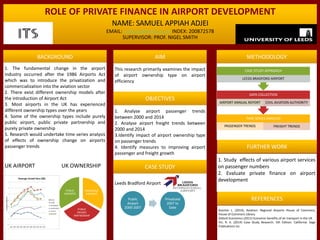
Understanding Choice of Departure Airport and its Relation to Surface Access
A Case Study of London Gatwick
and London Stansted Airports
Problem:
Currently, airport surface access in
the UK is heavily reliant on trips by
private car, which has resulted in
congestion on local road networks
and raised levels of pollution from
vehicle emissions.
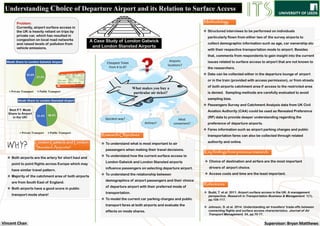
57.2%
42.6%
Mode Share to London Gatwick Airport
Private Transport Public Transport
48.3%51.5%
Mode Share to London Stansted Airport
Private Transport Public Transport
 Both airports are the artery for short haul and
point to point flights across Europe which may
have similar travel pattern.
 Majority of the catchment area of both airports
are from South East of England.
 Both airports have a good score in public
transport mode share!
 To understand what is most important to air
passengers when making their travel decisions.
 To understand how the current surface access to
London Gatwick and London Stansted airports
influence passengers on selecting departure airport.
 To understand the relationship between
demographics of airport passengers and their choice
of departure airport with their preferred mode of
transportation.
 To model the current car parking charges and public
transport fares at both airports and evaluate the
effects on mode shares.
Research Objectives
Methodology
 Structured interviews to be performed on individuals
particularly flown from either two of the survey airports to
collect demographic information such as age, car ownership etc
with their respective transportation mode to airport. Besides
that, comments from respondents to gain insight into the current
issues related to surface access to airport that are not known to
the researchers.
 Data can be collected either in the departure lounge of airport
or in the train (provided with access permission), or from streets
of both airports catchment area if access to the restricted area
is denied. Sampling methods are carefully evaluated to avoid
sampling bias.
 Passengers Survey and Catchment Analysis data from UK Civil
Aviation Authority (CAA) could be used as Revealed Preference
(RP) data to provide deeper understanding regarding the
preference of departure airports.
 Fares information such as airport parking charges and public
transportation fares can also be collected through related
authority and online.London Gatwick and London
Stansted Airports?
Supervisor: Bryan MatthewsVincent Chan
Best P.T. Mode
Share to Airport
in the UK!
What makes you buy a
particular air ticket?
Airports
locations?
Cheapest Ticket
from A to B?
Quickest way? Most
convenient?Airlines?
 Choice of destination and airfare are the most important
drivers of airport choice.
 Access costs and time are the least important.
Key findings from previous research:
References
 Budd, T. et al. 2011. Airport surface access in the UK: A management
perspective. Research in Transportation Business & Management. 1(1),
pp.109-117.
 Johnson, D. et al. 2014. Understanding air travellers' trade-offs between
connecting flights and surface access characteristics. Journal of Air
Transport Management. 34, pp.70-77.
The Impact of High Speed Rail on Tourism
− A Case Study of Shanghai
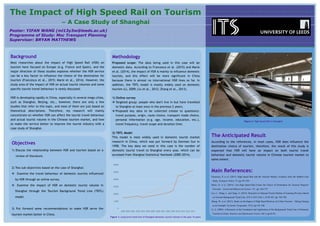
Figure 1: Long-term trend line of Shanghai domestic tourist volume in the past 14 years
0
5000
10000
15000
20000
25000
30000
1999 2000 2001 2002 2003 2004 2005 2006 2007 2008 2009 2010 2011 2012 2013
Poster: YIFAN WANG (ml13y3w@leeds.ac.uk)
Programme of Study: Msc Transport Planning
Supervisor: BRYAN MATTHEWS
Figure 2: High Speed Rail in Shanghai
Background
Most researches about the impact of High Speed Rail (HSR) on
tourism have focused on Europe (e.g. France and Spain), and the
major direction of these studies explores whether the HSR service
can be a key factor to influence the choice of the destination for
tourism (Francesca et al., 2015; Marie et al., 2014). However, the
study area of the impact of HSR on actual tourist volumes and some
specific tourist travel behaviour is rarely discussed.
HSR is developing rapidly in China, especially in several mega cities,
such as Shanghai, Beijing, etc., however, there are only a few
studies that refer to this topic, and most of them are just based on
theoretical descriptions. Therefore, my research will mainly
concentrate on whether HSR can affect the tourist travel behaviour
and actual tourist volume in the Chinese tourism market, and how
to make the service better to improve the tourist industry with a
case study of Shanghai.
Objectives
1) Discuss the relationship between HSR and tourism based on a
review of literature.
2) Two sub objectives based on the case of Shanghai:
 Examine the travel behaviour of domestic tourists influenced
by HSR through an online survey.
 Examine the impact of HSR on domestic tourist volume in
Shanghai through the Tourism Background Trend Line (TBTL)
model.
3) Put forward some recommendations to make HSR serve the
tourism market better in China.
Methodology
Proposed scope: The data being used in this case will be
domestic data. According to Francesca et al. (2015) and Marie
et al. (2014), the impact of HSR is mainly to influence domestic
tourists, and this effect will be more significant in China
because there is almost no international HSR lines so far. In
addition, the TBTL model is mostly widely used on domestic
tourism (Li, 2009; Liu et al., 2012; Zhang et al., 2013).
1) Online survey
 Targeted group: people who don't live in but have travelled
to Shanghai at least once in the previous 2 years;
 Proposed key data to be collected (relate to questions):
travel purpose, origin, route choice, transport mode choice,
personal information (e.g. age, income, education, etc.),
travel frequency, travel scope and duration time.
2) TBTL Model
This model is most widely used in domestic tourist market
research in China, which was put forward by Gennian Sun in
1998. The key data we need in this case is the number of
domestic tourist travel to Shanghai every year, which can be
accessed from Shanghai Statistical Yearbook (2000-2014).
The Anticipated Result
According to the references, in most cases, HSR does influence the
destination choice of tourism, therefore, the result of this study is
expected that HSR will have an impact on both tourist travel
behaviour and domestic tourist volume in Chinese tourism market to
some extent.
Main References:
Francesca, P. et al. (2015). High Speed Rail and the Tourism Market: Evidence from the Madrid Case
Study. Transport Policy. 37, pp.187-194.
Marie, D. et al. (2014). Can High Speed Rail Foster the Choice of Destination for Tourism Purpose?
Procedia – Social and Behavioral Science. 111. pp. 166-175.
Liu, C., Wang, L. and Yang, A. (2012). Research on Inbound Tourist Market of Liaoning Province Based
on Tourism Background Trend Line. ICICA 2012, Part 1, CCIS 307, pp. 783-788.
Zhang, W. et al. (2013). Study on the Impact of High Speed Railway on Urban Tourism – Taking Nanjing
as an Example. Economic Geography. 33(7), pp.163-168.
Li, Z. (2009). A Research on the Foundation and Application of the Background Trend Line of Domestic
Tourism in China. Statistics and Information Forum. 24(1), pp.62-65.
Research on Capacity Reduced by Taxi
Picking Up on Curb Parking Facilities
Presenter: Yihang Liu   Email: ml13y5l@leeds.ac.uk    Msc (Eng) Transport Planning and Engineering     Supervisor: Dr. Haibo Chen
Background
According to DFT 
(2013), there were 
an estimated 78 
thousand taxis in 
England and Wales 
at end March 2013 
and the grow ing 
rapidly from 1985 
(see figure right). 
In most major cities, the taxi is a more convenient 
mode due to its speediness, door‐to‐door attribute, 
privacy, comfort, long‐time operation and lack of 
parking fees.
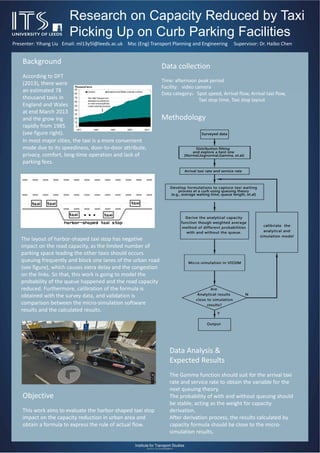
The layout of harbor‐shaped taxi stop has negative 
impact on the road capacity, as the limited number of 
parking space leading the other taxis should occurs 
queuing frequently and block one lanes of the urban road 
(see figure), which causes extra delay and the congestion 
on the links. So that, this work is going to model the 
probability of the queue happened and the road capacity 
reduced. Furthermore, calibration of the formula is 
obtained with the survey data, and validation is 
comparison between the micro‐simulation software 
results and the calculated results.
Objective
This work aims to evaluate the harbor‐shaped taxi stop 
impact on the capacity reduction in urban area and 
obtain a formula to express the rule of actual flow.
Data collection
Time: afternoon peak period
Facility:   video camera
Data category:Spot speed, Arrival flow, Arrival taxi flow, 
Taxi stop time, Taxi stop layout
Methodology
Data Analysis &
Expected Results
The Gamma function should suit for the arrival taxi 
rate and service rate to obtain the variable for the 
next queuing theory.
The probability of with and without queuing should 
be stable, acting as the weight for capacity 
derivation.
After derivation process, the results calculated by 
capacity formula should be close to the micro‐
simulation results.
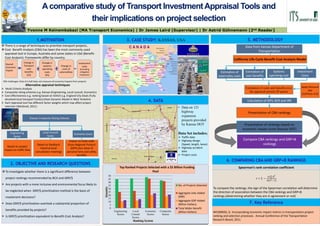
Acomparative study of Transport InvestmentAppraisal Tools and
their implications on project selection
Yvonne M Keinembabazi (MA Transport Economics) | Dr James Laird (Supervisor) | Dr Astrid Gühnemann (2nd Reader)
4. DATA
5. METHODOLOGY
7. Key Reference
0
5
10
15
20
25
30
35
40
45
50
Engineering
Scores
Local
Consult
Scores
Economic
Scores
Composite
Scores
Quantity
Ranking System
Top Ranked Projects Selected with a $5 Billion Funding
Pool
No. of Projects Selected
Aggregate Jobs Added
(000)
Aggregate GDP Added
(Billion Dollars)
Total Wider Benefit
(Billion Dollars)
r = 1 −
6∗ 𝑑2
𝑛 𝑛2−1
To compare the rankings, the sign of the Spearman correlation will determine
the direction of association between the CBA rankings and GRP+B
rankings.(determining whether they are in agreement or not)
Spearman’s rank correlation coefficient
WEISBROD, G. Incorporating economic impact metrics in transportation project
ranking and selection processes. Annual Conference of the Transportation
Research Board, 2011.
To investigate whether there is a significant difference between
project rankings recommended by BCA and GRP/$
 Are projects with a more inclusive and environmental focus likely to
be neglected when GRP/$ prioritization method is the basis of
investment decisions?
 Does GRP/$ prioritization overlook a substantial proportion of
benefits provided by projects?
 Is GRP/$ prioritization equivalent to Benefit-Cost Analysis?
There is a range of techniques to prioritize transport projects..
Cost- Benefit Analysis (CBA) has been the most commonly used
appraisal tool in Europe, Australia and some states in USA (Benefit-
Cost Analysis). Frameworks differ by country.
CBA challenges; Rule of a half does not measure all economy impacts from projects
Alternative appraisal techniques
 Multi-Criteria Analysis
 Composite rating schemes e.g. Kansas (Engineering, Local consult, Economic)
 Cost effectiveness e.g. ranking based on GVA/£ e.g. England City Deals (Fully
devolved local transport funds);Urban Dynamic Model in West Yorkshire
 Each Appraisal tool has different factor weights which may affect project
selection (Weisbrod, 2011)
Overall
Economic
Impact
Change in
Transport
user
benefits
(CS)
Change in
systems
operating
costs
(PS)
Change in
costs of
externalities
Investment
costs
(Including
mitigation
measures)
3. CASE STUDY: KANSAS, USA
6. COMPARING CBA AND GRP+B RANKNGS
Data from Kansas Department of
Transportation
Systems
operating cost
Investment
Costs
Estimation of
externality costs
Estimation of
user benefits
California Life-Cycle Benefit-Cost Analysis Model
Estimation of costs and benefits over
the appraisal period (20 years)
Apply Discount
rate
(CalTrans=4.0)
Calculation of NPV, BCR and IRR
Presentation of CBA rankings
Presentation of rankings based on
economic impact score (Kansas DOT)
Compare CBA rankings and GRP+B
rankings
• Data on 121
highway
expansion
projects provided
by Kansas DOT
Data Set includes;
 Traffic data
 Highway design
(Speed, length, lanes)
 Highway accident
data
 Project costs
1.MOTIVATION
Kansas Composite Rating Scheme
Local Consult
Score
Economic ScoreEngineering
Score
Based on project
impact on traffic flow
Based on feedback
heard at local
consultation meetings
Impact on state-wide
Gross Regional Product
(GRP) plus value of
personal time and safety
benefits
2. OBJECTIVE AND RESEARCH QUESTIONS
VEHICLE HANDLING WITH SHARED HAPTIC CONTROL
Xianshuchang Wu
Supervisor: Hamish Jamson; Andrew Tomlinson
Institute for Transport Studies, University of Leeds, Leeds, U.K.
E-mail: ts14xw@leeds.ac.uk
WHAT IS SHARED HAPTIC CONTROL? WHY SHARED HAPTIC CONTROL?
Task
Automation
Response
Automation
Haptic
Interface
How does it work?
Hpi
From Pedal Feedback to Steering Feedback
Figure 1. A schematic, symmetric representation of SHC
(adapted from Mulder et al., 2012)
Progress towards Haptic Shared Control
MAIN FOCUS OF THIS WORK
Limitation of Previous Work
METHOD / PATHWAY
Hypothesis
Figure 3. Brief illustration for the main experimental process
Mainly Estimated Dependent Measures
Figure 2. University of Leeds Driving Simulator
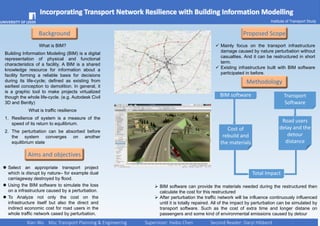
Incorporating Transport Network Resilience with Building Information Modelling
Background
What is BIM?
Building Information Modeling (BIM) is a digital
representation of physical and functional
characteristics of a facility. A BIM is a shared
knowledge resource for information about a
facility forming a reliable basis for decisions
during its life-cycle; defined as existing from
earliest conception to demolition. In general, it
is a graphic tool to make projects virtualized
though the whole life-cycle. (e.g. Autodesk Civil
3D and Bently)
What is traffic resilience
1. Resilience of system is a measure of the
speed of its return to equilibrium.
2. The perturbation can be absorbed before
the system converges on another
equilibrium state
 Select an appropriate transport project
which is disrupt by nature– for example dual
carriageway destroyed by flood.
 Using the BIM software to simulate the loss
on a infrastructure caused by a perturbation.
 To Analyze not only the cost on the
infrastructure itself but also the direct and
indirect economic cost for road users in the
whole traffic network cased by perturbation.
 Mainly focus on the transport infrastructure
damage caused by nature perturbation without
casualties. And it can be restructured in short
term.
 Existing infrastructure built with BIM software
participated in before.
Proposed Scope
Methodology
Aims and objectives
BIM software
Cost of
rebuild and
the materials
Xian Wu Msc Transport Planning & Engineering Supervisor: Haibo Chen Second Reader: Daryl Hibberd
Transport
Software
Road users
delay and the
detour
distance
Total Impact
 BIM software can provide the materials needed during the restructured then
calculate the cost for this restructured
 After perturbation the traffic network will be influence continuously influenced
until it is totally repaired. All of the impact by perturbation can be simulated by
transport software. Such as the cost of extra time and longer distane on
passengers and some kind of environmental emissions caused by detour
Institute of Transport Study
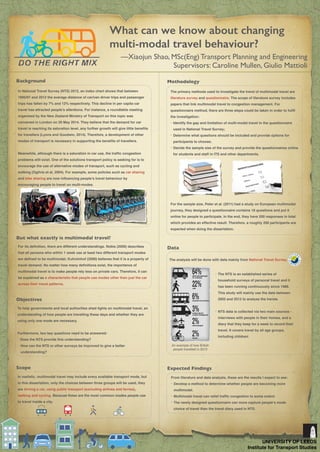
What can we know about changing
multi-modal travel behaviour?
—Xiaojun Shao, MSc(Eng) Transport Planning and Engineering
Supervisors: Caroline Mullen, Giulio Mattioli
Background
In National Travel Survey (NTS) 2012, an index chart shows that between
1995/97 and 2012 the average distance of car/van driver trips and passenger
trips has fallen by 7% and 12% respectively. This decline in per capita car
travel has attracted people’s attentions. For instance, a roundtable meeting
organised by the New Zealand Ministry of Transport on this topic was
convened in London on 20 May 2014. They believe that the demand for car
travel is reaching its saturation level, any further growth will give little benefits
for travellers (Lyons and Goodwin, 2014). Therefore, a development of other
modes of transport is necessary in supporting the benefits of travellers.
Meanwhile, although there is a saturation in car use, the traffic congestion
problems still exist. One of the solutions transport policy is seeking for is to
encourage the use of alternative modes of transport, such as cycling and
walking (Ogilvie et al, 2004). For example, some policies such as car sharing
and bike sharing are now influencing people’s travel behaviour by
encouraging people to travel on multi-modes.
For its definition, there are different understandings. Nobis (2006) describes
that all persons who within 1 week use at least two different transport modes
are defined to be multimodal; Kuhnimhof (2006) believes that it is a property of
travel demand. No matter how many definitions exist, the importance of
multimodal travel is to make people rely less on private cars. Therefore, it can
be explained as a characteristic that people use modes other than just the car
across their travel patterns.
But what exactly is multimodal travel?
To help governments and local authorities shed lights on multimodal travel, an
understanding of how people are travelling these days and whether they are
using only one mode are necessary.
Furthermore, two key questions need to be answered:
• Does the NTS provide this understanding?
• How can the NTS or other surveys be improved to give a better
understanding?
Objectives
In realistic, multimodal travel may include every available transport mode, but
in this dissertation, only the choices between three groups will be used, they
are driving a car, using public transport (excluding airlines and ferries),
walking and cycling. Because these are the most common modes people use
to travel inside a city.
Scope
Methodology
The primary methods used to investigate the trend of multimodal travel are
literature survey and questionnaire. The scope of literature survey includes
papers that link multimodal travel to congestion management. For
questionnaire method, there are three steps could be taken in order to fulfil
the investigation:
• Identify the gap and limitation of multi-modal travel in the questionnaire
used in National Travel Survey;
• Determine what questions should be included and provide options for
participants to choose;
• Decide the sample size of the survey and provide the questionnaires online
for students and staff in ITS and other departments.
For the sample size, Peter et al. (2011) had a study on European multimodal
journey, they designed a questionnaire contains 18 questions and put it
online for people to participate. In the end, they have 200 responses in total
which provides an effective result. Therefore, a roughly 200 participants are
expected when doing the dissertation.
The analysis will be done with data mainly from National Travel Survey.
Data
Expected Findings
UNIVERSITY OF LEEDS
Institute for Transport Studies
• The NTS is an established series of
household surveys of personal travel and it
has been running continuously since 1988.
This study will mainly use the data between
2002 and 2012 to analyse the trends.
• NTS data is collected via two main sources -
interviews with people in their homes, and a
diary that they keep for a week to record their
travel. It covers travel by all age groups,
including children.
An example of how British
people travelled in 2012
From literature and data analysis, these are the results I expect to see:
• Develop a method to determine whether people are becoming more
multimodal.
• Multimodal travel can relief traffic congestion to some extent.
• The newly designed questionnaire can more capture people’s mode
choice of travel than the travel diary used in NTS.
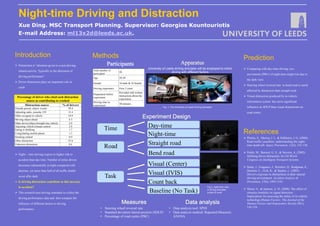
Night-time Driving and Distraction
Xue Ding. MSC Transport Planning. Supervisor: Georgios Kountouriotis
E-mail Address: ml13x2d@leeds.ac.uk.
 Night – time driving expose to higher risk to
accident than day time. Number of miles driven
decreases substantially at night compared with
daytime, yet more than half of all traffic deaths
occur after dark.
 Is driving distraction contribute to this increase
in accident?
 This research uses driving simulator to collect the
driving performance data and then compare the
influence of different factors to driving
performance.
Prediction
 Comparing with day-time driving, eye-
movements (PRC) of night-time might rise due to
the dark view.
 Steering wheel reversal rate in bend road is easily
affected by distraction than straight road
 Visual distraction produced by in-vehicle
information system has more significant
influence on SDLP than visual distractionn on
road centre.
References
 Plainis, S., Murray, I. J., & Pallikaris, I. G. (2006).
Road traffic casualties: understanding the night-
time death toll. Injury Prevention, 12(2), 125-138.
 Pettitt, M., Burnett, G. E., & Stevens, A. (2005).
Defining driver distraction. In12th World
Congress on Intelligent Transport Systems.
 Stutts, J., Feaganes, J., Reinfurt, D., Rodgman, E.,
Hamlett, C., Gish, K., & Staplin, L. (2005).
Driver's exposure to distractions in their natural
driving environment. Accident Analysis &
Prevention, 37(6), 1093-1101.
 Merat, N., & Jamson, A. H. (2008). The effect of
stimulus modality on signal detection:
Implications for assessing the safety of in-vehicle
technology.Human Factors: The Journal of the
Human Factors and Ergonomics Society,50(1),
145-158.
Time
Road
Task
Day-time
Night-time
Straight road
Bend road
Visual (Center)
Visual (IVIS)
Count back
Baseline (No Task)
Distraction source % of drivers
Outside person, object. events 29.4
Adjusting radio, cassette, CD 11.4
Other occupant in vehicle 10.9
Moving object ahead 4.3
Other device/object brought into vehicle 2.9
Adjusting vehicle/climate control 2.8
Eating or drinking 1.7
Using/dialing mobile phone 1.5
Smoking related 0.9
Other distraction 25.6
Unknown distraction 8.6
Percentage of driver who cited each distraction
source as contributing to crashed
Total number of
participant
20
Age 20-30
Gender 10 male & 10 female
Driving experience Over 2 years
Preparation before
experiment
Provided with written
instructions about the
experiment
Driving time in
experiment
30 minutes
Methods
University of Leeds driving simulator will be employed to mimic
driving with different factors
Fig. 1. The University of Leeds Driving Simulator
Fig.2. night-time view
in driving simulator
(urban & rural)
• Steering wheel reversal rate
• Standard deviation lateral position (SDLP)
• Percentage of road centre (PRC)
• Data analysis tool: SPSS
• Data analysis method: Repeated Measures
ANOVA
Introduction
 Distraction is “attention given to a non-driving-
related activity. Typically to the detriment of
driving performance”
 Driver distraction plays an important role in
crash
Simulate
SATURN
Scenario 3
Adjusted Capacity
Network
2009 Existing Leeds
OD Matrix
Optimal Signal Plan
from LINSIG
Scenario 1
(Base Scenario)
2009 Existing Leeds
Network
2009 Existing Leeds
OD Matrix
2009 Existing Leeds
Signal Plan
Scenario 2
Adjusted Capacity
Network
2009 Existing Leeds
OD Matrix
2009 Existing Leeds
Signal Plan
Find Optimal
Signal Plan
using LINSIG
Simulate
DRACULA
SATPIG SPATULA
Detailed
Public Transport
Modelling of Bus
Frequencies, Bus
Stop Locations etc.
Adjust the Road
Supply
Condition/Capacity
due to Road Work
in Network.dat
Comparative
analysis
of outputs from
Scenario Runs
SATURN LINSIGDRACULA
2. Data
University of Leeds and Leeds City Council provided:
The SATURN model and data files have been constructed according to
WebTAG recommendations and validated against DMRB guidelines).
6. Scope and Data Analysis
Win Thi Ha , MSc (Eng) Transport Planning & Engineering
Supervisor : Dr Chandra Balijepalli
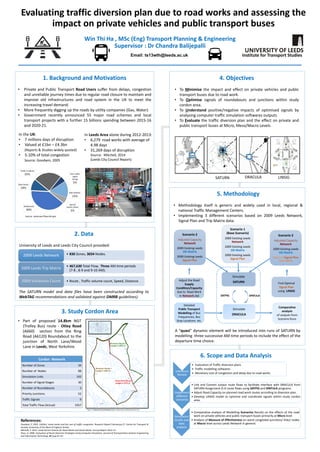
1. Background and Motivations
• Private and Public Transport Road Users suffer from delays, congestion
and unreliable journey times due to regular road closure to maintain and
improve old infrastructures and road system in the UK to meet the
increasing travel demand.
• More frequently digging up the roads by utility companies (Gas, Water)
• Government recently announced 55 major road schemes and local
transport projects with a further 15 billions spending between 2015-16
and 2020-21.
• Part of proposed 14.8km NGT
(Trolley Bus) route - Otley Road
(A660) section from the Ring
Road (A6120) Roundabout to the
junction of North Lane/Wood
Lane in Leeds, West Yorkshire.
A “quasi” dynamic element will be introduced into runs of SATURN by
modelling three successive AM time periods to include the effect of the
departure time choice.
Literature
Review
• Evaluation of Traffic diversion plans
• Traffic modelling softwares
• Monetary cost of congestion and delay due to road works
Implement
different
scenarios
• Link and Convert output route flows to facilitate interface with DRACULA from
SATURN Assignment O-D route flows using SATPIG and SPATULA programs.
• Adjust Road Capacity on planned road work routes according to diversion plan
• Develop LINSIG model to optimise and coordinate signals within study cordon
area.
Simulation
results and
data
analysis
• Comparative analysis of Modelling Scenarios Results on the effects of the road
work on private vehicles and public transport buses primarily at Micro level.
• Analysis of Measure of Effectiveness on worst congested junctions/ links/ nodes
at Macro level across Leeds Network in general.
Evaluating traffic diversion plan due to road works and assessing the
impact on private vehicles and public transport buses
Institute for Transport Studies
Image © Copyright Descry and licensed for reuse under a Creative Commons Attribution-ShareAlike 2.0
Generic (CC BY-SA 2.0)
In Leeds Area alone during 2012-2013:
• 6,279 road works with average of
4.98 days
• 31,269 days of disruption
Source: Mitchell, 2014
(Leeds City Council Report)
• 830 Zones, 3034 Nodes.2009 Leeds Network
• 467,630 Total Flow, Three AM time periods
(7-8 , 8-9 and 9-10 AM).
2009 Leeds Trip Matrix
• Route , Traffic volume count, Speed, Distance.2009 Validation Count
References:
Goodwin, P. 2005. Utilities’ street works and the cost of traffic congestion. Research Report February,p.37. Centre for Transport &
Society, University of the West of England, Bristol.
Mitchell, P. 2014. Leeds Permit Scheme for Road Works and Street Works. Annual Report 2012-13.
Zhou, H. 2008. Evaluation of Route Diversion Strategies Using Computer Simulation. Journal of Transportation Systems Engineering
and Information Technology. 8(1),pp.61–67.
Cordon Network
Number of Zones 34
Number of Nodes 88
Simulation Links 192
Number of Signal Stages 30
Number of Roundabouts 3
Priority Junctions 52
Traffic Signals 9
Total Traffic Flow (Actual) 3357
4. Objectives
• To Minimise the impact and effect on private vehicles and public
transport buses due to road work.
• To Optimise signals of roundabouts and junctions within study
cordon area.
• To Understand positive/negative impacts of optimised signals by
analysing computer traffic simulation softwares outputs
• To Evaluate the traffic diversion plan and the effect on private and
public transport buses at Micro, Meso/Macro Levels.
5. Methodology
• Methodology itself is generic and widely used in local, regional &
national Traffic Management Centers.
• Implementing 3 different scenarios based on 2009 Leeds Network,
Signal Plan and Trip Matrix data.
3. Study Cordon Area
.
Figure 1: Cordoned off Leeds Network (Maps created using ArcGIS® software by Esri)
Email: ts13wth@leeds.ac.uk
In the UK:
• 7 millions days of disruption
• Valued at £1bn – £4.3bn
(Reports & Studies widely quoted)
• 5-10% of total congestion
Source: Goodwin, 2005
Special
events /other
5%
Bottlenecks
40%
Road works
10%
Traffic Incidents
25% Poor traffic
signal
timing
5%
Bad weather
15%
Source: www.ops.fhwa.dot.gov
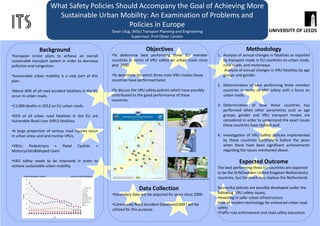
What Safety Policies Should Accompany the Goal of Achieving More
Sustainable Urban Mobility: An Examination of Problems and
Policies in Europe
Taner Ulug, (MSc) Transport Planning and Engineering
Supervisor: Prof Oliver Carsten
UNIVERSITY OF LEEDS
Background
•European Union plans to achieve an overall
sustainable transport system in order to decrease
pollution and congestion.
•Sustainable urban mobility is a vital part of this
plan.
•About 40% of all road accident fatalities in the EU
occur in urban roads.
•11,000 deaths in 2012 on EU urban roads.
•65% of all urban road fatalities in the EU are
Vulnerable Road User (VRU) fatalities.
•A large proportion of serious road injuries occur
in urban areas and and involve VRUs.
•VRUs: Pedestrians + Pedal Cyclists +
Motorcyclists&Moped Users
•VRU safety needs to be improved in order to
achieve sustainable urban mobility.
United Kingdom‐Urban Source: CARE Database
Objectives
•To determine best performing three EU member
countries in terms of VRU safety on urban roads since
year 2000.
•To determine for which three main VRU modes these
countries have performed beter.
•To discuss the VRU safety policies which have possibly
contributed to the good performance of these
countries.
Data Collection
•Secondary data will be acquired for years since 2000.
•Community Road Accident Database(CARE) will be 
utilized for this purpose.
Methodology
1. Analysis of annual changes in fatalities as reported
by transport mode in EU countries on urban roads,
rural roads, and motorways.
Analysis of annual changes in VRU fatalities by age
groups and gender.
2. Determination of best performing three member
countries in terms of VRU safety with a focus on
urban roads.
3. Determination of how these countries has
performed when other parametres such as age
groups, gender and VRU transport modes are
considered in order to understand the exact issues
these countries have tackled well.
4. Investigation of VRU safety policies implemented
by these countries particularly before the years
when there have been significant achievements
regarding the issues mentioned above.
Expected Outcome
The best performing three EU countries are expected
to be the SUN(Sweden‐United Kingdom‐Netherlands) 
countries, but Denmark may replace the Netherlands.
Successful policies are possibly developed under the
following VRU safety issues;
•Investing in safer urban infrastructure
•Use of modern technology for enhanced urban road
safety
•Traffic rule enforcement and road safety education
Photograph Sources: Road Safety in the European Union, Vademecum_2015
As a consequence of the arid conditions, PM dispersion from the
region is hindered and secondary process such as wind driven
resuspension dominate.
This means that while gas-phase species associate with their primary
sources (e,g. traffic levels), PM does not.
In 2010 air pollution was estimated to
have caused over 400,000 premature
deaths in Europe.
Ambient air pollution was estimated to
cause 3.7 million premature deaths
worldwide in 2012.
2. MECCA
Mecca is a major centre for tourist and
religious pilgrimage in Saudi Arabia.
As in many cities, local air pollution is
affected by multiple inputs, including
emissions from traffic, construction work,
industrial practices, etc.
However, arid conditions make it
especially sensitive to particulate matter
(PM) pollution.
3. PROJECT DATA
In this project Air Quality data (including
CO, NO/NO2, and PM10) and PM
compositional data (anions, cations,
and metals) collected by Professor Turki
Habeebullah and colleagues at Umm
Al-Qura University, Makkah, will be
analysed with the intention of extending
understanding of local air quality in the
region.
4. OBJECTIVES/METHODS
The study will proceed as follows:
i) Use R and R package openair to characterise local air
quality data, and
ii) Use specialist software, including US EPA UNIMIX , to conduct
the first source apportionment of the dataset.
Trophius Kufanga. Msc Transport Planning & the Environment. ts13tk@leeds.ac.uk
References:
5. RESULTS
6. NEXT STEP: SOURCE APPORTIONMENT
0
1
2 w s
3
4
5
6
W
S
N
E
mean
PM10
500
1000
1500
2000
2500
3000
3500
0
1
2 w s
3
4
5
6
W
S
N
E
mean
NO2
10
20
30
40
50
60
Improved Air Quality Management for Makkah Al-Mukarramah (Mecca),
Source Apportionment of Air Quality and Particulate Composition Data
Supervisor: Dr. Karl Ropkins
2nd reader: Dr. Haibo Chen
Some Preliminary Findings:
The Saudi Arabian PM10 standard 340 ug.m-3 daily average,
not to be exceeded more than 24 times a year. In 2012,
this was exceeded 32 times.
However, unlike in UK, where PM10 standards are also regularly
exceeded, this was not associated with NO2 exceedances,
highlighting the different nature of the air quality problems in
Makkah.
0
50
100
150
200
250
Source#1
Cl
SO4
NO3
NO2
PO4
NH4
Br
F
PM
10
Source compositions for run # 2 - Linear Scale.
0
10
20
30
Source#2
Cl
SO4
NO3
NO2
PO4
NH4
Br
F
PM
10
0
0.5
1
1.5
2
Source#1
Source Contributions for run # 2
09/15/2012
09/27/2012
10/09/2012
10/27/2012
11/09/2012
12/03/2012
12/22/2012
01/26/2013
02/07/2013
02/19/2013
03/09/2013
05/20/2013
08/06/2013
0
2
4
6
8
10
Source#2
09/15/2012
09/27/2012
10/09/2012
10/27/2012
11/09/2012
12/03/2012
12/22/2012
01/26/2013
02/07/2013
02/19/2013
03/09/2013
05/20/2013
08/06/2013
UNMIX source
apportionment
of PM
composition
trends, which
are not affected
by resuspension
will help us to
identify PM
sources.
By contrast, PM10 associates
with higher wind speeds, in
particular from the South East
Many gas phase species, like
NO2,associates with low wind
speeds, an indication of local
stagnant air related sources
Hitchcock, G., et al. (2014) Air Quality and Road Transport. Impacts and solutions. RAC
Foundation. London, United Kingdom.
WHO (2014) Ambient (outdoor) air quality & health
High Volume
Systems
(HVS PM Samplers)
Ion Chromatography
Anions and Cations
1. GENERAL BACKGROUND
・Categorize questioners
→social economics
(gender, age and employment state)
→general impression of PTP
(how does PTP make you feel)
→interest for PTP/level of satisfaction of PTP
(how are people satisfied with PTP)
→modal changes
(how do people change into use of public
transport)
→interest for sustainability
(continuous of new travel behavior)
・Using regression analysis
→how is effectiveness of PTP related with
questioners?
→For example, how much effectiveness of PTP is
linked with age or gender? Is there any difference
in the effectiveness between women and men?
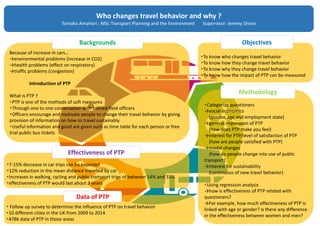
・To know who changes travel behavior
・To know how they change travel behavior
・To know why they change travel behavior
・To know how the impact of PTP can be measured
・ Follow up survey to determine the influence of PTP on travel behavior
・10 different cities in the UK from 2009 to 2014
・4786 data of PTP in those areas
・7-15% decrease in car trips can be expected
・12% reduction in the mean distance travelled by car
・increases in walking, cycling and public transport trips of between 14% and 33%
・effectiveness of PTP would last about 3 years
Because of increase in cars…
→environmental problems (increase in CO2)
→health problems (effect on respiratory)
→traffic problems (congestion)
Introduction of PTP
What is PTP ?
・PTP is one of the methods of soft measures
・Through one to one conversation with trained field officers
・Officers encourage and motivate people to change their travel behavior by giving
provision of information on how to travel sustainably
・Useful information and good are given such as time table for each person or free
trial public bus tickets
Who changes travel behavior and why ?
Tomoko Amahori : MSc Transport Planning and the Environment Supervisor: Jeremy Shires
Backgrounds
Effectiveness of PTP
Data of PTP
Objectives
Methodology
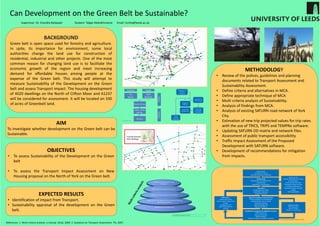
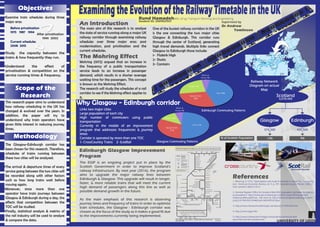
Can Development on the Green Belt be Sustainable?
BACKGROUND
Green belt is open space used for forestry and agriculture.
In spite, its importance for environment, some local
authorities change the land use for construction of
residential, industrial and other projects. One of the most
common reason for changing land use is to facilitate the
economic growth of the region and meet increasing
demand for affordable houses among people at the
expense of the Green belt. This study will attempt to
measure Sustainability of the Development on the Green
belt and assess Transport impact. The housing development
of 4020 dwellings on the North of Clifton Moor and A1237
will be considered for assessment. It will be located on 330
of acres of Greenbelt land.
AIM
To investigate whether development on the Green belt can be
Sustainable.
OBJECTIVES
• To assess Sustainability of the Development on the Green
belt
• To assess the Transport Impact Assessment on New
Housing proposal on the North of York on the Green belt.
METHODOLOGY
• Review of the polices, guidelines and planning 
documents related to Transport Assessment and 
Sustainability Assessment.
• Define criteria and alternatives in MCA .
• Define appropriate technique of MCA 
• Multi criteria analysis of Sustainability.
• Analysis of findings from MCA.
• Analysis of existing SATURN road network of York 
City.
• Estimation of new trip projected values for trip rates 
with the use of TRICS, TRIPS and TEMPRo software.   
• Updating SATURN OD matrix and network files.
• Assessment of public transport accessibility.
• Traffic Impact Assessment of the Proposed 
Development with SATURN software.
• Development of recommendations for mitigation 
from impacts. 
EXPECTED RESULTS
• Identification of impact from Transport.
• Sustainability appraisal of the development on the Green
belt.
Supervisor: Dr. Chandra Balijepali                  Student: Talgat Abdrakhmanov      Email: ts14ta@leeds.ac.uk
Preparation of 
Transport 
Assessment
Final 
Transport 
Assessment
Reducing the 
need to travel
Maximizing 
Sustainable 
accessibility
Dealing with 
Residual trips
Mitigation 
measures
References: 1. Multi‐criteria analysis: a manual. DCLG, 2009. 2. Guidance on Transport Assessment. TfL, 2007.
Policy context
Existing Site function
Proposed Development definition
Identification of Impacts and mitigation measures
NATA Assessment
Capacity Assessment
Identify problems
Preliminary design of mitigation measures
Scoping study
Initial appraisal consultation form
Scoping study
Agreement of methodology
Background data
Existing travel patterns by mode
Accident history
Environmental base case
Passenger transport services
Committed development
Committed transport network 
charges
Parking availability
Refinement step 2
Where appropriate
Additional support
Alterations to ITB measures
Refinement 1
(where appropriate)
Seek to reduce residual trips
Review:
Development mix
Scale of development 
phasing
Measures to influence Travel behavior
Parking availability and Management
Improvements to non‐car model
Travel plan initiatives
Capacity Management
Network alterations
Assessment
Trip generation by mode
Accessibility Assessment
Assignment of trips
Source: Transport Assessment Guidance. TfL, 2007.
5. Expected Outcomes4. Preliminary Results
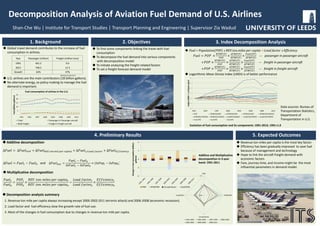
 Global travel demand contributes to the increase of fuel
consumption in airlines.
 U.S. airlines are the main contributors (18 billion gallons).
 No alternate energy, so policy-making to manage the fuel
demand is important.
Decomposition Analysis of Aviation Fuel Demand of U.S. Airlines
Shan-Che Wu | Institute for Transport Studies | Transport Planning and Engineering | Supervisor Zia Wadud
1. Background
Year Passenger (million) Freight (million tons)
1991 461.2 9.0
2013 748.5 12.3
Growth 62% 37%
(Airlines in the U.S.)
2. Objectives
 To find some components linking the travel with fuel
consumption
 To decompose the fuel demand into various components
with decomposition model
 To initiate analyzing the freight-related factors
 To set a freight forecast demand model
Multiplicative decomposition
-
5
10
15
20
25
1991 1994 1997 2000 2003 2006 2009 2012
Fuel(billiongallons)
Fuel consumption of airlines in the U.S.
Total Passenger in Passenger aircraft
Belly freight Freight in freight aircraft
3. Index Decomposition Analysis
 Fuel = Population(POP) × REV.ton.miles per capita ÷ Load factor × Efficiency
𝐹𝑢𝑒𝑙 = 𝑃𝑂𝑃 ×
𝑅𝑇𝑀𝑃 𝑃
𝑃𝑂𝑃
×
𝐴𝑇𝑀𝑃 𝑃
𝑅𝑇𝑀𝑃 𝑃
×
𝐹𝑢𝑒𝑙(𝑃𝑃)
𝐴𝑇𝑀𝑃 𝑃
--- passenger in passenger aircraft
+𝑃𝑂𝑃 ×
𝑅𝑇𝑀𝐹 𝑃
𝑃𝑂𝑃
×
𝐴𝑇𝑀𝐹 𝑃
𝑅𝑇𝑀𝐹 𝑃
×
𝐹𝑢𝑒𝑙 𝐹𝑃
𝐴𝑇𝑀𝐹 𝑃
--- freight in passenger aircraft
+𝑃𝑂𝑃 ×
𝑅𝑇𝑀𝐹(𝐹)
𝑃𝑂𝑃
×
𝐴𝑇𝑀𝐹(𝐹)
𝑅𝑇𝑀𝐹(𝐹)
×
𝐹𝑢𝑒𝑙(𝐹𝐹)
𝐴𝑇𝑀𝐹(𝐹)
--- freight in freight aircraft
 Logarithmic Mean Divisia Index (LMDI) is of better performance
Additive decomposition
and∆𝐹𝑢𝑒𝑙 = 𝐹𝑢𝑒𝑙𝑡 − 𝐹𝑢𝑒𝑙0
𝐹𝑢𝑒𝑙 𝑡
𝐹𝑢𝑒𝑙0
=
𝑃𝑂𝑃𝑡
𝑃𝑂𝑃0
×
𝑅𝐸𝑉. 𝑡𝑜𝑛. 𝑚𝑖𝑙𝑒𝑠 𝑝𝑒𝑟 𝑐𝑎𝑝𝑖𝑡𝑎 𝑡
𝑅𝐸𝑉. 𝑡𝑜𝑛. 𝑚𝑖𝑙𝑒𝑠 𝑝𝑒𝑟 𝑐𝑎𝑝𝑖𝑡𝑎0
÷
𝐿𝑜𝑎𝑑 𝑓𝑎𝑐𝑡𝑜𝑟𝑡
𝐿𝑜𝑎𝑑 𝑓𝑎𝑐𝑡𝑜𝑟0
×
𝐸𝑓𝑓𝑖𝑐𝑖𝑒𝑛𝑐𝑦𝑡
𝐸𝑓𝑓𝑖𝑐𝑖𝑒𝑛𝑐𝑦0
∆𝐹𝑢𝑒𝑙 = ∆𝐹𝑢𝑒𝑙 𝑃𝑂𝑃 + ∆𝐹𝑢𝑒𝑙 𝑅𝐸𝑉.𝑡𝑜𝑛.𝑚𝑖𝑙 𝑝𝑒𝑟 𝑐𝑎𝑝𝑖𝑡𝑎 + ∆𝐹𝑢𝑒𝑙1/𝐿𝑜𝑎𝑑 𝑓𝑎𝑐𝑡𝑜𝑟 + ∆𝐹𝑢𝑒𝑙 𝐸𝑓𝑓𝑖𝑐𝑖𝑒𝑛𝑐𝑦
∆𝐹𝑢𝑒𝑙 𝑝𝑜𝑝 =
𝐹𝑢𝑒𝑙𝑡 − 𝐹𝑢𝑒𝑙0
𝑙𝑛𝐹𝑢𝑒𝑙 𝑡 − 𝑙𝑛𝐹𝑢𝑒𝑙0
× (𝑙𝑛𝑃𝑜𝑝𝑡 − 𝑙𝑛𝑃𝑜𝑝0)
 Revenue ton miles per capita is the most key factor.
 Efficiency has been gradually improved to save fuel
because of management and technology
 Hope to link the aircraft freight demand with
economic factors
 Fare, journey time, and income might be the most
influential parameters in demand model.
Decomposition analysis summary
1. Revenue ton mile per capita always increasing except 2000-2002 (911 terrorist attack) and 2006-2008 (economic recession).
2. Load factor and fuel efficiency slow the growth rate of fuel use.
3. Most of the changes in fuel consumption due to changes in revenue ton mile per capita.
-6
-3
0
3
6
Changeinfuelconsumption(billion
gallons)
POP RTM/POP 1/Load factor Fuel/ATM
Additive and Multiplicative
decomposition in 3-year
band: 1991-2011
0.8
1
1.2
POP
RTM/POP
1/Load factor
Fuel/ATM
1991-1993 1994-1996 1997-1999 2000-2002
2003-2005 2006-2008 2009-2011
Data sources: Bureau of
Transportation Statistics,
Department of
Transportation in U.S.
Evolution of fuel consumption and its components: 1991-2013; 1991=1.0
0.0
0.5
1.0
1.5
2.0
2.5
3.0
1991 1994 1997 2000 2003 2006 2009 2012
Index(1991=1.0baseyear)
POP RTMP(P)/POP RTMF(P)/POP RTMF(F)/POP RTMP(P)/ATMP(P)
RTMF(P)/ATMF(P) RTMF(F)/ATMF(F) Fuel(PP)/ASM(P) Fuel(FP)/ATMF(P) Fuel(FF)/ATMF(F)
Fuel (PP) Fuel (FP) Fuel (FF)
Causative Factors of Accidents on Curve Negotiations: A Case Study of Malaysia
Institute for Transport Studies
Seri Ashikin Binti Sofian, MSc.Eng Transport Planning & Engineering Supervisor: Dr. Samantha Jamson Co-Supervisor: Dr. Frank Lai
• Traffic accidents rank fifth among the leading cause
of deaths in Malaysia.
• It is estimated that, one quarter of all accidents
happen in Malaysia occur while driving around
curves and in most cases contribute to fatal
accidents. Therefore, it is vital to understand the
factors lead to an accident that occurs on a curve.
• IRTAD report 2014, based on willingness-to-pay
estimation, road accident accounted for
approximately 1.6% of Malaysia national GDP.
• The accident rates in road curves are about 1.5 to 4
times higher than in straight roads
(Zegeer, Stewart, F. M. Council, Reinfurt, &
Hamilton, 1992).
• The accident severity of curve related crashes is
higher than those occurring in straight roads
(Glennon, Neuman, & Leisch, 1985).
• Accidents are not uniformly distributed on the road
network, high accident locations are a clear
indication that, besides human factor, there exist
other influencing parameters that are characterized
by the road (Lamm et.al, 2007).
• The curve's location chooses for this study are
identified from the 186 blackspot locations treated
under the ‘Rehabilitation Works Programme’ done
by the Public Works Department of Malaysia
(PWDs) from year 2009 to 2014.
• Seven (7) locations of curve are identified from the
blackspot locations and data collected from this
location are gathered through the POL form obtain
from the Royal Malaysian Police (Traffic
Department).
Background of Study Determine the factors that contribute to the accident
occurrence in a curve
Identify the characteristics to the cause of the
accidents occurrence on a curve
Recommendation for road accident on curve
treatment
Objectives
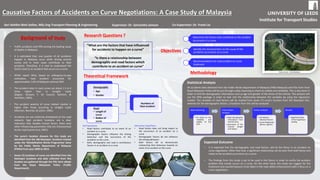
Research Questions ?
“What are the factors that have influenced
for accidents to happen on a curve”
“Is there a relationship between
demographic and road factors which
contribute to an accident on curve”
Theoretical Framework
Demographic
• Age
• Gender
Road
• Length of
curve
• Radius of
curve
Numbers of
fatal accident
Methodology
Null Hypothesis
• Road factors contribute to an event of an
accident on a curve
• Demographic factors influence the driving
behaviour and the occurrence of the
accidents on the curve
• Both, demographic and road is contributory
factors in an accident on a curve
Alternative Hypothesis
• Road factors does not bring impact to
the occurrence of an accident on a
curve
• Demographic factors do not influence
the driving behaviour
• Both factors fail to demonstrate
relationship their behaviour towards an
event of an accident on the curve
Statistical Analysis
All accidents data obtained from the Public Works Department of Malaysia (PWD Malaysia) and POL Form from
Royal Malaysian Police will be put through a data cleansing to check its validity and reliability. This is also done in
order to find the demographic information such as age and gender of the driver of the vehicle. This analysis will
use the SPSS package in order to look into the relationship between the variables by using the regression
models. The variables of road factors will be studied from seven (7) curve’s location from the blackspot lists,
whereas for the demographic factors, 2 locations from this will be analysed.
Data Cleansing
• To check on the
reliability and
validity of the
data
Information
Analysis
• Seek demographic
information from
the POL form.
• Geometry of the
location (length
and radius)
Factor analysis
• Correlation
between factors
• Linear Regression
(Binary Logistic)
Results
• Significant level
of the hypothesis
testing
Expected Outcome
• It is expected that the demographic and road factors, will be the factor in an accident on
curve negotiation. Other than that, a significant relationship can be seen from both factor and
relate to the accident occurrence on a curve.
• The findings from this study is yet to be used in the future in order to rectify the accident
problem that mostly occurs on a curve. On the other hand, this study can suggest for the
treatment and countermeasure to be taken in the road safety enhancement with a focus on a
curve negotiation.
Kuala Lumpur – Karak Highway
D e v e l o p i n g A c c e l e r a t i o n M o d e l s
C o m b i n i n g M u l t i p l e D a t a
Stavros Papadimitriou (Author); Charisma F. Choudhury (Supervisor); Daryl Hibberd (2nd Reader)
B A C K G R O U N D
I-80 Study Area Schematic
and Camera Coverage
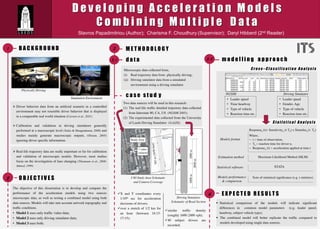
Ø Driver behavior data from an artificial scenario in a controlled
environment may not resemble driver behavior that is displayed
in a comparable real world situation (Carsten et al., 2011)
Ø Calibration and validation in driving simulators generally
performed at a macroscopic level (Sakia & Hoogendoorn, 2008) and
studies mainly generate macroscopic outputs, (Olstam, 2005)
ignoring driver specific information.
1 M E T H O D O L O G Y
d a t a
Driving Simulator
Schematic of Road Section
ü X and Y coordinates every
1/10th sec for acceleration
decisions of drivers;
ü over a stretch of 1/2 km for
an hour (between 16:15­
17:15);
ü similar traffic density
(roughly 1600-2400 vph);
ü 40 subject drivers are
recorded;
m o d e l l i n g a p p r o a c h
E X P E C T E D R E S U L T S
c a s e s t u d y
3.2
3
4
NGSIM Driving Simulator
C r o s s – C l a s s i f i c a t i o n A n a l y s i s
S t a t i s t i c a l A n a l y s i s
Maximum Likelihood Method (MLM)
Models format
Responsen (t)= Sensitivityn (t-Tn) x Stimulusn (t- Tn)
Where,
-  t = time of observation,
-  Tn = reaction time for driver n,
-  Responsen (t) = acceleration applied at time t
STATA
Estimation method
Statistical software
Models performance
& comparison
Tests of statistical significance (e.g. t-statistics)
3.1
Ø Real-life trajectory data are really important so far for calibration
and validation of microscopic models. However, most studies
focus on the investigation of lane changing (Thiemann et al., 2008;
Ahmed, 1999)
2
Simulation Environment
Physically Driving
Two data sources will be used in this research:
(1)  The real-life traffic detailed trajectory data collected
from Interstate 80, CA, US (NGSIM 2005);
(2)  The experimental data collected from the University
of Leeds Driving Simulator (UoLDS).
Microscopic data collected from,
(i)  Real trajectory data from physically driving;
(ii)  Driving simulator data from a simulated
environment using a driving simulator.
•  Leader speed
•  Time headway
•  Type of vehicle
•  Reaction time etc.
•  Leader speed
•  Gender, Age
•  Type of vehicle
•  Reaction time etc.
§  Statistical comparison of the models will indicate significant
differences in common model parameters (e.g. leader speed,
headway, subject vehicle type);
§  The combined model will better replicate the traffic compared to
models developed using single data sources.
The objective of this dissertation is to develop and compare the
performance of the acceleration models using two sources
microscopic data, as well as testing a combined model using both
data sources. Models will take into account network topography and
traffic conditions.
•  Model 1 uses only traffic video data;
•  Model 2 uses only driving simulator data;
•  Model 3 uses both.
1000m1000m
2000m
503m(1650feet)
Study Area
7 video
cameras
O B J E C T I V E S
EMERGENCY TRANSPORT PLANNING FOR MATERNAL HEALTH IN RURAL GHANA
MAHAMA SEINU SEIDU, MSc TRANSPORT PLANNING AND THE ENVIRONMENT          SUPERVISOR: JEFFREY TURNER    2ND READER: FRANCES HODGSON 
BACKGROUND
REFERRAL SYSTEM 
AIM AND OBJECTIVES
METHODOLOGY
EXPECTED OUTCOME
REFERENCES
Thaddeus and Maine,1994
The aim of the study is to assess the impact/effect of Ambulance
services in maternal health
OBJECTIVES:
The study is to focus on understanding and assessing the role of
ambulance services in emergency maternal health in Ghana. This is
intended to be achieved through :
 Assessment of the role and impact of Ambulance services in
maternal health delivery in rural areas .
 Whether or not Ambulance services have any significant
contribution to reduction of maternal mortality.
 How efficient and effective transport can improve emergency
maternal health intervention in rural Ghana
Millennium Development Goal (MDG 5),maternal mortality is
identifies by the United Nations(UN) as a serious concern for the
welfare of women across the world particularly a pandemic in
developing countries and specifically an “unfortunate tragedy in sub
sahara Africa as the region records the highest maternal mortality
ratio” (Ganyaglo & Hill, 2012)
 About 350,000 women die annually from pregnancy related causes
and child birth complications .
 Utilization and access to health facilities for maternal services in
these settings is hindered by several factors including lack of
transport and high cost –(4) .Referral intervention aim to address
these problems and one such intervention is the provision of
emergency ambulance referral transport services.
 In most developing countries such National ambulance services
have not been sustained effectively, providing very limited, or no
service. As a result, many segments of the population, particularly
in rural or peri‐urban areas are not covered and this poses serious
challenges to reach the appropriate health facility in case of an
emergency.
 In Ghana ,the maternal mortality ratio (MMR) is currently 350 in
every 100,000 live births .It is estimated that 75 percent of the
women who die in the course of childbirth do so as a result of
inadequate emergency transport‐(1).
 Transport is critical in the provision of health delivery and access to
services, and in the Overall effectiveness of the referral process.
 As have been identified by Thaddeus and Maine(1994), poor access
and lack of reliable transport also explain why families delay in
seeking care in an emergency situation or arrive too late at health
facilities for effective treatment as well as poor service utilization.
 Emergency transport interventions could save an estimated 75
percent of pregnant women each year, which could further save
nearly 14,500 births if functional referral systems are put in place.
The study will  be  conducted in the  Millennium Village  project 
communities  in the Ashanti Region of Ghana. A literature review 
will be done. Data on ambulance utilisation for maternal 
emergency referral in the health facilities in this communities 
will be accessed. Other case  received without intervention of 
the ambulance services within  the same period will also be 
collected .The response times and cost will be determined as 
well as the outcomes of the different scenarios. Analysis will 
then be done to assess the impacts.      
 Lack of ambulances and absence of other means of transport
in remote areas (Shehu et al. 1997) and high transport costs
represent a major constraint for women and their families
who need to access health facilities for both preventive and
emergency care. A key solution therefore is to improve
transport access in a way that is both affordable and
sustainable for these two levels of care.
 It should be possible to reduce maternal deaths in rural Ghana
by effective and efficient emergency (ambulance) referral
transport planning .
1. Babinard,J. and Roberts,P.,2006  Maternal and Child Mortality Development Goals: 
What Can the Transport Sector Do? The World Bank Group Washington, D.C.  
http://www.worldbank.org/transport/
2. Thaddeus S, Maine D (1994) Too far to walk: maternal mortality in context. Soc Sc
Med 38(8): 1091–1110.
3. Lungu K, Kamfose V, Hussein J, Ashwood‐Smith H (2001) Are bicycle ambulances and 
community transport plans effective in strengthening obstetric referral systems in 
Southern Malawi. Malawi Med J 13: 16–18.
4. Maxwell Ayindenaba Dalaba,et al.,2015 Cost to households in treating maternal 
complications in northern Ghana: a cross sectional study. BMC Health Services 
Research 2015, 15:34  doi:10.1186/s12913‐014‐0659‐1
5. Murray SF, Pearson SC (2006) Maternity referral systems in developing countries: 
current knowledge and future research needs. Soc Sc Med 62: 2205–2215.
6. WHO | Maternal mortality [http://www.who.int/mediacentre/factsheets/fs348/en/]
Without intervention
With intervention
UNIVERSITY OF LEEDS
`
Utilizing Real Time Bus Information Technology
To Encourage Bus Travel
Student: Steven Lightfoot (email: ts12sdl@leeds.ac.uk), Supervisors: Jeremy Toner and Mark Wardman
Background
• Metro Tracker survey 2014, Vector research
• Mishalani, Rabi G., Sungjoon Lee, and Mark R. McCord. 2000. "Evaluating real-time bus arrival information
systems." Transportation Research Record: Journal of the Transportation Research Board 1731.1: 81-87.
• Moss S 2015. The Guardian website. Available from: http://www.theguardian.com/cities/2015/apr/28/end-of-
the-car-age-how-cities-outgrew-the-automobile
• Tang, Lei, and Piyushimita Vonu Thakuriah. 2012 "Ridership effects of real-time bus information system: A
case study in the City of Chicago." Transportation Research Part C: Emerging Technologies 22: 146-161.
• Transportation Research Part A: Policy and Practice, Volume 45, Issue 8. 2011, Pages 839–848
• Transportation Research Part C: Emerging Technologies. Volume 53. 2015, Pages 59–75
• TLP Projects – Monitoring Report 2009 to 2013, Metro 2013
• Traveline. 2015. (online). Available from: http://dashboard.mxdata.co.uk/traveline/Account/login.aspx
Objectives
• New technologies enabling the provision of real time bus information and the
growth in smartphone use have the potential to transform the way people
view bus travel options.
• Utilize real time information to improve the way bus information is presented to the
public.
• Set out best way of displaying real time information to public on stop displays,
computers and mobile phones.
• Maximize public access to, awareness and usage of real time information.
• Set out best practice and future developments that will show how real time
information can be utilized by bus operators and traffic control centers to improve
reliability and speed whilst reducing operating costs.
Data and Scope
• Real time systems and literature from across the world will be reviewed.
• Data sources include: transport press, West Yorkshire bus user survey,
public usage of real time outputs in Yorkshire, real time user groups etc.
• Focus for recommendations will be Yorkshire, however they will be able to
be adapted for other areas.
• Recommendations will aim to retain existing bus users and attract new
users.
• Recommendations will focus on existing bus regulation system in Yorkshire,
but will consider different regulation models.
• Risks include:
• Difficulty accessing commercially sensitive formulas used to generate real time
predictions.
• Lack of regulation meaning there is no central body able to ensure recommendations
are implemented.
Methodology
• Result 1
• Result 2
• Result 3
Initial Findings
References
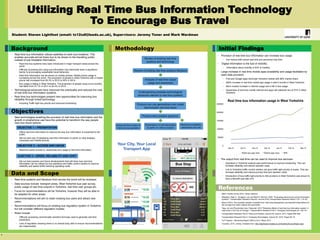
• Provision of real time bus information can increase bus usage.
• Can reduce both actual wait time and perceived wait time
• ‘Digital information is the fuel of mobility’,
• ‘Information about mobility is 50% of mobility’
• Large increase in real time mobile apps availability and usage facilitated by
open data provision.
• First and Google apps dominate Yorkshire market with 88% market share.
• 290% increase in real time mobile app usage in last 6 months in West Yorkshire.
• More modest increase in internet usage and a fall in text usage.
• Awareness of real time mobile internet and apps still relatively low at 27% in West
Yorkshire.
OBJECTIVE 1 – PRESENTATION
OBJECTIVE 2 – ACCESS AND USAGE
OJECTIVE 3 – SPEED, RELIABILITY AND COST
• Real time bus information utilizes satellites to track bus locations. This
enables accurate arrival times bus to be shown to the travelling public,
instead of just timetable information.
• Real time bus systems have been introduced in major transport areas across the
world.
• Difficulty accessing and using bus information has historically been a significant
barrier to encouraging sustainable travel behaviour.
• Real time information can be shown on mobile phones. Mobile phone usage is
increasing across the world. The proportion of people in West Yorkshire with a mobile
phone has increased from 90.3% in 2012 to 93% in 2014.
• Bus usage is falling in West Yorkshire. The proportion of people using a bus monthly
has fallen from 57.1% in 2011 to 52.4% in 2014.
• Technological advances have improved the practicality and reduced the cost
of real time bus information systems.
• Real time bus technologies present new opportunities for improving bus
reliability through linked technology.
• Including Traffic light bus priority and improved scheduling.
• The output from real time can be used to improve bus services.
• Operators in Yorkshire analyze past performance to improve scheduling. This can
increase reliability and reduce operator costs.
• Link to Yorkshire traffic control centers can give traffic light priority to buses. This can
increase reliability and reduce journey time and operator costs.
• Introduction of bus traffic light priority to 200 junctions in West Yorkshire was shown to
have a Benefit:cost ratio of 8.
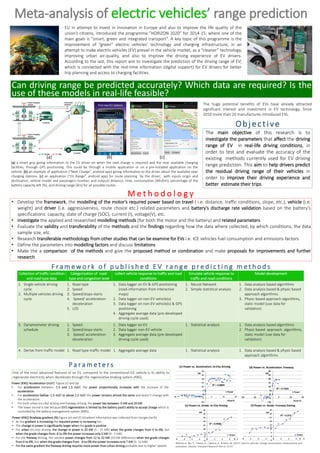
Evaluation of the Influence on Driving Behaviour by Music Tempo
Data Collection
• Free driving task
1. Average, maximum, minimum driving speeds
2. Average, maximum lateral deviations
• Overtaking task
1. Maximum speeds
2. Minimum headway distances before and after
overtaking
• Approaching signlised junction task
1. Decision making
2. Violation frequency
3. Passing speeds
• Stopping task
1. Reaction time
Objectives
The study will be approached through driving
simulator. Four questions are aiming to be
answered in this research about lisening slow/fast
tempo music during driving:
1. How much degree of influences on driving
performance under free driving condition?
2. Does the music induce more dangerous driving
in overtaking process?
3. Will the drivers be more aggressive towards a
signalised junction?
4. Is there any deterioration in reaction time for an
emergency stop?
Background
Dibben and Williamson (2007) conducts a survey
and finds that 75% young drivers listen music
during driving. However, the young drivers, who
preferred no music driving environment, are less
involved in road accidents.
The study in Brodsky(2001) selects some fast
tempo music to test the driving performance.
Higher driving speed, and more frequent traffic
violations are shown. Fast-paced music is proved
to deteriorate the driving behaviour.
In most of the previous studies ,drivers are tested
by driving in a city through driving simulator, but
not in some specific critical conditions. In current
study, some specific scenarios will be set up in
order to thoroughly investigate the driving
influence on these conditions, for example,
overtaking, dilemma in signalised junction, and
emergency stop.
Waterhouse et al., (2010) mentions that apart from
tempo, lyrics, melody, loudness and other
particular circumstance can also affect the musical
taste. To reduce the variables, same set of music
tracks, which differed in tempo, are used in this
study.
Tasks in a testExperimental Designs
20 driving licence owners, who age from 20-30
years old, will be invited to parcitipate the
experiment, because they are the most frequent
group of listening music, as well as the highest
risk group of getting involved in accidents.
Experimental flow is below:
Briefing (15mins)
• Introduce about the experiment, including all the
tasks they will meet in the test.
• Explain the manipulation of driving simulator.
• Provide free driving section for familiarisation.
Testing (55mins)
• Without music, fast tempo and slow tempo
scenario tests will be finished by participants
respectively in random order.
Surveying (10mins)
• Complete a self-reflection questionnaire
• Personal information: age, gender, driving
experience, etc.
• Personal perception in slow and fast tempo
music for each individual task
• Any mistake has taken in the test.
Driving Simulator
Overtaking
Approaching
signalised
junction
Stop
immediately
and restart
Overtaking
Start to play
slow/fast tempo
music
Approaching
signalised junction
Stop immediately
and finish
Free Driving
for 10 minutes
at 60mph
Free Driving
for 10 minutes
at 60 mph
2 mins 2 mins
2 mins2 mins
Data Analysis and Expected Results
Three sets of dependent variable data comparisons
will be analysed:
• Without music VS Slow tempo music
• Without music VS Fast tempo music
• Slow tempo music VS Fast tempo music
The results from the fast tempo music are expected
to show:
• higher free driving speeds,
• dangerous overtaking behaviour, with higher
speeds and shorter headway distances
• tending to pass the signalised junction with higher
speed rather than decide to stop in dilemma
situation,
• and a longer reaction time.
Li Shaotang, Alvis Email: ml13l6s@leeds.au.uk Msc (Eng) Transport Planning and Engineering Supervisor: Dr. Daryl Hibberd
Motorcyclists’ Acceptance of Automated
Road Transport Systems in Taiwan
Shu-Cheng, Hsieh (ml13sch@leeds.ac.uk)
MSc (Eng) Transport Planning & Engineering
Supervisor: Dr Natasha Merat, Tyron Louw
 Motorcycles in Taiwan
 Large density and amount of registered motorcycles
 Motorcycles : Other vehicles = 1.8 : 1
 Public Transport in Taiwan
 Projects promoting public transport
by Taiwanese government since 2010
 Involving buying new buses, improving
service quality, providing real-time and
subsiding rural routes
2. Background
Year Car Bus &
Coach
LGV HGV Subtotal Motorcycle
2013 6,236,879 31,960 875,544 162,122 7,367,522 14,195,123
2014 6,405,778 32,928 890,703 163,446 7,554,319 13,735,994
 Road user interactions
 Conflicts between
motorcycles and buses
(Particularly at bus
stops)
Public Transport
 Little changes on usage
 Financial difficulties for
operators
 Lack of drivers
3. Research Problems
 An example: City Mobil2
 An EU project
assessing ARTS
 Deliver ARTS in several
European cities
 Investigate road users acceptance
(focus on pedestrian)
 Aims:
1) Evaluate what ARTS could provide to sustainable
transport
2) Examine and improve interactions between ARTS and
other road users
How about in Taiwanese
transport environment?
4. Research Motivation
 Literature review, technology approach and integration
 Questionnaire
 Sample: Motorcyclists in Taiwan
 Asking acceptance in two sections
 Data Analysis and discussion
5. Methodology
Section 1
• Applying Drive Behaviour Questionnaire
• Initial acceptance by introducing ARTS
Section 2
• Scenario with safety systems on ARTS
• Scenario with road infrastructure for ARTS
 Understand the factors that influence
motorcyclist’s acceptance of ARTS
 Motorcyclist–centred design recommendation
fro ARTS in Taiwan
6. Expected Outcomes
 Public transport systems based on the use of a fleet of
communication-enabled cybercars – road vehicles with
automated driving capabilities.
 Advantages
 Provide “Last-mile connections” for individuals
 Low personnel costs (No drivers)
 Sustainable urban transport
 Existing Cases
1. What is Automated Road Transport
Systems (ARTS)?
ARTS in the West Region of
Lausanne, Switzerland
ARTS in La Rochelle, France
Key References
CityMobil (2015), http://www.citymobil-project.eu/. CityMobil2 (2015), http://www.citymobil2.eu/
Directorate General of Highways, Ministry of Transportation and Communications, Taiwan (R.O.C.) (2014), Annual Report for Motor Vehicle Administration.
Rockall, Wil, 2014, Can driverless car see off cyber attacks? [Online] London, United Kingdom. http://goo.gl/oFQZNg
Reason, Manstead, Stradling, Baxter & Campbell (1990), Errors and violations on the roads: a real distinction? http://goo.gl/ZMzgVX
 Understand motorcyclists’ initial acceptance of ARTS in
Taiwan
 Find out what will increase motorcyclists’ acceptance and
confidence of ARTS when assessing them, in:
 Safety systems on ARTS
 Road infrastructure
5. Objectives
Can ARTS be a solution?
ROLE OF PRIVATE FINANCE IN AIRPORT DEVELOPMENT
NAME: SAMUEL APPIAH ADJEI
EMAIL: ts14saa@leeds.ac.uk INDEX: 200872578
SUPERVISOR: PROF. NIGEL SMITH
BACKGROUND AIM METHODOLOGY
1. The fundamental change in the airport industry
occurred after the 1986 Airports Act which was to
introduce the privatization and commercialization
into the aviation sector
2. There exist different ownership models after
the introduction of Airport Act
3. Most airports in the UK has experienced
different ownership types over the years
4. Some of the ownership types include purely
public airport, public private partnership and
purely private ownership
5. Research would undertake time series analysis
of effects of ownership change on airports
passenger trends
Subhead
• Volor ilit nonsendiate magna ad erciliquip eugiam velent alisl dolor auguerat. Ut
dolore consendrerit verilla cons nosto cons nim quis elisci ex ea commy nis doloreet
ex estie vent ad molesto diat.
• Volor ilit nonsendiate magna ad erciliquip eugiam velent alisl dolor auguerat. Ut
dolore consendrerit verilla cons nosto cons nim quis elisci ex ea commy nis doloreet
ex estie vent ad molesto diat.
•Volor ilit nonsendiate magna ad erciliquip eugiam velent alisl dolor auguerat. Ut
dolore consendrerit verilla cons nosto cons nim quis elisci ex ea commy nis doloreet
ex.
This research primarily examines the impact
of airport ownership type on airport
efficiency
1. Analyse airport passenger trends
between 2000 and 2014
2. Analyse airport freight trends between
2000 and 2014
3.Identify impact of airport ownership type
on passenger trends
4. Identify measures to improving airport
passenger and freight growth
Leeds Bradford Airport
FURTHER WORK
1. Study effects of various airport services
on passenger numbers
2. Evaluate private finance on airport
development
1. The fundamental change in the airport
industry occurred after the 1986 Airports Act
which was to introduce the privatization and
commercialization into the aviation sector
2. There exist different ownership models after
the introduction of Airport Act
3. Most airports in the UK has experienced
different ownership types over the years
4. Some of the ownership types include purely
public airport, public private partnership and
purely private ownership
5. Research would undertake time series analysis
of effects of ownership change on airports
passenger trends
UK AIRPORT UK OWNERSHIP
PRIVATIZED
AIRPORTS
PUBLIC
PRIVATE
PARTNERSHIP
PUBLIC
AIRPORTS
OBJECTIVES
CASE STUDY
TIME SERIES ANALYSIS
PASSENGER TRENDS FREIGHT TRENDS
DATA COLLECTION
AIRPORT ANNUAL REPORT CIVIL AVIATION AUTHORITY
CASE STUDY APPROACH
LEEDS BRADFORD AIRPORT
Public
Airport
2000-2007
Privatized
2007 to
Date
REFERENCES
Butcher L. (2014), Aviation: Regional Airports House of Commons,
House of Commons Library
Oxford Economics (2011) Economic benefits of air transport in the UK
Yin, R. K. (2014) Case Study Research. 5th Edition. California. Sage
Publications Inc.
Traffic flows thresholds for Shared Space in Leeds
Transport Planning and Engineering. Student: Russell Oakes Supervisor: Dr James Tate
Introduction
Shared Space is a concept where streets are re-engineered to reduce the
dominance of motor vehicles (DfT, 2014) Street signage is limited and kerb heights
are reduced or removed completely in some cases.
The focus for this project will be in Headingley, North West Leeds. Pedestrian
desire lines vary due to the mixture of retail and leisure activities this district has to
offer; therefore providing an ideal location to test the theory.
Literature
The dissertation will be educated by various sources of literature, including...
Manual for Streets (1 & 2), Liverpool City Centre Plan (1961), Living Streets
Policy, Local Authority Policy (for example Leeds City Council Supplementary
Planning Documents), University of the West of England Research, Written
interview with the late Hans Monderman and scheme studies.
Objectives
To ascertain the potential for bringing Shared Space to Headingley by:
Understanding previous comparable Shared Space Schemes
Compiling a resource containing pedestrian and vehicular data
Applying the data to a Micro-simulation Package (Aimsun & Legion) with
sensitivity tests
Analysing the Aimsun & Legion outputs
Determining applicability to Headingley and wider Leeds
These objectives will act as milestones throughout the dissertation with the
expectation that each objective will be a development on its predecessor.
Methodology
The project will require site visits to various
contrasting examples, compilation of pedestrian
data from Leeds City Council and a suitable
model simulation running to satisfy the scope of
the project.
Anticipated issues include the inability to
compile pedestrian data for the Headingley
area, therefore flexibility with pilot site locations
may be required.
Two preliminary pilot sites of contrasting traffic
density will be used in order to determine the
relative scales of operation for a Shared Space
scheme. Currently, these sites are North Lane/
Otley Road and St Michaels Road outside the
Church.
Coventry Top: Before. Source: Oakes, R (2010) Bottom: After. Source: Oakes, R (2015)
Preston
De-cluttering of street furniture including
the removal of traffic lights
Narrowing of Fishergate providing wider
pavements
Provision of informal pedestrian crossings
Top: Before. Source: Oakes, R (2013) Bottom: After. Source:
Oakes, R (2015)
UrbanCaseStudies
Top: Before. Source: Oakes, R (2010) Bottom: After. Source:
Oakes, R (2015)
Downgraded routes complimented by
extensive landscaping
Closure of through routes and
implementation of UKs largest 20mph zone
(Coventry City Council, 2010)
Mixture of zebra and informal crossings
Coventry
Top: St Michaels Road. Source: Oakes, R (2015)
Bottom: Otley Road/North Lane. Source: Oakes, R (2015)
Sources used in the dissertation will include:
Early Indications and
Potential Outcomes
No Shared Space scheme is identical, as
demonstrated with the case studies. Therefore, the
site visits will assist in the appreciation of the issues
apparent in Headingley.
An understanding of which environments would
best suit a Shared Space scheme with the potential
to apply the key findings of this project to policy
making within Leeds City Council.
Communities are aware of the Shared Space
concept and have approached Leeds City Council
requesting that this is investigated.
If the timescales fit, efforts will be made to draw
comparisons where relevant to other Shared Space
schemes. This may lead to good practice workings
with other Local Authorities subject to interest.
Sources of Information
The dissertation will call upon quantitative and qualitative sources in order to provide a
robust analysis. This could include:
Quantitative
Leeds City Council Transport Monitoring Database
Primary data collection (where required)
Scheme monitoring reports
(where available)
Qualitative
City and County Borough of Liverpool 1965, Liverpool City Centre Plan,
Liverpool, City and County Borough of Liverpool
Moody, S. and Melia, S. (2014) Shared space: Research, policy and
problems. Proceedings of the Institution of Civil Engineers - Transport, [Online]
Available at: http://www.icevirtuallibrary.com/content/article/10.1680/
tran.12.00047 (Accessed 23rd April 2015)
Meta-analysis of electric vehicles’ range prediction
EU in attempt to invest in innovation in Europe and also to improve the life quality of the
union’s citizens, introduced the programme “HORIZON 2020” for 2014-15; where one of the
main goals is “smart, green and integrated transport”. A key topic of this programme is the
improvement of “green” electric vehicles’ technology and charging infrastructure; in an
attempt to make electric vehicles (EV) prevail in the vehicle market, as a “cleaner” technology,
improving urban air-quality, and also to improve the driving experience of EV drivers.
According to the last, this report aim to investigate the prediction of the driving range of EV;
which is connected with the real-time information (digital support) for EV drivers for better
trip planning and access to charging facilities.
The main objective of this research is to
investigate the parameters that affect the driving
range of EV in real-life driving conditions, in
order to test and evaluate the accuracy of the
existing methods currently used for EV driving
range prediction. This aim to help drivers predict
the residual driving range of their vehicles in
order to improve their driving experience and
better estimate their trips.
(a) a smart grip giving information to the EV driver on when the next charge is required and the near available charging
facilities, through GPS positioning. This could be through a mobile application or on a pre-installed application on the
vehicle. (b) an example of application (“Next Charge”, android app) giving information to the driver about the available near
charging stations. (c) an application (“EV Range”, android app) for route planning by the driver; with inputs origin and
destination, vehicle model and passengers number, and outputs distance, time, consumption (Wh/km), percentage of the
battery capacity left (%), and driving range (km) for all possible routes.
• Develop the framework, the modelling of the motor’s required power based on travel ( i.e. distance, traffic conditions, slope, etc.), vehicle (i.e.
weight) and driver (i.e. aggressiveness, route choice etc.) related parameters and battery’s discharge rate validation based on the battery's
specifications: capacity, state of charge (SOC), current (I), voltage(V), etc.
• Investigate the applied and researched modelling methods (for both the motor and the battery) and related parameters
• Evaluate the validity and transferability of the methods and the findings regarding how the data where collected, by which conditions, the data
sample size, etc.
• Research transferable methodology from other studies that can be examine for EVs i.e. ICE vehicles fuel consumption and emissions factors
• Define the parameters into modelling factors and discuss limitations
• Make the a comparison of the methods and give the proposed method or combination and make proposals for improvements and further
research
M e t h o d o l o g y
Objective
Can driving range be predicted accurately? Which data are required? Is the
use of these models in real-life feasible?
P a r a m e t e r s
One of the most advanced features of an EV, compared to the conventional ICE vehicle is its ability to
regenerate electricity when decelerate through the regenerative braking system (RBS).
Power (KW)/ Acceleration (m/s2) Figure (c) and (d)
• For acceleration between -1.5 and 1.5 m/s2, the power proportionally increases with the increase of the
acceleration.
• For acceleration bellow -1.5 m/s2 or above 1.5 m/s2 the power remains almost the same and doesn’t change with
the acceleration.
• For both urban (in-city) driving and freeway driving, the power lies between -5 kW and 20 kW
• The lower bound is low because EV’s regeneration is limited by the battery pack’s ability to accept charge which is
controlled by the battery management system (BMS).
Power (KW)/ Roadway gradient (%) Figure (e) and (f) (Gradient information was collected from Google Earth)
• As the gradient is increasing the required power is increasing too.
• The change in power is significantly larger when the grade is positive
• For urban (in-city) driving, the change in power is 20 kW (5 - 25 kW) when the grade changes from 0 to 6%; but
when the grade changes from -6 to 0% the power increases only 5 kW (0 - 5 kW)
• For the freeway driving, the needed power changes from 12 to 32 kW (20 kW difference) when the grade changes
from 0 to 6%; but when the grade changes from -6 to 0% the power increases only 7 kW (5- 12 kW).
• For the same gradient the freeway driving requires more power than urban driving probable due to higher speeds.
The huge potential benefits of EVs have already attracted
significant interest and investment in EV technology. Since
2010 more than 20 manufactures introduced EVs.
(a) (b) (c)
Reference: Wu, X., Freese, D., Cabrera, A., & Kitch, W. (2015). Electric vehicles' energy consumption measurement and
estimation. Elsevier, Transport Research Part D, 52-67.
Collection of traffic condition
and road type data
Categorisation of road-
type and congestion level
collect vehicle response to traffic and road
conditions
Simulate vehicle response to
traffic and road conditions
Model development
1. Single vehicle driving
cycle
2. Multiple vehicles driving
cycle
1. Road type
2. Speed
3. Speed/stops-starts
4. Speed/ acceleration-
deceleration
5. LOS
1. Data logger on EV & GPS positioning
(road-information from interactive
maps)
2. Data logger on non-EV vehicle(s)
3. Data logger on non-EV vehicle(s) & GPS
positioning
4. Aggregate average data (pre-developed
driving cycle used)
1. Neural Network
2. Simple statistical analysis
1. Data analysis based algorithms
2. Data analysis based & physic based
approach algorithms
3. Physic based approach algorithms,
static model (use data for
validation)
3. Dynamometer driving
schedule
1. Speed
2. Speed/stops-starts
3. Speed/ acceleration-
deceleration
1. Data logger on EV
2. Data logger non-EV vehicle
3. Aggregate average data (pre-developed
driving cycle used)
1. Statistical analysis 1. Data analysis based algorithms
2. Physic based approach algorithms,
static model (use data for
validation)
4. Derive from traffic model 1. Road type-traffic model 1. Aggregate average data 1. Statistical analysis 1. Data analysis based & physic based
approach algorithms
F r a m e w o r k o f p u b l i s h e d E V r a n g e p r e d i c t i n g m e t h o d s
Who spend what on the High Street? A comparison of the importance of non-car access between city
centre and local shops areas. Institute for Transport Studies, University of Leeds, UK.
RESEARCH QUESTION
(sustrans, 2006)
55% 22% (4'.•"'10% (6cq13% (1 1 %)
Actual mode of customer travel
(Shopkeepers estimates in brackets)
Shoppers' choice of travel modes in Bristol study
rivers limit the range of
compact urban centre, flat
ervice.
One of the best Park and Ride
QUESTIONS & OBJECTIVES
Which are the accessibility patterns in the city centre and
local shops areas?
Have they an implication in shops turnover?
To determinate if retailers perception about their customer mode
of access is accurate, in order to promote a better understanding of
transport and land-use policies.
CITY OF YORK
Advantages for sustainable modes:
geography and good public transport s
Foot street historical and retail centre.
schemes in the UK.
Disadvantages: Historical walls and
interventions.
METHODOLOGY
1) Literature review of economic, planning and transport
approaches to High Streets in U.K. and previous academic and "grey"
studies.
2)Questionnaires designing based on previous studies and
amendments for accuracy to City of York
RISK
Data collection task may take more time than expected.
Get retailers answers while they are working.
Fail in achieving the proposed sample size.
Lack of support from York City Council
CONTEXT
"Local areas should implement free controlled parking schemes..."
"Cars are an intrinsic part of the way many people shop..."
Worths Report,2011,p.5 and p.271
"There is not such thing as "free" parking"
(Tyler et a1,2012,p.651
"The literature on parking and retail divides into two groups: those
suggesting that parking is important for retail activity and those arguing
that retailers have a wrong perception about the modal split of their
customer and usually overestimate car use for shopping"
IMingrado,2012,p1951
3)Data will be collected by different methods with the aim of
accumulating as many answers as possible: face to face, mail drop and
email questionnaires.
4. Analysis: data analysis, interpretations and comparison with other
results from UK and overseas.
1. Conclusion: Findings of the work. Answers to the research questions
and implication for the city of York.
REFERENCES
s,M. (2011). The Portas Review. An independent review into the future of our Highs Streets. [ONLINE].
[Accessed 29 February 2015]. Available from: https://www.gov.uk/government/uploads/system/up-
loadsiattachment_dataifile/6292/2081646.pdf Sustrans. (2006). Real and Perceived travel behaviour in
neighbourhood shopping areas in Bristol. Bristol: Sustrans.
Tyler, S., Semper, G., Guest, P., & Fieldhouse, B. (2012). The relevance of parking in the
success of urban centres, A review for London Councils.
UNIVERSITY OF LEEDS
DATA
Desirable sample size:
Consumers centre(n=200)
Consumer local( n= 100);
Retailers centre(n= 50)
Retailers local(n=25).
QUESTION EXAMPLES
"How often and by which means do
you shop"?
"How often and by which means
do you think your customers
shop?"
Poster Presentation: 01 May 2015. Student: Pedro Scarpinelli . Dissertation Tutor: Professor Greg Marsden. Institute for Transport Studies, University of Leeds
Traffic flows thresholds for Shared Space in Leeds
Transport Planning and Engineering. Student: Russell Oakes Supervisor: Dr James Tate
Introduction
Shared Space is a concept where streets are re-engineered to reduce the
dominance of motor vehicles (DfT, 2014) Street signage is limited and kerb heights
are reduced or removed completely in some cases.
The focus for this project will be in Headingley, North West Leeds. Pedestrian
desire lines vary due to the mixture of retail and leisure activities this district has to
offer; therefore providing an ideal location to test the theory.
Literature
The dissertation will be educated by various sources of literature, including...
Manual for Streets (1 & 2), Liverpool City Centre Plan (1961), Living Streets
Policy, Local Authority Policy (for example Leeds City Council Supplementary
Planning Documents), University of the West of England Research, Written
interview with the late Hans Monderman and scheme studies.
Objectives
To ascertain the potential for bringing Shared Space to Headingley by:
Understanding previous comparable Shared Space Schemes
Compiling a resource containing pedestrian and vehicular data
Applying the data to a Micro-simulation Package (Aimsun & Legion) with
sensitivity tests
Analysing the Aimsun & Legion outputs
Determining applicability to Headingley and wider Leeds
These objectives will act as milestones throughout the dissertation with the
expectation that each objective will be a development on its predecessor.
Methodology
The project will require site visits to various
contrasting examples, compilation of pedestrian
data from Leeds City Council and a suitable
model simulation running to satisfy the scope of
the project.
Anticipated issues include the inability to
compile pedestrian data for the Headingley
area, therefore flexibility with pilot site locations
may be required.
Two preliminary pilot sites of contrasting traffic
density will be used in order to determine the
relative scales of operation for a Shared Space
scheme. Currently, these sites are North Lane/
Otley Road and St Michaels Road outside the
Church.
Coventry Top: Before. Source: Oakes, R (2010) Bottom: After. Source: Oakes, R (2015)
Preston
De-cluttering of street furniture including
the removal of traffic lights
Narrowing of Fishergate providing wider
pavements
Provision of informal pedestrian crossings
Top: Before. Source: Oakes, R (2013) Bottom: After. Source:
Oakes, R (2015)
UrbanCaseStudies
Top: Before. Source: Oakes, R (2010) Bottom: After. Source:
Oakes, R (2015)
Downgraded routes complimented by
extensive landscaping
Closure of through routes and
implementation of UKs largest 20mph zone
(Coventry City Council, 2010)
Mixture of zebra and informal crossings
Coventry
Top: St Michaels Road. Source: Oakes, R (2015)
Bottom: Otley Road/North Lane. Source: Oakes, R (2015)
Sources used in the dissertation will include:
Early Indications and
Potential Outcomes
No Shared Space scheme is identical, as
demonstrated with the case studies. Therefore, the
site visits will assist in the appreciation of the issues
apparent in Headingley.
An understanding of which environments would
best suit a Shared Space scheme with the potential
to apply the key findings of this project to policy
making within Leeds City Council.
Communities are aware of the Shared Space
concept and have approached Leeds City Council
requesting that this is investigated.
If the timescales fit, efforts will be made to draw
comparisons where relevant to other Shared Space
schemes. This may lead to good practice workings
with other Local Authorities subject to interest.
Sources of Information
The dissertation will call upon quantitative and qualitative sources in order to provide a
robust analysis. This could include:
Quantitative
Leeds City Council Transport Monitoring Database
Primary data collection (where required)
Scheme monitoring reports
(where available)
Qualitative
City and County Borough of Liverpool 1965, Liverpool City Centre Plan,
Liverpool, City and County Borough of Liverpool
Moody, S. and Melia, S. (2014) Shared space: Research, policy and
problems. Proceedings of the Institution of Civil Engineers - Transport, [Online]
Available at: http://www.icevirtuallibrary.com/content/article/10.1680/
tran.12.00047 (Accessed 23rd April 2015)
Evaluating the efficiency of Network Aggregation in providing accurate results, using SATURN
software. A case study of the Lendal bridge closure in York City.Panagiotis Anastasiadis
Dr. David Milne (Supervisor), Prof. David Watling (2nd reader)
I. Understand the patterns and unique characteristics of York’s
network
II. Investigate suitable approaches to network simplification
III. Define and describe step by step a network simplification
method, which best represents the effects of the traffic.
IV. Identify the ideal level of simplification to provide adequately
accurate results that help in evaluating transport policies.
3. Case study
Lendal bridge closure trial for cars, lorries and motorbikes (10:30-17:00).
Start date: 27 August 2013
End date: 26 February 2014
5. Methodology (Link extraction proposed methods)
4. Objectives
I)
II)
Adeke, Paul Terkumbur │ Supervisor: Dr. Richard Connors │ 2nd Supervisor: Prof. Stephane Hess
Objectives of the study include;
 To evaluate performance characteristics of different priority queuing systems for
economic and efficient service delivery.
 To implement the model using MATLAB – SimEvent based on real-life situations.
 To propose best configurations and service protocol for efficient and economic
operations of a security check system of an airport.
System Model Structure
 Arrivals described as Poisson (Markovian) Process
 Queue Discipline; FIFO and Non-Preemptive process
 Constant Arrival Rate; λt = λn + λp
 Constant Departure Rate; µt = µn + µp
 Number of servers; Nt = Nn + Np
 Waiting Times for NQ and PQ; Wn & Wp
 Queue Lengths for NQ and PQ; Ln &Lp
 Deterministic service time
 Steady state system ie ρn + ρp < 1 ρ = λ/µ
Queuing Area Service Area
λt µt
Nn
Np
µn
µp
Ln
Wn
Lp
Wp
Priority
Queue
Normal
Queue
Schematic diagram of priority queue
Discrete Random Arrivals (Poisson Process)
Queue Choice - Binary Logit Model
Arrivals on PQ Arrivals on NQ
Evaluation of NQ
Performance
Departures out of System
Departures Departures
The study aims at developing a mathematical model use for cost-benefit-analysis of
airport security checking system based on service protocol, queue performance and
configuration of a priority queuing system measured by time-money value of arriving
customers.
Parameters and Basic Assumptions:
 Mathematical Models developed in the past for examining the performance of
priority queues potentially include; the state-reduction based variant by Kao (1991),
modified boundary algorithm by Latouche (1993) and logarithm reduction algorithm
model by Latouche and Ramaswamni (1993) (Kao and Wilson ,1998)
 Previous studies examined suitable configurations (number of servers) and protocols
(discipline) for priority queues with stochastic (random) arrivals, infinite or infinite
capacity and exponentially distributed service times; ranging from one server to
multiple servers with varied classes of priorities (Gail, et. al., 1988; Osogami et. al.,
2003; Harchol-Balter, et. al. 2005;)
 The significant impact of system configuration, protocol and discipline to the
performance of priority queuing systems have been examined by previous researches
(Osogani, 2003; Harchol-Balter, 2005).
A priority queueing system is that in which arrivals are classified into groups based on
criterion. Though subjective and varies from one individual to another, time-money
value for every individual influences their respective decisions. Benjamin Franklin
once said ‘Time is Money’. In a queuing system, time-money value of arrivals is
essential and can be used to categorise customers into separate channels aimed at
optimum service delivery. This study considers Normal Queue (NQ)–without extra pay
and Priority Queue (PQ) - with extra pay in a security checking system of an airport.
NQ&PQ
Customers on NQ
allowed to switch
to PQ without extra
pay in the absence
of priority
customers
Scenarios
Probability Generating
Function for Poisson
Arrivals
Develop a Binary Logit
Model use for
Splitting arrivals into
NQ and PQ based on
time-money value
Formulation of system
operation
protocol/configuration
and assumptions
Debugging of
Simulated Model
Model Simulation using
MATLAB (SimEvents)
Build performance
evaluation model for
NQ & PQ using
probabilistic theorems
and Matrix algebra
Calibration and
Validation of Model
Using real-life data
Cost-Benefit Analysis
based on system
performance
parameters
Comparative Analysis
of Scenarios using
statistical techniques
Gail, H. R., Hantler, S. L. and Taylor, B. A. 1988. Analysis of a Non-Preemptive Priority Multiserver
Queue, Advances in Applied Probability, Applied Probability Trust, Vol. 20, No. 4, pp. 852-879.
Harchol-Balter, M., Osogami, T., Scheller-Wolf, A. and Wierman, A. 2005. Multiserver Queueing Systems with
Multiple Priorities, Queuing Systems: Theory and Applications Journal (QUESTA), 51, 3-4, 331 – 360.
Kao, E. P. C. and Wilson, S. D. 1998. Analysis of Nonpreemptive Priority Queues with Multiple Servers and Two
Priority Classes, European Journal of Operational Research 118 (1999)181– 193.
Osogami, T. 2003. How many Servers are Best in a Dual-priority FCFS System? Technical Report,
School of Computer Science, Carnegie Mellon University.
Customers on NQ
not allowed to
switch to PQ in the
absence of priority
customers-Priority
servers kept idle.
Institute for Transport Studies
Evaluation of PQ
Performance
UNIVERSITY OF LEEDS
0
1
2
3
4
5
6
7
8
9
10
0 1 2 3 4 5 6 7 8 9 10
NumberofPassengers(Persons)
Time Period (min.)
Arrival Curve
Departure Curve
WX
LX
PERFORMANCE CHARACTERISTICS OF A QUEUE (X)
∞
∞
Other parameters of interest include
max. number of passengers in the
system when arrival and departure
rates are not constant and idle period;
at low, medium and high demand.
01/05/2015
 Optimum service protocol
 Optimum system configuration
 Optimum service Time per customer
 Optimum service charge per customer
MATHEMATICAL MODELLING OF PRIORITY QUEUES
TRANSPORT AND CITY COMPETITVNESS
Do Transport Investments Matter More than Lower Taxes?
Dissertation for M.Sc. (Eng) in
Transport Planning and Engineering
By Nalbi Sadek, B. Sc.,
Supervisors: Caroline Mullen & James Laird
September 2015
BACKGROUND & MOTIVATIONS
With scarce resources, limited budgets
and continued emphasis on economic
development and growth; how do local
governments go about implementing
their economic development policies?
 Is transport infrastructure investment
the beating heart of economic
redevelopment?
 To what extent do fiscal policies
influence business attitudes and
decisions (location and investment
choices)?
 Why focus on Cities?
 Do the City Competitiveness rankings
matter? Should Cities be pursuing City
Competitiveness superiority?
OBJECTIVES
 Identify an operational definition for
City Competitiveness.
 Review the factors (policy tools)
promoting economic growth &
development and their degree of
importance
 How do local governments pursue City
Competitiveness (using case studies) in
comparison to academic theory
UNIVERSITY OF LEEDS
Institute for Transport Studies
METHODOLOGY
•Formulate Research Questions
Literature Review
•Review Case Studies (Greater
Manchester and Leeds)
•Stakeholders Interviews
•Targeted Literature Review
Problem Solving
•Future Work Recommendations
Conclusions
CONCLUSIONS:
Which factors to pursue first are
dependent on the unique characteristics
of a city
There are fundamental characteristics
needed for economic development and
hence are universally applicable
Raising government funds and
government investments are an
interactive cycle rather than conflicting
objectives
Future Work RECOMMENDATION
Investigate how city competiveness is
perceived in developing countries
1. Context
 In recent years the Government of Uganda has
concentrated on road infrastructure investment.
 There is need to assess the extent to which it has impacted
on the local economy.
 In recent years the Government of Uganda has
concentrated on road infrastructure investment.
 There is need to assess the extent to which it has impacted
on the local economy.
ROLE OF TRANSPORT IN PROMOTING ECONOMIC DEVELOPMENT IN UGANDA;‐
A Case Study Along the Corridors of Gulu to Atiak.
2. Research Objective
 To identify the direct impacts of transport investment in
terms of changes in petty trade and journey attributes along
Gulu to Atiak corridor.
 To identify the direct impacts of transport investment in
terms of changes in petty trade and journey attributes along
Gulu to Atiak corridor.
4. Methodology
3. Research Questions 
 To what extent have there been changes in modes of
transport that are owned and used for mobility as a
consequence of transport investment?
 How does transport infrastructure investment affect the level
of petty trade?
 To What extent has travel time and cost changed?
 To what extent have there been changes in modes of
transport that are owned and used for mobility as a
consequence of transport investment?
 How does transport infrastructure investment affect the level
of petty trade?
 To What extent has travel time and cost changed?
‐ Primary sources
‐ Questionnaire Design
& Administration
 Traders & Local Residence
In  Area With Project In Area Without Project
Statistical Analysis  of data
Secondary 
sources
Results 
Compare
information 
and Draw 
conclusions
Data sources  and Uses
 Can’t tell how truthful a respondent is being.
 Cant tell how much thought a respondent has put in.
 Respondents get Exhausted leading to bias responses
 systematic bias by enumerators
5. Risk involved
6. Key Points from Pilot
‐
‐
‐ Irrelevant Questions have been removed from the questionnaire
‐ Issues of misinterpretation of questions (Solved).
‐ There is High transport cost.
‐ There is 100% access to means of transport
 This research will use background information and interviews,
questionnaires will be administered to respondents selected
randomly.
 The data will be analyzed using statistical tools .
 This research will use background information and interviews,
questionnaires will be administered to respondents selected
randomly.
 The data will be analyzed using statistical tools .
Identify key 
findings/Analyze
Road 
Investment 
Affects
Market
activities
Piloting
By: Omony Nobert                  email: ts13no@leeds.ac.uk
Supervisor: Tony Plumbe
2nd Reader: Jeff Turner
Figure 1: Map of Uganda
Figure 2: Map of the corridor
Does rail franchise competition damage potential
for environmental performance?
Nicholas Forgham MSc Transport Planning Supervisor: Dr Caroline Mullen
• To investigate the justification for enhancing environmental
performance in rail franchises.
• To assess the effectiveness of the methods and measures
used by franchisees to improve their environmental
performance.
• To identify and discuss what barriers are preventing further
environmental performance improvements.
Context and Rationale
Objectives
Methodology
Key References
Dissertation Key Texts
Denscombe, M. (2011) The Good Research Guide. 5th edition. Maidenhead:
McGraw-Hill.
Department for Transport (2007) Delivering a Sustainable Railway. London: The
Stationary Office
Glover, J. (2013) Principles of Railway Operation. Hersham: Ian Allan Publishing.
Network Rail (2009) Network RUS: Electrification. London: Network Rail.
Network Rail (2013) Industry Strategic Business Plan - England and Wales:
Industry’s response to the High Level Output Specification for CP5. London:
Network Rail.
Rail Safety and Standards Board (2011) The Rail Industry Sustainable
Development Review. London: RSSB.
Rail Steering Group (2014) Long Term Passenger Rolling Stock Strategy for the
Rail Industry. London: Angel Trains.
The dissertation will adopt a qualitative structure using both
primary and secondary forms of data taking the form of:
• Documentary analysis of current reports on environmental
performance and the structure of the rail industry.
Denscombe (2014) suggests the wealth of information and
permanence of this research method can strengthen
investigations.
• Interviews with key stakeholders such as TOCs, Local
Authorities and Transport Campaign Groups.
• Analysis and evaluation of results to deliver conclusions on
environmental performance within the UK rail industry to
inform future policy direction.
Scope
The size and scale of the UK rail industry make it important for
this dissertation to clearly outline it’s intended scope as follows:
• Carbon Dioxide (CO2) reductions and how this is
achievable in the current railway industry from the
perspective of two geographically and operationally
different TOCs.
• To examine if environmental performance improvements
are motivated by economic or social reasons.
• To understand where the momentum for environmental
performance is in the current industry structure – TOCs,
ROSCOs, Network Rail.
Source: DfT (2012)
Source: RSSB (2011)
High Level Output Strategy Electrification by 2019
Source: Mark (2015)Source: Hampton (2015)
Source: Community Rail Lancashire (2015)
Dissertation Images
Community Rail Lancashire (2015) Accrington Station [online]. Available from:
http://www.communityraillancashire.co.uk/lines/east-lancashire. [Accessed 26th
April 2015].
DfT (2012) Rail HLOS electrification by 2019 [online]. Available from:
https://www.gov.uk/government/uploads/system/uploads/attachment_data/file/36
47/map-hlos-electrification.pdf. [Accessed 25th April 2015].
Hampton (2015) Together in electric dreams [online]. Available from:
http://www.roberthampton.me.uk/wordpress/wp-content/uploads/2015/03/bigger-
better-electric.jpeg. [Accessed 27th April 2015].
Mark (2015) 185113 at Eccles [online]. Available from:
http://mark5812.smugmug.com/keyword/Eccles/i-fxfCPvP/A. [Accessed 2015]
RSSB (2011) Sustainable Rail Program - Meeting Rail’s Carbon Ambition:
Carbon and cost reduction in the Industry Strategic Business Plan. London:
RSSB.
The demand for rail travel is increasing with over 1.4bn
passengers using the UK rail network in 2012, twice as many
as 1995 (Network Rail, 2013). This growth in demand is being
accommodated in Network Rail’s latest Control Period 5 (2014-
2019) which for the first time in recent years includes ambitious
plans for railway electrification.
The privately owned Train Operating Companies (TOCs), who
run services on Network Rail’s infrastructure, operate under a
franchise system specified by the Department for Transport
(DfT) which details performance criteria they must deliver
during their tenure.
However, the relatively short length of railway franchises,
compared to long term environmental performance
improvement projects, such as electrification, mean that
incumbent franchisees may be in the position of having to
endure service interruption and reduced revenues for
environmental performance gains which may not arise until the
next franchise (Glover, 2011).
Greening Leeds University to reduce CO2
from its own business travel
• UK carbon target supposes the reduction of emissions
(80% by 2050 and 34% by 2020). (1)
• Business travel is a key opportunity to curb CO2.
• The efficacy of some policies to encourage green
behaviour seems to be weak. Hence, it is necessary to
study individual ‘s willingness to perform greening
behaviour to achieve organisational goals. (2,3)
• Universities have a big role to play in tackling climate
change. The University of Leeds has agreed to meet the
government target.
• This goal can be contradictory with other UoL goals: more
academic travel is promoted with the idea of exchanging
knowledge and networking, often sustainable modes are
not available or increase time and cost.(4,5)
1. Background  
 Travel by Academic Staff and Departmental Managers
 Short-term travel (i.e. conferences, lectures, projects)
 Case study for Faculty of Environment (ITS,SEE,
Geography)
 Concentrate on most promising incentives such as:
Figure 2 & 3. Video conference rooms in Roger Steven Building (Own picture).Figure 4 & 5 :Wikipedia
and U.S Air Force. Figure 5: Train Station. (Own picture)
The aim is to understand UoL members individual intentions
to support changes towards greening organisations, and how
the Uol influences individual behaviour in business travel.
Figure 1:Theory of Planned Behaviour (Ajzen,1985)
The objectives are:
2. Aims and Objective  4. Methodology 
3. Scope 
Train
37%
Car (single ocuppant)
26%
Car (with others)
9%
Air
7%
Bus or coach
6%
Taxi
7%
Walk
6%
Others
2%
Chart 1  Number of business trips in the “last month” 
based on Travel Survey 2013 (University of Leeds)
0%
5%
10%
15%
20%
25%
30%
35%
40%
Skype from desk Rewards Improve  facilities Training Encourage
teleconferences
Increase
Awareness
Coverage percentage 
Nodes
Chart 3. Perceptions.
Policies that University should implement
to replace face to face meetings(based on Travel Survey 2013)
Modal ShiftCarbon OffsetTeleconference
• Travel Survey
2013 (Leeds
University)
• Report Scope 3
carbon emissions
(Leeds University)
- Potential
incentives to
reduce CO2
- How to introduce
incentives
without
contradict other
UoL goals
(reputation and
recognition)
- Information to
elaborate
questionnaires
- Attitudes toward
potential
incentives
- UoL influence on
academics
behaviour(i.e. if
Uol promotes
exchange of
knowledge and
international
collaborations;
how would affect
their careers if
that participation
is constrained)
- Perceptions
about business
travel (travel
survey 2013)
- Current
situation of
business travel
(amount of
academic
travel-Report
scope 3)
Mixed Method approach
M. Lucila Spotorno - Supervisor: Astrid Gühnemann
n/a
2%
Neutral, 34%
Disagree, 29%
Agree, 35%
Chart 2. Perceptions. 
People who fly should pay 
the damage  that air transport causes. 
(based on Travel Survey 2013, University of Leeds)
Explore the 
usefulness of 
Theory 
Planned 
Behaviour
Explore 
potential 
incentives 
to reduce 
CO2
Explore 
attitudes, 
subjective 
norms and 
(PBC)
Explore 
organisational 
influence in 
individual 
behaviour 
Expected outcomes
Secondary data
1 2
Semi-structured
Interviews
Academics and
Managers
(6 interviews)
Academics
(approx.390 from
ITS,SEE and
Geography)
Purposive sample
Online
Questionnaires
3
1. Climate Act Change 2008.
2. STORME, T., BEAVERSTOCK, J. V., DERRUDDER, B., FAULCONBRIDGE, J. R. & WITLOX, F. 2013. How
to cope with mobility expectations in academia: Individual travel strategies of tenured academics at Ghent
University, Flanders. Research in Transportation Business & Management, 9, 12-20.
3. STRENGERS, Y. Fly or die: air travel and the internationalisation of academic careers
4. STRINGER, L. 2010. The green workplace: Sustainable strategies that benefit employees, the environment,
and the bottom line, Macmillan.
5. AJZEN, I. 1991. The theory of planned behaviour. Organisational behaviour and human decision processes,
50, 179-211.
5. References 
Perceived
behavioural
control
(PBC)
Subjective
norms
Attitudes
Intentions Behaviour
Level of time consumed (Low (1),Medium (2),High(3)
Regional benchmarking of the British rail infrastructure
manager | A long panel approach
María Eugenia Rivas Amiassorho - MA Transport Economics | Supervisor: Dr Phill Wheat | 2015
𝑪𝒊 = 𝒇(𝒚𝒊, 𝒘𝒊; 𝜷) + 𝒗𝒊 + 𝒖𝒊
Deterministic
frontier
Noise Inefficiency
Stochastic frontier
4. 1. Data Base
4. 2. Internal Benchmarking
4. 3. International Context
The internal or regional benchmarking will be conducted using a panel data set.
The maintenance and renewal costs (𝐶𝑖) can be explained through different
explanatory variables such as network size, traffic density and type, among
others (Nash and Smith, 2014) and can be expressed as follows:
where:
𝑤𝑖 = 𝑖𝑛𝑝𝑢𝑡 𝑝𝑟𝑖𝑐𝑒𝑠 𝑣𝑒𝑐𝑡𝑜𝑟
𝑦𝑖 = 𝑜𝑢𝑡𝑝𝑢𝑡 𝑣𝑒𝑐𝑡𝑜𝑟
𝛽 = 𝑝𝑎𝑟𝑒𝑚𝑒𝑡𝑒𝑟 𝑣𝑒𝑐𝑡𝑜𝑟
The results of the internal benchmarking will be compared with the international
benchmarking results with the purpose of contributing from an internal
perspective in the efficiency analysis of Network Rail.
It will be considered a deterministic frontier approach and a stochastic frontier
approach. The methodologies allow to build a “efficiency frontier”; zones located
on the frontier are efficient and the inefficiency of other zones is measured
through the distance from the frontier (Smith et al., 2008):
Kennedy, J. and Smith, A.S. 2004. Assessing the efficient cost of sustaining Britain's rail network: Perspectives
based on zonal comparisons. Journal of Transport Economics and Policy. pp.157-190.
Kumbhakar, S.C. and Lovell, C.K. 2003. Stochastic frontier analysis. Cambridge University Press.
Lema, D. 2010. Topicos de econometría aplicada. Eficiencia productiva y cambio tecnológico. Modelos de
fronteras estocásticas. UCEMA.
Nash, C. and Smith, A. 2014. Rail efficiency: cost research and its implications for policy.
Smith, A. 2015. The value, challenges and future of performance benchmarking in transport and infrastructure
regulation. ITS Research Seminar. Institute for Transport Studies, University of Leeds.
Smith, A. et al. 2008. International Benchmarking of Network Rail’s Maintenance and Renewal Costs. Report
written as part of PR2008.
Figure-3: Stochastic and deterministic
frontier, (Smith, 2015)
Figure-4: Stochastic vs Deterministic
frontier, (Lema, 2010)
This dissertation constitutes an extension of the internal benchmarking carried
out by Kennedy and Smith (2004) covering the period 1995/96-2001/02.
Stochastic
inefficiency
Noise effect
Deterministic
frontier
Observed cost
Deterministic
inefficiency
Cost
Output
London North Western
London North Eastern
Western
Anglia
Scotland
Wessex
Sussex
Kent
Scotland
London North Eastern
London North Western
Anglia
Midland and Continental
Sussex
Western
Kent
Wessex
Scotland
London North Eastern
London North Western
Anglia
East Midlands
Sussex
Western
Kent & Continental
Wessex
Wales
Scotland
London North Eastern
North West
East Anglia
Midlands
Southern
Great Western
Figure-2: Configuration of zones
1995/1996 to 2003/20041 2004/2005 to 2007/20082 2008/2009 to 2010/20112 2011/2012 to 2012/20132
1Source: Kennedy and Smith (2004) and Annual Return to the Rail Regulator
2Source: Annual Return – Network Rail
0
200
400
600
800
1000
1200
1400
95/96 96/97 97/98 98/99 99/00 00/01 01/02 02/03 03/04 04/05 05/06 06/07 07/08 08/09 09/10
Hatfield Accident
(October 2000)
Figure-1: Maintenance and track renewal costs
00/01£m
Maintenance
Track renewal
𝑪𝒊 = 𝒇(𝒚𝒊, 𝒘𝒊; 𝜷)
This dissertation aims to analyse the performance of the rail infrastructure
manager in Britain in the period 1995/96-2012/13 by fulfilling the next objectives:
1. Analysis of the regional performance (efficiency) over time with special focus
on its evolution after Hatfield accident.
2. Comparison of internal benchmarking results with international benchmarking
evidence in order to place the results in context.
2 | Motivation
1 | What is benchmarking?
3 | Aim and objectives
4 | Methodology
5 | References
External cost
benchmarking
Comparison of British
infrastructure manager’s
cost with European rail
infrastructure managers
LICB (Lasting
infrastructure cost
benchmarking) data
set
Internal cost
benchmarking
Comparison of British
infrastructure manager’s
cost among different zones
. Kennedy and
Smith (2004)
. Current
dissertation
Data base
updating
Data base provided by Dr
Phillip Wheat will be updated
with information available on
the website of Network Rail.
Potential risk:
publicly available
information.
A zonal remapping will be required mainly as a consequence of the large period
under analysis (1995-2013) which implies differences in the configuration of
zones by the infrastructure manager (firstly Railtrack and secondly Network Rail).
The approach to be considered is to add zones rather than divide zones in order
to keep the consistency of the information:
Deterministic
frontier
Estimation of Corrected Ordinary Least Squares
(𝐶𝑂𝐿𝑆) which correct the Ordinary Least Squares
(𝑂𝐿𝑆) regression generating a cost frontier which is
on or under the data (Kumbhakar and Lovell, 2003).
Stochastic
frontier
Decomposes the unexplained variation in an
inefficiency term and a random error term. Different
specifications will be considered.
The period covered by the dissertation (1995/96-2012/13) contributes to answer:
How the performance of the infrastructure manager has evolved after Hatfield
accident? What are the factors that contribute to explain it? What is the best
performing region? What are the potential cost reductions per region?
Benchmarking refers to comparative measures of performance. It is necessary to
keep costs under control because Network Rail is a national network monopoly.
The Office of Rail and Road (ORR) is the independent regulator which makes
sure that the rail industry in Britain is competitive and fair.
1994-2001/02 from 2002/03
LIMDEP and Stata 12 are the preferred software to conduct the cost analysis.
Why commute by car? – Modelling mode choice at University of Leeds.
Student: Maria Poulopoulou Supervisor: Charisma Choudhury 2nd Reader: Stephane Hess
CHALLENGES UPDATED QUESTIONS
In order to identify more soft factors that
might affect mode choice.
Likert Scale
Questions
•Environmental awareness
•Level of convenience and flexibility
•Effect of weather conditions
In order to capture the social influence that
might affect car sharing as an option.
Car Share
Questions
•Knowledge and influence of people who car share
•Reliance of people in family or not to be commuted
•Split of the cost
In order to identify the available modes
that each household ones and that the staff
member is able to use.
Availability
of transport
modes
Data
•Missing Data
•Inconsistency across years
Modelling
•Cost Attribute:
Specification of MPG for
each engine size group.
Specification of Average
Price for each Fuel Type
•Missing Variables: Income,
HH size
PRELIMINARY MODEL STRUCTURE
MOTIVATION METHODOLOGY
Parking Demand is a major problem in campus
planning and therefore the behavior of staff
members should be understood (Bridgelall, 2014).
Construction projects in Universities often decrease
the spaces available and worsen the existing
problem.
Total Spaces in all zones 1321
Net off 262
Freely available spaces on
campus for staff 1059
Spaces at Central Villlage 10
Spaces at Motaguw Button 31
Total campus and
Residence parking
available to staff 1100
Current Parking Permit Data
DATA DESCRIPTION
 Source: Estate Office
 Time Period: 2008 and 2010 to 2014.
 Supplementary Data: Data for 2015 expected.1
•Literature Review
•Specification of Data Requirements
2
•Data Collection
•Design of Supplementary Questionnaire
•Statistical Analysis
3
•Development of an econometric model
•Specification of factors that affect choice of
car and mode choice in general
•Evaluation of the results and their impact
in a parking policy
Car Parking Losses
ParkingPlaces
Time Period
SCOPE OF THE STUDY
To investigate factors which are associated with
the choice of car instead of other travel modes and
that influence the mode choice behavior of the staff
of the University.
Response Rate  % Females % Males 
2008 2304 59.4 40.6
2010 2162 58.5 41.5
2011 2665 60.2 39.8
2012 2564 59.4 40.6
2013 2559 58.5 41.5
2014 2567 60.4 39.6
Percentage of males and females for each year
Appraisal of Factors Influencing Mode Share
Differences in West-Yorkshire
Manuel Martinez (MA Transport Economics) Supervisor: Dr. Judith Wang
Background & Study aims
 Since deregulation in October 1986, West-Yorkshire has experienced a substantial reduction of public
transport ridership over the last few decades whereas car modal share has been quite stable over the same
period of time.
 Especially noticeable is the case of bus patronage which modal share has fallen from 45% to 13% whereas
rail share has risen lately from 1.5% in 2001 to 3.2% in 2011
(Leeds City Council, 2011) (Leeds City Council, 2011)
 This study aims to identify the principal factors influencing both private and public transport patronage
across the different areas of West-Yorkshire
Spatial Analysis
Methodology
 Literature review. Analyse the nature, data employed and econometric analysis of previous studies.
Decide from those, which variables and modelling approach can best fit in our case study
 Data acquisition. Data collection & compilation of those variables considered potentially significant.
 Spatial Analysis. Observe graphically potential relationships and principal factors driving differences in travel
ddddddddddddddddd behaviours for each mode
 Econometric Analysis.
What’s next?
Model estimation
 Confirm expected influences
 Find out potential reassons
otherwise
(+) Factor affecting patronage
positively
(-) Factor affecting patronage
negatively
 High influence of rail accesibility on train trips generation
 Large concentration of rail trips to Leeds CBD destination
 Identify Rail-Road competition
 Large proportion of bus trips originated within highly density areas.
 Car use increases with distance to CBD
 Low car ownership levels within CBD reveal Public Transport dependence
 High influence of cycling routes
Leeds
Bradford
Carderdale
Kirklees
Wakefield
Leeds
Bradford
Kirklees
Explanatory variables
EXPECTED INFLUENCE
BUS RAIL CAR CYCLE
1 Distance to the nearest CBD + + - - - + + +
2 Distance to Leeds centre + + +
3 Population density + + - - - -
4 Total commuters + + + +
5 Bus Service + + + - - - - -
6 Car ownership - - - + +
7 Train station accesibility - + + + - -
8 Income - + + +
9 Cycling routes - + + +
10 Student share + + +
11 Parking bike facilities +
12 Average slope +
 Car ownership affected by rail accesibility
Leeds
Leeds
Effectiveness Evaluation of the Discounted Residential MetroCard Plan in West Yorkshire
Mengjiao Long
Supervisor: Jeremy Toner; Second Reader: Jeremy Shires
UNIVERSITY OF LEEDS Institute for Transport Studies, University of Leeds, Leeds, UK
Introduction
Proposed Methodology
Background
Predicted Results
References
The Aim and Objectives
Visit to the Study Area
Related Literature 
Review
Survey 
Design
Indicator 
Identification 
Questionnaire Delivery 
to the Control and 
Experiment Group
GIS and 
Census data 
Comments on 
the Plan
Data 
Collection
Data Analysis
Result Report and 
Conclusions 
The Coverage and Scope
Data Category
ITS
In order to encourage the new house occupier to utilise public transport from the very start, the Residential MetroCard (RMC) Scheme first launched in 2006 is a joint initiative between Metro, West
Yorkshire bus and rail operators. If a RMC agreement is in place, the new house occupier can enjoy:
• One RMC for each household.
• Totally free buses and trains in West Yorkshire for the first year, 25% discount in the second year and 10% discount in the third year.
• Property developers pay the balance for each household.
A major problem facing West Yorkshire today is the increasing
car use and decreasing public transport use, especially the bus.
Based on 2010 census data, in West Yorkshire:
• 32% of households have no car, 43% have one car and 20%
two or more cars.
• The bus patronage has been decreasing, a 5.5% decrease in
2010.
• Mode share: 56.1% car, 22.2% bus, train 16%, 4.2% walk,
1.6% cycle.
As a short term incentive (just 3 years), the RMC scheme is
expected to influence the travel habit of new house owners in
the long term, attracting them out of cars and taking public
transport as a preference.
A survey will be conducted among the targeted population.
• Focus on all journey types.
• Focus on households not individuals.
• The target experiment population is the new house occupiers
with a provision of RMC scheme in West Yorkshire.
• The target control population will be the new house occupiers
without a RMC scheme provision.
A point to point comparison will be applied to analyse the
collected data, mainly involving data:
• Household basic information
• RMC use
• Car use
• Public transport accessibility and quality
The aim of the topic is to:
• Study the impacts of the RMC plan on travel behaviour
change in the target households.
The objectives:
• Identity factors that affect residents mode choice.
• To identify whether the scheme has helped the property
developers mitigate traffic generation from new home
buyers in the short and long term perspective.
The predicted outcomes should be:
• Residents in the experiment group should have a higher
use of public transport, especially in the first year, and may
decrease in the following 2 years.
• RMC should restrain the car increase at least in the first 3
years.
• Residents’ awareness in the experiment area on public
transport use will be improved in the long term.
• Off-peak travels may have a higher use of public transport.
• Good degree of satisfaction from new residents.
• Thøgersen, J. and Møller, B. 2008. Breaking car use habits: The
effectiveness of a free one-month travelcard. Transportation. 35(3),
pp.329-345.
• Bonsall P. Do we know whether personal travel planning really
works?[J]. Transport Policy, 2009, 16(6): 306-314.
• Chatterjee K. A comparative evaluation of large-scale personal travel
planning projects in England[J]. Transport Policy, 2009, 16(6): 293-
305.
• Möser G, Bamberg S. The effectiveness of soft transport policy
measures: A critical assessment and meta-analysis of empirical
evidence[J]. Journal of Environmental Psychology, 2008, 28(1): 10-26
Monica Kousoulou (200847158) Institute for Transport Studies (ITS) Supervisor: Dr Richard Connors
MSc (Eng) Transport Planning and Engineering UNIVERSITY OF LEEDS Second Reader: Dr Paul Timms
Objectives
 Identify and incorporate the impacts of adverse weather in an
aggregate city transport model.
 Quantify the impact of adverse weather conditions on urban
travel mode-choice and travel times.
 Estimate the consequent impact on air quality(CO emissions)
and health (level of exercise and pollution uptake).
 Identify mechanisms for the reduction of these weather
impacts in order to promote sustainable urban travel choices.
Background
 Weather causes a variety of impacts on the transportation
system. Day-to-day weather events such as rain, fog, snow, and
wind can have a serious impact on the mobility of the
transportation system users.
 Capacity and speeds are two traffic parameters of a
transportation system that may be greatly affected by the
weather, resulting in change of travel times (Koetse and Rietveld,
2007).
 Additionally, weather has a considerable impact on a series of
human decisions such as transport modal choice, trip
distribution, trip cancellation or postponement; altering roadway
users’ valuation of actual transport costs and travel times.
Methodology
Parameterisation of
weather scenarios
Adjustments to the
LMC model
Matlab coding and
Run of the simulations
Comparison of the results with
the base scenario
Literature Review Light Rain
Heavy Rain
Light Snow
Heavy Snow
Strong Wind
Impacts on
travel time
Impacts on
mode choice
CO emissions
estimation
Health impact
assessment
Model Description
An integrated land use, transport planning, air quality and health impact assessment model
for a linear monocentric city (Wang and Connors, 2015).
1. Characteristics of this linear monocentric city
 An urban corridor leads to a central business area(CBD).
 Population is distributed continuously along this corridor and commuters have the same
destination, the CBD.
 Available modes : walk, bicycle, train and car .
 Access to the road at any location and to the nearest rail station by walking or cycling.
Linear City
CBD
CBD
E 12
Length of the City = L
2.EquilibriumAnalysis
Commuters Objectives
Travel Time Travel Time Reliability Monetary Cost
Three-Objective User Equilibrium model
(Travel Time Budget Surplus (TTBS))
Vehicle Emission Prediction
Travel TimeModal Split Individual
Exercise Level
Pollutant Uptake Estimation
Total CO
emissions
Individual
Pollutant Uptake
3.AirQuality&
HealthImpactAssessment
Preliminary Results
Base Scenario: Normal Weather Conditions
References Available at: http://transportdissertation.simplesite.com/
Hot Weather
Normal Weather
(Wang and Connors , 2015)
Hypothesis 1: As house prices increase, the house price uplift
per minute of time saving from public transport decreases.
Background and Proposal
• High congestion on the A660 corridor
• Tram proposal scrapped in 2005 due to escalating costs
• Trolleybus proposed as cheaper alternative at £250 million to run
between Holt Park in the north-west to Stourton in the south-east
• Electrically powered by overhead cables
• 65% route segregation, Peak frequency of 10 services per hour
• Due to open in 2020 if approved by government
Current Literature
• Travel time is main transport characteristic reflected on house prices
• Current hedonic pricing methods only give overall percentage change
in house prices
• Steer Davies Greave (2013) used a linear model from Volaterra (2008)
to predict house price changes from the Leeds trolleybus, though the
model is only a good fit to actual house prices up to about £150,000,
after which the model overestimates house prices
• Du and Mulley (2012) found areas were affected differently in the Tyne
and Wear region from changes in public transport accessibility, by use
of geographically weighted regression. Larger percentage changes in
house prices per change in accessibility occurred in poorer areas
compared to richer areas
Value this work will add to the subject area
• Provide clear evidence of house price uplift deviating from a
uniform uplift when certain characteristics are strong
• Provide solid grounding for further research into different
house price uplift from transport investment
Hypothesis 2: As car ownership increases, the house price uplift
per minute of time saving from public transport decreases.
Map of Local parameter estimates of house prices in Tyne and
Wear, associated with Public Transport Accessibility
Methodology
• Using past investments in transport infrastructure to
assess the property price changes caused by changes in
travel time
• Use Arc GIS Geographically Weighted Regression to
identify house price changes per travel time saving
• Use of colour coded maps to compare areas differing in
car ownership and previous property prices
• Further regression analysis used to identify the extent
car ownership and previous property prices are
responsible for changes in house price uplift per travel
time saving
• Use of actual house prices from the UK Land Registry
• Past UK tram investments used including Manchester
Metrolink, Nottingham tram and Edinburgh tram
• Non UK trolleybuses not considered due to ridership
differences between Europe and the rest of the world,
(Currie and Delbosc, 2013), modal split differences
between the UK and Europe, except Germany (European
commission, 2012, p.47), different paced housing
markets in the UK and Germany (Hilbers et al, 2008)
Modelled House Prices Against Actual House Prices
References
• Carey-Campbell, C. 2013. A Presentation to Leeds City Council on Wednesday 8th May Regarding the Proposal NGT Trolleybus Scheme. North Leeds life. [Online]. 9 May. [Accessed
22 April 2015]. Available from: http://www.northleedslifegroup.com/
• Currie, G. and Delbosc, A. 2013. Exploring Comparative Ridership Drivers of Bus Rapid Transit and Light Rail Transit Routes. Journal of Public Transportation [Online]. 16 (2), pp.47–
65. Available from: www.researchgate.net
• Du, H. and Mulley, C. 2012. Understanding spatial variations in the impact of accessibility on land value using geographically weighted regression. Journal of Transport and Land
Use [Online]. 5 (2), pp.46-59. Available from: https://www.jtlu.org/
• European Commission. 2012. EU Transport in Figures: Statistical Pocketbook 2012. [Online]. Luxembourg City, Luxembourg: European Union. [Accessed 16 April 2015]. Available
from: http://ec.europa.eu/
• Hilbers, P. Hoffmaister, A. Banerji, A. and Shi, H. 2008. House Price Developments in Europe: A Comparison. [Online]. Washington D.C., USA: International Monetary Fund.
[Accessed 16 April 2015]. Available from: https://www.imf.org/
• New Generation Transport (NGT). No Date. New Generation Transport’s Website. [Online]. [Accessed 14 April 2015]. Available from: http://www.ngtmetro.com/
• Office of National Statistics (ONS). 2011a. 2001 vs 2011 Census – Car Ownership. [Online]. [Accessed 14 April 2015]. Available from: http://www.ons.gov.uk/
• Steer Davies Gleave. 2013. New Generation Transport for Leeds: Improving Connectivity, Adding Value. [Online]. Leeds, United Kingdom: New Generation Transport (NGT).
[Accessed 15 April 2015]. Available from: www.ngtmetro.com/
(NGT, No Date)
(Carey-Campbell, 2013)
9. POTENTIAL IMPLICATIONS
Bringing residents closer to destinations and 
providing  basic access to services and viable 
alternatives to driving might encourage less driving, 
however affordability needs to be considered
1. INTRODUCTION
Cities in developing countries are experiencing massive and rapid urbanisation
• In Kenya 60% of the urban population live in the capital city, Nairobi (JICA 
2013)
• City characterised by extreme congestion, poor public transport and car 
dependency
• Current advocacy for compact, high density mixed use development with 
good transit service to accommodate growth and influence travel behaviour
2. OBJECTIVES
• Is the built environment capable of influencing peoples travel patterns in 
unregulated environments or do peoples travel preferences dictate their 
neighbourhood choice?
• Inform policy development
3. HISTORY AND URBAN FORM
• Urban planning follows colonial segregationist policies
• Nairobi East was restricted to African residents, while the Western regions, for 
European settlers
• The current data on settlement patterns, distribution of social services and 
facilities suggests that inequalities between West and East may be reflective of 
the disproportionality of resources caused during this earlier period
6. METHODOLOGY4. LITERATURE REVIEW
Travel behavior is complex
THE URBAN FORM AND ITS INFLUENCE ON TRAVEL BEHAVIOUR: A CASE STUDY OF NAIROBI
Maina Gachoya Msc Transport Planning and Engineering
Ann Jopson (Supervisor)
TRAVEL 
PATTERN
BUILT 
ENVIRONMENT
ATTITUDES
BELIEFS
SOCIO
ECONOMICS
Results
Oral Presentation Written dissertation
Analysis
Data Cleansing Multivariate Analysis 
Data Collection
Questionnaire Interviews
Transport surveys 
and spatial studies 
Literature Review
• Multivariate analysis commonly used to test the relationship 
between these three key areas and determine their influence on 
travel patterns
• Stead (2001) found that socio‐economic factors explained more 
than 50% of the variation in the amount of travel however did 
not account for attitudes 
• Kitamura et.al. (1997) attempted to capture behavioural aspects 
through a travel diary and found attitudinal variables  could 
explain the highest proportion of variation in the data
• Handy et.al. (2005) captured attitudes on both urban form and 
travel characteristics determined that differences in travel 
behaviour between suburban and traditional neighbourhoods 
are largely explained by these and a causal relationship exists 
Research Gaps:
• Most studies not transferable: fail to consider how unstructured 
urban form influences travel behaviour in their transport studies 
(Vasconcellos, 1997)
• Studies are UK/US based which are different in terms of political, 
cultural and historical contexts4. Kibera 780 person/acre2. Kilimani 12 
person/acre
5. Buruburu 150 person/acre
General Change in Typology
1. Karen 2 
persons/acre
3. Eastleigh 200 
person/acre
7. DATA COLLECTION
A questionnaire was piloted to capture four key 
criteria : 
1. Travel attitudes : Format based on theory of 
planned behaviour principles 
2. Preferred urban form and  perceptions: Adopted 
from studies by Handy et al(2005)
3. Travel Pattern: travel  time and distance
4. Socio‐ economic characteristics
5. RESEARCH QUESTIONS
a. Is there a relationship between the built environment, 
attitudes and socioeconomics?
b. To what extent do these factors individually or in combination 
influence travel patterns?
8. PRELIMINARY RESULTS
a. 12 responses received from a pilot of 20 
questionnaires.
b. Survey conducted during a period of traffic 
management implementation might have bias
c. Car use predominant mainly due to convenience, 
time efficiency and affordability
d. Rent, availability of water and proximity to work 
ranked highly in influencing residential conditions
e. Some responses indicate preference to living far 
from the “chaos” of CBD
NEW TECHNOLOGY AND RESILIENCE IN TRANSPORT SYSTEM
2. Objectives
•Understanding the road infrastructure based Intelligent Transport System
particularly pertaining to ATMS and ATIS.
•Analyzing a road network in Greater Manchester from data provided by
TFGM and determining the transport resilience using Passive Bluetooth
Sensors with respect to travel times from accidents and their impacts on
the remaining road links.
•Analyzing the scope of this technology for future considerations.
1. Purpose of my work:
• Bluetooth is the latest wireless technology currently in use with
characteristics of interference resilience and power efficiency.
• The reason I chose to study the following road and network is
since, the A6 is one of England’s historic and longest A road
running past Manchester in the North South direction,
experiencing high number of accidents, giving a strong analysis
for my research.
• Carrying out an in depth analysis of this system to improve the
scope for future consideration.
3. Research methodology
The journey times of vehicles in the months of October and November
2014 are analysed and related to the accidents occurred on the chosen
route. Resilience is determined using two measures; Mobility and
Recovery.
1. Mobility – The total time is observed, where the average speed of the
vehicle over the street is less than the prescribed speed limit. The
other measure is Volume/ Capacity ratio expressed in percentage with
a V/C value greater than 100% indicating extreme congestion.
2. Recovery - Analysing the total time required to reduce congestion,
calculated by analysing the speed of the vehicles exceeding the
respective speed limit of the street and by observing the V/C
returning to its acceptable limit.
Road Network in
ManchesterCase study area
Key References
1. Grant Muller and Usher (2013) Intelligent Transport
System: The propensity of environmental and economic
benefits: Technology forecasting and social change. Vd –
82, pp 149-166..
2. Murray- Tuite, P. M. (2006, December). A comparison
of transportation network resilience under simulated
system optimum and user equilibrium conditions. In
Simulation Conference, 2006. WSC 06. Proceedings of
the Winter (pp. 1398-1405). IEEE.
MAC IDs
http://www.libelium.com/vehicle_traffic_monitoring_bluetooth_sensor
s_over_zigbee/
4. Expected outcome
• Bluetooth devices being extremely
sensitive with journey times to
unexpected situations.
• Clear difference spotted by the
devices with changes in journey
times on the remaining links due to
accidents.
• Accurate resilience determination
using the devices giving empirical
results.
Data from Transport for Greater Manchester showing
sensitivity of device
Match count
The above graph shows a sudden peak in the journey times
observed on the A6 on the 17th November 2014 with a wide
gap and no vehicle data recorded clearly illustrating the
sensitivity of the devices.
Transport For Greater Manchester Database
Sensors placed in
Manchester
Levels of Autonomous Vehicles
• Level 0 (no automation)
• Level 1 (function‐specific automation) 
e.g. cruise control, assisted braking
• Level 2 (combined function automation) 
e.g. cruise control with lane assist
• Level 3 (limited self‐driving automation) 
– Vehicle automated, but monitors for 
situations where driver is necessary
• Level 4 (full self‐driving automation) –
Vehicle fully automated
How will Autonomous Vehicles (AVs) alter and inform the appraisal 
and popularity of public transport in the UK?
1. Introduction and background
3. Methodology 4. Expected conclusions and implications
2. Key research questions
Key references
Anderson, J.M. et al. 2014. Autonomous Vehicle Technology: A Guide for Policymakers. Santa Monica: Rand Corporation.
Begg, D. 2014. A 2050 Vision for London: What are the Implications of Driverless Transport? Reading: The Javelin Partnership.
Fagnant, D.J. and Kockelman, K. 2014. Preparing a Nation for Autonomous Vehicles: Opportunities, Barriers and Policy 
Recommendations. Washington, DC: Eno Center for Transportation.
Le Vine, S. and Polak, J. 2014. Automated Cars: A Smooth Ride Ahead? London: Independent Transport Commission.
Litman, T. 2015. Autonomous Vehicle Implementation Predictions: Implications for Transport Planning. Victoria: Victoria Transport 
Policy Institute.
Laurence Venables – MSc Transport Planning Supervisor: Dr. Zia Wadud
• What stage is AV technology currently at?
• How might AVs change the appraisal of public 
transport projects in the UK?
• Should specific policy measures be 
introduced prior to the introduction of AVs on 
the UK’s roads? 
• AV technology could significantly reduce public transport operator costs
• Public transport operators may need to embrace AV technology to limit modal shift to 
private AVs
• Governments/LAs may have to subsidise AV investment for PT
• More productive journeys and removing the search for/inconvenience of parking may 
increase car demand and cause congestion
• Transport models may have to be recalibrated to represent increased capacity of AV 
highways or reflect changes in travel behaviour
• Further research to be done on possible uptake of AV vehicles
• A lengthy implementation may create traffic management and demand forecast problems
• Will public transport operators need to 
embrace AV technology to maintain or 
increase their mode share?
• Will it be  private or public transport to 
embrace AV technology first?
• How might AV technology change 
passengers’ Value Of Time?
• Will AVs cause more or less congestion?
Costs Costs
Demand Demand
Journey Times
Demand Model
PT Model Highway Model
Car-available trips
Public
Transport Car
VOYAGER
EMME
Walk+Cycle
Fast Mode Choice
(car vs. public transport)
Parking Choice
Time Period Choice
Trip Distribution
On Street
Trip Distribution
Public Transport Mode Choice
(rail vs. bus)
Off Street
Park-and-Ride
Rail
Bus
Time Period Choice
NGT
Active Mode Choice
(motorised vs. active)
Time Period Choice
Trip Distribution
Leeds Transport Model
• Scenarios could be modelled in Leeds Transport 
Model assuming AVs have been implemented:
• value of time change (productive journeys)
• remove parking search/charge
• increase vehicle occupancy  (greater car sharing)
• remove walk time (door‐to‐door journeys)
• reduced PT fares (automated fleets, lower 
running costs)
• Outputs from modelled scenarios can be analysed 
and compared to base year (without automation)
• demand totals, vehicle kms
(Litman, 2015)
AV implementation projections
Major stakeholders
• Google, Audi, Volvo, 
BMW (and other 
manufacturers)
• Government, Local 
Authorities, PT operators
• Oxford University, Uber 
Taxis, UK Autodrive
What are AVs?
Autonomous Vehicles. Capable of navigating public 
roads without human input. Can negotiate junctions, 
park and make emergency manoeuvres.
(Huffington Post, 2014)(Transport Systems Catapult, 2015)
(Begg, 2014)
(KPMG, 2013)
(WYCA and 
LCC, 2015)
(AECOM, 2011)
ANALYSING THE RELATION BETWEEN PUBLIC TRANSPORT AND SOCIAL EXCLUSION
IN INNER-CITY AND SUBURBS OF BUENOS AIRES
LUCILA CAPELLI - TS14LC@LEEDS.AC.UK
SUPERVISORS: JEFF TURNER & FRANCES HODGSON
1. JUSTIFICATION & BACKGROUND
-In the Metropolitan Area of Buenos Aires (MABA) there are almost
340,000 of households with unsatisfied needs (INDEC, 2010).
-There is a broad consensus around the idea that problems with transport
provision can reinforce social exclusion and that public transport plays a
key role in guarantee access to employment, rights and goods (Social
Exclusion Unit, 2003, Lucas, 2004, Hine and Mitchell, 2003, Church et al., 2000 & Farbiarz
Castro, 2013).
-There is a lack of data and analysis regarding public transport access in
deprived areas of Buenos Aires.
2. MAIN OBJECTIVE
Determine the existing disparity of public transport system in the MABA
and its relation with social exclusion.
3. RESEARCH QUESTIONS
4. METHODOLOGY
-Mapping primary data sources (especially National Census of 2010) and
transport supply using GIS (unit of analysis: census radius)
-Calculation of indexes, following Farbiarz Castro (2013):
-Analysis of particular results in case study areas, including relation with
planning projects.
Weaknesses: it is not a forecast demand study. Some data is not publically
available. Lack of official data about travel behaviour and accessibility.
Strengths: it will give a cross-sectional account of the relation between
socio-economical profile of households, transport provision and impact on
BRT and planning projects.
5. CASE STUDY AND SPECIFIC AREAS OF ANALYSIS
-Currently, the MABA has almost 13,000,000 inhabitants. MABA includes
Buenos Aires City district and 24 municipalities of Buenos Aires Province as
it is shown in Figure I.
-While population in Buenos Aires City has not grown in the last 50 years,
in the suburbs from 1947 to 2010 the population has increased six times
(from 1,730,511 to 9,916,715 inhabitants).
Case study 1: La Matanza municipality is located in Buenos Aires Province
and it is the most populated of the suburbs of MABA. Also, it presents the
biggest intercensal population variation (41.8%). Figure II shows deprived
households, existing transport infrastructure and projected BRT.
Case Study 2: The “Villa 21-24” is a slum in the south of Buenos Aires City.
Although the population is not increasing in the city, it grew a 52.6% in
slums (48% in the Villa 21-24). It is close to the Business Central District of
MABA and important transport infrastructures (See Figure III).
6. INDICATIVE RESULTS
-Preliminary analysis indicates much lees public transport provision in
areas with higher levels/proportions of deprived households.
-Urbanisation increasing very quickly but no evidence that public transport
provision is keeping pace.
-Most households are in the south of the MABA.
-There is a lack of transport provision in the suburbs, especially in affecting
case study areas. Poor interurban train service in most of the MABA
corridors.
-Lack of metropolitan view: MABA has not a unified transport authority.
Policy decisions are not made after a planning process. There is not a land
use´s MABA policy, and less and integration between urban development
and transport.
7.REFERENCES
CHURCH, A., FROST, M. & SULLIVAN, K. 2000. Transport and social exclusion in London. Transport Policy, 7, 195-205.
GREAT BRITAIN. SOCIAL EXCLUSION UNIT 2003. Making the connections Final report on transport and social exclusion: summary.
HINE, J. & MITCHELL, F. 2003. Transport disadvantage and social exclusion. London, Aschgate.
LUCAS, K. 2004. Running on empty. Transport, social exclusion and environmental justice. Bristol.
FARBIARZ CASTRO, V. 2013. Measuring the disparity in Bogotá's public transport system. University of Leeds.
BOCAREJO S., J. O. H., D.R. 2012. Transport accessibility and social inequities: a tool for identification of mobility needs and evaluation of transport investments. Journal of Transport
Geography, 24, 142-154.
CARRUTHERS, R. D., M; SAURKAR, A. 2005. Affordability of Public Transport in Developing Countries. In: GROUP, T. W. B. (ed.) Transport Papers.
CURRIE, G. 2004. Gap analysis of public transport needs. Measuring spatial distribution of public transport needs and identifying gaps in the quality of public transport provision.
Transportation Research Record. The Journal of the Transportation Research Board, 1895, 137-146.
CURRIE, G. 2010. Quantifying spatial gaps in public transport supply based on social needs. Journal of Transport Geography, 18, 31-41.
DEPARTMEN OF TRANSPORT 2006. Accessibility Planning Guidance. In: DFT (ed.) Guidance
INDEC 2010. Censo Nacional de Hogares y Población 2010.
SECRETARÍA DE TRANSPORTE 2007. Investigación de Transporte Urbano Público de Buenos Aires (INTRUPUBA). In: NACIÓN, S. D. T. D. L. (ed.).
BUENOS AIRES CITY GOVERNMENT. 2015. Buenos Aires Data [Online]. Buenos Aires City Government. Available: http://data.buenosaires.gob.ar/dataset [Accessed 10/04/2015 2015].
IGN. 2015. Base de datos geografica [Online]. Instituto Geografico Nacional. Available: http://www.ign.gob.ar/sig [Accessed 10/04/2015 2015].
Figure I. Percentage of deprived households per census radio with interurban rail, metro
and BRT infrastructure of MABA.
Source: map prepared by author in base of INDEC (2010); Buenos Aires City Government (2015) and IGM (2015)
Figure III. (a) Map of Case study 2 (“Villa 21-24”) with % of deprived households, transport
infrastructure and planned projects. (b) Google Earth view of neighbourhood
Figure II. (a) Map of Case study 1 (“La Matanza” municipality)
Source: prepared by author in base of INDEC (2010); Buenos Aires City Government (2015) and IGM (2015)
b.a.
DOES THE DRIVER CONTROL THE CAR DURING INTERACTION WITH SECONDARY TASKS?
Konstantina Solomou
MSc Transport Planning and Engineering
Supervisor: Dr.Natasha Merat Second Reader: Tyron Louw
Stage 1: Select the appropriate type of secondary tasks (interesting and boring) by
using a questionnaire, which is going to be administered to 24 people.
Equipment: Driving performance is going to be evaluated by using the
University of Leeds Driving Simulator
Stage 2: Main Experiment: 24 car drivers(20-59 years) are going to use driving
simulator, who should meet the following requirements:
 Valid driver’s licence
 >3 years driving experience
 Normal or corrected to normal visual acuity
Different perspective comes from literature:
 Automation is perceived as safety enhancing,
whereas the distraction related risks of using media
are increasingly acknowledged (Strayer & Johnston,
2001).
 A previous study using in-vehicle video footage
found that 22% of crashes were caused by driver
distraction. It also showed that the possibility to
crash is two or three times bigger while drivers use
a secondary task at the wheel (National,Highway
Traffic Safety Administration, 2006).
 Figure 1 shows the number of total drivers who
were involved on fatal accidents and the proportion
of them who were distracted.
 According to Verwey and Zaidel(1999), performing a
secondary task under certain conditions, increased
task engagement and alertness. Furthermore,
Gershon et al.(2009) found that an interactive
cognitive task helped improve driver performance
and mental state.
Background Methodology
 The current study aims to test how the two types of
secondary tasks (boring and exciting games on iPad)
affect driver performance when driver meets unexpected
incident on the road and has to take control of the car.
Objective
Driving Performance Measures
.
Expected Findings
 Based on a previous study, (Merat et al., 2014)
the automation is expected to reduce workload.
However, the change into manual mode while
driver's attention is attracted by the secondary
tasks, will affect negatively the driving safety.
 The worst performance is expected to be
observed when drivers in the automated mode
are going to regain control of driving while
distracted by the exciting secondary task due to
that their attention will be attracted more.
Progress of the experiment
Boring/exciting: secondary tasks (games on IPad)
Critical incident: A car in front brakes unexpectedly
References:
1)Gerson, P., Ronen, A., Oron-Gilad, T., & Shinar, D. (2009). The affects of an interactive cognitive
task (ICT) in suppressing fatigue symptoms in driving. Transportation Research Part F, 12, 21-28.
2) Merat, N., Jamson, H., Lai, F., Daly, M., & Carsten, O. (2014). Transiton to manual: Driver
behaviour when resuming control from highly automated vehicle. Human Factors, 27,274-282.
3)National Highway Traffic Safety Administration. (2006). The Impact of Driver Inattention on
Near Crash/Crash Risk: An Analysis Using the 100-Car Naturalistic Driving Study Data. DOT HS
810 594.
4) Jamson, H., Merat, N., Carsten, O., & Lai, F. (2013).Behavioural changes in drivers
experiencing highly-automated vehicle control in varying traffic conditions. Human Factors, 30
,116-125.
5)Strayer, D/l., & Johnston, W. A. (2001). Dual-task studies of simulated driving and conversing
on cellular elephone. American Psychological Society, 12, 462-466.
6)Verwey, W.B. & Zaidel, D.M.(1999). Preventing drowsiness accidents by an alertness
maintenance device, Accident Analysis and Prevention, 31, 199-211.
Figure 1: Drivers involved in Fatal crashes by age,2011
Figure 4: Behaviour following “Beep” and driving performance
measures
Figure 2: The University of Leeds Driving Simulator (Jamson et al., 2013)
Figure 3: Progress of the experiment
Source: ( National Highway Traffic Safety Administration, 2006).
COMMUTING AND TRANSPORT ATTITUDES IN LUANDA
Situation of Luanda’s Roads
1/3/5 Street of Luanda.
2/4/6 Highly congested roads at peak hours.
Researched by Google.
Institute for Transport Studies
MSc (Eng) Transport Planning and Engineering
ANGOLA
ZAMBIA
NAMIBIA
DEM.REP. OF THE CONGO
SOUTH
ATLANTIC
OCEAN
LUANDATHE CAPITAL OF ANOGLA
34%Population of
Luanda
Population of
Angola
STUDENT NAME l KILSON GOUVEIA
SUPERVISOR l TONY PLUMBE
SECOND READER l TONY WHITEING
Data Collection
(Primary source-Questionnarie)
Data Collection
(Secondary Source - Existing Source) Data Analyses Writing UP/Conclusion Text RevisionLiterature Review
Progress Map
Research objectives
To identify travel patterns
To understand commuters’ attitudes towards shifting from private car use to public transport (or other modes)
To indicate the extent to which changes in travelers’ habits could lead to a reduction in congestion levels
Research questions
How does urban form affect travel patterns?
How does accessibility influence commuters’ modal choice?
Why does the private car appear to be the preferred mode for commuting?
How does the use of non-motorized modes would help reducing congestion?
How do commuters’ perceive costs?
Would a reduction in car ownership levels encourage more people to use public transport? What would need to happen?
Methodology
02
03
04
01
Qualitative Data Analyses Quantitative Data Analyses
CorrelationNon-parametric tests In-depth interview
Likert scale analyses
Regression analyses
people coming
to municipal market
Civil servants
Luanda - capital city of Angola - has 6.5 million* of people.
Over 2 milion cars.
Highly congested roads at peak hours.
Urban sprawled development.
Road accidents kill ~1000 people/year*
Time spent commuting ~ 4 hours/day
Workplaces largely established in city centre
Inefficient and unreliable public transport system
Background
Public Transport network integration connecting city centre to Via Express
: Bus lane and BRT.
Bus Lane
BRT Vias
Terminals
LUANDA
(Number of people)
ANGOAUSTRAL
4,495,723
MACON SGO TCUL TURA
6,318,771
5,344,497
995,508
156,322
Population projection in Luanda .2014-2030
Population of Luanda
Concentration of the national population in Luanda
27% 27% 29% 31%
34%
6.5 Millions 6.8 Millions
8.4 Millions 10.6 Millions 12.9 Millions
22%
18%66%
17%
33%
50%
28%
22%
50%
2014Time line 2015 2020 2025 2030
Percentage of trips undertaken by each mode for the Luanda Province in 2030
Public Transport
Private car
Non mototrised
Number of BUS companies operating in Luanda in 2014
STEP
STEP
STEP
STEP
COMMUTING
MODE CHOICES
URBAN FORM TRAVEL BEHAVIOUR
SOURCE : INTR.2014
SOURCE : PDGML.2014
SOURCE : INE, CENSUS PRELIMINARY RESULTS.2014
; PGML.2014
SOURCE : PDGML.2014
SOURCE : INTR.2014
Background
Current researches about pedestrian crossing’s evaluation could be allocated into two groups:
•Comprehensive assessment before building a crossing including location, highway
facilities, visibility, complexity, crossing traffic, vehicles and road accident(Note, 1995).
•Evaluation of existing crossings in safety perspective including pedestrians’ behaviours,
accident data analysis, etc(Martin, 2006; Webster, 2006; Davies, 1999).
However, less attentions were paid on how well does the existing pedestrian crossing perform
in adjusting the different priorities (i.e. delay caused by pedestrian crossings) of pedestrians
and vehicles which could be used for making decisions about the improvements of existing
crossings.
Under this circumstances, research will focus on the delay caused by pedestrian crossings and
reasons behind individual situations to provide useful factors that could be considered when
evaluating existing pedestrian crossings
Priority Evaluation of Existing Pedestrian Crossings
Assessment
Framework
before building
Site condition
Location,
Crossing flow,
Facilities, etc.
Safety
Pervious
accident
record
Difficulty of
crossing
Waiting time,
Area features
Cost
Installation cost,
operation cost.
Assessment
Framework
after building
Safety
Location,
Crossing flow,
Facilities, etc.
Accident record,
Pedestrians’
behaviours
Difficulty of
crossing
Less attentions
Cost
Installation cost,
operation cost.
Jiajun Zhuo Email: ts14jz@leeds.ac.uk Msc (Eng) Transport Planning and Engineering Supervisor: Dr. Frank Lai
Proposed Analysis
Effects from traffic flow, group of pedestrians,
time period, pedestrians’ behaviour to delay of
pedestrians and vehicles(positive or negative,
what’s the extent range of effects).
Expected Contribution
This research will put efforts to assess the
effectiveness of existing pedestrian crossings in
terms of users’ priorities, which could be used to
reconsider whether the existing pedestrian
crossing is still suitable or need to be improved
after being allocated.
Main References
Note, L. T. 1/95, April 1995. The Assessment of
Pedestrian Crossings.
Note, L. T. 2/95, April 1995. The Design of
Pedestrian Crossings.
Davies, D. G. (1999). Research, development
and implementation of pedestrian safety facilities
in the United Kingdom. Publication No. FHWA-
RD-99-089. Federal Highway Administration.
Martin, A. (2006). Factors influencing pedestrian
safety: a literature review(No. PPR241). TRL.
Webster, N. (2006). The effect of newly installed
Puffin crossings on collisions. Transport for
London Street Management.
Observation Table
Proposed Methodology
Scope:
•Non-signal control (Zebra crossings)
•Fixed time control (Pelican crossings)
•Dynamic control (Puffin crossings)
These three groups are the most common
crossing types in UK with different working
principles of priorities control(Davies, 1999).
Key Data
Delay time of pedestrians and vehicles, site
traffic flow, time period, pedestrian group
(elderly and disable, young), pedestrian
behaviour, facilities feature(midblock or not),
signal control, these above are based on
assessments for planning pedestrian
crossings (Martin, 2006).
Research Questions
Q1: What factors would affect delay time of
existing pedestrian crossings?(Situations
where delay would be changed)
Q2: How could these factors influence delay
time? (e.g. vehicle gap in different conditions,
ability of crossing of pedestrians, different
proportion of vehicles and pedestrians, illegal
crossing or distracted from signals)
Q3: Despite of externalities, what kind of
crossings would be affected more effectively ?
(e.g. signal control type and mid-block )
Collecting Method
Site observation, video camera could be used as
support. Take one sample from a group of
pedestrians/vehicles, record their waiting time
(from the mount target are stopped till they get
the access to pass, if there is a mid-block, two
parts of delay should be added up), pedestrian
characteristics, time period, behaviours, facilities
condition(e.g. mid-island, signal type).
Analysis Method
As the observation table categorized, delay time
could be divided into several groups. T-test
would be used before analysis to calculate a
representative average delay time for each
conditions.
Then, by using control variable method, delay
time could be assessed with only one factors
different while keeping others in the similar level.
Zebra Pelican Puffin
Type: Mid-block:
Date: Traffic flow:
Pedestrian features Behaviour
Vehicle△
elderly/disable
○
young Illegal Normal Distracted
Time period
Rush
hour
lunch
break
Off-
peak
The Effect of Flow Change on Travel Time in Headingley
Student: Joseph Matar
INSTITUTE FOR TRANSPORT STUDIES
UNIVERSITY OF LEEDS
Supervisor: Dr. James Tate 2nd Reader: Prof. Simon Shepherd
TravelTimeInSec
Flow in PCU/hr/lane
Travel Time – Flow Relation
References
• Akcelik, R. 2003. Speed-flow models for uninterrupted traffic facilities
• Lei, H. Predicting corridor-level travel time distributions based on stochastic flow and capacity variations
• Charlesworth, J. 1975. Relation between travel-time and traffic for the links of road networks controlled by fixed-time signals.
 Congestion is a non-linear phenomenon, once you go
above the capacity threshold, each car you add to the
flow, it adds a non-linear value to the travel time. If the
flow value varies from zero to a certain free flow
value, there is no congestion and the travel time is
low, and even constant in some cases. However, after
reaching the road capacity, congestion starts. A queue
shapes up and shockwave is seen, as a result the
travel time increases severely. The relation between
travel time and flow rate is not linear, the relation is
represented in the graph below:
Introduction
Headingley road is an urban, two lane road located in
Leeds, West Yorkshire, England. This road is congested,
especially in the a.m. peak hours, towards the city centre.
Methodology
 Aimsun is an integrated transport modelling software, it
visualizes the network and calculates travel time of
vehicles. The data collected will be compared with
Aimsun result.
Travel time – flow relation can be represented by the
following equation: 𝑡 𝑓 = 𝑎 + 𝑏𝑓 𝑛
With:
o a is the free flow travel time in seconds
o f is a variable representing the flow in PCU/hr/lane
o b is a constant
Background
In Sweden, the flow was reduced by 20%, so 80%
of vehicles are still using the road, however, as we
can see in the pictures below that there was no
more congestion. The picture on the left
represents the old situation, and the picture on the
right represents the case with the reduction of
20% the flow.
Data
Data will be provided from ITS, traffic data will be provided
from the loop detectors to find the number and type of
vehicles crossing Headingley road, and also their travel
time. The data will be analysed, to see the change of flow
throughout the week and how it varies during the day.
Headingley has a maximum speed of 30 mph, which is
relatively low. A small absolute difference in travel speeds at
low speeds has a greater effect on travel time than the same
absolute difference at higher speeds, therefore a small
change in speed will have a significant effect on the travel
time.
Objective
The objective of the dissertation is to find that
turning point, when the congestion starts, and the
travel-time to flow curve grows rapidly.
The effect of disruption on travel behaviour following workplace reorganisation:
City of York Council
Research Questions
Aim to assess how the disruption of changing
workplace can catalyse travel behaviour change.
Objectives
1. Quantify post reorganisation travel behaviour
changes, over four years.
2. Assess how staff have adjusted their working
patterns.
3. Examine wider reaching, longer term,
changes in lifestyle, work and travel.
Considerations
Longitudinal Study
Account for background changes over time:
 National increase in active travel
External variables:
 Transport network changes
Dataset Limitations:
 Survey: self-selection bias
 Staff joining date: Before or during
reorganisation
 Staff turnover: need large dataset
 Relocation may skew dataset:
o e.g. city centre location may attract and
retain employees who favour active and
public transport.
Joanne Best
Background
West Offices
Up to 1,400 staff > 1,100 workstations
At home working
Scope
West Offices & Hazel Court
Previous study:
Year 1 in 2013
Year 2 in 2014
(Shires, J. 2014)
This study:
Year 3 and 4
2015 and 2016
City of York Council
17 Sites
Hazel
Court
West
Offices
2 Sites
(2012)
276 parking spaces at West Offices
Free City Centre Parking
for staff abolished earllier
Findings
Possible correlations: e.g.
 Working form home, and
feeling in control of working
0%
10%
20%
30%
40%
50%
60%
Car Car as
passenger
Train Bus Cycle Walk
EmployedPopulation
Travel to Work at City of York Council (CYC)
CYC - before
CYC - after
York
England
J. Best
Context
Analysis
Mode of travel
 Journey to work
 Business travel
 Non-working travel
Working habits
 Timing of the working day
 Office- and home-based
working
Wider changes
 Lifestyle and home base changes
 Commencing and ceasing
employment
 Changing views of the
reorganisation over time
Data: Survey
Questions similar to Year 1 & 2
 comparisons
New surveys 2015 and 2016
Data: Interviews
Open ended questions
16 interviewees
30 minutes
New interviews 2015
Advantages
Insight into decision making
Capture anecdotal evidence
 Intentions to move home
 Staff leaving and joining
References
AECOM. 2012. City of York Council HQ (West
Offices) – Travel Plan.
City of York Council. 2015. www.york.gov.uk
Shires, J. 2014. City of York Council: Workplace
Reorganisation - Initial Survey Findings. Institute
for Transport Studies, University of Leeds.
Office for National Statistics. 2013. 2011 Census:
Method of travel to work. Table CT0015.
Acknowledgements
Contact ts14jab@leeds.ac.uk
J. Best
Contains Ordnance Survey data © Crown copyright and database right 2015
Central Location
(2014)
(2011)
Jeremy Shires, Supervisor
A	
  study	
  of	
  Public	
  Bike	
  Sharing	
  in	
  Madrid:	
  BiciMAD	
  
What	
  are	
  we	
  hoping	
  to	
  find	
  out	
  and	
  how	
  are	
  we	
  going	
  to	
  do	
  it?	
  
Wait	
  a	
  minute…	
  Why	
  is	
  all	
  of	
  this	
  important?	
  
Let’s
Madrid	
  DOES	
  NOT	
  HAVE	
  A	
  
CYCLING	
  CULTURE	


Quick	
  facts	
  related	
  to	
  cycling	
  in	
  Madrid:	


•  Low	
  modal	
  share	
  of	
  cycling	
  (0.6%)	
  
but	
   high	
   share	
   of	
   walking	
   (36%)	
  
and	
  public	
  transport	
  (43%)	
  
•  316	
  km	
  of	
  bicycle	
  routes	
  (see	
  map)	
  
•  Hilly	
   topography,	
   up	
   to	
   200	
   m	
   of	
  
level	
  difference	
  
•  Aging	
  society	
  (mean	
  age	
  43	
  years)	
  
•  Government	
   commitment	
   to	
  
promote	
  cycling	
  
Exisng	
  cycling	
  infrastructure	
  in	
  Madrid	
  
in	
  red	
  and	
  green	
  (Green	
  Ring):	
  
What	
  is	
  cycling	
  
in	
  Madrid	
  like?	
  
Locaon	
  of	
  current	
  BiciMAD	
  staons:	
  
Irene	
  Cobián	
  Mar_n	
  
Final	
  Dissertaon	
  2014-­‐2015	
  
MSc	
  Sustainability	
  (Transport)	
  
Instute	
  for	
  Transport	
  Studies	
  
University	
  of	
  Leeds	
  
Recent progress:

The piloting was carried out trying to reach different types of
individuals so that the small sample was representative (a student,
an employed person, a retired person, a parent, a tourist…). The
questionnaire was fixed to make it more understandable.

The final version questionnaire was launched on 10th April. It will be
allowed to respondents to send their responses back until 10th May
(a month). At the moment 32 responses have been delivered.

RESEARCH	
  QUESTIONS:	


Has	
  the	
  system	
  changed	
  
actudes	
  towards	
  biking?	
  
Which	
  are	
  the	
  travel	
  purposes	
  
that	
  BiciMAD	
  is	
  preferred	
  for?	
  
Which	
  are	
  sll	
  the	
  most	
  
important	
  barriers	
  to	
  cycling	
  in	
  
Madrid?	
  
How	
  well	
  integrated	
  is	
  
BiciMAD	
  in	
  Madrid’s	
  public	
  
transport	
  network?	
  
METHODOLOGY:	


Informaon	
  will	
  be	
  collected	
  through	
  a	
  
quesonnaire:	


•  The	
  quesonnaire	
  is	
  based	
  on	
  the	
  theory	
  of	
  
planned	
  behaviour	
  
•  It	
  will	
  be	
  piloted	
  and	
  corrected	
  before	
  launching	
  
•  A	
  snowball	
  technique	
  will	
  be	
  used	
  (online)	
  and	
  
some	
  people	
  will	
  be	
  interviewed	
  
•  A	
  period	
  of	
  a	
  month	
  will	
  be	
  allowed	
  for	
  
respondents	
  to	
  answer	
  online	


What	
  is	
  BiciMAD?	
  
Public	
   Bike	
   Sharing	
   has	
   enabled	
   bicycles	
   to	
   rise	
   as	
   as	
  
public	
   transport	
   opon.	
   BiciMAD	
   is	
   a	
   Public	
   Bike	
  
Sharing	
  System	
  installed	
  in	
  the	
  city	
  of	
  Madrid.	


   Inaugurated	
  in	
  June	
  2014,	
  its	
  characteris;cs	
  are:	


•  Electric-­‐power-­‐assisted	
  bycicles	
  (pedelecs)	
  
•  123	
  docking	
  sta;ons	
  with	
  3,120	
  racks	
  installed	
  every	
  
300-­‐500	
  m	
  opera;ng	
  24/7	
  
•  High-­‐tech	
   kiosks	
   for	
   registra;on,	
   pick	
   up/drop	
   off,	
  
payment,	
  account	
  recharge…	
  
•  Online	
   applica;ons	
   and	
   mobile	
   apps	
   provide	
  
informa;on	
   on	
   availability	
   and	
   allow	
   for	
   dock	
  
reserva;ons	
  
•  Demand	
   responsiveness:	
   discounts	
   for	
   picking	
   up/
dropping	
  off	
  in	
  high/low	
  availability	
  sta;ons	
  
•  Tariffs	
  designed	
  to	
  respect	
  the	
  walking	
  share	
  
Parts	
  of	
  the	
  
quesionnaire:	
  
1.  General	
  quesons	
  
2.  Actudes	
  
3.  Subjecve	
  norms	
  
4.  Perceived	
  
behavioural	
  
control	
  
5.  Habits	
  
6.  Demographics	
  
Cycling	
  has	
  so	
  many	
  BENEFTIS	
  to	
  offer	
  to	
  society	
  in	
  many	
  different	
  fields!	


Figuring	
  out	
  what	
  works	
  to	
  promote	
  cycling	
  and	
  what	
  doesn’t	
  is	
  key	
  in	
  
order	
  to	
  design	
  successful	
  measures	
  and	
  achieve	
  these	
  benefits.	


NOISE
	
  
HEALTH
	
  
Economy
	
  
Road
safety
	
  
Landscape
invasion
	
  
Energy
consumption	


Convenience
	
  
POLLUTION	
  
First impressions are that there is great 
concern about safety (great speed of 
cars in Madrid) due to the lack of 
cycling infrastructure and that 
respondents consider the 
system to be too 
expensive.
While they have the potential to solve the problems inherent to conventional drainage
systems, the application of permeable pavements on heavily-trafficked roads poses a
number of challenges.
• The lower structural bearing capacity of the permeable pavement means difficulty handling
the high loads of traffic (MAPC, 2010).
• Loose pavement material as well as brake and tyre dust could accumulate in a way that clogs
the pavement pores (Hunt, 2011).
Conventional Asphalt Pavement Permeable Asphalt Pavement
Images adapted from Marshalls, 2015.
One way is to stabilise the permeable pavement layers with cement or other material.
Stabilisation Permeability Bearing Capacity Layer Depth Cost
•Water is the number one enemy of bituminous
pavements. The reason behind this is the fact that
water infiltrating the pavement layer, mixed with
oxygen, could form reactions that make the bitumen
binder brittle, causing it to strip away and destroy the
pavement (Lambert Bros., 2005).
•Another cause for concern when it comes to water
damage is infiltration into the lower layers of the
pavement, where water may cause structural failure
in expansive soils that are prone to swelling (Elarabi,
2010).
•Traditional design of highway pavements revolve
around the idea of keeping water out (DMRB, 2013),
requiring impermeable pavement binding materials,
such as bitumen, as well as cross-sloping roadways
and gullies and gutters to drain all the water from the
pavement.
• Conventional water drainage systems are not only
expensive to maintain, but recent research shows they
pose environmental threats in that running water
across pavement surfaces carry with them pollutants
and biological contaminants that end up in our rivers
and waterways, poisoning marine life, wildlife as
well as us (Davis and Masten, 2003).
•Permeable pavements allow for the infiltration of
water through the pavement into the subgrade soil
without the need to generate runoff.
1. Davis, M. and Masten, S. 2004. Principles of environmental engineering and science. New
York, NY: McGraw-Hill.
2. Department for Transport. 2013. Design Manual for Roads and Bridges.Volume 4:
Geotechnics and Drainage, Section 2: Drainage. London: Department for Transport.
3. Elarabi, H. 2010. Damage mechanism of expansive soils. Khartoum: University of Khartoum.
• Define and identify the problems underlying the use of
permeable pavements on high traffic roads.
• Address the underlying problems in a way that
optimises performance and costs to ensure an effective
and improved design.
BACKGROUND OBJECTIVES
METHODOLOGY
PERMEABLE PAVEMENTS
APPLICATION OF PERMEABLE PAVEMENTS IN HEAVILY-TRAFFICKED ROADS
Isam Bitar, MSc Transport Planning and Engineering
Institute for Transport Studies. Supervised by Mr David Rockliff
Asphalt Layer
Well-graded
Base
Permeable Asphalt Layer
Open-graded
Base
Well-graded
Sub-base
Subgrade
Open-graded
Sub-base
Literature
Review
Identifying
Problems
Underlying
Reasons
PerformanceCost
Other
Factors
Solutions
Based on
Literature
Own
Suggestions
REFERENCES
4. Hunt, W. 2015. Maintaining Permeable Pavements. [Online]. Raleigh, NC: North Carolina
Cooperative Extension. Available from:
http://www.bae.ncsu.edu/stormwater/PublicationFiles/PermPaveMaintenance2011.pdf
5. Lambert Bros. Paving. 2005. Facts about asphalt pavement. Lambertpaving.com [Online].
Available from: http://www.lambertpaving.com/articles.htm#1
6. Marshalls Garden Paving and Driveways, 2015. Drivesett Argent Priora Permeable Block Paving. Marshalls.co.uk. [Online].
Available from: http://www.marshalls.co.uk/homeowners/view-drivesett-argent-priora-permeable-block-paving
7. Metropolitan Area Planning Council (MAPC), 2010. Factsheet # 6: Permeable Paving [Online]. Massachusetts: Metropolitan
Area Planning Council. Available from: http://www.mapc.org/sites/default/files/LID_Fact_Sheet_-_Permeable_Paving.pdf
All links last retrieved 25 April 2015
DEPLOYMENT STRATEGIES OF ELECTRICVEHICLES IN EUROPE – UK Case Study on DriverAcceptance
Researcher: HasanTUFAN (ts14ht@leeds.ac.uk), MSc. Sustainability (Transport)
Supervisor: Dr. Frank Lai (f.c.h.lai@its.leeds.ac.uk); Second Reader: Dr. Samantha Jampson
Introduction
Driving electric vehicles is considered as an important alternative solution to
improve the environmental sustainability of road transport reducing relevant
carbon emissions. Many automotive manufacturers have recently introduced
different models of electric vehicles (EV) to the market especially in developed
countries such as European countries.
EU Target: Decreasing the usage of fossil fuel cars by 50% in urban transport by
2030 and gradually getting rid of them by 2050.(European Commission,2011)
United Kingdom: The key technology to achieve the targets of emission
reductions for light duty vehicles in UK is electric powertrains. 16% market share
by 2020, 60% market share by 2030, 100% market share by 2040 (Element
Energy,2013)
Background
Many European governments apply policies to deploy more EVs on their roads to
benefit this technology for their future goals in respect to EU framework on
energy consumption, greenhouse gas emissions and dynamic economic
environment for automotive industry. However, some barriers such as range
anxiety, maximum speed and performance, purchase price, charging time and
shortage of charging locations against the success of these policies.(EU,2012a;Tran
et.al.2012)The leading current policy action is the implementation of government
incentives for wider adoption of EVs in Europe. (Zhang et.al.,2014)
UK incentives cover Plug-in Car and Plug-in Van Grants for the purchase of eligible
cars by 25% of the cost of the vehicle; for vans, up to 20%, Zero-rated car tax;,
Zero-rated fuel tax,and the Ultra Low Emission Discount Scheme (ULED) which
exempts EVs from paying the London Congestion Charge. (Next Green Car,
2015)
Objectives
The key objective of this study is to uderstand the impact of government
incentives for the deployment of electric vehicles, analyzing the case in
UK. This involves in general;
 Influence of incentives in product related criteria such as price,
charging time and range
 Their impact on consumer related issues such as age, gender, income
and social status
 Implications for EU wide policy
Gaps In Industry
There are many researches on the effects of barriers on drivers, but a
limited answers on interrelationsips of potential solutions are provided.
(Lin, 2014)
The familiarity of solutions for the adoption of new technologies is an
important concern. (EU, 2012a) Therefore, it is not clear that how
incentives affect the familiarity of potential customers for EVs.
Proposed Methodology
Proposed Analysis
Analysis of the answers of the respondents in questionnaire and focus
group who are currently driving fossil fuel cars depending on their
perceptions about incentives including following issues:
 In what extent the fossil fuel car drivers aware of incentives?
 Cross tabulation: Any change on the familiarity level of EVs after
incentives,
 Relationship of incentives and other factors
 The future of incentives
Expected Contributions and Implications
The success of incentives in UK showed that they might benefit for wider
adoption of EVs and changed the perception of people who intend to buy
a new car.
As a EU member, the similar incentive policies on EV incentives in UK
can be extended to all members of EU in order to deploy more
sustainable cars in the roads.
Institute for Transport Studies
FACULTY OF ENVIRONMENT
Research Questions
 Despite the fact that average distance of daily car travels in UK is
almost 40 km, why range is considered as an excuse for reluctancy and
how incentives can change such perceptions?
 In what extent, government incentives change the purchase decision of
EVs, and how did work in UK?
 In the future, how long and in what circumstances incentives should
continue in UK?Source: http://www.edie.net/news/6/Ultra-low-emission-vehicle-SMMT-electric-car-sales-2014/
Alternative FuelVehicle Registrations (2010-2014)
Source: EU, 2012b
Since 2011, the year the incentives
on EV purchases initiated, number
of EVs purchased have increased;
the rate of increase between 2013
and 2014 was 300.8% in UK, while
this figure was 40.8% in Germany
and 20.3% in France.(ACEA,2015)
There are many criterion on the
decision of buying EVs like price,fuel
costs, brand, age,gender, education
and income.(Emsenhuber,2012)
Average Distance of Daily CarTravel in European Countries
Results
Report of Dissertation
Analysis
Data Cleansing Analysis of Factors
Data Collection
Questionnaire Focus Group
Literature Review
Incentives for EV
Purchase Decision
Criteria
Relationship of Factors
Poster Presentation Galo Cardenas / Institute for Transport Studies / May 1 / Transport Dissertation / Author: Galo Cardenas / Supervisor
Caroline Mullen / Co-supervisor: Giulio Matiolli
GIS Based Accessibility Study of Lancashire
Muhammed Farhad Rahman | Student no. 200750535 | University of Leeds | 01 May 2015
Background
• Accessibility is the ‘extent to which individuals and households can access 
day to day services, such as employment, education, healthcare, food 
stores and town centres’ (DfT, 2012. P2)
• Without suitable access to opportunities an individual’s economic and 
social welfare can be limited leading to social exclusion
Study area
• Population of over 1.4 million (census 2011)
• Estimated economic value £23 billion per annum (LEP, 
2014. P7)
• Contains areas within the 10% most and least deprived in 
the country
• 80% is classified as rural and 79% of the population live in 
urban areas (LCC, 2014)
The number of opportunities at an LSOA* level within specified time
thresholds based on weekday journey times by public transport with an arrival
time by 09.00 *DEFINITION A super output area was ‘designed to improve the
reporting of small area statistics’ (ONS n.d.), of which a LSOA is the smallest
output area.
Objectives
• Understand the role of accessibility within local government and the 
limitation of LTP2
• Clearly define measurable and non measurable barriers to accessibility 
across different domains
• Quantify origin accessibility within the study area by undertaking a strategic 
mapping exercise and make policy recommendations based on results
Local Transport Plan 2 (LTP2)
Methodology
Limitations
• Accessibility is multi‐faceted; a single
accessibility score does not reflect this
• Transport ‐ does not factor in car
ownership
• Land use ‐ limits users to public transport
despite opportunities being accessible
via walking or cycling resulting in an
inappropriate land use measure
• Socioeconomic ‐ does not take into
consider 'deprived' individuals may lack
the resource to access public transport in
terms of finance or limited mobility as a
result of health problems or limited
travel horizon
• Arc View GIS will be used as it is a powerful mapping analysis tool enabling
data to be inputted at the required geographical scale (LSOA level)
• Accessibility is separated into domains enabling in‐depth analysis through
individual domain scores [please note each domain produces average scores
at an LSOA level and does not reflect an individual’s circumstance]
Transport – the availability of transport
• Car ownership (census 2011) – calculate the 
proportion of homes that have at least 1 car or 
van 
• Availability of peak time high frequency bus 
(at least 6 buses an hour) – acceptable walking 
distance 400m to bus stop
Land use – the number of opportunities within 
time threshold
• Use LTP2 time thresholds to calculate the 
number of opportunities within an LSOA using 
any mode of travel other than a car or van
Socioeconomic – interaction of social and 
economic factors
• Index of multiple deprivation (IMD) score will 
be used as an indicator
• IMD provides ‘a relative measure of 
deprivation at small area level across England’ 
(Department for communities and local 
government. n.d.). 
• ‘Income effects and other indices of social 
disadvantage have a significant influence on 
travel behaviours' (Lucas K, et .al. n.d. P14) 
Accessibility score – overall accessibility ranking
• Measure of the transport, land use and socioeconomic domains combined
• A relative measure  of accessibility is produced i.e. a score of 80 is not twice 
as accessible as 40
• An LSOA can be characterised as highly accessible relative to other areas, 
however, individuals within the LSOA may still face accessibility issues
Example of preliminary results
Policy recommendation
A low transport score means….
• Increase bus frequency if appropriate
• Enable community transport if applicable
• Encourage car sharing 
Analysis
• Despite 005C being classified as rural, at 
a LSOA level it is deemed more accessible 
than 007C with accessibility scores of 
179.44 and 176.25 respectively
• 005C – with a land use score of 14.3, the 
physical separation of opportunities is 
the main factor limiting accessibility
• 007C – with a socioeconomic score of 
19.92,  deprivation is the main factor 
limiting accessibility
Project limitation
Following domains are not included
A low land use score means….
• Increase mixed use developments
• Increase density of opportunities through the planning process and 
planning policies (e.g. local plan)
CAUTION increasing density in the urban fringe 'can spoil the amenities that
urban fringe resident's desire' (Litman T, 2015. P26).
A low socioeconomic score means....
• Make travel more affordable if applicable
• Increase travel horizon (linked with education, health, living conditions
etc.) – further study necessary
Information
• A lack of information has a direct link on an individual’s travel mode and 
ability to travel
• People ‘tend to avoid modes where they feel they do not have good 
enough route knowledge' (TfL, 2009. P15). 
• Difficult to measure how much information is needed for a location to be 
accessible
Perception
• Perception is 'the way in which something is regarded, understood or 
interpreted’ (Oxford dictionary).
• Our perception of a journey may limit our travel horizon
• Requires large data collection exercise – very costly
References
Department for communities and local government n.d. English Indices of Deprivation 2010 http://data.gov.uk/dataset/index‐of‐multiple‐deprivation date
accessed 21.04.15
Department for Transport (DfT). Accessibility statistics guidance V1.2. July 2012. P2
Geograph. Photograph every grid square. Portland Street Accrington. http://www.geograph.org.uk/photo/2311769
Lancashire County Council (LCC). Local Transport Plan 2 (LTP2), 2006. P355
Lancashire County Council (LCC).Rural urban definition for small area geographies. 2014
http://www3.lancashire.gov.uk/corporate/web/?siteid=6116&pageid=43246&e=e date accessed 21.04.15
Lancashire Enterprise Partnership (LEP). A Gorwth Deal for the Arc of Prosperity March 2014. P7
Office of National Statistics (ONS). Super Output Area (SOA). n.d. http://www.ons.gov.uk/ons/guide‐method/geography/beginner‐s‐guide/census/super‐
output‐areas‐‐soas‐/index.html date accessed 21.04.15
Litman T, Evaluating accessibility for transportation planning. Measuring people’s ability to reach desired goods and activities. Victoria Transport Institute.
January 2015. P26
Lucas K, Bates J, Moore J, Carrasco J & Antonio J. Modelling the relationship between travel behaviours and social disadvantage. n.d. P14
Morris K. Research into travel horizons and its subsequent influence on accessibility planning and demand responsive transport strategies in Greater
Manchester. Halcrow Group Limited 2006. P1
Oxford dictionary http://www.oxforddictionaries.com/definition/english/perception date accessed 21.04.15
The Marmot Review, Fair Society, Healthy Lives. Strategic Review of Health Inequalities (2010). P134
Transport for London (TfL) Older people’s experience of travelling in London. Mayor of London. 2009. P15
Risks
• Results are only as reliable as the data inputted
• Accessibility scores produced are an average of the LSOA and is not a 
reflection on whether individuals face accessibility issues
0
10
20
30
40
50
60
70
80
90
100
LSOA domain scoring
Ribble Valley 005C Burnley 007C
Source: LCC, 2006. P355
LTP2: Accessibility mapping exercise
Burnley bus station
Portland Street, 
Accrington
Source: Geograph
Policies
• Lancashire Highways and Transport Masterplans have stated a need for an 
accessibility study
• The Marmot Review states ‘fully integrate the planning, transport, housing, 
environmental and health systems to address social determinants of health 
in each locality’ (The Marmot Review, 2010, P134)
Recommendation will vary depending on
domain score, geography and individual
circumstance
0
20
40
60
80
100
Car ownership Access to high
frequency bus
Transport domain
Ribble Valley 005C Burnley 007C
 For normalization, Z score= (Raw Score of each MSOA- Mean Raw
Score of whole District)/Standard deviation of Raw Score of Whole
District
 WI= (2*CI) +(HDI +FARI)+ EntI + EF +PI
 GIS Model Builder:
1. BACKGROUND AND SCOPE
 To select indices for calculating a walkability index
from existing literatures
 To test the applicability of this index in two case
study areas of UK (Leeds and York)
 To make recommendations for more general
application of the method in UK and other places
 Scope: This study will help to see the applicability
of such method in other cities of UK from the
comparative analysis of the cities. Spatial
aggregation is also possible, but not in scope of this
study.
 Walkability defines the extent to which the built environment is walking friendly. The
role of built environment is utmost important in this case (NZ Transport Agency, 2009).
 Creating walkability index is such a method where indices can be developed both
subjectively (Walkonomics.com, Walkscore.com) and objectively (GIS) to define the
relationship (Leslie et al., 2007; Cervero, R., 2005; Agampatian, R. 2014).
 PERS is a qualitative walking audit tool but for route based system (TRL, 2009). IPEN
developed a method where four partial indices were created which then combined to
get a final composite (area wide) score (Dobesova, Z. and Krivka, T. 2012). This method is
widely used in North American cities but there are very few applications in UK .
 Considering all the above situation, this study intends to create a walkability index
from the publicly available GIS data for the cities of UK.
An Automatically Generated Area Wide Walkability Index For UK Cities Based On Existing GIS Data
4. METHODOLOGY
3. STUDY AREA AND DATA SOURCE
Step 1: Calculating 5 partial/raw parameter indices
1. Connectivity index:
 Directness of the
pathway between
households, shops and
places of employment
 CI = Number of
intersections of roads/
square km of urban
units
5. Proximity
 Describes number and
variety of destinations
within a specified distance
(buffer) of any location.
 Creating points of interest
destinations (eg. Parks).
 Creating buffers (< 1 km)
 Weighting these buffer
layers based on importance
4. Environmental
friendliness:
 Important for Comfort;
Cleanliness and Safety.
 EF = sidewalk coverage
in m2/street-roadbed
coverage in m2
2. Density:
 Household density:
HDI = No. of HHs/ sq km
residential area.
 Commercial Density:
FARI = area of CBs/area
of CLs
 Middle Layer Super Output Area (MSOA):
minimum 5,000 population (an average of 7,700)
and 2,000 households (an average of 3,200)of
Leeds and York (National Statistics, 2011).
 Data sources:
1. Edina Digimap website (digimap.edina.ac.uk)
2. National Statistics website (ons.gov.uk)
3. UK data service: census support website
(census.ukdataservice.ac.uk)
4. OpenStreet Map website (openstreetmap.org)
5. Google Earth (earth.google.com)
 A map showing which areas
are walking friendly and
which are not, based on WI.
 Will help to understand the
walking condition of UK
based on the physical
environment.
 Will help decision makers to
take proper interventions
regarding investment on the
pedestrian facilities.
5. INTENDED RESULTS
2. OBJECTIVES AND SCOPE
6. LIMITATIONS 7. REFERENCES
Agampatian, R. 2014. Using GIS to measure walkability: A Case study in New York City. Unpublished Thesis Report.
[Online]. [Accessed on 30 January, 2015]. [Available at http://www.diva-
portal.se/smash/get/diva2:715646/FULLTEXT01.pdf]
Cervero, R., 2005. Accessible Cities and Regions: A Framework for Sustainable Transport and Urbanism in the 21st Century.
UC Berkeley Center for Future Urban Transport: A Volvo Center of Excellence. Institute of Transportation
Studies (UCB), UC Berkeley. [Online]. [Accessed on 30 January, 2015]/. [Available at:
http://escholarship.org/uc/item/27g2q0cx]
Dobesova, Z. and Krivka, T. 2012. Walkability Index in the Urban Planning: A Case Study in Olomouc City. Advances in
Spatial Planning. Dr Jaroslav Burian (Ed.). ISBN: 978-953-51-0377-6.
Leslie, E., Coffee, N., Frank, L., Owen, N., Baumane, A. and Hugo. G., 2007. Walkability of local communities: Using
geographic information systems to objectively assess relevant environmental attributes. Health & Place. (13) pp: 111–122.
NZ Transport Agency, 2009. Pedestrian planning and design guide. [Online]. [Accessed on 24 January, 2015]. Available
at http://www.nzta.govt.nz/resources/pedestrian-planning-guide/docs/pedestrian-planning-guide.pdf
TRL, 2009. Pedestrian Environment Review Software. [Online]. [Accessed on 24 January 2015]. Available at
https://trlsoftware.co.uk/products/street_auditing/pers
Step 2: Final Walkability Index:
 The current GIS database are not readily
available and incomplete. The missing gaps will
be filled in manually by the researcher from
Google Earth source.
 Some of the parameters cannot be incorporated
for unavailability of recent data like: traffic flow,
speed etc.
 This study is based on objectively measurable
data. Subjective data (such as people perception
about walkability) is not considered.
FARZANA KHATUN (Student No: 200890976), MSc Transport Planning and the Environment- May 2015
Supervisor: Dr ASTRID GÜHNEMANN, Senior Lecturer, ITS, University of Leeds
MSOA boundaries: Leeds
MSOA boundaries: York
Weighted
Overlay
Connectivity
Index
Density
Index
Diversity
Index
Environmental
Friendliness
Index
Household
Density
Commercial
Density
Walkability
Index
Proximity
Index
INSTITUTE FOR TRANSPORT STUDIES
3. Diversity:
 Spatial arrangement of
landuse
 𝐸𝑛𝑡𝐼 =
− [(𝑃 𝑖
𝑘
𝑖=1 ) .(𝑙𝑛𝑃 𝑖 )]
𝑙𝑛𝑘
 k is the category of land
use;
 p is the proportion of
the land area devoted
to a specific land use;
 N is the number of land
use
Investigating the Temporal Transferability of Vehicle Ownership Models: A case study of the
Dhaka Metropolitan Area, Bangladesh.
Flavia Anyiko.| Dr. Charisma Choudhury (Supervisor) | Dr. Thijs Dekker ( Second Reader)
1. To develop vehicle ownership models
and test for temporal transferability
2. To investigate the effect of model
structure on temporal transferability
3. To compare the performance of
potential methods in improving
temporal transferability.
BACKGROUND DATA AND SCOPE
OBJECTIVES
Growing use and
ownership of private
vehicles in
developing countries.
Accurate prediction
of vehicle growth
important for policy
aimed at control and
management
Modelling of vehicle
ownership costly.
Previous models
used without
updating.
Transport conditions
in developed and
developing countries
are significantly
different.
Research on the temporal
transferability of vehicle ownership
models in the context of developing
countries.
MODEL STRUCTURE
Previously used models from literature include;
• MNL, ORL, NL
This research will estimate relationship between vehicle ownership and
independent variables (Income, HH size, Licenced drivers,..etc)
Model Structure 1: MNL model
Model structure 2: NL model
None Cars Motorcycl
es
Bicycles
None
Car
MC BC
Cars MC BC
1 2+ 1 2+
1 2+
Estimate Vehicle ownership models using
2005 data
Output: subset of models with goodness of fit
Test Transferability of estimated models.
Re-estimate models using 2010 data. Conduct
tranferability test, comparing models from two data
sets
Model Updating
Update models by bayesian method, combined transfer
estimation, joint context estimation. Repeat transferability
tests to compare performance of updating method and model
structure
METHODOLOGYPreliminary Findings
Model Structure 1
Variables that positively impact vehicle
ownership; HH size, licenced drivers,
workers per HH.
Outstanding: No meaningful results yet to
explain r/ship between income and vehicle
ownership
CHALLENGES
Many zeros in the data. Will selected model
structures correctly estimate the relationship?
Differences in 2005 and 2010 datasets. Different
sample size
The Issues
• To examine critically the current urban
railway regulatory framework
• To develop set of recommendations for
amendment to the current framework
• What are the different structures used world
wide for the regulation and organization of
railways?
• To what extent is the separation of management
and accounting in the delivery of both railway
infrastructure and railway operations
appropriate in the study area?
• To what extent are the financing arrangements
supportive of the regulatory, management and
accounting structure of railways in study area?
• What amendments to the existing regulatory,
management, accounting and financing for
railways in the study area are to be
recommended?
2. Research Objectives 4. Methodology
3. Research Questions
Literature review
Review on regulatory
framework world wide
Review on regulatory
framework in Jakarta
Determine the
criteria & method
in assessing the
framework
Data Collection
Analysis
Conclusions and recommendations
Appropriateness of the Regulatory Framework of Urban Railway
in Jakarta and its Greater Area
Classification of framework
& Selection of cities to be
benchmarked
Main Structures
Identified
• Integration model
• Holding model
• Separation model
Qualitative Analysis Benchmarking
5. Preliminary Findings
Main Institutional
Arrangements
identified
• Public Monopoly
• Competition in the market
• Competition for the market
Assessment
Criteria
Identified
• Efficiency
• Cost
• Level of Services
Potential Risk:
• Unavailability of
data
• Commercial-in-
confidence data
which can not be
published
• Inconsistency in
data collection
methodology or
definition of data
between different
sources
• Stakeholders might
refuse to be
interviewed
• Bias in qualitative
research
Primary Data:
Video call and email
Interviews with
relevant stakeholders
(transport authority,
train operating
company, line
ministries)
Secondary Data:
• Train operators &
infrastructure’s annual &
performance reports,
• Railway statistic report
(Eurostat, OECD &
Directory etc.)
• Consultancy report
(World Bank, JICA etc.)
Indonesian Government (Policy Maker)
Transport Authority
(Technical Auditor)
Service Provider
(State Owned Companies)
Private
Contractors
KCJ MRT-J
Ministry of State
Owned Enterprises
(Financial Auditor)
Track Access
Charge
Infrastructure
O & M fees
Subsidy
Business
Contract
Current Urban Railway Regulatory Framework
• Massive vehicular movements & road based
congestions
Tokyo 37.2
Jakarta 26.7
New York 20.7
Sao Paolo 20.6
World’s City Population
(2013, in millions)
• One of the most densely populated mega cities
• High rate of Vehicle growth & motorization
Source: World Bank (2014)
25
30
35
40
45
50
2004
2006
2008
2010
2012
2014
RoadArea
(millionm2)
Year
Vehicle Growth related to Roads Development
in Jakarta
Road
Vehicle
4 wheel
vehicle
(x 1000)
3.300
3.000
2.700
2.400
2.100
1.800
Source: Provincial Government of DKI Jakarta (2012)
The Plans
1. Background Context
• Increasing public transport modal share from
20% to 60%
• Focus on rail system : expanding current lines,
constructing new lines, reforming regulatory
framework
• Rudimentary rail system (commuter lines) –
total of 235 km track length
KCJ manage infrastructure
and operate trains for the
commuter lines. MRT-J
will manage and operate
trains for MRT lines
Total Area Jakarta & Its
Greater Area: 6932 Km2
Source: Lubis (2008)
Type Variables Justification Collection
Demographic Gender,age,employability,income, Socio-economicstatus Personalbackground
characteristics householdroleandsize,drivinglicenseheld.
Physicaland Healthcondition,dailybehavioural Individualphysicalandpsychological Instrumentalactivitiesofdaily
psychological capacity condition living(IADL’s)
Travel Tripgeneration,originanddestination, timeandspaceconstraintsandactivity TraveldiaryandPersonal
behaviour purpose,triptimeandduration,travel pattern,activitytypeandplace backgroundbehaviour purpose,triptimeandduration,travel pattern,activitytypeandplace background
distance,modalchoice,modalowned
Inthisstudy,Traveltimeratioisalwaysexpectedtobewithinrangefrom0to1,therefore,ageneralisedlinearmodel(GLM)willbe
adopted.Theexponential-familydistributionsshouldbebinomialandlinkfunctionislogitsinceconstraintofTTRiswithin0to1.
Alsnih,R.andHensher,D.(2003)Themobilityandaccessibilityexpectationsofseniorsinanageingpopulation.TransprtationResearchPartA37:903-913
Ben-Akiva,M.andJ.L.Bowman,IntegrationofanActivity-basedModelSystemandaResidentialLocationModel.UrbanStudies,1998.35(7):p.1131-1153.
Dijst,M.J.(1995)Hetelliptischleven:actieruimtealsintegralemaatvoorbereikenmobiliteit–modelontwikkelingmetalsvoorbeeldtweeverdienersmetkindereninHoutenenUtrecht.Utrecht/Delft,KoninklijkNederlandsAardrijkskundigGe-
nootschap/FaculteitBouwkunde,TU-Delft(doctoratethesis,inDutchwithextensivesummaryinEnglish).
Kwan,M.-P.(1998)Space-timeandintegralmeasuresofindividualaccessibility:acomparativeanalysisusingapoint-basedframework.GeographicalAnalysis30(3):191-216
Newbold,K.,Scott,D.,Spinney,J.,Kanaroglou,P.,andPáez,A.(2005)TravelbehaviorwithinCanada’solderpopulation:acohortanalysis.JournalofTransportGeography13:340-351.
Pas,E.I.(1985).Stateoftheartandresearchopportunitiesintraveldemand:Anotherperspective.TransportationResearchPartA:General,19(5–6),460-464.doi:http://dx.doi.org/10.1016/0191-2607(85)90048-2
Rosenbloom,S.(2001)Sustainabilityandautomobilityamongtheelderly:Aninternationalassessment.Transportation28:375–408.Rosenbloom,S.(2001)Sustainabilityandautomobilityamongtheelderly:Aninternationalassessment.Transportation28:375–408.
Schmöcker,J.,Quddus,M.,Noland,R.,Bell,M.,(2005)Estimatingtripgenerationofelderlyanddisabledpeople:ananalysisofLondondata.In:Proceedingsofthe84thAnnualMeetingoftheTransportationResearchBoard
Susilo,Y.O.andDijst,M.(2009)Howfaristoofar?TraveltimeratiosforactivityparticipationsintheNetherlands.TransportationResearchRecord2134:89-98.
Wen,C.-H.andF.Koppelman,Aconceptualandmethodologicalframeworkforthegenerationofactivity-travelpatterns.Transportation,2000.27(1):p.5-23.
HuangDing–Jhong
SupervisedbyDr.FrankLai
M.Sc.TransportPlanning&Environment
RESEARCH POSTER PRESENTATION DESIGN © 2012
www.PosterPresentations.com
•To	review	traffic	micro‐simulation	studies	of	scramble	
intersections
•Assess	the	performance	of	the	Scramble	junction	option	in	
comparison	with	the	current	signalised	junction	under	various	
traffic	flows	and	pedestrian	demand	conditions.
•Suggest	general	guidelines	criteria	for	Scramble	junctions	micro	
simulations.
The	concept	of	scramble	intersection	was	introduced	in	Vancouver	
and	Kansas	City	in	the	1940s	then	in	Denver	in	the	1950s.		
Japan	has	over	three	hundred	of	scramble	junctions,	this	includes	
the	world’s	heavily	pedestrian	scramble,	at	Hachiko Square,	
Shibuya	,	Tokyo.
In	UK,	Balham	crossing	was	introduced	first	in	2005	then	the	
Oxford	Circus	in	2009.
However,	in	UK,	little	guidance	is	given	by	the	DfT on	determining	
whether	diagonal	crossing	should	be	used	as	opposed	to	more	
traditional	layout	(Greenwood,	2012).
Introduction
The	Objectives
Example:	Oxford	Circus
Methodology
Legion	for	Aimsun model
Case	Study	Area
This	research	is	carried	out	at	the	junction	along	A660	Otley Road	
and		B6157	in	Headingley.	The	study	intersection	is	located	at	the	
core	of	the	Headingley area	which	has	high	percentage	of	student	
accommodation,	bars,	shops	and	the	venue	for	Leeds	Rhinos	RLFC	
and	Leeds	Carnegie.		It	is	along	the	busy	A660	road	which	connects	
Leeds	City	and	northern	areas.		This	junction	carries	high	local	
vehicle	and	pedestrian	traffic.		Figure	1	shows	the	Google	picture	of	
the	proposed	junction.
References
Google	Maps.	2015.	A660/B6157	junction	[Online].	[Accessed	14	April	2015].	Available	from:	
www.google.co.uk/maps/@53.821135,‐
1.577556,3a,75y,340.05h,70.01t/data=!3m4!1e1!3m2!1sbnxcuBjzgwMYwZDIZddxjg!2e0
Greenwood,	C	2012.	Image	of	Oxford	Circus	scheme.	[Online].	[Accessed	14	April	2015].	Available	from:	
http://www.atkinsglobal.com/~/media/Files/A/Atkins‐Global/Attachments/sectors/roads/library‐docs/technical‐
journal‐4/scrambled‐pedestrian‐crossings‐at‐signal‐controlled‐junctions‐a‐case‐study.pdf
Bradshaw,	A.	2015.	Proposed	food	store	modelling	.	[Online].	[Accessed	on	14	April	2015].	Available	from:	http://www.its‐
ukreview.org/a‐model‐approach‐to‐transport‐assessment/
Leeds	City	Council.	2014.	Personal	injury	accidents	in	Leeds:	Sites	for	concern.[Online].[Accessed	on	26	April	2015].	
Available	from:	http://www.leeds.gov.uk/docs/Sites%20for%20concern%202014.pdf
HCM.2000.	Transportation	research	board.	National	Research	Council,	Washington,	DC.
Supervisor: Dr James Tate; 2nd Reader : Hamish Jamson
Clifford Zwomuya:  MSc (Eng) Transport Planning and Engineering
Assessing the performance of a Scramble intersection using microscopic traffic and 
pedestrian simulation tools
Figure	2:	View	of	Oxford	Circus	(Source:	Greenwood)
Figure	1:	Option	junction	(Source:	Google	Maps)
Geometric	Representation
•Global	parameters
•Local	parameters
•DXF	file	from	GIS
•Traffic	parameters
•Traffic	signals
The	Model
Scenario	1:	
Signalised	Option
Scenario	2:	
Scramble	Option
Comparison
•Junction	performance
•Safety	level
Best	Scenario
Table	1:	Level	of	Service	(LoS)	criteria	(Source:	HCM	2000)
Figure	3:	Legion	for	Aimsun model	(source:	Bradshaw)
Model		coding	
Configuration
Estimation	of	Origin‐
Destination	Matrix
Traffic flows
•Pedestrian	counts
•Pedestrian	crossing	locations
•Side	walk	characteristics
Data	Input
Model	Calibration	
and	Quality	control
Pedestrian	and
Traffic	Modelling
GEH Analysis:	
Comparison	with	the	DfT
Base	Model	Formulation
1. Literature	Review
Reviewing		and	determination	of		relevant	literature
2.	Data	Collection	and	Preparation
Relevant	data,	cleaning	and	organising	data
3.	Data	Analysis	
Use	of	LEGION	of	AIMSUN	
4.		Interpretation	of	Results
Evaluating	the	relevancy	of	results
AIMSUN:	Calibrated	and	Validated	for	2014	demand	levels
Veh travel	speed	LoS on	urban	roads
Pedestrian	LoS criteria	for	signalised	
delay
LoS 30	mph LoS Delay	(s)
Likelihood	of	ped
noncompliance
A >25
Motorists	driving	at	
desired	speed
A <10
Low
B 19	‐ 25	 Desired	speed	significant B 10	‐ 20
C 13	‐ 25	
Flows stable	but	
susceptible	to	congestion
C 20	‐ 30
Moderate
D 9	‐ 13	 Unstable	traffic	flows D 30	‐ 40
E 7	‐ 9	
Unstable	and	difficult	to	
predict
E 40	‐ 60	 High
F ≤7 Heavily	congested F ≥60 Very	high
Year Slight Serious Fatal Total
2009 2 0 0 2
2010 1 1 0 2
2011 2 0 0 2
2012 4 2 0 6
2013 2 1 0 3
Total 11 4 0 15
Table	2:	The	study	area’s	accident	analysis	(Source:	Leeds	City	Council)	
Safety:		Depends	on	user	compliance	to	signal	indications;	
Compliance	rests	on	perceived	fairness
The	Level	of	service	(LoS):	Concerned	with	the	quality	of	
service	provided	by	the	road	junction																																																																			
0
20
40
60
80
100
120
140
160
180
2009 2010 2011 2012 2013
Number of accidents
Year
slight Serious Fatal
Figure	4:	Accidents	recorded	in	Leeds
Estimating the Marginal Cost of Rail Infrastructure Usage in Britain: An Econometric Approach
By Christophe J. W. Speth Supervised by Andrew S. J. Smith
A very unique model of railway organisation
in Britain:
- Vertical separation between network management
(Network Rail) and train operations (28 TOCs)
- Horizontal separation between train operating
companies, mainly on a geographic basis
- This is not current practice in other European
countries (Belgium, Germany and Northern Ireland)
Hence the need to set up track access charges
at the right level:
- Variable access charges should reflect the marginal
cost of running extra traffic on the network
- The objective of this work is to estimate the
marginal cost of maintenance with respect to traffic
- The full marginal cost of running traffic on the
network should also take renewals, congestion and
environmental effects into account
Different methods to measure marginal cost:
- Engineering approach (bottom-up)
- Cost allocation approach (top-down)
- Econometric approach (top-down)
Methodology:
- Following Wheat and Smith (2008), and using econometric methods, estimation
of a cost function:
𝑚_𝑐𝑜𝑠𝑡𝑠𝑖 = 𝑓 𝑡𝑟𝑎𝑓𝑓𝑖𝑐𝑖, 𝑖𝑛𝑓𝑟𝑎_𝑐𝑖, 𝑖𝑛𝑝𝑢𝑡_𝑝𝑟𝑖𝑐𝑒𝑠𝑖
- Level of disaggregation: MDU or route
- If possible, use of a panel (of at least 5 years)
- Otherwise, use of a cross-section (only 1 year)
Data:
- Data on traffic (and possibly input prices) to be provided by Network Rail?
- Data on maintenance expenditure available in Regulatory Financial Statements
(Network Rail, 2014a)
- Data on infrastructure characteristics in Annual Return (Network Rail, 2014b)
Policy implications and results:
- Are the variable access charges set too low in Britain?
- Cost elasticity findings may help to compare results with similar studies
- How has the situation evolved since the work of Wheat and Smith (2008)?
…
References
• Abrantes, P., Wheat, P., Iwnicki, S., Nash, C., Smith, A.S.J., 2007. Review of Rail Track Cost Allocation Studies for Deliverable 1 of CATRIN.
• Kennedy, J., Smith, A.S.J., 2004. Assessing the Efficient Cost of Sustaining Britain’s Rail Network: Perspectives Based on Zonal Comparisons. J.
Transp. Econ. Policy 38, 157–190.
• Link, H., Stuhlemmer, A., Haraldsson, M., Abrantes, P., Wheat, P., Iwnicki, S., Nash, C., Smith, A.S.J., 2008. Cost Allocation Practices in the
European Transport Sector.
• Network Rail, 2014a. 2014 Regulatory Financial Statements.
• Network Rail, 2014b. Annual Return 2014.
• Smith, A.S.J., Kaushal, A., Odolinski, K., Iwnicki, S., Wheat, P., 2014. Developing Improved Understanding of the Relative Cost of Damage
Mechanisms through Integrating Engineering Simulation and Statistical Modelling Approaches.
• Wheat, P., Smith, A.S.J., 2008. Assessing the Marginal Infrastructure Maintenance Wear and Tear Costs for Britain’s Railway Network. J. Transp.
Econ. Policy 42, 189–224.
Image Credits
• http://www.londonmidlandparking.com/images/lm-logo.jpg
• http://www.trackandtrain.org.uk/wp-content/uploads/2012/01/trans-pennine-express.png
• http://www.petsallowed.co.uk/images/arrivawales.gif
• https://twitter.com/networkrail
• http://referentiel.nouvelobs.com/file/5153596.jpg
• http://www.trimble.com/rail/images/railwayTrolley_imageLR.jpg
• http://www.networkrail.co.uk/aspx/10451.aspx
1.0 Aims and objectives
The research aims to investigate the maintenance of local roads in England, 
identifying areas that need the implementation of more efficient and 
sustainable policies and practises.
This investigation will follow the Objectives stated below:
I. Identify and assess existing literature on road maintenance regimes, 
noting the best practices and policies necessary for efficient and 
sustainable delivery of road maintenance.
I. Asses the road maintenance regime employed by the local authorities in 
England.
I. Identify the areas that can be improved in the regimes in England and 
hence, recommend the most suitable efficient and sustainable practises 
and policies to those areas.
2.0 Context and Context Background
2.1 Introduction
• In most countries, an efficient road transport system is seen as a critical 
pre‐condition for general economic development (Robinson, Danielson 
& Snaith, 1998).
• The Department for Transport and Highways Agency (2014) see the 
strategic and local road network as England’s “most highly valued 
infrastructure asset” and admit that maintaining it is vital for the 
economy and also the social well being of individuals.
• Road user benefits gotten from road improvements include improved 
access, comfort, speed and safety. Vehicle operating costs are lowered 
as well (Robinson et al, 1998).
• To sustain those benefits, a well planned maintenance programme must 
be followed (Robinson et al, 1998).
• Lack of routine and periodic maintenance results in high direct and 
indirect costs (Robinson et al, 1998). 
• With the current spending cuts (Dft & HA, 2014) by the government and 
the inflation of material costs (Dft & HA, 2014), cost‐effective 
maintenance regime has to be implemented
3.0 Research Questions
• What are the best practices & policies of successful & effective 
road maintenance regimes?
• What maintenance regime is used in England and why?
• How could suitable efficient and sustainable improvements be 
made to the regime in use?
2.2 Key Findings on Road Maintenance in England
Fig 1: Estimated value of England’s roads, miles in England’s road network 
and maintenance spend 2013/2014 respectively (Dft & HA, 2014).
Fig. 2: Key data on maintenance by local authorities (AIA, 2015)
4.0 Research Methodology
Student Number: 200910126
Poster Board:  7
Course: Msc(Eng) TP & Eng.
344bn 187000 4.2bn
6.0 Data and risks
• Data sources so far: Government documents, documents from 
international organizations, textbooks, ALARM survey.
• Other data sources include National transport survey, data from 
local authorities.
• The risks in conducting this research include:
I. Lack of response.
II. Accidents when travelling.
III. Lack of relevant data.
Write up the findings from the researchWrite up the findings from the research
Present final results Present final results 
Analyze collected dataAnalyze collected data
Conduct interviews/Collect relevant secondary dataConduct interviews/Collect relevant secondary data
Review relevant literatureReview relevant literature
Establish Objectives and research questionsEstablish Objectives and research questions
5.0 Scope of research
This research is to cover road maintenance by the local authorities in
England. The interview will be conducted on 6 – 8 local authorities,
with scope for more local authorities of possible. Ideally half of the
local authorities interviewed are to have successful maintenance
regime and the other half, unsuccessful ones.
7.0 References
Robinson, R. Danielson, U. & Snaith, M. (1998). Road maintenance management: Concepts and Systems. Basingstoke and
London. Macmillan Press LTD.
Department for Transport and Highways Agency. (2014). Managing strategic infrastructures: Roads (Online). [Accessed on
24/04/15]. Available from http://www.nao.org.uk/wp-content/uploads/2015/06/Maintaining-Strategic-Infrastructure-Roads.pdf
Asphalt industry Alliance. (2015). Annual Local Authority Road Maintenance Survey 2015 (Online). [Accessed on 30/04/15].
Available from http://www.asphaltindustryalliance.com/images/library/files/ALARM%202015/ALARM_survey_2015.pdf
Smartphone	
  impact	
  on	
  college	
  pedestrians	
  while	
  crossing	
  
street	
  intersection	
  at	
  Leeds	
  University	
  
	
  Background	
   Objec0ves	
  
Methodology	
  
Scope	
  of	
  the	
  research	
  
Chen	
  and	
  Katz	
  (2009):	
  92%	
  young	
  adult	
  in	
  the	
  
UK	
   were	
   possess	
   a	
   mobile	
   phone,	
   become	
  
addicted	
  and	
  daily	
  needs	
  in	
  their	
  lives	
  	
  
Hat$ield	
   and	
   Murphy	
   (2006):	
   The	
   usual	
  
pedestrian	
  casualties	
  most	
  happen	
  when	
  the	
  
pedestrian	
   crossing	
   the	
   street,	
   which	
   also	
  
including	
  the	
  intersection	
  
Schwebel	
  et	
  al	
  (2012):	
  Mobile	
  phone	
  or	
  any	
  
other	
   distraction	
   such	
   as	
   listening	
   music,	
  
conversation	
   and	
   eating	
   gives	
   higher	
   risk	
  
while	
  crossing	
  the	
  street	
  	
  
Bungum	
   et	
   al	
   (2005):	
   The	
   road	
   or	
  
intersections	
   near	
   campus	
   are	
   more	
  
dangerous	
   compared	
   not	
   in	
   campus	
   site	
   as	
  
were	
  the	
  pedestrian	
  frequently	
  did	
  not	
  obey	
  
the	
  traf$ic	
  signalized	
  due	
  to	
  running	
  on	
  time	
  
This	
   study	
   is	
   more	
   focused	
   on	
   pedestrian	
  
behaviors	
  that	
  using	
  a	
  mobile	
  phone	
  while	
  
crossing	
   the	
   signalized	
   	
   intersection	
   on	
  
campus	
  circumstances.	
  	
  
To	
   have	
   better	
   understanding	
   the	
   role	
   of	
  
impact	
   mobile	
   phone	
   and	
   any	
   distraction	
  
activities	
  among	
  young	
  adult	
  pedestrian	
  	
  
To	
   compare	
   the	
   crossing	
   safety	
   between	
  
pedestrian	
   using	
   mobile	
   phone	
   and	
   not	
  
using	
  
To	
   compare	
   the	
   result	
   between	
  
observation	
   method	
   and	
   virtual	
  
environment	
  method	
  
Research	
  Ques0on	
  
Is	
   mobile	
   phone	
   use	
   increase	
   or	
   decrease	
  
the	
  cautionary	
  behavior?	
  
Is	
   Real	
   and	
   Virtual	
   Environment	
   are	
   the	
  
same?	
  
This	
   study	
   will	
   focus	
   on	
   pedestrian	
   at	
  
Leeds	
   University	
   intersection	
   among	
  
campus	
  circumstances	
  
National	
   Road	
   Traf$ic	
   Survey	
   (2014):	
   In	
  
2013,	
   there	
   are	
   12,304	
   of	
   pedestrians	
  
casualties,	
   200	
   were	
   killed,	
   which	
  
categorized	
   by	
   a	
   group	
   age	
   youth	
   or	
   young	
  
adult	
  in	
  Great	
  Britain.	
  	
  
Observation:	
  Weekday	
  2/2	
  h	
  period	
  
Place:	
   three	
   different	
   intersection	
   near	
  
Leeds	
  University	
  (represent	
  most	
  common	
  
used	
   crossing	
   site	
   and	
   due	
   to	
   heavy	
  
pedestrian	
  traf$ic)	
  
Analysis	
  and	
  Discussion	
  	
  
Pilot	
   Observation:	
   determine	
   cautionary	
  
measurement	
  and	
  pedestrian	
  traf$ic	
  time	
  
Figure	
  1	
  
Figure	
  2	
  
Figure	
  3	
  
The	
   data	
   will	
   collected,	
   processed	
  
statistically	
   and	
   will	
   presented	
   by	
   texts	
  
charts	
  and	
  tables.	
  Then,	
  a	
  brief	
  discussion	
  
will	
   reported	
   while	
   try	
   to	
   answer	
   the	
  
research	
  question	
  	
  and	
  reach	
  to	
  conclusion	
  
Supervisor:	
  Dr.	
  Frank	
  Lai	
  
Ciptaghani	
  Antasaputra,	
  Msc	
  Transport	
  Planning	
  
Design:	
   time	
   matched	
   control	
   –	
   observer	
  
recorded	
   all	
   pedestrian	
   using	
   the	
   mobile	
  
phone,	
  at	
  the	
  same	
  passing	
  time,	
  recorded	
  
who	
  not	
  using	
  	
  
Walker	
  et	
  al	
  (2012):	
  there	
  are	
  no	
  difference	
  
between	
   mobile	
   phone	
   user	
   and	
   not	
   trough	
  
Virtual	
  Environment	
  
Biomass
Collection
Transport Storage
Energy
Conversion
Pellets
Distribution
BIOMASS-TO-BIOENERGY SUPPLY CHAIN
Developing Strategies for Carbon Reduction
Antonia Thanou Supervisor: Anthony Whiteing
BACKGROUND
• By 2050, EU leaders have to reduce Europe’s GHG
emissions by 80-95% compared to 1990 levels (IPCC,
2013)
• By 2020, Directive 2009/28/EC requires that at least 20%
of energy consumption in the EU should produced by
renewable energy sources
• Biomass is a renewable energy source that could make a
larger contribution in the reduction of GHG emissions in
terms of electricity generation (Evan et al., 2010)
AIM OF THE STUDY
• Exploration of the supply chain of biomass from
agricultural-derived sources in Greece, focusing on the
distribution and logistical processes:
 Transportation,
 Storage, and
 Transhipment
• To what extent is biomass for electricity an attractive
option for climate change mitigation in the energy
sector?
WHY GREECE?
• A big percentage of the available biomass remains
unused
• There is a potential to improve its position in the global
pellet market
• Increasing necessity for renewable energy due to the
high fossil fuel prices and environmental concerns
OBJECTIVES
• Investigate the Greek source of biomass material and its
location
• Identify the distribution channel and the foreign markets
that the Greek pellets-industry exports to
• Mapping of the supply chain, including the stages of
transport and storage
• Evaluate ways in which that particular supply chain could
be improved so as to mitigate GHG emissions
METHODOLOGY &
DATA COLLECTION
Literature
Review
•Deeper understanding of
biomass supply chains
•How the use of biomass can
contribute to climate change
Data Collection
•Face-to-face interviews from
three Greek pellets
manufacturers
•Academic papers on
biomass logistics
Supply Chain
Mapping
•Accurate identification of
the stages and processes in
the supply chain
Estimate
GHG emissions
•Calculation of the energy
inputs to the system and
mass of carbon emitted
References Available: http://biomass-supply-chain.simplesite.com/
http://www.ecosmartsolutionsuk.com/
http://www.bbc.co.uk/news/science-environment
http://www.alfapellet.gr/
https://www.google.co.uk/maps
Poster template by ResearchPosters.co.za
THE ROLE OF TRANSPORT IN CITY COMPETITIVENESS:
DOES TRANSPORT INVESTMENT MATTER?
CASE STUDY OF ACCRA AND TAMALE – GHANA
SUPERVISOR: Dr. James Laird
1. General Introduction 4. Scope at a Glance 7. Methodology
2. Study Aim and Objectives 5. Development Indicators 8. Primary Data Collection Sources
3. Quick Read about Transport in Ghana 6. The Major Transport Sectors 9. Data Analytical Method
• The transport sector accounts for approximately 9
percent of GDP;
• About 944 kilometers of railway lines and 60,000
kilometers of road network consisting of 20,500
kilometers of trunk roads, 34,000 kilometers of feeder
roads and over 5,500 kilometers of urban roads;
• Ghana has one international airport in Accra (KIA),
and 8 regional airports and airstrips throughout the
country; and
• Road transport remains the predominant mode of
transportation and accounts for 94 percent of freight
and 97 percent of all traffic movement in the country.
Aim
To ascertain how transport investment can influence
city competitiveness: Whether transport decision-
makers consider investment in transport
infrastructure as having greater influence on
development in Accra/Tamale.
Objectives
•To understand the meaning and nature of city
competitiveness in Accra and Tamale; and
•To identify the specific roles of transport
infrastructure investment in the competitiveness of
Accra and Tamale.
Transport & Connectivity
Presented By: Alhassan Siiba MSc. Transport Planning Student ID: 200861516
University of Leeds, Institute for Transport Studies, UK
TRANSPORT
INVESTMENT
Genearalised transport cost
reduction
Accessibility and proximity
Increase economic
productivity
& growth
Improvement in living
standards
& well-being
Economic cluster:
Agglomeration benefits
CITY COMPETITIVENESS
Source: Adapted from: Venables, Laird and Overman (2014)
CASE
STUDY
RESEARCH
1. Review of
secondary
data
2. Design of
primary data
collection
instruments
3. Collection
of primary
data
4. Analysis of
primary data
5. Presentation
of results and
discussion
Source: Author’s Construct, (2015)
CENTRAL
INSTITUTIONS
Ministry of Transport
(MoT)
Ministry of Finance and
Economic Planning
Metro. Planning and
Coordinating Units
Department of
Urban Roads
Budget and Rating
Departments
LOCAL INSTITUTIONS
Ghana Private Roads and
Transport Unions
Source: Author’s Construct, (2015)
•Both qualitative and quantitative analytical techniques
would be approached.
•Quantitative analytical technique in the form of
descriptive statistics, maps, charts and graphs using GIS,
and Microsoft Office Package would be used to
complement qualitative analysis.
•Qualitative data in the form of self-completing
questionnaires and interviews would be analysed using the
Statistical Package for the Social Sciences (SPSS).
 Self Completing Questionnaires Would be
Administered to each Institution
 The Metropolitan Economic and Policy Planning
Officers would be granted Recorded In-Depth
Interviews
Accra, 89.9
Tamale, 60.1
0
10
20
30
40
50
60
70
80
90
100
0
500000
1000000
1500000
2000000
2500000
LiteracyRate
Population
Capital Cities
Population and Literacy Rates of Capital Cities in Ghana
Population Literacy rate
Source: Ghana Statistical Service, 2012
“Trotro” Transport
Service Station In Accra
References:
• Venables A. J., Laird J. and Overman H, 2014. Transport investment and economic performance: Implications for project appraisal, Available
at: https://www.gov.uk/government/publications/transport-investment-and-economic-performance-tiep-report.
• Ghana Statistical Service, 2012. 2010 Population and Housing Census: Summary Report of Final Results, Accra. Available at:
www.statsghana.gov.gh/docfiles/2010phc/2010_POPULATION_AND_HOUSING_CENSUS_FINAL_RESULTS.pdf.
N
Available from: http://images.search.yahoo.com/yhs/. Accessed: 29/04/2014
The prospects for greening the international shipping industry
Background
o The international shipping industry is hugely
important to national economies.
o Pollution from global ships is a major blot against
the industry; increasing evidence against the use
of diesel engines.
o International shipping volume increased 252%
between 1970 and 2012 (UNCTAD, 2013), and is
predicted to increase by 300% by 2050 (Lloyds
Loading List, 2015).
o More international freight means an increase in
external costs.
(supplychainbeyond.com)
Global shipping routes 2011
Methodology
Interviews will be conducted with key stakeholders,
including:
o A senior official of the Port of Ningbo-Zhoushan
o A senior employee from Ulstein, a shipbuilders
who manufacture in China.
o Members of AECOM’s freight and ports team in
the UK.
o Shipping, trade and freight experts from the
University of Nottingham Ningbo, China.
o Shipbroker based in London or Hamburg.
o Academics from the University of Leeds
Business School.
o Activists against pollution from campaign groups
such as Greenpeace or Friends of the Earth.
o Employee from Associated British Ports.
Assess and analyse trade and emissions data to
predict future trends.
References
UNCTAD, 2013. Review of Maritime Transport 2013. Geneva:
UNCTAD.
Lloyds Loading List, 2015.
Pimental, D. Zuniga R. & Morrison, D., 2005. Update on the
environmental and economic costs associated with alien species in
the United States. Ecological Economics, 52(3), pp.273-288.
(http://en.wikipedia.org/wiki/MSC_Oscar)
Objectives
o Identify key strategical developments to reduce long-term
effects associated with shipping.
o Rationalise shortcomings within the industry.
o Calculate and analyse value of external costs associated with
shipping.
o Explore possibilities to internalise such long-term costs.
o Apply these findings to information and data obtained
through interviews with stakeholders.
Alexander Ryan – MSc Sustainability (Transport) – ts14agr@leeds.ac.uk – 200904177
Supervisor: Dr Anthony Whiteing
Research questions
o Are key stakeholders implementing strategies and
technologies that can ‘green’ the industry long-term?
o What can be done to internalise external costs?
o Would potential strategies dramatically increase the cost of
shipping goods?
Scope
o Ships use bunker fuel, which is leftover after oil
has been refined; extremely high sulphur
content.
o Reduce the impact of invasive species, which
cause $120billion of damage annually in the USA
alone (Pimental et al., 2005).
o Destruction of fragile marine habitats e.g. Great
Barrier Reef.
o The impact of slow steaming.
o Costs attributed to piracy.
o Lost cargo loses ship operators and exporting
companies money.
(ordiate.com)
Development in international seaborne trade
(Millions of tonnes loaded)
Year
Oil and
gas
Main
bulks
Other dry
cargo
Total (all
cargoes)
1970 1440 448 717 2605
1980 1871 608 1225 3704
1990 1755 988 1265 4008
2000 2163 1295 2526 5984
2005 2422 1709 2978 7109
2006 2698 1814 3188 7700
2007 2747 1953 3334 8034
2008 2742 2065 3422 8229
2009 2642 2085 3131 7858
2010 2772 2335 3302 8409
2011 2794 2486 3505 8785
2012 2836 2665 3664 9165
(UNCTAD, 2013)
Using new technologies to support sustainable travel behaviour
Objective
Assess how effective
new technologies are to
promote the uptake of
sustainable travel choices
amongst the student population
at the University of Leeds
Used in step
Method Description 1 2 3 4
Literature review Strategies to promote sustainable travel behaviour and its effectiveness. a a a
Commercial
state-of-the-art
Review of solutions offered by commercial companies. a a
Interviews to
relevant
stakeholders
Who
First Group, WYMetro, University of Leeds Sustainable Development Office,
UTravelActive Leeds, Bike Hub and more.
a a a
Why
Identify relevant questions they face, success factors and barriers and
obtain its critical opinion about the solutions to propose.
Primary data
(students)
Focus
groups
• Corroborate travel behaviour patterns and barriers.
• Recruitment through social networks and mail, with a free weekly bus ticket
reward.
a a a
Surveys
• Three questions added to the University student travel survey.
• Second survey evaluating the proposed solutions. On-line through mail
and personally on campus.
Other data
• University student travel survey answers from years 2012 to 2015.
• Annual survey performed by WYMetro, including questions about information, as well
as statistics on its website use by sections.
a a
Solutions on the scope
Areas of research
A. How to reach
awareness of the
available tools
B. The influence of
information in bus
travel
E. The role of
Smart Payment
F. The decision of
bringing a car to
Leeds
C. First access to
cycling: overcome
barriers for bike
hiring?
D. The influence of
information on
cycling and
walking
Methodology
Will be achieved through four steps:
1. Understand travel behaviour of students
2. Review available products and initiatives
3. Propose improvements to current solutions or
complete new solutions
4. Evaluate the proposalsː attractiveness and
feasibility
Motivation: Raised as a main concern
from industry experts.
Expected results: Best points to
include/promote transport information:
specific-purpose apps or general
Expected results: Recommendations on
the type of tool to prioritize (journey
planner, real-time, personalized
information) and how to better present
this information.
Motivation: Raised as a main concern
from industry experts.
Expected results: Assessment of types
of smart-payment methods.
Proposal on how to better sell an MCard-
style ticket to students.
Motivation: 25% do have access to a car
in Leeds while less than 7% use it to go to
the university.
Expected results: Recommendations on
how to discourage bringing a car to Leeds
or buying it.
Motivation: Available services of bike
hiring in University of Leeds (Bike Hub)
and in Leeds city centre (cycling point).
Expected results: Best points to promote
a bike hiring service.
Expected results: Recommendations on
the type of tool to prioritize (journey
planner, real-time, personalized
information) and how to better present
this information.
Studentː Adrià Ramirez Papell
Source of the images: photographs have been made by the author and screen captures have been obtained from WYMetro website, Facebook and Twitter. Icons of current solutions have been obtained from official webpages or social network accounts.
Journey Planner
Static information
Maps, timetables, fares, etc.
Real-time information
Bus
Smart payment
Social networks
Information and campaigning
Fully automated
vehicle hiring
Supervisor: Jeremy Shires
Second reader: Frances Hodgson
INTRODUCTION
MOTIVATION:
o The environmental impact of fossil fuel consumption by
the transport sector is a global concern
o Waste cooking oil (WCO) appears to be the most
commercial viable biodiesel alternative but impacts are
not well understood
WHY WASTE COOKING OIL BIOFUEL?
Like other biofuels, it reduces fossil fuel dependence
BUT compared with ‘unused’ biofuels…
o There is demand/competition for it from other sectors
o Large UK ‘reserve’ so reduced food security issues
o It has a low production cost
o It is estimated to reduce CO2 lifecycle emissions by 90%
DATA (data provided by Dr. Hu Li)
ASSESSING THE SCALE-UP POTENTIAL FOR AN ALTERNATIVE FUEL VEHICLE FLEET
Adrián Ortega Calle (email: ml13afoc@leeds.ac.uk)
RESULTS:
Preliminary analysis indicates that non-intrusive loggers are
typically logging at about 0.25-0.3 Hz (1 measurement every
3-4 seconds randomly)
Blended
Mode
Empty
Truck
Cold
Start
Neat
Diesel
Hot Start
WCO/DIE
SEL
Loaded
Truck
Cold
Start
Neat
Diesel
Hot Star
WCO/DIE
SEL
DATA SETS Vbox
Position
Velocity
PEMS
CO2
NOx
Exhaust Flow
Non-Intrusive
Logger
Diesel
Consumption
Temperature
Flow
Load Number
Supervisors: Karl Ropkins and Hu Li
ECONOMIC ENVIRONMENTAL SOCIETY
• Lower
running
costs
• Less
reliance on
fossil fuels
• Reduce global
warming (CO2
emissions)
• Potential for lower
urban pollution
(NO, NO2, HC and
PM emissions)
• Improve Air
Quality
• Improve
quality of life
• Lower health
impacts
PROJECT BACKGROUND:
o A commercial UK HGV fleet operator has modified selected
vehicles within their fleet to run on blended WCO/DIESEL
o These HGVs use a fuel management system that delivers
a WCO/DIESEL ratio based on engine operating
temperature and load
o The fleet operator has been monitoring HGV activity and
some engine data using (non-intrusive) data loggers
o The fleet operator together with University of Leeds
have collected higher resolution data, including PEMS
(portable emissions measurement systems), in a project
led by Dr. Hu Li
BENEFITS
THIS PROJECT :
Will focus on two components of the analysis of data
collected by the fleet operator and Dr. Li’s team:
•Hole filling (non-intrusive) data – these
loggers collect data intermittently so strategies
will be investigated that regularize data and
thereby simplify analysis
•Higher level fuel economy analysis –
Provisional total journey analysis already been
undertaken but the aim is complement this by
investigating in-journey performance
DATA ANALYSIS; HOLE FILLING
Method Development:
Using higher resolution data (1 Hz PEMS data)
• Make ‘sparse’ subsample by randomly removing
measurements, hole fill and compare filled sparse and
parent data
• Use this as a test method to compare the performance of
different hole filling methods over varying degrees and
distributions of sparseness
HDV OPERATING MODES STUDIED
EXAMPLE HGV ROUTE
DATA COLLECTION
Variable
engine work
dependent
(See Results)
Fixed 0.5Hz
Logging Rate
Fixed 0.5Hz
OR BETTER
Possible Methods
• Single-Value Imputation
• Constant Value Interpolation
• Linear Interpolation
• Non-linear(e.g. Spline)
Interpolation
• Multiple Input Model Based
Inference
DATA ANALYSIS; MICRO-TRIP ANALYSIS
Chopping the journey data into small
portions to analyse and provide detailed
information about performance (e.g. on
slopes, at junctions, etc.)
Early results from method testing suggest that both linear and
Spline based interpolation methods are reliable hole fitting
options for the purposes of this project
REFERENCES/SOURCES: (1) Map/example vehicle route from SEYED ALI HADAVI, BULAND DIZAYI, HU LI, ALISON TOMLIN. 2015. Emissions from a HGV using Used Cooking Oil as a Fuel under Real World Driving Conditions. SAE Paper 2015-01-0905; (2) plot generated with R, R Core Team (2014). R: A language and environment for statistical
computing. R Foundation for Statistical Computing, Vienna, Austria. URL http://www.R-project.org/; (3) Figure from https://my.vertica.com/; (4) Plot generated with R, see REF (3), and pem.utils. KARL ROPKINS, AWAT ABDALLA, STEPHEN G. HANLEY (2012). 22nd CRC Real World Emissions Workshop. San Diego, US; (5) Plot generated with R,
see REF (3), and lattice, SARKAR, DEEPAYAN (2008) Lattice: Multivariate Data Visualization with R. Springer, New York. ISBN 978-0-387-75968-5; (6) Plot generated with R, see REF (3), lattice, see REF(5), and grey.area, KARL ROPKINS (2015). grey.area package. version 0.1.10.
NEXT STEPS:
 Extend the above testing of hole filling methods to a
larger test set of data (more vehicles, more different
journeys, more variables) to provide ensure the
robustness of the selected hole fit methods
 To use the ‘best choice’ method to hole fill the HGV
data
 To use this enhanced data as the basis to more
detailed (e.g. micro-trips) analysis of fuel economy
data for the HGV fleet
(1)
(3)(2)
(4)
(5)
(6)
High traffic on link A65 and A658,
particularly in the peak times, deteriorating
travel time reliability to the airport and
potentially decreasing its level of accessibility.
Airport passenger numbers have
increased from 1.4 million in 2004 to 4.3 million
in 2011 and the airport management company
has further plans to increase passenger
numbers to 5.1 million in 2016 and 7 million by
2030.
The Travel Time from Leeds to LBIA
In PM Peak Times
a) To investigate the impact alternative
measures intervention such as road
widening, improving junction
capacity, implementing bus lane to
improve airport accessibility level in
the term of travel time and cost.
b) To measure the welfare benefit in
consideration of the lower traffic
flows in the road networks.
c) To investigate the impact of
alternative measures to the car
parking demand at the airport.
1) Collecting Leeds road network and car origins-
destinations (O-D) matrix data.
2) Assigning and simulating traffic of Leeds road
network.
3) Investigating the flows, generalised cost and travel
time in networks accessing to the LBIA
4) Implementing alternative measures to the network.
5) Assigning and simulating the model using SATURN.
6) Analysing the outputs
7) Estimating the welfare benefits using the Rule of a
Half principle. As demand in SATURN is fixed the
excess trip will be estimated using “pseudo link”
analysis
 Level of Accessibility (the difference
travel time and cost in accessing airport)
 Welfare Benefit (Road Users)
 New flows and V-C ratio
 Travel time and cost in accessing airport
 Demand elasticity
METHODOLOGY
OBJECTIVESBACKGROUND
MODEL OUTPUT
EXPECTED RESULT
Routes
Bus Car
Peak Off-Peak Peak Off-Peak
A65-A658-LBIA 43 mins 31 mins 37 mins 25 mins
A660-A658-LBIA - - 26 mins 50 mins
A660-Otley Old Road-LBIA - - 40 mins 22 mins
A65-Horsforth-Scotland Ln-LBIA - - 36 mins 23 mins
 The Leeds city region (and its
surroundings regions) road
networks
 Travel demand (O-D matrix) of
private car users
 Cost of travel and travel time
 Demand elasticity of car mode
Assignment Methods:
 Wardrop’s Equilibrium
 Frank-Wolfe Algorithm
SCOPE
LBIA
A65 and A658 in Leeds SATURN Network
Below 10 mph
11 – 20
21 – 30
31 – 39
40 – 49
50 – 60
> 60
AM Peak Speed (mph) 7.30 – 9.30
Source: Wharfedale and Airedale Review Development Group, 2011
Source: www.google.co.uk/maps/ 2015
(-): No direct bus access
IMPROVING THE ACCESSIBILITY TO LEEDS BRADFORD INTERNATIONAL AIRPORT
Cost = f(flow)
Equilibrium;
Cost route a = Cost route b
i.e, 15 + 0.005Va = 10 + 0.002Vb
𝛿 =
𝑇𝑖𝑗𝑟 (𝐶𝑖𝑗𝑟 − 𝐶𝑖𝑗
∗
)𝑖𝑗𝑟
𝑇𝑖𝑗𝑖𝑗 𝐶𝑖𝑗
∗
Junctions in A65 Road
Source: Wharfedale and Airedale Review Development Group, 2011
A65-B6157
A65-A58 (M) Inner Ring Road
A65-Hawksworth Road
A65-A6120 Outer Ring Road
A65-A658
KirkstallRawdon
Degree of Convergence
Research Modelling Framework in SATURN
Convergence
Level
Not Converged
Alternative
Measures
(Network Building)
Leeds Road
Network (*.UFN file)
Leeds Car O-D
Matrix (*.UFM file)
SATALL Leeds (*UFS)
Used as
Benchmark
Output Comparison
and Performance
Evaluation
Post Analysis (P1X)Converged
New Leeds
(*.UFS)
Simulation and
Assignment
Leeds Car O-D
Matrix
Mitigated Delay
in Links
AM Peak:
• Rawdon Airdale Works to
Outer Ringroad Junction
• Kirkstall Abey to Leeds
Centre
PM Peak:
• Leeds city centre to
Kirkstall Lane traffic signals
• Horsforth via Outer Ring
Road and Rawdon traffic
light
Ahmad Nurdin, ml13a2n@leeds.ac.uk INSTITUTE FOR TRANSPORT STUDIES
Cost and Efficiency of
Powertrains Oil Price Changes
UK / EU Emissions Policy
EURO 6 Standard (2015-2020)
Low Emissions Zones
Subsidies
Factors Effecting Change
Anand Mistry – MSc (Eng)Transport Planning and Engineering Student
Background
Changes to EU legislation regarding emissions, and the increasing
affordability and efficiency of modern powertrains is encouraging a rapid
change to the powertrains used in vehicles in the UK.
(Fleetnews, 2013)
(Ecomento, 2014)
(Mercedez-Benz, 2011)
What will the UKVehicle Fleet Look Like in 2020?
Literature:
To be gathered:
• Department for Transport and DEFRA publications
• EU and UK government policies and strategies
affecting next 5 years.
Dissertation Supervisor – Dr JamesTate
Available Powertrains
Conventional Petrol and Diesel
Petrol and Diesel Hybrids:
• Internal Combustion ElectricVehicle (ICEV)
• Hybrid ElectricVehicle (HEV)
• Plug-in Hybrid ElectricVehicle (PHEV) Range
Extended ElectricVehicles (REEV)
Battery ElectricVehicle (BEV)
Hydrogen Fuel Cell ElectricVehicle (FCEV)
Biofuels
Outcomes
Methodology:
1. Analyse existing data, including:
• 24 hour number plate survey in Leeds
• Company car data from SMMT (50% of new sales are company cars)
2. Analyse published trends and literature on:
• Trends of powertrains, vehicle size and weight (from SMMT)
• Impact of economic changes in UK, factors effecting choice of powertrain.
• Examples in other countries.
3. Determine any other required data.
4. Predict different futures based on:
• Oil prices, Government Policy / EU Targets, Different Economic Conditions
Data Sources:
To be retrieved:
• Society of Motor Manufacturers and Traders (SMMT)
Already Gathered:
• Transport for London
• Road Traffic Surveys in Leeds
Objectives
To estimate:
Power Trains ● Air Quality Emissions ● Greenhouse
Gas Emissions
(Tate, 2015)
Proportion of Vehicle Fleet by Euro Standard
References
Ecomento, (2014), Image [Online], Accessed 29th April 2015, Available: http://cdn.ecomento.tv/wp-content/uploads/2014/01/VW-Golf-GTE-Plug-in-Hybrid-740x425.jpg
Fleetnews, (2013), Image [Online], Accessed 29th April 2015, Available: (20https://fncdn.blob.core.windows.net/web/1/root/19147_w268.jpg
Mercedez-Benz, (2011), Image, [Online], Accessed 29th April 2015, Available: http://www2.mercedes-benz.co.uk/content/media_library/unitedkingdom/mpc_unitedkingdom/trucks_refresh_2011/more_about_mercedes-benz/environment/euro-vi/how_can_mercedes-benz.object-Single-MEDIA.tmp/euro-help.jpg
Tate, J, (2015),Vehicles Emissions: Measurement and Analysis Lecture
Traffic Survey Leeds, (2015), Query ANPR Results, [Excel Document from Dr JamesTate], University of Leeds
BACKGROUND
A. A travel survey is a survey of individual travel behaviour.
The result of the survey represent what people do over
space, and how people use transport. One of the option
method to analyze the results of a travel survey is by
using a GIS analysis. The advantage of this analysis is able
to transform the survey data into a spatial form.
B. University of Leeds as a destination, attract so many
people to come from different locations and with
different ways to travel. With the number of students at
31,906 and 7,517 number of employees (UoL, 2014),
there are many possible ways of their journey to get to
the university, according to their personal preferences.
1
WHY GIS ANALYSIS?
Can support spatial decision making and capable to integrate
the descriptions of locations with the characteristic of the
phenomenon that is found in that location.
GIS in land-use suitability analysis aims at identifying the most
appropriate spatial pattern for future land uses according to
specify requirements, preferences, or predictors of some
activity (Hopkins, 1977; Collins et al., 2001).
2
METHODOLOGY
A. Spatial Analysis by adding some criteria that are contained in the
travel survey like social-demographic. Technically in ARCGIS, the
analysis will do the following functions :
• Measure, spatial query, and classification function
• Overlay function
• Neighbourhood function
• Network function
B. Statistical descriptive analysis to process the data which are
difficult to be represented in the spatial form.
4
EXPECTED OUTCOMES
• Spatially represent the analysis of the travel survey.
• The Analysis results can suggest new recommendations
based on spatial, such as a new pedestrian path, location of
parking provision, cycle roads, or a new public transport
services.
7
Source:
1. http://conistonbillsgarage.co.uk/
2. http://immediateentourage.com/
3. http://www.mevaseret.org/
4. http://skalgubbar.se/
Map based : google maps
1
2
3
4
OBJECTIVES and SCOPE
• To identify the distribution of origin place of
employees of University of Leeds.
• To identify the dominant factors that influence
people in making their way to the university.
• To bring the existing of public transport
services
• To compare and analyze the current travel
conditions of existing provision network as
future plan by the university and the city
council.
3
DATA6
PRIMARY DATA
• in the form of
survey results was
supplied by the ITS.
• The number of
Respondents totaled
about 2,500
employees.
SPATIAL DATA
• map of West
Yorkshire in which
already includes
transport
infrastructures, such
as road networks,
bus stations, parking
lots, cycle roads,
and pedestrian.
DOCUMENTS
• development plan
documents by the
university and city
council.
REFERENCES
Collins, M.G., Steiner, F.R., Rushman, M.J. (2001). Land-use suitability analysis in the United States: historical
development and promising technological achievements. Environmental Management 28 (5), 611–621.
Hopkins, L.. (1977). Methods for generating land suitability maps: a comparative evaluation. Journal for American
Institute of Planners 34 (1), 19–29.
University of Leeds. Facts and Figures Section http://www.leeds.ac.uk/info/20014/about/234/facts_and_figures
8
GIS ANALYSIS SAMPLE5
The potential use of Stone Mastic Asphalt (sma)
surface course on the Kuwait highway network
Aims
1. To establish an efficient procedure that will remedy the Kuwait
highway pavements problems.
2. To provide a set of methods and suggestion that would be practical in
Kuwait.
Objectives
1. To establish a comparison between two types of asphalt
2. Determine what kind of chemical additives can be used
in the asphalt
3. To design the new road structure
4. To present the results in logical and cost efficient way
Methodology
1. On this study a compressive analysis of existing
literature and design techniques will be used to develop
a solution that could be applied on the Kuwait highway
network
2. Data will be gathered from previous works on the
subject to develop a literature piece of work to
compare the use of stone mastic asphalt and the
commonly used hot mixed asphalt and determine what
are the risks that accompany its usage
3. To analyse the main problems being faced by
conducting site visits to the most damaged areas and
roads so the source of the problem can be found using
knowledge gained from learning the aspects of
pavements and roads from lecture notes and available
literature.
Background
Kuwait is a country located in the Middle east, It currently has
over 4 million people living in it and because of its geographical
location Kuwait’s weather can be very severe ranging from very
hot summers (over 50 degrees) to very cold winters (-5 degrees)
which raises an issue, Kuwait has nine main highways constantly
being used by all people and all sorts of vehicles from HGV’s to
small cars which results in extreme pavement damage on those
highways due to the constant heavy vehicle usage on them.
During the summer the high temperatures causes extreme
movement on the asphalt surface resulting in what is known as
rutting and in winter the cold weather causes constant cracks on
the road surface and weak spots. With this research a solution
might be found in the use of stone mastic asphalt instead of hot
mixed asphalt because of its weather and load resistant
properties.
Benefits of stone mastic asphalt:
• Better resistant to pavement deformation
• High wearing resistance
• Less cracking
• Coarse surface structure
• Good macro roughness
• Good long term behaviour
• High skid resistance
• A high amount of coarse aggregate
• High binder content
• Stabilizing additives
Stone mastic asphalt
Stone mastic asphalt was first used and made in Germany in the 1960s on
heavily traffic roads and still being used since then because that specific
mix provide the wanted protection on heavily trafficked roads.
Resulting in a mix strong like the Gussaphalt mix but can paved
transported like asphalt concrete.
Expected findings
• Stone mastic asphalt would be eligible use in Kuwait.
• A large amount of high quality coarse aggregate and additives provider
would be needed for the construction of the road.
• Temperature of the asphalt has to be controlled to avoid any cold
spots occurring on the pavement
• Usage would be on part of the road being used by HGV’s to reduce the
cost of construction
Paving and distributions:
• Compacting should be done as soon as possible and as close as
possible to the pavers.
• At least two rollers are required for each lane that is to be paved
• the roller compaction should be done using a tandem or a three
wheel roller with operating weight not less than 9 tons
References
Student: Abdulhadi Kazem
Supervisor: Eng. David Rockliff
Course: Transportation planning and engineering
What Can Travel History Interviews Tell Us About Mobility Characteristics?
1. INTRODUCTION
How do people move every day?
In Great Britain
1952
42 27 3
11 17 0.1
2013
5 83 1
1 9 1.1
1 x per month : 86.3%
1 x per week : 77.3%
3 x per week : 54.7%
5 x per week : 43.7%
Proportion of residents who walk at least
10 minutes continuous
England, 2012/13
In percentage
In percentage
Source : Transportation Statistics Great
Britain (2014)
National Travel Survey (2013)
2. RESEARCH BACKGROUND
• Conventional transport modelling has been around for the last five decades or so
and is still popular among transport planners
• While it may has solved transport demands according to planners and decision
makers, how about the ‘users’ perspective on the transport system especially in UK?
• EPSRC sponsor a research project conducted by ITS University of Leeds, School of
Civil Engineering University of Birmingham and ESRC CRESC University of Manchester
called the STEP CHANGE (Sustainable Transport Evidence and modelling Paradigms:
Cohort Household Analysis to support New Goals in Engineering Design) project.
• The project aims to understand how people behaviour change over time and to
develop a new modelling paradigms that recognize the complexity of people travel’s
practices rather than the current emphasize on travel costs.
• STEP CHANGE conducted surveys and interviews to 240 households around Leeds
and Manchester and observe the changes and continuities in their transport
behaviour related to their background, circumstances, life histories and everyday
lives.
• This dissertation project aim to understand people mobility by analysing data that
was conducted from the STEP CHANGE project. Mobility itself is increasingly popular
within transport studies as sustainable urban environment is often established based
on how the people travel.
3. RESEARCH OBJECTIVES
How do people perceive
their mobility all along?
What factors affect them
to prefer a specific modes
of transportation?
Are there any different
perspective within different
generational cohort (Baby
Boomers, gen X, gen Y)?
Can we develop new transport
modelling paradigms based on our
understanding of people mobility?
4. LITERATURE REVIEW
Mobility
Objects
able or
capable of
movement
Mob
(Disorder
Group of
Movement)
Vertical
Hierarchy
of
Positions
Migration
Macro Mobility
Walking
Cycling
Driving
Etc.
Generic Mobility
• The proliferation of places, technologies and gates enhance the mobilities
of some while reinforcing the immobilities of others.
• Time spent traveling is not necessarily unproductive that people always
wish to minimize. Movement often involves an embodied experience of
the material and sociable modes of dwelling-in-motion.
• Activities conducted while traveling including the ‘anti-activity’ of relaxing,
thinking, shifting gears and the pleasure of travelling itself, including the
sensation of speed, of movement through and exposure to the
environment, the beauty of a route and so on.
John Urry in Mobilities (2007)
5. METHODOLOGY
Research
Objective
Literature
Review
Data
Collection
STEP
CHANGE
Data
Data Management
and Analysis
NVivo
Findings and
Results
Conclusion
By : Adhi Bukhari Hernowo Putra (M.Sc.) Transport Planning Supervisor : Dr. David Milne
0
200
400
600
800
1,000
1,200
0-16 17-20 21-29 30-39 40-49 50-59 60-69 70+
TripsperPerson/Year
Walk Bicycle Car / van driver
Car / van passenger Other private transport1 Local and non-local buses
Rail2 Taxi / minicab Other public transport3
In Depth Interviews:
 Mobility pattern
o Transformation of individual mobility over time
 Significant event in life
 View toward other modes of transportation
• Identify the general pattern of households
mobility in Leeds and Manchester
• Identify people perspective on different type
of mobility and possibly perspectives from
different generational cohort
• Identify the main problem in Leeds and
Manchester transportation system that may
represent UK in general
Context
CRPs experience extra demand increases ●
Volunteers add value to rail industry ●
The recent Northern Invitation to Tender (ITT)
requires bidders to support and develop CRPs ●
Growing rail demand works toward achieving
sustainability goals ●
CRPs have a
4:1 BCR for
investment(2)
Objectives
Understand and document the actions taken
by CRPs ●
Establish links between actions and demand
on specific lines ●
Understand public perception of CRPs ●
Develop best practice for CRPs ●
Inform the rail industry of potential for CRPs
to increase demand on local lines ●
Place CRPs within the policy framework ●
Community Rail Partnerships (CRPs) and
Impacts on Passenger Rail Demand
Student: Alexander Heard Supervisor: Dr Mark Wardman
What actions do CRPs take? ● What impact do these actions have on demand?
What is ‘best practice’ for CRPs?
References
(1)Transport Regeneration Ltd, 2008. The Value of Community Rail
Partnerships. Bury St Edmunds: Transport Regeneration Ltd
(2)Transport Regeneration Ltd, 2015. The Value of Community Rail
Volunteering. Bury St Edmunds: Transport Regeneration Ltd
What are Community
Rail Partnerships?
Over 50 CRPs in the UK ● Specified by
the Department for Transport
-CRPs bring together:
• Infrastructure operator
(Network Rail)
• Train service provider (TOCs)
• Volunteers
CRP lines:
+2.8% yearly
demand
increases
above other
lines(1)
Analysis & Discussion
Link specific actions and their perceptions across CRPs
to trends in demand to understand their effect
Develop a portfolio of best practice actions most
effective in increasing demand
5-10 CRP’s in the North, covering a range of
population density and demand trends,
mindful of local demand influences.
Methodology
2
Demand data
Plotting ORR
station usage
data to examine
trends in demand
for CRP lines vs.
non-CRP lines
Linear regression
LENNON ticket
sales data – excel
analysis
1
Information
from CRPs
Compiling CRP
actions from
newsletters and
articles
Consulting the
CRPs to
determine the
actions that they
take and their
goals
3
Passenger
survey data
Site visits
Market research
questionnaires
Perception of
changes delivered
by CRPs
Data
“Community rail partnerships
are a bridge between the
railway and local
communities. (…) Some
partnerships have been
instrumental in achieving
spectacular increases in use
of rail”
– ACORP Website
What do they do?
maintain station facilities ● advertise train services ●
engage with communities ● organise events ●
develop intermodal options ● aim to increase demand ●
TRAN5911 Poster presentation, May 2015; images Mid-Cheshire CRP
 Use ARCADY to determine Capacity and delays at the existing roundabout.
 Use LINSIG to signalise roundabout and to tabulate the delays.
 Replacing the existing roundabout by designing Continuous flow intersection .
 Use VISSIM to carry out the micro simulation of the three options to calculate the
idling emissions based on the data obtained from transport models.
 Hypotheses testing for the for emissions, driver perception and efficiency of CFI in
reference to a normal roundabout and signalised roundabout.
MULTI-CRITERIA ANALYSIS OF CONTINUOUS FLOW INTERSECTION
By Amir Farooq(MSc. Transport Planning and Engineering) ¦ Supervisor: Dr. Haibo Chen ¦ 2nd Reader: Dr. Yvonne Barnard
Also referred as 
displaced right turn 
intersection, CFI is a 
displaced crossover 
junction which takes 
the right turning 
movement away 
from the junction to 
increase efficiency 
at the 
Intersection.
Data Collection And Methodology
• Works on the principle of reducing the conflict points at the central node by
creating a new crossover for right turning movements. The relocated right turning
movement creates a new 2 stage intersection.
• It was introduced in Mexico in early 2000’s as an alternate to grade and at-grade intersections.
• CFI’s have been observed to achieve a reduction of 30%- 70% in travel time and intersection delay.
• Problems have been faced with respect to driver expectancy and comfort, and a negative public
perception.
• Other problems with Continuous flow intersections is with respect its complex signal operations,
longer pedestrian crossings, corner business impacts, and a potential for more user delays in light
traffic conditions.
More about CFI
Need for Study?
0
5
10
15
20
25
30
35
40
45
50
Delays(AM Peak
in 0's Sec.)
Speeds( AM
Peak in Kmph)
Delays(PM Peak
in 0's Sec.)
Speeds( PM
Peak in Kmph)
Roundabout High Capacity Signals Continuous Flow Intersection
Performance Statistics for Paulsgrove Roundabout 
Roundabout redesign options (Source: JCT Report on 
CFI)
How?
Data CollectionData AnalysisMulti‐criteria Analysis
Research Questions
As a case study for this analysis, A660/A6120 Weetwood roundabout is used to compare
performance of CFI to a normal roundabout, signalised roundabout.
 Primary sources of data – Parameters for the existing roundabout, Questionnaires
for driver perception of for CFI’s, Simulator Studies?
 Secondary sources of data-
 Classified turn based traffic count from 2002 AIMSUN model of the Headingley
corridor ,developed by Halcrow(for Leeds Super tram project).
 Extract results for emissions data from well established transport models.
A multi criteria analysis of continuous flow intersection for the Weetwood junction to be
carried out based on the Indicators obtained from the Data analysis of emissions data , driver
behaviour and efficiency variables. It would involve weighing and scoring of each indicator to
make choices and analysis.
 Can reduction in conflict points by CFI help improve
efficiency at intersections? If yes, is it significantly
improved?
Does CFI produce reduction in the environmental
impacts of traffic at intersection?
Will it cause driver confusion due to its un-conventional
design? How significant is the driver confusion?
Intersection time distribution*
7%
12%
37%
44%
5%
9%
17%
69%
Through Green
Amber
Red
Right Green
Four arm signalised Intersection 2 Arm CFI
Criteria for Performance
Driver BehaviourEnvironmentalEfficiency
Suitable Solution
Literature Review                                                                                    Micro simulation
Roundabout assessment Signalised roundabout 
Questionnaires                                                                                        Multi‐Criteria Analysis
Week 21‐ Week 24
Week 23 ‐ Week28
Week 12‐ Week 20
Week 34 ‐ Week 39
Week29 ‐Week33
Week 40‐ Week 43
Congestion Driver acceptanceDriver adaptationCO2,NOXFuel ConsumptionEffect on 
Pedestrians
Capacity
1. Background:
• Reliability is a key factor for rail passengers.
• There is a need for an intra-modal reliability
metric for the rail industry.
• This will enable passengers to see the likelihood
of their train arriving at their desired destination
on time.
2. Literature Review:
• The only publically available reliability
information comes from Public Performance
Measure but this is not helpful for passengers.
• There is currently no information for rail
passengers about the reliability of an intra-modal
journey or even a specific journey.
• Reliability is a key factor influencing demand and
passengers have to factor in reliability when
planning journeys (de Jong and Bliemer, 2015).
5. Scope:
• This project will focus on 5 main origin-
destination paths as summarised in table 1.
• An airport was chosen as the destination as
they have the largest reliability elasticities
(Wardman and Batley, 2014).
4. Objectives and aim of this report:
• Objective 1: To develop a reliability metric for
intra-modal trips to Manchester Airport.
• Objective 2: To present the data findings in a
format which is best for rail passengers.
Origin Option Location of first
change
Time for
connection (mins)
Location of second
change
Time for
connection (mins)
Regularity Average journey time
(mins)
Brighouse 1 Huddersfield 10 Manchester Piccadilly 15 Hourly 90-95
2 Huddersfield 25 Hourly 95
3 Manchester Victoria 6 Salford Crescent 8 Hourly 115
4 Mirfield 11 Huddersfield 5 Infrequent 110
Ilkley 1 Leeds 13 Twice an hour 120-150
Mossley
(Manchester)
1 Stalybridge 5 Manchester Piccadilly 13 Hourly 56
Knottingley 1 Leeds 28 Hourly 146
2 Wakefield Kirkgate 5 Meadowhall 7 Hourly 150-160
Cottingley 1 Huddersfield 5 Hourly 105
2 Dewsbury 5 Manchester Piccadilly 6 Evening Peak 95
Measuring reliability for intra-modal rail journeys:
A journey planner approach – Andrew Carson
Data
collection
• Data collected on arrival and departure times from
train services in table 1.
Data
analysis
• Once the data has been collected the number of
intra-modal journeys that arrive at their destination
on time will be calculated.
Data
presentation
• The data will be presented in a similar style to
Table 1. with an additional column of the reliability
of the service.
Data
evaluation
• Once the data has been presented for the first
time it will be shown to members of the public in a
focus group(s).
• As a result of this focus group the presentation
will be developed for a final output which is best
for passengers.
Train at Manchester Airport (Mike Peel, 2009, sourced Wikipedia, 2015)
6. Methodology:
Table 1: Typology of journeys to be studied
Key References:
de Jong, G. and Bliemer, M. (2015) ‘On including travel time reliability of road traffic in appraisal’, Transportation Research Part A: Policy and Practice, 73, pp.80-95
Marsden, G., Shires, J.D. and Wardman, M. (2014) Integrated information for integrated transport – Final report for transport systems catapult’, Institute for Transport Studies, Leeds
Peel, M. (2009) A British Rail Class 323 train at Manchester Airport railway station, sourced; Wikipedia (2015) Manchester Airport Railway Station, [online], available at
http://commons.wikimedia.org/wiki/File:Manchester_Airport_Railway_Station_1.jpg, licensed under CC-BY-SA 4.0
Wardman, M. and Batley, R. (2014) ‘Travel time reliability: a review of late time valuations, elasticities and demand impacts in passenger rail market in Great Britain’, Transportation, 41, pp. 1041-1069
3. Key Aim: To provide simple and clear
information on intra-modal journey
reliability, for rail passengers.
ts14apc@leeds.ac.uk

Masters Dissertation Posters 2015

  • 1.
    1. Introduction andBackground • Driver performance can be influenced by surrounding vehicle. “It is well known that the surrounding roads and traffic environment influences driver’s behaviour; for example, the road environment (surrounding landscape, road characteristics), traffic composition (cars and heavy vehicles) affects driver’s desired speed, lane changing behaviour, lateral positioning, and overtaking behaviour” (Antonson, H., 2009; Olstam, J. 2009; Moridpour, S et al., 2010). • There is also substantial research about other influencing factors such as distraction, fatigue, and personality on driving performance, but could something as simple as the lane position of another vehicle influence your performance. 1.1. Aims & Objectives AIM: To investigate the interaction between surrounding driver behaviours and driving controls. OBJECTIVES: are to determine: 1. The extent to which a lead driver’s behaviour influences driving performance and vehicle control of a following driver on (Rural roads) 2. Which lead vehicle type has greater influence on drivers’ performance and vehicle control? (Car vs HGV) 3. Who is likely to be more affected by lead vehicle aggressive driving behaviour? (Male driver vs female driver) 4. Research Methodology Simulator Validity • Ideally this study will require the simulator validity to be closely related to real world driving in order to consider the simulator as an adequate tool. • Selection of simulator is based on trade-off between (validity and controllability) Participant Sample • Findings show that young drivers aged 17-25 are particularly prone to have relatively more accidents than other driver (Clarke, D et al., 2006). The characteristics of young driver accidents includes: accidents on single carriageway rural roads; loss of control; excess speeding; accident during darkness (Clarke, D et al., 2006). • Male drivers have more accidents compared to their female counterpart (Clarke, D et al., 2006; Jiménez-Mejías, E et al., 2014). • 20 young drivers (10 males and 10 females) will be recruited for this study. This sample size was informed by a similar driving simulator study on the comparison of driving styles (Pampel, S. M., et al., 2015). 3. Literature Review The idea behind this study is connected to earlier road safety paradigm and research carried out between 1950 and 1970 which tried to establish the cause of accidents as being “Road user, or the vehicle, or the road” (Hagenzieker, M.P et al., 2014). References  Antonson, H., Mårdh, S., Wiklund, M., & Blomqvist, G. (2009). Effect of surrounding landscape on driving behaviour: A driving simulator study. Journal of Environmental Psychology, 29(4), 493-502.  Bella, F. (2005). Validation of a driving simulator for work zone design. Transportation Research Record: Journal of the Transportation Research Board, 1937(1), 136-144.  Clarke, D. D., Ward, P., Bartle, C., & Truman, W. (2006). Young driver accidents in the UK: The influence of age, experience, and time of day. Accident Analysis & Prevention, 38(5), 871-878.  Hagenzieker, M. P., Commandeur, J. J., & Bijleveld, F. D. (2014). The history of road safety research: A quantitative approach. Transportation research part F: traffic psychology and behaviour, 25, 150-162.  Jiménez-Mejías, E., Prieto, C. A., Martínez-Ruiz, V., del Castillo, J. D. D. L., Lardelli-Claret, P., & Jimenez-Moleon, J. J. (2014). Gender-related differences in distances travelled, driving behaviour and traffic accidents among university students. Transportation research part F: traffic psychology and behaviour, 27, 81-89.  Moridpour, S., Rose, G., & Sarvi, M. (2010). Effect of surrounding traffic characteristics on lane changing behavior. Journal of Transportation Engineering, 136(11), 973-985.  Olstam, J. (2009). Simulation of surrounding vehicles in driving simulators.  Pampel, S. M., Jamson, S. L., Hibberd, D. L., & Barnard, Y. (2015). How I reduce fuel consumption: An experimental study on mental models of eco-driving. Transportation Research Part C: Emerging Technologies. IS VEHICLE CONTROL AFFECTED BY SURROUNDING VEHICLES? (A DRIVER SAFETY PERSPECTIVE) Name: Adesina AdelusiName: Adesina Adelusi MSc (Eng) Transport Planning & Engineering Email: ts14aoa@leeds. ac.uk Supervisor: Dr Daryl Hibberd Road type Lead vehicle type Following vehicle driver Rural road Car Male Heavy vehicle Female 2. Experiment Design • The desktop driving simulator experiment design as described in Table 2 includes a road type, traffic composition and a series of traffic events being presented to the participants. • There are two main scenario where the traffic events will be presented to the participants . Each scenario should last about 20 minutes including a 5-10 minutes familiarization time. • A distraction event is also being considered. Simulator drive Scenario car vs car Scenario car vs HGV Scenario Events Participants will drive on a Rural road Base line (normal drive) and treatment drive (events drive) Base line (normal drive) and treatment drive (events drive) Aggressive driving behaviour and violation including: • Speeding & overtaking, • Weaving (drink & drive) • Running the stop sign. *Distraction sub task? 5. Conclusion • The outcome of this study is expected to follow similar trends as in previous studies on the effects of driving behaviour on other road users. • It will be interesting to observe the pattern of the data collected. • Male drivers are expected to react differently to female drivers while heavy vehicles are expected to have more effect on participants driving performance. • Aggressive behaviour and • violation • Rural roads “accounts for 2/3 of road deaths in the UK” (RRCGB, 2013) • Cars • Heavy Vehicles • Longitudinal control (Headway) • Lateral Control (Lane change/ positioning) Vehicle Control Surrounding Vehicles Driver behaviour Road type Figure 5, Factors contributing to young drivers accident (RRCGB, 2011). Figure 6, Accident involving young car drivers aged 17-24 in 2012 per million population (RRCGB, 2012) Figure 3, Interaction contributing to accident cause (Lai, 2014). Figure 4, Comparison of available experiment methods (Lai, 2014). Figure 2, Desktop driving simulator and its capabilities Figure 1, Typical driving situation on a rural road in the UK (Riley, 2014). Table 1: The fundamental basis for this research Table 2: Experiment design to be implemented in the driving simulator Experiment Design Participant Recruitment Simulator Data Collection Data Analysis
  • 2.
    Understanding Choice ofDeparture Airport and its Relation to Surface Access A Case Study of London Gatwick and London Stansted Airports Problem: Currently, airport surface access in the UK is heavily reliant on trips by private car, which has resulted in congestion on local road networks and raised levels of pollution from vehicle emissions. 57.2% 42.6% Mode Share to London Gatwick Airport Private Transport Public Transport 48.3%51.5% Mode Share to London Stansted Airport Private Transport Public Transport  Both airports are the artery for short haul and point to point flights across Europe which may have similar travel pattern.  Majority of the catchment area of both airports are from South East of England.  Both airports have a good score in public transport mode share!  To understand what is most important to air passengers when making their travel decisions.  To understand how the current surface access to London Gatwick and London Stansted airports influence passengers on selecting departure airport.  To understand the relationship between demographics of airport passengers and their choice of departure airport with their preferred mode of transportation.  To model the current car parking charges and public transport fares at both airports and evaluate the effects on mode shares. Research Objectives Methodology  Structured interviews to be performed on individuals particularly flown from either two of the survey airports to collect demographic information such as age, car ownership etc with their respective transportation mode to airport. Besides that, comments from respondents to gain insight into the current issues related to surface access to airport that are not known to the researchers.  Data can be collected either in the departure lounge of airport or in the train (provided with access permission), or from streets of both airports catchment area if access to the restricted area is denied. Sampling methods are carefully evaluated to avoid sampling bias.  Passengers Survey and Catchment Analysis data from UK Civil Aviation Authority (CAA) could be used as Revealed Preference (RP) data to provide deeper understanding regarding the preference of departure airports.  Fares information such as airport parking charges and public transportation fares can also be collected through related authority and online.London Gatwick and London Stansted Airports? Supervisor: Bryan MatthewsVincent Chan Best P.T. Mode Share to Airport in the UK! What makes you buy a particular air ticket? Airports locations? Cheapest Ticket from A to B? Quickest way? Most convenient?Airlines?  Choice of destination and airfare are the most important drivers of airport choice.  Access costs and time are the least important. Key findings from previous research: References  Budd, T. et al. 2011. Airport surface access in the UK: A management perspective. Research in Transportation Business & Management. 1(1), pp.109-117.  Johnson, D. et al. 2014. Understanding air travellers' trade-offs between connecting flights and surface access characteristics. Journal of Air Transport Management. 34, pp.70-77.
  • 3.
    The Impact ofHigh Speed Rail on Tourism − A Case Study of Shanghai Figure 1: Long-term trend line of Shanghai domestic tourist volume in the past 14 years 0 5000 10000 15000 20000 25000 30000 1999 2000 2001 2002 2003 2004 2005 2006 2007 2008 2009 2010 2011 2012 2013 Poster: YIFAN WANG (ml13y3w@leeds.ac.uk) Programme of Study: Msc Transport Planning Supervisor: BRYAN MATTHEWS Figure 2: High Speed Rail in Shanghai Background Most researches about the impact of High Speed Rail (HSR) on tourism have focused on Europe (e.g. France and Spain), and the major direction of these studies explores whether the HSR service can be a key factor to influence the choice of the destination for tourism (Francesca et al., 2015; Marie et al., 2014). However, the study area of the impact of HSR on actual tourist volumes and some specific tourist travel behaviour is rarely discussed. HSR is developing rapidly in China, especially in several mega cities, such as Shanghai, Beijing, etc., however, there are only a few studies that refer to this topic, and most of them are just based on theoretical descriptions. Therefore, my research will mainly concentrate on whether HSR can affect the tourist travel behaviour and actual tourist volume in the Chinese tourism market, and how to make the service better to improve the tourist industry with a case study of Shanghai. Objectives 1) Discuss the relationship between HSR and tourism based on a review of literature. 2) Two sub objectives based on the case of Shanghai:  Examine the travel behaviour of domestic tourists influenced by HSR through an online survey.  Examine the impact of HSR on domestic tourist volume in Shanghai through the Tourism Background Trend Line (TBTL) model. 3) Put forward some recommendations to make HSR serve the tourism market better in China. Methodology Proposed scope: The data being used in this case will be domestic data. According to Francesca et al. (2015) and Marie et al. (2014), the impact of HSR is mainly to influence domestic tourists, and this effect will be more significant in China because there is almost no international HSR lines so far. In addition, the TBTL model is mostly widely used on domestic tourism (Li, 2009; Liu et al., 2012; Zhang et al., 2013). 1) Online survey  Targeted group: people who don't live in but have travelled to Shanghai at least once in the previous 2 years;  Proposed key data to be collected (relate to questions): travel purpose, origin, route choice, transport mode choice, personal information (e.g. age, income, education, etc.), travel frequency, travel scope and duration time. 2) TBTL Model This model is most widely used in domestic tourist market research in China, which was put forward by Gennian Sun in 1998. The key data we need in this case is the number of domestic tourist travel to Shanghai every year, which can be accessed from Shanghai Statistical Yearbook (2000-2014). The Anticipated Result According to the references, in most cases, HSR does influence the destination choice of tourism, therefore, the result of this study is expected that HSR will have an impact on both tourist travel behaviour and domestic tourist volume in Chinese tourism market to some extent. Main References: Francesca, P. et al. (2015). High Speed Rail and the Tourism Market: Evidence from the Madrid Case Study. Transport Policy. 37, pp.187-194. Marie, D. et al. (2014). Can High Speed Rail Foster the Choice of Destination for Tourism Purpose? Procedia – Social and Behavioral Science. 111. pp. 166-175. Liu, C., Wang, L. and Yang, A. (2012). Research on Inbound Tourist Market of Liaoning Province Based on Tourism Background Trend Line. ICICA 2012, Part 1, CCIS 307, pp. 783-788. Zhang, W. et al. (2013). Study on the Impact of High Speed Railway on Urban Tourism – Taking Nanjing as an Example. Economic Geography. 33(7), pp.163-168. Li, Z. (2009). A Research on the Foundation and Application of the Background Trend Line of Domestic Tourism in China. Statistics and Information Forum. 24(1), pp.62-65.
  • 4.
    Research on CapacityReduced by Taxi Picking Up on Curb Parking Facilities Presenter: Yihang Liu   Email: ml13y5l@leeds.ac.uk    Msc (Eng) Transport Planning and Engineering     Supervisor: Dr. Haibo Chen Background According to DFT  (2013), there were  an estimated 78  thousand taxis in  England and Wales  at end March 2013  and the grow ing  rapidly from 1985  (see figure right).  In most major cities, the taxi is a more convenient  mode due to its speediness, door‐to‐door attribute,  privacy, comfort, long‐time operation and lack of  parking fees. The layout of harbor‐shaped taxi stop has negative  impact on the road capacity, as the limited number of  parking space leading the other taxis should occurs  queuing frequently and block one lanes of the urban road  (see figure), which causes extra delay and the congestion  on the links. So that, this work is going to model the  probability of the queue happened and the road capacity  reduced. Furthermore, calibration of the formula is  obtained with the survey data, and validation is  comparison between the micro‐simulation software  results and the calculated results. Objective This work aims to evaluate the harbor‐shaped taxi stop  impact on the capacity reduction in urban area and  obtain a formula to express the rule of actual flow. Data collection Time: afternoon peak period Facility:   video camera Data category:Spot speed, Arrival flow, Arrival taxi flow,  Taxi stop time, Taxi stop layout Methodology Data Analysis & Expected Results The Gamma function should suit for the arrival taxi  rate and service rate to obtain the variable for the  next queuing theory. The probability of with and without queuing should  be stable, acting as the weight for capacity  derivation. After derivation process, the results calculated by  capacity formula should be close to the micro‐ simulation results.
  • 5.
    Acomparative study ofTransport InvestmentAppraisal Tools and their implications on project selection Yvonne M Keinembabazi (MA Transport Economics) | Dr James Laird (Supervisor) | Dr Astrid Gühnemann (2nd Reader) 4. DATA 5. METHODOLOGY 7. Key Reference 0 5 10 15 20 25 30 35 40 45 50 Engineering Scores Local Consult Scores Economic Scores Composite Scores Quantity Ranking System Top Ranked Projects Selected with a $5 Billion Funding Pool No. of Projects Selected Aggregate Jobs Added (000) Aggregate GDP Added (Billion Dollars) Total Wider Benefit (Billion Dollars) r = 1 − 6∗ 𝑑2 𝑛 𝑛2−1 To compare the rankings, the sign of the Spearman correlation will determine the direction of association between the CBA rankings and GRP+B rankings.(determining whether they are in agreement or not) Spearman’s rank correlation coefficient WEISBROD, G. Incorporating economic impact metrics in transportation project ranking and selection processes. Annual Conference of the Transportation Research Board, 2011. To investigate whether there is a significant difference between project rankings recommended by BCA and GRP/$  Are projects with a more inclusive and environmental focus likely to be neglected when GRP/$ prioritization method is the basis of investment decisions?  Does GRP/$ prioritization overlook a substantial proportion of benefits provided by projects?  Is GRP/$ prioritization equivalent to Benefit-Cost Analysis? There is a range of techniques to prioritize transport projects.. Cost- Benefit Analysis (CBA) has been the most commonly used appraisal tool in Europe, Australia and some states in USA (Benefit- Cost Analysis). Frameworks differ by country. CBA challenges; Rule of a half does not measure all economy impacts from projects Alternative appraisal techniques  Multi-Criteria Analysis  Composite rating schemes e.g. Kansas (Engineering, Local consult, Economic)  Cost effectiveness e.g. ranking based on GVA/£ e.g. England City Deals (Fully devolved local transport funds);Urban Dynamic Model in West Yorkshire  Each Appraisal tool has different factor weights which may affect project selection (Weisbrod, 2011) Overall Economic Impact Change in Transport user benefits (CS) Change in systems operating costs (PS) Change in costs of externalities Investment costs (Including mitigation measures) 3. CASE STUDY: KANSAS, USA 6. COMPARING CBA AND GRP+B RANKNGS Data from Kansas Department of Transportation Systems operating cost Investment Costs Estimation of externality costs Estimation of user benefits California Life-Cycle Benefit-Cost Analysis Model Estimation of costs and benefits over the appraisal period (20 years) Apply Discount rate (CalTrans=4.0) Calculation of NPV, BCR and IRR Presentation of CBA rankings Presentation of rankings based on economic impact score (Kansas DOT) Compare CBA rankings and GRP+B rankings • Data on 121 highway expansion projects provided by Kansas DOT Data Set includes;  Traffic data  Highway design (Speed, length, lanes)  Highway accident data  Project costs 1.MOTIVATION Kansas Composite Rating Scheme Local Consult Score Economic ScoreEngineering Score Based on project impact on traffic flow Based on feedback heard at local consultation meetings Impact on state-wide Gross Regional Product (GRP) plus value of personal time and safety benefits 2. OBJECTIVE AND RESEARCH QUESTIONS
  • 6.
    VEHICLE HANDLING WITHSHARED HAPTIC CONTROL Xianshuchang Wu Supervisor: Hamish Jamson; Andrew Tomlinson Institute for Transport Studies, University of Leeds, Leeds, U.K. E-mail: ts14xw@leeds.ac.uk WHAT IS SHARED HAPTIC CONTROL? WHY SHARED HAPTIC CONTROL? Task Automation Response Automation Haptic Interface How does it work? Hpi From Pedal Feedback to Steering Feedback Figure 1. A schematic, symmetric representation of SHC (adapted from Mulder et al., 2012) Progress towards Haptic Shared Control MAIN FOCUS OF THIS WORK Limitation of Previous Work METHOD / PATHWAY Hypothesis Figure 3. Brief illustration for the main experimental process Mainly Estimated Dependent Measures Figure 2. University of Leeds Driving Simulator
  • 7.
    Incorporating Transport NetworkResilience with Building Information Modelling Background What is BIM? Building Information Modeling (BIM) is a digital representation of physical and functional characteristics of a facility. A BIM is a shared knowledge resource for information about a facility forming a reliable basis for decisions during its life-cycle; defined as existing from earliest conception to demolition. In general, it is a graphic tool to make projects virtualized though the whole life-cycle. (e.g. Autodesk Civil 3D and Bently) What is traffic resilience 1. Resilience of system is a measure of the speed of its return to equilibrium. 2. The perturbation can be absorbed before the system converges on another equilibrium state  Select an appropriate transport project which is disrupt by nature– for example dual carriageway destroyed by flood.  Using the BIM software to simulate the loss on a infrastructure caused by a perturbation.  To Analyze not only the cost on the infrastructure itself but also the direct and indirect economic cost for road users in the whole traffic network cased by perturbation.  Mainly focus on the transport infrastructure damage caused by nature perturbation without casualties. And it can be restructured in short term.  Existing infrastructure built with BIM software participated in before. Proposed Scope Methodology Aims and objectives BIM software Cost of rebuild and the materials Xian Wu Msc Transport Planning & Engineering Supervisor: Haibo Chen Second Reader: Daryl Hibberd Transport Software Road users delay and the detour distance Total Impact  BIM software can provide the materials needed during the restructured then calculate the cost for this restructured  After perturbation the traffic network will be influence continuously influenced until it is totally repaired. All of the impact by perturbation can be simulated by transport software. Such as the cost of extra time and longer distane on passengers and some kind of environmental emissions caused by detour Institute of Transport Study
  • 8.
    What can weknow about changing multi-modal travel behaviour? —Xiaojun Shao, MSc(Eng) Transport Planning and Engineering Supervisors: Caroline Mullen, Giulio Mattioli Background In National Travel Survey (NTS) 2012, an index chart shows that between 1995/97 and 2012 the average distance of car/van driver trips and passenger trips has fallen by 7% and 12% respectively. This decline in per capita car travel has attracted people’s attentions. For instance, a roundtable meeting organised by the New Zealand Ministry of Transport on this topic was convened in London on 20 May 2014. They believe that the demand for car travel is reaching its saturation level, any further growth will give little benefits for travellers (Lyons and Goodwin, 2014). Therefore, a development of other modes of transport is necessary in supporting the benefits of travellers. Meanwhile, although there is a saturation in car use, the traffic congestion problems still exist. One of the solutions transport policy is seeking for is to encourage the use of alternative modes of transport, such as cycling and walking (Ogilvie et al, 2004). For example, some policies such as car sharing and bike sharing are now influencing people’s travel behaviour by encouraging people to travel on multi-modes. For its definition, there are different understandings. Nobis (2006) describes that all persons who within 1 week use at least two different transport modes are defined to be multimodal; Kuhnimhof (2006) believes that it is a property of travel demand. No matter how many definitions exist, the importance of multimodal travel is to make people rely less on private cars. Therefore, it can be explained as a characteristic that people use modes other than just the car across their travel patterns. But what exactly is multimodal travel? To help governments and local authorities shed lights on multimodal travel, an understanding of how people are travelling these days and whether they are using only one mode are necessary. Furthermore, two key questions need to be answered: • Does the NTS provide this understanding? • How can the NTS or other surveys be improved to give a better understanding? Objectives In realistic, multimodal travel may include every available transport mode, but in this dissertation, only the choices between three groups will be used, they are driving a car, using public transport (excluding airlines and ferries), walking and cycling. Because these are the most common modes people use to travel inside a city. Scope Methodology The primary methods used to investigate the trend of multimodal travel are literature survey and questionnaire. The scope of literature survey includes papers that link multimodal travel to congestion management. For questionnaire method, there are three steps could be taken in order to fulfil the investigation: • Identify the gap and limitation of multi-modal travel in the questionnaire used in National Travel Survey; • Determine what questions should be included and provide options for participants to choose; • Decide the sample size of the survey and provide the questionnaires online for students and staff in ITS and other departments. For the sample size, Peter et al. (2011) had a study on European multimodal journey, they designed a questionnaire contains 18 questions and put it online for people to participate. In the end, they have 200 responses in total which provides an effective result. Therefore, a roughly 200 participants are expected when doing the dissertation. The analysis will be done with data mainly from National Travel Survey. Data Expected Findings UNIVERSITY OF LEEDS Institute for Transport Studies • The NTS is an established series of household surveys of personal travel and it has been running continuously since 1988. This study will mainly use the data between 2002 and 2012 to analyse the trends. • NTS data is collected via two main sources - interviews with people in their homes, and a diary that they keep for a week to record their travel. It covers travel by all age groups, including children. An example of how British people travelled in 2012 From literature and data analysis, these are the results I expect to see: • Develop a method to determine whether people are becoming more multimodal. • Multimodal travel can relief traffic congestion to some extent. • The newly designed questionnaire can more capture people’s mode choice of travel than the travel diary used in NTS.
  • 9.
    Night-time Driving andDistraction Xue Ding. MSC Transport Planning. Supervisor: Georgios Kountouriotis E-mail Address: ml13x2d@leeds.ac.uk.  Night – time driving expose to higher risk to accident than day time. Number of miles driven decreases substantially at night compared with daytime, yet more than half of all traffic deaths occur after dark.  Is driving distraction contribute to this increase in accident?  This research uses driving simulator to collect the driving performance data and then compare the influence of different factors to driving performance. Prediction  Comparing with day-time driving, eye- movements (PRC) of night-time might rise due to the dark view.  Steering wheel reversal rate in bend road is easily affected by distraction than straight road  Visual distraction produced by in-vehicle information system has more significant influence on SDLP than visual distractionn on road centre. References  Plainis, S., Murray, I. J., & Pallikaris, I. G. (2006). Road traffic casualties: understanding the night- time death toll. Injury Prevention, 12(2), 125-138.  Pettitt, M., Burnett, G. E., & Stevens, A. (2005). Defining driver distraction. In12th World Congress on Intelligent Transport Systems.  Stutts, J., Feaganes, J., Reinfurt, D., Rodgman, E., Hamlett, C., Gish, K., & Staplin, L. (2005). Driver's exposure to distractions in their natural driving environment. Accident Analysis & Prevention, 37(6), 1093-1101.  Merat, N., & Jamson, A. H. (2008). The effect of stimulus modality on signal detection: Implications for assessing the safety of in-vehicle technology.Human Factors: The Journal of the Human Factors and Ergonomics Society,50(1), 145-158. Time Road Task Day-time Night-time Straight road Bend road Visual (Center) Visual (IVIS) Count back Baseline (No Task) Distraction source % of drivers Outside person, object. events 29.4 Adjusting radio, cassette, CD 11.4 Other occupant in vehicle 10.9 Moving object ahead 4.3 Other device/object brought into vehicle 2.9 Adjusting vehicle/climate control 2.8 Eating or drinking 1.7 Using/dialing mobile phone 1.5 Smoking related 0.9 Other distraction 25.6 Unknown distraction 8.6 Percentage of driver who cited each distraction source as contributing to crashed Total number of participant 20 Age 20-30 Gender 10 male & 10 female Driving experience Over 2 years Preparation before experiment Provided with written instructions about the experiment Driving time in experiment 30 minutes Methods University of Leeds driving simulator will be employed to mimic driving with different factors Fig. 1. The University of Leeds Driving Simulator Fig.2. night-time view in driving simulator (urban & rural) • Steering wheel reversal rate • Standard deviation lateral position (SDLP) • Percentage of road centre (PRC) • Data analysis tool: SPSS • Data analysis method: Repeated Measures ANOVA Introduction  Distraction is “attention given to a non-driving- related activity. Typically to the detriment of driving performance”  Driver distraction plays an important role in crash
  • 10.
    Simulate SATURN Scenario 3 Adjusted Capacity Network 2009Existing Leeds OD Matrix Optimal Signal Plan from LINSIG Scenario 1 (Base Scenario) 2009 Existing Leeds Network 2009 Existing Leeds OD Matrix 2009 Existing Leeds Signal Plan Scenario 2 Adjusted Capacity Network 2009 Existing Leeds OD Matrix 2009 Existing Leeds Signal Plan Find Optimal Signal Plan using LINSIG Simulate DRACULA SATPIG SPATULA Detailed Public Transport Modelling of Bus Frequencies, Bus Stop Locations etc. Adjust the Road Supply Condition/Capacity due to Road Work in Network.dat Comparative analysis of outputs from Scenario Runs SATURN LINSIGDRACULA 2. Data University of Leeds and Leeds City Council provided: The SATURN model and data files have been constructed according to WebTAG recommendations and validated against DMRB guidelines). 6. Scope and Data Analysis Win Thi Ha , MSc (Eng) Transport Planning & Engineering Supervisor : Dr Chandra Balijepalli 1. Background and Motivations • Private and Public Transport Road Users suffer from delays, congestion and unreliable journey times due to regular road closure to maintain and improve old infrastructures and road system in the UK to meet the increasing travel demand. • More frequently digging up the roads by utility companies (Gas, Water) • Government recently announced 55 major road schemes and local transport projects with a further 15 billions spending between 2015-16 and 2020-21. • Part of proposed 14.8km NGT (Trolley Bus) route - Otley Road (A660) section from the Ring Road (A6120) Roundabout to the junction of North Lane/Wood Lane in Leeds, West Yorkshire. A “quasi” dynamic element will be introduced into runs of SATURN by modelling three successive AM time periods to include the effect of the departure time choice. Literature Review • Evaluation of Traffic diversion plans • Traffic modelling softwares • Monetary cost of congestion and delay due to road works Implement different scenarios • Link and Convert output route flows to facilitate interface with DRACULA from SATURN Assignment O-D route flows using SATPIG and SPATULA programs. • Adjust Road Capacity on planned road work routes according to diversion plan • Develop LINSIG model to optimise and coordinate signals within study cordon area. Simulation results and data analysis • Comparative analysis of Modelling Scenarios Results on the effects of the road work on private vehicles and public transport buses primarily at Micro level. • Analysis of Measure of Effectiveness on worst congested junctions/ links/ nodes at Macro level across Leeds Network in general. Evaluating traffic diversion plan due to road works and assessing the impact on private vehicles and public transport buses Institute for Transport Studies Image © Copyright Descry and licensed for reuse under a Creative Commons Attribution-ShareAlike 2.0 Generic (CC BY-SA 2.0) In Leeds Area alone during 2012-2013: • 6,279 road works with average of 4.98 days • 31,269 days of disruption Source: Mitchell, 2014 (Leeds City Council Report) • 830 Zones, 3034 Nodes.2009 Leeds Network • 467,630 Total Flow, Three AM time periods (7-8 , 8-9 and 9-10 AM). 2009 Leeds Trip Matrix • Route , Traffic volume count, Speed, Distance.2009 Validation Count References: Goodwin, P. 2005. Utilities’ street works and the cost of traffic congestion. Research Report February,p.37. Centre for Transport & Society, University of the West of England, Bristol. Mitchell, P. 2014. Leeds Permit Scheme for Road Works and Street Works. Annual Report 2012-13. Zhou, H. 2008. Evaluation of Route Diversion Strategies Using Computer Simulation. Journal of Transportation Systems Engineering and Information Technology. 8(1),pp.61–67. Cordon Network Number of Zones 34 Number of Nodes 88 Simulation Links 192 Number of Signal Stages 30 Number of Roundabouts 3 Priority Junctions 52 Traffic Signals 9 Total Traffic Flow (Actual) 3357 4. Objectives • To Minimise the impact and effect on private vehicles and public transport buses due to road work. • To Optimise signals of roundabouts and junctions within study cordon area. • To Understand positive/negative impacts of optimised signals by analysing computer traffic simulation softwares outputs • To Evaluate the traffic diversion plan and the effect on private and public transport buses at Micro, Meso/Macro Levels. 5. Methodology • Methodology itself is generic and widely used in local, regional & national Traffic Management Centers. • Implementing 3 different scenarios based on 2009 Leeds Network, Signal Plan and Trip Matrix data. 3. Study Cordon Area . Figure 1: Cordoned off Leeds Network (Maps created using ArcGIS® software by Esri) Email: ts13wth@leeds.ac.uk In the UK: • 7 millions days of disruption • Valued at £1bn – £4.3bn (Reports & Studies widely quoted) • 5-10% of total congestion Source: Goodwin, 2005 Special events /other 5% Bottlenecks 40% Road works 10% Traffic Incidents 25% Poor traffic signal timing 5% Bad weather 15% Source: www.ops.fhwa.dot.gov
  • 11.
    What Safety PoliciesShould Accompany the Goal of Achieving More Sustainable Urban Mobility: An Examination of Problems and Policies in Europe Taner Ulug, (MSc) Transport Planning and Engineering Supervisor: Prof Oliver Carsten UNIVERSITY OF LEEDS Background •European Union plans to achieve an overall sustainable transport system in order to decrease pollution and congestion. •Sustainable urban mobility is a vital part of this plan. •About 40% of all road accident fatalities in the EU occur in urban roads. •11,000 deaths in 2012 on EU urban roads. •65% of all urban road fatalities in the EU are Vulnerable Road User (VRU) fatalities. •A large proportion of serious road injuries occur in urban areas and and involve VRUs. •VRUs: Pedestrians + Pedal Cyclists + Motorcyclists&Moped Users •VRU safety needs to be improved in order to achieve sustainable urban mobility. United Kingdom‐Urban Source: CARE Database Objectives •To determine best performing three EU member countries in terms of VRU safety on urban roads since year 2000. •To determine for which three main VRU modes these countries have performed beter. •To discuss the VRU safety policies which have possibly contributed to the good performance of these countries. Data Collection •Secondary data will be acquired for years since 2000. •Community Road Accident Database(CARE) will be  utilized for this purpose. Methodology 1. Analysis of annual changes in fatalities as reported by transport mode in EU countries on urban roads, rural roads, and motorways. Analysis of annual changes in VRU fatalities by age groups and gender. 2. Determination of best performing three member countries in terms of VRU safety with a focus on urban roads. 3. Determination of how these countries has performed when other parametres such as age groups, gender and VRU transport modes are considered in order to understand the exact issues these countries have tackled well. 4. Investigation of VRU safety policies implemented by these countries particularly before the years when there have been significant achievements regarding the issues mentioned above. Expected Outcome The best performing three EU countries are expected to be the SUN(Sweden‐United Kingdom‐Netherlands)  countries, but Denmark may replace the Netherlands. Successful policies are possibly developed under the following VRU safety issues; •Investing in safer urban infrastructure •Use of modern technology for enhanced urban road safety •Traffic rule enforcement and road safety education Photograph Sources: Road Safety in the European Union, Vademecum_2015
  • 12.
    As a consequenceof the arid conditions, PM dispersion from the region is hindered and secondary process such as wind driven resuspension dominate. This means that while gas-phase species associate with their primary sources (e,g. traffic levels), PM does not. In 2010 air pollution was estimated to have caused over 400,000 premature deaths in Europe. Ambient air pollution was estimated to cause 3.7 million premature deaths worldwide in 2012. 2. MECCA Mecca is a major centre for tourist and religious pilgrimage in Saudi Arabia. As in many cities, local air pollution is affected by multiple inputs, including emissions from traffic, construction work, industrial practices, etc. However, arid conditions make it especially sensitive to particulate matter (PM) pollution. 3. PROJECT DATA In this project Air Quality data (including CO, NO/NO2, and PM10) and PM compositional data (anions, cations, and metals) collected by Professor Turki Habeebullah and colleagues at Umm Al-Qura University, Makkah, will be analysed with the intention of extending understanding of local air quality in the region. 4. OBJECTIVES/METHODS The study will proceed as follows: i) Use R and R package openair to characterise local air quality data, and ii) Use specialist software, including US EPA UNIMIX , to conduct the first source apportionment of the dataset. Trophius Kufanga. Msc Transport Planning & the Environment. ts13tk@leeds.ac.uk References: 5. RESULTS 6. NEXT STEP: SOURCE APPORTIONMENT 0 1 2 w s 3 4 5 6 W S N E mean PM10 500 1000 1500 2000 2500 3000 3500 0 1 2 w s 3 4 5 6 W S N E mean NO2 10 20 30 40 50 60 Improved Air Quality Management for Makkah Al-Mukarramah (Mecca), Source Apportionment of Air Quality and Particulate Composition Data Supervisor: Dr. Karl Ropkins 2nd reader: Dr. Haibo Chen Some Preliminary Findings: The Saudi Arabian PM10 standard 340 ug.m-3 daily average, not to be exceeded more than 24 times a year. In 2012, this was exceeded 32 times. However, unlike in UK, where PM10 standards are also regularly exceeded, this was not associated with NO2 exceedances, highlighting the different nature of the air quality problems in Makkah. 0 50 100 150 200 250 Source#1 Cl SO4 NO3 NO2 PO4 NH4 Br F PM 10 Source compositions for run # 2 - Linear Scale. 0 10 20 30 Source#2 Cl SO4 NO3 NO2 PO4 NH4 Br F PM 10 0 0.5 1 1.5 2 Source#1 Source Contributions for run # 2 09/15/2012 09/27/2012 10/09/2012 10/27/2012 11/09/2012 12/03/2012 12/22/2012 01/26/2013 02/07/2013 02/19/2013 03/09/2013 05/20/2013 08/06/2013 0 2 4 6 8 10 Source#2 09/15/2012 09/27/2012 10/09/2012 10/27/2012 11/09/2012 12/03/2012 12/22/2012 01/26/2013 02/07/2013 02/19/2013 03/09/2013 05/20/2013 08/06/2013 UNMIX source apportionment of PM composition trends, which are not affected by resuspension will help us to identify PM sources. By contrast, PM10 associates with higher wind speeds, in particular from the South East Many gas phase species, like NO2,associates with low wind speeds, an indication of local stagnant air related sources Hitchcock, G., et al. (2014) Air Quality and Road Transport. Impacts and solutions. RAC Foundation. London, United Kingdom. WHO (2014) Ambient (outdoor) air quality & health High Volume Systems (HVS PM Samplers) Ion Chromatography Anions and Cations 1. GENERAL BACKGROUND
  • 13.
    ・Categorize questioners →social economics (gender,age and employment state) →general impression of PTP (how does PTP make you feel) →interest for PTP/level of satisfaction of PTP (how are people satisfied with PTP) →modal changes (how do people change into use of public transport) →interest for sustainability (continuous of new travel behavior) ・Using regression analysis →how is effectiveness of PTP related with questioners? →For example, how much effectiveness of PTP is linked with age or gender? Is there any difference in the effectiveness between women and men? ・To know who changes travel behavior ・To know how they change travel behavior ・To know why they change travel behavior ・To know how the impact of PTP can be measured ・ Follow up survey to determine the influence of PTP on travel behavior ・10 different cities in the UK from 2009 to 2014 ・4786 data of PTP in those areas ・7-15% decrease in car trips can be expected ・12% reduction in the mean distance travelled by car ・increases in walking, cycling and public transport trips of between 14% and 33% ・effectiveness of PTP would last about 3 years Because of increase in cars… →environmental problems (increase in CO2) →health problems (effect on respiratory) →traffic problems (congestion) Introduction of PTP What is PTP ? ・PTP is one of the methods of soft measures ・Through one to one conversation with trained field officers ・Officers encourage and motivate people to change their travel behavior by giving provision of information on how to travel sustainably ・Useful information and good are given such as time table for each person or free trial public bus tickets Who changes travel behavior and why ? Tomoko Amahori : MSc Transport Planning and the Environment Supervisor: Jeremy Shires Backgrounds Effectiveness of PTP Data of PTP Objectives Methodology
  • 14.
    Can Development on the Green Belt be Sustainable? BACKGROUND Green belt isopen space used for forestry and agriculture. In spite, its importance for environment, some local authorities change the land use for construction of residential, industrial and other projects. One of the most common reason for changing land use is to facilitate the economic growth of the region and meet increasing demand for affordable houses among people at the expense of the Green belt. This study will attempt to measure Sustainability of the Development on the Green belt and assess Transport impact. The housing development of 4020 dwellings on the North of Clifton Moor and A1237 will be considered for assessment. It will be located on 330 of acres of Greenbelt land. AIM To investigate whether development on the Green belt can be Sustainable. OBJECTIVES • To assess Sustainability of the Development on the Green belt • To assess the Transport Impact Assessment on New Housing proposal on the North of York on the Green belt. METHODOLOGY • Review of the polices, guidelines and planning  documents related to Transport Assessment and  Sustainability Assessment. • Define criteria and alternatives in MCA . • Define appropriate technique of MCA  • Multi criteria analysis of Sustainability. • Analysis of findings from MCA. • Analysis of existing SATURN road network of York  City. • Estimation of new trip projected values for trip rates  with the use of TRICS, TRIPS and TEMPRo software.    • Updating SATURN OD matrix and network files. • Assessment of public transport accessibility. • Traffic Impact Assessment of the Proposed  Development with SATURN software. • Development of recommendations for mitigation  from impacts.  EXPECTED RESULTS • Identification of impact from Transport. • Sustainability appraisal of the development on the Green belt. Supervisor: Dr. Chandra Balijepali                  Student: Talgat Abdrakhmanov      Email: ts14ta@leeds.ac.uk Preparation of  Transport  Assessment Final  Transport  Assessment Reducing the  need to travel Maximizing  Sustainable  accessibility Dealing with  Residual trips Mitigation  measures References: 1. Multi‐criteria analysis: a manual. DCLG, 2009. 2. Guidance on Transport Assessment. TfL, 2007. Policy context Existing Site function Proposed Development definition Identification of Impacts and mitigation measures NATA Assessment Capacity Assessment Identify problems Preliminary design of mitigation measures Scoping study Initial appraisal consultation form Scoping study Agreement of methodology Background data Existing travel patterns by mode Accident history Environmental base case Passenger transport services Committed development Committed transport network  charges Parking availability Refinement step 2 Where appropriate Additional support Alterations to ITB measures Refinement 1 (where appropriate) Seek to reduce residual trips Review: Development mix Scale of development  phasing Measures to influence Travel behavior Parking availability and Management Improvements to non‐car model Travel plan initiatives Capacity Management Network alterations Assessment Trip generation by mode Accessibility Assessment Assignment of trips Source: Transport Assessment Guidance. TfL, 2007.
  • 15.
    5. Expected Outcomes4.Preliminary Results  Global travel demand contributes to the increase of fuel consumption in airlines.  U.S. airlines are the main contributors (18 billion gallons).  No alternate energy, so policy-making to manage the fuel demand is important. Decomposition Analysis of Aviation Fuel Demand of U.S. Airlines Shan-Che Wu | Institute for Transport Studies | Transport Planning and Engineering | Supervisor Zia Wadud 1. Background Year Passenger (million) Freight (million tons) 1991 461.2 9.0 2013 748.5 12.3 Growth 62% 37% (Airlines in the U.S.) 2. Objectives  To find some components linking the travel with fuel consumption  To decompose the fuel demand into various components with decomposition model  To initiate analyzing the freight-related factors  To set a freight forecast demand model Multiplicative decomposition - 5 10 15 20 25 1991 1994 1997 2000 2003 2006 2009 2012 Fuel(billiongallons) Fuel consumption of airlines in the U.S. Total Passenger in Passenger aircraft Belly freight Freight in freight aircraft 3. Index Decomposition Analysis  Fuel = Population(POP) × REV.ton.miles per capita ÷ Load factor × Efficiency 𝐹𝑢𝑒𝑙 = 𝑃𝑂𝑃 × 𝑅𝑇𝑀𝑃 𝑃 𝑃𝑂𝑃 × 𝐴𝑇𝑀𝑃 𝑃 𝑅𝑇𝑀𝑃 𝑃 × 𝐹𝑢𝑒𝑙(𝑃𝑃) 𝐴𝑇𝑀𝑃 𝑃 --- passenger in passenger aircraft +𝑃𝑂𝑃 × 𝑅𝑇𝑀𝐹 𝑃 𝑃𝑂𝑃 × 𝐴𝑇𝑀𝐹 𝑃 𝑅𝑇𝑀𝐹 𝑃 × 𝐹𝑢𝑒𝑙 𝐹𝑃 𝐴𝑇𝑀𝐹 𝑃 --- freight in passenger aircraft +𝑃𝑂𝑃 × 𝑅𝑇𝑀𝐹(𝐹) 𝑃𝑂𝑃 × 𝐴𝑇𝑀𝐹(𝐹) 𝑅𝑇𝑀𝐹(𝐹) × 𝐹𝑢𝑒𝑙(𝐹𝐹) 𝐴𝑇𝑀𝐹(𝐹) --- freight in freight aircraft  Logarithmic Mean Divisia Index (LMDI) is of better performance Additive decomposition and∆𝐹𝑢𝑒𝑙 = 𝐹𝑢𝑒𝑙𝑡 − 𝐹𝑢𝑒𝑙0 𝐹𝑢𝑒𝑙 𝑡 𝐹𝑢𝑒𝑙0 = 𝑃𝑂𝑃𝑡 𝑃𝑂𝑃0 × 𝑅𝐸𝑉. 𝑡𝑜𝑛. 𝑚𝑖𝑙𝑒𝑠 𝑝𝑒𝑟 𝑐𝑎𝑝𝑖𝑡𝑎 𝑡 𝑅𝐸𝑉. 𝑡𝑜𝑛. 𝑚𝑖𝑙𝑒𝑠 𝑝𝑒𝑟 𝑐𝑎𝑝𝑖𝑡𝑎0 ÷ 𝐿𝑜𝑎𝑑 𝑓𝑎𝑐𝑡𝑜𝑟𝑡 𝐿𝑜𝑎𝑑 𝑓𝑎𝑐𝑡𝑜𝑟0 × 𝐸𝑓𝑓𝑖𝑐𝑖𝑒𝑛𝑐𝑦𝑡 𝐸𝑓𝑓𝑖𝑐𝑖𝑒𝑛𝑐𝑦0 ∆𝐹𝑢𝑒𝑙 = ∆𝐹𝑢𝑒𝑙 𝑃𝑂𝑃 + ∆𝐹𝑢𝑒𝑙 𝑅𝐸𝑉.𝑡𝑜𝑛.𝑚𝑖𝑙 𝑝𝑒𝑟 𝑐𝑎𝑝𝑖𝑡𝑎 + ∆𝐹𝑢𝑒𝑙1/𝐿𝑜𝑎𝑑 𝑓𝑎𝑐𝑡𝑜𝑟 + ∆𝐹𝑢𝑒𝑙 𝐸𝑓𝑓𝑖𝑐𝑖𝑒𝑛𝑐𝑦 ∆𝐹𝑢𝑒𝑙 𝑝𝑜𝑝 = 𝐹𝑢𝑒𝑙𝑡 − 𝐹𝑢𝑒𝑙0 𝑙𝑛𝐹𝑢𝑒𝑙 𝑡 − 𝑙𝑛𝐹𝑢𝑒𝑙0 × (𝑙𝑛𝑃𝑜𝑝𝑡 − 𝑙𝑛𝑃𝑜𝑝0)  Revenue ton miles per capita is the most key factor.  Efficiency has been gradually improved to save fuel because of management and technology  Hope to link the aircraft freight demand with economic factors  Fare, journey time, and income might be the most influential parameters in demand model. Decomposition analysis summary 1. Revenue ton mile per capita always increasing except 2000-2002 (911 terrorist attack) and 2006-2008 (economic recession). 2. Load factor and fuel efficiency slow the growth rate of fuel use. 3. Most of the changes in fuel consumption due to changes in revenue ton mile per capita. -6 -3 0 3 6 Changeinfuelconsumption(billion gallons) POP RTM/POP 1/Load factor Fuel/ATM Additive and Multiplicative decomposition in 3-year band: 1991-2011 0.8 1 1.2 POP RTM/POP 1/Load factor Fuel/ATM 1991-1993 1994-1996 1997-1999 2000-2002 2003-2005 2006-2008 2009-2011 Data sources: Bureau of Transportation Statistics, Department of Transportation in U.S. Evolution of fuel consumption and its components: 1991-2013; 1991=1.0 0.0 0.5 1.0 1.5 2.0 2.5 3.0 1991 1994 1997 2000 2003 2006 2009 2012 Index(1991=1.0baseyear) POP RTMP(P)/POP RTMF(P)/POP RTMF(F)/POP RTMP(P)/ATMP(P) RTMF(P)/ATMF(P) RTMF(F)/ATMF(F) Fuel(PP)/ASM(P) Fuel(FP)/ATMF(P) Fuel(FF)/ATMF(F) Fuel (PP) Fuel (FP) Fuel (FF)
  • 16.
    Causative Factors ofAccidents on Curve Negotiations: A Case Study of Malaysia Institute for Transport Studies Seri Ashikin Binti Sofian, MSc.Eng Transport Planning & Engineering Supervisor: Dr. Samantha Jamson Co-Supervisor: Dr. Frank Lai • Traffic accidents rank fifth among the leading cause of deaths in Malaysia. • It is estimated that, one quarter of all accidents happen in Malaysia occur while driving around curves and in most cases contribute to fatal accidents. Therefore, it is vital to understand the factors lead to an accident that occurs on a curve. • IRTAD report 2014, based on willingness-to-pay estimation, road accident accounted for approximately 1.6% of Malaysia national GDP. • The accident rates in road curves are about 1.5 to 4 times higher than in straight roads (Zegeer, Stewart, F. M. Council, Reinfurt, & Hamilton, 1992). • The accident severity of curve related crashes is higher than those occurring in straight roads (Glennon, Neuman, & Leisch, 1985). • Accidents are not uniformly distributed on the road network, high accident locations are a clear indication that, besides human factor, there exist other influencing parameters that are characterized by the road (Lamm et.al, 2007). • The curve's location chooses for this study are identified from the 186 blackspot locations treated under the ‘Rehabilitation Works Programme’ done by the Public Works Department of Malaysia (PWDs) from year 2009 to 2014. • Seven (7) locations of curve are identified from the blackspot locations and data collected from this location are gathered through the POL form obtain from the Royal Malaysian Police (Traffic Department). Background of Study Determine the factors that contribute to the accident occurrence in a curve Identify the characteristics to the cause of the accidents occurrence on a curve Recommendation for road accident on curve treatment Objectives Research Questions ? “What are the factors that have influenced for accidents to happen on a curve” “Is there a relationship between demographic and road factors which contribute to an accident on curve” Theoretical Framework Demographic • Age • Gender Road • Length of curve • Radius of curve Numbers of fatal accident Methodology Null Hypothesis • Road factors contribute to an event of an accident on a curve • Demographic factors influence the driving behaviour and the occurrence of the accidents on the curve • Both, demographic and road is contributory factors in an accident on a curve Alternative Hypothesis • Road factors does not bring impact to the occurrence of an accident on a curve • Demographic factors do not influence the driving behaviour • Both factors fail to demonstrate relationship their behaviour towards an event of an accident on the curve Statistical Analysis All accidents data obtained from the Public Works Department of Malaysia (PWD Malaysia) and POL Form from Royal Malaysian Police will be put through a data cleansing to check its validity and reliability. This is also done in order to find the demographic information such as age and gender of the driver of the vehicle. This analysis will use the SPSS package in order to look into the relationship between the variables by using the regression models. The variables of road factors will be studied from seven (7) curve’s location from the blackspot lists, whereas for the demographic factors, 2 locations from this will be analysed. Data Cleansing • To check on the reliability and validity of the data Information Analysis • Seek demographic information from the POL form. • Geometry of the location (length and radius) Factor analysis • Correlation between factors • Linear Regression (Binary Logistic) Results • Significant level of the hypothesis testing Expected Outcome • It is expected that the demographic and road factors, will be the factor in an accident on curve negotiation. Other than that, a significant relationship can be seen from both factor and relate to the accident occurrence on a curve. • The findings from this study is yet to be used in the future in order to rectify the accident problem that mostly occurs on a curve. On the other hand, this study can suggest for the treatment and countermeasure to be taken in the road safety enhancement with a focus on a curve negotiation. Kuala Lumpur – Karak Highway
  • 17.
    D e ve l o p i n g A c c e l e r a t i o n M o d e l s C o m b i n i n g M u l t i p l e D a t a Stavros Papadimitriou (Author); Charisma F. Choudhury (Supervisor); Daryl Hibberd (2nd Reader) B A C K G R O U N D I-80 Study Area Schematic and Camera Coverage Ø Driver behavior data from an artificial scenario in a controlled environment may not resemble driver behavior that is displayed in a comparable real world situation (Carsten et al., 2011) Ø Calibration and validation in driving simulators generally performed at a macroscopic level (Sakia & Hoogendoorn, 2008) and studies mainly generate macroscopic outputs, (Olstam, 2005) ignoring driver specific information. 1 M E T H O D O L O G Y d a t a Driving Simulator Schematic of Road Section ü X and Y coordinates every 1/10th sec for acceleration decisions of drivers; ü over a stretch of 1/2 km for an hour (between 16:15­ 17:15); ü similar traffic density (roughly 1600-2400 vph); ü 40 subject drivers are recorded; m o d e l l i n g a p p r o a c h E X P E C T E D R E S U L T S c a s e s t u d y 3.2 3 4 NGSIM Driving Simulator C r o s s – C l a s s i f i c a t i o n A n a l y s i s S t a t i s t i c a l A n a l y s i s Maximum Likelihood Method (MLM) Models format Responsen (t)= Sensitivityn (t-Tn) x Stimulusn (t- Tn) Where, -  t = time of observation, -  Tn = reaction time for driver n, -  Responsen (t) = acceleration applied at time t STATA Estimation method Statistical software Models performance & comparison Tests of statistical significance (e.g. t-statistics) 3.1 Ø Real-life trajectory data are really important so far for calibration and validation of microscopic models. However, most studies focus on the investigation of lane changing (Thiemann et al., 2008; Ahmed, 1999) 2 Simulation Environment Physically Driving Two data sources will be used in this research: (1)  The real-life traffic detailed trajectory data collected from Interstate 80, CA, US (NGSIM 2005); (2)  The experimental data collected from the University of Leeds Driving Simulator (UoLDS). Microscopic data collected from, (i)  Real trajectory data from physically driving; (ii)  Driving simulator data from a simulated environment using a driving simulator. •  Leader speed •  Time headway •  Type of vehicle •  Reaction time etc. •  Leader speed •  Gender, Age •  Type of vehicle •  Reaction time etc. §  Statistical comparison of the models will indicate significant differences in common model parameters (e.g. leader speed, headway, subject vehicle type); §  The combined model will better replicate the traffic compared to models developed using single data sources. The objective of this dissertation is to develop and compare the performance of the acceleration models using two sources microscopic data, as well as testing a combined model using both data sources. Models will take into account network topography and traffic conditions. •  Model 1 uses only traffic video data; •  Model 2 uses only driving simulator data; •  Model 3 uses both. 1000m1000m 2000m 503m(1650feet) Study Area 7 video cameras O B J E C T I V E S
  • 18.
    EMERGENCY TRANSPORT PLANNINGFOR MATERNAL HEALTH IN RURAL GHANA MAHAMA SEINU SEIDU, MSc TRANSPORT PLANNING AND THE ENVIRONMENT          SUPERVISOR: JEFFREY TURNER    2ND READER: FRANCES HODGSON  BACKGROUND REFERRAL SYSTEM  AIM AND OBJECTIVES METHODOLOGY EXPECTED OUTCOME REFERENCES Thaddeus and Maine,1994 The aim of the study is to assess the impact/effect of Ambulance services in maternal health OBJECTIVES: The study is to focus on understanding and assessing the role of ambulance services in emergency maternal health in Ghana. This is intended to be achieved through :  Assessment of the role and impact of Ambulance services in maternal health delivery in rural areas .  Whether or not Ambulance services have any significant contribution to reduction of maternal mortality.  How efficient and effective transport can improve emergency maternal health intervention in rural Ghana Millennium Development Goal (MDG 5),maternal mortality is identifies by the United Nations(UN) as a serious concern for the welfare of women across the world particularly a pandemic in developing countries and specifically an “unfortunate tragedy in sub sahara Africa as the region records the highest maternal mortality ratio” (Ganyaglo & Hill, 2012)  About 350,000 women die annually from pregnancy related causes and child birth complications .  Utilization and access to health facilities for maternal services in these settings is hindered by several factors including lack of transport and high cost –(4) .Referral intervention aim to address these problems and one such intervention is the provision of emergency ambulance referral transport services.  In most developing countries such National ambulance services have not been sustained effectively, providing very limited, or no service. As a result, many segments of the population, particularly in rural or peri‐urban areas are not covered and this poses serious challenges to reach the appropriate health facility in case of an emergency.  In Ghana ,the maternal mortality ratio (MMR) is currently 350 in every 100,000 live births .It is estimated that 75 percent of the women who die in the course of childbirth do so as a result of inadequate emergency transport‐(1).  Transport is critical in the provision of health delivery and access to services, and in the Overall effectiveness of the referral process.  As have been identified by Thaddeus and Maine(1994), poor access and lack of reliable transport also explain why families delay in seeking care in an emergency situation or arrive too late at health facilities for effective treatment as well as poor service utilization.  Emergency transport interventions could save an estimated 75 percent of pregnant women each year, which could further save nearly 14,500 births if functional referral systems are put in place. The study will  be  conducted in the  Millennium Village  project  communities  in the Ashanti Region of Ghana. A literature review  will be done. Data on ambulance utilisation for maternal  emergency referral in the health facilities in this communities  will be accessed. Other case  received without intervention of  the ambulance services within  the same period will also be  collected .The response times and cost will be determined as  well as the outcomes of the different scenarios. Analysis will  then be done to assess the impacts.        Lack of ambulances and absence of other means of transport in remote areas (Shehu et al. 1997) and high transport costs represent a major constraint for women and their families who need to access health facilities for both preventive and emergency care. A key solution therefore is to improve transport access in a way that is both affordable and sustainable for these two levels of care.  It should be possible to reduce maternal deaths in rural Ghana by effective and efficient emergency (ambulance) referral transport planning . 1. Babinard,J. and Roberts,P.,2006  Maternal and Child Mortality Development Goals:  What Can the Transport Sector Do? The World Bank Group Washington, D.C.   http://www.worldbank.org/transport/ 2. Thaddeus S, Maine D (1994) Too far to walk: maternal mortality in context. Soc Sc Med 38(8): 1091–1110. 3. Lungu K, Kamfose V, Hussein J, Ashwood‐Smith H (2001) Are bicycle ambulances and  community transport plans effective in strengthening obstetric referral systems in  Southern Malawi. Malawi Med J 13: 16–18. 4. Maxwell Ayindenaba Dalaba,et al.,2015 Cost to households in treating maternal  complications in northern Ghana: a cross sectional study. BMC Health Services  Research 2015, 15:34  doi:10.1186/s12913‐014‐0659‐1 5. Murray SF, Pearson SC (2006) Maternity referral systems in developing countries:  current knowledge and future research needs. Soc Sc Med 62: 2205–2215. 6. WHO | Maternal mortality [http://www.who.int/mediacentre/factsheets/fs348/en/] Without intervention With intervention UNIVERSITY OF LEEDS
  • 19.
    ` Utilizing Real TimeBus Information Technology To Encourage Bus Travel Student: Steven Lightfoot (email: ts12sdl@leeds.ac.uk), Supervisors: Jeremy Toner and Mark Wardman Background • Metro Tracker survey 2014, Vector research • Mishalani, Rabi G., Sungjoon Lee, and Mark R. McCord. 2000. "Evaluating real-time bus arrival information systems." Transportation Research Record: Journal of the Transportation Research Board 1731.1: 81-87. • Moss S 2015. The Guardian website. Available from: http://www.theguardian.com/cities/2015/apr/28/end-of- the-car-age-how-cities-outgrew-the-automobile • Tang, Lei, and Piyushimita Vonu Thakuriah. 2012 "Ridership effects of real-time bus information system: A case study in the City of Chicago." Transportation Research Part C: Emerging Technologies 22: 146-161. • Transportation Research Part A: Policy and Practice, Volume 45, Issue 8. 2011, Pages 839–848 • Transportation Research Part C: Emerging Technologies. Volume 53. 2015, Pages 59–75 • TLP Projects – Monitoring Report 2009 to 2013, Metro 2013 • Traveline. 2015. (online). Available from: http://dashboard.mxdata.co.uk/traveline/Account/login.aspx Objectives • New technologies enabling the provision of real time bus information and the growth in smartphone use have the potential to transform the way people view bus travel options. • Utilize real time information to improve the way bus information is presented to the public. • Set out best way of displaying real time information to public on stop displays, computers and mobile phones. • Maximize public access to, awareness and usage of real time information. • Set out best practice and future developments that will show how real time information can be utilized by bus operators and traffic control centers to improve reliability and speed whilst reducing operating costs. Data and Scope • Real time systems and literature from across the world will be reviewed. • Data sources include: transport press, West Yorkshire bus user survey, public usage of real time outputs in Yorkshire, real time user groups etc. • Focus for recommendations will be Yorkshire, however they will be able to be adapted for other areas. • Recommendations will aim to retain existing bus users and attract new users. • Recommendations will focus on existing bus regulation system in Yorkshire, but will consider different regulation models. • Risks include: • Difficulty accessing commercially sensitive formulas used to generate real time predictions. • Lack of regulation meaning there is no central body able to ensure recommendations are implemented. Methodology • Result 1 • Result 2 • Result 3 Initial Findings References • Provision of real time bus information can increase bus usage. • Can reduce both actual wait time and perceived wait time • ‘Digital information is the fuel of mobility’, • ‘Information about mobility is 50% of mobility’ • Large increase in real time mobile apps availability and usage facilitated by open data provision. • First and Google apps dominate Yorkshire market with 88% market share. • 290% increase in real time mobile app usage in last 6 months in West Yorkshire. • More modest increase in internet usage and a fall in text usage. • Awareness of real time mobile internet and apps still relatively low at 27% in West Yorkshire. OBJECTIVE 1 – PRESENTATION OBJECTIVE 2 – ACCESS AND USAGE OJECTIVE 3 – SPEED, RELIABILITY AND COST • Real time bus information utilizes satellites to track bus locations. This enables accurate arrival times bus to be shown to the travelling public, instead of just timetable information. • Real time bus systems have been introduced in major transport areas across the world. • Difficulty accessing and using bus information has historically been a significant barrier to encouraging sustainable travel behaviour. • Real time information can be shown on mobile phones. Mobile phone usage is increasing across the world. The proportion of people in West Yorkshire with a mobile phone has increased from 90.3% in 2012 to 93% in 2014. • Bus usage is falling in West Yorkshire. The proportion of people using a bus monthly has fallen from 57.1% in 2011 to 52.4% in 2014. • Technological advances have improved the practicality and reduced the cost of real time bus information systems. • Real time bus technologies present new opportunities for improving bus reliability through linked technology. • Including Traffic light bus priority and improved scheduling. • The output from real time can be used to improve bus services. • Operators in Yorkshire analyze past performance to improve scheduling. This can increase reliability and reduce operator costs. • Link to Yorkshire traffic control centers can give traffic light priority to buses. This can increase reliability and reduce journey time and operator costs. • Introduction of bus traffic light priority to 200 junctions in West Yorkshire was shown to have a Benefit:cost ratio of 8.
  • 20.
    Evaluation of theInfluence on Driving Behaviour by Music Tempo Data Collection • Free driving task 1. Average, maximum, minimum driving speeds 2. Average, maximum lateral deviations • Overtaking task 1. Maximum speeds 2. Minimum headway distances before and after overtaking • Approaching signlised junction task 1. Decision making 2. Violation frequency 3. Passing speeds • Stopping task 1. Reaction time Objectives The study will be approached through driving simulator. Four questions are aiming to be answered in this research about lisening slow/fast tempo music during driving: 1. How much degree of influences on driving performance under free driving condition? 2. Does the music induce more dangerous driving in overtaking process? 3. Will the drivers be more aggressive towards a signalised junction? 4. Is there any deterioration in reaction time for an emergency stop? Background Dibben and Williamson (2007) conducts a survey and finds that 75% young drivers listen music during driving. However, the young drivers, who preferred no music driving environment, are less involved in road accidents. The study in Brodsky(2001) selects some fast tempo music to test the driving performance. Higher driving speed, and more frequent traffic violations are shown. Fast-paced music is proved to deteriorate the driving behaviour. In most of the previous studies ,drivers are tested by driving in a city through driving simulator, but not in some specific critical conditions. In current study, some specific scenarios will be set up in order to thoroughly investigate the driving influence on these conditions, for example, overtaking, dilemma in signalised junction, and emergency stop. Waterhouse et al., (2010) mentions that apart from tempo, lyrics, melody, loudness and other particular circumstance can also affect the musical taste. To reduce the variables, same set of music tracks, which differed in tempo, are used in this study. Tasks in a testExperimental Designs 20 driving licence owners, who age from 20-30 years old, will be invited to parcitipate the experiment, because they are the most frequent group of listening music, as well as the highest risk group of getting involved in accidents. Experimental flow is below: Briefing (15mins) • Introduce about the experiment, including all the tasks they will meet in the test. • Explain the manipulation of driving simulator. • Provide free driving section for familiarisation. Testing (55mins) • Without music, fast tempo and slow tempo scenario tests will be finished by participants respectively in random order. Surveying (10mins) • Complete a self-reflection questionnaire • Personal information: age, gender, driving experience, etc. • Personal perception in slow and fast tempo music for each individual task • Any mistake has taken in the test. Driving Simulator Overtaking Approaching signalised junction Stop immediately and restart Overtaking Start to play slow/fast tempo music Approaching signalised junction Stop immediately and finish Free Driving for 10 minutes at 60mph Free Driving for 10 minutes at 60 mph 2 mins 2 mins 2 mins2 mins Data Analysis and Expected Results Three sets of dependent variable data comparisons will be analysed: • Without music VS Slow tempo music • Without music VS Fast tempo music • Slow tempo music VS Fast tempo music The results from the fast tempo music are expected to show: • higher free driving speeds, • dangerous overtaking behaviour, with higher speeds and shorter headway distances • tending to pass the signalised junction with higher speed rather than decide to stop in dilemma situation, • and a longer reaction time. Li Shaotang, Alvis Email: ml13l6s@leeds.au.uk Msc (Eng) Transport Planning and Engineering Supervisor: Dr. Daryl Hibberd
  • 21.
    Motorcyclists’ Acceptance ofAutomated Road Transport Systems in Taiwan Shu-Cheng, Hsieh (ml13sch@leeds.ac.uk) MSc (Eng) Transport Planning & Engineering Supervisor: Dr Natasha Merat, Tyron Louw  Motorcycles in Taiwan  Large density and amount of registered motorcycles  Motorcycles : Other vehicles = 1.8 : 1  Public Transport in Taiwan  Projects promoting public transport by Taiwanese government since 2010  Involving buying new buses, improving service quality, providing real-time and subsiding rural routes 2. Background Year Car Bus & Coach LGV HGV Subtotal Motorcycle 2013 6,236,879 31,960 875,544 162,122 7,367,522 14,195,123 2014 6,405,778 32,928 890,703 163,446 7,554,319 13,735,994  Road user interactions  Conflicts between motorcycles and buses (Particularly at bus stops) Public Transport  Little changes on usage  Financial difficulties for operators  Lack of drivers 3. Research Problems  An example: City Mobil2  An EU project assessing ARTS  Deliver ARTS in several European cities  Investigate road users acceptance (focus on pedestrian)  Aims: 1) Evaluate what ARTS could provide to sustainable transport 2) Examine and improve interactions between ARTS and other road users How about in Taiwanese transport environment? 4. Research Motivation  Literature review, technology approach and integration  Questionnaire  Sample: Motorcyclists in Taiwan  Asking acceptance in two sections  Data Analysis and discussion 5. Methodology Section 1 • Applying Drive Behaviour Questionnaire • Initial acceptance by introducing ARTS Section 2 • Scenario with safety systems on ARTS • Scenario with road infrastructure for ARTS  Understand the factors that influence motorcyclist’s acceptance of ARTS  Motorcyclist–centred design recommendation fro ARTS in Taiwan 6. Expected Outcomes  Public transport systems based on the use of a fleet of communication-enabled cybercars – road vehicles with automated driving capabilities.  Advantages  Provide “Last-mile connections” for individuals  Low personnel costs (No drivers)  Sustainable urban transport  Existing Cases 1. What is Automated Road Transport Systems (ARTS)? ARTS in the West Region of Lausanne, Switzerland ARTS in La Rochelle, France Key References CityMobil (2015), http://www.citymobil-project.eu/. CityMobil2 (2015), http://www.citymobil2.eu/ Directorate General of Highways, Ministry of Transportation and Communications, Taiwan (R.O.C.) (2014), Annual Report for Motor Vehicle Administration. Rockall, Wil, 2014, Can driverless car see off cyber attacks? [Online] London, United Kingdom. http://goo.gl/oFQZNg Reason, Manstead, Stradling, Baxter & Campbell (1990), Errors and violations on the roads: a real distinction? http://goo.gl/ZMzgVX  Understand motorcyclists’ initial acceptance of ARTS in Taiwan  Find out what will increase motorcyclists’ acceptance and confidence of ARTS when assessing them, in:  Safety systems on ARTS  Road infrastructure 5. Objectives Can ARTS be a solution?
  • 22.
    ROLE OF PRIVATEFINANCE IN AIRPORT DEVELOPMENT NAME: SAMUEL APPIAH ADJEI EMAIL: ts14saa@leeds.ac.uk INDEX: 200872578 SUPERVISOR: PROF. NIGEL SMITH BACKGROUND AIM METHODOLOGY 1. The fundamental change in the airport industry occurred after the 1986 Airports Act which was to introduce the privatization and commercialization into the aviation sector 2. There exist different ownership models after the introduction of Airport Act 3. Most airports in the UK has experienced different ownership types over the years 4. Some of the ownership types include purely public airport, public private partnership and purely private ownership 5. Research would undertake time series analysis of effects of ownership change on airports passenger trends Subhead • Volor ilit nonsendiate magna ad erciliquip eugiam velent alisl dolor auguerat. Ut dolore consendrerit verilla cons nosto cons nim quis elisci ex ea commy nis doloreet ex estie vent ad molesto diat. • Volor ilit nonsendiate magna ad erciliquip eugiam velent alisl dolor auguerat. Ut dolore consendrerit verilla cons nosto cons nim quis elisci ex ea commy nis doloreet ex estie vent ad molesto diat. •Volor ilit nonsendiate magna ad erciliquip eugiam velent alisl dolor auguerat. Ut dolore consendrerit verilla cons nosto cons nim quis elisci ex ea commy nis doloreet ex. This research primarily examines the impact of airport ownership type on airport efficiency 1. Analyse airport passenger trends between 2000 and 2014 2. Analyse airport freight trends between 2000 and 2014 3.Identify impact of airport ownership type on passenger trends 4. Identify measures to improving airport passenger and freight growth Leeds Bradford Airport FURTHER WORK 1. Study effects of various airport services on passenger numbers 2. Evaluate private finance on airport development 1. The fundamental change in the airport industry occurred after the 1986 Airports Act which was to introduce the privatization and commercialization into the aviation sector 2. There exist different ownership models after the introduction of Airport Act 3. Most airports in the UK has experienced different ownership types over the years 4. Some of the ownership types include purely public airport, public private partnership and purely private ownership 5. Research would undertake time series analysis of effects of ownership change on airports passenger trends UK AIRPORT UK OWNERSHIP PRIVATIZED AIRPORTS PUBLIC PRIVATE PARTNERSHIP PUBLIC AIRPORTS OBJECTIVES CASE STUDY TIME SERIES ANALYSIS PASSENGER TRENDS FREIGHT TRENDS DATA COLLECTION AIRPORT ANNUAL REPORT CIVIL AVIATION AUTHORITY CASE STUDY APPROACH LEEDS BRADFORD AIRPORT Public Airport 2000-2007 Privatized 2007 to Date REFERENCES Butcher L. (2014), Aviation: Regional Airports House of Commons, House of Commons Library Oxford Economics (2011) Economic benefits of air transport in the UK Yin, R. K. (2014) Case Study Research. 5th Edition. California. Sage Publications Inc.
  • 23.
    Traffic flows thresholdsfor Shared Space in Leeds Transport Planning and Engineering. Student: Russell Oakes Supervisor: Dr James Tate Introduction Shared Space is a concept where streets are re-engineered to reduce the dominance of motor vehicles (DfT, 2014) Street signage is limited and kerb heights are reduced or removed completely in some cases. The focus for this project will be in Headingley, North West Leeds. Pedestrian desire lines vary due to the mixture of retail and leisure activities this district has to offer; therefore providing an ideal location to test the theory. Literature The dissertation will be educated by various sources of literature, including... Manual for Streets (1 & 2), Liverpool City Centre Plan (1961), Living Streets Policy, Local Authority Policy (for example Leeds City Council Supplementary Planning Documents), University of the West of England Research, Written interview with the late Hans Monderman and scheme studies. Objectives To ascertain the potential for bringing Shared Space to Headingley by: Understanding previous comparable Shared Space Schemes Compiling a resource containing pedestrian and vehicular data Applying the data to a Micro-simulation Package (Aimsun & Legion) with sensitivity tests Analysing the Aimsun & Legion outputs Determining applicability to Headingley and wider Leeds These objectives will act as milestones throughout the dissertation with the expectation that each objective will be a development on its predecessor. Methodology The project will require site visits to various contrasting examples, compilation of pedestrian data from Leeds City Council and a suitable model simulation running to satisfy the scope of the project. Anticipated issues include the inability to compile pedestrian data for the Headingley area, therefore flexibility with pilot site locations may be required. Two preliminary pilot sites of contrasting traffic density will be used in order to determine the relative scales of operation for a Shared Space scheme. Currently, these sites are North Lane/ Otley Road and St Michaels Road outside the Church. Coventry Top: Before. Source: Oakes, R (2010) Bottom: After. Source: Oakes, R (2015) Preston De-cluttering of street furniture including the removal of traffic lights Narrowing of Fishergate providing wider pavements Provision of informal pedestrian crossings Top: Before. Source: Oakes, R (2013) Bottom: After. Source: Oakes, R (2015) UrbanCaseStudies Top: Before. Source: Oakes, R (2010) Bottom: After. Source: Oakes, R (2015) Downgraded routes complimented by extensive landscaping Closure of through routes and implementation of UKs largest 20mph zone (Coventry City Council, 2010) Mixture of zebra and informal crossings Coventry Top: St Michaels Road. Source: Oakes, R (2015) Bottom: Otley Road/North Lane. Source: Oakes, R (2015) Sources used in the dissertation will include: Early Indications and Potential Outcomes No Shared Space scheme is identical, as demonstrated with the case studies. Therefore, the site visits will assist in the appreciation of the issues apparent in Headingley. An understanding of which environments would best suit a Shared Space scheme with the potential to apply the key findings of this project to policy making within Leeds City Council. Communities are aware of the Shared Space concept and have approached Leeds City Council requesting that this is investigated. If the timescales fit, efforts will be made to draw comparisons where relevant to other Shared Space schemes. This may lead to good practice workings with other Local Authorities subject to interest. Sources of Information The dissertation will call upon quantitative and qualitative sources in order to provide a robust analysis. This could include: Quantitative Leeds City Council Transport Monitoring Database Primary data collection (where required) Scheme monitoring reports (where available) Qualitative City and County Borough of Liverpool 1965, Liverpool City Centre Plan, Liverpool, City and County Borough of Liverpool Moody, S. and Melia, S. (2014) Shared space: Research, policy and problems. Proceedings of the Institution of Civil Engineers - Transport, [Online] Available at: http://www.icevirtuallibrary.com/content/article/10.1680/ tran.12.00047 (Accessed 23rd April 2015)
  • 25.
    Meta-analysis of electricvehicles’ range prediction EU in attempt to invest in innovation in Europe and also to improve the life quality of the union’s citizens, introduced the programme “HORIZON 2020” for 2014-15; where one of the main goals is “smart, green and integrated transport”. A key topic of this programme is the improvement of “green” electric vehicles’ technology and charging infrastructure; in an attempt to make electric vehicles (EV) prevail in the vehicle market, as a “cleaner” technology, improving urban air-quality, and also to improve the driving experience of EV drivers. According to the last, this report aim to investigate the prediction of the driving range of EV; which is connected with the real-time information (digital support) for EV drivers for better trip planning and access to charging facilities. The main objective of this research is to investigate the parameters that affect the driving range of EV in real-life driving conditions, in order to test and evaluate the accuracy of the existing methods currently used for EV driving range prediction. This aim to help drivers predict the residual driving range of their vehicles in order to improve their driving experience and better estimate their trips. (a) a smart grip giving information to the EV driver on when the next charge is required and the near available charging facilities, through GPS positioning. This could be through a mobile application or on a pre-installed application on the vehicle. (b) an example of application (“Next Charge”, android app) giving information to the driver about the available near charging stations. (c) an application (“EV Range”, android app) for route planning by the driver; with inputs origin and destination, vehicle model and passengers number, and outputs distance, time, consumption (Wh/km), percentage of the battery capacity left (%), and driving range (km) for all possible routes. • Develop the framework, the modelling of the motor’s required power based on travel ( i.e. distance, traffic conditions, slope, etc.), vehicle (i.e. weight) and driver (i.e. aggressiveness, route choice etc.) related parameters and battery’s discharge rate validation based on the battery's specifications: capacity, state of charge (SOC), current (I), voltage(V), etc. • Investigate the applied and researched modelling methods (for both the motor and the battery) and related parameters • Evaluate the validity and transferability of the methods and the findings regarding how the data where collected, by which conditions, the data sample size, etc. • Research transferable methodology from other studies that can be examine for EVs i.e. ICE vehicles fuel consumption and emissions factors • Define the parameters into modelling factors and discuss limitations • Make the a comparison of the methods and give the proposed method or combination and make proposals for improvements and further research M e t h o d o l o g y Objective Can driving range be predicted accurately? Which data are required? Is the use of these models in real-life feasible? P a r a m e t e r s One of the most advanced features of an EV, compared to the conventional ICE vehicle is its ability to regenerate electricity when decelerate through the regenerative braking system (RBS). Power (KW)/ Acceleration (m/s2) Figure (c) and (d) • For acceleration between -1.5 and 1.5 m/s2, the power proportionally increases with the increase of the acceleration. • For acceleration bellow -1.5 m/s2 or above 1.5 m/s2 the power remains almost the same and doesn’t change with the acceleration. • For both urban (in-city) driving and freeway driving, the power lies between -5 kW and 20 kW • The lower bound is low because EV’s regeneration is limited by the battery pack’s ability to accept charge which is controlled by the battery management system (BMS). Power (KW)/ Roadway gradient (%) Figure (e) and (f) (Gradient information was collected from Google Earth) • As the gradient is increasing the required power is increasing too. • The change in power is significantly larger when the grade is positive • For urban (in-city) driving, the change in power is 20 kW (5 - 25 kW) when the grade changes from 0 to 6%; but when the grade changes from -6 to 0% the power increases only 5 kW (0 - 5 kW) • For the freeway driving, the needed power changes from 12 to 32 kW (20 kW difference) when the grade changes from 0 to 6%; but when the grade changes from -6 to 0% the power increases only 7 kW (5- 12 kW). • For the same gradient the freeway driving requires more power than urban driving probable due to higher speeds. The huge potential benefits of EVs have already attracted significant interest and investment in EV technology. Since 2010 more than 20 manufactures introduced EVs. (a) (b) (c) Reference: Wu, X., Freese, D., Cabrera, A., & Kitch, W. (2015). Electric vehicles' energy consumption measurement and estimation. Elsevier, Transport Research Part D, 52-67. Collection of traffic condition and road type data Categorisation of road- type and congestion level collect vehicle response to traffic and road conditions Simulate vehicle response to traffic and road conditions Model development 1. Single vehicle driving cycle 2. Multiple vehicles driving cycle 1. Road type 2. Speed 3. Speed/stops-starts 4. Speed/ acceleration- deceleration 5. LOS 1. Data logger on EV & GPS positioning (road-information from interactive maps) 2. Data logger on non-EV vehicle(s) 3. Data logger on non-EV vehicle(s) & GPS positioning 4. Aggregate average data (pre-developed driving cycle used) 1. Neural Network 2. Simple statistical analysis 1. Data analysis based algorithms 2. Data analysis based & physic based approach algorithms 3. Physic based approach algorithms, static model (use data for validation) 3. Dynamometer driving schedule 1. Speed 2. Speed/stops-starts 3. Speed/ acceleration- deceleration 1. Data logger on EV 2. Data logger non-EV vehicle 3. Aggregate average data (pre-developed driving cycle used) 1. Statistical analysis 1. Data analysis based algorithms 2. Physic based approach algorithms, static model (use data for validation) 4. Derive from traffic model 1. Road type-traffic model 1. Aggregate average data 1. Statistical analysis 1. Data analysis based & physic based approach algorithms F r a m e w o r k o f p u b l i s h e d E V r a n g e p r e d i c t i n g m e t h o d s
  • 26.
    Who spend whaton the High Street? A comparison of the importance of non-car access between city centre and local shops areas. Institute for Transport Studies, University of Leeds, UK. RESEARCH QUESTION (sustrans, 2006) 55% 22% (4'.•"'10% (6cq13% (1 1 %) Actual mode of customer travel (Shopkeepers estimates in brackets) Shoppers' choice of travel modes in Bristol study rivers limit the range of compact urban centre, flat ervice. One of the best Park and Ride QUESTIONS & OBJECTIVES Which are the accessibility patterns in the city centre and local shops areas? Have they an implication in shops turnover? To determinate if retailers perception about their customer mode of access is accurate, in order to promote a better understanding of transport and land-use policies. CITY OF YORK Advantages for sustainable modes: geography and good public transport s Foot street historical and retail centre. schemes in the UK. Disadvantages: Historical walls and interventions. METHODOLOGY 1) Literature review of economic, planning and transport approaches to High Streets in U.K. and previous academic and "grey" studies. 2)Questionnaires designing based on previous studies and amendments for accuracy to City of York RISK Data collection task may take more time than expected. Get retailers answers while they are working. Fail in achieving the proposed sample size. Lack of support from York City Council CONTEXT "Local areas should implement free controlled parking schemes..." "Cars are an intrinsic part of the way many people shop..." Worths Report,2011,p.5 and p.271 "There is not such thing as "free" parking" (Tyler et a1,2012,p.651 "The literature on parking and retail divides into two groups: those suggesting that parking is important for retail activity and those arguing that retailers have a wrong perception about the modal split of their customer and usually overestimate car use for shopping" IMingrado,2012,p1951 3)Data will be collected by different methods with the aim of accumulating as many answers as possible: face to face, mail drop and email questionnaires. 4. Analysis: data analysis, interpretations and comparison with other results from UK and overseas. 1. Conclusion: Findings of the work. Answers to the research questions and implication for the city of York. REFERENCES s,M. (2011). The Portas Review. An independent review into the future of our Highs Streets. [ONLINE]. [Accessed 29 February 2015]. Available from: https://www.gov.uk/government/uploads/system/up- loadsiattachment_dataifile/6292/2081646.pdf Sustrans. (2006). Real and Perceived travel behaviour in neighbourhood shopping areas in Bristol. Bristol: Sustrans. Tyler, S., Semper, G., Guest, P., & Fieldhouse, B. (2012). The relevance of parking in the success of urban centres, A review for London Councils. UNIVERSITY OF LEEDS DATA Desirable sample size: Consumers centre(n=200) Consumer local( n= 100); Retailers centre(n= 50) Retailers local(n=25). QUESTION EXAMPLES "How often and by which means do you shop"? "How often and by which means do you think your customers shop?" Poster Presentation: 01 May 2015. Student: Pedro Scarpinelli . Dissertation Tutor: Professor Greg Marsden. Institute for Transport Studies, University of Leeds
  • 27.
    Traffic flows thresholdsfor Shared Space in Leeds Transport Planning and Engineering. Student: Russell Oakes Supervisor: Dr James Tate Introduction Shared Space is a concept where streets are re-engineered to reduce the dominance of motor vehicles (DfT, 2014) Street signage is limited and kerb heights are reduced or removed completely in some cases. The focus for this project will be in Headingley, North West Leeds. Pedestrian desire lines vary due to the mixture of retail and leisure activities this district has to offer; therefore providing an ideal location to test the theory. Literature The dissertation will be educated by various sources of literature, including... Manual for Streets (1 & 2), Liverpool City Centre Plan (1961), Living Streets Policy, Local Authority Policy (for example Leeds City Council Supplementary Planning Documents), University of the West of England Research, Written interview with the late Hans Monderman and scheme studies. Objectives To ascertain the potential for bringing Shared Space to Headingley by: Understanding previous comparable Shared Space Schemes Compiling a resource containing pedestrian and vehicular data Applying the data to a Micro-simulation Package (Aimsun & Legion) with sensitivity tests Analysing the Aimsun & Legion outputs Determining applicability to Headingley and wider Leeds These objectives will act as milestones throughout the dissertation with the expectation that each objective will be a development on its predecessor. Methodology The project will require site visits to various contrasting examples, compilation of pedestrian data from Leeds City Council and a suitable model simulation running to satisfy the scope of the project. Anticipated issues include the inability to compile pedestrian data for the Headingley area, therefore flexibility with pilot site locations may be required. Two preliminary pilot sites of contrasting traffic density will be used in order to determine the relative scales of operation for a Shared Space scheme. Currently, these sites are North Lane/ Otley Road and St Michaels Road outside the Church. Coventry Top: Before. Source: Oakes, R (2010) Bottom: After. Source: Oakes, R (2015) Preston De-cluttering of street furniture including the removal of traffic lights Narrowing of Fishergate providing wider pavements Provision of informal pedestrian crossings Top: Before. Source: Oakes, R (2013) Bottom: After. Source: Oakes, R (2015) UrbanCaseStudies Top: Before. Source: Oakes, R (2010) Bottom: After. Source: Oakes, R (2015) Downgraded routes complimented by extensive landscaping Closure of through routes and implementation of UKs largest 20mph zone (Coventry City Council, 2010) Mixture of zebra and informal crossings Coventry Top: St Michaels Road. Source: Oakes, R (2015) Bottom: Otley Road/North Lane. Source: Oakes, R (2015) Sources used in the dissertation will include: Early Indications and Potential Outcomes No Shared Space scheme is identical, as demonstrated with the case studies. Therefore, the site visits will assist in the appreciation of the issues apparent in Headingley. An understanding of which environments would best suit a Shared Space scheme with the potential to apply the key findings of this project to policy making within Leeds City Council. Communities are aware of the Shared Space concept and have approached Leeds City Council requesting that this is investigated. If the timescales fit, efforts will be made to draw comparisons where relevant to other Shared Space schemes. This may lead to good practice workings with other Local Authorities subject to interest. Sources of Information The dissertation will call upon quantitative and qualitative sources in order to provide a robust analysis. This could include: Quantitative Leeds City Council Transport Monitoring Database Primary data collection (where required) Scheme monitoring reports (where available) Qualitative City and County Borough of Liverpool 1965, Liverpool City Centre Plan, Liverpool, City and County Borough of Liverpool Moody, S. and Melia, S. (2014) Shared space: Research, policy and problems. Proceedings of the Institution of Civil Engineers - Transport, [Online] Available at: http://www.icevirtuallibrary.com/content/article/10.1680/ tran.12.00047 (Accessed 23rd April 2015)
  • 28.
    Evaluating the efficiencyof Network Aggregation in providing accurate results, using SATURN software. A case study of the Lendal bridge closure in York City.Panagiotis Anastasiadis Dr. David Milne (Supervisor), Prof. David Watling (2nd reader) I. Understand the patterns and unique characteristics of York’s network II. Investigate suitable approaches to network simplification III. Define and describe step by step a network simplification method, which best represents the effects of the traffic. IV. Identify the ideal level of simplification to provide adequately accurate results that help in evaluating transport policies. 3. Case study Lendal bridge closure trial for cars, lorries and motorbikes (10:30-17:00). Start date: 27 August 2013 End date: 26 February 2014 5. Methodology (Link extraction proposed methods) 4. Objectives I) II)
  • 29.
    Adeke, Paul Terkumbur│ Supervisor: Dr. Richard Connors │ 2nd Supervisor: Prof. Stephane Hess Objectives of the study include;  To evaluate performance characteristics of different priority queuing systems for economic and efficient service delivery.  To implement the model using MATLAB – SimEvent based on real-life situations.  To propose best configurations and service protocol for efficient and economic operations of a security check system of an airport. System Model Structure  Arrivals described as Poisson (Markovian) Process  Queue Discipline; FIFO and Non-Preemptive process  Constant Arrival Rate; λt = λn + λp  Constant Departure Rate; µt = µn + µp  Number of servers; Nt = Nn + Np  Waiting Times for NQ and PQ; Wn & Wp  Queue Lengths for NQ and PQ; Ln &Lp  Deterministic service time  Steady state system ie ρn + ρp < 1 ρ = λ/µ Queuing Area Service Area λt µt Nn Np µn µp Ln Wn Lp Wp Priority Queue Normal Queue Schematic diagram of priority queue Discrete Random Arrivals (Poisson Process) Queue Choice - Binary Logit Model Arrivals on PQ Arrivals on NQ Evaluation of NQ Performance Departures out of System Departures Departures The study aims at developing a mathematical model use for cost-benefit-analysis of airport security checking system based on service protocol, queue performance and configuration of a priority queuing system measured by time-money value of arriving customers. Parameters and Basic Assumptions:  Mathematical Models developed in the past for examining the performance of priority queues potentially include; the state-reduction based variant by Kao (1991), modified boundary algorithm by Latouche (1993) and logarithm reduction algorithm model by Latouche and Ramaswamni (1993) (Kao and Wilson ,1998)  Previous studies examined suitable configurations (number of servers) and protocols (discipline) for priority queues with stochastic (random) arrivals, infinite or infinite capacity and exponentially distributed service times; ranging from one server to multiple servers with varied classes of priorities (Gail, et. al., 1988; Osogami et. al., 2003; Harchol-Balter, et. al. 2005;)  The significant impact of system configuration, protocol and discipline to the performance of priority queuing systems have been examined by previous researches (Osogani, 2003; Harchol-Balter, 2005). A priority queueing system is that in which arrivals are classified into groups based on criterion. Though subjective and varies from one individual to another, time-money value for every individual influences their respective decisions. Benjamin Franklin once said ‘Time is Money’. In a queuing system, time-money value of arrivals is essential and can be used to categorise customers into separate channels aimed at optimum service delivery. This study considers Normal Queue (NQ)–without extra pay and Priority Queue (PQ) - with extra pay in a security checking system of an airport. NQ&PQ Customers on NQ allowed to switch to PQ without extra pay in the absence of priority customers Scenarios Probability Generating Function for Poisson Arrivals Develop a Binary Logit Model use for Splitting arrivals into NQ and PQ based on time-money value Formulation of system operation protocol/configuration and assumptions Debugging of Simulated Model Model Simulation using MATLAB (SimEvents) Build performance evaluation model for NQ & PQ using probabilistic theorems and Matrix algebra Calibration and Validation of Model Using real-life data Cost-Benefit Analysis based on system performance parameters Comparative Analysis of Scenarios using statistical techniques Gail, H. R., Hantler, S. L. and Taylor, B. A. 1988. Analysis of a Non-Preemptive Priority Multiserver Queue, Advances in Applied Probability, Applied Probability Trust, Vol. 20, No. 4, pp. 852-879. Harchol-Balter, M., Osogami, T., Scheller-Wolf, A. and Wierman, A. 2005. Multiserver Queueing Systems with Multiple Priorities, Queuing Systems: Theory and Applications Journal (QUESTA), 51, 3-4, 331 – 360. Kao, E. P. C. and Wilson, S. D. 1998. Analysis of Nonpreemptive Priority Queues with Multiple Servers and Two Priority Classes, European Journal of Operational Research 118 (1999)181– 193. Osogami, T. 2003. How many Servers are Best in a Dual-priority FCFS System? Technical Report, School of Computer Science, Carnegie Mellon University. Customers on NQ not allowed to switch to PQ in the absence of priority customers-Priority servers kept idle. Institute for Transport Studies Evaluation of PQ Performance UNIVERSITY OF LEEDS 0 1 2 3 4 5 6 7 8 9 10 0 1 2 3 4 5 6 7 8 9 10 NumberofPassengers(Persons) Time Period (min.) Arrival Curve Departure Curve WX LX PERFORMANCE CHARACTERISTICS OF A QUEUE (X) ∞ ∞ Other parameters of interest include max. number of passengers in the system when arrival and departure rates are not constant and idle period; at low, medium and high demand. 01/05/2015  Optimum service protocol  Optimum system configuration  Optimum service Time per customer  Optimum service charge per customer MATHEMATICAL MODELLING OF PRIORITY QUEUES
  • 30.
    TRANSPORT AND CITYCOMPETITVNESS Do Transport Investments Matter More than Lower Taxes? Dissertation for M.Sc. (Eng) in Transport Planning and Engineering By Nalbi Sadek, B. Sc., Supervisors: Caroline Mullen & James Laird September 2015 BACKGROUND & MOTIVATIONS With scarce resources, limited budgets and continued emphasis on economic development and growth; how do local governments go about implementing their economic development policies?  Is transport infrastructure investment the beating heart of economic redevelopment?  To what extent do fiscal policies influence business attitudes and decisions (location and investment choices)?  Why focus on Cities?  Do the City Competitiveness rankings matter? Should Cities be pursuing City Competitiveness superiority? OBJECTIVES  Identify an operational definition for City Competitiveness.  Review the factors (policy tools) promoting economic growth & development and their degree of importance  How do local governments pursue City Competitiveness (using case studies) in comparison to academic theory UNIVERSITY OF LEEDS Institute for Transport Studies METHODOLOGY •Formulate Research Questions Literature Review •Review Case Studies (Greater Manchester and Leeds) •Stakeholders Interviews •Targeted Literature Review Problem Solving •Future Work Recommendations Conclusions CONCLUSIONS: Which factors to pursue first are dependent on the unique characteristics of a city There are fundamental characteristics needed for economic development and hence are universally applicable Raising government funds and government investments are an interactive cycle rather than conflicting objectives Future Work RECOMMENDATION Investigate how city competiveness is perceived in developing countries
  • 31.
    1. Context  In recentyears the Government of Uganda has concentrated on road infrastructure investment.  There is need to assess the extent to which it has impacted on the local economy.  In recent years the Government of Uganda has concentrated on road infrastructure investment.  There is need to assess the extent to which it has impacted on the local economy. ROLE OF TRANSPORT IN PROMOTING ECONOMIC DEVELOPMENT IN UGANDA;‐ A Case Study Along the Corridors of Gulu to Atiak. 2. Research Objective  To identify the direct impacts of transport investment in terms of changes in petty trade and journey attributes along Gulu to Atiak corridor.  To identify the direct impacts of transport investment in terms of changes in petty trade and journey attributes along Gulu to Atiak corridor. 4. Methodology 3. Research Questions   To what extent have there been changes in modes of transport that are owned and used for mobility as a consequence of transport investment?  How does transport infrastructure investment affect the level of petty trade?  To What extent has travel time and cost changed?  To what extent have there been changes in modes of transport that are owned and used for mobility as a consequence of transport investment?  How does transport infrastructure investment affect the level of petty trade?  To What extent has travel time and cost changed? ‐ Primary sources ‐ Questionnaire Design & Administration  Traders & Local Residence In  Area With Project In Area Without Project Statistical Analysis  of data Secondary  sources Results  Compare information  and Draw  conclusions Data sources  and Uses  Can’t tell how truthful a respondent is being.  Cant tell how much thought a respondent has put in.  Respondents get Exhausted leading to bias responses  systematic bias by enumerators 5. Risk involved 6. Key Points from Pilot ‐ ‐ ‐ Irrelevant Questions have been removed from the questionnaire ‐ Issues of misinterpretation of questions (Solved). ‐ There is High transport cost. ‐ There is 100% access to means of transport  This research will use background information and interviews, questionnaires will be administered to respondents selected randomly.  The data will be analyzed using statistical tools .  This research will use background information and interviews, questionnaires will be administered to respondents selected randomly.  The data will be analyzed using statistical tools . Identify key  findings/Analyze Road  Investment  Affects Market activities Piloting By: Omony Nobert                  email: ts13no@leeds.ac.uk Supervisor: Tony Plumbe 2nd Reader: Jeff Turner Figure 1: Map of Uganda Figure 2: Map of the corridor
  • 32.
    Does rail franchisecompetition damage potential for environmental performance? Nicholas Forgham MSc Transport Planning Supervisor: Dr Caroline Mullen • To investigate the justification for enhancing environmental performance in rail franchises. • To assess the effectiveness of the methods and measures used by franchisees to improve their environmental performance. • To identify and discuss what barriers are preventing further environmental performance improvements. Context and Rationale Objectives Methodology Key References Dissertation Key Texts Denscombe, M. (2011) The Good Research Guide. 5th edition. Maidenhead: McGraw-Hill. Department for Transport (2007) Delivering a Sustainable Railway. London: The Stationary Office Glover, J. (2013) Principles of Railway Operation. Hersham: Ian Allan Publishing. Network Rail (2009) Network RUS: Electrification. London: Network Rail. Network Rail (2013) Industry Strategic Business Plan - England and Wales: Industry’s response to the High Level Output Specification for CP5. London: Network Rail. Rail Safety and Standards Board (2011) The Rail Industry Sustainable Development Review. London: RSSB. Rail Steering Group (2014) Long Term Passenger Rolling Stock Strategy for the Rail Industry. London: Angel Trains. The dissertation will adopt a qualitative structure using both primary and secondary forms of data taking the form of: • Documentary analysis of current reports on environmental performance and the structure of the rail industry. Denscombe (2014) suggests the wealth of information and permanence of this research method can strengthen investigations. • Interviews with key stakeholders such as TOCs, Local Authorities and Transport Campaign Groups. • Analysis and evaluation of results to deliver conclusions on environmental performance within the UK rail industry to inform future policy direction. Scope The size and scale of the UK rail industry make it important for this dissertation to clearly outline it’s intended scope as follows: • Carbon Dioxide (CO2) reductions and how this is achievable in the current railway industry from the perspective of two geographically and operationally different TOCs. • To examine if environmental performance improvements are motivated by economic or social reasons. • To understand where the momentum for environmental performance is in the current industry structure – TOCs, ROSCOs, Network Rail. Source: DfT (2012) Source: RSSB (2011) High Level Output Strategy Electrification by 2019 Source: Mark (2015)Source: Hampton (2015) Source: Community Rail Lancashire (2015) Dissertation Images Community Rail Lancashire (2015) Accrington Station [online]. Available from: http://www.communityraillancashire.co.uk/lines/east-lancashire. [Accessed 26th April 2015]. DfT (2012) Rail HLOS electrification by 2019 [online]. Available from: https://www.gov.uk/government/uploads/system/uploads/attachment_data/file/36 47/map-hlos-electrification.pdf. [Accessed 25th April 2015]. Hampton (2015) Together in electric dreams [online]. Available from: http://www.roberthampton.me.uk/wordpress/wp-content/uploads/2015/03/bigger- better-electric.jpeg. [Accessed 27th April 2015]. Mark (2015) 185113 at Eccles [online]. Available from: http://mark5812.smugmug.com/keyword/Eccles/i-fxfCPvP/A. [Accessed 2015] RSSB (2011) Sustainable Rail Program - Meeting Rail’s Carbon Ambition: Carbon and cost reduction in the Industry Strategic Business Plan. London: RSSB. The demand for rail travel is increasing with over 1.4bn passengers using the UK rail network in 2012, twice as many as 1995 (Network Rail, 2013). This growth in demand is being accommodated in Network Rail’s latest Control Period 5 (2014- 2019) which for the first time in recent years includes ambitious plans for railway electrification. The privately owned Train Operating Companies (TOCs), who run services on Network Rail’s infrastructure, operate under a franchise system specified by the Department for Transport (DfT) which details performance criteria they must deliver during their tenure. However, the relatively short length of railway franchises, compared to long term environmental performance improvement projects, such as electrification, mean that incumbent franchisees may be in the position of having to endure service interruption and reduced revenues for environmental performance gains which may not arise until the next franchise (Glover, 2011).
  • 33.
    Greening Leeds Universityto reduce CO2 from its own business travel • UK carbon target supposes the reduction of emissions (80% by 2050 and 34% by 2020). (1) • Business travel is a key opportunity to curb CO2. • The efficacy of some policies to encourage green behaviour seems to be weak. Hence, it is necessary to study individual ‘s willingness to perform greening behaviour to achieve organisational goals. (2,3) • Universities have a big role to play in tackling climate change. The University of Leeds has agreed to meet the government target. • This goal can be contradictory with other UoL goals: more academic travel is promoted with the idea of exchanging knowledge and networking, often sustainable modes are not available or increase time and cost.(4,5) 1. Background    Travel by Academic Staff and Departmental Managers  Short-term travel (i.e. conferences, lectures, projects)  Case study for Faculty of Environment (ITS,SEE, Geography)  Concentrate on most promising incentives such as: Figure 2 & 3. Video conference rooms in Roger Steven Building (Own picture).Figure 4 & 5 :Wikipedia and U.S Air Force. Figure 5: Train Station. (Own picture) The aim is to understand UoL members individual intentions to support changes towards greening organisations, and how the Uol influences individual behaviour in business travel. Figure 1:Theory of Planned Behaviour (Ajzen,1985) The objectives are: 2. Aims and Objective  4. Methodology  3. Scope  Train 37% Car (single ocuppant) 26% Car (with others) 9% Air 7% Bus or coach 6% Taxi 7% Walk 6% Others 2% Chart 1  Number of business trips in the “last month”  based on Travel Survey 2013 (University of Leeds) 0% 5% 10% 15% 20% 25% 30% 35% 40% Skype from desk Rewards Improve  facilities Training Encourage teleconferences Increase Awareness Coverage percentage  Nodes Chart 3. Perceptions. Policies that University should implement to replace face to face meetings(based on Travel Survey 2013) Modal ShiftCarbon OffsetTeleconference • Travel Survey 2013 (Leeds University) • Report Scope 3 carbon emissions (Leeds University) - Potential incentives to reduce CO2 - How to introduce incentives without contradict other UoL goals (reputation and recognition) - Information to elaborate questionnaires - Attitudes toward potential incentives - UoL influence on academics behaviour(i.e. if Uol promotes exchange of knowledge and international collaborations; how would affect their careers if that participation is constrained) - Perceptions about business travel (travel survey 2013) - Current situation of business travel (amount of academic travel-Report scope 3) Mixed Method approach M. Lucila Spotorno - Supervisor: Astrid Gühnemann n/a 2% Neutral, 34% Disagree, 29% Agree, 35% Chart 2. Perceptions.  People who fly should pay  the damage  that air transport causes.  (based on Travel Survey 2013, University of Leeds) Explore the  usefulness of  Theory  Planned  Behaviour Explore  potential  incentives  to reduce  CO2 Explore  attitudes,  subjective  norms and  (PBC) Explore  organisational  influence in  individual  behaviour  Expected outcomes Secondary data 1 2 Semi-structured Interviews Academics and Managers (6 interviews) Academics (approx.390 from ITS,SEE and Geography) Purposive sample Online Questionnaires 3 1. Climate Act Change 2008. 2. STORME, T., BEAVERSTOCK, J. V., DERRUDDER, B., FAULCONBRIDGE, J. R. & WITLOX, F. 2013. How to cope with mobility expectations in academia: Individual travel strategies of tenured academics at Ghent University, Flanders. Research in Transportation Business & Management, 9, 12-20. 3. STRENGERS, Y. Fly or die: air travel and the internationalisation of academic careers 4. STRINGER, L. 2010. The green workplace: Sustainable strategies that benefit employees, the environment, and the bottom line, Macmillan. 5. AJZEN, I. 1991. The theory of planned behaviour. Organisational behaviour and human decision processes, 50, 179-211. 5. References  Perceived behavioural control (PBC) Subjective norms Attitudes Intentions Behaviour Level of time consumed (Low (1),Medium (2),High(3)
  • 34.
    Regional benchmarking ofthe British rail infrastructure manager | A long panel approach María Eugenia Rivas Amiassorho - MA Transport Economics | Supervisor: Dr Phill Wheat | 2015 𝑪𝒊 = 𝒇(𝒚𝒊, 𝒘𝒊; 𝜷) + 𝒗𝒊 + 𝒖𝒊 Deterministic frontier Noise Inefficiency Stochastic frontier 4. 1. Data Base 4. 2. Internal Benchmarking 4. 3. International Context The internal or regional benchmarking will be conducted using a panel data set. The maintenance and renewal costs (𝐶𝑖) can be explained through different explanatory variables such as network size, traffic density and type, among others (Nash and Smith, 2014) and can be expressed as follows: where: 𝑤𝑖 = 𝑖𝑛𝑝𝑢𝑡 𝑝𝑟𝑖𝑐𝑒𝑠 𝑣𝑒𝑐𝑡𝑜𝑟 𝑦𝑖 = 𝑜𝑢𝑡𝑝𝑢𝑡 𝑣𝑒𝑐𝑡𝑜𝑟 𝛽 = 𝑝𝑎𝑟𝑒𝑚𝑒𝑡𝑒𝑟 𝑣𝑒𝑐𝑡𝑜𝑟 The results of the internal benchmarking will be compared with the international benchmarking results with the purpose of contributing from an internal perspective in the efficiency analysis of Network Rail. It will be considered a deterministic frontier approach and a stochastic frontier approach. The methodologies allow to build a “efficiency frontier”; zones located on the frontier are efficient and the inefficiency of other zones is measured through the distance from the frontier (Smith et al., 2008): Kennedy, J. and Smith, A.S. 2004. Assessing the efficient cost of sustaining Britain's rail network: Perspectives based on zonal comparisons. Journal of Transport Economics and Policy. pp.157-190. Kumbhakar, S.C. and Lovell, C.K. 2003. Stochastic frontier analysis. Cambridge University Press. Lema, D. 2010. Topicos de econometría aplicada. Eficiencia productiva y cambio tecnológico. Modelos de fronteras estocásticas. UCEMA. Nash, C. and Smith, A. 2014. Rail efficiency: cost research and its implications for policy. Smith, A. 2015. The value, challenges and future of performance benchmarking in transport and infrastructure regulation. ITS Research Seminar. Institute for Transport Studies, University of Leeds. Smith, A. et al. 2008. International Benchmarking of Network Rail’s Maintenance and Renewal Costs. Report written as part of PR2008. Figure-3: Stochastic and deterministic frontier, (Smith, 2015) Figure-4: Stochastic vs Deterministic frontier, (Lema, 2010) This dissertation constitutes an extension of the internal benchmarking carried out by Kennedy and Smith (2004) covering the period 1995/96-2001/02. Stochastic inefficiency Noise effect Deterministic frontier Observed cost Deterministic inefficiency Cost Output London North Western London North Eastern Western Anglia Scotland Wessex Sussex Kent Scotland London North Eastern London North Western Anglia Midland and Continental Sussex Western Kent Wessex Scotland London North Eastern London North Western Anglia East Midlands Sussex Western Kent & Continental Wessex Wales Scotland London North Eastern North West East Anglia Midlands Southern Great Western Figure-2: Configuration of zones 1995/1996 to 2003/20041 2004/2005 to 2007/20082 2008/2009 to 2010/20112 2011/2012 to 2012/20132 1Source: Kennedy and Smith (2004) and Annual Return to the Rail Regulator 2Source: Annual Return – Network Rail 0 200 400 600 800 1000 1200 1400 95/96 96/97 97/98 98/99 99/00 00/01 01/02 02/03 03/04 04/05 05/06 06/07 07/08 08/09 09/10 Hatfield Accident (October 2000) Figure-1: Maintenance and track renewal costs 00/01£m Maintenance Track renewal 𝑪𝒊 = 𝒇(𝒚𝒊, 𝒘𝒊; 𝜷) This dissertation aims to analyse the performance of the rail infrastructure manager in Britain in the period 1995/96-2012/13 by fulfilling the next objectives: 1. Analysis of the regional performance (efficiency) over time with special focus on its evolution after Hatfield accident. 2. Comparison of internal benchmarking results with international benchmarking evidence in order to place the results in context. 2 | Motivation 1 | What is benchmarking? 3 | Aim and objectives 4 | Methodology 5 | References External cost benchmarking Comparison of British infrastructure manager’s cost with European rail infrastructure managers LICB (Lasting infrastructure cost benchmarking) data set Internal cost benchmarking Comparison of British infrastructure manager’s cost among different zones . Kennedy and Smith (2004) . Current dissertation Data base updating Data base provided by Dr Phillip Wheat will be updated with information available on the website of Network Rail. Potential risk: publicly available information. A zonal remapping will be required mainly as a consequence of the large period under analysis (1995-2013) which implies differences in the configuration of zones by the infrastructure manager (firstly Railtrack and secondly Network Rail). The approach to be considered is to add zones rather than divide zones in order to keep the consistency of the information: Deterministic frontier Estimation of Corrected Ordinary Least Squares (𝐶𝑂𝐿𝑆) which correct the Ordinary Least Squares (𝑂𝐿𝑆) regression generating a cost frontier which is on or under the data (Kumbhakar and Lovell, 2003). Stochastic frontier Decomposes the unexplained variation in an inefficiency term and a random error term. Different specifications will be considered. The period covered by the dissertation (1995/96-2012/13) contributes to answer: How the performance of the infrastructure manager has evolved after Hatfield accident? What are the factors that contribute to explain it? What is the best performing region? What are the potential cost reductions per region? Benchmarking refers to comparative measures of performance. It is necessary to keep costs under control because Network Rail is a national network monopoly. The Office of Rail and Road (ORR) is the independent regulator which makes sure that the rail industry in Britain is competitive and fair. 1994-2001/02 from 2002/03 LIMDEP and Stata 12 are the preferred software to conduct the cost analysis.
  • 36.
    Why commute bycar? – Modelling mode choice at University of Leeds. Student: Maria Poulopoulou Supervisor: Charisma Choudhury 2nd Reader: Stephane Hess CHALLENGES UPDATED QUESTIONS In order to identify more soft factors that might affect mode choice. Likert Scale Questions •Environmental awareness •Level of convenience and flexibility •Effect of weather conditions In order to capture the social influence that might affect car sharing as an option. Car Share Questions •Knowledge and influence of people who car share •Reliance of people in family or not to be commuted •Split of the cost In order to identify the available modes that each household ones and that the staff member is able to use. Availability of transport modes Data •Missing Data •Inconsistency across years Modelling •Cost Attribute: Specification of MPG for each engine size group. Specification of Average Price for each Fuel Type •Missing Variables: Income, HH size PRELIMINARY MODEL STRUCTURE MOTIVATION METHODOLOGY Parking Demand is a major problem in campus planning and therefore the behavior of staff members should be understood (Bridgelall, 2014). Construction projects in Universities often decrease the spaces available and worsen the existing problem. Total Spaces in all zones 1321 Net off 262 Freely available spaces on campus for staff 1059 Spaces at Central Villlage 10 Spaces at Motaguw Button 31 Total campus and Residence parking available to staff 1100 Current Parking Permit Data DATA DESCRIPTION  Source: Estate Office  Time Period: 2008 and 2010 to 2014.  Supplementary Data: Data for 2015 expected.1 •Literature Review •Specification of Data Requirements 2 •Data Collection •Design of Supplementary Questionnaire •Statistical Analysis 3 •Development of an econometric model •Specification of factors that affect choice of car and mode choice in general •Evaluation of the results and their impact in a parking policy Car Parking Losses ParkingPlaces Time Period SCOPE OF THE STUDY To investigate factors which are associated with the choice of car instead of other travel modes and that influence the mode choice behavior of the staff of the University. Response Rate  % Females % Males  2008 2304 59.4 40.6 2010 2162 58.5 41.5 2011 2665 60.2 39.8 2012 2564 59.4 40.6 2013 2559 58.5 41.5 2014 2567 60.4 39.6 Percentage of males and females for each year
  • 37.
    Appraisal of FactorsInfluencing Mode Share Differences in West-Yorkshire Manuel Martinez (MA Transport Economics) Supervisor: Dr. Judith Wang Background & Study aims  Since deregulation in October 1986, West-Yorkshire has experienced a substantial reduction of public transport ridership over the last few decades whereas car modal share has been quite stable over the same period of time.  Especially noticeable is the case of bus patronage which modal share has fallen from 45% to 13% whereas rail share has risen lately from 1.5% in 2001 to 3.2% in 2011 (Leeds City Council, 2011) (Leeds City Council, 2011)  This study aims to identify the principal factors influencing both private and public transport patronage across the different areas of West-Yorkshire Spatial Analysis Methodology  Literature review. Analyse the nature, data employed and econometric analysis of previous studies. Decide from those, which variables and modelling approach can best fit in our case study  Data acquisition. Data collection & compilation of those variables considered potentially significant.  Spatial Analysis. Observe graphically potential relationships and principal factors driving differences in travel ddddddddddddddddd behaviours for each mode  Econometric Analysis. What’s next? Model estimation  Confirm expected influences  Find out potential reassons otherwise (+) Factor affecting patronage positively (-) Factor affecting patronage negatively  High influence of rail accesibility on train trips generation  Large concentration of rail trips to Leeds CBD destination  Identify Rail-Road competition  Large proportion of bus trips originated within highly density areas.  Car use increases with distance to CBD  Low car ownership levels within CBD reveal Public Transport dependence  High influence of cycling routes Leeds Bradford Carderdale Kirklees Wakefield Leeds Bradford Kirklees Explanatory variables EXPECTED INFLUENCE BUS RAIL CAR CYCLE 1 Distance to the nearest CBD + + - - - + + + 2 Distance to Leeds centre + + + 3 Population density + + - - - - 4 Total commuters + + + + 5 Bus Service + + + - - - - - 6 Car ownership - - - + + 7 Train station accesibility - + + + - - 8 Income - + + + 9 Cycling routes - + + + 10 Student share + + + 11 Parking bike facilities + 12 Average slope +  Car ownership affected by rail accesibility Leeds Leeds
  • 38.
    Effectiveness Evaluation ofthe Discounted Residential MetroCard Plan in West Yorkshire Mengjiao Long Supervisor: Jeremy Toner; Second Reader: Jeremy Shires UNIVERSITY OF LEEDS Institute for Transport Studies, University of Leeds, Leeds, UK Introduction Proposed Methodology Background Predicted Results References The Aim and Objectives Visit to the Study Area Related Literature  Review Survey  Design Indicator  Identification  Questionnaire Delivery  to the Control and  Experiment Group GIS and  Census data  Comments on  the Plan Data  Collection Data Analysis Result Report and  Conclusions  The Coverage and Scope Data Category ITS In order to encourage the new house occupier to utilise public transport from the very start, the Residential MetroCard (RMC) Scheme first launched in 2006 is a joint initiative between Metro, West Yorkshire bus and rail operators. If a RMC agreement is in place, the new house occupier can enjoy: • One RMC for each household. • Totally free buses and trains in West Yorkshire for the first year, 25% discount in the second year and 10% discount in the third year. • Property developers pay the balance for each household. A major problem facing West Yorkshire today is the increasing car use and decreasing public transport use, especially the bus. Based on 2010 census data, in West Yorkshire: • 32% of households have no car, 43% have one car and 20% two or more cars. • The bus patronage has been decreasing, a 5.5% decrease in 2010. • Mode share: 56.1% car, 22.2% bus, train 16%, 4.2% walk, 1.6% cycle. As a short term incentive (just 3 years), the RMC scheme is expected to influence the travel habit of new house owners in the long term, attracting them out of cars and taking public transport as a preference. A survey will be conducted among the targeted population. • Focus on all journey types. • Focus on households not individuals. • The target experiment population is the new house occupiers with a provision of RMC scheme in West Yorkshire. • The target control population will be the new house occupiers without a RMC scheme provision. A point to point comparison will be applied to analyse the collected data, mainly involving data: • Household basic information • RMC use • Car use • Public transport accessibility and quality The aim of the topic is to: • Study the impacts of the RMC plan on travel behaviour change in the target households. The objectives: • Identity factors that affect residents mode choice. • To identify whether the scheme has helped the property developers mitigate traffic generation from new home buyers in the short and long term perspective. The predicted outcomes should be: • Residents in the experiment group should have a higher use of public transport, especially in the first year, and may decrease in the following 2 years. • RMC should restrain the car increase at least in the first 3 years. • Residents’ awareness in the experiment area on public transport use will be improved in the long term. • Off-peak travels may have a higher use of public transport. • Good degree of satisfaction from new residents. • Thøgersen, J. and Møller, B. 2008. Breaking car use habits: The effectiveness of a free one-month travelcard. Transportation. 35(3), pp.329-345. • Bonsall P. Do we know whether personal travel planning really works?[J]. Transport Policy, 2009, 16(6): 306-314. • Chatterjee K. A comparative evaluation of large-scale personal travel planning projects in England[J]. Transport Policy, 2009, 16(6): 293- 305. • Möser G, Bamberg S. The effectiveness of soft transport policy measures: A critical assessment and meta-analysis of empirical evidence[J]. Journal of Environmental Psychology, 2008, 28(1): 10-26
  • 39.
    Monica Kousoulou (200847158)Institute for Transport Studies (ITS) Supervisor: Dr Richard Connors MSc (Eng) Transport Planning and Engineering UNIVERSITY OF LEEDS Second Reader: Dr Paul Timms Objectives  Identify and incorporate the impacts of adverse weather in an aggregate city transport model.  Quantify the impact of adverse weather conditions on urban travel mode-choice and travel times.  Estimate the consequent impact on air quality(CO emissions) and health (level of exercise and pollution uptake).  Identify mechanisms for the reduction of these weather impacts in order to promote sustainable urban travel choices. Background  Weather causes a variety of impacts on the transportation system. Day-to-day weather events such as rain, fog, snow, and wind can have a serious impact on the mobility of the transportation system users.  Capacity and speeds are two traffic parameters of a transportation system that may be greatly affected by the weather, resulting in change of travel times (Koetse and Rietveld, 2007).  Additionally, weather has a considerable impact on a series of human decisions such as transport modal choice, trip distribution, trip cancellation or postponement; altering roadway users’ valuation of actual transport costs and travel times. Methodology Parameterisation of weather scenarios Adjustments to the LMC model Matlab coding and Run of the simulations Comparison of the results with the base scenario Literature Review Light Rain Heavy Rain Light Snow Heavy Snow Strong Wind Impacts on travel time Impacts on mode choice CO emissions estimation Health impact assessment Model Description An integrated land use, transport planning, air quality and health impact assessment model for a linear monocentric city (Wang and Connors, 2015). 1. Characteristics of this linear monocentric city  An urban corridor leads to a central business area(CBD).  Population is distributed continuously along this corridor and commuters have the same destination, the CBD.  Available modes : walk, bicycle, train and car .  Access to the road at any location and to the nearest rail station by walking or cycling. Linear City CBD CBD E 12 Length of the City = L 2.EquilibriumAnalysis Commuters Objectives Travel Time Travel Time Reliability Monetary Cost Three-Objective User Equilibrium model (Travel Time Budget Surplus (TTBS)) Vehicle Emission Prediction Travel TimeModal Split Individual Exercise Level Pollutant Uptake Estimation Total CO emissions Individual Pollutant Uptake 3.AirQuality& HealthImpactAssessment Preliminary Results Base Scenario: Normal Weather Conditions References Available at: http://transportdissertation.simplesite.com/ Hot Weather Normal Weather (Wang and Connors , 2015)
  • 40.
    Hypothesis 1: Ashouse prices increase, the house price uplift per minute of time saving from public transport decreases. Background and Proposal • High congestion on the A660 corridor • Tram proposal scrapped in 2005 due to escalating costs • Trolleybus proposed as cheaper alternative at £250 million to run between Holt Park in the north-west to Stourton in the south-east • Electrically powered by overhead cables • 65% route segregation, Peak frequency of 10 services per hour • Due to open in 2020 if approved by government Current Literature • Travel time is main transport characteristic reflected on house prices • Current hedonic pricing methods only give overall percentage change in house prices • Steer Davies Greave (2013) used a linear model from Volaterra (2008) to predict house price changes from the Leeds trolleybus, though the model is only a good fit to actual house prices up to about £150,000, after which the model overestimates house prices • Du and Mulley (2012) found areas were affected differently in the Tyne and Wear region from changes in public transport accessibility, by use of geographically weighted regression. Larger percentage changes in house prices per change in accessibility occurred in poorer areas compared to richer areas Value this work will add to the subject area • Provide clear evidence of house price uplift deviating from a uniform uplift when certain characteristics are strong • Provide solid grounding for further research into different house price uplift from transport investment Hypothesis 2: As car ownership increases, the house price uplift per minute of time saving from public transport decreases. Map of Local parameter estimates of house prices in Tyne and Wear, associated with Public Transport Accessibility Methodology • Using past investments in transport infrastructure to assess the property price changes caused by changes in travel time • Use Arc GIS Geographically Weighted Regression to identify house price changes per travel time saving • Use of colour coded maps to compare areas differing in car ownership and previous property prices • Further regression analysis used to identify the extent car ownership and previous property prices are responsible for changes in house price uplift per travel time saving • Use of actual house prices from the UK Land Registry • Past UK tram investments used including Manchester Metrolink, Nottingham tram and Edinburgh tram • Non UK trolleybuses not considered due to ridership differences between Europe and the rest of the world, (Currie and Delbosc, 2013), modal split differences between the UK and Europe, except Germany (European commission, 2012, p.47), different paced housing markets in the UK and Germany (Hilbers et al, 2008) Modelled House Prices Against Actual House Prices References • Carey-Campbell, C. 2013. A Presentation to Leeds City Council on Wednesday 8th May Regarding the Proposal NGT Trolleybus Scheme. North Leeds life. [Online]. 9 May. [Accessed 22 April 2015]. Available from: http://www.northleedslifegroup.com/ • Currie, G. and Delbosc, A. 2013. Exploring Comparative Ridership Drivers of Bus Rapid Transit and Light Rail Transit Routes. Journal of Public Transportation [Online]. 16 (2), pp.47– 65. Available from: www.researchgate.net • Du, H. and Mulley, C. 2012. Understanding spatial variations in the impact of accessibility on land value using geographically weighted regression. Journal of Transport and Land Use [Online]. 5 (2), pp.46-59. Available from: https://www.jtlu.org/ • European Commission. 2012. EU Transport in Figures: Statistical Pocketbook 2012. [Online]. Luxembourg City, Luxembourg: European Union. [Accessed 16 April 2015]. Available from: http://ec.europa.eu/ • Hilbers, P. Hoffmaister, A. Banerji, A. and Shi, H. 2008. House Price Developments in Europe: A Comparison. [Online]. Washington D.C., USA: International Monetary Fund. [Accessed 16 April 2015]. Available from: https://www.imf.org/ • New Generation Transport (NGT). No Date. New Generation Transport’s Website. [Online]. [Accessed 14 April 2015]. Available from: http://www.ngtmetro.com/ • Office of National Statistics (ONS). 2011a. 2001 vs 2011 Census – Car Ownership. [Online]. [Accessed 14 April 2015]. Available from: http://www.ons.gov.uk/ • Steer Davies Gleave. 2013. New Generation Transport for Leeds: Improving Connectivity, Adding Value. [Online]. Leeds, United Kingdom: New Generation Transport (NGT). [Accessed 15 April 2015]. Available from: www.ngtmetro.com/ (NGT, No Date) (Carey-Campbell, 2013)
  • 41.
    9. POTENTIAL IMPLICATIONS Bringing residents closer to destinations and  providing  basic access to services and viable  alternatives to driving might encourage less driving,  however affordability needs to be considered 1. INTRODUCTION Cities in developing countries are experiencing massive and rapid urbanisation • In Kenya 60% of the urban population live in the capital city, Nairobi (JICA  2013) • City characterised by extreme congestion, poor public transport and car  dependency •Current advocacy for compact, high density mixed use development with  good transit service to accommodate growth and influence travel behaviour 2. OBJECTIVES • Is the built environment capable of influencing peoples travel patterns in  unregulated environments or do peoples travel preferences dictate their  neighbourhood choice? • Inform policy development 3. HISTORY AND URBAN FORM • Urban planning follows colonial segregationist policies • Nairobi East was restricted to African residents, while the Western regions, for  European settlers • The current data on settlement patterns, distribution of social services and  facilities suggests that inequalities between West and East may be reflective of  the disproportionality of resources caused during this earlier period 6. METHODOLOGY4. LITERATURE REVIEW Travel behavior is complex THE URBAN FORM AND ITS INFLUENCE ON TRAVEL BEHAVIOUR: A CASE STUDY OF NAIROBI Maina Gachoya Msc Transport Planning and Engineering Ann Jopson (Supervisor) TRAVEL  PATTERN BUILT  ENVIRONMENT ATTITUDES BELIEFS SOCIO ECONOMICS Results Oral Presentation Written dissertation Analysis Data Cleansing Multivariate Analysis  Data Collection Questionnaire Interviews Transport surveys  and spatial studies  Literature Review • Multivariate analysis commonly used to test the relationship  between these three key areas and determine their influence on  travel patterns • Stead (2001) found that socio‐economic factors explained more  than 50% of the variation in the amount of travel however did  not account for attitudes  • Kitamura et.al. (1997) attempted to capture behavioural aspects  through a travel diary and found attitudinal variables  could  explain the highest proportion of variation in the data • Handy et.al. (2005) captured attitudes on both urban form and  travel characteristics determined that differences in travel  behaviour between suburban and traditional neighbourhoods  are largely explained by these and a causal relationship exists  Research Gaps: • Most studies not transferable: fail to consider how unstructured  urban form influences travel behaviour in their transport studies  (Vasconcellos, 1997) • Studies are UK/US based which are different in terms of political,  cultural and historical contexts4. Kibera 780 person/acre2. Kilimani 12  person/acre 5. Buruburu 150 person/acre General Change in Typology 1. Karen 2  persons/acre 3. Eastleigh 200  person/acre 7. DATA COLLECTION A questionnaire was piloted to capture four key  criteria :  1. Travel attitudes : Format based on theory of  planned behaviour principles  2. Preferred urban form and  perceptions: Adopted  from studies by Handy et al(2005) 3. Travel Pattern: travel  time and distance 4. Socio‐ economic characteristics 5. RESEARCH QUESTIONS a. Is there a relationship between the built environment,  attitudes and socioeconomics? b. To what extent do these factors individually or in combination  influence travel patterns? 8. PRELIMINARY RESULTS a. 12 responses received from a pilot of 20  questionnaires. b. Survey conducted during a period of traffic  management implementation might have bias c. Car use predominant mainly due to convenience,  time efficiency and affordability d. Rent, availability of water and proximity to work  ranked highly in influencing residential conditions e. Some responses indicate preference to living far  from the “chaos” of CBD
  • 42.
    NEW TECHNOLOGY ANDRESILIENCE IN TRANSPORT SYSTEM 2. Objectives •Understanding the road infrastructure based Intelligent Transport System particularly pertaining to ATMS and ATIS. •Analyzing a road network in Greater Manchester from data provided by TFGM and determining the transport resilience using Passive Bluetooth Sensors with respect to travel times from accidents and their impacts on the remaining road links. •Analyzing the scope of this technology for future considerations. 1. Purpose of my work: • Bluetooth is the latest wireless technology currently in use with characteristics of interference resilience and power efficiency. • The reason I chose to study the following road and network is since, the A6 is one of England’s historic and longest A road running past Manchester in the North South direction, experiencing high number of accidents, giving a strong analysis for my research. • Carrying out an in depth analysis of this system to improve the scope for future consideration. 3. Research methodology The journey times of vehicles in the months of October and November 2014 are analysed and related to the accidents occurred on the chosen route. Resilience is determined using two measures; Mobility and Recovery. 1. Mobility – The total time is observed, where the average speed of the vehicle over the street is less than the prescribed speed limit. The other measure is Volume/ Capacity ratio expressed in percentage with a V/C value greater than 100% indicating extreme congestion. 2. Recovery - Analysing the total time required to reduce congestion, calculated by analysing the speed of the vehicles exceeding the respective speed limit of the street and by observing the V/C returning to its acceptable limit. Road Network in ManchesterCase study area Key References 1. Grant Muller and Usher (2013) Intelligent Transport System: The propensity of environmental and economic benefits: Technology forecasting and social change. Vd – 82, pp 149-166.. 2. Murray- Tuite, P. M. (2006, December). A comparison of transportation network resilience under simulated system optimum and user equilibrium conditions. In Simulation Conference, 2006. WSC 06. Proceedings of the Winter (pp. 1398-1405). IEEE. MAC IDs http://www.libelium.com/vehicle_traffic_monitoring_bluetooth_sensor s_over_zigbee/ 4. Expected outcome • Bluetooth devices being extremely sensitive with journey times to unexpected situations. • Clear difference spotted by the devices with changes in journey times on the remaining links due to accidents. • Accurate resilience determination using the devices giving empirical results. Data from Transport for Greater Manchester showing sensitivity of device Match count The above graph shows a sudden peak in the journey times observed on the A6 on the 17th November 2014 with a wide gap and no vehicle data recorded clearly illustrating the sensitivity of the devices. Transport For Greater Manchester Database Sensors placed in Manchester
  • 43.
    Levels of Autonomous Vehicles • Level 0 (no automation) • Level 1 (function‐specific automation)  e.g. cruise control, assisted braking •Level 2 (combined function automation)  e.g. cruise control with lane assist • Level 3 (limited self‐driving automation)  – Vehicle automated, but monitors for  situations where driver is necessary • Level 4 (full self‐driving automation) – Vehicle fully automated How will Autonomous Vehicles (AVs) alter and inform the appraisal  and popularity of public transport in the UK? 1. Introduction and background 3. Methodology 4. Expected conclusions and implications 2. Key research questions Key references Anderson, J.M. et al. 2014. Autonomous Vehicle Technology: A Guide for Policymakers. Santa Monica: Rand Corporation. Begg, D. 2014. A 2050 Vision for London: What are the Implications of Driverless Transport? Reading: The Javelin Partnership. Fagnant, D.J. and Kockelman, K. 2014. Preparing a Nation for Autonomous Vehicles: Opportunities, Barriers and Policy  Recommendations. Washington, DC: Eno Center for Transportation. Le Vine, S. and Polak, J. 2014. Automated Cars: A Smooth Ride Ahead? London: Independent Transport Commission. Litman, T. 2015. Autonomous Vehicle Implementation Predictions: Implications for Transport Planning. Victoria: Victoria Transport  Policy Institute. Laurence Venables – MSc Transport Planning Supervisor: Dr. Zia Wadud • What stage is AV technology currently at? • How might AVs change the appraisal of public  transport projects in the UK? • Should specific policy measures be  introduced prior to the introduction of AVs on  the UK’s roads?  • AV technology could significantly reduce public transport operator costs • Public transport operators may need to embrace AV technology to limit modal shift to  private AVs • Governments/LAs may have to subsidise AV investment for PT • More productive journeys and removing the search for/inconvenience of parking may  increase car demand and cause congestion • Transport models may have to be recalibrated to represent increased capacity of AV  highways or reflect changes in travel behaviour • Further research to be done on possible uptake of AV vehicles • A lengthy implementation may create traffic management and demand forecast problems • Will public transport operators need to  embrace AV technology to maintain or  increase their mode share? • Will it be  private or public transport to  embrace AV technology first? • How might AV technology change  passengers’ Value Of Time? • Will AVs cause more or less congestion? Costs Costs Demand Demand Journey Times Demand Model PT Model Highway Model Car-available trips Public Transport Car VOYAGER EMME Walk+Cycle Fast Mode Choice (car vs. public transport) Parking Choice Time Period Choice Trip Distribution On Street Trip Distribution Public Transport Mode Choice (rail vs. bus) Off Street Park-and-Ride Rail Bus Time Period Choice NGT Active Mode Choice (motorised vs. active) Time Period Choice Trip Distribution Leeds Transport Model • Scenarios could be modelled in Leeds Transport  Model assuming AVs have been implemented: • value of time change (productive journeys) • remove parking search/charge • increase vehicle occupancy  (greater car sharing) • remove walk time (door‐to‐door journeys) • reduced PT fares (automated fleets, lower  running costs) • Outputs from modelled scenarios can be analysed  and compared to base year (without automation) • demand totals, vehicle kms (Litman, 2015) AV implementation projections Major stakeholders • Google, Audi, Volvo,  BMW (and other  manufacturers) • Government, Local  Authorities, PT operators • Oxford University, Uber  Taxis, UK Autodrive What are AVs? Autonomous Vehicles. Capable of navigating public  roads without human input. Can negotiate junctions,  park and make emergency manoeuvres. (Huffington Post, 2014)(Transport Systems Catapult, 2015) (Begg, 2014) (KPMG, 2013) (WYCA and  LCC, 2015) (AECOM, 2011)
  • 44.
    ANALYSING THE RELATIONBETWEEN PUBLIC TRANSPORT AND SOCIAL EXCLUSION IN INNER-CITY AND SUBURBS OF BUENOS AIRES LUCILA CAPELLI - TS14LC@LEEDS.AC.UK SUPERVISORS: JEFF TURNER & FRANCES HODGSON 1. JUSTIFICATION & BACKGROUND -In the Metropolitan Area of Buenos Aires (MABA) there are almost 340,000 of households with unsatisfied needs (INDEC, 2010). -There is a broad consensus around the idea that problems with transport provision can reinforce social exclusion and that public transport plays a key role in guarantee access to employment, rights and goods (Social Exclusion Unit, 2003, Lucas, 2004, Hine and Mitchell, 2003, Church et al., 2000 & Farbiarz Castro, 2013). -There is a lack of data and analysis regarding public transport access in deprived areas of Buenos Aires. 2. MAIN OBJECTIVE Determine the existing disparity of public transport system in the MABA and its relation with social exclusion. 3. RESEARCH QUESTIONS 4. METHODOLOGY -Mapping primary data sources (especially National Census of 2010) and transport supply using GIS (unit of analysis: census radius) -Calculation of indexes, following Farbiarz Castro (2013): -Analysis of particular results in case study areas, including relation with planning projects. Weaknesses: it is not a forecast demand study. Some data is not publically available. Lack of official data about travel behaviour and accessibility. Strengths: it will give a cross-sectional account of the relation between socio-economical profile of households, transport provision and impact on BRT and planning projects. 5. CASE STUDY AND SPECIFIC AREAS OF ANALYSIS -Currently, the MABA has almost 13,000,000 inhabitants. MABA includes Buenos Aires City district and 24 municipalities of Buenos Aires Province as it is shown in Figure I. -While population in Buenos Aires City has not grown in the last 50 years, in the suburbs from 1947 to 2010 the population has increased six times (from 1,730,511 to 9,916,715 inhabitants). Case study 1: La Matanza municipality is located in Buenos Aires Province and it is the most populated of the suburbs of MABA. Also, it presents the biggest intercensal population variation (41.8%). Figure II shows deprived households, existing transport infrastructure and projected BRT. Case Study 2: The “Villa 21-24” is a slum in the south of Buenos Aires City. Although the population is not increasing in the city, it grew a 52.6% in slums (48% in the Villa 21-24). It is close to the Business Central District of MABA and important transport infrastructures (See Figure III). 6. INDICATIVE RESULTS -Preliminary analysis indicates much lees public transport provision in areas with higher levels/proportions of deprived households. -Urbanisation increasing very quickly but no evidence that public transport provision is keeping pace. -Most households are in the south of the MABA. -There is a lack of transport provision in the suburbs, especially in affecting case study areas. Poor interurban train service in most of the MABA corridors. -Lack of metropolitan view: MABA has not a unified transport authority. Policy decisions are not made after a planning process. There is not a land use´s MABA policy, and less and integration between urban development and transport. 7.REFERENCES CHURCH, A., FROST, M. & SULLIVAN, K. 2000. Transport and social exclusion in London. Transport Policy, 7, 195-205. GREAT BRITAIN. SOCIAL EXCLUSION UNIT 2003. Making the connections Final report on transport and social exclusion: summary. HINE, J. & MITCHELL, F. 2003. Transport disadvantage and social exclusion. London, Aschgate. LUCAS, K. 2004. Running on empty. Transport, social exclusion and environmental justice. Bristol. FARBIARZ CASTRO, V. 2013. Measuring the disparity in Bogotá's public transport system. University of Leeds. BOCAREJO S., J. O. H., D.R. 2012. Transport accessibility and social inequities: a tool for identification of mobility needs and evaluation of transport investments. Journal of Transport Geography, 24, 142-154. CARRUTHERS, R. D., M; SAURKAR, A. 2005. Affordability of Public Transport in Developing Countries. In: GROUP, T. W. B. (ed.) Transport Papers. CURRIE, G. 2004. Gap analysis of public transport needs. Measuring spatial distribution of public transport needs and identifying gaps in the quality of public transport provision. Transportation Research Record. The Journal of the Transportation Research Board, 1895, 137-146. CURRIE, G. 2010. Quantifying spatial gaps in public transport supply based on social needs. Journal of Transport Geography, 18, 31-41. DEPARTMEN OF TRANSPORT 2006. Accessibility Planning Guidance. In: DFT (ed.) Guidance INDEC 2010. Censo Nacional de Hogares y Población 2010. SECRETARÍA DE TRANSPORTE 2007. Investigación de Transporte Urbano Público de Buenos Aires (INTRUPUBA). In: NACIÓN, S. D. T. D. L. (ed.). BUENOS AIRES CITY GOVERNMENT. 2015. Buenos Aires Data [Online]. Buenos Aires City Government. Available: http://data.buenosaires.gob.ar/dataset [Accessed 10/04/2015 2015]. IGN. 2015. Base de datos geografica [Online]. Instituto Geografico Nacional. Available: http://www.ign.gob.ar/sig [Accessed 10/04/2015 2015]. Figure I. Percentage of deprived households per census radio with interurban rail, metro and BRT infrastructure of MABA. Source: map prepared by author in base of INDEC (2010); Buenos Aires City Government (2015) and IGM (2015) Figure III. (a) Map of Case study 2 (“Villa 21-24”) with % of deprived households, transport infrastructure and planned projects. (b) Google Earth view of neighbourhood Figure II. (a) Map of Case study 1 (“La Matanza” municipality) Source: prepared by author in base of INDEC (2010); Buenos Aires City Government (2015) and IGM (2015) Source: prepared by author in base of INDEC (2010); Buenos Aires City Government (2015) and IGM (2015) b.a.
  • 46.
    DOES THE DRIVERCONTROL THE CAR DURING INTERACTION WITH SECONDARY TASKS? Konstantina Solomou MSc Transport Planning and Engineering Supervisor: Dr.Natasha Merat Second Reader: Tyron Louw Stage 1: Select the appropriate type of secondary tasks (interesting and boring) by using a questionnaire, which is going to be administered to 24 people. Equipment: Driving performance is going to be evaluated by using the University of Leeds Driving Simulator Stage 2: Main Experiment: 24 car drivers(20-59 years) are going to use driving simulator, who should meet the following requirements:  Valid driver’s licence  >3 years driving experience  Normal or corrected to normal visual acuity Different perspective comes from literature:  Automation is perceived as safety enhancing, whereas the distraction related risks of using media are increasingly acknowledged (Strayer & Johnston, 2001).  A previous study using in-vehicle video footage found that 22% of crashes were caused by driver distraction. It also showed that the possibility to crash is two or three times bigger while drivers use a secondary task at the wheel (National,Highway Traffic Safety Administration, 2006).  Figure 1 shows the number of total drivers who were involved on fatal accidents and the proportion of them who were distracted.  According to Verwey and Zaidel(1999), performing a secondary task under certain conditions, increased task engagement and alertness. Furthermore, Gershon et al.(2009) found that an interactive cognitive task helped improve driver performance and mental state. Background Methodology  The current study aims to test how the two types of secondary tasks (boring and exciting games on iPad) affect driver performance when driver meets unexpected incident on the road and has to take control of the car. Objective Driving Performance Measures . Expected Findings  Based on a previous study, (Merat et al., 2014) the automation is expected to reduce workload. However, the change into manual mode while driver's attention is attracted by the secondary tasks, will affect negatively the driving safety.  The worst performance is expected to be observed when drivers in the automated mode are going to regain control of driving while distracted by the exciting secondary task due to that their attention will be attracted more. Progress of the experiment Boring/exciting: secondary tasks (games on IPad) Critical incident: A car in front brakes unexpectedly References: 1)Gerson, P., Ronen, A., Oron-Gilad, T., & Shinar, D. (2009). The affects of an interactive cognitive task (ICT) in suppressing fatigue symptoms in driving. Transportation Research Part F, 12, 21-28. 2) Merat, N., Jamson, H., Lai, F., Daly, M., & Carsten, O. (2014). Transiton to manual: Driver behaviour when resuming control from highly automated vehicle. Human Factors, 27,274-282. 3)National Highway Traffic Safety Administration. (2006). The Impact of Driver Inattention on Near Crash/Crash Risk: An Analysis Using the 100-Car Naturalistic Driving Study Data. DOT HS 810 594. 4) Jamson, H., Merat, N., Carsten, O., & Lai, F. (2013).Behavioural changes in drivers experiencing highly-automated vehicle control in varying traffic conditions. Human Factors, 30 ,116-125. 5)Strayer, D/l., & Johnston, W. A. (2001). Dual-task studies of simulated driving and conversing on cellular elephone. American Psychological Society, 12, 462-466. 6)Verwey, W.B. & Zaidel, D.M.(1999). Preventing drowsiness accidents by an alertness maintenance device, Accident Analysis and Prevention, 31, 199-211. Figure 1: Drivers involved in Fatal crashes by age,2011 Figure 4: Behaviour following “Beep” and driving performance measures Figure 2: The University of Leeds Driving Simulator (Jamson et al., 2013) Figure 3: Progress of the experiment Source: ( National Highway Traffic Safety Administration, 2006).
  • 47.
    COMMUTING AND TRANSPORTATTITUDES IN LUANDA Situation of Luanda’s Roads 1/3/5 Street of Luanda. 2/4/6 Highly congested roads at peak hours. Researched by Google. Institute for Transport Studies MSc (Eng) Transport Planning and Engineering ANGOLA ZAMBIA NAMIBIA DEM.REP. OF THE CONGO SOUTH ATLANTIC OCEAN LUANDATHE CAPITAL OF ANOGLA 34%Population of Luanda Population of Angola STUDENT NAME l KILSON GOUVEIA SUPERVISOR l TONY PLUMBE SECOND READER l TONY WHITEING Data Collection (Primary source-Questionnarie) Data Collection (Secondary Source - Existing Source) Data Analyses Writing UP/Conclusion Text RevisionLiterature Review Progress Map Research objectives To identify travel patterns To understand commuters’ attitudes towards shifting from private car use to public transport (or other modes) To indicate the extent to which changes in travelers’ habits could lead to a reduction in congestion levels Research questions How does urban form affect travel patterns? How does accessibility influence commuters’ modal choice? Why does the private car appear to be the preferred mode for commuting? How does the use of non-motorized modes would help reducing congestion? How do commuters’ perceive costs? Would a reduction in car ownership levels encourage more people to use public transport? What would need to happen? Methodology 02 03 04 01 Qualitative Data Analyses Quantitative Data Analyses CorrelationNon-parametric tests In-depth interview Likert scale analyses Regression analyses people coming to municipal market Civil servants Luanda - capital city of Angola - has 6.5 million* of people. Over 2 milion cars. Highly congested roads at peak hours. Urban sprawled development. Road accidents kill ~1000 people/year* Time spent commuting ~ 4 hours/day Workplaces largely established in city centre Inefficient and unreliable public transport system Background Public Transport network integration connecting city centre to Via Express : Bus lane and BRT. Bus Lane BRT Vias Terminals LUANDA (Number of people) ANGOAUSTRAL 4,495,723 MACON SGO TCUL TURA 6,318,771 5,344,497 995,508 156,322 Population projection in Luanda .2014-2030 Population of Luanda Concentration of the national population in Luanda 27% 27% 29% 31% 34% 6.5 Millions 6.8 Millions 8.4 Millions 10.6 Millions 12.9 Millions 22% 18%66% 17% 33% 50% 28% 22% 50% 2014Time line 2015 2020 2025 2030 Percentage of trips undertaken by each mode for the Luanda Province in 2030 Public Transport Private car Non mototrised Number of BUS companies operating in Luanda in 2014 STEP STEP STEP STEP COMMUTING MODE CHOICES URBAN FORM TRAVEL BEHAVIOUR SOURCE : INTR.2014 SOURCE : PDGML.2014 SOURCE : INE, CENSUS PRELIMINARY RESULTS.2014 ; PGML.2014 SOURCE : PDGML.2014 SOURCE : INTR.2014
  • 48.
    Background Current researches aboutpedestrian crossing’s evaluation could be allocated into two groups: •Comprehensive assessment before building a crossing including location, highway facilities, visibility, complexity, crossing traffic, vehicles and road accident(Note, 1995). •Evaluation of existing crossings in safety perspective including pedestrians’ behaviours, accident data analysis, etc(Martin, 2006; Webster, 2006; Davies, 1999). However, less attentions were paid on how well does the existing pedestrian crossing perform in adjusting the different priorities (i.e. delay caused by pedestrian crossings) of pedestrians and vehicles which could be used for making decisions about the improvements of existing crossings. Under this circumstances, research will focus on the delay caused by pedestrian crossings and reasons behind individual situations to provide useful factors that could be considered when evaluating existing pedestrian crossings Priority Evaluation of Existing Pedestrian Crossings Assessment Framework before building Site condition Location, Crossing flow, Facilities, etc. Safety Pervious accident record Difficulty of crossing Waiting time, Area features Cost Installation cost, operation cost. Assessment Framework after building Safety Location, Crossing flow, Facilities, etc. Accident record, Pedestrians’ behaviours Difficulty of crossing Less attentions Cost Installation cost, operation cost. Jiajun Zhuo Email: ts14jz@leeds.ac.uk Msc (Eng) Transport Planning and Engineering Supervisor: Dr. Frank Lai Proposed Analysis Effects from traffic flow, group of pedestrians, time period, pedestrians’ behaviour to delay of pedestrians and vehicles(positive or negative, what’s the extent range of effects). Expected Contribution This research will put efforts to assess the effectiveness of existing pedestrian crossings in terms of users’ priorities, which could be used to reconsider whether the existing pedestrian crossing is still suitable or need to be improved after being allocated. Main References Note, L. T. 1/95, April 1995. The Assessment of Pedestrian Crossings. Note, L. T. 2/95, April 1995. The Design of Pedestrian Crossings. Davies, D. G. (1999). Research, development and implementation of pedestrian safety facilities in the United Kingdom. Publication No. FHWA- RD-99-089. Federal Highway Administration. Martin, A. (2006). Factors influencing pedestrian safety: a literature review(No. PPR241). TRL. Webster, N. (2006). The effect of newly installed Puffin crossings on collisions. Transport for London Street Management. Observation Table Proposed Methodology Scope: •Non-signal control (Zebra crossings) •Fixed time control (Pelican crossings) •Dynamic control (Puffin crossings) These three groups are the most common crossing types in UK with different working principles of priorities control(Davies, 1999). Key Data Delay time of pedestrians and vehicles, site traffic flow, time period, pedestrian group (elderly and disable, young), pedestrian behaviour, facilities feature(midblock or not), signal control, these above are based on assessments for planning pedestrian crossings (Martin, 2006). Research Questions Q1: What factors would affect delay time of existing pedestrian crossings?(Situations where delay would be changed) Q2: How could these factors influence delay time? (e.g. vehicle gap in different conditions, ability of crossing of pedestrians, different proportion of vehicles and pedestrians, illegal crossing or distracted from signals) Q3: Despite of externalities, what kind of crossings would be affected more effectively ? (e.g. signal control type and mid-block ) Collecting Method Site observation, video camera could be used as support. Take one sample from a group of pedestrians/vehicles, record their waiting time (from the mount target are stopped till they get the access to pass, if there is a mid-block, two parts of delay should be added up), pedestrian characteristics, time period, behaviours, facilities condition(e.g. mid-island, signal type). Analysis Method As the observation table categorized, delay time could be divided into several groups. T-test would be used before analysis to calculate a representative average delay time for each conditions. Then, by using control variable method, delay time could be assessed with only one factors different while keeping others in the similar level. Zebra Pelican Puffin Type: Mid-block: Date: Traffic flow: Pedestrian features Behaviour Vehicle△ elderly/disable ○ young Illegal Normal Distracted Time period Rush hour lunch break Off- peak
  • 49.
    The Effect ofFlow Change on Travel Time in Headingley Student: Joseph Matar INSTITUTE FOR TRANSPORT STUDIES UNIVERSITY OF LEEDS Supervisor: Dr. James Tate 2nd Reader: Prof. Simon Shepherd TravelTimeInSec Flow in PCU/hr/lane Travel Time – Flow Relation References • Akcelik, R. 2003. Speed-flow models for uninterrupted traffic facilities • Lei, H. Predicting corridor-level travel time distributions based on stochastic flow and capacity variations • Charlesworth, J. 1975. Relation between travel-time and traffic for the links of road networks controlled by fixed-time signals.  Congestion is a non-linear phenomenon, once you go above the capacity threshold, each car you add to the flow, it adds a non-linear value to the travel time. If the flow value varies from zero to a certain free flow value, there is no congestion and the travel time is low, and even constant in some cases. However, after reaching the road capacity, congestion starts. A queue shapes up and shockwave is seen, as a result the travel time increases severely. The relation between travel time and flow rate is not linear, the relation is represented in the graph below: Introduction Headingley road is an urban, two lane road located in Leeds, West Yorkshire, England. This road is congested, especially in the a.m. peak hours, towards the city centre. Methodology  Aimsun is an integrated transport modelling software, it visualizes the network and calculates travel time of vehicles. The data collected will be compared with Aimsun result. Travel time – flow relation can be represented by the following equation: 𝑡 𝑓 = 𝑎 + 𝑏𝑓 𝑛 With: o a is the free flow travel time in seconds o f is a variable representing the flow in PCU/hr/lane o b is a constant Background In Sweden, the flow was reduced by 20%, so 80% of vehicles are still using the road, however, as we can see in the pictures below that there was no more congestion. The picture on the left represents the old situation, and the picture on the right represents the case with the reduction of 20% the flow. Data Data will be provided from ITS, traffic data will be provided from the loop detectors to find the number and type of vehicles crossing Headingley road, and also their travel time. The data will be analysed, to see the change of flow throughout the week and how it varies during the day. Headingley has a maximum speed of 30 mph, which is relatively low. A small absolute difference in travel speeds at low speeds has a greater effect on travel time than the same absolute difference at higher speeds, therefore a small change in speed will have a significant effect on the travel time. Objective The objective of the dissertation is to find that turning point, when the congestion starts, and the travel-time to flow curve grows rapidly.
  • 50.
    The effect ofdisruption on travel behaviour following workplace reorganisation: City of York Council Research Questions Aim to assess how the disruption of changing workplace can catalyse travel behaviour change. Objectives 1. Quantify post reorganisation travel behaviour changes, over four years. 2. Assess how staff have adjusted their working patterns. 3. Examine wider reaching, longer term, changes in lifestyle, work and travel. Considerations Longitudinal Study Account for background changes over time:  National increase in active travel External variables:  Transport network changes Dataset Limitations:  Survey: self-selection bias  Staff joining date: Before or during reorganisation  Staff turnover: need large dataset  Relocation may skew dataset: o e.g. city centre location may attract and retain employees who favour active and public transport. Joanne Best Background West Offices Up to 1,400 staff > 1,100 workstations At home working Scope West Offices & Hazel Court Previous study: Year 1 in 2013 Year 2 in 2014 (Shires, J. 2014) This study: Year 3 and 4 2015 and 2016 City of York Council 17 Sites Hazel Court West Offices 2 Sites (2012) 276 parking spaces at West Offices Free City Centre Parking for staff abolished earllier Findings Possible correlations: e.g.  Working form home, and feeling in control of working 0% 10% 20% 30% 40% 50% 60% Car Car as passenger Train Bus Cycle Walk EmployedPopulation Travel to Work at City of York Council (CYC) CYC - before CYC - after York England J. Best Context Analysis Mode of travel  Journey to work  Business travel  Non-working travel Working habits  Timing of the working day  Office- and home-based working Wider changes  Lifestyle and home base changes  Commencing and ceasing employment  Changing views of the reorganisation over time Data: Survey Questions similar to Year 1 & 2  comparisons New surveys 2015 and 2016 Data: Interviews Open ended questions 16 interviewees 30 minutes New interviews 2015 Advantages Insight into decision making Capture anecdotal evidence  Intentions to move home  Staff leaving and joining References AECOM. 2012. City of York Council HQ (West Offices) – Travel Plan. City of York Council. 2015. www.york.gov.uk Shires, J. 2014. City of York Council: Workplace Reorganisation - Initial Survey Findings. Institute for Transport Studies, University of Leeds. Office for National Statistics. 2013. 2011 Census: Method of travel to work. Table CT0015. Acknowledgements Contact ts14jab@leeds.ac.uk J. Best Contains Ordnance Survey data © Crown copyright and database right 2015 Central Location (2014) (2011) Jeremy Shires, Supervisor
  • 51.
    A  study  of  Public  Bike  Sharing  in  Madrid:  BiciMAD   What  are  we  hoping  to  find  out  and  how  are  we  going  to  do  it?   Wait  a  minute…  Why  is  all  of  this  important?   Let’s Madrid  DOES  NOT  HAVE  A   CYCLING  CULTURE     Quick  facts  related  to  cycling  in  Madrid:     •  Low  modal  share  of  cycling  (0.6%)   but   high   share   of   walking   (36%)   and  public  transport  (43%)   •  316  km  of  bicycle  routes  (see  map)   •  Hilly   topography,   up   to   200   m   of   level  difference   •  Aging  society  (mean  age  43  years)   •  Government   commitment   to   promote  cycling   Exisng  cycling  infrastructure  in  Madrid   in  red  and  green  (Green  Ring):   What  is  cycling   in  Madrid  like?   Locaon  of  current  BiciMAD  staons:   Irene  Cobián  Mar_n   Final  Dissertaon  2014-­‐2015   MSc  Sustainability  (Transport)   Instute  for  Transport  Studies   University  of  Leeds   Recent progress: The piloting was carried out trying to reach different types of individuals so that the small sample was representative (a student, an employed person, a retired person, a parent, a tourist…). The questionnaire was fixed to make it more understandable. The final version questionnaire was launched on 10th April. It will be allowed to respondents to send their responses back until 10th May (a month). At the moment 32 responses have been delivered. RESEARCH  QUESTIONS:     Has  the  system  changed   actudes  towards  biking?   Which  are  the  travel  purposes   that  BiciMAD  is  preferred  for?   Which  are  sll  the  most   important  barriers  to  cycling  in   Madrid?   How  well  integrated  is   BiciMAD  in  Madrid’s  public   transport  network?   METHODOLOGY:     Informaon  will  be  collected  through  a   quesonnaire:     •  The  quesonnaire  is  based  on  the  theory  of   planned  behaviour   •  It  will  be  piloted  and  corrected  before  launching   •  A  snowball  technique  will  be  used  (online)  and   some  people  will  be  interviewed   •  A  period  of  a  month  will  be  allowed  for   respondents  to  answer  online       What  is  BiciMAD?   Public   Bike   Sharing   has   enabled   bicycles   to   rise   as   as   public   transport   opon.   BiciMAD   is   a   Public   Bike   Sharing  System  installed  in  the  city  of  Madrid.       Inaugurated  in  June  2014,  its  characteris;cs  are:     •  Electric-­‐power-­‐assisted  bycicles  (pedelecs)   •  123  docking  sta;ons  with  3,120  racks  installed  every   300-­‐500  m  opera;ng  24/7   •  High-­‐tech   kiosks   for   registra;on,   pick   up/drop   off,   payment,  account  recharge…   •  Online   applica;ons   and   mobile   apps   provide   informa;on   on   availability   and   allow   for   dock   reserva;ons   •  Demand   responsiveness:   discounts   for   picking   up/ dropping  off  in  high/low  availability  sta;ons   •  Tariffs  designed  to  respect  the  walking  share   Parts  of  the   quesionnaire:   1.  General  quesons   2.  Actudes   3.  Subjecve  norms   4.  Perceived   behavioural   control   5.  Habits   6.  Demographics   Cycling  has  so  many  BENEFTIS  to  offer  to  society  in  many  different  fields!       Figuring  out  what  works  to  promote  cycling  and  what  doesn’t  is  key  in   order  to  design  successful  measures  and  achieve  these  benefits.       NOISE   HEALTH   Economy   Road safety   Landscape invasion   Energy consumption   Convenience   POLLUTION   First impressions are that there is great concern about safety (great speed of cars in Madrid) due to the lack of cycling infrastructure and that respondents consider the system to be too expensive.
  • 52.
    While they havethe potential to solve the problems inherent to conventional drainage systems, the application of permeable pavements on heavily-trafficked roads poses a number of challenges. • The lower structural bearing capacity of the permeable pavement means difficulty handling the high loads of traffic (MAPC, 2010). • Loose pavement material as well as brake and tyre dust could accumulate in a way that clogs the pavement pores (Hunt, 2011). Conventional Asphalt Pavement Permeable Asphalt Pavement Images adapted from Marshalls, 2015. One way is to stabilise the permeable pavement layers with cement or other material. Stabilisation Permeability Bearing Capacity Layer Depth Cost •Water is the number one enemy of bituminous pavements. The reason behind this is the fact that water infiltrating the pavement layer, mixed with oxygen, could form reactions that make the bitumen binder brittle, causing it to strip away and destroy the pavement (Lambert Bros., 2005). •Another cause for concern when it comes to water damage is infiltration into the lower layers of the pavement, where water may cause structural failure in expansive soils that are prone to swelling (Elarabi, 2010). •Traditional design of highway pavements revolve around the idea of keeping water out (DMRB, 2013), requiring impermeable pavement binding materials, such as bitumen, as well as cross-sloping roadways and gullies and gutters to drain all the water from the pavement. • Conventional water drainage systems are not only expensive to maintain, but recent research shows they pose environmental threats in that running water across pavement surfaces carry with them pollutants and biological contaminants that end up in our rivers and waterways, poisoning marine life, wildlife as well as us (Davis and Masten, 2003). •Permeable pavements allow for the infiltration of water through the pavement into the subgrade soil without the need to generate runoff. 1. Davis, M. and Masten, S. 2004. Principles of environmental engineering and science. New York, NY: McGraw-Hill. 2. Department for Transport. 2013. Design Manual for Roads and Bridges.Volume 4: Geotechnics and Drainage, Section 2: Drainage. London: Department for Transport. 3. Elarabi, H. 2010. Damage mechanism of expansive soils. Khartoum: University of Khartoum. • Define and identify the problems underlying the use of permeable pavements on high traffic roads. • Address the underlying problems in a way that optimises performance and costs to ensure an effective and improved design. BACKGROUND OBJECTIVES METHODOLOGY PERMEABLE PAVEMENTS APPLICATION OF PERMEABLE PAVEMENTS IN HEAVILY-TRAFFICKED ROADS Isam Bitar, MSc Transport Planning and Engineering Institute for Transport Studies. Supervised by Mr David Rockliff Asphalt Layer Well-graded Base Permeable Asphalt Layer Open-graded Base Well-graded Sub-base Subgrade Open-graded Sub-base Literature Review Identifying Problems Underlying Reasons PerformanceCost Other Factors Solutions Based on Literature Own Suggestions REFERENCES 4. Hunt, W. 2015. Maintaining Permeable Pavements. [Online]. Raleigh, NC: North Carolina Cooperative Extension. Available from: http://www.bae.ncsu.edu/stormwater/PublicationFiles/PermPaveMaintenance2011.pdf 5. Lambert Bros. Paving. 2005. Facts about asphalt pavement. Lambertpaving.com [Online]. Available from: http://www.lambertpaving.com/articles.htm#1 6. Marshalls Garden Paving and Driveways, 2015. Drivesett Argent Priora Permeable Block Paving. Marshalls.co.uk. [Online]. Available from: http://www.marshalls.co.uk/homeowners/view-drivesett-argent-priora-permeable-block-paving 7. Metropolitan Area Planning Council (MAPC), 2010. Factsheet # 6: Permeable Paving [Online]. Massachusetts: Metropolitan Area Planning Council. Available from: http://www.mapc.org/sites/default/files/LID_Fact_Sheet_-_Permeable_Paving.pdf All links last retrieved 25 April 2015
  • 53.
    DEPLOYMENT STRATEGIES OFELECTRICVEHICLES IN EUROPE – UK Case Study on DriverAcceptance Researcher: HasanTUFAN (ts14ht@leeds.ac.uk), MSc. Sustainability (Transport) Supervisor: Dr. Frank Lai (f.c.h.lai@its.leeds.ac.uk); Second Reader: Dr. Samantha Jampson Introduction Driving electric vehicles is considered as an important alternative solution to improve the environmental sustainability of road transport reducing relevant carbon emissions. Many automotive manufacturers have recently introduced different models of electric vehicles (EV) to the market especially in developed countries such as European countries. EU Target: Decreasing the usage of fossil fuel cars by 50% in urban transport by 2030 and gradually getting rid of them by 2050.(European Commission,2011) United Kingdom: The key technology to achieve the targets of emission reductions for light duty vehicles in UK is electric powertrains. 16% market share by 2020, 60% market share by 2030, 100% market share by 2040 (Element Energy,2013) Background Many European governments apply policies to deploy more EVs on their roads to benefit this technology for their future goals in respect to EU framework on energy consumption, greenhouse gas emissions and dynamic economic environment for automotive industry. However, some barriers such as range anxiety, maximum speed and performance, purchase price, charging time and shortage of charging locations against the success of these policies.(EU,2012a;Tran et.al.2012)The leading current policy action is the implementation of government incentives for wider adoption of EVs in Europe. (Zhang et.al.,2014) UK incentives cover Plug-in Car and Plug-in Van Grants for the purchase of eligible cars by 25% of the cost of the vehicle; for vans, up to 20%, Zero-rated car tax;, Zero-rated fuel tax,and the Ultra Low Emission Discount Scheme (ULED) which exempts EVs from paying the London Congestion Charge. (Next Green Car, 2015) Objectives The key objective of this study is to uderstand the impact of government incentives for the deployment of electric vehicles, analyzing the case in UK. This involves in general;  Influence of incentives in product related criteria such as price, charging time and range  Their impact on consumer related issues such as age, gender, income and social status  Implications for EU wide policy Gaps In Industry There are many researches on the effects of barriers on drivers, but a limited answers on interrelationsips of potential solutions are provided. (Lin, 2014) The familiarity of solutions for the adoption of new technologies is an important concern. (EU, 2012a) Therefore, it is not clear that how incentives affect the familiarity of potential customers for EVs. Proposed Methodology Proposed Analysis Analysis of the answers of the respondents in questionnaire and focus group who are currently driving fossil fuel cars depending on their perceptions about incentives including following issues:  In what extent the fossil fuel car drivers aware of incentives?  Cross tabulation: Any change on the familiarity level of EVs after incentives,  Relationship of incentives and other factors  The future of incentives Expected Contributions and Implications The success of incentives in UK showed that they might benefit for wider adoption of EVs and changed the perception of people who intend to buy a new car. As a EU member, the similar incentive policies on EV incentives in UK can be extended to all members of EU in order to deploy more sustainable cars in the roads. Institute for Transport Studies FACULTY OF ENVIRONMENT Research Questions  Despite the fact that average distance of daily car travels in UK is almost 40 km, why range is considered as an excuse for reluctancy and how incentives can change such perceptions?  In what extent, government incentives change the purchase decision of EVs, and how did work in UK?  In the future, how long and in what circumstances incentives should continue in UK?Source: http://www.edie.net/news/6/Ultra-low-emission-vehicle-SMMT-electric-car-sales-2014/ Alternative FuelVehicle Registrations (2010-2014) Source: EU, 2012b Since 2011, the year the incentives on EV purchases initiated, number of EVs purchased have increased; the rate of increase between 2013 and 2014 was 300.8% in UK, while this figure was 40.8% in Germany and 20.3% in France.(ACEA,2015) There are many criterion on the decision of buying EVs like price,fuel costs, brand, age,gender, education and income.(Emsenhuber,2012) Average Distance of Daily CarTravel in European Countries Results Report of Dissertation Analysis Data Cleansing Analysis of Factors Data Collection Questionnaire Focus Group Literature Review Incentives for EV Purchase Decision Criteria Relationship of Factors
  • 54.
    Poster Presentation GaloCardenas / Institute for Transport Studies / May 1 / Transport Dissertation / Author: Galo Cardenas / Supervisor Caroline Mullen / Co-supervisor: Giulio Matiolli
  • 55.
    GIS Based Accessibility Study of Lancashire Muhammed Farhad Rahman | Student no. 200750535 | University of Leeds | 01 May 2015 Background • Accessibility is the ‘extent to which individuals and households can access  day to day services, such as employment, education, healthcare, food  stores and town centres’ (DfT, 2012. P2) •Without suitable access to opportunities an individual’s economic and  social welfare can be limited leading to social exclusion Study area • Population of over 1.4 million (census 2011) • Estimated economic value £23 billion per annum (LEP,  2014. P7) • Contains areas within the 10% most and least deprived in  the country • 80% is classified as rural and 79% of the population live in  urban areas (LCC, 2014) The number of opportunities at an LSOA* level within specified time thresholds based on weekday journey times by public transport with an arrival time by 09.00 *DEFINITION A super output area was ‘designed to improve the reporting of small area statistics’ (ONS n.d.), of which a LSOA is the smallest output area. Objectives • Understand the role of accessibility within local government and the  limitation of LTP2 • Clearly define measurable and non measurable barriers to accessibility  across different domains • Quantify origin accessibility within the study area by undertaking a strategic  mapping exercise and make policy recommendations based on results Local Transport Plan 2 (LTP2) Methodology Limitations • Accessibility is multi‐faceted; a single accessibility score does not reflect this • Transport ‐ does not factor in car ownership • Land use ‐ limits users to public transport despite opportunities being accessible via walking or cycling resulting in an inappropriate land use measure • Socioeconomic ‐ does not take into consider 'deprived' individuals may lack the resource to access public transport in terms of finance or limited mobility as a result of health problems or limited travel horizon • Arc View GIS will be used as it is a powerful mapping analysis tool enabling data to be inputted at the required geographical scale (LSOA level) • Accessibility is separated into domains enabling in‐depth analysis through individual domain scores [please note each domain produces average scores at an LSOA level and does not reflect an individual’s circumstance] Transport – the availability of transport • Car ownership (census 2011) – calculate the  proportion of homes that have at least 1 car or  van  • Availability of peak time high frequency bus  (at least 6 buses an hour) – acceptable walking  distance 400m to bus stop Land use – the number of opportunities within  time threshold • Use LTP2 time thresholds to calculate the  number of opportunities within an LSOA using  any mode of travel other than a car or van Socioeconomic – interaction of social and  economic factors • Index of multiple deprivation (IMD) score will  be used as an indicator • IMD provides ‘a relative measure of  deprivation at small area level across England’  (Department for communities and local  government. n.d.).  • ‘Income effects and other indices of social  disadvantage have a significant influence on  travel behaviours' (Lucas K, et .al. n.d. P14)  Accessibility score – overall accessibility ranking • Measure of the transport, land use and socioeconomic domains combined • A relative measure  of accessibility is produced i.e. a score of 80 is not twice  as accessible as 40 • An LSOA can be characterised as highly accessible relative to other areas,  however, individuals within the LSOA may still face accessibility issues Example of preliminary results Policy recommendation A low transport score means…. • Increase bus frequency if appropriate • Enable community transport if applicable • Encourage car sharing  Analysis • Despite 005C being classified as rural, at  a LSOA level it is deemed more accessible  than 007C with accessibility scores of  179.44 and 176.25 respectively • 005C – with a land use score of 14.3, the  physical separation of opportunities is  the main factor limiting accessibility • 007C – with a socioeconomic score of  19.92,  deprivation is the main factor  limiting accessibility Project limitation Following domains are not included A low land use score means…. • Increase mixed use developments • Increase density of opportunities through the planning process and  planning policies (e.g. local plan) CAUTION increasing density in the urban fringe 'can spoil the amenities that urban fringe resident's desire' (Litman T, 2015. P26). A low socioeconomic score means.... • Make travel more affordable if applicable • Increase travel horizon (linked with education, health, living conditions etc.) – further study necessary Information • A lack of information has a direct link on an individual’s travel mode and  ability to travel • People ‘tend to avoid modes where they feel they do not have good  enough route knowledge' (TfL, 2009. P15).  • Difficult to measure how much information is needed for a location to be  accessible Perception • Perception is 'the way in which something is regarded, understood or  interpreted’ (Oxford dictionary). • Our perception of a journey may limit our travel horizon • Requires large data collection exercise – very costly References Department for communities and local government n.d. English Indices of Deprivation 2010 http://data.gov.uk/dataset/index‐of‐multiple‐deprivation date accessed 21.04.15 Department for Transport (DfT). Accessibility statistics guidance V1.2. July 2012. P2 Geograph. Photograph every grid square. Portland Street Accrington. http://www.geograph.org.uk/photo/2311769 Lancashire County Council (LCC). Local Transport Plan 2 (LTP2), 2006. P355 Lancashire County Council (LCC).Rural urban definition for small area geographies. 2014 http://www3.lancashire.gov.uk/corporate/web/?siteid=6116&pageid=43246&e=e date accessed 21.04.15 Lancashire Enterprise Partnership (LEP). A Gorwth Deal for the Arc of Prosperity March 2014. P7 Office of National Statistics (ONS). Super Output Area (SOA). n.d. http://www.ons.gov.uk/ons/guide‐method/geography/beginner‐s‐guide/census/super‐ output‐areas‐‐soas‐/index.html date accessed 21.04.15 Litman T, Evaluating accessibility for transportation planning. Measuring people’s ability to reach desired goods and activities. Victoria Transport Institute. January 2015. P26 Lucas K, Bates J, Moore J, Carrasco J & Antonio J. Modelling the relationship between travel behaviours and social disadvantage. n.d. P14 Morris K. Research into travel horizons and its subsequent influence on accessibility planning and demand responsive transport strategies in Greater Manchester. Halcrow Group Limited 2006. P1 Oxford dictionary http://www.oxforddictionaries.com/definition/english/perception date accessed 21.04.15 The Marmot Review, Fair Society, Healthy Lives. Strategic Review of Health Inequalities (2010). P134 Transport for London (TfL) Older people’s experience of travelling in London. Mayor of London. 2009. P15 Risks • Results are only as reliable as the data inputted • Accessibility scores produced are an average of the LSOA and is not a  reflection on whether individuals face accessibility issues 0 10 20 30 40 50 60 70 80 90 100 LSOA domain scoring Ribble Valley 005C Burnley 007C Source: LCC, 2006. P355 LTP2: Accessibility mapping exercise Burnley bus station Portland Street,  Accrington Source: Geograph Policies • Lancashire Highways and Transport Masterplans have stated a need for an  accessibility study • The Marmot Review states ‘fully integrate the planning, transport, housing,  environmental and health systems to address social determinants of health  in each locality’ (The Marmot Review, 2010, P134) Recommendation will vary depending on domain score, geography and individual circumstance 0 20 40 60 80 100 Car ownership Access to high frequency bus Transport domain Ribble Valley 005C Burnley 007C
  • 56.
     For normalization,Z score= (Raw Score of each MSOA- Mean Raw Score of whole District)/Standard deviation of Raw Score of Whole District  WI= (2*CI) +(HDI +FARI)+ EntI + EF +PI  GIS Model Builder: 1. BACKGROUND AND SCOPE  To select indices for calculating a walkability index from existing literatures  To test the applicability of this index in two case study areas of UK (Leeds and York)  To make recommendations for more general application of the method in UK and other places  Scope: This study will help to see the applicability of such method in other cities of UK from the comparative analysis of the cities. Spatial aggregation is also possible, but not in scope of this study.  Walkability defines the extent to which the built environment is walking friendly. The role of built environment is utmost important in this case (NZ Transport Agency, 2009).  Creating walkability index is such a method where indices can be developed both subjectively (Walkonomics.com, Walkscore.com) and objectively (GIS) to define the relationship (Leslie et al., 2007; Cervero, R., 2005; Agampatian, R. 2014).  PERS is a qualitative walking audit tool but for route based system (TRL, 2009). IPEN developed a method where four partial indices were created which then combined to get a final composite (area wide) score (Dobesova, Z. and Krivka, T. 2012). This method is widely used in North American cities but there are very few applications in UK .  Considering all the above situation, this study intends to create a walkability index from the publicly available GIS data for the cities of UK. An Automatically Generated Area Wide Walkability Index For UK Cities Based On Existing GIS Data 4. METHODOLOGY 3. STUDY AREA AND DATA SOURCE Step 1: Calculating 5 partial/raw parameter indices 1. Connectivity index:  Directness of the pathway between households, shops and places of employment  CI = Number of intersections of roads/ square km of urban units 5. Proximity  Describes number and variety of destinations within a specified distance (buffer) of any location.  Creating points of interest destinations (eg. Parks).  Creating buffers (< 1 km)  Weighting these buffer layers based on importance 4. Environmental friendliness:  Important for Comfort; Cleanliness and Safety.  EF = sidewalk coverage in m2/street-roadbed coverage in m2 2. Density:  Household density: HDI = No. of HHs/ sq km residential area.  Commercial Density: FARI = area of CBs/area of CLs  Middle Layer Super Output Area (MSOA): minimum 5,000 population (an average of 7,700) and 2,000 households (an average of 3,200)of Leeds and York (National Statistics, 2011).  Data sources: 1. Edina Digimap website (digimap.edina.ac.uk) 2. National Statistics website (ons.gov.uk) 3. UK data service: census support website (census.ukdataservice.ac.uk) 4. OpenStreet Map website (openstreetmap.org) 5. Google Earth (earth.google.com)  A map showing which areas are walking friendly and which are not, based on WI.  Will help to understand the walking condition of UK based on the physical environment.  Will help decision makers to take proper interventions regarding investment on the pedestrian facilities. 5. INTENDED RESULTS 2. OBJECTIVES AND SCOPE 6. LIMITATIONS 7. REFERENCES Agampatian, R. 2014. Using GIS to measure walkability: A Case study in New York City. Unpublished Thesis Report. [Online]. [Accessed on 30 January, 2015]. [Available at http://www.diva- portal.se/smash/get/diva2:715646/FULLTEXT01.pdf] Cervero, R., 2005. Accessible Cities and Regions: A Framework for Sustainable Transport and Urbanism in the 21st Century. UC Berkeley Center for Future Urban Transport: A Volvo Center of Excellence. Institute of Transportation Studies (UCB), UC Berkeley. [Online]. [Accessed on 30 January, 2015]/. [Available at: http://escholarship.org/uc/item/27g2q0cx] Dobesova, Z. and Krivka, T. 2012. Walkability Index in the Urban Planning: A Case Study in Olomouc City. Advances in Spatial Planning. Dr Jaroslav Burian (Ed.). ISBN: 978-953-51-0377-6. Leslie, E., Coffee, N., Frank, L., Owen, N., Baumane, A. and Hugo. G., 2007. Walkability of local communities: Using geographic information systems to objectively assess relevant environmental attributes. Health & Place. (13) pp: 111–122. NZ Transport Agency, 2009. Pedestrian planning and design guide. [Online]. [Accessed on 24 January, 2015]. Available at http://www.nzta.govt.nz/resources/pedestrian-planning-guide/docs/pedestrian-planning-guide.pdf TRL, 2009. Pedestrian Environment Review Software. [Online]. [Accessed on 24 January 2015]. Available at https://trlsoftware.co.uk/products/street_auditing/pers Step 2: Final Walkability Index:  The current GIS database are not readily available and incomplete. The missing gaps will be filled in manually by the researcher from Google Earth source.  Some of the parameters cannot be incorporated for unavailability of recent data like: traffic flow, speed etc.  This study is based on objectively measurable data. Subjective data (such as people perception about walkability) is not considered. FARZANA KHATUN (Student No: 200890976), MSc Transport Planning and the Environment- May 2015 Supervisor: Dr ASTRID GÜHNEMANN, Senior Lecturer, ITS, University of Leeds MSOA boundaries: Leeds MSOA boundaries: York Weighted Overlay Connectivity Index Density Index Diversity Index Environmental Friendliness Index Household Density Commercial Density Walkability Index Proximity Index INSTITUTE FOR TRANSPORT STUDIES 3. Diversity:  Spatial arrangement of landuse  𝐸𝑛𝑡𝐼 = − [(𝑃 𝑖 𝑘 𝑖=1 ) .(𝑙𝑛𝑃 𝑖 )] 𝑙𝑛𝑘  k is the category of land use;  p is the proportion of the land area devoted to a specific land use;  N is the number of land use
  • 57.
    Investigating the TemporalTransferability of Vehicle Ownership Models: A case study of the Dhaka Metropolitan Area, Bangladesh. Flavia Anyiko.| Dr. Charisma Choudhury (Supervisor) | Dr. Thijs Dekker ( Second Reader) 1. To develop vehicle ownership models and test for temporal transferability 2. To investigate the effect of model structure on temporal transferability 3. To compare the performance of potential methods in improving temporal transferability. BACKGROUND DATA AND SCOPE OBJECTIVES Growing use and ownership of private vehicles in developing countries. Accurate prediction of vehicle growth important for policy aimed at control and management Modelling of vehicle ownership costly. Previous models used without updating. Transport conditions in developed and developing countries are significantly different. Research on the temporal transferability of vehicle ownership models in the context of developing countries. MODEL STRUCTURE Previously used models from literature include; • MNL, ORL, NL This research will estimate relationship between vehicle ownership and independent variables (Income, HH size, Licenced drivers,..etc) Model Structure 1: MNL model Model structure 2: NL model None Cars Motorcycl es Bicycles None Car MC BC Cars MC BC 1 2+ 1 2+ 1 2+ Estimate Vehicle ownership models using 2005 data Output: subset of models with goodness of fit Test Transferability of estimated models. Re-estimate models using 2010 data. Conduct tranferability test, comparing models from two data sets Model Updating Update models by bayesian method, combined transfer estimation, joint context estimation. Repeat transferability tests to compare performance of updating method and model structure METHODOLOGYPreliminary Findings Model Structure 1 Variables that positively impact vehicle ownership; HH size, licenced drivers, workers per HH. Outstanding: No meaningful results yet to explain r/ship between income and vehicle ownership CHALLENGES Many zeros in the data. Will selected model structures correctly estimate the relationship? Differences in 2005 and 2010 datasets. Different sample size
  • 58.
    The Issues • Toexamine critically the current urban railway regulatory framework • To develop set of recommendations for amendment to the current framework • What are the different structures used world wide for the regulation and organization of railways? • To what extent is the separation of management and accounting in the delivery of both railway infrastructure and railway operations appropriate in the study area? • To what extent are the financing arrangements supportive of the regulatory, management and accounting structure of railways in study area? • What amendments to the existing regulatory, management, accounting and financing for railways in the study area are to be recommended? 2. Research Objectives 4. Methodology 3. Research Questions Literature review Review on regulatory framework world wide Review on regulatory framework in Jakarta Determine the criteria & method in assessing the framework Data Collection Analysis Conclusions and recommendations Appropriateness of the Regulatory Framework of Urban Railway in Jakarta and its Greater Area Classification of framework & Selection of cities to be benchmarked Main Structures Identified • Integration model • Holding model • Separation model Qualitative Analysis Benchmarking 5. Preliminary Findings Main Institutional Arrangements identified • Public Monopoly • Competition in the market • Competition for the market Assessment Criteria Identified • Efficiency • Cost • Level of Services Potential Risk: • Unavailability of data • Commercial-in- confidence data which can not be published • Inconsistency in data collection methodology or definition of data between different sources • Stakeholders might refuse to be interviewed • Bias in qualitative research Primary Data: Video call and email Interviews with relevant stakeholders (transport authority, train operating company, line ministries) Secondary Data: • Train operators & infrastructure’s annual & performance reports, • Railway statistic report (Eurostat, OECD & Directory etc.) • Consultancy report (World Bank, JICA etc.) Indonesian Government (Policy Maker) Transport Authority (Technical Auditor) Service Provider (State Owned Companies) Private Contractors KCJ MRT-J Ministry of State Owned Enterprises (Financial Auditor) Track Access Charge Infrastructure O & M fees Subsidy Business Contract Current Urban Railway Regulatory Framework • Massive vehicular movements & road based congestions Tokyo 37.2 Jakarta 26.7 New York 20.7 Sao Paolo 20.6 World’s City Population (2013, in millions) • One of the most densely populated mega cities • High rate of Vehicle growth & motorization Source: World Bank (2014) 25 30 35 40 45 50 2004 2006 2008 2010 2012 2014 RoadArea (millionm2) Year Vehicle Growth related to Roads Development in Jakarta Road Vehicle 4 wheel vehicle (x 1000) 3.300 3.000 2.700 2.400 2.100 1.800 Source: Provincial Government of DKI Jakarta (2012) The Plans 1. Background Context • Increasing public transport modal share from 20% to 60% • Focus on rail system : expanding current lines, constructing new lines, reforming regulatory framework • Rudimentary rail system (commuter lines) – total of 235 km track length KCJ manage infrastructure and operate trains for the commuter lines. MRT-J will manage and operate trains for MRT lines Total Area Jakarta & Its Greater Area: 6932 Km2 Source: Lubis (2008)
  • 59.
    Type Variables JustificationCollection Demographic Gender,age,employability,income, Socio-economicstatus Personalbackground characteristics householdroleandsize,drivinglicenseheld. Physicaland Healthcondition,dailybehavioural Individualphysicalandpsychological Instrumentalactivitiesofdaily psychological capacity condition living(IADL’s) Travel Tripgeneration,originanddestination, timeandspaceconstraintsandactivity TraveldiaryandPersonal behaviour purpose,triptimeandduration,travel pattern,activitytypeandplace backgroundbehaviour purpose,triptimeandduration,travel pattern,activitytypeandplace background distance,modalchoice,modalowned Inthisstudy,Traveltimeratioisalwaysexpectedtobewithinrangefrom0to1,therefore,ageneralisedlinearmodel(GLM)willbe adopted.Theexponential-familydistributionsshouldbebinomialandlinkfunctionislogitsinceconstraintofTTRiswithin0to1. Alsnih,R.andHensher,D.(2003)Themobilityandaccessibilityexpectationsofseniorsinanageingpopulation.TransprtationResearchPartA37:903-913 Ben-Akiva,M.andJ.L.Bowman,IntegrationofanActivity-basedModelSystemandaResidentialLocationModel.UrbanStudies,1998.35(7):p.1131-1153. Dijst,M.J.(1995)Hetelliptischleven:actieruimtealsintegralemaatvoorbereikenmobiliteit–modelontwikkelingmetalsvoorbeeldtweeverdienersmetkindereninHoutenenUtrecht.Utrecht/Delft,KoninklijkNederlandsAardrijkskundigGe- nootschap/FaculteitBouwkunde,TU-Delft(doctoratethesis,inDutchwithextensivesummaryinEnglish). Kwan,M.-P.(1998)Space-timeandintegralmeasuresofindividualaccessibility:acomparativeanalysisusingapoint-basedframework.GeographicalAnalysis30(3):191-216 Newbold,K.,Scott,D.,Spinney,J.,Kanaroglou,P.,andPáez,A.(2005)TravelbehaviorwithinCanada’solderpopulation:acohortanalysis.JournalofTransportGeography13:340-351. Pas,E.I.(1985).Stateoftheartandresearchopportunitiesintraveldemand:Anotherperspective.TransportationResearchPartA:General,19(5–6),460-464.doi:http://dx.doi.org/10.1016/0191-2607(85)90048-2 Rosenbloom,S.(2001)Sustainabilityandautomobilityamongtheelderly:Aninternationalassessment.Transportation28:375–408.Rosenbloom,S.(2001)Sustainabilityandautomobilityamongtheelderly:Aninternationalassessment.Transportation28:375–408. Schmöcker,J.,Quddus,M.,Noland,R.,Bell,M.,(2005)Estimatingtripgenerationofelderlyanddisabledpeople:ananalysisofLondondata.In:Proceedingsofthe84thAnnualMeetingoftheTransportationResearchBoard Susilo,Y.O.andDijst,M.(2009)Howfaristoofar?TraveltimeratiosforactivityparticipationsintheNetherlands.TransportationResearchRecord2134:89-98. Wen,C.-H.andF.Koppelman,Aconceptualandmethodologicalframeworkforthegenerationofactivity-travelpatterns.Transportation,2000.27(1):p.5-23. HuangDing–Jhong SupervisedbyDr.FrankLai M.Sc.TransportPlanning&Environment
  • 60.
    RESEARCH POSTER PRESENTATIONDESIGN © 2012 www.PosterPresentations.com •To review traffic micro‐simulation studies of scramble intersections •Assess the performance of the Scramble junction option in comparison with the current signalised junction under various traffic flows and pedestrian demand conditions. •Suggest general guidelines criteria for Scramble junctions micro simulations. The concept of scramble intersection was introduced in Vancouver and Kansas City in the 1940s then in Denver in the 1950s. Japan has over three hundred of scramble junctions, this includes the world’s heavily pedestrian scramble, at Hachiko Square, Shibuya , Tokyo. In UK, Balham crossing was introduced first in 2005 then the Oxford Circus in 2009. However, in UK, little guidance is given by the DfT on determining whether diagonal crossing should be used as opposed to more traditional layout (Greenwood, 2012). Introduction The Objectives Example: Oxford Circus Methodology Legion for Aimsun model Case Study Area This research is carried out at the junction along A660 Otley Road and B6157 in Headingley. The study intersection is located at the core of the Headingley area which has high percentage of student accommodation, bars, shops and the venue for Leeds Rhinos RLFC and Leeds Carnegie. It is along the busy A660 road which connects Leeds City and northern areas. This junction carries high local vehicle and pedestrian traffic. Figure 1 shows the Google picture of the proposed junction. References Google Maps. 2015. A660/B6157 junction [Online]. [Accessed 14 April 2015]. Available from: www.google.co.uk/maps/@53.821135,‐ 1.577556,3a,75y,340.05h,70.01t/data=!3m4!1e1!3m2!1sbnxcuBjzgwMYwZDIZddxjg!2e0 Greenwood, C 2012. Image of Oxford Circus scheme. [Online]. [Accessed 14 April 2015]. Available from: http://www.atkinsglobal.com/~/media/Files/A/Atkins‐Global/Attachments/sectors/roads/library‐docs/technical‐ journal‐4/scrambled‐pedestrian‐crossings‐at‐signal‐controlled‐junctions‐a‐case‐study.pdf Bradshaw, A. 2015. Proposed food store modelling . [Online]. [Accessed on 14 April 2015]. Available from: http://www.its‐ ukreview.org/a‐model‐approach‐to‐transport‐assessment/ Leeds City Council. 2014. Personal injury accidents in Leeds: Sites for concern.[Online].[Accessed on 26 April 2015]. Available from: http://www.leeds.gov.uk/docs/Sites%20for%20concern%202014.pdf HCM.2000. Transportation research board. National Research Council, Washington, DC. Supervisor: Dr James Tate; 2nd Reader : Hamish Jamson Clifford Zwomuya:  MSc (Eng) Transport Planning and Engineering Assessing the performance of a Scramble intersection using microscopic traffic and  pedestrian simulation tools Figure 2: View of Oxford Circus (Source: Greenwood) Figure 1: Option junction (Source: Google Maps) Geometric Representation •Global parameters •Local parameters •DXF file from GIS •Traffic parameters •Traffic signals The Model Scenario 1: Signalised Option Scenario 2: Scramble Option Comparison •Junction performance •Safety level Best Scenario Table 1: Level of Service (LoS) criteria (Source: HCM 2000) Figure 3: Legion for Aimsun model (source: Bradshaw) Model coding Configuration Estimation of Origin‐ Destination Matrix Traffic flows •Pedestrian counts •Pedestrian crossing locations •Side walk characteristics Data Input Model Calibration and Quality control Pedestrian and Traffic Modelling GEH Analysis: Comparison with the DfT Base Model Formulation 1. Literature Review Reviewing and determination of relevant literature 2. Data Collection and Preparation Relevant data, cleaning and organising data 3. Data Analysis Use of LEGION of AIMSUN 4. Interpretation of Results Evaluating the relevancy of results AIMSUN: Calibrated and Validated for 2014 demand levels Veh travel speed LoS on urban roads Pedestrian LoS criteria for signalised delay LoS 30 mph LoS Delay (s) Likelihood of ped noncompliance A >25 Motorists driving at desired speed A <10 Low B 19 ‐ 25 Desired speed significant B 10 ‐ 20 C 13 ‐ 25 Flows stable but susceptible to congestion C 20 ‐ 30 Moderate D 9 ‐ 13 Unstable traffic flows D 30 ‐ 40 E 7 ‐ 9 Unstable and difficult to predict E 40 ‐ 60 High F ≤7 Heavily congested F ≥60 Very high Year Slight Serious Fatal Total 2009 2 0 0 2 2010 1 1 0 2 2011 2 0 0 2 2012 4 2 0 6 2013 2 1 0 3 Total 11 4 0 15 Table 2: The study area’s accident analysis (Source: Leeds City Council) Safety: Depends on user compliance to signal indications; Compliance rests on perceived fairness The Level of service (LoS): Concerned with the quality of service provided by the road junction 0 20 40 60 80 100 120 140 160 180 2009 2010 2011 2012 2013 Number of accidents Year slight Serious Fatal Figure 4: Accidents recorded in Leeds
  • 61.
    Estimating the MarginalCost of Rail Infrastructure Usage in Britain: An Econometric Approach By Christophe J. W. Speth Supervised by Andrew S. J. Smith A very unique model of railway organisation in Britain: - Vertical separation between network management (Network Rail) and train operations (28 TOCs) - Horizontal separation between train operating companies, mainly on a geographic basis - This is not current practice in other European countries (Belgium, Germany and Northern Ireland) Hence the need to set up track access charges at the right level: - Variable access charges should reflect the marginal cost of running extra traffic on the network - The objective of this work is to estimate the marginal cost of maintenance with respect to traffic - The full marginal cost of running traffic on the network should also take renewals, congestion and environmental effects into account Different methods to measure marginal cost: - Engineering approach (bottom-up) - Cost allocation approach (top-down) - Econometric approach (top-down) Methodology: - Following Wheat and Smith (2008), and using econometric methods, estimation of a cost function: 𝑚_𝑐𝑜𝑠𝑡𝑠𝑖 = 𝑓 𝑡𝑟𝑎𝑓𝑓𝑖𝑐𝑖, 𝑖𝑛𝑓𝑟𝑎_𝑐𝑖, 𝑖𝑛𝑝𝑢𝑡_𝑝𝑟𝑖𝑐𝑒𝑠𝑖 - Level of disaggregation: MDU or route - If possible, use of a panel (of at least 5 years) - Otherwise, use of a cross-section (only 1 year) Data: - Data on traffic (and possibly input prices) to be provided by Network Rail? - Data on maintenance expenditure available in Regulatory Financial Statements (Network Rail, 2014a) - Data on infrastructure characteristics in Annual Return (Network Rail, 2014b) Policy implications and results: - Are the variable access charges set too low in Britain? - Cost elasticity findings may help to compare results with similar studies - How has the situation evolved since the work of Wheat and Smith (2008)? … References • Abrantes, P., Wheat, P., Iwnicki, S., Nash, C., Smith, A.S.J., 2007. Review of Rail Track Cost Allocation Studies for Deliverable 1 of CATRIN. • Kennedy, J., Smith, A.S.J., 2004. Assessing the Efficient Cost of Sustaining Britain’s Rail Network: Perspectives Based on Zonal Comparisons. J. Transp. Econ. Policy 38, 157–190. • Link, H., Stuhlemmer, A., Haraldsson, M., Abrantes, P., Wheat, P., Iwnicki, S., Nash, C., Smith, A.S.J., 2008. Cost Allocation Practices in the European Transport Sector. • Network Rail, 2014a. 2014 Regulatory Financial Statements. • Network Rail, 2014b. Annual Return 2014. • Smith, A.S.J., Kaushal, A., Odolinski, K., Iwnicki, S., Wheat, P., 2014. Developing Improved Understanding of the Relative Cost of Damage Mechanisms through Integrating Engineering Simulation and Statistical Modelling Approaches. • Wheat, P., Smith, A.S.J., 2008. Assessing the Marginal Infrastructure Maintenance Wear and Tear Costs for Britain’s Railway Network. J. Transp. Econ. Policy 42, 189–224. Image Credits • http://www.londonmidlandparking.com/images/lm-logo.jpg • http://www.trackandtrain.org.uk/wp-content/uploads/2012/01/trans-pennine-express.png • http://www.petsallowed.co.uk/images/arrivawales.gif • https://twitter.com/networkrail • http://referentiel.nouvelobs.com/file/5153596.jpg • http://www.trimble.com/rail/images/railwayTrolley_imageLR.jpg • http://www.networkrail.co.uk/aspx/10451.aspx
  • 62.
    1.0 Aims and objectives The research aims to investigate the maintenance of local roads in England,  identifying areas that need the implementation of more efficient and  sustainable policies and practises. This investigation will follow the Objectives stated below: I.Identify and assess existing literature on road maintenance regimes,  noting the best practices and policies necessary for efficient and  sustainable delivery of road maintenance. I. Asses the road maintenance regime employed by the local authorities in  England. I. Identify the areas that can be improved in the regimes in England and  hence, recommend the most suitable efficient and sustainable practises  and policies to those areas. 2.0 Context and Context Background 2.1 Introduction • In most countries, an efficient road transport system is seen as a critical  pre‐condition for general economic development (Robinson, Danielson  & Snaith, 1998). • The Department for Transport and Highways Agency (2014) see the  strategic and local road network as England’s “most highly valued  infrastructure asset” and admit that maintaining it is vital for the  economy and also the social well being of individuals. • Road user benefits gotten from road improvements include improved  access, comfort, speed and safety. Vehicle operating costs are lowered  as well (Robinson et al, 1998). • To sustain those benefits, a well planned maintenance programme must  be followed (Robinson et al, 1998). • Lack of routine and periodic maintenance results in high direct and  indirect costs (Robinson et al, 1998).  • With the current spending cuts (Dft & HA, 2014) by the government and  the inflation of material costs (Dft & HA, 2014), cost‐effective  maintenance regime has to be implemented 3.0 Research Questions • What are the best practices & policies of successful & effective  road maintenance regimes? • What maintenance regime is used in England and why? • How could suitable efficient and sustainable improvements be  made to the regime in use? 2.2 Key Findings on Road Maintenance in England Fig 1: Estimated value of England’s roads, miles in England’s road network  and maintenance spend 2013/2014 respectively (Dft & HA, 2014). Fig. 2: Key data on maintenance by local authorities (AIA, 2015) 4.0 Research Methodology Student Number: 200910126 Poster Board:  7 Course: Msc(Eng) TP & Eng. 344bn 187000 4.2bn 6.0 Data and risks • Data sources so far: Government documents, documents from  international organizations, textbooks, ALARM survey. • Other data sources include National transport survey, data from  local authorities. • The risks in conducting this research include: I. Lack of response. II. Accidents when travelling. III. Lack of relevant data. Write up the findings from the researchWrite up the findings from the research Present final results Present final results  Analyze collected dataAnalyze collected data Conduct interviews/Collect relevant secondary dataConduct interviews/Collect relevant secondary data Review relevant literatureReview relevant literature Establish Objectives and research questionsEstablish Objectives and research questions 5.0 Scope of research This research is to cover road maintenance by the local authorities in England. The interview will be conducted on 6 – 8 local authorities, with scope for more local authorities of possible. Ideally half of the local authorities interviewed are to have successful maintenance regime and the other half, unsuccessful ones. 7.0 References Robinson, R. Danielson, U. & Snaith, M. (1998). Road maintenance management: Concepts and Systems. Basingstoke and London. Macmillan Press LTD. Department for Transport and Highways Agency. (2014). Managing strategic infrastructures: Roads (Online). [Accessed on 24/04/15]. Available from http://www.nao.org.uk/wp-content/uploads/2015/06/Maintaining-Strategic-Infrastructure-Roads.pdf Asphalt industry Alliance. (2015). Annual Local Authority Road Maintenance Survey 2015 (Online). [Accessed on 30/04/15]. Available from http://www.asphaltindustryalliance.com/images/library/files/ALARM%202015/ALARM_survey_2015.pdf
  • 63.
    Smartphone  impact  on  college  pedestrians  while  crossing   street  intersection  at  Leeds  University    Background   Objec0ves   Methodology   Scope  of  the  research   Chen  and  Katz  (2009):  92%  young  adult  in  the   UK   were   possess   a   mobile   phone,   become   addicted  and  daily  needs  in  their  lives     Hat$ield   and   Murphy   (2006):   The   usual   pedestrian  casualties  most  happen  when  the   pedestrian   crossing   the   street,   which   also   including  the  intersection   Schwebel  et  al  (2012):  Mobile  phone  or  any   other   distraction   such   as   listening   music,   conversation   and   eating   gives   higher   risk   while  crossing  the  street     Bungum   et   al   (2005):   The   road   or   intersections   near   campus   are   more   dangerous   compared   not   in   campus   site   as   were  the  pedestrian  frequently  did  not  obey   the  traf$ic  signalized  due  to  running  on  time   This   study   is   more   focused   on   pedestrian   behaviors  that  using  a  mobile  phone  while   crossing   the   signalized     intersection   on   campus  circumstances.     To   have   better   understanding   the   role   of   impact   mobile   phone   and   any   distraction   activities  among  young  adult  pedestrian     To   compare   the   crossing   safety   between   pedestrian   using   mobile   phone   and   not   using   To   compare   the   result   between   observation   method   and   virtual   environment  method   Research  Ques0on   Is   mobile   phone   use   increase   or   decrease   the  cautionary  behavior?   Is   Real   and   Virtual   Environment   are   the   same?   This   study   will   focus   on   pedestrian   at   Leeds   University   intersection   among   campus  circumstances   National   Road   Traf$ic   Survey   (2014):   In   2013,   there   are   12,304   of   pedestrians   casualties,   200   were   killed,   which   categorized   by   a   group   age   youth   or   young   adult  in  Great  Britain.     Observation:  Weekday  2/2  h  period   Place:   three   different   intersection   near   Leeds  University  (represent  most  common   used   crossing   site   and   due   to   heavy   pedestrian  traf$ic)   Analysis  and  Discussion     Pilot   Observation:   determine   cautionary   measurement  and  pedestrian  traf$ic  time   Figure  1   Figure  2   Figure  3   The   data   will   collected,   processed   statistically   and   will   presented   by   texts   charts  and  tables.  Then,  a  brief  discussion   will   reported   while   try   to   answer   the   research  question    and  reach  to  conclusion   Supervisor:  Dr.  Frank  Lai   Ciptaghani  Antasaputra,  Msc  Transport  Planning   Design:   time   matched   control   –   observer   recorded   all   pedestrian   using   the   mobile   phone,  at  the  same  passing  time,  recorded   who  not  using     Walker  et  al  (2012):  there  are  no  difference   between   mobile   phone   user   and   not   trough   Virtual  Environment  
  • 64.
    Biomass Collection Transport Storage Energy Conversion Pellets Distribution BIOMASS-TO-BIOENERGY SUPPLYCHAIN Developing Strategies for Carbon Reduction Antonia Thanou Supervisor: Anthony Whiteing BACKGROUND • By 2050, EU leaders have to reduce Europe’s GHG emissions by 80-95% compared to 1990 levels (IPCC, 2013) • By 2020, Directive 2009/28/EC requires that at least 20% of energy consumption in the EU should produced by renewable energy sources • Biomass is a renewable energy source that could make a larger contribution in the reduction of GHG emissions in terms of electricity generation (Evan et al., 2010) AIM OF THE STUDY • Exploration of the supply chain of biomass from agricultural-derived sources in Greece, focusing on the distribution and logistical processes:  Transportation,  Storage, and  Transhipment • To what extent is biomass for electricity an attractive option for climate change mitigation in the energy sector? WHY GREECE? • A big percentage of the available biomass remains unused • There is a potential to improve its position in the global pellet market • Increasing necessity for renewable energy due to the high fossil fuel prices and environmental concerns OBJECTIVES • Investigate the Greek source of biomass material and its location • Identify the distribution channel and the foreign markets that the Greek pellets-industry exports to • Mapping of the supply chain, including the stages of transport and storage • Evaluate ways in which that particular supply chain could be improved so as to mitigate GHG emissions METHODOLOGY & DATA COLLECTION Literature Review •Deeper understanding of biomass supply chains •How the use of biomass can contribute to climate change Data Collection •Face-to-face interviews from three Greek pellets manufacturers •Academic papers on biomass logistics Supply Chain Mapping •Accurate identification of the stages and processes in the supply chain Estimate GHG emissions •Calculation of the energy inputs to the system and mass of carbon emitted References Available: http://biomass-supply-chain.simplesite.com/ http://www.ecosmartsolutionsuk.com/ http://www.bbc.co.uk/news/science-environment http://www.alfapellet.gr/ https://www.google.co.uk/maps
  • 65.
    Poster template byResearchPosters.co.za THE ROLE OF TRANSPORT IN CITY COMPETITIVENESS: DOES TRANSPORT INVESTMENT MATTER? CASE STUDY OF ACCRA AND TAMALE – GHANA SUPERVISOR: Dr. James Laird 1. General Introduction 4. Scope at a Glance 7. Methodology 2. Study Aim and Objectives 5. Development Indicators 8. Primary Data Collection Sources 3. Quick Read about Transport in Ghana 6. The Major Transport Sectors 9. Data Analytical Method • The transport sector accounts for approximately 9 percent of GDP; • About 944 kilometers of railway lines and 60,000 kilometers of road network consisting of 20,500 kilometers of trunk roads, 34,000 kilometers of feeder roads and over 5,500 kilometers of urban roads; • Ghana has one international airport in Accra (KIA), and 8 regional airports and airstrips throughout the country; and • Road transport remains the predominant mode of transportation and accounts for 94 percent of freight and 97 percent of all traffic movement in the country. Aim To ascertain how transport investment can influence city competitiveness: Whether transport decision- makers consider investment in transport infrastructure as having greater influence on development in Accra/Tamale. Objectives •To understand the meaning and nature of city competitiveness in Accra and Tamale; and •To identify the specific roles of transport infrastructure investment in the competitiveness of Accra and Tamale. Transport & Connectivity Presented By: Alhassan Siiba MSc. Transport Planning Student ID: 200861516 University of Leeds, Institute for Transport Studies, UK TRANSPORT INVESTMENT Genearalised transport cost reduction Accessibility and proximity Increase economic productivity & growth Improvement in living standards & well-being Economic cluster: Agglomeration benefits CITY COMPETITIVENESS Source: Adapted from: Venables, Laird and Overman (2014) CASE STUDY RESEARCH 1. Review of secondary data 2. Design of primary data collection instruments 3. Collection of primary data 4. Analysis of primary data 5. Presentation of results and discussion Source: Author’s Construct, (2015) CENTRAL INSTITUTIONS Ministry of Transport (MoT) Ministry of Finance and Economic Planning Metro. Planning and Coordinating Units Department of Urban Roads Budget and Rating Departments LOCAL INSTITUTIONS Ghana Private Roads and Transport Unions Source: Author’s Construct, (2015) •Both qualitative and quantitative analytical techniques would be approached. •Quantitative analytical technique in the form of descriptive statistics, maps, charts and graphs using GIS, and Microsoft Office Package would be used to complement qualitative analysis. •Qualitative data in the form of self-completing questionnaires and interviews would be analysed using the Statistical Package for the Social Sciences (SPSS).  Self Completing Questionnaires Would be Administered to each Institution  The Metropolitan Economic and Policy Planning Officers would be granted Recorded In-Depth Interviews Accra, 89.9 Tamale, 60.1 0 10 20 30 40 50 60 70 80 90 100 0 500000 1000000 1500000 2000000 2500000 LiteracyRate Population Capital Cities Population and Literacy Rates of Capital Cities in Ghana Population Literacy rate Source: Ghana Statistical Service, 2012 “Trotro” Transport Service Station In Accra References: • Venables A. J., Laird J. and Overman H, 2014. Transport investment and economic performance: Implications for project appraisal, Available at: https://www.gov.uk/government/publications/transport-investment-and-economic-performance-tiep-report. • Ghana Statistical Service, 2012. 2010 Population and Housing Census: Summary Report of Final Results, Accra. Available at: www.statsghana.gov.gh/docfiles/2010phc/2010_POPULATION_AND_HOUSING_CENSUS_FINAL_RESULTS.pdf. N Available from: http://images.search.yahoo.com/yhs/. Accessed: 29/04/2014 Available from: http://images.search.yahoo.com/yhs/. Accessed: 29/04/2014 Available from: http://images.search.yahoo.com/yhs/. Accessed: 29/04/2014 Available from: http://images.search.yahoo.com/yhs/. Accessed: 29/04/2014
  • 66.
    The prospects forgreening the international shipping industry Background o The international shipping industry is hugely important to national economies. o Pollution from global ships is a major blot against the industry; increasing evidence against the use of diesel engines. o International shipping volume increased 252% between 1970 and 2012 (UNCTAD, 2013), and is predicted to increase by 300% by 2050 (Lloyds Loading List, 2015). o More international freight means an increase in external costs. (supplychainbeyond.com) Global shipping routes 2011 Methodology Interviews will be conducted with key stakeholders, including: o A senior official of the Port of Ningbo-Zhoushan o A senior employee from Ulstein, a shipbuilders who manufacture in China. o Members of AECOM’s freight and ports team in the UK. o Shipping, trade and freight experts from the University of Nottingham Ningbo, China. o Shipbroker based in London or Hamburg. o Academics from the University of Leeds Business School. o Activists against pollution from campaign groups such as Greenpeace or Friends of the Earth. o Employee from Associated British Ports. Assess and analyse trade and emissions data to predict future trends. References UNCTAD, 2013. Review of Maritime Transport 2013. Geneva: UNCTAD. Lloyds Loading List, 2015. Pimental, D. Zuniga R. & Morrison, D., 2005. Update on the environmental and economic costs associated with alien species in the United States. Ecological Economics, 52(3), pp.273-288. (http://en.wikipedia.org/wiki/MSC_Oscar) Objectives o Identify key strategical developments to reduce long-term effects associated with shipping. o Rationalise shortcomings within the industry. o Calculate and analyse value of external costs associated with shipping. o Explore possibilities to internalise such long-term costs. o Apply these findings to information and data obtained through interviews with stakeholders. Alexander Ryan – MSc Sustainability (Transport) – ts14agr@leeds.ac.uk – 200904177 Supervisor: Dr Anthony Whiteing Research questions o Are key stakeholders implementing strategies and technologies that can ‘green’ the industry long-term? o What can be done to internalise external costs? o Would potential strategies dramatically increase the cost of shipping goods? Scope o Ships use bunker fuel, which is leftover after oil has been refined; extremely high sulphur content. o Reduce the impact of invasive species, which cause $120billion of damage annually in the USA alone (Pimental et al., 2005). o Destruction of fragile marine habitats e.g. Great Barrier Reef. o The impact of slow steaming. o Costs attributed to piracy. o Lost cargo loses ship operators and exporting companies money. (ordiate.com) Development in international seaborne trade (Millions of tonnes loaded) Year Oil and gas Main bulks Other dry cargo Total (all cargoes) 1970 1440 448 717 2605 1980 1871 608 1225 3704 1990 1755 988 1265 4008 2000 2163 1295 2526 5984 2005 2422 1709 2978 7109 2006 2698 1814 3188 7700 2007 2747 1953 3334 8034 2008 2742 2065 3422 8229 2009 2642 2085 3131 7858 2010 2772 2335 3302 8409 2011 2794 2486 3505 8785 2012 2836 2665 3664 9165 (UNCTAD, 2013)
  • 67.
    Using new technologiesto support sustainable travel behaviour Objective Assess how effective new technologies are to promote the uptake of sustainable travel choices amongst the student population at the University of Leeds Used in step Method Description 1 2 3 4 Literature review Strategies to promote sustainable travel behaviour and its effectiveness. a a a Commercial state-of-the-art Review of solutions offered by commercial companies. a a Interviews to relevant stakeholders Who First Group, WYMetro, University of Leeds Sustainable Development Office, UTravelActive Leeds, Bike Hub and more. a a a Why Identify relevant questions they face, success factors and barriers and obtain its critical opinion about the solutions to propose. Primary data (students) Focus groups • Corroborate travel behaviour patterns and barriers. • Recruitment through social networks and mail, with a free weekly bus ticket reward. a a a Surveys • Three questions added to the University student travel survey. • Second survey evaluating the proposed solutions. On-line through mail and personally on campus. Other data • University student travel survey answers from years 2012 to 2015. • Annual survey performed by WYMetro, including questions about information, as well as statistics on its website use by sections. a a Solutions on the scope Areas of research A. How to reach awareness of the available tools B. The influence of information in bus travel E. The role of Smart Payment F. The decision of bringing a car to Leeds C. First access to cycling: overcome barriers for bike hiring? D. The influence of information on cycling and walking Methodology Will be achieved through four steps: 1. Understand travel behaviour of students 2. Review available products and initiatives 3. Propose improvements to current solutions or complete new solutions 4. Evaluate the proposalsː attractiveness and feasibility Motivation: Raised as a main concern from industry experts. Expected results: Best points to include/promote transport information: specific-purpose apps or general Expected results: Recommendations on the type of tool to prioritize (journey planner, real-time, personalized information) and how to better present this information. Motivation: Raised as a main concern from industry experts. Expected results: Assessment of types of smart-payment methods. Proposal on how to better sell an MCard- style ticket to students. Motivation: 25% do have access to a car in Leeds while less than 7% use it to go to the university. Expected results: Recommendations on how to discourage bringing a car to Leeds or buying it. Motivation: Available services of bike hiring in University of Leeds (Bike Hub) and in Leeds city centre (cycling point). Expected results: Best points to promote a bike hiring service. Expected results: Recommendations on the type of tool to prioritize (journey planner, real-time, personalized information) and how to better present this information. Studentː Adrià Ramirez Papell Source of the images: photographs have been made by the author and screen captures have been obtained from WYMetro website, Facebook and Twitter. Icons of current solutions have been obtained from official webpages or social network accounts. Journey Planner Static information Maps, timetables, fares, etc. Real-time information Bus Smart payment Social networks Information and campaigning Fully automated vehicle hiring Supervisor: Jeremy Shires Second reader: Frances Hodgson
  • 68.
    INTRODUCTION MOTIVATION: o The environmentalimpact of fossil fuel consumption by the transport sector is a global concern o Waste cooking oil (WCO) appears to be the most commercial viable biodiesel alternative but impacts are not well understood WHY WASTE COOKING OIL BIOFUEL? Like other biofuels, it reduces fossil fuel dependence BUT compared with ‘unused’ biofuels… o There is demand/competition for it from other sectors o Large UK ‘reserve’ so reduced food security issues o It has a low production cost o It is estimated to reduce CO2 lifecycle emissions by 90% DATA (data provided by Dr. Hu Li) ASSESSING THE SCALE-UP POTENTIAL FOR AN ALTERNATIVE FUEL VEHICLE FLEET Adrián Ortega Calle (email: ml13afoc@leeds.ac.uk) RESULTS: Preliminary analysis indicates that non-intrusive loggers are typically logging at about 0.25-0.3 Hz (1 measurement every 3-4 seconds randomly) Blended Mode Empty Truck Cold Start Neat Diesel Hot Start WCO/DIE SEL Loaded Truck Cold Start Neat Diesel Hot Star WCO/DIE SEL DATA SETS Vbox Position Velocity PEMS CO2 NOx Exhaust Flow Non-Intrusive Logger Diesel Consumption Temperature Flow Load Number Supervisors: Karl Ropkins and Hu Li ECONOMIC ENVIRONMENTAL SOCIETY • Lower running costs • Less reliance on fossil fuels • Reduce global warming (CO2 emissions) • Potential for lower urban pollution (NO, NO2, HC and PM emissions) • Improve Air Quality • Improve quality of life • Lower health impacts PROJECT BACKGROUND: o A commercial UK HGV fleet operator has modified selected vehicles within their fleet to run on blended WCO/DIESEL o These HGVs use a fuel management system that delivers a WCO/DIESEL ratio based on engine operating temperature and load o The fleet operator has been monitoring HGV activity and some engine data using (non-intrusive) data loggers o The fleet operator together with University of Leeds have collected higher resolution data, including PEMS (portable emissions measurement systems), in a project led by Dr. Hu Li BENEFITS THIS PROJECT : Will focus on two components of the analysis of data collected by the fleet operator and Dr. Li’s team: •Hole filling (non-intrusive) data – these loggers collect data intermittently so strategies will be investigated that regularize data and thereby simplify analysis •Higher level fuel economy analysis – Provisional total journey analysis already been undertaken but the aim is complement this by investigating in-journey performance DATA ANALYSIS; HOLE FILLING Method Development: Using higher resolution data (1 Hz PEMS data) • Make ‘sparse’ subsample by randomly removing measurements, hole fill and compare filled sparse and parent data • Use this as a test method to compare the performance of different hole filling methods over varying degrees and distributions of sparseness HDV OPERATING MODES STUDIED EXAMPLE HGV ROUTE DATA COLLECTION Variable engine work dependent (See Results) Fixed 0.5Hz Logging Rate Fixed 0.5Hz OR BETTER Possible Methods • Single-Value Imputation • Constant Value Interpolation • Linear Interpolation • Non-linear(e.g. Spline) Interpolation • Multiple Input Model Based Inference DATA ANALYSIS; MICRO-TRIP ANALYSIS Chopping the journey data into small portions to analyse and provide detailed information about performance (e.g. on slopes, at junctions, etc.) Early results from method testing suggest that both linear and Spline based interpolation methods are reliable hole fitting options for the purposes of this project REFERENCES/SOURCES: (1) Map/example vehicle route from SEYED ALI HADAVI, BULAND DIZAYI, HU LI, ALISON TOMLIN. 2015. Emissions from a HGV using Used Cooking Oil as a Fuel under Real World Driving Conditions. SAE Paper 2015-01-0905; (2) plot generated with R, R Core Team (2014). R: A language and environment for statistical computing. R Foundation for Statistical Computing, Vienna, Austria. URL http://www.R-project.org/; (3) Figure from https://my.vertica.com/; (4) Plot generated with R, see REF (3), and pem.utils. KARL ROPKINS, AWAT ABDALLA, STEPHEN G. HANLEY (2012). 22nd CRC Real World Emissions Workshop. San Diego, US; (5) Plot generated with R, see REF (3), and lattice, SARKAR, DEEPAYAN (2008) Lattice: Multivariate Data Visualization with R. Springer, New York. ISBN 978-0-387-75968-5; (6) Plot generated with R, see REF (3), lattice, see REF(5), and grey.area, KARL ROPKINS (2015). grey.area package. version 0.1.10. NEXT STEPS:  Extend the above testing of hole filling methods to a larger test set of data (more vehicles, more different journeys, more variables) to provide ensure the robustness of the selected hole fit methods  To use the ‘best choice’ method to hole fill the HGV data  To use this enhanced data as the basis to more detailed (e.g. micro-trips) analysis of fuel economy data for the HGV fleet (1) (3)(2) (4) (5) (6)
  • 69.
    High traffic onlink A65 and A658, particularly in the peak times, deteriorating travel time reliability to the airport and potentially decreasing its level of accessibility. Airport passenger numbers have increased from 1.4 million in 2004 to 4.3 million in 2011 and the airport management company has further plans to increase passenger numbers to 5.1 million in 2016 and 7 million by 2030. The Travel Time from Leeds to LBIA In PM Peak Times a) To investigate the impact alternative measures intervention such as road widening, improving junction capacity, implementing bus lane to improve airport accessibility level in the term of travel time and cost. b) To measure the welfare benefit in consideration of the lower traffic flows in the road networks. c) To investigate the impact of alternative measures to the car parking demand at the airport. 1) Collecting Leeds road network and car origins- destinations (O-D) matrix data. 2) Assigning and simulating traffic of Leeds road network. 3) Investigating the flows, generalised cost and travel time in networks accessing to the LBIA 4) Implementing alternative measures to the network. 5) Assigning and simulating the model using SATURN. 6) Analysing the outputs 7) Estimating the welfare benefits using the Rule of a Half principle. As demand in SATURN is fixed the excess trip will be estimated using “pseudo link” analysis  Level of Accessibility (the difference travel time and cost in accessing airport)  Welfare Benefit (Road Users)  New flows and V-C ratio  Travel time and cost in accessing airport  Demand elasticity METHODOLOGY OBJECTIVESBACKGROUND MODEL OUTPUT EXPECTED RESULT Routes Bus Car Peak Off-Peak Peak Off-Peak A65-A658-LBIA 43 mins 31 mins 37 mins 25 mins A660-A658-LBIA - - 26 mins 50 mins A660-Otley Old Road-LBIA - - 40 mins 22 mins A65-Horsforth-Scotland Ln-LBIA - - 36 mins 23 mins  The Leeds city region (and its surroundings regions) road networks  Travel demand (O-D matrix) of private car users  Cost of travel and travel time  Demand elasticity of car mode Assignment Methods:  Wardrop’s Equilibrium  Frank-Wolfe Algorithm SCOPE LBIA A65 and A658 in Leeds SATURN Network Below 10 mph 11 – 20 21 – 30 31 – 39 40 – 49 50 – 60 > 60 AM Peak Speed (mph) 7.30 – 9.30 Source: Wharfedale and Airedale Review Development Group, 2011 Source: www.google.co.uk/maps/ 2015 (-): No direct bus access IMPROVING THE ACCESSIBILITY TO LEEDS BRADFORD INTERNATIONAL AIRPORT Cost = f(flow) Equilibrium; Cost route a = Cost route b i.e, 15 + 0.005Va = 10 + 0.002Vb 𝛿 = 𝑇𝑖𝑗𝑟 (𝐶𝑖𝑗𝑟 − 𝐶𝑖𝑗 ∗ )𝑖𝑗𝑟 𝑇𝑖𝑗𝑖𝑗 𝐶𝑖𝑗 ∗ Junctions in A65 Road Source: Wharfedale and Airedale Review Development Group, 2011 A65-B6157 A65-A58 (M) Inner Ring Road A65-Hawksworth Road A65-A6120 Outer Ring Road A65-A658 KirkstallRawdon Degree of Convergence Research Modelling Framework in SATURN Convergence Level Not Converged Alternative Measures (Network Building) Leeds Road Network (*.UFN file) Leeds Car O-D Matrix (*.UFM file) SATALL Leeds (*UFS) Used as Benchmark Output Comparison and Performance Evaluation Post Analysis (P1X)Converged New Leeds (*.UFS) Simulation and Assignment Leeds Car O-D Matrix Mitigated Delay in Links AM Peak: • Rawdon Airdale Works to Outer Ringroad Junction • Kirkstall Abey to Leeds Centre PM Peak: • Leeds city centre to Kirkstall Lane traffic signals • Horsforth via Outer Ring Road and Rawdon traffic light Ahmad Nurdin, ml13a2n@leeds.ac.uk INSTITUTE FOR TRANSPORT STUDIES
  • 70.
    Cost and Efficiencyof Powertrains Oil Price Changes UK / EU Emissions Policy EURO 6 Standard (2015-2020) Low Emissions Zones Subsidies Factors Effecting Change Anand Mistry – MSc (Eng)Transport Planning and Engineering Student Background Changes to EU legislation regarding emissions, and the increasing affordability and efficiency of modern powertrains is encouraging a rapid change to the powertrains used in vehicles in the UK. (Fleetnews, 2013) (Ecomento, 2014) (Mercedez-Benz, 2011) What will the UKVehicle Fleet Look Like in 2020? Literature: To be gathered: • Department for Transport and DEFRA publications • EU and UK government policies and strategies affecting next 5 years. Dissertation Supervisor – Dr JamesTate Available Powertrains Conventional Petrol and Diesel Petrol and Diesel Hybrids: • Internal Combustion ElectricVehicle (ICEV) • Hybrid ElectricVehicle (HEV) • Plug-in Hybrid ElectricVehicle (PHEV) Range Extended ElectricVehicles (REEV) Battery ElectricVehicle (BEV) Hydrogen Fuel Cell ElectricVehicle (FCEV) Biofuels Outcomes Methodology: 1. Analyse existing data, including: • 24 hour number plate survey in Leeds • Company car data from SMMT (50% of new sales are company cars) 2. Analyse published trends and literature on: • Trends of powertrains, vehicle size and weight (from SMMT) • Impact of economic changes in UK, factors effecting choice of powertrain. • Examples in other countries. 3. Determine any other required data. 4. Predict different futures based on: • Oil prices, Government Policy / EU Targets, Different Economic Conditions Data Sources: To be retrieved: • Society of Motor Manufacturers and Traders (SMMT) Already Gathered: • Transport for London • Road Traffic Surveys in Leeds Objectives To estimate: Power Trains ● Air Quality Emissions ● Greenhouse Gas Emissions (Tate, 2015) Proportion of Vehicle Fleet by Euro Standard References Ecomento, (2014), Image [Online], Accessed 29th April 2015, Available: http://cdn.ecomento.tv/wp-content/uploads/2014/01/VW-Golf-GTE-Plug-in-Hybrid-740x425.jpg Fleetnews, (2013), Image [Online], Accessed 29th April 2015, Available: (20https://fncdn.blob.core.windows.net/web/1/root/19147_w268.jpg Mercedez-Benz, (2011), Image, [Online], Accessed 29th April 2015, Available: http://www2.mercedes-benz.co.uk/content/media_library/unitedkingdom/mpc_unitedkingdom/trucks_refresh_2011/more_about_mercedes-benz/environment/euro-vi/how_can_mercedes-benz.object-Single-MEDIA.tmp/euro-help.jpg Tate, J, (2015),Vehicles Emissions: Measurement and Analysis Lecture Traffic Survey Leeds, (2015), Query ANPR Results, [Excel Document from Dr JamesTate], University of Leeds
  • 71.
    BACKGROUND A. A travelsurvey is a survey of individual travel behaviour. The result of the survey represent what people do over space, and how people use transport. One of the option method to analyze the results of a travel survey is by using a GIS analysis. The advantage of this analysis is able to transform the survey data into a spatial form. B. University of Leeds as a destination, attract so many people to come from different locations and with different ways to travel. With the number of students at 31,906 and 7,517 number of employees (UoL, 2014), there are many possible ways of their journey to get to the university, according to their personal preferences. 1 WHY GIS ANALYSIS? Can support spatial decision making and capable to integrate the descriptions of locations with the characteristic of the phenomenon that is found in that location. GIS in land-use suitability analysis aims at identifying the most appropriate spatial pattern for future land uses according to specify requirements, preferences, or predictors of some activity (Hopkins, 1977; Collins et al., 2001). 2 METHODOLOGY A. Spatial Analysis by adding some criteria that are contained in the travel survey like social-demographic. Technically in ARCGIS, the analysis will do the following functions : • Measure, spatial query, and classification function • Overlay function • Neighbourhood function • Network function B. Statistical descriptive analysis to process the data which are difficult to be represented in the spatial form. 4 EXPECTED OUTCOMES • Spatially represent the analysis of the travel survey. • The Analysis results can suggest new recommendations based on spatial, such as a new pedestrian path, location of parking provision, cycle roads, or a new public transport services. 7 Source: 1. http://conistonbillsgarage.co.uk/ 2. http://immediateentourage.com/ 3. http://www.mevaseret.org/ 4. http://skalgubbar.se/ Map based : google maps 1 2 3 4 OBJECTIVES and SCOPE • To identify the distribution of origin place of employees of University of Leeds. • To identify the dominant factors that influence people in making their way to the university. • To bring the existing of public transport services • To compare and analyze the current travel conditions of existing provision network as future plan by the university and the city council. 3 DATA6 PRIMARY DATA • in the form of survey results was supplied by the ITS. • The number of Respondents totaled about 2,500 employees. SPATIAL DATA • map of West Yorkshire in which already includes transport infrastructures, such as road networks, bus stations, parking lots, cycle roads, and pedestrian. DOCUMENTS • development plan documents by the university and city council. REFERENCES Collins, M.G., Steiner, F.R., Rushman, M.J. (2001). Land-use suitability analysis in the United States: historical development and promising technological achievements. Environmental Management 28 (5), 611–621. Hopkins, L.. (1977). Methods for generating land suitability maps: a comparative evaluation. Journal for American Institute of Planners 34 (1), 19–29. University of Leeds. Facts and Figures Section http://www.leeds.ac.uk/info/20014/about/234/facts_and_figures 8 GIS ANALYSIS SAMPLE5
  • 72.
    The potential useof Stone Mastic Asphalt (sma) surface course on the Kuwait highway network Aims 1. To establish an efficient procedure that will remedy the Kuwait highway pavements problems. 2. To provide a set of methods and suggestion that would be practical in Kuwait. Objectives 1. To establish a comparison between two types of asphalt 2. Determine what kind of chemical additives can be used in the asphalt 3. To design the new road structure 4. To present the results in logical and cost efficient way Methodology 1. On this study a compressive analysis of existing literature and design techniques will be used to develop a solution that could be applied on the Kuwait highway network 2. Data will be gathered from previous works on the subject to develop a literature piece of work to compare the use of stone mastic asphalt and the commonly used hot mixed asphalt and determine what are the risks that accompany its usage 3. To analyse the main problems being faced by conducting site visits to the most damaged areas and roads so the source of the problem can be found using knowledge gained from learning the aspects of pavements and roads from lecture notes and available literature. Background Kuwait is a country located in the Middle east, It currently has over 4 million people living in it and because of its geographical location Kuwait’s weather can be very severe ranging from very hot summers (over 50 degrees) to very cold winters (-5 degrees) which raises an issue, Kuwait has nine main highways constantly being used by all people and all sorts of vehicles from HGV’s to small cars which results in extreme pavement damage on those highways due to the constant heavy vehicle usage on them. During the summer the high temperatures causes extreme movement on the asphalt surface resulting in what is known as rutting and in winter the cold weather causes constant cracks on the road surface and weak spots. With this research a solution might be found in the use of stone mastic asphalt instead of hot mixed asphalt because of its weather and load resistant properties. Benefits of stone mastic asphalt: • Better resistant to pavement deformation • High wearing resistance • Less cracking • Coarse surface structure • Good macro roughness • Good long term behaviour • High skid resistance • A high amount of coarse aggregate • High binder content • Stabilizing additives Stone mastic asphalt Stone mastic asphalt was first used and made in Germany in the 1960s on heavily traffic roads and still being used since then because that specific mix provide the wanted protection on heavily trafficked roads. Resulting in a mix strong like the Gussaphalt mix but can paved transported like asphalt concrete. Expected findings • Stone mastic asphalt would be eligible use in Kuwait. • A large amount of high quality coarse aggregate and additives provider would be needed for the construction of the road. • Temperature of the asphalt has to be controlled to avoid any cold spots occurring on the pavement • Usage would be on part of the road being used by HGV’s to reduce the cost of construction Paving and distributions: • Compacting should be done as soon as possible and as close as possible to the pavers. • At least two rollers are required for each lane that is to be paved • the roller compaction should be done using a tandem or a three wheel roller with operating weight not less than 9 tons References Student: Abdulhadi Kazem Supervisor: Eng. David Rockliff Course: Transportation planning and engineering
  • 73.
    What Can TravelHistory Interviews Tell Us About Mobility Characteristics? 1. INTRODUCTION How do people move every day? In Great Britain 1952 42 27 3 11 17 0.1 2013 5 83 1 1 9 1.1 1 x per month : 86.3% 1 x per week : 77.3% 3 x per week : 54.7% 5 x per week : 43.7% Proportion of residents who walk at least 10 minutes continuous England, 2012/13 In percentage In percentage Source : Transportation Statistics Great Britain (2014) National Travel Survey (2013) 2. RESEARCH BACKGROUND • Conventional transport modelling has been around for the last five decades or so and is still popular among transport planners • While it may has solved transport demands according to planners and decision makers, how about the ‘users’ perspective on the transport system especially in UK? • EPSRC sponsor a research project conducted by ITS University of Leeds, School of Civil Engineering University of Birmingham and ESRC CRESC University of Manchester called the STEP CHANGE (Sustainable Transport Evidence and modelling Paradigms: Cohort Household Analysis to support New Goals in Engineering Design) project. • The project aims to understand how people behaviour change over time and to develop a new modelling paradigms that recognize the complexity of people travel’s practices rather than the current emphasize on travel costs. • STEP CHANGE conducted surveys and interviews to 240 households around Leeds and Manchester and observe the changes and continuities in their transport behaviour related to their background, circumstances, life histories and everyday lives. • This dissertation project aim to understand people mobility by analysing data that was conducted from the STEP CHANGE project. Mobility itself is increasingly popular within transport studies as sustainable urban environment is often established based on how the people travel. 3. RESEARCH OBJECTIVES How do people perceive their mobility all along? What factors affect them to prefer a specific modes of transportation? Are there any different perspective within different generational cohort (Baby Boomers, gen X, gen Y)? Can we develop new transport modelling paradigms based on our understanding of people mobility? 4. LITERATURE REVIEW Mobility Objects able or capable of movement Mob (Disorder Group of Movement) Vertical Hierarchy of Positions Migration Macro Mobility Walking Cycling Driving Etc. Generic Mobility • The proliferation of places, technologies and gates enhance the mobilities of some while reinforcing the immobilities of others. • Time spent traveling is not necessarily unproductive that people always wish to minimize. Movement often involves an embodied experience of the material and sociable modes of dwelling-in-motion. • Activities conducted while traveling including the ‘anti-activity’ of relaxing, thinking, shifting gears and the pleasure of travelling itself, including the sensation of speed, of movement through and exposure to the environment, the beauty of a route and so on. John Urry in Mobilities (2007) 5. METHODOLOGY Research Objective Literature Review Data Collection STEP CHANGE Data Data Management and Analysis NVivo Findings and Results Conclusion By : Adhi Bukhari Hernowo Putra (M.Sc.) Transport Planning Supervisor : Dr. David Milne 0 200 400 600 800 1,000 1,200 0-16 17-20 21-29 30-39 40-49 50-59 60-69 70+ TripsperPerson/Year Walk Bicycle Car / van driver Car / van passenger Other private transport1 Local and non-local buses Rail2 Taxi / minicab Other public transport3 In Depth Interviews:  Mobility pattern o Transformation of individual mobility over time  Significant event in life  View toward other modes of transportation • Identify the general pattern of households mobility in Leeds and Manchester • Identify people perspective on different type of mobility and possibly perspectives from different generational cohort • Identify the main problem in Leeds and Manchester transportation system that may represent UK in general
  • 74.
    Context CRPs experience extrademand increases ● Volunteers add value to rail industry ● The recent Northern Invitation to Tender (ITT) requires bidders to support and develop CRPs ● Growing rail demand works toward achieving sustainability goals ● CRPs have a 4:1 BCR for investment(2) Objectives Understand and document the actions taken by CRPs ● Establish links between actions and demand on specific lines ● Understand public perception of CRPs ● Develop best practice for CRPs ● Inform the rail industry of potential for CRPs to increase demand on local lines ● Place CRPs within the policy framework ● Community Rail Partnerships (CRPs) and Impacts on Passenger Rail Demand Student: Alexander Heard Supervisor: Dr Mark Wardman What actions do CRPs take? ● What impact do these actions have on demand? What is ‘best practice’ for CRPs? References (1)Transport Regeneration Ltd, 2008. The Value of Community Rail Partnerships. Bury St Edmunds: Transport Regeneration Ltd (2)Transport Regeneration Ltd, 2015. The Value of Community Rail Volunteering. Bury St Edmunds: Transport Regeneration Ltd What are Community Rail Partnerships? Over 50 CRPs in the UK ● Specified by the Department for Transport -CRPs bring together: • Infrastructure operator (Network Rail) • Train service provider (TOCs) • Volunteers CRP lines: +2.8% yearly demand increases above other lines(1) Analysis & Discussion Link specific actions and their perceptions across CRPs to trends in demand to understand their effect Develop a portfolio of best practice actions most effective in increasing demand 5-10 CRP’s in the North, covering a range of population density and demand trends, mindful of local demand influences. Methodology 2 Demand data Plotting ORR station usage data to examine trends in demand for CRP lines vs. non-CRP lines Linear regression LENNON ticket sales data – excel analysis 1 Information from CRPs Compiling CRP actions from newsletters and articles Consulting the CRPs to determine the actions that they take and their goals 3 Passenger survey data Site visits Market research questionnaires Perception of changes delivered by CRPs Data “Community rail partnerships are a bridge between the railway and local communities. (…) Some partnerships have been instrumental in achieving spectacular increases in use of rail” – ACORP Website What do they do? maintain station facilities ● advertise train services ● engage with communities ● organise events ● develop intermodal options ● aim to increase demand ● TRAN5911 Poster presentation, May 2015; images Mid-Cheshire CRP
  • 75.
     Use ARCADYto determine Capacity and delays at the existing roundabout.  Use LINSIG to signalise roundabout and to tabulate the delays.  Replacing the existing roundabout by designing Continuous flow intersection .  Use VISSIM to carry out the micro simulation of the three options to calculate the idling emissions based on the data obtained from transport models.  Hypotheses testing for the for emissions, driver perception and efficiency of CFI in reference to a normal roundabout and signalised roundabout. MULTI-CRITERIA ANALYSIS OF CONTINUOUS FLOW INTERSECTION By Amir Farooq(MSc. Transport Planning and Engineering) ¦ Supervisor: Dr. Haibo Chen ¦ 2nd Reader: Dr. Yvonne Barnard Also referred as  displaced right turn  intersection, CFI is a  displaced crossover  junction which takes  the right turning  movement away  from the junction to  increase efficiency  at the  Intersection. Data Collection And Methodology • Works on the principle of reducing the conflict points at the central node by creating a new crossover for right turning movements. The relocated right turning movement creates a new 2 stage intersection. • It was introduced in Mexico in early 2000’s as an alternate to grade and at-grade intersections. • CFI’s have been observed to achieve a reduction of 30%- 70% in travel time and intersection delay. • Problems have been faced with respect to driver expectancy and comfort, and a negative public perception. • Other problems with Continuous flow intersections is with respect its complex signal operations, longer pedestrian crossings, corner business impacts, and a potential for more user delays in light traffic conditions. More about CFI Need for Study? 0 5 10 15 20 25 30 35 40 45 50 Delays(AM Peak in 0's Sec.) Speeds( AM Peak in Kmph) Delays(PM Peak in 0's Sec.) Speeds( PM Peak in Kmph) Roundabout High Capacity Signals Continuous Flow Intersection Performance Statistics for Paulsgrove Roundabout  Roundabout redesign options (Source: JCT Report on  CFI) How? Data CollectionData AnalysisMulti‐criteria Analysis Research Questions As a case study for this analysis, A660/A6120 Weetwood roundabout is used to compare performance of CFI to a normal roundabout, signalised roundabout.  Primary sources of data – Parameters for the existing roundabout, Questionnaires for driver perception of for CFI’s, Simulator Studies?  Secondary sources of data-  Classified turn based traffic count from 2002 AIMSUN model of the Headingley corridor ,developed by Halcrow(for Leeds Super tram project).  Extract results for emissions data from well established transport models. A multi criteria analysis of continuous flow intersection for the Weetwood junction to be carried out based on the Indicators obtained from the Data analysis of emissions data , driver behaviour and efficiency variables. It would involve weighing and scoring of each indicator to make choices and analysis.  Can reduction in conflict points by CFI help improve efficiency at intersections? If yes, is it significantly improved? Does CFI produce reduction in the environmental impacts of traffic at intersection? Will it cause driver confusion due to its un-conventional design? How significant is the driver confusion? Intersection time distribution* 7% 12% 37% 44% 5% 9% 17% 69% Through Green Amber Red Right Green Four arm signalised Intersection 2 Arm CFI Criteria for Performance Driver BehaviourEnvironmentalEfficiency Suitable Solution Literature Review                                                                                    Micro simulation Roundabout assessment Signalised roundabout  Questionnaires                                                                                        Multi‐Criteria Analysis Week 21‐ Week 24 Week 23 ‐ Week28 Week 12‐ Week 20 Week 34 ‐ Week 39 Week29 ‐Week33 Week 40‐ Week 43 Congestion Driver acceptanceDriver adaptationCO2,NOXFuel ConsumptionEffect on  Pedestrians Capacity
  • 76.
    1. Background: • Reliabilityis a key factor for rail passengers. • There is a need for an intra-modal reliability metric for the rail industry. • This will enable passengers to see the likelihood of their train arriving at their desired destination on time. 2. Literature Review: • The only publically available reliability information comes from Public Performance Measure but this is not helpful for passengers. • There is currently no information for rail passengers about the reliability of an intra-modal journey or even a specific journey. • Reliability is a key factor influencing demand and passengers have to factor in reliability when planning journeys (de Jong and Bliemer, 2015). 5. Scope: • This project will focus on 5 main origin- destination paths as summarised in table 1. • An airport was chosen as the destination as they have the largest reliability elasticities (Wardman and Batley, 2014). 4. Objectives and aim of this report: • Objective 1: To develop a reliability metric for intra-modal trips to Manchester Airport. • Objective 2: To present the data findings in a format which is best for rail passengers. Origin Option Location of first change Time for connection (mins) Location of second change Time for connection (mins) Regularity Average journey time (mins) Brighouse 1 Huddersfield 10 Manchester Piccadilly 15 Hourly 90-95 2 Huddersfield 25 Hourly 95 3 Manchester Victoria 6 Salford Crescent 8 Hourly 115 4 Mirfield 11 Huddersfield 5 Infrequent 110 Ilkley 1 Leeds 13 Twice an hour 120-150 Mossley (Manchester) 1 Stalybridge 5 Manchester Piccadilly 13 Hourly 56 Knottingley 1 Leeds 28 Hourly 146 2 Wakefield Kirkgate 5 Meadowhall 7 Hourly 150-160 Cottingley 1 Huddersfield 5 Hourly 105 2 Dewsbury 5 Manchester Piccadilly 6 Evening Peak 95 Measuring reliability for intra-modal rail journeys: A journey planner approach – Andrew Carson Data collection • Data collected on arrival and departure times from train services in table 1. Data analysis • Once the data has been collected the number of intra-modal journeys that arrive at their destination on time will be calculated. Data presentation • The data will be presented in a similar style to Table 1. with an additional column of the reliability of the service. Data evaluation • Once the data has been presented for the first time it will be shown to members of the public in a focus group(s). • As a result of this focus group the presentation will be developed for a final output which is best for passengers. Train at Manchester Airport (Mike Peel, 2009, sourced Wikipedia, 2015) 6. Methodology: Table 1: Typology of journeys to be studied Key References: de Jong, G. and Bliemer, M. (2015) ‘On including travel time reliability of road traffic in appraisal’, Transportation Research Part A: Policy and Practice, 73, pp.80-95 Marsden, G., Shires, J.D. and Wardman, M. (2014) Integrated information for integrated transport – Final report for transport systems catapult’, Institute for Transport Studies, Leeds Peel, M. (2009) A British Rail Class 323 train at Manchester Airport railway station, sourced; Wikipedia (2015) Manchester Airport Railway Station, [online], available at http://commons.wikimedia.org/wiki/File:Manchester_Airport_Railway_Station_1.jpg, licensed under CC-BY-SA 4.0 Wardman, M. and Batley, R. (2014) ‘Travel time reliability: a review of late time valuations, elasticities and demand impacts in passenger rail market in Great Britain’, Transportation, 41, pp. 1041-1069 3. Key Aim: To provide simple and clear information on intra-modal journey reliability, for rail passengers. ts14apc@leeds.ac.uk