Rail Passenger Demand Forecasting A View from the Industry Tony Magee Passenger Demand Forecasting Scheme Manager Presented to: ITS Masters Students November 2014
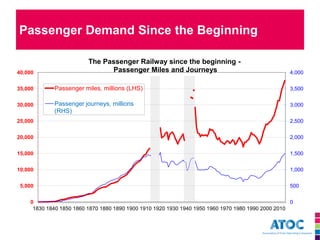
Passenger Demand Since the Beginning 
0 
500 
1,000 
1,500 
2,000 
2,500 
3,000 
3,500 
4,000 
0 
5,000 
10,000 
15,000 
20,000 
25,000 
30,000 
35,000 
40,000 
1830 
1840 
1850 
1860 
1870 
1880 
1890 
1900 
1910 
1920 
1930 
1940 
1950 
1960 
1970 
1980 
1990 
2000 
2010 
The Passenger Railway since the beginning - Passenger Miles and Journeys 
Passenger miles, millions (LHS) 
Passenger journeys, millions (RHS)
ITS November 2014 
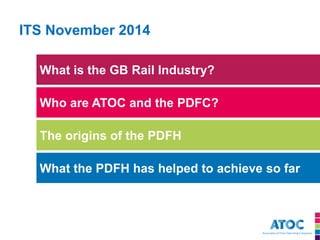
What is the GB Rail Industry? 
Who are ATOC and the PDFC? 
The origins of the PDFH 
What the PDFH has helped to achieve so far
ITS November 2014 
Some examples of where PDFH was used 
Comparing PDFH and TP approaches 
Some areas to be improved on 
Some more nice charts and a picture!
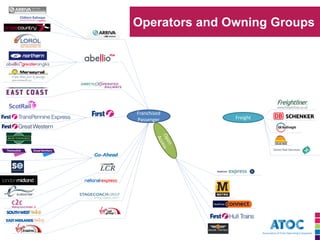
Franchised Passenger 
Freight 
Operators and Owning Groups
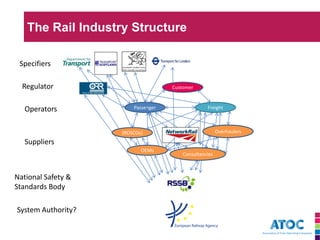
The Rail Industry Structure 
Freight 
Passenger 
Specifiers 
Regulator 
Operators 
Suppliers 
National Safety & Standards Body 
System Authority? 
(ROSCOs) 
OEMs 
Customer 
Consultancies 
Overhaulers
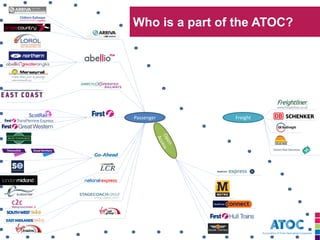
Passenger 
Freight 
Who is a part of the ATOC?
What is ATOC? 
•ATOC is a trade organisation 
•ATOC's mission is to work for passenger rail operators in serving customers and supporting a prosperous railway 
•ATOC incorporates: 
•Rail Settlement Plan (Ticketing) 
•National Rail Enquiries (Customer Information) 
•Commercial Activities (Including the PDF Scheme) 
•Rail Staff Travel
The Passenger Demand Forecasting Scheme 
•The PDF Scheme is a part of ATOC with its own full time Manager and Governing body: 
•The PDF Scheme Manager 
•Passenger Demand Forecasting Executive (PDFE) 
•Passenger Demand Forecasting Council (PDFC)
Who are a part of the Passenger Demand Forecasting Council (PDFC)? 
It is similar to a club with a fee paying membership: Full Members 
•All the Train Operating Companies (TOCs) 
•The Department for Transport (Rail Executive) 
•Transport Scotland & the Welsh Government (Devolved) 
• The Office of Rail Regulation (ORR) 
•Transport for London (TfL) 
•Passenger Transport Executive Group (PTEG) 
•Associate Members 
•Industry Consultants, the larger orgs but also the smaller 
•The proportion of overseas Associates is growing
The interest shared by the Membership 
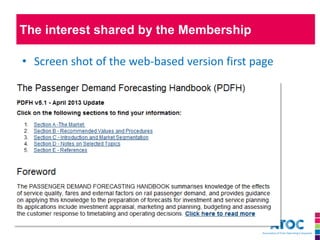
Passenger Demand Forecasting Handbook (PDFH) 
•The PDFH is unique in the world 
•The envy of other national railway planning organisations 
•The above also applies to our LENNON ticket sales data
The interest shared by the Membership 
•Screen shot of the web-based version first page
The Origins of the PDFH
The Origins of the PDFH 
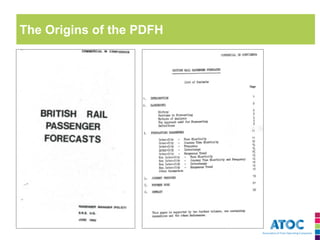
•PDFH came about in June 1986 (Bitish Rail [BR] Policy Unit) 
•Replaced British Rail Passenger Forecasts (June 1982) 
•The central aim was to provide a consistent and solid basis for investment appraisal 
•Also pricing and service planning across BR 
•Supporting well founded investment proposals at Dept for Transport 
•Contained 55 references and similar to current structure
The Origins of the PDFH 
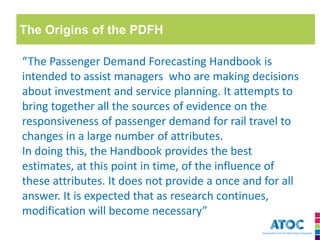
“The Passenger Demand Forecasting Handbook is intended to assist managers who are making decisions about investment and service planning. It attempts to bring together all the sources of evidence on the responsiveness of passenger demand for rail travel to changes in a large number of attributes. 
In doing this, the Handbook provides the best estimates, at this point in time, of the influence of these attributes. It does not provide a once and for all answer. It is expected that as research continues, modification will become necessary”
The history the PDFH 
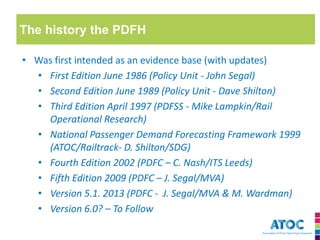
•Was first intended as an evidence base (with updates) 
•First Edition June 1986 (Policy Unit - John Segal) 
•Second Edition June 1989 (Policy Unit - Dave Shilton) 
•Third Edition April 1997 (PDFSS - Mike Lampkin/Rail Operational Research) 
•National Passenger Demand Forecasting Framework 1999 (ATOC/Railtrack- D. Shilton/SDG) 
•Fourth Edition 2002 (PDFC – C. Nash/ITS Leeds) 
•Fifth Edition 2009 (PDFC – J. Segal/MVA) 
•Version 5.1. 2013 (PDFC - J. Segal/MVA & M. Wardman) 
•Version 6.0? – To Follow
What PDFH has achieved so far 
The PDFS/PDFC demand forum has: 
•Proactively supported research, ultimately responsive to outside evidence 
•Exploited large amounts of ticket sales data for analytical purposes 
•Helped pioneer the use of SP in transport planning in UK 
•Now 278 references in PDFH Section E 
•Transparent and easy to apply and update method 
•No “black boxes” in PDFH 
•All studies involve a panel of experts from industry
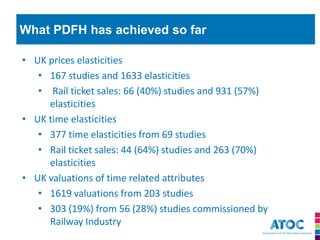
What PDFH has achieved so far 
•UK prices elasticities 
•167 studies and 1633 elasticities 
• Rail ticket sales: 66 (40%) studies and 931 (57%) elasticities 
•UK time elasticities 
•377 time elasticities from 69 studies 
•Rail ticket sales: 44 (64%) studies and 263 (70%) elasticities 
•UK valuations of time related attributes 
•1619 valuations from 203 studies 
•303 (19%) from 56 (28%) studies commissioned by Railway Industry
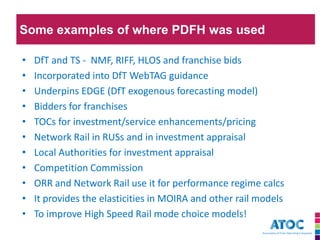
Some examples of where PDFH was used 
•DfT and TS - NMF, RIFF, HLOS and franchise bids 
•Incorporated into DfT WebTAG guidance 
•Underpins EDGE (DfT exogenous forecasting model) 
•Bidders for franchises 
•TOCs for investment/service enhancements/pricing 
•Network Rail in RUSs and in investment appraisal 
•Local Authorities for investment appraisal 
•Competition Commission 
•ORR and Network Rail use it for performance regime calcs 
•It provides the elasticities in MOIRA and other rail models 
•To improve High Speed Rail mode choice models!
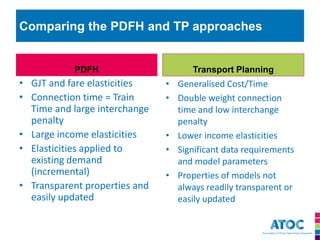
PDFH 
•GJT and fare elasticities 
•Connection time = Train Time and large interchange penalty 
•Large income elasticities 
•Elasticities applied to existing demand (incremental) 
•Transparent properties and easily updated 
Transport Planning 
•Generalised Cost/Time 
•Double weight connection time and low interchange penalty 
•Lower income elasticities 
•Significant data requirements and model parameters 
•Properties of models not always readily transparent or easily updated 
Comparing the PDFH and TP approaches
Some areas to be improved on: 
•Ticket Sales Data 
•NPAAS 1972-1985 (the largest data base outside the Pentagon) 
•LENNON – 1 year by date; 2 years by week; 5 years of four- weekly data; 10 years by annual 
•Ticket Sales Data in Travelcard areas 
•No archiving/pooling of data used in many studies 
•Historic data on competition 
•Historic and detailed data on reliability and crowding
Some areas to be improved on: 
•Too many studies not had the resources to “bottom the issue” 
•Dynamic behavioural adjustments (although we have tried) 
•Not exploited outside/matching funding opportunities enough 
•Short term/parochial focus at times 
•Separate world to disaggregate modelling 
•Not exploited Census, NTS, GIS, ‘Before and After’ monitoring much yet 
•Catchment area analysis - People don’t travel station-to- station but O to D 
•Fresh blood and ideas
Some research areas to be explored further 
•Better understanding of ticket competition (is volume being achieved but at the expense of revenue losses)? 
•How will new technology impact on rail demand? 
•To understand better how the elasticities central to PDFH vary: 
•with the competitive situation; 
•with levels that they take; 
•importantly, with the levels other variables take; 
•between the short- and the long-run (how long is the L-R?) 
•Bridge the Gap with other modelling approaches 
•Exploit different and new data sources to fill gaps and enhance understanding
Please bring on the charts and the picture!
Perception of the Railway Industry 
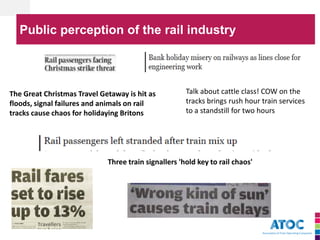
Three train signallers 'hold key to rail chaos' 
The Great Christmas Travel Getaway is hit as floods, signal failures and animals on rail tracks cause chaos for holidaying Britons 
Talk about cattle class! COW on the tracks brings rush hour train services to a standstill for two hours 
Public perception of the rail industry
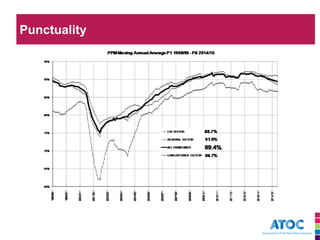
Punctuality
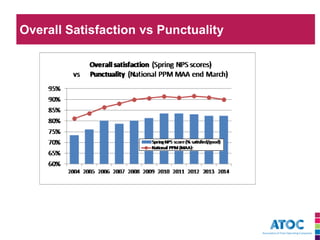
Overall satisfaction Vs Punctuality (PPM) 
Satisfaction vs Punctuality
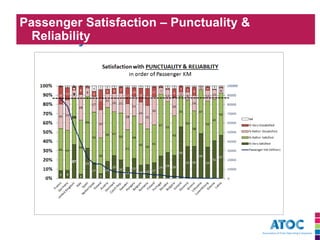
Passenger satisfaction – Punctuality & Reliability 
Satisfaction – Punctuality & Reliability
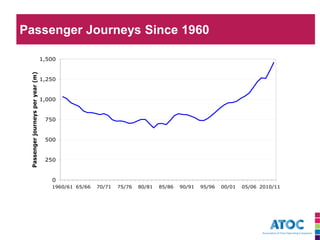
Passenger Journeys 
0 
250 
500 
750 
1,000 
1,250 
1,500 
1960/61 65/66 70/71 75/76 80/81 85/86 90/91 95/96 00/01 05/06 2010/11 
Passenger journeys per year (m) 
Journeys Since 1960
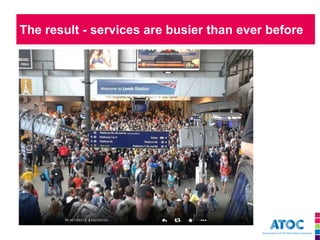
The result - services are busier than ever before
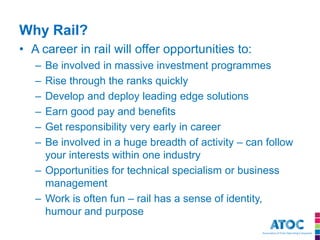
Why Rail? 
•A career in rail will offer opportunities to: 
–Be involved in massive investment programmes 
–Rise through the ranks quickly 
–Develop and deploy leading edge solutions 
–Earn good pay and benefits 
–Get responsibility very early in career 
–Be involved in a huge breadth of activity – can follow your interests within one industry 
–Opportunities for technical specialism or business management 
–Work is often fun – rail has a sense of identity, humour and purpose
Rail Passenger Demand Forecasting - a view from the industry

Rail Passenger Demand Forecasting - a view from the industry

  • 1.
    Rail Passenger DemandForecasting A View from the Industry Tony Magee Passenger Demand Forecasting Scheme Manager Presented to: ITS Masters Students November 2014
  • 2.
    Passenger Demand Sincethe Beginning 0 500 1,000 1,500 2,000 2,500 3,000 3,500 4,000 0 5,000 10,000 15,000 20,000 25,000 30,000 35,000 40,000 1830 1840 1850 1860 1870 1880 1890 1900 1910 1920 1930 1940 1950 1960 1970 1980 1990 2000 2010 The Passenger Railway since the beginning - Passenger Miles and Journeys Passenger miles, millions (LHS) Passenger journeys, millions (RHS)
  • 3.
    ITS November 2014 What is the GB Rail Industry? Who are ATOC and the PDFC? The origins of the PDFH What the PDFH has helped to achieve so far
  • 4.
    ITS November 2014 Some examples of where PDFH was used Comparing PDFH and TP approaches Some areas to be improved on Some more nice charts and a picture!
  • 5.
    Franchised Passenger Freight Operators and Owning Groups
  • 6.
    The Rail IndustryStructure Freight Passenger Specifiers Regulator Operators Suppliers National Safety & Standards Body System Authority? (ROSCOs) OEMs Customer Consultancies Overhaulers
  • 7.
    Passenger Freight Whois a part of the ATOC?
  • 8.
    What is ATOC? •ATOC is a trade organisation •ATOC's mission is to work for passenger rail operators in serving customers and supporting a prosperous railway •ATOC incorporates: •Rail Settlement Plan (Ticketing) •National Rail Enquiries (Customer Information) •Commercial Activities (Including the PDF Scheme) •Rail Staff Travel
  • 9.
    The Passenger DemandForecasting Scheme •The PDF Scheme is a part of ATOC with its own full time Manager and Governing body: •The PDF Scheme Manager •Passenger Demand Forecasting Executive (PDFE) •Passenger Demand Forecasting Council (PDFC)
  • 10.
    Who are apart of the Passenger Demand Forecasting Council (PDFC)? It is similar to a club with a fee paying membership: Full Members •All the Train Operating Companies (TOCs) •The Department for Transport (Rail Executive) •Transport Scotland & the Welsh Government (Devolved) • The Office of Rail Regulation (ORR) •Transport for London (TfL) •Passenger Transport Executive Group (PTEG) •Associate Members •Industry Consultants, the larger orgs but also the smaller •The proportion of overseas Associates is growing
  • 11.
    The interest sharedby the Membership Passenger Demand Forecasting Handbook (PDFH) •The PDFH is unique in the world •The envy of other national railway planning organisations •The above also applies to our LENNON ticket sales data
  • 12.
    The interest sharedby the Membership •Screen shot of the web-based version first page
  • 13.
  • 14.
    The Origins ofthe PDFH •PDFH came about in June 1986 (Bitish Rail [BR] Policy Unit) •Replaced British Rail Passenger Forecasts (June 1982) •The central aim was to provide a consistent and solid basis for investment appraisal •Also pricing and service planning across BR •Supporting well founded investment proposals at Dept for Transport •Contained 55 references and similar to current structure
  • 15.
    The Origins ofthe PDFH “The Passenger Demand Forecasting Handbook is intended to assist managers who are making decisions about investment and service planning. It attempts to bring together all the sources of evidence on the responsiveness of passenger demand for rail travel to changes in a large number of attributes. In doing this, the Handbook provides the best estimates, at this point in time, of the influence of these attributes. It does not provide a once and for all answer. It is expected that as research continues, modification will become necessary”
  • 16.
    The history thePDFH •Was first intended as an evidence base (with updates) •First Edition June 1986 (Policy Unit - John Segal) •Second Edition June 1989 (Policy Unit - Dave Shilton) •Third Edition April 1997 (PDFSS - Mike Lampkin/Rail Operational Research) •National Passenger Demand Forecasting Framework 1999 (ATOC/Railtrack- D. Shilton/SDG) •Fourth Edition 2002 (PDFC – C. Nash/ITS Leeds) •Fifth Edition 2009 (PDFC – J. Segal/MVA) •Version 5.1. 2013 (PDFC - J. Segal/MVA & M. Wardman) •Version 6.0? – To Follow
  • 17.
    What PDFH hasachieved so far The PDFS/PDFC demand forum has: •Proactively supported research, ultimately responsive to outside evidence •Exploited large amounts of ticket sales data for analytical purposes •Helped pioneer the use of SP in transport planning in UK •Now 278 references in PDFH Section E •Transparent and easy to apply and update method •No “black boxes” in PDFH •All studies involve a panel of experts from industry
  • 18.
    What PDFH hasachieved so far •UK prices elasticities •167 studies and 1633 elasticities • Rail ticket sales: 66 (40%) studies and 931 (57%) elasticities •UK time elasticities •377 time elasticities from 69 studies •Rail ticket sales: 44 (64%) studies and 263 (70%) elasticities •UK valuations of time related attributes •1619 valuations from 203 studies •303 (19%) from 56 (28%) studies commissioned by Railway Industry
  • 19.
    Some examples ofwhere PDFH was used •DfT and TS - NMF, RIFF, HLOS and franchise bids •Incorporated into DfT WebTAG guidance •Underpins EDGE (DfT exogenous forecasting model) •Bidders for franchises •TOCs for investment/service enhancements/pricing •Network Rail in RUSs and in investment appraisal •Local Authorities for investment appraisal •Competition Commission •ORR and Network Rail use it for performance regime calcs •It provides the elasticities in MOIRA and other rail models •To improve High Speed Rail mode choice models!
  • 20.
    PDFH •GJT andfare elasticities •Connection time = Train Time and large interchange penalty •Large income elasticities •Elasticities applied to existing demand (incremental) •Transparent properties and easily updated Transport Planning •Generalised Cost/Time •Double weight connection time and low interchange penalty •Lower income elasticities •Significant data requirements and model parameters •Properties of models not always readily transparent or easily updated Comparing the PDFH and TP approaches
  • 21.
    Some areas tobe improved on: •Ticket Sales Data •NPAAS 1972-1985 (the largest data base outside the Pentagon) •LENNON – 1 year by date; 2 years by week; 5 years of four- weekly data; 10 years by annual •Ticket Sales Data in Travelcard areas •No archiving/pooling of data used in many studies •Historic data on competition •Historic and detailed data on reliability and crowding
  • 22.
    Some areas tobe improved on: •Too many studies not had the resources to “bottom the issue” •Dynamic behavioural adjustments (although we have tried) •Not exploited outside/matching funding opportunities enough •Short term/parochial focus at times •Separate world to disaggregate modelling •Not exploited Census, NTS, GIS, ‘Before and After’ monitoring much yet •Catchment area analysis - People don’t travel station-to- station but O to D •Fresh blood and ideas
  • 23.
    Some research areasto be explored further •Better understanding of ticket competition (is volume being achieved but at the expense of revenue losses)? •How will new technology impact on rail demand? •To understand better how the elasticities central to PDFH vary: •with the competitive situation; •with levels that they take; •importantly, with the levels other variables take; •between the short- and the long-run (how long is the L-R?) •Bridge the Gap with other modelling approaches •Exploit different and new data sources to fill gaps and enhance understanding
  • 24.
    Please bring onthe charts and the picture!
  • 25.
    Perception of theRailway Industry Three train signallers 'hold key to rail chaos' The Great Christmas Travel Getaway is hit as floods, signal failures and animals on rail tracks cause chaos for holidaying Britons Talk about cattle class! COW on the tracks brings rush hour train services to a standstill for two hours Public perception of the rail industry
  • 26.
  • 27.
    Overall satisfaction VsPunctuality (PPM) Satisfaction vs Punctuality
  • 28.
    Passenger satisfaction –Punctuality & Reliability Satisfaction – Punctuality & Reliability
  • 29.
    Passenger Journeys 0 250 500 750 1,000 1,250 1,500 1960/61 65/66 70/71 75/76 80/81 85/86 90/91 95/96 00/01 05/06 2010/11 Passenger journeys per year (m) Journeys Since 1960
  • 30.
    The result -services are busier than ever before
  • 31.
    Why Rail? •Acareer in rail will offer opportunities to: –Be involved in massive investment programmes –Rise through the ranks quickly –Develop and deploy leading edge solutions –Earn good pay and benefits –Get responsibility very early in career –Be involved in a huge breadth of activity – can follow your interests within one industry –Opportunities for technical specialism or business management –Work is often fun – rail has a sense of identity, humour and purpose