Designing a New Train
Ian Walmsley
Engineering Development Manager
Porterbrook

1
ROSCO - Our business









Simple business model
Long term assets
Short term customers
Straight Line depreciation
Gosplan economics
Market should be predictable
Policy isn’t
Pre-emptive work = high risk

2
What’s good for us?




Stock stays on lease for 35 years
Minimum changes to achieve this
Rolling stock should be: • Reliable
• Comfortable
• Energy efficient
• Low maintenance
• Coupling compatible
• Suitable for the service
• Adaptable for other services
3
An example








High reliability (90,000 mpc)
Regenerative Braking (15% less energy)
AC traction, low maintenance
Compliant to modern safety standards
Compliant to disability regulations
Air conditioned, good ride, modern interior
Perfectly designed for the service it operates



Risk of displacement?

4
5
6
7
8
9
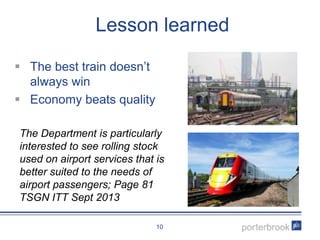
Lesson learned
 The best train doesn’t
always win
 Economy beats quality
The Department is particularly
interested to see rolling stock
used on airport services that is
better suited to the needs of
airport passengers; Page 81
TSGN ITT Sept 2013
10
The UK rolling stock market
is neither free nor controlled

11
Market and cost





12

Rail 2% of market
Modal transfer
CO2 Reduction
Capacity of system
Market and cost
Train is 15% of industry cost : 12% capital + 3% Maintenance

13
New train specification – Non-compliances























GSM link to PIS
Coupling with doors open
GOP panel full function
Current standards
Ride better than 450
Inter-Vehicle damping
Noise – new standard
Reliability 340,000 MTIN
Water tank gauge
Insulation infra-red scan
Dead haulage in service to 90 mph
Light flash guard position
1450mm wide doors
Standbacks at doors
Footsteps cannot obstruct doors
Emergency brake in Neutral
No hill start button
Sanding – dedicated power supply
Low sand indicator
Sandbox trace heating
WSP failure alarm
P12 Profile wheels























14

Wheelset coating to minimise UAT
Option for flange lubrication
GSMR radio fitted
Maintenance free batteries
PIS letter descenders uncompressed
Coach letter display in train
Side of train PIS displays
Wi-Fi remote upload PIS
OTMR – GSMR Interface
OTMR 7-day recording
OTMR flash card download
Train Manager’s office
275 seats (270)
Emergency light power supplies
No bonded glass
Ergonomic layout for vehicle on it’s side
Seat re-arrange with same body panels
Toilet flush with lid up
CCTV viewing screen
Power close cab door
ERTMS space provision and supply
New train requirement
 Use existing design?

•
•
•
•
•

 Produce new design?

•
•
•
•
•

Capacity
Acceleration
24 tph
New technology
Competition

15

Higher risk
Design costs
Safety Case
Potential market
Maintenance cost
Safety is a “given”









Rail Group Standards
Codes of practice
European standards
Disabled legislation
Fire regulations
Accident reports
Design review
Acceptance bodies









16

Crashworthiness
Materials used
Control logic
Redundancy
Human Factors
Stepping distances
Electrical Interference
Kinematic Envelope
Market divisions





High Speed Lines
Inter-City
Outer Suburban Commuter
Inner Suburban Metro

17
What do you want? – Passenger focus

18
What do you want? (Leeds area figures)
2009

2010

2011

2012

2013

Spring

Autumn

Spring

Autumn

Spring

Autumn

Spring

Autumn

Spring

Autumn

Satisfied

n/a

86%

84%

78%

83%

87%

87%

78%

75%

78%

Neutral

n/a

10%

10%

11%

12%

8%

9%

14%

16%

11%

Dissatisfi
ed

n/a

5%

6%

11%

6%

6%

5%

8%

9%

11%

19
What do you want?

20
New train decisions - speed
 Maximum Speed

•
•
•
•
•
•

140 mph
125 mph
118 mph
100 mph
90 mph
75 mph









21

Track costs
Train weight limits
Installed power
Braking ability
Acceleration
No. Powered axles
Cost
New train decisions - length






3, 4 or 5 car
20m long
23m long
26m long
16.6m long









22

Platform Lengths
Selective Door Opening
Station dwell times
No. of bogies
Weight (Energy, track)
Axle load (speed)
Expected capacity need
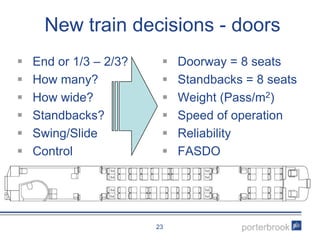
New train decisions - doors







End or 1/3 – 2/3?
How many?
How wide?
Standbacks?
Swing/Slide
Control








23

Doorway = 8 seats
Standbacks = 8 seats
Weight (Pass/m2)
Speed of operation
Reliability
FASDO
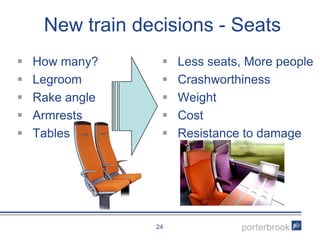
New train decisions - Seats






How many?
Legroom
Rake angle
Armrests
Tables







24

Less seats, More people
Crashworthiness
Weight
Cost
Resistance to damage
25
Limiting case design

26
Limiting case design






Centre section peak operation sets design
Bedford – Brighton 2 hrs 15 min
Thameslink & Crossrail – same problem
Not ideal for off-peak journeys
Is there a choice?

27
The “Platform”





Need to spread design cost
Make design flexible around a fixed “platform”
New trains around country will be similar
Platform designs usually last about 10 years

1970s

1960s

1990s

1980s
28

2000s
Maintenance Options - 1
 All inclusive deal with manufacturer

•
•
•
•
•






Capital
Depots
Materials
Depot maintenance
Major overhaul

Only specify number of diagrams to be covered
Best incentive to minimise maintenance cost
Usually most expensive deal – risk brings reward
“Wet” lease with ROSCO “Power by the hour”
29
Maintenance Options - 2
 “Soggy” lease with ROSCO

•
•
•
•
•






Capital rental
Non-cap for overhaul
Operator maintains
Network Rail facilities
Contract sets responsibility

Operator controls daily availability
“Lumpy” overhaul and repair costs smoothed out
Terms to fit franchises
System used when privatised in 1994
30
Maintenance Options - 3
 “Dry” lease with ROSCO

•
•
•
•
•






Capital rental only
No “maintenance reserve”
Operator maintains
ROSCO audits asset
Redelivery inspections

Operator controls all aspects
Lower initial cost
Higher risk to operator – design and endemic faults
Operators often expect support not paid for
31
Residual Value
 Franchise operators come and go
 ROSCO carries residual value
 Example:-

•
•
•
•

200 vehicles at £1.7m each = £340M investment.
Assumed a 35 year life
After 7 year franchise residual value is 28/35 of £340M
£272M

 Risk may be backed off to Government
 No more diesels
32
Conclusions
 Designing a train is a series of compromises
 Designs will primarily aim at one of 4 markets

•
•
•
•

High Speed
Inter City
Suburban
Metro

 Adaptable for different routes – the “Platform”
 Residual Value (i.e. life) very important

33


http://www.youtube.com/watch?v=BVQYldQpeKY



http://www.youtube.com/watch?v=vZqsdOEdUuA

34
Thank you

35

Designing a new train

  • 1.
    Designing a NewTrain Ian Walmsley Engineering Development Manager Porterbrook 1
  • 2.
    ROSCO - Ourbusiness         Simple business model Long term assets Short term customers Straight Line depreciation Gosplan economics Market should be predictable Policy isn’t Pre-emptive work = high risk 2
  • 3.
    What’s good forus?    Stock stays on lease for 35 years Minimum changes to achieve this Rolling stock should be: • Reliable • Comfortable • Energy efficient • Low maintenance • Coupling compatible • Suitable for the service • Adaptable for other services 3
  • 4.
    An example        High reliability(90,000 mpc) Regenerative Braking (15% less energy) AC traction, low maintenance Compliant to modern safety standards Compliant to disability regulations Air conditioned, good ride, modern interior Perfectly designed for the service it operates  Risk of displacement? 4
  • 5.
  • 6.
  • 7.
  • 8.
  • 9.
  • 10.
    Lesson learned  Thebest train doesn’t always win  Economy beats quality The Department is particularly interested to see rolling stock used on airport services that is better suited to the needs of airport passengers; Page 81 TSGN ITT Sept 2013 10
  • 11.
    The UK rollingstock market is neither free nor controlled 11
  • 12.
    Market and cost     12 Rail2% of market Modal transfer CO2 Reduction Capacity of system
  • 13.
    Market and cost Trainis 15% of industry cost : 12% capital + 3% Maintenance 13
  • 14.
    New train specification– Non-compliances                       GSM link to PIS Coupling with doors open GOP panel full function Current standards Ride better than 450 Inter-Vehicle damping Noise – new standard Reliability 340,000 MTIN Water tank gauge Insulation infra-red scan Dead haulage in service to 90 mph Light flash guard position 1450mm wide doors Standbacks at doors Footsteps cannot obstruct doors Emergency brake in Neutral No hill start button Sanding – dedicated power supply Low sand indicator Sandbox trace heating WSP failure alarm P12 Profile wheels                      14 Wheelset coating to minimise UAT Option for flange lubrication GSMR radio fitted Maintenance free batteries PIS letter descenders uncompressed Coach letter display in train Side of train PIS displays Wi-Fi remote upload PIS OTMR – GSMR Interface OTMR 7-day recording OTMR flash card download Train Manager’s office 275 seats (270) Emergency light power supplies No bonded glass Ergonomic layout for vehicle on it’s side Seat re-arrange with same body panels Toilet flush with lid up CCTV viewing screen Power close cab door ERTMS space provision and supply
  • 15.
    New train requirement Use existing design? • • • • •  Produce new design? • • • • • Capacity Acceleration 24 tph New technology Competition 15 Higher risk Design costs Safety Case Potential market Maintenance cost
  • 16.
    Safety is a“given”         Rail Group Standards Codes of practice European standards Disabled legislation Fire regulations Accident reports Design review Acceptance bodies         16 Crashworthiness Materials used Control logic Redundancy Human Factors Stepping distances Electrical Interference Kinematic Envelope
  • 17.
    Market divisions     High SpeedLines Inter-City Outer Suburban Commuter Inner Suburban Metro 17
  • 18.
    What do youwant? – Passenger focus 18
  • 19.
    What do youwant? (Leeds area figures) 2009 2010 2011 2012 2013 Spring Autumn Spring Autumn Spring Autumn Spring Autumn Spring Autumn Satisfied n/a 86% 84% 78% 83% 87% 87% 78% 75% 78% Neutral n/a 10% 10% 11% 12% 8% 9% 14% 16% 11% Dissatisfi ed n/a 5% 6% 11% 6% 6% 5% 8% 9% 11% 19
  • 20.
    What do youwant? 20
  • 21.
    New train decisions- speed  Maximum Speed • • • • • • 140 mph 125 mph 118 mph 100 mph 90 mph 75 mph        21 Track costs Train weight limits Installed power Braking ability Acceleration No. Powered axles Cost
  • 22.
    New train decisions- length      3, 4 or 5 car 20m long 23m long 26m long 16.6m long        22 Platform Lengths Selective Door Opening Station dwell times No. of bogies Weight (Energy, track) Axle load (speed) Expected capacity need
  • 23.
    New train decisions- doors       End or 1/3 – 2/3? How many? How wide? Standbacks? Swing/Slide Control       23 Doorway = 8 seats Standbacks = 8 seats Weight (Pass/m2) Speed of operation Reliability FASDO
  • 24.
    New train decisions- Seats      How many? Legroom Rake angle Armrests Tables      24 Less seats, More people Crashworthiness Weight Cost Resistance to damage
  • 25.
  • 26.
  • 27.
    Limiting case design      Centresection peak operation sets design Bedford – Brighton 2 hrs 15 min Thameslink & Crossrail – same problem Not ideal for off-peak journeys Is there a choice? 27
  • 28.
    The “Platform”     Need tospread design cost Make design flexible around a fixed “platform” New trains around country will be similar Platform designs usually last about 10 years 1970s 1960s 1990s 1980s 28 2000s
  • 29.
    Maintenance Options -1  All inclusive deal with manufacturer • • • • •     Capital Depots Materials Depot maintenance Major overhaul Only specify number of diagrams to be covered Best incentive to minimise maintenance cost Usually most expensive deal – risk brings reward “Wet” lease with ROSCO “Power by the hour” 29
  • 30.
    Maintenance Options -2  “Soggy” lease with ROSCO • • • • •     Capital rental Non-cap for overhaul Operator maintains Network Rail facilities Contract sets responsibility Operator controls daily availability “Lumpy” overhaul and repair costs smoothed out Terms to fit franchises System used when privatised in 1994 30
  • 31.
    Maintenance Options -3  “Dry” lease with ROSCO • • • • •     Capital rental only No “maintenance reserve” Operator maintains ROSCO audits asset Redelivery inspections Operator controls all aspects Lower initial cost Higher risk to operator – design and endemic faults Operators often expect support not paid for 31
  • 32.
    Residual Value  Franchiseoperators come and go  ROSCO carries residual value  Example:- • • • • 200 vehicles at £1.7m each = £340M investment. Assumed a 35 year life After 7 year franchise residual value is 28/35 of £340M £272M  Risk may be backed off to Government  No more diesels 32
  • 33.
    Conclusions  Designing atrain is a series of compromises  Designs will primarily aim at one of 4 markets • • • • High Speed Inter City Suburban Metro  Adaptable for different routes – the “Platform”  Residual Value (i.e. life) very important 33
  • 34.
  • 35.