

Large-scale trap crop research and
demonstrations to manage leaffooted
bugs and squash bugs
Dr. Ayanava Majumdar (Dr. A)
Ext. Entomologist &
State SARE Coordinator
Auburn, AL 36849
Tel: (251) 331-8416
bugdoctor@auburn.edu
www.aces.edu/vegetableipm
• Boucher, T. J., and R. Durgy. 2004. Demonstrating a perimeter trap crop approach to
pest management on summer squash in New England. Journal of Extension. 42(5):
5RIB2.
• Mizel, III, R. F., T. C. Riddle, and A. S. Blount. 2008b. Trap cropping system to suppress
stink bugs in the southern Coastal Plain. Proc. Fla. State Hort. Soc. 121: 377-382.
• Tillman, P. G. 2006. Sorghum as a trap crop for Nezara viridula L. (Heteroptera:
Pentatomidae) in cotton in the southern United States. Environ. Entomol. 35 (3): 771-
783.
• Wszelaki, A., and S. Broughton. 2010. Trap crops, intercropping and companion
planting. University of Tennessee Extension. Pub. W235F.
• Majumdar, A., R. Akridge, C. Becker, A. Caylor, J. Pitts, and M. Reeves. 2012. Trap
crops for leaffooted bug management in tomatoes. Journal of the NACAA. Vol. 5 (2).
• Akotsen-Mensah, C., R. R. Balusu, J. Anikwe, and H. Y. Fadamiro. 2017. Evaluating
potential trap crops for managing leaffooted (Hemiptera: Coreidae) and phytophagous
stink bug (Hemiptera: Pentatomidae) species in peaches. Agricultural and Forest
Entomology. 19: 332-340.
References Cited – Trap Crops
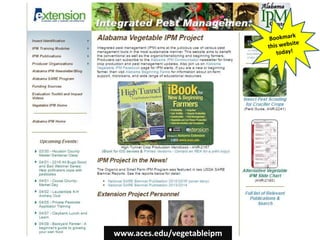
www.aces.edu/vegetableipm
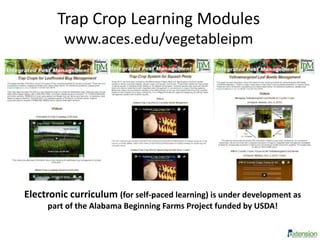
Trap Crop Learning Modules
www.aces.edu/vegetableipm
Electronic curriculum (for self-paced learning) is under development as
part of the Alabama Beginning Farms Project funded by USDA!
Alabama IPM Communicator Newsletter
Great source of
information about crop
production and educational
events statewide.
Sign up today!
www.aces.edu/ipmcommunicator
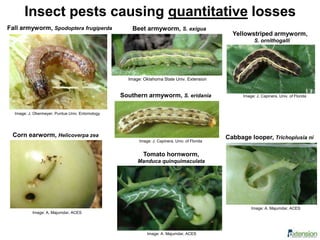
Fall armyworm, Spodoptera frugiperda
Image: J. Obermeyer, Purdue Univ. Entomology
Beet armyworm, S. exigua
Image: Oklahoma State Univ. Extension
Image: J. Capinera, Univ. of Florida
Yellowstriped armyworm,
S. ornithogalli
Southern armyworm, S. eridania
Image: J. Capinera, Univ. of Florida
Corn earworm, Helicoverpa zea
Image: A. Majumdar, ACES
Tomato hornworm,
Manduca quinquimaculata
Image: A. Majumdar, ACES
Cabbage looper, Trichoplusia ni
Image: A. Majumdar, ACES
Insect pests causing quantitative losses
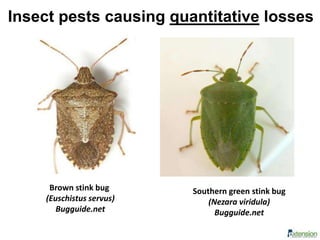
Brown stink bug
(Euschistus servus)
Bugguide.net
Southern green stink bug
(Nezara viridula)
Bugguide.net
Insect pests causing quantitative losses
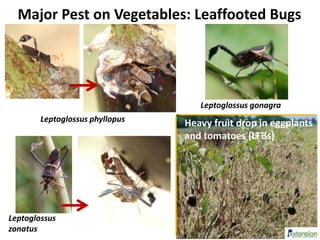
Major Pest on Vegetables: Leaffooted Bugs
Leptoglossus phyllopus
Leptoglossus
zonatus
Leptoglossus gonagra
Heavy fruit drop in eggplants
and tomatoes (LFBs)
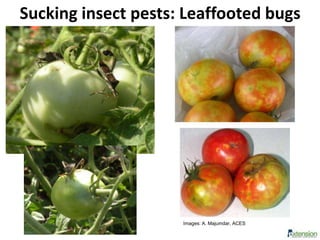
Sucking insect pests: Leaffooted bugs
Images: A. Majumdar, ACES
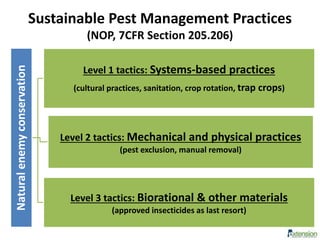
Sustainable Pest Management Practices
(NOP, 7CFR Section 205.206)
Naturalenemyconservation
Level 1 tactics: Systems-based practices
(cultural practices, sanitation, crop rotation, trap crops)
Level 2 tactics: Mechanical and physical practices
(pest exclusion, manual removal)
Level 3 tactics: Biorational & other materials
(approved insecticides as last resort)
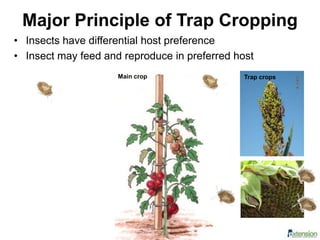
Major Principle of Trap Cropping
• Insects have differential host preference
• Insect may feed and reproduce in preferred host
Main crop Trap crops
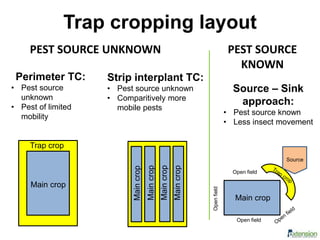
Perimeter TC:
• Pest source
unknown
• Pest of limited
mobility
Trap cropping layout
Trap crop
Main crop
Maincrop
Maincrop
Maincrop
Maincrop
Main crop
Source
Open field
Openfield
Open field
Strip interplant TC:
• Pest source unknown
• Comparitively more
mobile pests
Source – Sink
approach:
• Pest source known
• Less insect movement
PEST SOURCE UNKNOWN PEST SOURCE
KNOWN
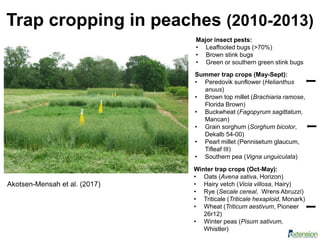
Trap cropping in peaches (2010-2013)
Akotsen-Mensah et al. (2017)
Summer trap crops (May-Sept):
• Peredovik sunflower (Helianthus
anuus)
• Brown top millet (Brachiaria ramose,
Florida Brown)
• Buckwheat (Fagopyrum sagittatum,
Mancan)
• Grain sorghum (Sorghum bicolor,
Dekalb 54-00)
• Pearl millet (Pennisetum glaucum,
Tifleaf III)
• Southern pea (Vigna unguiculata)
Winter trap crops (Oct-May):
• Oats (Avena sativa, Horizon)
• Hairy vetch (Vicia villosa, Hairy)
• Rye (Secale cereal, Wrens Abruzzi)
• Triticale (Triticale hexaploid, Monark)
• Wheat (Triticum aestivum, Pioneer
26r12)
• Winter peas (Pisum sativum,
Whistler)
Major insect pests:
• Leaffooted bugs (>70%)
• Brown stink bugs
• Green or southern green stink bugs
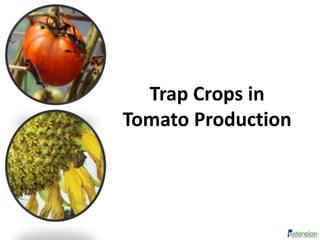
Trap Crops in
Tomato Production
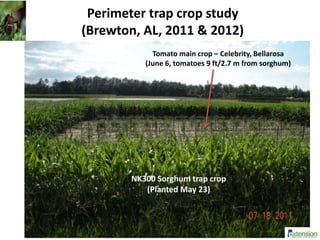
Perimeter trap crop study
(Brewton, AL, 2011 & 2012)
Tomato main crop – Celebrity, Bellarosa
(June 6, tomatoes 9 ft/2.7 m from sorghum)
NK300 Sorghum trap crop
(Planted May 23)
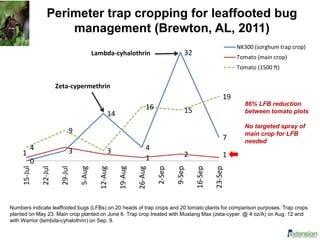
0
3
14
4
32
7
1
1 2 1
4
9
3
16 15
19
15-Jul
22-Jul
29-Jul
5-Aug
12-Aug
19-Aug
26-Aug
2-Sep
9-Sep
16-Sep
23-Sep
NK300 (sorghum trap crop)
Tomato (main crop)
Tomato (1500 ft)
Zeta-cypermethrin
Lambda-cyhalothrin
Numbers indicate leaffooted bugs (LFBs) on 20 heads of trap crops and 20 tomato plants for comparison purposes. Trap crops
planted on May 23. Main crop planted on June 6. Trap crop treated with Mustang Max (zeta-cyper. @ 4 oz/A) on Aug. 12 and
with Warrior (lambda-cyhalothrin) on Sep. 9.
Perimeter trap cropping for leaffooted bug
management (Brewton, AL, 2011)
86% LFB reduction
between tomato plots
No targeted spray of
main crop for LFB
needed
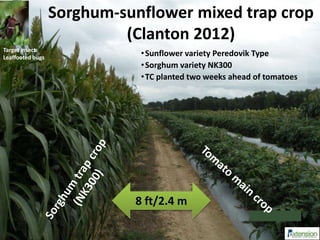
Sorghum-sunflower mixed trap crop
(Clanton 2012)
8 ft/2.4 m
Target insect:
Leaffooted bugs
•Sunflower variety Peredovik Type
•Sorghum variety NK300
•TC planted two weeks ahead of tomatoes
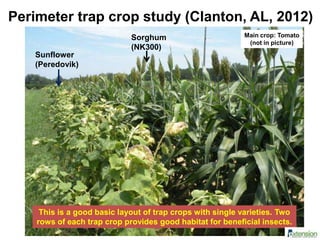
Sunflower
(Peredovik)
Sorghum
(NK300)
Main crop: Tomato
(not in picture)
Perimeter trap crop study (Clanton, AL, 2012)
This is a good basic layout of trap crops with single varieties. Two
rows of each trap crop provides good habitat for beneficial insects.
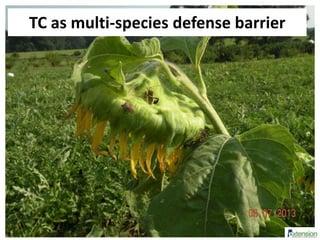
TC as multi-species defense barrier
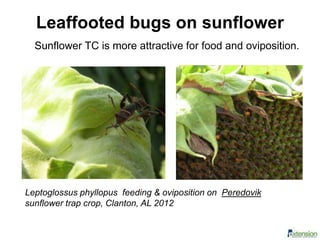
Sunflower TC is more attractive for food and oviposition.
Leaffooted bugs on sunflower
Leptoglossus phyllopus feeding & oviposition on Peredovik
sunflower trap crop, Clanton, AL 2012
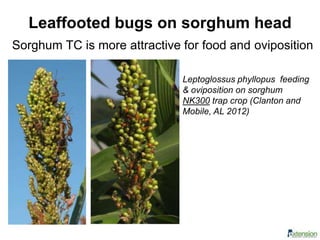
Sorghum TC is more attractive for food and oviposition
Leaffooted bugs on sorghum head
Leptoglossus phyllopus feeding
& oviposition on sorghum
NK300 trap crop (Clanton and
Mobile, AL 2012)
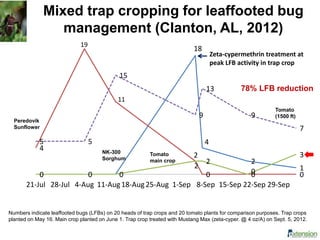
Mixed trap cropping for leaffooted bug
management (Clanton, AL, 2012)
0 0
18
4
2
1
4
2
0 0 00 0 0
2
2
0
3
5 5
15
9
13
9
7
21-Jul 28-Jul 4-Aug 11-Aug18-Aug25-Aug 1-Sep 8-Sep 15-Sep 22-Sep 29-Sep
19
Numbers indicate leaffooted bugs (LFBs) on 20 heads of trap crops and 20 tomato plants for comparison purposes. Trap crops
planted on May 16. Main crop planted on June 1. Trap crop treated with Mustang Max (zeta-cyper. @ 4 oz/A) on Sept. 5, 2012.
Zeta-cypermethrin treatment at
peak LFB activity in trap crop
78% LFB reduction
11
Peredovik
Sunflower
Tomato
main crop
NK-300
Sorghum
Tomato
(1500 ft)
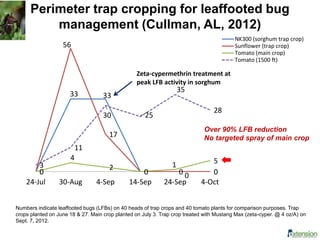
Perimeter trap cropping for leaffooted bug
management (Cullman, AL, 2012)
0
33 33
0 0 00
56
17
0 0 00
4
2
0
1 5
3
11
30 25
35
28
24-Jul 30-Aug 4-Sep 14-Sep 24-Sep 4-Oct
NK300 (sorghum trap crop)
Sunflower (trap crop)
Tomato (main crop)
Tomato (1500 ft)
Numbers indicate leaffooted bugs (LFBs) on 40 heads of trap crops and 40 tomato plants for comparison purposes. Trap
crops planted on June 18 & 27. Main crop planted on July 3. Trap crop treated with Mustang Max (zeta-cyper. @ 4 oz/A) on
Sept. 7, 2012.
Zeta-cypermethrin treatment at
peak LFB activity in sorghum
Over 90% LFB reduction
No targeted spray of main crop
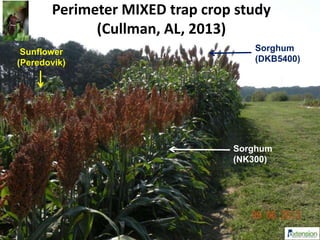
Perimeter MIXED trap crop study
(Cullman, AL, 2013)
Sunflower
(Peredovik)
Sorghum
(NK300)
Sorghum
(DKB5400)
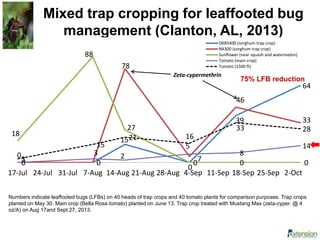
Mixed trap cropping for leaffooted bug
management (Clanton, AL, 2013)
0 0
15
0
39
64
0 0
78
5
46
33
18
88
27
0
0 0
0 3 2 7
8
14
3
15
21 16
33 28
17-Jul 24-Jul 31-Jul 7-Aug 14-Aug 21-Aug 28-Aug 4-Sep 11-Sep 18-Sep 25-Sep 2-Oct
DKB5400 (sorghum trap crop)
NK300 (sorghum trap crop)
Sunflower (near squash and watermelon)
Tomato (main crop)
Tomato (1500 ft)
Numbers indicate leaffooted bugs (LFBs) on 40 heads of trap crops and 40 tomato plants for comparison purposes. Trap crops
planted on May 30. Main crop (Bella Rosa tomato) planted on June 13. Trap crop treated with Mustang Max (zeta-cyper. @ 4
oz/A) on Aug 17and Sept 27, 2013.
Zeta-cypermethrin
75% LFB reduction
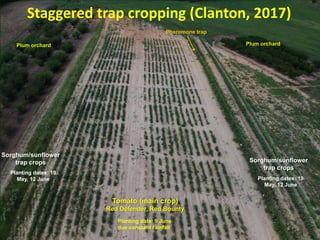
Staggered trap cropping (Clanton, 2017)
Tomato (main crop)
Red Defender, Red Bounty
Sorghum/sunflower
trap crops
Sorghum/sunflower
trap crops
Plum orchard Plum orchard
Planting dates: 19
May, 12 June
Planting date: 9 June
due constant rainfall
Pheromone trap
Planting dates: 19
May, 12 June
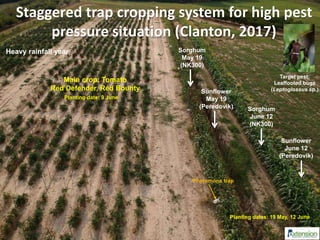
Sunflower
May 19
(Peredovik) Sorghum
June 12
(NK300)
Main crop: Tomato
Red Defender, Red Bounty
Staggered trap cropping system for high pest
pressure situation (Clanton, 2017)
Sorghum
May 19
(NK300)
Target pest:
Leaffooted bugs
(Leptoglossus sp.)
Sunflower
June 12
(Peredovik)
Planting dates: 19 May, 12 June
Planting date: 9 June
Pheromone trap
Heavy rainfall year
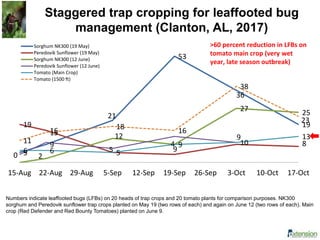
Staggered trap cropping for leaffooted bug
management (Clanton, AL, 2017)
5
9
21
53
36
1919
16
5
4
9
8
0 2
12
9
27
25
6 6 5
9 10
13
11
15
18
16
38
23
15-Aug 22-Aug 29-Aug 5-Sep 12-Sep 19-Sep 26-Sep 3-Oct 10-Oct 17-Oct
Sorghum NK300 (19 May)
Peredovik Sunflower (19 May)
Sorghum NK300 (12 June)
Peredovik Sunflower (12 June)
Tomato (Main Crop)
Tomato (1500 ft)
>60 percent reduction in LFBs on
tomato main crop (very wet
year, late season outbreak)
Numbers indicate leaffooted bugs (LFBs) on 20 heads of trap crops and 20 tomato plants for comparison purposes. NK300
sorghum and Peredovik sunflower trap crops planted on May 19 (two rows of each) and again on June 12 (two rows of each). Main
crop (Red Defender and Red Bounty Tomatoes) planted on June 9.
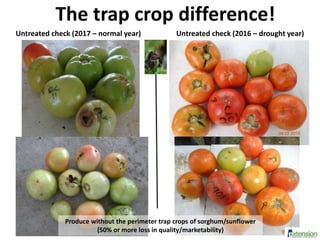
The trap crop difference!
Untreated check (2017 – normal year) Untreated check (2016 – drought year)
Produce without the perimeter trap crops of sorghum/sunflower
(50% or more loss in quality/marketability)
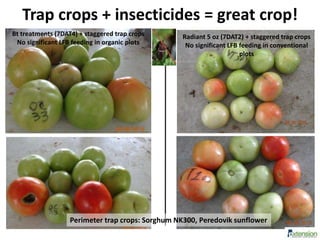
Trap crops + insecticides = great crop!
Radiant 5 oz (7DAT2) + staggered trap crops
No significant LFB feeding in conventional
plots
Perimeter trap crops: Sorghum NK300, Peredovik sunflower
Bt treatments (7DAT4) + staggered trap crops
No significant LFB feeding in organic plots
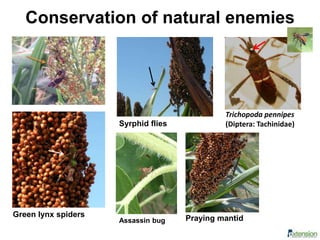
Conservation of natural enemies
Green lynx spiders
Syrphid flies
Assassin bug Praying mantid
Trichopoda pennipes
(Diptera: Tachinidae)
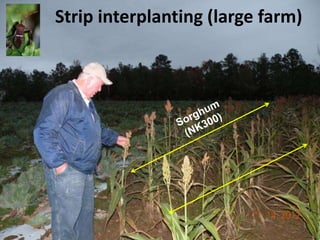
Strip interplanting (large farm)
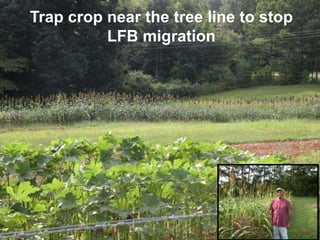
Trap crop near the tree line to stop
LFB migration
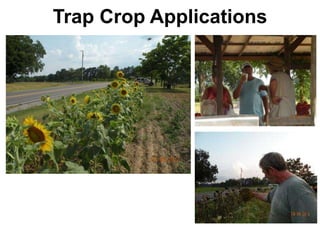
Trap Crop Applications
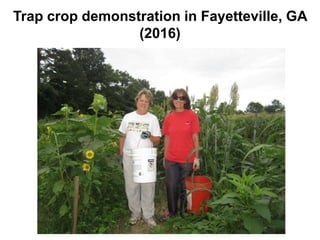
Trap crop demonstration in Fayetteville, GA
(2016)
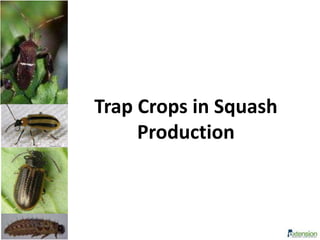
Trap Crops in Squash
Production
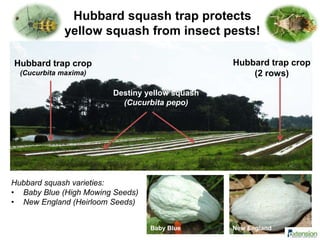
Hubbard squash trap protects
yellow squash from insect pests!
Hubbard trap crop
(Cucurbita maxima)
Hubbard trap crop
(2 rows)
Destiny yellow squash
(Cucurbita pepo)
Hubbard squash varieties:
• Baby Blue (High Mowing Seeds)
• New England (Heirloom Seeds)
Baby Blue New England
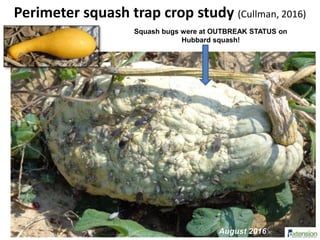
Perimeter squash trap crop study (Cullman, 2016)
Squash bugs were at OUTBREAK STATUS on
Hubbard squash!
August 2016
Hubbard squash
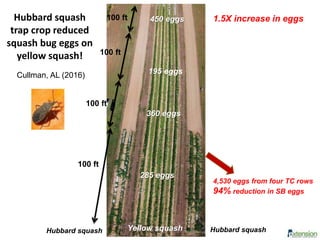
trap crop reduced
squash bug eggs on
yellow squash!
100 ft
100 ft
Yellow squashHubbard squash Hubbard squash
100 ft
100 ft
Cullman, AL (2016)
4,530 eggs from four TC rows
94% reduction in SB eggs
285 eggs
360 eggs
195 eggs
450 eggs 1.5X increase in eggs
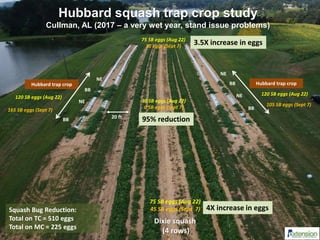
Hubbard squash trap crop study
Cullman, AL (2017 – a very wet year, stand issue problems)
Hubbard trap crop Hubbard trap crop
Dixie squash
(4 rows)
BB
NE
NE
BB
BB
NE
NE
BB
75 SB eggs (Aug 22)
30 eggs (Sept 7)
75 SB eggs (Aug 22)
45 SB eggs (Sept 7)
30 SB eggs (Aug 22)
0 SB eggs (Sept 7)
120 SB eggs (Aug 22)
165 SB eggs (Sept 7)
105 SB eggs (Sept 7)
Squash Bug Reduction:
Total on TC = 510 eggs
Total on MC = 225 eggs
20 ft
95% reduction
4X increase in eggs
3.5X increase in eggs
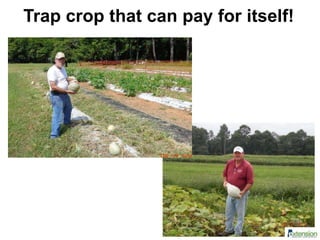
Hubbard squash: A marketable trap crop
Trap crop that can pay for itself!
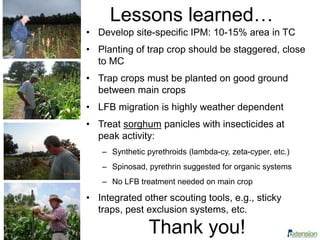
Lessons learned…
• Develop site-specific IPM: 10-15% area in TC
• Planting of trap crop should be staggered, close
to MC
• Trap crops must be planted on good ground
between main crops
• LFB migration is highly weather dependent
• Treat sorghum panicles with insecticides at
peak activity:
– Synthetic pyrethroids (lambda-cy, zeta-cyper, etc.)
– Spinosad, pyrethrin suggested for organic systems
– No LFB treatment needed on main crop
• Integrated other scouting tools, e.g., sticky
traps, pest exclusion systems, etc.
Thank you!

Trap crop research overview (2011-2017)

  • 1.
    Large-scale trap cropresearch and demonstrations to manage leaffooted bugs and squash bugs Dr. Ayanava Majumdar (Dr. A) Ext. Entomologist & State SARE Coordinator Auburn, AL 36849 Tel: (251) 331-8416 bugdoctor@auburn.edu www.aces.edu/vegetableipm
  • 2.
    • Boucher, T.J., and R. Durgy. 2004. Demonstrating a perimeter trap crop approach to pest management on summer squash in New England. Journal of Extension. 42(5): 5RIB2. • Mizel, III, R. F., T. C. Riddle, and A. S. Blount. 2008b. Trap cropping system to suppress stink bugs in the southern Coastal Plain. Proc. Fla. State Hort. Soc. 121: 377-382. • Tillman, P. G. 2006. Sorghum as a trap crop for Nezara viridula L. (Heteroptera: Pentatomidae) in cotton in the southern United States. Environ. Entomol. 35 (3): 771- 783. • Wszelaki, A., and S. Broughton. 2010. Trap crops, intercropping and companion planting. University of Tennessee Extension. Pub. W235F. • Majumdar, A., R. Akridge, C. Becker, A. Caylor, J. Pitts, and M. Reeves. 2012. Trap crops for leaffooted bug management in tomatoes. Journal of the NACAA. Vol. 5 (2). • Akotsen-Mensah, C., R. R. Balusu, J. Anikwe, and H. Y. Fadamiro. 2017. Evaluating potential trap crops for managing leaffooted (Hemiptera: Coreidae) and phytophagous stink bug (Hemiptera: Pentatomidae) species in peaches. Agricultural and Forest Entomology. 19: 332-340. References Cited – Trap Crops
  • 3.
  • 4.
    Trap Crop LearningModules www.aces.edu/vegetableipm Electronic curriculum (for self-paced learning) is under development as part of the Alabama Beginning Farms Project funded by USDA!
  • 5.
    Alabama IPM CommunicatorNewsletter Great source of information about crop production and educational events statewide. Sign up today! www.aces.edu/ipmcommunicator
  • 6.
    Fall armyworm, Spodopterafrugiperda Image: J. Obermeyer, Purdue Univ. Entomology Beet armyworm, S. exigua Image: Oklahoma State Univ. Extension Image: J. Capinera, Univ. of Florida Yellowstriped armyworm, S. ornithogalli Southern armyworm, S. eridania Image: J. Capinera, Univ. of Florida Corn earworm, Helicoverpa zea Image: A. Majumdar, ACES Tomato hornworm, Manduca quinquimaculata Image: A. Majumdar, ACES Cabbage looper, Trichoplusia ni Image: A. Majumdar, ACES Insect pests causing quantitative losses
  • 7.
    Brown stink bug (Euschistusservus) Bugguide.net Southern green stink bug (Nezara viridula) Bugguide.net Insect pests causing quantitative losses
  • 8.
    Major Pest onVegetables: Leaffooted Bugs Leptoglossus phyllopus Leptoglossus zonatus Leptoglossus gonagra Heavy fruit drop in eggplants and tomatoes (LFBs)
  • 9.
    Sucking insect pests:Leaffooted bugs Images: A. Majumdar, ACES
  • 10.
    Sustainable Pest ManagementPractices (NOP, 7CFR Section 205.206) Naturalenemyconservation Level 1 tactics: Systems-based practices (cultural practices, sanitation, crop rotation, trap crops) Level 2 tactics: Mechanical and physical practices (pest exclusion, manual removal) Level 3 tactics: Biorational & other materials (approved insecticides as last resort)
  • 11.
    Major Principle ofTrap Cropping • Insects have differential host preference • Insect may feed and reproduce in preferred host Main crop Trap crops
  • 12.
    Perimeter TC: • Pestsource unknown • Pest of limited mobility Trap cropping layout Trap crop Main crop Maincrop Maincrop Maincrop Maincrop Main crop Source Open field Openfield Open field Strip interplant TC: • Pest source unknown • Comparitively more mobile pests Source – Sink approach: • Pest source known • Less insect movement PEST SOURCE UNKNOWN PEST SOURCE KNOWN
  • 13.
    Trap cropping inpeaches (2010-2013) Akotsen-Mensah et al. (2017) Summer trap crops (May-Sept): • Peredovik sunflower (Helianthus anuus) • Brown top millet (Brachiaria ramose, Florida Brown) • Buckwheat (Fagopyrum sagittatum, Mancan) • Grain sorghum (Sorghum bicolor, Dekalb 54-00) • Pearl millet (Pennisetum glaucum, Tifleaf III) • Southern pea (Vigna unguiculata) Winter trap crops (Oct-May): • Oats (Avena sativa, Horizon) • Hairy vetch (Vicia villosa, Hairy) • Rye (Secale cereal, Wrens Abruzzi) • Triticale (Triticale hexaploid, Monark) • Wheat (Triticum aestivum, Pioneer 26r12) • Winter peas (Pisum sativum, Whistler) Major insect pests: • Leaffooted bugs (>70%) • Brown stink bugs • Green or southern green stink bugs
  • 14.
  • 15.
    Perimeter trap cropstudy (Brewton, AL, 2011 & 2012) Tomato main crop – Celebrity, Bellarosa (June 6, tomatoes 9 ft/2.7 m from sorghum) NK300 Sorghum trap crop (Planted May 23)
  • 16.
    0 3 14 4 32 7 1 1 2 1 4 9 3 1615 19 15-Jul 22-Jul 29-Jul 5-Aug 12-Aug 19-Aug 26-Aug 2-Sep 9-Sep 16-Sep 23-Sep NK300 (sorghum trap crop) Tomato (main crop) Tomato (1500 ft) Zeta-cypermethrin Lambda-cyhalothrin Numbers indicate leaffooted bugs (LFBs) on 20 heads of trap crops and 20 tomato plants for comparison purposes. Trap crops planted on May 23. Main crop planted on June 6. Trap crop treated with Mustang Max (zeta-cyper. @ 4 oz/A) on Aug. 12 and with Warrior (lambda-cyhalothrin) on Sep. 9. Perimeter trap cropping for leaffooted bug management (Brewton, AL, 2011) 86% LFB reduction between tomato plots No targeted spray of main crop for LFB needed
  • 17.
    Sorghum-sunflower mixed trapcrop (Clanton 2012) 8 ft/2.4 m Target insect: Leaffooted bugs •Sunflower variety Peredovik Type •Sorghum variety NK300 •TC planted two weeks ahead of tomatoes
  • 18.
    Sunflower (Peredovik) Sorghum (NK300) Main crop: Tomato (notin picture) Perimeter trap crop study (Clanton, AL, 2012) This is a good basic layout of trap crops with single varieties. Two rows of each trap crop provides good habitat for beneficial insects.
  • 19.
    TC as multi-speciesdefense barrier
  • 20.
    Sunflower TC ismore attractive for food and oviposition. Leaffooted bugs on sunflower Leptoglossus phyllopus feeding & oviposition on Peredovik sunflower trap crop, Clanton, AL 2012
  • 21.
    Sorghum TC ismore attractive for food and oviposition Leaffooted bugs on sorghum head Leptoglossus phyllopus feeding & oviposition on sorghum NK300 trap crop (Clanton and Mobile, AL 2012)
  • 22.
    Mixed trap croppingfor leaffooted bug management (Clanton, AL, 2012) 0 0 18 4 2 1 4 2 0 0 00 0 0 2 2 0 3 5 5 15 9 13 9 7 21-Jul 28-Jul 4-Aug 11-Aug18-Aug25-Aug 1-Sep 8-Sep 15-Sep 22-Sep 29-Sep 19 Numbers indicate leaffooted bugs (LFBs) on 20 heads of trap crops and 20 tomato plants for comparison purposes. Trap crops planted on May 16. Main crop planted on June 1. Trap crop treated with Mustang Max (zeta-cyper. @ 4 oz/A) on Sept. 5, 2012. Zeta-cypermethrin treatment at peak LFB activity in trap crop 78% LFB reduction 11 Peredovik Sunflower Tomato main crop NK-300 Sorghum Tomato (1500 ft)
  • 23.
    Perimeter trap croppingfor leaffooted bug management (Cullman, AL, 2012) 0 33 33 0 0 00 56 17 0 0 00 4 2 0 1 5 3 11 30 25 35 28 24-Jul 30-Aug 4-Sep 14-Sep 24-Sep 4-Oct NK300 (sorghum trap crop) Sunflower (trap crop) Tomato (main crop) Tomato (1500 ft) Numbers indicate leaffooted bugs (LFBs) on 40 heads of trap crops and 40 tomato plants for comparison purposes. Trap crops planted on June 18 & 27. Main crop planted on July 3. Trap crop treated with Mustang Max (zeta-cyper. @ 4 oz/A) on Sept. 7, 2012. Zeta-cypermethrin treatment at peak LFB activity in sorghum Over 90% LFB reduction No targeted spray of main crop
  • 24.
    Perimeter MIXED trapcrop study (Cullman, AL, 2013) Sunflower (Peredovik) Sorghum (NK300) Sorghum (DKB5400)
  • 25.
    Mixed trap croppingfor leaffooted bug management (Clanton, AL, 2013) 0 0 15 0 39 64 0 0 78 5 46 33 18 88 27 0 0 0 0 3 2 7 8 14 3 15 21 16 33 28 17-Jul 24-Jul 31-Jul 7-Aug 14-Aug 21-Aug 28-Aug 4-Sep 11-Sep 18-Sep 25-Sep 2-Oct DKB5400 (sorghum trap crop) NK300 (sorghum trap crop) Sunflower (near squash and watermelon) Tomato (main crop) Tomato (1500 ft) Numbers indicate leaffooted bugs (LFBs) on 40 heads of trap crops and 40 tomato plants for comparison purposes. Trap crops planted on May 30. Main crop (Bella Rosa tomato) planted on June 13. Trap crop treated with Mustang Max (zeta-cyper. @ 4 oz/A) on Aug 17and Sept 27, 2013. Zeta-cypermethrin 75% LFB reduction
  • 26.
    Staggered trap cropping(Clanton, 2017) Tomato (main crop) Red Defender, Red Bounty Sorghum/sunflower trap crops Sorghum/sunflower trap crops Plum orchard Plum orchard Planting dates: 19 May, 12 June Planting date: 9 June due constant rainfall Pheromone trap Planting dates: 19 May, 12 June
  • 27.
    Sunflower May 19 (Peredovik) Sorghum June12 (NK300) Main crop: Tomato Red Defender, Red Bounty Staggered trap cropping system for high pest pressure situation (Clanton, 2017) Sorghum May 19 (NK300) Target pest: Leaffooted bugs (Leptoglossus sp.) Sunflower June 12 (Peredovik) Planting dates: 19 May, 12 June Planting date: 9 June Pheromone trap Heavy rainfall year
  • 28.
    Staggered trap croppingfor leaffooted bug management (Clanton, AL, 2017) 5 9 21 53 36 1919 16 5 4 9 8 0 2 12 9 27 25 6 6 5 9 10 13 11 15 18 16 38 23 15-Aug 22-Aug 29-Aug 5-Sep 12-Sep 19-Sep 26-Sep 3-Oct 10-Oct 17-Oct Sorghum NK300 (19 May) Peredovik Sunflower (19 May) Sorghum NK300 (12 June) Peredovik Sunflower (12 June) Tomato (Main Crop) Tomato (1500 ft) >60 percent reduction in LFBs on tomato main crop (very wet year, late season outbreak) Numbers indicate leaffooted bugs (LFBs) on 20 heads of trap crops and 20 tomato plants for comparison purposes. NK300 sorghum and Peredovik sunflower trap crops planted on May 19 (two rows of each) and again on June 12 (two rows of each). Main crop (Red Defender and Red Bounty Tomatoes) planted on June 9.
  • 29.
    The trap cropdifference! Untreated check (2017 – normal year) Untreated check (2016 – drought year) Produce without the perimeter trap crops of sorghum/sunflower (50% or more loss in quality/marketability)
  • 30.
    Trap crops +insecticides = great crop! Radiant 5 oz (7DAT2) + staggered trap crops No significant LFB feeding in conventional plots Perimeter trap crops: Sorghum NK300, Peredovik sunflower Bt treatments (7DAT4) + staggered trap crops No significant LFB feeding in organic plots
  • 31.
    Conservation of naturalenemies Green lynx spiders Syrphid flies Assassin bug Praying mantid Trichopoda pennipes (Diptera: Tachinidae)
  • 32.
  • 33.
    Trap crop nearthe tree line to stop LFB migration
  • 34.
  • 35.
    Trap crop demonstrationin Fayetteville, GA (2016)
  • 36.
    Trap Crops inSquash Production
  • 37.
    Hubbard squash trapprotects yellow squash from insect pests! Hubbard trap crop (Cucurbita maxima) Hubbard trap crop (2 rows) Destiny yellow squash (Cucurbita pepo) Hubbard squash varieties: • Baby Blue (High Mowing Seeds) • New England (Heirloom Seeds) Baby Blue New England
  • 38.
    Perimeter squash trapcrop study (Cullman, 2016) Squash bugs were at OUTBREAK STATUS on Hubbard squash! August 2016
  • 39.
    Hubbard squash trap cropreduced squash bug eggs on yellow squash! 100 ft 100 ft Yellow squashHubbard squash Hubbard squash 100 ft 100 ft Cullman, AL (2016) 4,530 eggs from four TC rows 94% reduction in SB eggs 285 eggs 360 eggs 195 eggs 450 eggs 1.5X increase in eggs
  • 40.
    Hubbard squash trapcrop study Cullman, AL (2017 – a very wet year, stand issue problems) Hubbard trap crop Hubbard trap crop Dixie squash (4 rows) BB NE NE BB BB NE NE BB 75 SB eggs (Aug 22) 30 eggs (Sept 7) 75 SB eggs (Aug 22) 45 SB eggs (Sept 7) 30 SB eggs (Aug 22) 0 SB eggs (Sept 7) 120 SB eggs (Aug 22) 120 SB eggs (Aug 22) 165 SB eggs (Sept 7) 105 SB eggs (Sept 7) Squash Bug Reduction: Total on TC = 510 eggs Total on MC = 225 eggs 20 ft 95% reduction 4X increase in eggs 3.5X increase in eggs
  • 41.
    Hubbard squash: Amarketable trap crop
  • 42.
    Trap crop thatcan pay for itself!
  • 43.
    Lessons learned… • Developsite-specific IPM: 10-15% area in TC • Planting of trap crop should be staggered, close to MC • Trap crops must be planted on good ground between main crops • LFB migration is highly weather dependent • Treat sorghum panicles with insecticides at peak activity: – Synthetic pyrethroids (lambda-cy, zeta-cyper, etc.) – Spinosad, pyrethrin suggested for organic systems – No LFB treatment needed on main crop • Integrated other scouting tools, e.g., sticky traps, pest exclusion systems, etc. Thank you!

Editor's Notes

  • #10 Leaffooted bugs are closely related to the stink bugs. Large aggregations of leaffooted bugs may be seen on commercial vegetables that are surrounded by permanent fruit orchards. Many species of leaffooted bugs have been seen feeding on specialty crops; infestations are very difficult to control with home garden and organic insecticides. Producers and home gardeners are encouraged to checkout the Alabama Vegetable IPM website for short videos about trap crops and other tactics that can provide adequate crop improvement.
  • #11 There are three recommended IPM approaches for sustainable farming systems. Level 1 (systems based practices like trap crops) and Level 3 (use of biorational insecticides) have been discussed separately in the training modules on Alabama Vegetable IPM website. This video discusses the Level 2 IPM practices related to insect pest exclusion practices.