International Journal of Research in Advent Technology, Vol.3, No.12, December 2015
E-ISSN: 2321-9637
Available online at www.ijrat.org
18
A Review on Unmanned Aerial Vehicle (U.A.V.)
S. Mukesh Kosmeଵ
,Prakash Kumar Sen2
, Gopal Sahu3
1
Student,Mechanical Engineering, Kirodimal Institute of Technology, Raigarh (C.G.)
2,3
Faculty,Mechanical Engineering, Kirodimal Institute of Technology, Raigarh (C.G.)
Abstract- UAV-Unmanned Aerial Vehicle commonly known as Drones are extensively being used these years.
Today drones are used in various applications like Military, Commercial Cargo Transport, and 3-D Mapping etc. For
supporting the weight of the plane, and shock absorption functions, landing gear design is highly essential.
Unmanned aerial vehicles (UAV) are the logical successors to modern aircraft and advancements in automated
technology. The current generation of UAV’s is focused on wartime capabilities and reconnaissance, leaving an
existing market untapped by UAV technology: the commercial field. There are hundreds of applications for UAV
technology in the civilian market, from emergency response applications and media outlets to communication
technicians and horticulturalists. The vehicle can even act as a path guider in normal case and as a fire extinguisher
in emergency.
Keywords: UAV, Tx/Rx, module, Delta, mixing, bed.
1. INTRODUCTION
An unmanned aerial vehicle (UAV), called
a drone, is an aircraft without a human pilot on
board. Its flight is controlled either autonomously
by computers in the vehicle or under the remote
control of a pilot on the ground or in another
vehicle. UAV has many applications besides the
military applications with which "drones" became
most associated. Numerous civil aviation uses have
been developed, including aerial surveying of crops,
acrobatic aerial footage in filmmaking, search and
rescue operations, inspecting power lines and
pipelines, and counting wildlife, business
advertisements etc. A small scale UAV can be
designed using EPP foam, 2.4 GHz Transmitter &
Receiver (Tx/Rx), brushless motor, servos, Electronic
Speed Controller (ESC). The UAV makes use of
eleven (delta) mixing which reduces
the hardware requirements and complexity in
designing the model. The small scale UAV can be
used for commercial aerial surveillance, remote sensing,
scientific research, etc. There are many applications
for UAV technology in the military and civilian
market, from emergency response applications and
media outlets to communication technicians and
horticulturalists. It is a fact, though a very
simplistic fact, that unmanned aerial vehicles
(UAVs) are little aircraft, more or less. This means
that the UAVs follow the laws of thermodynamics
and the laws of physics. UAVs are even more
varied in their physical characteristics than are
manned aircraft. Their size widely varies with
wingspans ranging from 7 inches to 13 ft.Mini-
UAVs in the current field have wingspans ranging
from 21 inches to 10 ft. These UAVs can be
remotely controlled or can fly autonomously based
on pre-programmed flight plans. They carry a
variety of payloads including infrared cameras,
television cameras and jamming electronics. UAVs
are of growing interest to military operations, but
they can also be used in a variety of civilian
applications. Potential military applications for mini-
UAVs include local reconnaissance, target
identification, post-strike battle damage assessment,
electronic warfare (including radar jamming) and
combat search and rescue. Potential civilian
applications include monitoring traffic, inspection of
oil pipelines or power-lines, border surveillance,
killing harmful insects, surveying wildlife, real
estate photography, monitoring concentrations in
chemical spills and more.
2. REQUIRED HARDWARE
List of hardware
• 2.4 GHz Tx/Rx (Mode 2-Throttle on the left)
with delta mixing.
• 24x36 sheet of 30mm EPP Foam.
• Two Micro Metal Gear 9g servos.
• 2200kV brushless out-runner motor
• 2200mA 3S1P 30C Lithium polymer (LiPo)
battery.
International Journal of Research in Advent Technology, Vol.3, No.12, December 2015
E-ISSN: 2321-9637
Available online at www.ijrat.org
19
• 40A ESC with inbuilt battery eliminator
circuit(BEC)
• Propeller with diameter 6 inch and pitch 4 inch
(6x4).
• Balsa Wood.
3. COMPONENTS DESCRIPTION
3.1 Brushless Out-runner Motor
It is a synchronous motor that is powered by a DC
electric source via an integrated switching power
supply, which produces an AC electric signal to drive
the motor.
3.2 Electronic Speed Controller with Battery
Eliminator Circuit (ESC)
It is an electronic circuit with the purpose to vary
an electric motor's speed, its direction and possibly also
to act as a dynamic brake. The ESCs with built in BEC
are engineered so that the current to power the radio
system in the UAV is drawn from the Li-Po battery (that
also powers the brushless motor). This saves weight as
no separate battery is required to be installed to power
the radio.
3.3 Lithium Polymer battery
Lithium-ion polymer battery is a rechargeable
(secondary cell) battery. It is usually composed of
several identical secondary cells in parallel to increase
the discharge current capability, and is often available in
series configuration to increase the total available
voltage.
3.4 Servo
A servo is a specific type of motor and rotary
encoder combination that forms a servo mechanism.
The encoder provides position and usually speed
feedback, which by the use of a PID controller allow
more precise control of position and thus faster
achievement of a position.
3.5 GHz 4 Channel Tx/Rx
It performs the function of transmitting and
receiving communication signals used to control any
system. It has a range of 1 kilometer radius and comes
with 4 channels which are used to control different
components connected to the receiver (eg . servos,
speed controller, etc.).
4. SYSTEM DESCRIPTION
4.1 Airframe and Power Plant
A COTS Radio controlled model airplane kit is used as
the airframe/test platform. The airframe chosen for this
a Hangar 9, 1/4th scale Piper J3 Cub. See Figure 1(a).
The kit is available in Almost Ready-To-Fly condition,
an hence minimized assembly time. The scaled down
model of a popularly studied general aviation aircraft,
such as the Piper Cub, also simplexes dynamic
modeling of the platform. The Hangar 9 Piper Cub is
equipped with individually actuated control surfaces
that are used to simulate situations such as aircraft
damage and un modeled dynamics such as a change in
the moment coincident, Cm0 , due to lowering of both
ailerons simultaneously, thus acting as apes. These
capabilities make the UAV a good test platform for
adaptive control research. The power plant chosen for
this project is a Fuji Imvac BT43EI gasoline/oil
engine(Figure 2(b)
International Journal of Research in Advent Technology, Vol.3, No.12, December 2015
E-ISSN: 2321-9637
Available online at www.ijrat.org
20
4.2 Flight Computer
The light computer used is a FitPC2
minicomputer. The FitPC2 is finless Intel Atom based
Single board computer. This computer was chosen due
to its light and small form factor and
rugged construction. The Intel based architecture
enables the use of commercially used operating systems
such as Windows Embedded and VX Works. The
computer has six external USB ports, an HDMI display
port and uses a solid state memory (CF card) for data
storage. This makes the light computer less susceptible
to damage due to vibration. Power to the light computer
is provided Lithium Polymer batteries, capable of
delivering a charge of up to 2450 mAh at 14.8 volts. A
power board comprising of two voltage regulators, to
step down the voltage from 14.8 volts to 12 volts was
built.
4.3 Avionics/Sensor Suite
The UAV will uses a Micro strain 3DM-GX3
Attitude Heading Reference System for orientation,
angular and linear inertial force measurements. The
Micro strain 3DM-GX3 combines a tri-axial
accelerometer, tri-axial gyro, tri-axial magnetometer,
temperature sensors, and an on-board processor running
a sophisticated sensor fusion algorithm to provide static
and dynamic orientation and inertial measurements.
4.4 Software
Microsoft Windows XP Embedded will be
used as the onboard operating system. The Embedded
version of Windows provides real time operating system
capabilities, ensuring stable running of the control
system programs. The current configuration of the UAV
is running Windows XP Professional, for ease of
development .The UAV is developed around a central
Plug-and-Play software infrastructure, the Reaction
Architecture.
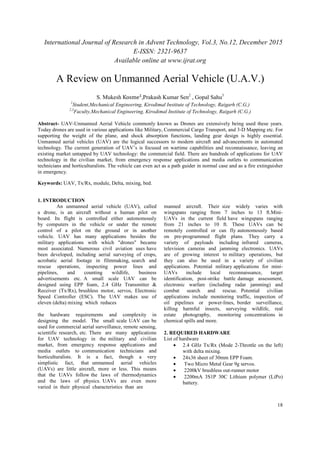
Figure 2:top view chassis frame
5. USES OF U.A.V.
5.1. Professional aerial surveying
UAS technologies are used worldwide as aerial
photogrammetric and LiDAR platforms.
5.2. Commercial and motion picture filmmaking
In the United States, FAA regulations generally
permit hobbyist drone use when they are flown below
400 feet, and within the UAV operator’s line of sight.
For commercial drone camerawork inside the United
States, industry sources state that usage is largely at the
de facto consent – or benign neglect – of local law
enforcement. Use of UAVs for filmmaking is generally
easier on large private lots or in rural and exurban areas
with fewer space concerns. In certain localities such as
Los Angeles and New York, authorities have actively
interceded to shut down drone filmmaking efforts due to
concerns driven by safety or terrorism.Drones were used
in the 2014 Winter Olympics in Sochi for filming skiing
and snowboarding events. Some advantages of using
unmanned aerial vehicles in sports are that they allow
video to get closer to the athletes, and they are more
flexible than cable-suspended camera systems
5.3. Search and rescue
UAVs were used in search and rescue after
hurricanes struck Louisiana and Texas in 2008.
Predators, operating between 18,000 and 29,000 feet
above sea level, performed search and rescue and
damage assessment. Payloads carried were an optical
sensor and a synthetic aperture radar. The latter can
provide images through clouds, rain, or fog, and in
daytime or nighttime conditions, all in real time. Photos
taken before and after the storm are compared, and a
computer highlights areas of damage. Micro UAVs,
such as the Aeryon Scout, have been used to perform
search and rescue activities on a smaller scale, such as
International Journal of Research in Advent Technology, Vol.3, No.12, December 2015
the search for missing persons UAVs have been tested
as airborne lifeguards, locating distressed swimmers
using thermal cameras and dropping
swimmers.
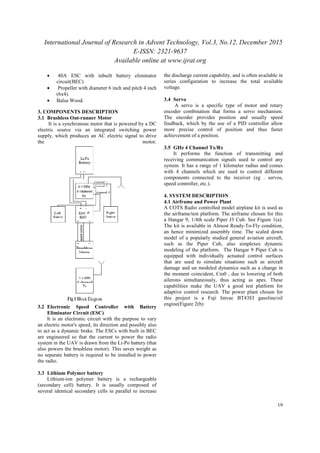
Figure 3:uas 3.1 octocopter
5.4. Demining
The Space Assets for Demining Assistance
program from the European Space Agency aims to
improve the socioeconomic impact of land release
activities in mine actionIt is developing and has tested
UAV technology for demining in Bosnia
5.5. Scientific research
Unmanned aircraft are especially useful in
penetrating areas that may be too dangerous for manned
aircraft. The U.S. National Oceanic and Atmospheric
Administration began using the Aerosonde unmanned
aircraft system in 2006 as a hurricane hunter. The 35
pound system can fly into a hurricane and communicate
near-real-time data directly to the National Hurricane
Center. Beyond the standard barometric pressure and
temperature data typically culled from manned
hurricane hunters, the Aerosonde system provides
measurements from closer to the water’s surface than
previously captured. NASA later began using the
Northrop Grumman RQ-4 Global Hawk for e
hurricane measurements.
International Journal of Research in Advent Technology, Vol.3, No.12, December 2015
E-ISSN: 2321-9637
Available online at www.ijrat.org
UAVs have been tested
as airborne lifeguards, locating distressed swimmers
using thermal cameras and dropping life preservers to
:uas 3.1 octocopter
Demining Assistance
program from the European Space Agency aims to
improve the socioeconomic impact of land release
activities in mine actionIt is developing and has tested
UAV technology for demining in Bosnia-Herzegovina.
Unmanned aircraft are especially useful in
penetrating areas that may be too dangerous for manned
aircraft. The U.S. National Oceanic and Atmospheric
Administration began using the Aerosonde unmanned
aircraft system in 2006 as a hurricane hunter. The 35-
und system can fly into a hurricane and communicate
time data directly to the National Hurricane
Center. Beyond the standard barometric pressure and
temperature data typically culled from manned
hurricane hunters, the Aerosonde system provides
asurements from closer to the water’s surface than
previously captured. NASA later began using the
4 Global Hawk for extended
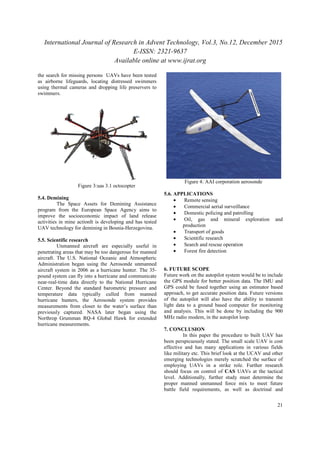
Figure 4: AAI corporation
5.6. APPLICATIONS
• Remote sensing
• Commercial aerial surveillance
• Domestic policing and patrolling
• Oil, gas and mineral exploration and
production
• Transport of goods
• Scientific research
• Search and rescue operation
• Forest fire detection
6. FUTURE SCOPE
Future work on the autopilot system would be to include
the GPS module for better position data. The IMU and
GPS could be fused together using an estimator based
approach, to get accurate position data. Future versions
of the autopilot will also have the a
light data to a ground based computer for monitoring
and analysis. This will be done by including the 900
MHz radio modem, in the autopilot loop.
7. CONCLUSION
In this paper the procedure to built UAV has
been perspicuously stated. The
effective and has many applications in various fields
like military etc. This brief look at the UCAV and other
emerging technologies merely scratched the surface of
employing UAVs in a strike role. Further research
should focus on control of CAS
level. Additionally, further study must determine the
proper manned unmanned force mix to meet future
battle field requirements, as well as doctrinal and
International Journal of Research in Advent Technology, Vol.3, No.12, December 2015
21
corporation aerosonde
erial surveillance
Domestic policing and patrolling
Oil, gas and mineral exploration and
Search and rescue operation
Forest fire detection
Future work on the autopilot system would be to include
the GPS module for better position data. The IMU and
GPS could be fused together using an estimator based
approach, to get accurate position data. Future versions
of the autopilot will also have the ability to transmit
data to a ground based computer for monitoring
and analysis. This will be done by including the 900
MHz radio modem, in the autopilot loop.
In this paper the procedure to built UAV has
been perspicuously stated. The small scale UAV is cost
effective and has many applications in various fields
This brief look at the UCAV and other
emerging technologies merely scratched the surface of
employing UAVs in a strike role. Further research
CAS UAVs at the tactical
level. Additionally, further study must determine the
proper manned unmanned force mix to meet future
battle field requirements, as well as doctrinal and
International Journal of Research in Advent Technology, Vol.3, No.12, December 2015
E-ISSN: 2321-9637
Available online at www.ijrat.org
22
operational considerations for employing UAVs in civil
airspace and in concert with Air Expeditionary Forces.
REFERENCES
[1]Mr. Prithvishmamtora, Mr.Sahil ,Mr.Vaibhav shah,
“Unmanned aerial vehicle(UAV),IJEEET,volume-
4,Issue-5,sept-oct,2013,pp.187-191
[2] Cambone S. A., Krieg K., Pace P., and II L. W.
“Unmanned Aircraft Systems Roadmap 2005-
2030”. Technical Report, Office of the Secretary of
Defense, 2005
[3]. Abhishek S H and Dr. C Anil Kumar, “A Review of
Unmanned Aerial Vehicle and theirMorphing
Concepts Evolution and Implications for the
Present Day Technology”,
[4] Don won Jung. Hierarchical Path Planning and
Control of a Small Fixed-Wing uav: theory and
experimental validation. phd thesis, december,
2007.
[5] parth kumar,design of the shelf components
capstone project for me 5643; mechatronics
[6] http://www.microstrain.com/3dm-gx3-25.aspx.
[7] corey ippolito. reflection user manual.
[8]www.wikepedia.org/unmannedarialvehical

Paper id 312201505

  • 1.
    International Journal ofResearch in Advent Technology, Vol.3, No.12, December 2015 E-ISSN: 2321-9637 Available online at www.ijrat.org 18 A Review on Unmanned Aerial Vehicle (U.A.V.) S. Mukesh Kosmeଵ ,Prakash Kumar Sen2 , Gopal Sahu3 1 Student,Mechanical Engineering, Kirodimal Institute of Technology, Raigarh (C.G.) 2,3 Faculty,Mechanical Engineering, Kirodimal Institute of Technology, Raigarh (C.G.) Abstract- UAV-Unmanned Aerial Vehicle commonly known as Drones are extensively being used these years. Today drones are used in various applications like Military, Commercial Cargo Transport, and 3-D Mapping etc. For supporting the weight of the plane, and shock absorption functions, landing gear design is highly essential. Unmanned aerial vehicles (UAV) are the logical successors to modern aircraft and advancements in automated technology. The current generation of UAV’s is focused on wartime capabilities and reconnaissance, leaving an existing market untapped by UAV technology: the commercial field. There are hundreds of applications for UAV technology in the civilian market, from emergency response applications and media outlets to communication technicians and horticulturalists. The vehicle can even act as a path guider in normal case and as a fire extinguisher in emergency. Keywords: UAV, Tx/Rx, module, Delta, mixing, bed. 1. INTRODUCTION An unmanned aerial vehicle (UAV), called a drone, is an aircraft without a human pilot on board. Its flight is controlled either autonomously by computers in the vehicle or under the remote control of a pilot on the ground or in another vehicle. UAV has many applications besides the military applications with which "drones" became most associated. Numerous civil aviation uses have been developed, including aerial surveying of crops, acrobatic aerial footage in filmmaking, search and rescue operations, inspecting power lines and pipelines, and counting wildlife, business advertisements etc. A small scale UAV can be designed using EPP foam, 2.4 GHz Transmitter & Receiver (Tx/Rx), brushless motor, servos, Electronic Speed Controller (ESC). The UAV makes use of eleven (delta) mixing which reduces the hardware requirements and complexity in designing the model. The small scale UAV can be used for commercial aerial surveillance, remote sensing, scientific research, etc. There are many applications for UAV technology in the military and civilian market, from emergency response applications and media outlets to communication technicians and horticulturalists. It is a fact, though a very simplistic fact, that unmanned aerial vehicles (UAVs) are little aircraft, more or less. This means that the UAVs follow the laws of thermodynamics and the laws of physics. UAVs are even more varied in their physical characteristics than are manned aircraft. Their size widely varies with wingspans ranging from 7 inches to 13 ft.Mini- UAVs in the current field have wingspans ranging from 21 inches to 10 ft. These UAVs can be remotely controlled or can fly autonomously based on pre-programmed flight plans. They carry a variety of payloads including infrared cameras, television cameras and jamming electronics. UAVs are of growing interest to military operations, but they can also be used in a variety of civilian applications. Potential military applications for mini- UAVs include local reconnaissance, target identification, post-strike battle damage assessment, electronic warfare (including radar jamming) and combat search and rescue. Potential civilian applications include monitoring traffic, inspection of oil pipelines or power-lines, border surveillance, killing harmful insects, surveying wildlife, real estate photography, monitoring concentrations in chemical spills and more. 2. REQUIRED HARDWARE List of hardware • 2.4 GHz Tx/Rx (Mode 2-Throttle on the left) with delta mixing. • 24x36 sheet of 30mm EPP Foam. • Two Micro Metal Gear 9g servos. • 2200kV brushless out-runner motor • 2200mA 3S1P 30C Lithium polymer (LiPo) battery.
  • 2.
    International Journal ofResearch in Advent Technology, Vol.3, No.12, December 2015 E-ISSN: 2321-9637 Available online at www.ijrat.org 19 • 40A ESC with inbuilt battery eliminator circuit(BEC) • Propeller with diameter 6 inch and pitch 4 inch (6x4). • Balsa Wood. 3. COMPONENTS DESCRIPTION 3.1 Brushless Out-runner Motor It is a synchronous motor that is powered by a DC electric source via an integrated switching power supply, which produces an AC electric signal to drive the motor. 3.2 Electronic Speed Controller with Battery Eliminator Circuit (ESC) It is an electronic circuit with the purpose to vary an electric motor's speed, its direction and possibly also to act as a dynamic brake. The ESCs with built in BEC are engineered so that the current to power the radio system in the UAV is drawn from the Li-Po battery (that also powers the brushless motor). This saves weight as no separate battery is required to be installed to power the radio. 3.3 Lithium Polymer battery Lithium-ion polymer battery is a rechargeable (secondary cell) battery. It is usually composed of several identical secondary cells in parallel to increase the discharge current capability, and is often available in series configuration to increase the total available voltage. 3.4 Servo A servo is a specific type of motor and rotary encoder combination that forms a servo mechanism. The encoder provides position and usually speed feedback, which by the use of a PID controller allow more precise control of position and thus faster achievement of a position. 3.5 GHz 4 Channel Tx/Rx It performs the function of transmitting and receiving communication signals used to control any system. It has a range of 1 kilometer radius and comes with 4 channels which are used to control different components connected to the receiver (eg . servos, speed controller, etc.). 4. SYSTEM DESCRIPTION 4.1 Airframe and Power Plant A COTS Radio controlled model airplane kit is used as the airframe/test platform. The airframe chosen for this a Hangar 9, 1/4th scale Piper J3 Cub. See Figure 1(a). The kit is available in Almost Ready-To-Fly condition, an hence minimized assembly time. The scaled down model of a popularly studied general aviation aircraft, such as the Piper Cub, also simplexes dynamic modeling of the platform. The Hangar 9 Piper Cub is equipped with individually actuated control surfaces that are used to simulate situations such as aircraft damage and un modeled dynamics such as a change in the moment coincident, Cm0 , due to lowering of both ailerons simultaneously, thus acting as apes. These capabilities make the UAV a good test platform for adaptive control research. The power plant chosen for this project is a Fuji Imvac BT43EI gasoline/oil engine(Figure 2(b)
  • 3.
    International Journal ofResearch in Advent Technology, Vol.3, No.12, December 2015 E-ISSN: 2321-9637 Available online at www.ijrat.org 20 4.2 Flight Computer The light computer used is a FitPC2 minicomputer. The FitPC2 is finless Intel Atom based Single board computer. This computer was chosen due to its light and small form factor and rugged construction. The Intel based architecture enables the use of commercially used operating systems such as Windows Embedded and VX Works. The computer has six external USB ports, an HDMI display port and uses a solid state memory (CF card) for data storage. This makes the light computer less susceptible to damage due to vibration. Power to the light computer is provided Lithium Polymer batteries, capable of delivering a charge of up to 2450 mAh at 14.8 volts. A power board comprising of two voltage regulators, to step down the voltage from 14.8 volts to 12 volts was built. 4.3 Avionics/Sensor Suite The UAV will uses a Micro strain 3DM-GX3 Attitude Heading Reference System for orientation, angular and linear inertial force measurements. The Micro strain 3DM-GX3 combines a tri-axial accelerometer, tri-axial gyro, tri-axial magnetometer, temperature sensors, and an on-board processor running a sophisticated sensor fusion algorithm to provide static and dynamic orientation and inertial measurements. 4.4 Software Microsoft Windows XP Embedded will be used as the onboard operating system. The Embedded version of Windows provides real time operating system capabilities, ensuring stable running of the control system programs. The current configuration of the UAV is running Windows XP Professional, for ease of development .The UAV is developed around a central Plug-and-Play software infrastructure, the Reaction Architecture. Figure 2:top view chassis frame 5. USES OF U.A.V. 5.1. Professional aerial surveying UAS technologies are used worldwide as aerial photogrammetric and LiDAR platforms. 5.2. Commercial and motion picture filmmaking In the United States, FAA regulations generally permit hobbyist drone use when they are flown below 400 feet, and within the UAV operator’s line of sight. For commercial drone camerawork inside the United States, industry sources state that usage is largely at the de facto consent – or benign neglect – of local law enforcement. Use of UAVs for filmmaking is generally easier on large private lots or in rural and exurban areas with fewer space concerns. In certain localities such as Los Angeles and New York, authorities have actively interceded to shut down drone filmmaking efforts due to concerns driven by safety or terrorism.Drones were used in the 2014 Winter Olympics in Sochi for filming skiing and snowboarding events. Some advantages of using unmanned aerial vehicles in sports are that they allow video to get closer to the athletes, and they are more flexible than cable-suspended camera systems 5.3. Search and rescue UAVs were used in search and rescue after hurricanes struck Louisiana and Texas in 2008. Predators, operating between 18,000 and 29,000 feet above sea level, performed search and rescue and damage assessment. Payloads carried were an optical sensor and a synthetic aperture radar. The latter can provide images through clouds, rain, or fog, and in daytime or nighttime conditions, all in real time. Photos taken before and after the storm are compared, and a computer highlights areas of damage. Micro UAVs, such as the Aeryon Scout, have been used to perform search and rescue activities on a smaller scale, such as
  • 4.
    International Journal ofResearch in Advent Technology, Vol.3, No.12, December 2015 the search for missing persons UAVs have been tested as airborne lifeguards, locating distressed swimmers using thermal cameras and dropping swimmers. Figure 3:uas 3.1 octocopter 5.4. Demining The Space Assets for Demining Assistance program from the European Space Agency aims to improve the socioeconomic impact of land release activities in mine actionIt is developing and has tested UAV technology for demining in Bosnia 5.5. Scientific research Unmanned aircraft are especially useful in penetrating areas that may be too dangerous for manned aircraft. The U.S. National Oceanic and Atmospheric Administration began using the Aerosonde unmanned aircraft system in 2006 as a hurricane hunter. The 35 pound system can fly into a hurricane and communicate near-real-time data directly to the National Hurricane Center. Beyond the standard barometric pressure and temperature data typically culled from manned hurricane hunters, the Aerosonde system provides measurements from closer to the water’s surface than previously captured. NASA later began using the Northrop Grumman RQ-4 Global Hawk for e hurricane measurements. International Journal of Research in Advent Technology, Vol.3, No.12, December 2015 E-ISSN: 2321-9637 Available online at www.ijrat.org UAVs have been tested as airborne lifeguards, locating distressed swimmers using thermal cameras and dropping life preservers to :uas 3.1 octocopter Demining Assistance program from the European Space Agency aims to improve the socioeconomic impact of land release activities in mine actionIt is developing and has tested UAV technology for demining in Bosnia-Herzegovina. Unmanned aircraft are especially useful in penetrating areas that may be too dangerous for manned aircraft. The U.S. National Oceanic and Atmospheric Administration began using the Aerosonde unmanned aircraft system in 2006 as a hurricane hunter. The 35- und system can fly into a hurricane and communicate time data directly to the National Hurricane Center. Beyond the standard barometric pressure and temperature data typically culled from manned hurricane hunters, the Aerosonde system provides asurements from closer to the water’s surface than previously captured. NASA later began using the 4 Global Hawk for extended Figure 4: AAI corporation 5.6. APPLICATIONS • Remote sensing • Commercial aerial surveillance • Domestic policing and patrolling • Oil, gas and mineral exploration and production • Transport of goods • Scientific research • Search and rescue operation • Forest fire detection 6. FUTURE SCOPE Future work on the autopilot system would be to include the GPS module for better position data. The IMU and GPS could be fused together using an estimator based approach, to get accurate position data. Future versions of the autopilot will also have the a light data to a ground based computer for monitoring and analysis. This will be done by including the 900 MHz radio modem, in the autopilot loop. 7. CONCLUSION In this paper the procedure to built UAV has been perspicuously stated. The effective and has many applications in various fields like military etc. This brief look at the UCAV and other emerging technologies merely scratched the surface of employing UAVs in a strike role. Further research should focus on control of CAS level. Additionally, further study must determine the proper manned unmanned force mix to meet future battle field requirements, as well as doctrinal and International Journal of Research in Advent Technology, Vol.3, No.12, December 2015 21 corporation aerosonde erial surveillance Domestic policing and patrolling Oil, gas and mineral exploration and Search and rescue operation Forest fire detection Future work on the autopilot system would be to include the GPS module for better position data. The IMU and GPS could be fused together using an estimator based approach, to get accurate position data. Future versions of the autopilot will also have the ability to transmit data to a ground based computer for monitoring and analysis. This will be done by including the 900 MHz radio modem, in the autopilot loop. In this paper the procedure to built UAV has been perspicuously stated. The small scale UAV is cost effective and has many applications in various fields This brief look at the UCAV and other emerging technologies merely scratched the surface of employing UAVs in a strike role. Further research CAS UAVs at the tactical level. Additionally, further study must determine the proper manned unmanned force mix to meet future battle field requirements, as well as doctrinal and
  • 5.
    International Journal ofResearch in Advent Technology, Vol.3, No.12, December 2015 E-ISSN: 2321-9637 Available online at www.ijrat.org 22 operational considerations for employing UAVs in civil airspace and in concert with Air Expeditionary Forces. REFERENCES [1]Mr. Prithvishmamtora, Mr.Sahil ,Mr.Vaibhav shah, “Unmanned aerial vehicle(UAV),IJEEET,volume- 4,Issue-5,sept-oct,2013,pp.187-191 [2] Cambone S. A., Krieg K., Pace P., and II L. W. “Unmanned Aircraft Systems Roadmap 2005- 2030”. Technical Report, Office of the Secretary of Defense, 2005 [3]. Abhishek S H and Dr. C Anil Kumar, “A Review of Unmanned Aerial Vehicle and theirMorphing Concepts Evolution and Implications for the Present Day Technology”, [4] Don won Jung. Hierarchical Path Planning and Control of a Small Fixed-Wing uav: theory and experimental validation. phd thesis, december, 2007. [5] parth kumar,design of the shelf components capstone project for me 5643; mechatronics [6] http://www.microstrain.com/3dm-gx3-25.aspx. [7] corey ippolito. reflection user manual. [8]www.wikepedia.org/unmannedarialvehical