Infiltration & embedding
1. To remove the clearing agent
within the tissue by the process
of diffusion.
2. To infiltrate the tissue space with
the embedding media (molten
wax).
Principles of Infiltration &
embedding
After cooling in room temperature,
the molten wax is solidified to
provide support for cutting into
thin section.
Ideal impregnating medium:
• Miscible with clearing agent
• Liquid in higher temperature (30–
60 °C) and solid in room
temperature
• Homogenous and stable
• Non-toxic and cheap
• Transparent
• Fit for sectioning the tissue
The time duration and the number of changes
required for the impregnation in tissue depends
on:
1.Size of tissue:
• Thick large tissue;
• Takes more time to impregnate
with the wax.
• Contains more clearing agent to
remove.
2. Type of tissue:
• Hard tissue takes more time
for embedding than soft tissue.
• Hard tissue  bone and
cartilage.
3. Type of clearing
agent:
• Xylene and toluene are easy
to remove than cedar wood
oil.
4. Type of processing:
•Vacuum embedding
enhances impregnation.
Different impregnating
medium
Characteristics:
• Hydrocarbon
• Produced as by-product during
refining of crude petroleum.
• Non-toxic & inexpensive.
Milting point:
• Varies from 39 °C – 70 °C.
• Soft Paraffin wax  Low melting
point
• Hard Paraffin wax  High
melting point
The best for laboratory use:
• Paraffin wax with melting point
60 °C.
Impregnation time:
• Total 3–4 h’ time in paraffin
wax is sufficient for
impregnation of tissue by wax.
Advantages of paraffin
wax:
• Tissue block can be stored for
long duration.
• Non-toxic.
• Cheap.
• Safe.
Disadvantages of paraffin wax:
• Cause tissue shrinkage and
hardening (in case of prolonged
impregnation).
• Takes long duration for the
impregnation of the bone and eye.
Additives & modification
of paraffin wax:
1.Stearic acid
2.Phenanthrene
3.0.5% Ceresin
1.To increase hardness:
• Add stearic acid
2. Reduction of melting point:
• Add phenanthrene
3. Improving adhesiveness
with tissue and wax:
• Add 0.5% ceresin
Dimethyl sulphoxide (DMSO)
• The addition of amount of DMSO in
paraffin wax:
1. Reduces the infiltration time of
the wax.
2. Removes the residual clearing
agent.
3. Produces a homogenous matrix
and better support.
1. Manual processor
• Manual tissue processing is done only in
a small laboratory with a handful number
of tissue.
2. Automated processor
• The basic principle of tissue processor is
to transfer the tissue in different fluid for a
specified time in a desired environment.
• widely used in laboratories.
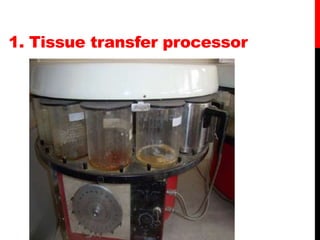
1. Tissue transfer processor
• Specimens are transferred
from container to container.
1. The tissue is submerged in a
container for a particular
time.
2. Then transferred to the next
container automatically.
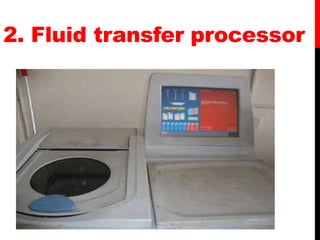
2. Fluid transfer processor
• Completely closed processor.
1. The tissue is kept in the container,
and the container is periodically
filled with fluid.
2. Then the fluid is pumped out from
the container.
3. It is again filled with the fluid
required for the next step.
Advantages of fluid transfer
processor:
1. Vacuum pressure makes the
system faster and efficient.
2. No tissue drying.
• It is closed system.
1.The tissue should be optimum.
• for good penetration of fluid.
2.The fluid level should be always
higher than the tissue level.
3.The tissue basket and cassettes
should be clean.
• any spillage of wax should be
cleaned.
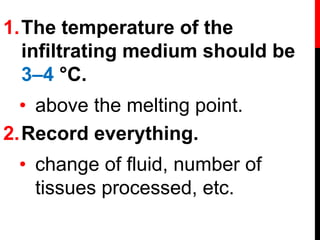
1.The temperature of the
infiltrating medium should be
3–4 °C.
• above the melting point.
2.Record everything.
• change of fluid, number of
tissues processed, etc.
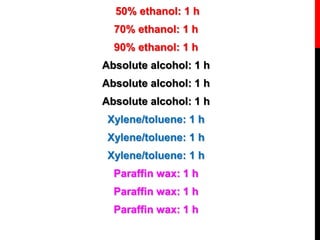
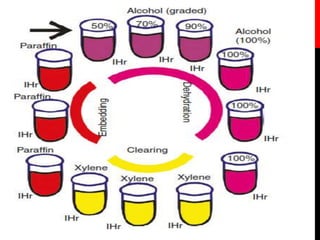
50% ethanol: 1 h
70% ethanol: 1 h
90% ethanol: 1 h
Absolute alcohol: 1 h
Xylene/toluene: 1 h
Xylene/toluene: 1 h
Xylene/toluene: 1 h
Paraffin wax: 1 h
Paraffin wax: 1 h
Paraffin wax: 1 h
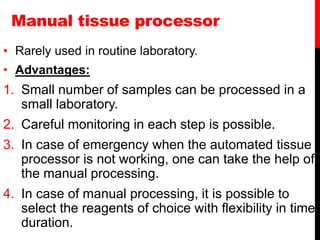
Manual tissue processor
• Rarely used in routine laboratory.
• Advantages:
1. Small number of samples can be processed in a
small laboratory.
2. Careful monitoring in each step is possible.
3. In case of emergency when the automated tissue
processor is not working, one can take the help of
the manual processing.
4. In case of manual processing, it is possible to
select the reagents of choice with flexibility in time
duration.
Disadvantages of manual
processing
• Inconvenient for processing/
exhausted.
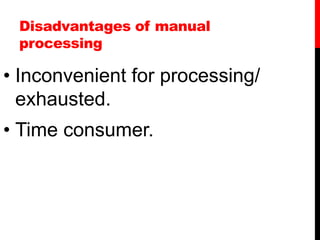
• Time consumer.
Microwave processing
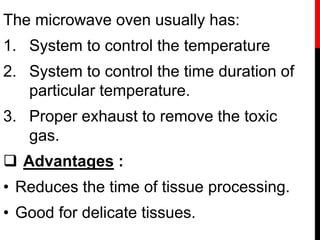
The microwave oven usually has:
1. System to control the temperature
2. System to control the time duration of
particular temperature.
3. Proper exhaust to remove the toxic
gas.
 Advantages :
• Reduces the time of tissue processing.
• Good for delicate tissues.
1. Size of the tissue sample:
• The smaller the size of the tissue is the
best for infiltration of the embedding
medium.
• Optimum thickness : 3–4 mm
.
2. Agitation:
Gently agitated is good.
Too rapid agitation causes damage to
the soft and delicate tissue.
3. Heat:
 Heat is good (45°C)
• Increases the rate of penetration of
the fluid within the tissue,
 Low temperature is not good.
• Disturb the whole process.
 Overheating is bad.
• It may produce hard and brittle tissue.
4. Viscosity:
• The viscosity of the embedding
media.
 Higher viscosity of the medium 
not good
• lowers the penetration rate in the
tissue.
How to reduces
the viscosity??
Heat reduces the viscosity of
the medium and helps in better
penetration
5. Vacuum:
• Vacuum = Negative pressure
1. Vacuum helps to remove the entrapped
air from the tissue.
• Enhances the penetration of fluid
within the tissue.
2. Increases the volatility of the clearing
agent.
• helps to remove the fluid from the
tissue.
BOOKS:
"Basic and Advanced Laboratory Techniques in
Histopathology and Cytology" by Pranab Dey

Lecture (6)tissue processing methods

  • 2.
  • 3.
    1. To removethe clearing agent within the tissue by the process of diffusion. 2. To infiltrate the tissue space with the embedding media (molten wax). Principles of Infiltration & embedding
  • 4.
    After cooling inroom temperature, the molten wax is solidified to provide support for cutting into thin section.
  • 5.
    Ideal impregnating medium: •Miscible with clearing agent • Liquid in higher temperature (30– 60 °C) and solid in room temperature • Homogenous and stable • Non-toxic and cheap • Transparent • Fit for sectioning the tissue
  • 6.
    The time durationand the number of changes required for the impregnation in tissue depends on: 1.Size of tissue: • Thick large tissue; • Takes more time to impregnate with the wax. • Contains more clearing agent to remove.
  • 7.
    2. Type oftissue: • Hard tissue takes more time for embedding than soft tissue. • Hard tissue  bone and cartilage.
  • 8.
    3. Type ofclearing agent: • Xylene and toluene are easy to remove than cedar wood oil.
  • 9.
    4. Type ofprocessing: •Vacuum embedding enhances impregnation.
  • 10.
  • 12.
    Characteristics: • Hydrocarbon • Producedas by-product during refining of crude petroleum. • Non-toxic & inexpensive.
  • 13.
    Milting point: • Variesfrom 39 °C – 70 °C. • Soft Paraffin wax  Low melting point • Hard Paraffin wax  High melting point
  • 14.
    The best forlaboratory use: • Paraffin wax with melting point 60 °C. Impregnation time: • Total 3–4 h’ time in paraffin wax is sufficient for impregnation of tissue by wax.
  • 15.
    Advantages of paraffin wax: •Tissue block can be stored for long duration. • Non-toxic. • Cheap. • Safe.
  • 16.
    Disadvantages of paraffinwax: • Cause tissue shrinkage and hardening (in case of prolonged impregnation). • Takes long duration for the impregnation of the bone and eye.
  • 17.
  • 18.
  • 19.
    1.To increase hardness: •Add stearic acid 2. Reduction of melting point: • Add phenanthrene 3. Improving adhesiveness with tissue and wax: • Add 0.5% ceresin
  • 21.
    Dimethyl sulphoxide (DMSO) •The addition of amount of DMSO in paraffin wax: 1. Reduces the infiltration time of the wax. 2. Removes the residual clearing agent. 3. Produces a homogenous matrix and better support.
  • 23.
    1. Manual processor •Manual tissue processing is done only in a small laboratory with a handful number of tissue. 2. Automated processor • The basic principle of tissue processor is to transfer the tissue in different fluid for a specified time in a desired environment. • widely used in laboratories.
  • 25.
  • 26.
    • Specimens aretransferred from container to container. 1. The tissue is submerged in a container for a particular time. 2. Then transferred to the next container automatically.
  • 27.
  • 28.
    • Completely closedprocessor. 1. The tissue is kept in the container, and the container is periodically filled with fluid. 2. Then the fluid is pumped out from the container. 3. It is again filled with the fluid required for the next step.
  • 29.
    Advantages of fluidtransfer processor: 1. Vacuum pressure makes the system faster and efficient. 2. No tissue drying. • It is closed system.
  • 31.
    1.The tissue shouldbe optimum. • for good penetration of fluid. 2.The fluid level should be always higher than the tissue level. 3.The tissue basket and cassettes should be clean. • any spillage of wax should be cleaned.
  • 32.
    1.The temperature ofthe infiltrating medium should be 3–4 °C. • above the melting point. 2.Record everything. • change of fluid, number of tissues processed, etc.
  • 34.
    50% ethanol: 1h 70% ethanol: 1 h 90% ethanol: 1 h Absolute alcohol: 1 h Absolute alcohol: 1 h Absolute alcohol: 1 h Xylene/toluene: 1 h Xylene/toluene: 1 h Xylene/toluene: 1 h Paraffin wax: 1 h Paraffin wax: 1 h Paraffin wax: 1 h
  • 36.
    Manual tissue processor •Rarely used in routine laboratory. • Advantages: 1. Small number of samples can be processed in a small laboratory. 2. Careful monitoring in each step is possible. 3. In case of emergency when the automated tissue processor is not working, one can take the help of the manual processing. 4. In case of manual processing, it is possible to select the reagents of choice with flexibility in time duration.
  • 37.
    Disadvantages of manual processing •Inconvenient for processing/ exhausted. • Time consumer.
  • 38.
  • 39.
    The microwave ovenusually has: 1. System to control the temperature 2. System to control the time duration of particular temperature. 3. Proper exhaust to remove the toxic gas.  Advantages : • Reduces the time of tissue processing. • Good for delicate tissues.
  • 41.
    1. Size ofthe tissue sample: • The smaller the size of the tissue is the best for infiltration of the embedding medium. • Optimum thickness : 3–4 mm .
  • 42.
    2. Agitation: Gently agitatedis good. Too rapid agitation causes damage to the soft and delicate tissue.
  • 43.
    3. Heat:  Heatis good (45°C) • Increases the rate of penetration of the fluid within the tissue,  Low temperature is not good. • Disturb the whole process.  Overheating is bad. • It may produce hard and brittle tissue.
  • 44.
    4. Viscosity: • Theviscosity of the embedding media.  Higher viscosity of the medium  not good • lowers the penetration rate in the tissue.
  • 45.
    How to reduces theviscosity??
  • 46.
    Heat reduces theviscosity of the medium and helps in better penetration
  • 47.
    5. Vacuum: • Vacuum= Negative pressure 1. Vacuum helps to remove the entrapped air from the tissue. • Enhances the penetration of fluid within the tissue. 2. Increases the volatility of the clearing agent. • helps to remove the fluid from the tissue.
  • 48.
    BOOKS: "Basic and AdvancedLaboratory Techniques in Histopathology and Cytology" by Pranab Dey