STEPS OF TISSUE
PROCESSING
DR.R.VENKATESH
PATHOLOGY PG 1ST
YEAR
MMCHRI
AIMS AND PRINCIPLE
•Aim: The basic aim is to provide sufficient
rigidity so it can cut into thin section for
microscopic study.
•Principle: Is to remove the water within the
tissue and impregnated with another
medium.
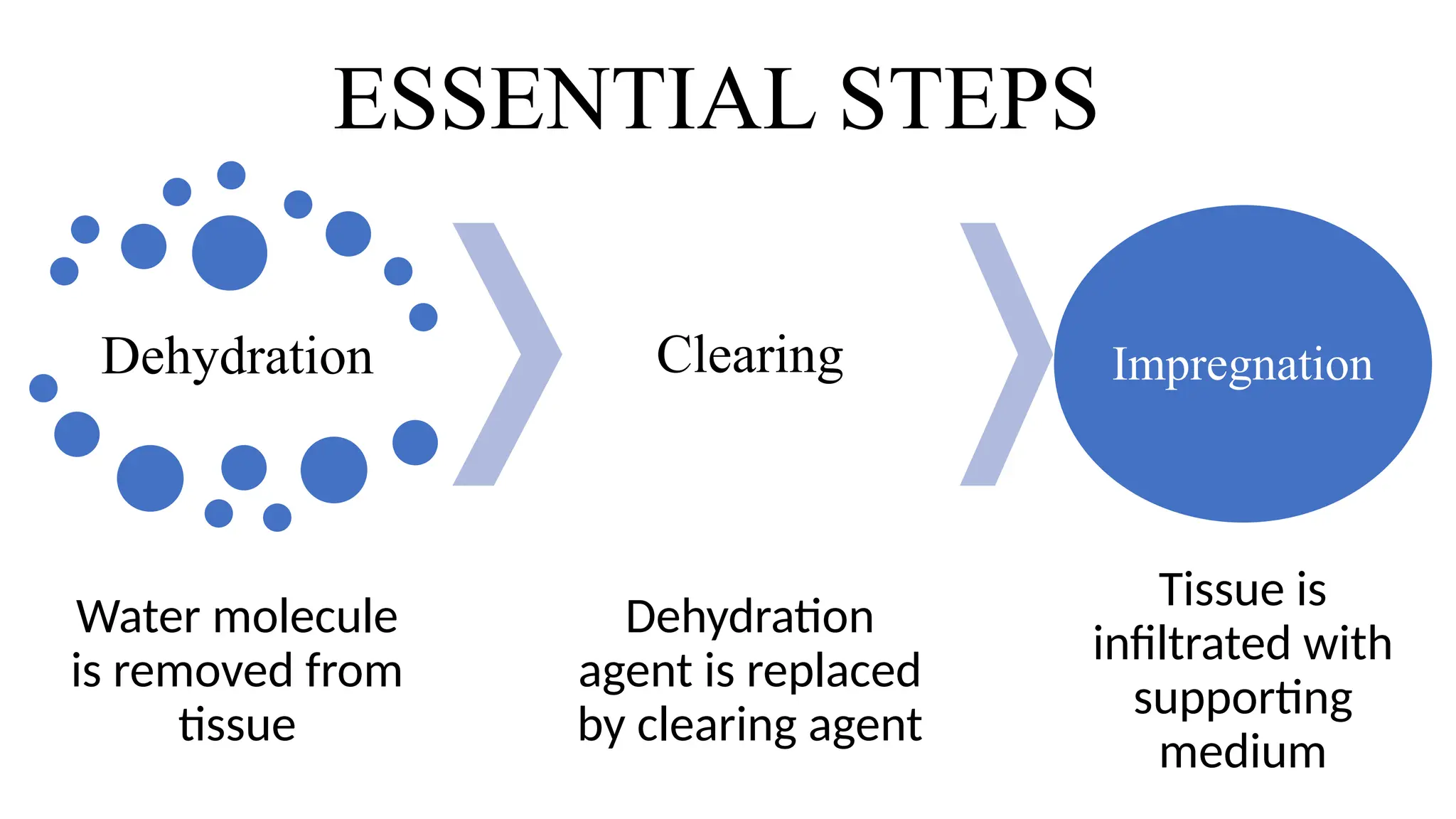
ESSENTIAL STEPS
Dehydration
Water molecule
is removed from
tissue
Clearing
Dehydration
agent is replaced
by clearing agent
Impregnation
Tissue is
infiltrated with
supporting
medium
FACTORS THAT INFLUENCE
TISSUE PROCESSING
•Size of the tissue sample: The smaller size, the
better processing
•Agitation: Facilitate the contact of tissue with
fresh solution
•Heat: Increase the better penetration
•Viscosity: The higher viscosity, lower the penetration
•Vacuum: Negative pressure to remove trapped air in
the tissue
DEHYDRATION
•Every tissue contains some amount of free or unbound
water molecules
•It is necessary to remove the water from tissue
•The sharp concentration gradient between the tissue
and the dehydration agent may cause rush of fluid, and
this may damage
•So the dehydration should be done gradually from low
concentration to the high concentration
•The tissue should kept in dehydration solution for
optimum time
•Too little time may insufficient to remove the water
molecules.
DEHYDRARTING AGENTS
•Ethanol alcohol
•Methylated spirit
•Methanol
•Butyl alcohol
•Isopropyl alcohol
•Other than alcohol: dioxane, ethylene glycol and
acetone.
CLEARING
•It’s the next step, after removal of water molecules
from the tissue
•The clearing agent should miscible with both
dehydrating agent and the embedding medium
•The refraction index of clearing agent is similar to the
tissue
SELECTION OF THE APPROPRIATE
CLEARING AGENT :
•Type of tissue
•Type of processor
•Processing condition
•Speed of removal of dehydrating agent
•Ease of replacement by molten wax
•Safety factors.
CLEARING AGENTS
•Xylene
•Toluene
•Chloroform
•Esters
•Cedarwood oil
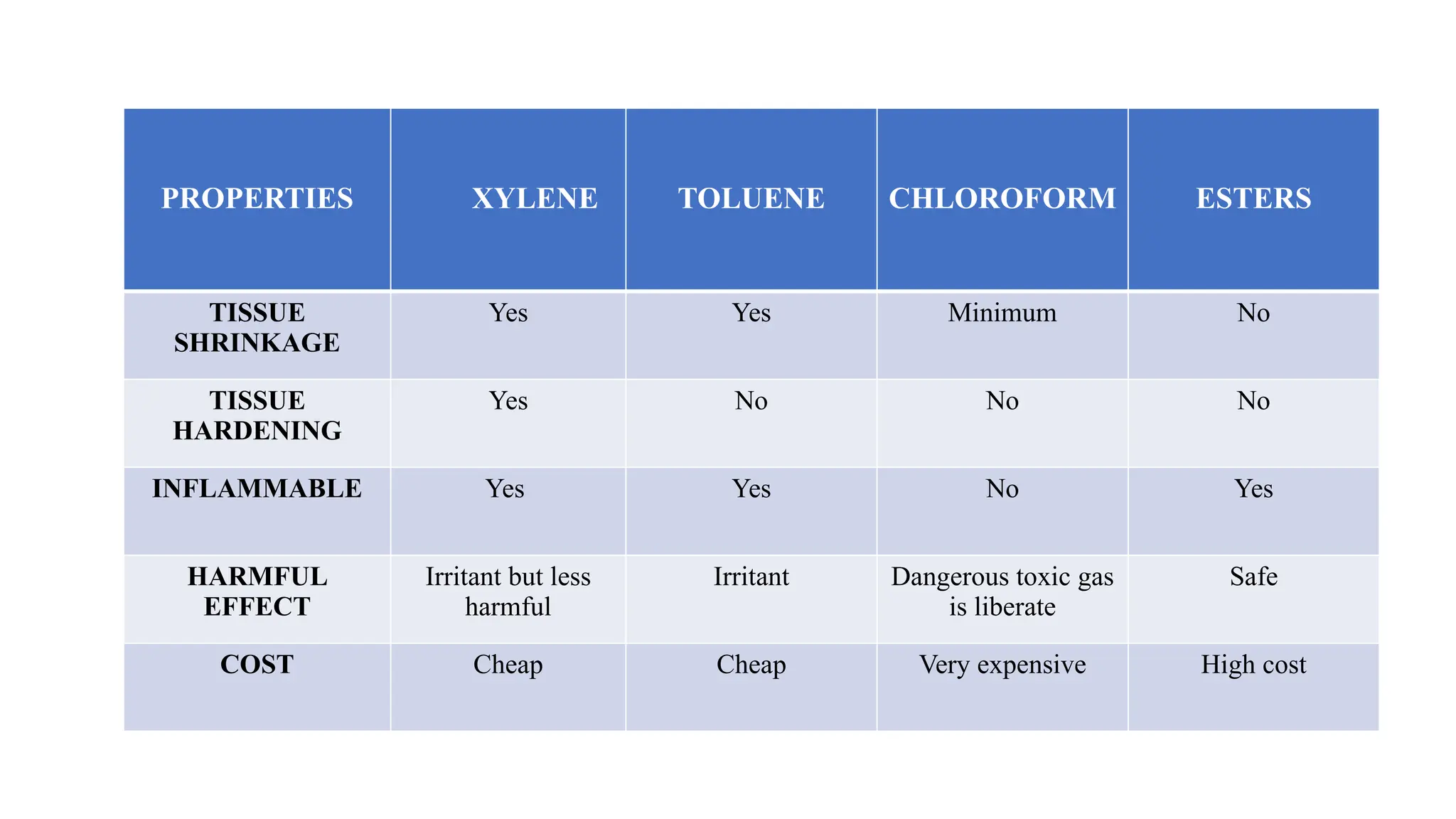
PROPERTIES XYLENE TOLUENE CHLOROFORM ESTERS
TISSUE
SHRINKAGE
Yes Yes Minimum No
TISSUE
HARDENING
Yes No No No
INFLAMMABLE Yes Yes No Yes
HARMFUL
EFFECT
Irritant but less
harmful
Irritant Dangerous toxic gas
is liberate
Safe
COST Cheap Cheap Very expensive High cost
INFILTRATION AND EMBEDDING
•This is the next step after clearing
•The tissue space is infiltrate embedding medium
•Usually molten wax is used
•After cooling in room temperature, the molten wax is
solidified to provide support for thin section cutting
IMPREGNATING MEDIUM
An ideal impregnating medium should have following
qualities
• Miscible with clearing agent
• Liquid in higher temperature and solid in room temperature
• Homogenous and stable
• Non toxic and cheap
• Transparent
• Fit for section cutting
THE TIME AND NUMBER OF CHANGES
DEPENDS ON
• Size of the tissue
• Type of the tissue
• Type of the clearing agent
• Type of the processing
TISSUE PROCESSING METHODS
MANUAL
•Tissue transfer processor
•Fluid transfer processor
AUTOMATIC
TIME SCHEDULE FOE OVERNIGHT
THANK YOU

STEPS OF TISSUE PROCESSING in pathology for slide

  • 1.
  • 2.
    AIMS AND PRINCIPLE •Aim:The basic aim is to provide sufficient rigidity so it can cut into thin section for microscopic study. •Principle: Is to remove the water within the tissue and impregnated with another medium.
  • 3.
    ESSENTIAL STEPS Dehydration Water molecule isremoved from tissue Clearing Dehydration agent is replaced by clearing agent Impregnation Tissue is infiltrated with supporting medium
  • 4.
    FACTORS THAT INFLUENCE TISSUEPROCESSING •Size of the tissue sample: The smaller size, the better processing •Agitation: Facilitate the contact of tissue with fresh solution
  • 5.
    •Heat: Increase thebetter penetration •Viscosity: The higher viscosity, lower the penetration •Vacuum: Negative pressure to remove trapped air in the tissue
  • 6.
    DEHYDRATION •Every tissue containssome amount of free or unbound water molecules •It is necessary to remove the water from tissue •The sharp concentration gradient between the tissue and the dehydration agent may cause rush of fluid, and this may damage
  • 7.
    •So the dehydrationshould be done gradually from low concentration to the high concentration •The tissue should kept in dehydration solution for optimum time •Too little time may insufficient to remove the water molecules.
  • 8.
    DEHYDRARTING AGENTS •Ethanol alcohol •Methylatedspirit •Methanol •Butyl alcohol •Isopropyl alcohol •Other than alcohol: dioxane, ethylene glycol and acetone.
  • 9.
    CLEARING •It’s the nextstep, after removal of water molecules from the tissue •The clearing agent should miscible with both dehydrating agent and the embedding medium •The refraction index of clearing agent is similar to the tissue
  • 10.
    SELECTION OF THEAPPROPRIATE CLEARING AGENT : •Type of tissue •Type of processor •Processing condition •Speed of removal of dehydrating agent •Ease of replacement by molten wax •Safety factors.
  • 11.
  • 12.
    PROPERTIES XYLENE TOLUENECHLOROFORM ESTERS TISSUE SHRINKAGE Yes Yes Minimum No TISSUE HARDENING Yes No No No INFLAMMABLE Yes Yes No Yes HARMFUL EFFECT Irritant but less harmful Irritant Dangerous toxic gas is liberate Safe COST Cheap Cheap Very expensive High cost
  • 13.
    INFILTRATION AND EMBEDDING •Thisis the next step after clearing •The tissue space is infiltrate embedding medium •Usually molten wax is used •After cooling in room temperature, the molten wax is solidified to provide support for thin section cutting
  • 14.
    IMPREGNATING MEDIUM An idealimpregnating medium should have following qualities • Miscible with clearing agent • Liquid in higher temperature and solid in room temperature • Homogenous and stable • Non toxic and cheap • Transparent • Fit for section cutting
  • 15.
    THE TIME ANDNUMBER OF CHANGES DEPENDS ON • Size of the tissue • Type of the tissue • Type of the clearing agent • Type of the processing
  • 16.
    TISSUE PROCESSING METHODS MANUAL •Tissuetransfer processor •Fluid transfer processor AUTOMATIC
  • 17.
  • 18.