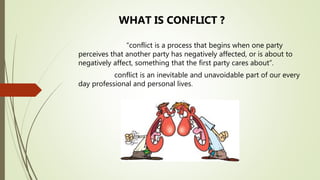
“conflict is a process that begins when one party
perceives that another party has negatively affected, or is about to
negatively affect, something that the first party cares about”.
conflict is an inevitable and unavoidable part of our every
day professional and personal lives.
WHAT IS CONFLICT ?
TYPES OF CONFLICT
Interpersonal conflict:
It refers to a conflict between two individuals. This occurs typically due to how
people are different from one another. We have varied personalities which usually
results to incompatible choices and opinions.
Intragroup conflict:
It is a type of conflict that happens among individuals within a team. The
incompatibilities and misunderstandings among these individuals lead to
an intragroup conflict. It is arises from interpersonal disagreements or
differences in views and ideas
Intergroup conflict:
takes place when a misunderstanding arises among different teams within an
organization. This is due to the varied sets of goals and interests of these different
groups.
CAUSES FOR CONFLICT
1. Poor communication
2. Personality conflicts
3. Opposing interests
4. Differing values
5. Competition
6. Lack of planning
7. Poor staff selection
8. Lack of empathy
9. Desire for power
10.Ignorance
MEANING OF CONFLICT MANAGEMENT
Conflict management is the process of limiting the negative aspects of conflict while
increasing the positive aspects of conflict. The aim of conflict management is to enhance
learning and group outcomes, including effectiveness or performance in organizational
setting.
IMPORTANCE OF CONFLICT MANAGEMENT
 Conflict management goes a long way in strengthening the bond among the
employees and half of the problems automatically disappear
 Conflict management also plays an important role in our personal lives.
 Conflict management helps to find a middle way, an alternative to any problem and
successful implementation of the idea.
 Conflict Management is very important because it is always wise to prevent a fight at
the first place rather than facing its negative consequences'.
DIFFERENT STRATEGIES USED IN CONFLICT MANAGEMENT
Accommodating:
The accommodating strategy essentially entails giving the opposing side what it
wants. The use of accommodation often occurs when one of the parties wishes to
keep the peace or perceives the issue as minor.
Avoiding:
The avoidance strategy seeks to put off conflict indefinitely. By delaying or ignoring
the conflict, the avoider hopes the problem resolves itself without a confrontation.
Those who actively avoid conflict frequently have low esteem or hold a position of
low power.
Collaborating:
Collaboration works by integrating ideas set out by multiple people. The object is to
find a creative solution acceptable to everyone. Collaboration, though useful, calls for
a significant time commitment not appropriate to all conflicts.
Competing:
Competition operates as a zero-sum game, in which one side wins and other loses.
Highly assertive personalities often fall back on competition as a conflict
management strategy. The competitive strategy works best in a limited number of
conflicts, such as emergency situations.
Compromising
The compromising strategy typically calls for both sides of a conflict to give up
elements of their position in order to establish an acceptable, if not agreeable,
solution. This strategy prevails most often in conflicts where the parties hold
approximately equivalent power.
Conflict Handling Techniques
CONFLICT-RESOLUTION TECHNIQUES
Problem solving:
Face to face meeting and resolving the problems through open talks
Superordinate goals:
Creating shared goals that cannot be attained without co-Operation of each of the
conflicting parties.
Expansion of resources:
Conflict caused by scarcity of resources can be resolved by expanding the same,
which can create win-win solution
Avoidance:
Withdrawal from or suppression of the conflict.
Compromise:
Each party of conflict gives up something of value.
Authoritative command:
Management uses its formal authority to resolve the conflict and then
its desires to the parties involved.
Altering structural variables:
Changing the formal organisation structure of conflicting parties through job
redesign, transfers, coordinating positions, etc.,
Conflict Stimulation Techniques
Communication:
using ambiguous or threatening messages to increase conflict levels.
Bringing in outsiders:
Adding employee to a group whose backgrounds, values, attitudes, or managerial
styles, differ from those of present members.
Restructuring the organisation:
Realigning work groups, altering rules and regulations, increasing, interdependence,
and making similar structural changes to disrupt the status quo.
Appointing a devils advocate:
Designating a critic to purposely argue against the majority position held by the
group.
Conflict Management and conflict resolution techniques

Conflict Management and conflict resolution techniques

  • 1.
    “conflict is aprocess that begins when one party perceives that another party has negatively affected, or is about to negatively affect, something that the first party cares about”. conflict is an inevitable and unavoidable part of our every day professional and personal lives. WHAT IS CONFLICT ?
  • 2.
    TYPES OF CONFLICT Interpersonalconflict: It refers to a conflict between two individuals. This occurs typically due to how people are different from one another. We have varied personalities which usually results to incompatible choices and opinions. Intragroup conflict: It is a type of conflict that happens among individuals within a team. The incompatibilities and misunderstandings among these individuals lead to an intragroup conflict. It is arises from interpersonal disagreements or differences in views and ideas Intergroup conflict: takes place when a misunderstanding arises among different teams within an organization. This is due to the varied sets of goals and interests of these different groups.
  • 3.
    CAUSES FOR CONFLICT 1.Poor communication 2. Personality conflicts 3. Opposing interests 4. Differing values 5. Competition 6. Lack of planning 7. Poor staff selection 8. Lack of empathy 9. Desire for power 10.Ignorance
  • 4.
    MEANING OF CONFLICTMANAGEMENT Conflict management is the process of limiting the negative aspects of conflict while increasing the positive aspects of conflict. The aim of conflict management is to enhance learning and group outcomes, including effectiveness or performance in organizational setting. IMPORTANCE OF CONFLICT MANAGEMENT  Conflict management goes a long way in strengthening the bond among the employees and half of the problems automatically disappear  Conflict management also plays an important role in our personal lives.  Conflict management helps to find a middle way, an alternative to any problem and successful implementation of the idea.  Conflict Management is very important because it is always wise to prevent a fight at the first place rather than facing its negative consequences'.
  • 5.
    DIFFERENT STRATEGIES USEDIN CONFLICT MANAGEMENT Accommodating: The accommodating strategy essentially entails giving the opposing side what it wants. The use of accommodation often occurs when one of the parties wishes to keep the peace or perceives the issue as minor. Avoiding: The avoidance strategy seeks to put off conflict indefinitely. By delaying or ignoring the conflict, the avoider hopes the problem resolves itself without a confrontation. Those who actively avoid conflict frequently have low esteem or hold a position of low power. Collaborating: Collaboration works by integrating ideas set out by multiple people. The object is to find a creative solution acceptable to everyone. Collaboration, though useful, calls for a significant time commitment not appropriate to all conflicts.
  • 6.
    Competing: Competition operates asa zero-sum game, in which one side wins and other loses. Highly assertive personalities often fall back on competition as a conflict management strategy. The competitive strategy works best in a limited number of conflicts, such as emergency situations. Compromising The compromising strategy typically calls for both sides of a conflict to give up elements of their position in order to establish an acceptable, if not agreeable, solution. This strategy prevails most often in conflicts where the parties hold approximately equivalent power.
  • 7.
  • 8.
    CONFLICT-RESOLUTION TECHNIQUES Problem solving: Faceto face meeting and resolving the problems through open talks Superordinate goals: Creating shared goals that cannot be attained without co-Operation of each of the conflicting parties. Expansion of resources: Conflict caused by scarcity of resources can be resolved by expanding the same, which can create win-win solution Avoidance: Withdrawal from or suppression of the conflict.
  • 9.
    Compromise: Each party ofconflict gives up something of value. Authoritative command: Management uses its formal authority to resolve the conflict and then its desires to the parties involved. Altering structural variables: Changing the formal organisation structure of conflicting parties through job redesign, transfers, coordinating positions, etc.,
  • 10.
    Conflict Stimulation Techniques Communication: usingambiguous or threatening messages to increase conflict levels. Bringing in outsiders: Adding employee to a group whose backgrounds, values, attitudes, or managerial styles, differ from those of present members. Restructuring the organisation: Realigning work groups, altering rules and regulations, increasing, interdependence, and making similar structural changes to disrupt the status quo. Appointing a devils advocate: Designating a critic to purposely argue against the majority position held by the group.