Activities, Methods, and Tools for Better Teaching in Multilingual Classrooms Tracey Tokuhama-Espinosa November 2009 Rotterdam, The Netherlands Early Bird
Today’s Focus: Background and Two presumptions General Tools: Best practices Retention varies with Methods  Emotions and Teaching Sense and Meaning Learning Environments Specific Tools  (Marzano, Pickering, & Pollock) Evidence-based teaching methods for long-term retention and more efficient teaching  Rubrics
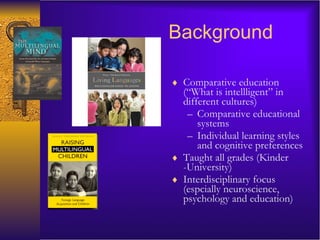
Background Comparative education (“What is intellligent” in different cultures) Comparative educational systems  Individual learning styles and cognitive preferences Taught all grades (Kinder -University) Interdisciplinary focus (espcially neuroscience, psychology and education)
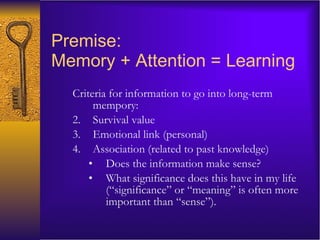
Premise:  Memory + Attention  = Learning Criteria for information to go into long-term mempory: Survival value Emotional link (personal) Association (related to past knowledge)  Does the information make sense? What significance does this have in my life (“significance” or “meaning” is often more important than “sense”).
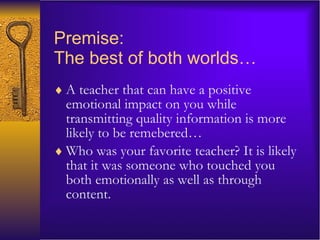
Premise:  The best of both worlds… A teacher that can have a positive emotional impact on you while transmitting quality information is more likely to be remebered… Who was your favorite teacher? It is likely that it was someone who touched you both emotionally as well as through content.
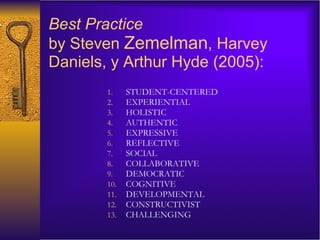
Best Practice  by   Steven  Zemelman , Harvey Daniels, y Arthur Hyde (2005):  STUDENT-CENTERED  EXPERIENTIAL HOLISTIC AUTHENTIC EXPRESSIVE REFLECTIVE SOCIAL COLLABORATIVE DEMOCRATIC COGNITIVE DEVELOPMENTAL  CONSTRUCTIVIST CHALLENGING
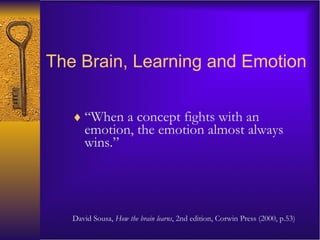
The Brain, Learning and Emotion “ When a concept fights with an emotion, the emotion almost always wins .” David Sousa,  How the brain learns , 2nd edition, Corwin Press (2000, p.53)
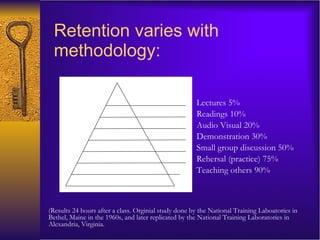
Retention varies with methodology: Lectures 5% Readings 10% Audio Visual 20% Demonstration 30% Small group discussion 50% Rehersal (practice) 75% Teaching others 90% (Results 24 hours after a class. Orginial study done by the National Training Laboatories in Bethel, Maine in the 1960s, and later replicated by the National Training Laboratories in Alexandria, Virginia.
The Use of the Primacy-Recency Effect in Class During a period of learning, we remember best what happens first, second best what happens last, and in last place we remember what happens in the middle.  This means we should teach important informacion (concepts) first (and avoid secreatrial duties like roll call). It also means we should avoid asking students to guess at the beginning of class as false answers are rememebred better than correct information given later.  David Sousa,  How the brain learns , 2nd edition, Corwin Press (2000, p.88)
Sense and Meaning in Classroom Planning: Teachers spend a lot of time making sure their lessons make sense, but little time ensuring they have meaning in the lives of their students.  Initial learning involves being able to attribute significance and value to the information. David Sousa,  How the brain learns , 2nd edition, Corwin Press (2000, p.54)
Good Learning Environments  by Dorothy Billington:  Seven factors influence learning environments:  Sense of security Intellectual liberty  Respet Self-directedness Paced goals Active learning Feedback By Dorothy D. Billington. PhD  Seven Characteristics of Highly Effective Adult Learning Programs
Specific Tools
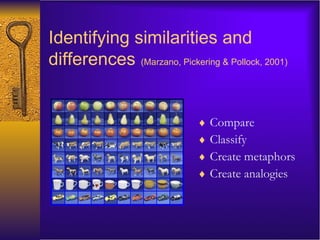
Identifying similarities and differences   (Marzano, Pickering & Pollock, 2001) Compare Classify Create metaphors Create analogies
Summarizing   (Marzano, Pickering & Pollock, 2001) “ Rule-based strategy” (help students identify what is trivial or redundant and identify topic sentences--or write one themselves) “ Summary Frames” Structures for organizing information (e.g., in a narrative, identify the main characters, setting, time, etc.) Reciprocal teaching (1) Summarizing; (2) questioning; (3) clarifying; (4) predicting
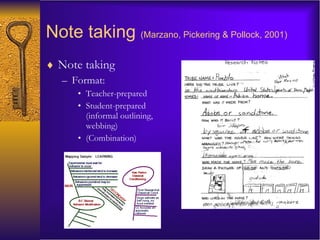
Note taking   (Marzano, Pickering & Pollock, 2001) Note taking Format: Teacher-prepared Student-prepared (informal outlining, webbing) (Combination)
Homework  (Marzano, Pickering, & Pollock, 2001) Establish and communicate expectations (homework policy) Design homework assignments with purpose and identified outcome. Vary feedback mechanisms.
Practice   (Marzano, Pickering, & Pollock, 2001) Design practice that focuses on specific elements of complex skills (break down skill areas) Chart progress (accuracy and speed) Give time for practice (to solidify conceptual understanding of skills or processes)
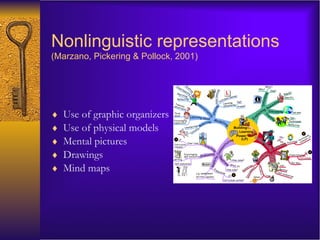
Nonlinguistic representations   (Marzano, Pickering & Pollock, 2001) Use of graphic organizers Use of physical models Mental pictures Drawings Mind maps
Reinforcing Effort and Providing Recognition   (Marzano, Pickering, & Pollock, 2001) Explicitly teach about effort Keep track of effort and achievement Personalize recognition Pause, prompt, and praise Concrete symbols of recognition
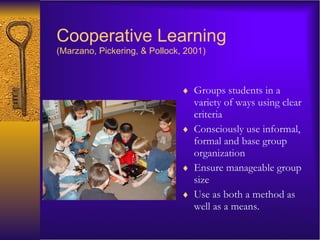
Cooperative Learning   (Marzano, Pickering, & Pollock, 2001) Groups students in a variety of ways using clear criteria Consciously use informal, formal and base group organization Ensure manageable group size Use as both a method as well as a means.
Cooperative learning (Allen, 2002)   “ Cooperative learning physiologically engages more of the brain's neural networks through the stimulation of sensory information from kinesthetic, visual, and auditory input.... cooperative learning taps into students’ ‘natural capacities to be engaged socially and emotionally’ and supports their efforts to construct knowledge and apply it in problem solving, says Dickmann.” Rick Allen (2002), descargada de ACSD: http://www.ascd.org
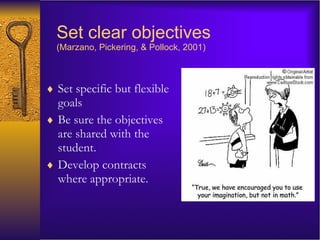
Set clear objectives  (Marzano, Pickering, & Pollock, 2001) Set specific but flexible goals Be sure the objectives are shared with the student. Develop contracts where appropriate.
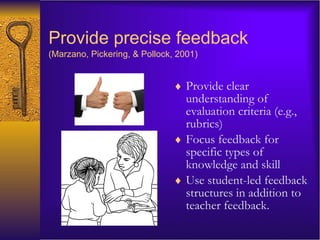
Provide precise feedback   (Marzano, Pickering, & Pollock, 2001) Provide clear understanding of evaluation criteria (e.g., rubrics) Focus feedback for specific types of knowledge and skill Use student-led feedback structures in addition to teacher feedback.
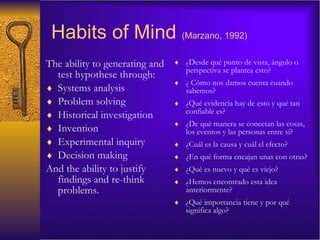
Habits of Mind  (Marzano, 1992) The ability to generating and test hypothese through: Systems analysis Problem solving Historical investigation Invention Experimental inquiry Decision making And the ability to justify findings and re-think problems. ¿Desde qué punto de vista, ángulo o perspectiva se plantea esto?  ¿ Cómo nos damos cuenta cuando sabemos?  ¿Qué evidencia hay de esto y qué tan confiable es?  ¿De qué manera se conectan las cosas, los eventos y las personas entre sí?  ¿Cuál es la causa y cuál el efecto?  ¿En qué forma encajan unas con otras?  ¿Qué es nuevo y qué es viejo?  ¿Hemos encontrado esta idea anteriormente?  ¿Qué importancia tiene y por qué significa algo?
The Art of Questioning Provide explicit cues Develop questions that elicit inferences Generate analytic questions. What do we know about….  How do we know…? Why do we accept or believe that… Is there evidence for…
Summary There are general tools that facilitate student learning (e.g., creating good learning environments; considering the role of emotions in learning; primacy-receny; sense and meaning) There are specific tools that facilitate student learning (e.g., note taking; summarizing; questioning; clear objectives, cooperative learning; reinforcing effort; feedback; nonlinguistic representations, organizers; homework; in-class practice). Both general and specific tools become second nature to great teachers.
In practice:  Choose one tool you have not taken advantage of in the past and think about how you will apply it starting tomorrow:
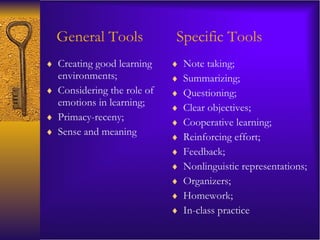
Creating good learning environments;  Considering the role of emotions in learning;  Primacy-receny;  Sense and meaning Note taking;  Summarizing;  Questioning;  Clear objectives; Cooperative learning;  Reinforcing effort;  Feedback;  Nonlinguistic representations; Organizers;  Homework;  In-class practice General Tools Specific Tools
Referencias Abbott, J. & Ryan, T. (1999). Constructing knowledge, reconstructing schooling.  Educational Leadership, 57 (3), 66-70.  Allen, R. (2002). Honing the tools of instruction: How research can improve teaching for the 21st century.  Curriculum Update 8 , 1-3.  Ames, C. (1992). Classroom goals, structures, and student motivation.  Journal of Educational Psychology, 84 (3), 261-271.  Bandura, A. (1997).  Self-efficacy: The exercise of control.  New York: W. H. Freeman.   Billington, D. (1997).  Seven characteristics of highly effective adult learning environments . Retrieved January 4 2005 from www.newhorizons.com. Coplen, W., Duffield, J., Swimpson, I., Taylor, D. (2005)  Developing the moduel: Monitoring student progress . PowerPoint. Descargada de www.montgomeryschoolsmd.org/schools/churchillwootton/CITW%20powerpt..ppt el 12 de octubre 2008.
Giordano, P. J. (2003).  Critical moments in learning: Student, faculty, and alumni experiences.  Workshop presented at the meeting of the National Lilly Conference on College Teaching, Oxford, OH.  Marzano (2003).  What works in schools: Translating research into action.  Virginia: Association for Supervision and Curriculum Development Marzano, R., Pickering, D.J., and Pollock, J.E. (2001).  Classroom instruction that works: research-based strategies for increasing student achievement.  Virginia: Association for Supervision and Curriculum Development. Sousa, D. (2000).  How the brain learns . Thousand Oaks, CA: Corwin Press. Tomlinson, Carol Ann. (2000). Reconcilable Differences? Standards-Based Teaching and Differentiation.  Educational Leadership, 58 (1), 6-12.  Zemelman, S., Daniels, H. & Hyde, A. (2005).  Best practice: new standards for teaching and learning in America’s schools, 3rd ed..  New Hampshire: Heinemann.
For more information: Tracey Tokuhama-Espinosa, Ph.D. Universidad San Francisco de Quito Edif. Galileo #101 Telf: +593 2 297-1700 x1338 o +593-2-297-18937 [email_address] Tracey Tokuhama-Espinosa is a professor of Education and Psychology at the  Universidad San Francisco de Quito  in Ecuador at the undergraduate and Master’s levels.  Tracey received her doctorate (PhD) in the new field of Mind, Brain, and Education Science in July 2008 (Capella University), her Master’s of Education from Harvard University (International Development) and her Bachelor’s of Arts (International Relations) and Bachelor’s of Science (Communications) from Boston University,  magna cum laude .

Toolbox for better teaching

  • 1.
    Activities, Methods, andTools for Better Teaching in Multilingual Classrooms Tracey Tokuhama-Espinosa November 2009 Rotterdam, The Netherlands Early Bird
  • 2.
    Today’s Focus: Backgroundand Two presumptions General Tools: Best practices Retention varies with Methods Emotions and Teaching Sense and Meaning Learning Environments Specific Tools (Marzano, Pickering, & Pollock) Evidence-based teaching methods for long-term retention and more efficient teaching Rubrics
  • 3.
    Background Comparative education(“What is intellligent” in different cultures) Comparative educational systems Individual learning styles and cognitive preferences Taught all grades (Kinder -University) Interdisciplinary focus (espcially neuroscience, psychology and education)
  • 4.
    Premise: Memory+ Attention = Learning Criteria for information to go into long-term mempory: Survival value Emotional link (personal) Association (related to past knowledge) Does the information make sense? What significance does this have in my life (“significance” or “meaning” is often more important than “sense”).
  • 5.
    Premise: Thebest of both worlds… A teacher that can have a positive emotional impact on you while transmitting quality information is more likely to be remebered… Who was your favorite teacher? It is likely that it was someone who touched you both emotionally as well as through content.
  • 6.
    Best Practice by Steven Zemelman , Harvey Daniels, y Arthur Hyde (2005): STUDENT-CENTERED EXPERIENTIAL HOLISTIC AUTHENTIC EXPRESSIVE REFLECTIVE SOCIAL COLLABORATIVE DEMOCRATIC COGNITIVE DEVELOPMENTAL CONSTRUCTIVIST CHALLENGING
  • 7.
    The Brain, Learningand Emotion “ When a concept fights with an emotion, the emotion almost always wins .” David Sousa, How the brain learns , 2nd edition, Corwin Press (2000, p.53)
  • 8.
    Retention varies withmethodology: Lectures 5% Readings 10% Audio Visual 20% Demonstration 30% Small group discussion 50% Rehersal (practice) 75% Teaching others 90% (Results 24 hours after a class. Orginial study done by the National Training Laboatories in Bethel, Maine in the 1960s, and later replicated by the National Training Laboratories in Alexandria, Virginia.
  • 9.
    The Use ofthe Primacy-Recency Effect in Class During a period of learning, we remember best what happens first, second best what happens last, and in last place we remember what happens in the middle. This means we should teach important informacion (concepts) first (and avoid secreatrial duties like roll call). It also means we should avoid asking students to guess at the beginning of class as false answers are rememebred better than correct information given later. David Sousa, How the brain learns , 2nd edition, Corwin Press (2000, p.88)
  • 10.
    Sense and Meaningin Classroom Planning: Teachers spend a lot of time making sure their lessons make sense, but little time ensuring they have meaning in the lives of their students. Initial learning involves being able to attribute significance and value to the information. David Sousa, How the brain learns , 2nd edition, Corwin Press (2000, p.54)
  • 11.
    Good Learning Environments by Dorothy Billington: Seven factors influence learning environments: Sense of security Intellectual liberty Respet Self-directedness Paced goals Active learning Feedback By Dorothy D. Billington. PhD Seven Characteristics of Highly Effective Adult Learning Programs
  • 12.
  • 13.
    Identifying similarities anddifferences (Marzano, Pickering & Pollock, 2001) Compare Classify Create metaphors Create analogies
  • 14.
    Summarizing (Marzano, Pickering & Pollock, 2001) “ Rule-based strategy” (help students identify what is trivial or redundant and identify topic sentences--or write one themselves) “ Summary Frames” Structures for organizing information (e.g., in a narrative, identify the main characters, setting, time, etc.) Reciprocal teaching (1) Summarizing; (2) questioning; (3) clarifying; (4) predicting
  • 15.
    Note taking (Marzano, Pickering & Pollock, 2001) Note taking Format: Teacher-prepared Student-prepared (informal outlining, webbing) (Combination)
  • 16.
    Homework (Marzano,Pickering, & Pollock, 2001) Establish and communicate expectations (homework policy) Design homework assignments with purpose and identified outcome. Vary feedback mechanisms.
  • 17.
    Practice (Marzano, Pickering, & Pollock, 2001) Design practice that focuses on specific elements of complex skills (break down skill areas) Chart progress (accuracy and speed) Give time for practice (to solidify conceptual understanding of skills or processes)
  • 18.
    Nonlinguistic representations (Marzano, Pickering & Pollock, 2001) Use of graphic organizers Use of physical models Mental pictures Drawings Mind maps
  • 19.
    Reinforcing Effort andProviding Recognition (Marzano, Pickering, & Pollock, 2001) Explicitly teach about effort Keep track of effort and achievement Personalize recognition Pause, prompt, and praise Concrete symbols of recognition
  • 20.
    Cooperative Learning (Marzano, Pickering, & Pollock, 2001) Groups students in a variety of ways using clear criteria Consciously use informal, formal and base group organization Ensure manageable group size Use as both a method as well as a means.
  • 21.
    Cooperative learning (Allen,2002) “ Cooperative learning physiologically engages more of the brain's neural networks through the stimulation of sensory information from kinesthetic, visual, and auditory input.... cooperative learning taps into students’ ‘natural capacities to be engaged socially and emotionally’ and supports their efforts to construct knowledge and apply it in problem solving, says Dickmann.” Rick Allen (2002), descargada de ACSD: http://www.ascd.org
  • 22.
    Set clear objectives (Marzano, Pickering, & Pollock, 2001) Set specific but flexible goals Be sure the objectives are shared with the student. Develop contracts where appropriate.
  • 23.
    Provide precise feedback (Marzano, Pickering, & Pollock, 2001) Provide clear understanding of evaluation criteria (e.g., rubrics) Focus feedback for specific types of knowledge and skill Use student-led feedback structures in addition to teacher feedback.
  • 24.
    Habits of Mind (Marzano, 1992) The ability to generating and test hypothese through: Systems analysis Problem solving Historical investigation Invention Experimental inquiry Decision making And the ability to justify findings and re-think problems. ¿Desde qué punto de vista, ángulo o perspectiva se plantea esto? ¿ Cómo nos damos cuenta cuando sabemos? ¿Qué evidencia hay de esto y qué tan confiable es? ¿De qué manera se conectan las cosas, los eventos y las personas entre sí? ¿Cuál es la causa y cuál el efecto? ¿En qué forma encajan unas con otras? ¿Qué es nuevo y qué es viejo? ¿Hemos encontrado esta idea anteriormente? ¿Qué importancia tiene y por qué significa algo?
  • 25.
    The Art ofQuestioning Provide explicit cues Develop questions that elicit inferences Generate analytic questions. What do we know about…. How do we know…? Why do we accept or believe that… Is there evidence for…
  • 26.
    Summary There aregeneral tools that facilitate student learning (e.g., creating good learning environments; considering the role of emotions in learning; primacy-receny; sense and meaning) There are specific tools that facilitate student learning (e.g., note taking; summarizing; questioning; clear objectives, cooperative learning; reinforcing effort; feedback; nonlinguistic representations, organizers; homework; in-class practice). Both general and specific tools become second nature to great teachers.
  • 27.
    In practice: Choose one tool you have not taken advantage of in the past and think about how you will apply it starting tomorrow:
  • 28.
    Creating good learningenvironments; Considering the role of emotions in learning; Primacy-receny; Sense and meaning Note taking; Summarizing; Questioning; Clear objectives; Cooperative learning; Reinforcing effort; Feedback; Nonlinguistic representations; Organizers; Homework; In-class practice General Tools Specific Tools
  • 29.
    Referencias Abbott, J.& Ryan, T. (1999). Constructing knowledge, reconstructing schooling. Educational Leadership, 57 (3), 66-70. Allen, R. (2002). Honing the tools of instruction: How research can improve teaching for the 21st century. Curriculum Update 8 , 1-3. Ames, C. (1992). Classroom goals, structures, and student motivation. Journal of Educational Psychology, 84 (3), 261-271. Bandura, A. (1997). Self-efficacy: The exercise of control. New York: W. H. Freeman.  Billington, D. (1997). Seven characteristics of highly effective adult learning environments . Retrieved January 4 2005 from www.newhorizons.com. Coplen, W., Duffield, J., Swimpson, I., Taylor, D. (2005) Developing the moduel: Monitoring student progress . PowerPoint. Descargada de www.montgomeryschoolsmd.org/schools/churchillwootton/CITW%20powerpt..ppt el 12 de octubre 2008.
  • 30.
    Giordano, P. J.(2003). Critical moments in learning: Student, faculty, and alumni experiences. Workshop presented at the meeting of the National Lilly Conference on College Teaching, Oxford, OH. Marzano (2003). What works in schools: Translating research into action. Virginia: Association for Supervision and Curriculum Development Marzano, R., Pickering, D.J., and Pollock, J.E. (2001). Classroom instruction that works: research-based strategies for increasing student achievement. Virginia: Association for Supervision and Curriculum Development. Sousa, D. (2000). How the brain learns . Thousand Oaks, CA: Corwin Press. Tomlinson, Carol Ann. (2000). Reconcilable Differences? Standards-Based Teaching and Differentiation. Educational Leadership, 58 (1), 6-12. Zemelman, S., Daniels, H. & Hyde, A. (2005). Best practice: new standards for teaching and learning in America’s schools, 3rd ed.. New Hampshire: Heinemann.
  • 31.
    For more information:Tracey Tokuhama-Espinosa, Ph.D. Universidad San Francisco de Quito Edif. Galileo #101 Telf: +593 2 297-1700 x1338 o +593-2-297-18937 [email_address] Tracey Tokuhama-Espinosa is a professor of Education and Psychology at the Universidad San Francisco de Quito in Ecuador at the undergraduate and Master’s levels. Tracey received her doctorate (PhD) in the new field of Mind, Brain, and Education Science in July 2008 (Capella University), her Master’s of Education from Harvard University (International Development) and her Bachelor’s of Arts (International Relations) and Bachelor’s of Science (Communications) from Boston University, magna cum laude .

Editor's Notes

  • #2 Tokuhama-Espinosa 08/03
  • #3 Tokuhama-Espinosa 08/03
  • #4 Tokuhama-Espinosa 08/03
  • #5 Tokuhama-Espinosa 08/03
  • #6 Tokuhama-Espinosa 08/03
  • #7 Tokuhama-Espinosa 08/03
  • #8 Tokuhama-Espinosa 08/03
  • #9 Tokuhama-Espinosa 08/03
  • #10 Tokuhama-Espinosa 08/03
  • #11 Tokuhama-Espinosa 08/03
  • #12 Tokuhama-Espinosa 08/03
  • #13 Tokuhama-Espinosa 08/03
  • #14 Tokuhama-Espinosa 08/03
  • #15 Tokuhama-Espinosa 08/03
  • #16 Tokuhama-Espinosa 08/03
  • #17 Tokuhama-Espinosa 08/03
  • #18 Tokuhama-Espinosa 08/03
  • #19 Tokuhama-Espinosa 08/03
  • #20 Tokuhama-Espinosa 08/03
  • #21 Tokuhama-Espinosa 08/03
  • #22 Tokuhama-Espinosa 08/03
  • #23 Tokuhama-Espinosa 08/03
  • #24 Tokuhama-Espinosa 08/03
  • #25 Tokuhama-Espinosa 08/03
  • #26 Tokuhama-Espinosa 08/03
  • #27 Tokuhama-Espinosa 08/03
  • #28 Tokuhama-Espinosa 08/03
  • #29 Tokuhama-Espinosa 08/03
  • #30 Tokuhama-Espinosa 08/03
  • #31 Tokuhama-Espinosa 08/03
  • #32 Tokuhama-Espinosa 08/03