8–1
John A. Schreifels
Chemistry 212
Chapter 14-1
Chapter 14
Rates of Reaction
8–2
John A. Schreifels
Chemistry 212
Chapter 14-2
Overview
• Reaction Rates
– Definition of Reaction Rates
– Experimental Determination of Rate
– Dependence of Rate on Concentration
– Change of Concentration with Time
– Temperature and Rate; Collision and Transition-State
Theories.
– Arrhenius Equation
• Reaction Mechanisms
– Elementary Reactions
– Rate Law and the Mechanism
– Catalysis
8–3
John A. Schreifels
Chemistry 212
Chapter 14-3
Reaction Rates
• Deal with the speed of a reaction and controlled by:
– Proportional to concentrations of reactants
– Proportional to catalyst concentration; catalyst = a substance
that increases the rate of reaction without being consumed in
the reaction.
– Larger surface area of catalyst means higher reaction rate
(more sites for reaction to take place).
– Temperature: Higher temperature of reaction means faster.
8–4
John A. Schreifels
Chemistry 212
Chapter 14-4
Definition of Reaction Rate
• Reaction rate = increase in
concentration of product of a
reaction as a function of time or
decrease in concentration of
reaction as a function of time.
• Thus the rate of a reaction is:
1
2
1
2
change
time
A
change
conc
t
t
]
A
[
]
A
[
t
]
A
[
RateA







Concentration vs Reaction Time
A + 2B --> 3C
0.000
0.045
0.090
0 250 500
Time, s
Concentration,
M
Init
Rate
Ave.
Rate
Inst.
Rate
• Rates are expressed as positive numbers. For the reaction in
the graph we have:
t
]
A
[
RA




t
]
B
[
RB




t
]
C
[
RC




8–5
John A. Schreifels
Chemistry 212
Chapter 14-5
Reaction Rates and Stoichiometry
• A + B  C; RC = RA = RB.
• A + 2B  3C;
E.g.Calculate the rate of decomposition of HI in the
reaction: 2HI(g)  H2(g) + I2(g). Given: After a
reaction time of 100 secs. the concentration of HI
decreased by 0.500 M.
• For the general reaction: aA + bB  cC + dD
E.g. For the reaction 2A + 3B  4C + 2D; determine
the rates of B, C and D if the rate of consumption of A
is 0.100 M/s.
C
B
A R
3
1
R
2
1
R 

D
C
B
A R
d
a
R
c
a
R
b
a
R 


8–6
John A. Schreifels
Chemistry 212
Chapter 14-6
Rate Laws and Reaction Order
• Rate Law – an equation that tells how the reaction rate depends on the
concentration of each reaction.
• Reaction order – the value of the exponents of concentration terms in
the rate law.
• For the reaction: aA + bB  cC + dD, the initial rate of reaction is
related to the concentration of reactants.
• Varying the initial concentration of one reactant at a time produces
rates, which will lead to the order of each reactant.
• The rate law describes this dependence: R = k[A]m[B]n where k = rate
constant and m and n are the orders of A and B respectively.
– m = 1 (A varied, B held constant) gives R = k’[A]. Rate is directly
proportional to [A]. Doubling A doubles R
– m = 2 (A varied, B held constant) gives R = k’[A]2. The rate is proportional
to [A]2. Doubling A quadruples R.
E.g. Determine order of each reactant:
HCOOH(aq) + Br2(aq)  2H+(aq) + 2Br(aq) + CO2(g) R = k[Br2]
E.g. The formation of HI gas has the following rate law: R = k[H2][I2].
What is the order of each reactant?
8–7
John A. Schreifels
Chemistry 212
Chapter 14-7
Experimental Determination of a Rate Law: First
Order
• Varying initial concentration of reactants
changes the initial rate (usually all but
one held constant) like one with two
unknowns.
• Initial rate is the initial slope of the
graph shown.
• As the initial concentration of that
compound increases so does the rate.
– Initial rate vs. [A]o plotted.
– If straight line then reaction is first order
and slope is rate constant.
• Second order rate law determined in
like manner.
Concentration vs Reaction Time
A + 2B --> 3C
0.000
0.050
0.100
0 250 500
Time, s
[A]
0
,
M
Initial Rate vs. [A]o
0.0000
0.0001
0.0002
0.0003
0.0004
0.0005
0.00 0.03 0.05 0.08 0.10
[A]o
R
o
8–8
John A. Schreifels
Chemistry 212
Chapter 14-8
Rate Law for All Reactants
• Order for all components done same way.
E.g. Determine the reaction order for each reactant from the table.
(aq)+5Br(aq)+6H+(aq)3Br2(aq)+3H2O(l)
[ 
3
BrO ]o [Br
]o [H+
]o Ro
0.10 0.10 0.10 1.2
0.20 0.10 0.10 2.4
0.10 0.30 0.10 3.5
0.20 0.10 0.15 5.4

3
BrO
Eg. 2: Determine the reaction orders for the reaction indicated from
the data provided.
A + 2B + C  Products.
[A]o [B]o [C]o Ro
2.06 3.05 4.00 3.7
0.87 3.05 4.00 0.66
0.50 0.50 0.50 0.013
1.00 0.50 1.00 0.072
8–9
John A. Schreifels
Chemistry 212
Chapter 14-9
Integrated Rate Law: First–Order Reaction
• For a first order reaction, Rate = [A]/t = k[A] or RA = d[A]/dt = k[A].
• Use of calculus leads to: or
• Allows one to calculate the [A] at any time after the start of the reaction.
E.g. Calculate the concentration of N2O remaining after its decomposition
according to 2N2O(g)  2N2(g) + O2(g) if it’s rate is first order and [N2O]o = 0.20M,
k = 3.4 s1 and T = 780°C. Find its concentration after 100 ms.
• Linearized forms: or
• Plot ln[A] vs t.
• Slope of straight line leads to rate constant, k.
E.g. When cyclohexane(let's call it C) is heated to 500 oC, it changes into
propene. Using the following data from one experiment, determine the first order
rate constant.:
kt
]
A
[
]
A
[
ln
o

 t
303
.
2
k
]
A
[
]
A
[
log
o


o
]
A
ln[
kt
]
A
ln[ 

 o
]
A
log[
t
303
.
2
k
]
A
log[ 


t,min 0.00 5.00 10.00 15.00
[C],mM 1.50 1.24 1.00 0.83
8–10
John A. Schreifels
Chemistry 212
Chapter 14-10
Half-Life: First Order Reaction
• Half-life of First order reaction,
t1/2 = 0.693/k. the time required for
the concentration of the reactant to
change to ½ of its initial value.
i.e. at t1/2 , [A] = ½ [A]o
E.g. For the decomposition of N2O5
at 65 °C, the half-life was found to
be 130 s. Determine the rate
constant for this reaction.
k
t
t
k
t
k
A
A
o
o
/
693
.
0
2
1
ln
]
[
]
[
2
/
1
ln
2
/
1
2
/
1
2
/
1



















• For n half-lives t = n*t1/2 [A] = 2n [A]o
o
t
n
n
n
/
]
A
[
]
A
[
t
k
ln
t
n
k
ln
n



























2
1
2
1
2
1
2
1
8–11
John A. Schreifels
Chemistry 212
Chapter 14-11
Second–Order Reactions: Integrated Rate
Law
• Rate law: R = k[A]2 and the integrated rate equation is:
• Plot of vs. t gives a straight line with a slope of k.
• Half-life is:
E.g. At 330°C, the rate constant for the decomposition of
NO2 is 0.775 L/(mol*s). If the reaction is second-order,
what is the concentration of NO2 after 2.5x10² s if the
starting of concentration was 0.050 M?
o
t ]
A
[
kt
]
A
[
1
1


t
]
A
[
1
o
2
/
1
]
A
[
k
1
t


8–12
John A. Schreifels
Chemistry 212
Chapter 14-12
Reaction Mechanisms
• Give insight into sequence of reaction events leading to product
(reaction mechanism).
• Each of the steps leading to product is called an elementary
reaction or elementary step.
• Consider the reaction of nitrogen dioxide with carbon dioxide which
is second order on NO2:
NO2(g) + CO(g)  NO(g) + CO2(g) Rate = k[NO2]2.
• Rate law suggests at least two steps.
• A proposed mechanism for this reaction involves two steps.
– NO3 is a reaction intermediate = a substance that is produced and
consumed in the reaction so that none is detected when the reaction is
finished.
• The elementary reactions are often described in terms of their
molecularity.
– Unimolecular One particle in elementary.
– Bimolecular = 2 particles and
– Termolecular = 3 particles
Step 1 2NO2(g)  NO3(g) + NO(g)
Step 2 NO3(g) +CO(g) NO2(g) + CO2(g)
Overall NO2 + CO  NO + CO2
8–13
John A. Schreifels
Chemistry 212
Chapter 14-13
Rate Laws and Reaction Mechanisms
• Overall reaction order is often determined by the rate determining step.
• Use rate law of limiting step; No intermediates!
2NO2(g)  NO3(g) + NO(g), R1 = k1[NO2]2 Slow
NO3(g) +CO(g) NO2(g) + CO2(g) R2 = k2[NO3][CO] Fast
NO2 + CO  NO + CO2 Robs = k[NO2]2
E.g. Determine the rate law for the following mechanism:
2*[N2O5(g) )
g
(
NO
)
g
(
NO 3
2
k1
1
k


 


] Fast
NO3(g) +NO2(g) )
g
(
O
)
g
(
NO
)
g
(
NO 2
2
k2 


 

Slow
NO3 + NO )
g
(
NO
2 2
k3

 

Fast
2N2O5(g) )
g
(
O
)
g
(
NO
4 2
2
kobs 


 

 Use steady state approximation. at “equilibrium” rates of forward and
reverse reactions are same. Use to eliminate intermediates from rate law
equations.
or
3
2
1
5
2
1
1
1
]
NO
][
NO
[
k
]
O
N
[
k
R
R




]
NO
[
]
O
N
[
k
k
]
NO
[
2
5
2
1
3
1


8–14
John A. Schreifels
Chemistry 212
Chapter 14-14
Reaction Rates and Temperature: The Arrhenius
Equation
• Rate (rate constant) increases exponentially with temperature.
• Collision theory indicates collisions every 109s – 1010s at 25°C and 1
atm.
i.e. only a small fraction of the colliding molecules actually react.
• Collision theory assumes:
– Reaction can only occur if collision takes place.
– Colliding molecules must have correct orientation and energy.
– Collision rate is directing proportional to the concentration of colliding
particles.
A + B  Products; Rc = Z[A][B]
2A + B  Products; Rc = Z[A]2[B], etc.
• Only a fraction of the molecules, p (“steric factor”), have correct
orientation; multiply collision rate by p.
• Particle must have enough energy. Fraction of those with correct
energy follows Boltzmann equation where Ea = activation
energy, R = gas constant and T = temp. (Kelvin scale only please).
• This gives: k = Zpf
RT
/
Ea
e
f 

8–15
John A. Schreifels
Chemistry 212
Chapter 14-15
Transition State Theory
• Explains the reaction resulting from the collision of molecules to
form an activated complex.
• Activated complex is unstable and can break to form product.
Exothermic Reaction Endothermic Reaction
8–16
John A. Schreifels
Chemistry 212
Chapter 14-16
The Arrhenius Equation
• Summary: where A = frequency factor.
• Linear form: .
• Plot ln k vs. 1/T; the slope gives Ea/R.
E.g. determine the activation energy for the decomposition of N2O5 from the
temperature dependence of the rate constant.
• Two point equation sometimes used also:
E.g.2: Determine the rate constant at 35°C for the hydrolysis of sucrose, given that
at 37°C it is 0.91mL/(mol*sec). The activation energy of this reaction is 108
kJ/mol.
• Rate constant increases when T2>T1
RT
E
A
ln
k
ln a










RT
E
exp
A
k a
Arrhenius Plot
1/T, K
0.00300 0.00305 0.00310 0.00315
ln
k
-8
-7
-6
-5
k, s1 Temp., °C Temp., K
4.8x104 45.0 318.15
8.8x104 50.0 323.15
1.6x103 55.0 328.15
2.8x103 60.0 333.15










2
1
a
1
2
T
1
T
1
R
E
k
k
ln
8–17
John A. Schreifels
Chemistry 212
Chapter 14-17
Catalysis
• Catalysts a substance that increases the rate of a reaction
without being consumed in the reaction.
• Catalyst provides an alternative pathway from reactant to
product which has a rate determining step that has a lower
activation energy than that of the original pathway.
• E.g. Hydrogen peroxide and bromine:
2H2O2(aq)  2H2O(l)+ O2(g).
• Mechanism is believed to be :
1. Br2 red Br2(aq) + H2O2(aq)  2Br(aq) +2H+(aq)+O2(g)
2. Br oxid 2H+(aq)+2Br(aq)+H2O2(aq)  Br2(aq) + 2H2O(l).
Overall 2H2O2(aq)  2H2O(l)+O2(g)
• Notice that bromine is not consumed, even though it has
participated in the reaction.
8–18
John A. Schreifels
Chemistry 212
Chapter 14-18
Homogeneous and Heterogeneous Catalysts
• Homogeneous catalyst: catalyst existing in the same
phase as the reactants.
• Heterogeneous catalysis: catalyst existing in a
different phase than the reactants.
– The previous section gave an example of a homogeneous
catalyst since the catalyst Br2 was in the same phase as
the hydrogen peroxide.
• The catalytic hydrogenation of ethylene is an example
of a heterogeneous catalysis reaction:
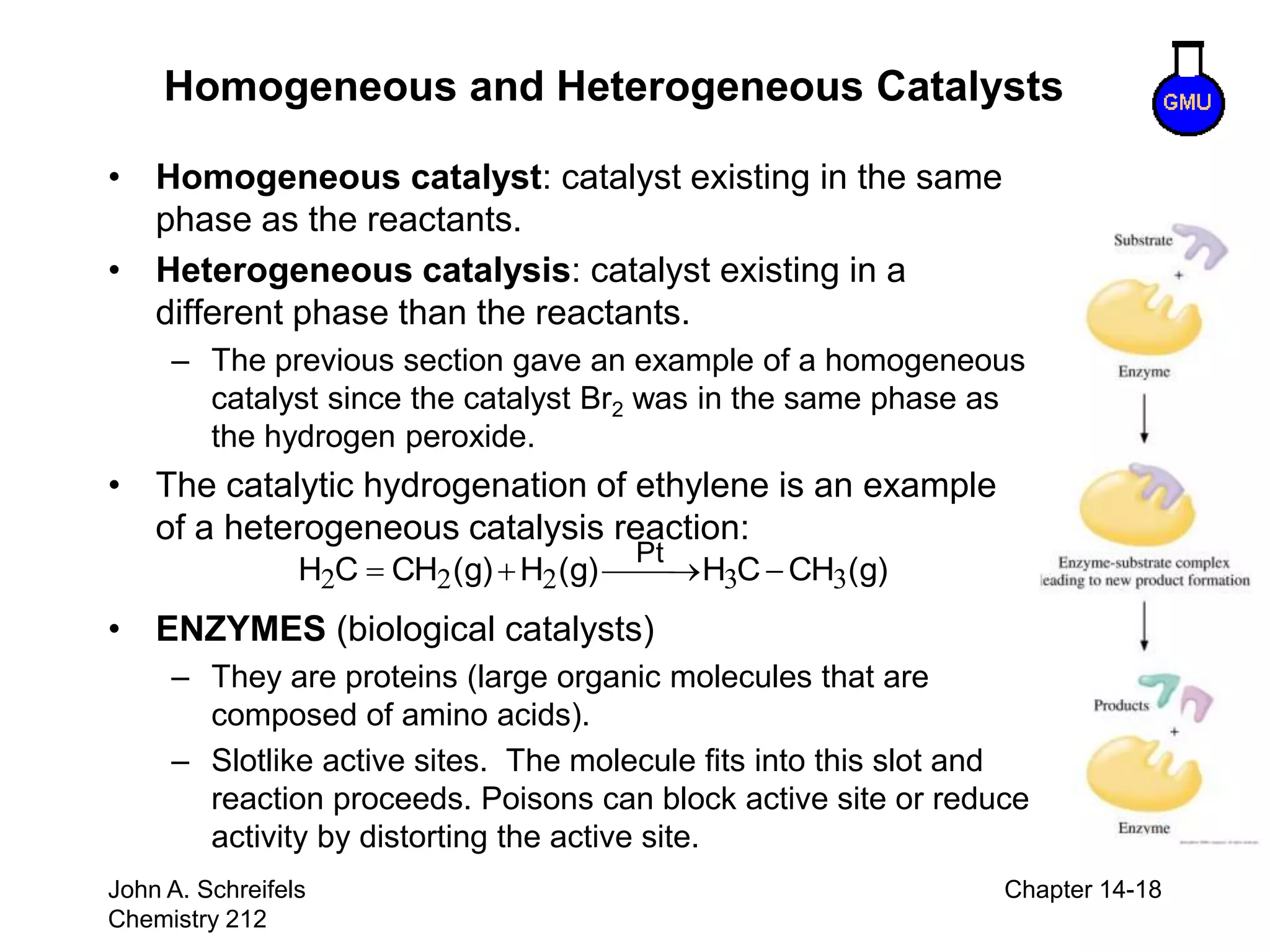
• ENZYMES (biological catalysts)
– They are proteins (large organic molecules that are
composed of amino acids).
– Slotlike active sites. The molecule fits into this slot and
reaction proceeds. Poisons can block active site or reduce
activity by distorting the active site.
)
g
(
CH
C
H
)
g
(
H
)
g
(
CH
C
H
Pt
3
3
2
2
2 





8–19
John A. Schreifels
Chemistry 212
Chapter 14-19
“Steric Factor”
• Molecules must have the correct orientation before
a reaction can take place.
Figure 14.12 Importance of Molecular Orientation
Return to p. 14-14

rate of reaction ppt.ppt

  • 1.
    8–1 John A. Schreifels Chemistry212 Chapter 14-1 Chapter 14 Rates of Reaction
  • 2.
    8–2 John A. Schreifels Chemistry212 Chapter 14-2 Overview • Reaction Rates – Definition of Reaction Rates – Experimental Determination of Rate – Dependence of Rate on Concentration – Change of Concentration with Time – Temperature and Rate; Collision and Transition-State Theories. – Arrhenius Equation • Reaction Mechanisms – Elementary Reactions – Rate Law and the Mechanism – Catalysis
  • 3.
    8–3 John A. Schreifels Chemistry212 Chapter 14-3 Reaction Rates • Deal with the speed of a reaction and controlled by: – Proportional to concentrations of reactants – Proportional to catalyst concentration; catalyst = a substance that increases the rate of reaction without being consumed in the reaction. – Larger surface area of catalyst means higher reaction rate (more sites for reaction to take place). – Temperature: Higher temperature of reaction means faster.
  • 4.
    8–4 John A. Schreifels Chemistry212 Chapter 14-4 Definition of Reaction Rate • Reaction rate = increase in concentration of product of a reaction as a function of time or decrease in concentration of reaction as a function of time. • Thus the rate of a reaction is: 1 2 1 2 change time A change conc t t ] A [ ] A [ t ] A [ RateA        Concentration vs Reaction Time A + 2B --> 3C 0.000 0.045 0.090 0 250 500 Time, s Concentration, M Init Rate Ave. Rate Inst. Rate • Rates are expressed as positive numbers. For the reaction in the graph we have: t ] A [ RA     t ] B [ RB     t ] C [ RC    
  • 5.
    8–5 John A. Schreifels Chemistry212 Chapter 14-5 Reaction Rates and Stoichiometry • A + B  C; RC = RA = RB. • A + 2B  3C; E.g.Calculate the rate of decomposition of HI in the reaction: 2HI(g)  H2(g) + I2(g). Given: After a reaction time of 100 secs. the concentration of HI decreased by 0.500 M. • For the general reaction: aA + bB  cC + dD E.g. For the reaction 2A + 3B  4C + 2D; determine the rates of B, C and D if the rate of consumption of A is 0.100 M/s. C B A R 3 1 R 2 1 R   D C B A R d a R c a R b a R   
  • 6.
    8–6 John A. Schreifels Chemistry212 Chapter 14-6 Rate Laws and Reaction Order • Rate Law – an equation that tells how the reaction rate depends on the concentration of each reaction. • Reaction order – the value of the exponents of concentration terms in the rate law. • For the reaction: aA + bB  cC + dD, the initial rate of reaction is related to the concentration of reactants. • Varying the initial concentration of one reactant at a time produces rates, which will lead to the order of each reactant. • The rate law describes this dependence: R = k[A]m[B]n where k = rate constant and m and n are the orders of A and B respectively. – m = 1 (A varied, B held constant) gives R = k’[A]. Rate is directly proportional to [A]. Doubling A doubles R – m = 2 (A varied, B held constant) gives R = k’[A]2. The rate is proportional to [A]2. Doubling A quadruples R. E.g. Determine order of each reactant: HCOOH(aq) + Br2(aq)  2H+(aq) + 2Br(aq) + CO2(g) R = k[Br2] E.g. The formation of HI gas has the following rate law: R = k[H2][I2]. What is the order of each reactant?
  • 7.
    8–7 John A. Schreifels Chemistry212 Chapter 14-7 Experimental Determination of a Rate Law: First Order • Varying initial concentration of reactants changes the initial rate (usually all but one held constant) like one with two unknowns. • Initial rate is the initial slope of the graph shown. • As the initial concentration of that compound increases so does the rate. – Initial rate vs. [A]o plotted. – If straight line then reaction is first order and slope is rate constant. • Second order rate law determined in like manner. Concentration vs Reaction Time A + 2B --> 3C 0.000 0.050 0.100 0 250 500 Time, s [A] 0 , M Initial Rate vs. [A]o 0.0000 0.0001 0.0002 0.0003 0.0004 0.0005 0.00 0.03 0.05 0.08 0.10 [A]o R o
  • 8.
    8–8 John A. Schreifels Chemistry212 Chapter 14-8 Rate Law for All Reactants • Order for all components done same way. E.g. Determine the reaction order for each reactant from the table. (aq)+5Br(aq)+6H+(aq)3Br2(aq)+3H2O(l) [  3 BrO ]o [Br ]o [H+ ]o Ro 0.10 0.10 0.10 1.2 0.20 0.10 0.10 2.4 0.10 0.30 0.10 3.5 0.20 0.10 0.15 5.4  3 BrO Eg. 2: Determine the reaction orders for the reaction indicated from the data provided. A + 2B + C  Products. [A]o [B]o [C]o Ro 2.06 3.05 4.00 3.7 0.87 3.05 4.00 0.66 0.50 0.50 0.50 0.013 1.00 0.50 1.00 0.072
  • 9.
    8–9 John A. Schreifels Chemistry212 Chapter 14-9 Integrated Rate Law: First–Order Reaction • For a first order reaction, Rate = [A]/t = k[A] or RA = d[A]/dt = k[A]. • Use of calculus leads to: or • Allows one to calculate the [A] at any time after the start of the reaction. E.g. Calculate the concentration of N2O remaining after its decomposition according to 2N2O(g)  2N2(g) + O2(g) if it’s rate is first order and [N2O]o = 0.20M, k = 3.4 s1 and T = 780°C. Find its concentration after 100 ms. • Linearized forms: or • Plot ln[A] vs t. • Slope of straight line leads to rate constant, k. E.g. When cyclohexane(let's call it C) is heated to 500 oC, it changes into propene. Using the following data from one experiment, determine the first order rate constant.: kt ] A [ ] A [ ln o   t 303 . 2 k ] A [ ] A [ log o   o ] A ln[ kt ] A ln[    o ] A log[ t 303 . 2 k ] A log[    t,min 0.00 5.00 10.00 15.00 [C],mM 1.50 1.24 1.00 0.83
  • 10.
    8–10 John A. Schreifels Chemistry212 Chapter 14-10 Half-Life: First Order Reaction • Half-life of First order reaction, t1/2 = 0.693/k. the time required for the concentration of the reactant to change to ½ of its initial value. i.e. at t1/2 , [A] = ½ [A]o E.g. For the decomposition of N2O5 at 65 °C, the half-life was found to be 130 s. Determine the rate constant for this reaction. k t t k t k A A o o / 693 . 0 2 1 ln ] [ ] [ 2 / 1 ln 2 / 1 2 / 1 2 / 1                    • For n half-lives t = n*t1/2 [A] = 2n [A]o o t n n n / ] A [ ] A [ t k ln t n k ln n                            2 1 2 1 2 1 2 1
  • 11.
    8–11 John A. Schreifels Chemistry212 Chapter 14-11 Second–Order Reactions: Integrated Rate Law • Rate law: R = k[A]2 and the integrated rate equation is: • Plot of vs. t gives a straight line with a slope of k. • Half-life is: E.g. At 330°C, the rate constant for the decomposition of NO2 is 0.775 L/(mol*s). If the reaction is second-order, what is the concentration of NO2 after 2.5x10² s if the starting of concentration was 0.050 M? o t ] A [ kt ] A [ 1 1   t ] A [ 1 o 2 / 1 ] A [ k 1 t  
  • 12.
    8–12 John A. Schreifels Chemistry212 Chapter 14-12 Reaction Mechanisms • Give insight into sequence of reaction events leading to product (reaction mechanism). • Each of the steps leading to product is called an elementary reaction or elementary step. • Consider the reaction of nitrogen dioxide with carbon dioxide which is second order on NO2: NO2(g) + CO(g)  NO(g) + CO2(g) Rate = k[NO2]2. • Rate law suggests at least two steps. • A proposed mechanism for this reaction involves two steps. – NO3 is a reaction intermediate = a substance that is produced and consumed in the reaction so that none is detected when the reaction is finished. • The elementary reactions are often described in terms of their molecularity. – Unimolecular One particle in elementary. – Bimolecular = 2 particles and – Termolecular = 3 particles Step 1 2NO2(g)  NO3(g) + NO(g) Step 2 NO3(g) +CO(g) NO2(g) + CO2(g) Overall NO2 + CO  NO + CO2
  • 13.
    8–13 John A. Schreifels Chemistry212 Chapter 14-13 Rate Laws and Reaction Mechanisms • Overall reaction order is often determined by the rate determining step. • Use rate law of limiting step; No intermediates! 2NO2(g)  NO3(g) + NO(g), R1 = k1[NO2]2 Slow NO3(g) +CO(g) NO2(g) + CO2(g) R2 = k2[NO3][CO] Fast NO2 + CO  NO + CO2 Robs = k[NO2]2 E.g. Determine the rate law for the following mechanism: 2*[N2O5(g) ) g ( NO ) g ( NO 3 2 k1 1 k       ] Fast NO3(g) +NO2(g) ) g ( O ) g ( NO ) g ( NO 2 2 k2       Slow NO3 + NO ) g ( NO 2 2 k3     Fast 2N2O5(g) ) g ( O ) g ( NO 4 2 2 kobs        Use steady state approximation. at “equilibrium” rates of forward and reverse reactions are same. Use to eliminate intermediates from rate law equations. or 3 2 1 5 2 1 1 1 ] NO ][ NO [ k ] O N [ k R R     ] NO [ ] O N [ k k ] NO [ 2 5 2 1 3 1  
  • 14.
    8–14 John A. Schreifels Chemistry212 Chapter 14-14 Reaction Rates and Temperature: The Arrhenius Equation • Rate (rate constant) increases exponentially with temperature. • Collision theory indicates collisions every 109s – 1010s at 25°C and 1 atm. i.e. only a small fraction of the colliding molecules actually react. • Collision theory assumes: – Reaction can only occur if collision takes place. – Colliding molecules must have correct orientation and energy. – Collision rate is directing proportional to the concentration of colliding particles. A + B  Products; Rc = Z[A][B] 2A + B  Products; Rc = Z[A]2[B], etc. • Only a fraction of the molecules, p (“steric factor”), have correct orientation; multiply collision rate by p. • Particle must have enough energy. Fraction of those with correct energy follows Boltzmann equation where Ea = activation energy, R = gas constant and T = temp. (Kelvin scale only please). • This gives: k = Zpf RT / Ea e f  
  • 15.
    8–15 John A. Schreifels Chemistry212 Chapter 14-15 Transition State Theory • Explains the reaction resulting from the collision of molecules to form an activated complex. • Activated complex is unstable and can break to form product. Exothermic Reaction Endothermic Reaction
  • 16.
    8–16 John A. Schreifels Chemistry212 Chapter 14-16 The Arrhenius Equation • Summary: where A = frequency factor. • Linear form: . • Plot ln k vs. 1/T; the slope gives Ea/R. E.g. determine the activation energy for the decomposition of N2O5 from the temperature dependence of the rate constant. • Two point equation sometimes used also: E.g.2: Determine the rate constant at 35°C for the hydrolysis of sucrose, given that at 37°C it is 0.91mL/(mol*sec). The activation energy of this reaction is 108 kJ/mol. • Rate constant increases when T2>T1 RT E A ln k ln a           RT E exp A k a Arrhenius Plot 1/T, K 0.00300 0.00305 0.00310 0.00315 ln k -8 -7 -6 -5 k, s1 Temp., °C Temp., K 4.8x104 45.0 318.15 8.8x104 50.0 323.15 1.6x103 55.0 328.15 2.8x103 60.0 333.15           2 1 a 1 2 T 1 T 1 R E k k ln
  • 17.
    8–17 John A. Schreifels Chemistry212 Chapter 14-17 Catalysis • Catalysts a substance that increases the rate of a reaction without being consumed in the reaction. • Catalyst provides an alternative pathway from reactant to product which has a rate determining step that has a lower activation energy than that of the original pathway. • E.g. Hydrogen peroxide and bromine: 2H2O2(aq)  2H2O(l)+ O2(g). • Mechanism is believed to be : 1. Br2 red Br2(aq) + H2O2(aq)  2Br(aq) +2H+(aq)+O2(g) 2. Br oxid 2H+(aq)+2Br(aq)+H2O2(aq)  Br2(aq) + 2H2O(l). Overall 2H2O2(aq)  2H2O(l)+O2(g) • Notice that bromine is not consumed, even though it has participated in the reaction.
  • 18.
    8–18 John A. Schreifels Chemistry212 Chapter 14-18 Homogeneous and Heterogeneous Catalysts • Homogeneous catalyst: catalyst existing in the same phase as the reactants. • Heterogeneous catalysis: catalyst existing in a different phase than the reactants. – The previous section gave an example of a homogeneous catalyst since the catalyst Br2 was in the same phase as the hydrogen peroxide. • The catalytic hydrogenation of ethylene is an example of a heterogeneous catalysis reaction: • ENZYMES (biological catalysts) – They are proteins (large organic molecules that are composed of amino acids). – Slotlike active sites. The molecule fits into this slot and reaction proceeds. Poisons can block active site or reduce activity by distorting the active site. ) g ( CH C H ) g ( H ) g ( CH C H Pt 3 3 2 2 2      
  • 19.
    8–19 John A. Schreifels Chemistry212 Chapter 14-19 “Steric Factor” • Molecules must have the correct orientation before a reaction can take place. Figure 14.12 Importance of Molecular Orientation Return to p. 14-14