
Improving HBase availability in a multi-tenant
environment
James Moore (jcmoore@hubspot.com)
Kahlil Oppenheimer (kahlil@hubspot.com)
Outline
● Who are we?
● What problems are we solving?
● Reducing the cost of Region Server failure
● Improving the stochastic load balancer
● Eliminating workload driven failure
● Reducing the impact of hardware failure
Who are we?
● HubSpot’s Big Data Team provides HBase as a Service to
our 50+ Product and Engineering teams.
● HBase is Hubspot’s canonical Data store and reliably
stores all of our customers’ data
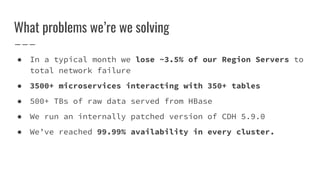
What problems we’re we solving
● In a typical month we lose ~3.5% of our Region Servers to
total network failure
● 3500+ microservices interacting with 350+ tables
● 500+ TBs of raw data served from HBase
● We run an internally patched version of CDH 5.9.0
● We’ve reached 99.99% availability in every cluster.
Reducing the cost of failure
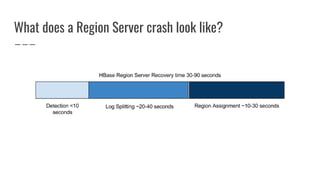
What does a Region Server crash look like?
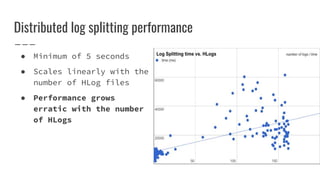
Distributed log splitting performance
● Minimum of 5 seconds
● Scales linearly with the
number of HLog files
● Performance grows
erratic with the number
of HLogs
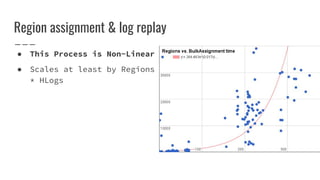
Region assignment & log replay
● This Process is Non-Linear
● Scales at least by Regions
* HLogs
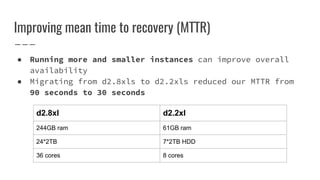
Improving mean time to recovery (MTTR)
● Running more and smaller instances can improve overall
availability
● Migrating from d2.8xls to d2.2xls reduced our MTTR from
90 seconds to 30 seconds
d2.8xl d2.2xl
244GB ram 61GB ram
24*2TB 7*2TB HDD
36 cores 8 cores
… But the AsyncProcess can get in the way
● AsyncProcess & AsyncRequestFutureImpl didn’t respect
operation timeout
● Meta fetches didn’t respect operation timeout
● Open connections to an offline meta server could cause
the client to block until socket failure far into the
future.
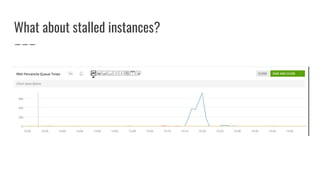
What about stalled instances?
What is the cause?
● Degraded hardware performance?
○ Slow I/O
○ Stuck kernel threads
○ High packet loss
● Long GC pauses?
● Hot regions?
● Noisy user?
Strategy
● Eliminate usage related failures
● Tune GC bit.ly/hbasegc
● Monitor and proactively remove misbehaving hardware
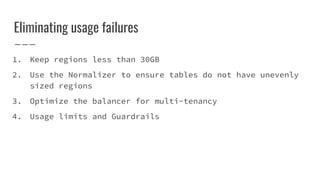
Eliminating usage failures
1. Keep regions less than 30GB
2. Use the Normalizer to ensure tables do not have unevenly
sized regions
3. Optimize the balancer for multi-tenancy
4. Usage limits and Guardrails
Improving the balancer
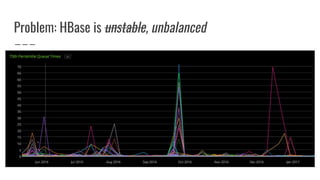
Problem: HBase is unstable, unbalanced
We investigated and found one issue...
1. Balancer stops if servers host same number of regions
We investigated and found one two issues...
1. Balancer stops if servers host same number of regions
2. Requests for tables aren’t distributed across cluster
We investigated and found one two three issues...
1. Balancer stops if servers host same number of regions
2. Requests for tables aren’t distributed across cluster
3. Balancer performance doesn’t scale well with cluster size
Quick refresher
on stochastic load
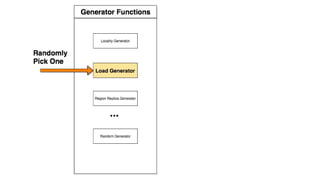
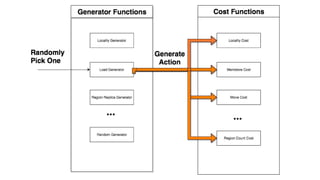
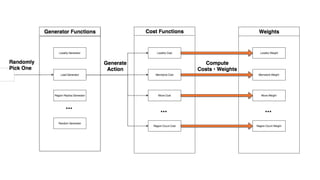
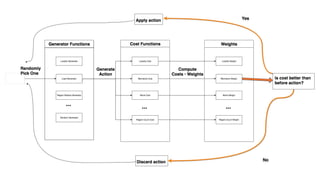
balancer There will be pictures...
The first issue
1. Balancer stops if servers host same number of regions
The first issue...turned out to be intentional
1. Balancer stops if servers host same number of regions
Theory: design choice when balancer was simpler
So our solution is perhaps a design choice
1. Balancer stops if servers host same number of regions
Theory: design choice when balancer was simpler
Solution: disable the “slop” logic for the stochastic load balancer
The second issue
2. Requests for tables aren’t distributed across cluster
The second issue, involved some theorizing
2. Requests for tables aren’t distributed across cluster
Theory: cluster has high table skew
But every good theory requires a bit of background...
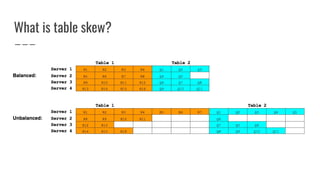
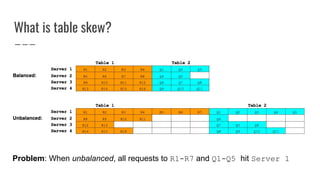
What is table skew?
What is table skew?
Problem: When unbalanced, all requests to R1-R7 and Q1-Q5 hit Server 1
If cluster has high table skew, we expect...
● High table skew cost
● High responsiveness to tuning table skew weight
But we found...
● High low table skew cost
● High low responsiveness to tuning table skew weight
So we dug in and discovered...
● Regions are not evenly distributed across the cluster
● Table skew is present, contrary to what balancer reports
Time for a new theory...
2. Requests for single tables hit subset of region servers
Theory: table skew not properly computed
And a solution!
2. Requests for single tables hit subset of region servers
Theory: table skew not properly computed
Solution: Create new table skew cost function and generator
New table skew cost function (HBASE-17707)
● Computes number of moves/swaps required to evenly
distribute each table’s regions
New table skew cost function (HBASE-17707)
● Computes number of moves/swaps required to evenly
distribute each table’s regions
● Outputs a value between [0, 1] proportional to the number
of moves required
New table skew cost function (HBASE-17707)
● Computes number of moves/swaps required to evenly
distribute each table’s regions
● Outputs a value between [0, 1] proportional to the number
of moves required
● Analogous to “edit distance” between two words
New table skew candidate generator (HBASE-17707)
Propose region moves/swaps to optimize TableSkewCostFunction
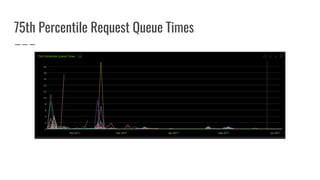
How did our fix work in practice?
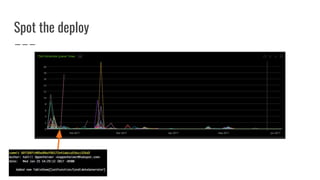
75th Percentile Request Queue Times
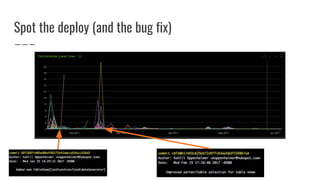
Spot the deploy
Spot the deploy (and the bug fix)
Back to investigating...
3. Balancer performance doesn’t scale well with cluster size
Back to investigating...
3. Balancer performance doesn’t scale well with cluster size
Theory: table skew calculation takes too long
Back to investigating...
3. Balancer performance doesn’t scale well with cluster size
Theory: table skew calculation takes too long
But new table skew code didn’t improve performance...
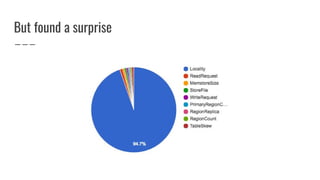
So we benchmarked cost functions
But found a surprise
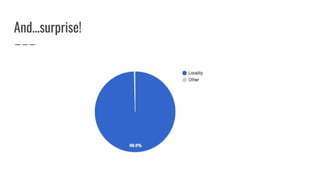
We benchmarked generators too...
And...surprise!
What is locality?
A measure of how close the data is to the computation
For HBase: How much of a region’s data is on its host’s disk
Back to theorizing
3. Balancer performance doesn’t scale well with cluster size
Theory: table skew calculation takes too long
Theory: locality computation takes too long
And solution-izing
3. Balancer performance doesn’t scale well with cluster size
Theory: Locality computation takes too long
Solution: Redesign locality cost function and generator
The old locality code
● Recomputes locality of every region on every server
The old locality code
● Recomputes locality of every region on every server
● Reads every HDFS block location of every region
The old locality code
● Recomputes locality of every region on every server
● Reads every HDFS block location of every region
● For every action the balancer proposes!
New locality code (HBASE-18164)
● Caches localities of all regions on all servers
New locality code (HBASE-18164)
● Caches localities of all regions on all servers
● Incrementally updates locality cost based on proposed
region moves/swaps
New locality code (HBASE-18164)
● Caches localities of all regions on all servers
● Incrementally updates locality cost based on proposed
region moves/swaps
● Add per-rack locality computation
○ Reduce AWS charges for inter-rack data transfer
But does it work?
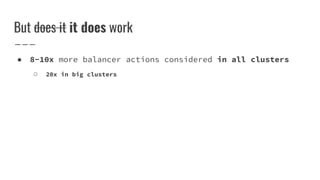
But does it it does work
● 8-10x more balancer actions considered in all clusters
○ 20x in big clusters
But does it it does work
● 8-10x more balancer actions considered in all clusters
○ 20x in big clusters
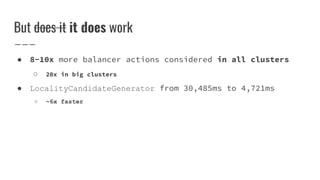
● LocalityCandidateGenerator from 30,485ms to 4,721ms
○ ~6x faster
But does it it does work
● 8-10x more balancer actions considered in all clusters
○ 20x in big clusters
● LocalityCandidateGenerator from 30,485ms to 4,721ms
○ ~6x faster
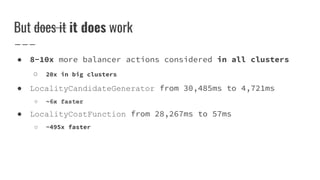
● LocalityCostFunction from 28,267ms to 57ms
○ ~495x faster
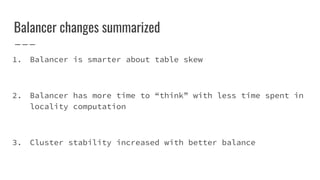
Balancer changes summarized
1. Balancer is smarter about table skew
2. Balancer has more time to “think” with less time spent in
locality computation
3. Cluster stability increased with better balance
Eliminating workload driven failure
Limit RPC handler usage by service
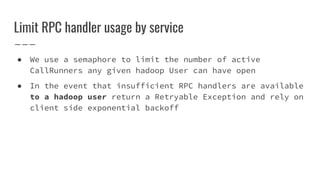
● We use a semaphore to limit the number of active
CallRunners any given hadoop User can have open
● In the event that insufficient RPC handlers are available
to a hadoop user return a Retryable Exception and rely on
client side exponential backoff
Client guardrails
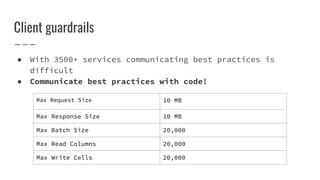
● With 3500+ services communicating best practices is
difficult
● Communicate best practices with code!
Max Request Size 10 MB
Max Response Size 10 MB
Max Batch Size 20,000
Max Read Columns 20,000
Max Write Cells 20,000
Reducing the impact of hardware failure
Prioritize removal of bad hardware
● Watch kernel logs for
○ I/O failures
○ Stuck Threads
○ General kernel errors
● Prioritize removal of these instances to prevent
regionserver stalls
● We use an in-house orchestration tool known as
Tranquility for this
Now we’ll take questions :)
Thanks for listening. Feel free to reach out!
jcmoore@hubspot.com, kahlil@hubspot.com

HBaseCon2017 Improving HBase availability in a multi tenant environment

  • 1.
    Improving HBase availabilityin a multi-tenant environment James Moore (jcmoore@hubspot.com) Kahlil Oppenheimer (kahlil@hubspot.com)
  • 2.
    Outline ● Who arewe? ● What problems are we solving? ● Reducing the cost of Region Server failure ● Improving the stochastic load balancer ● Eliminating workload driven failure ● Reducing the impact of hardware failure
  • 3.
    Who are we? ●HubSpot’s Big Data Team provides HBase as a Service to our 50+ Product and Engineering teams. ● HBase is Hubspot’s canonical Data store and reliably stores all of our customers’ data
  • 4.
    What problems we’rewe solving ● In a typical month we lose ~3.5% of our Region Servers to total network failure ● 3500+ microservices interacting with 350+ tables ● 500+ TBs of raw data served from HBase ● We run an internally patched version of CDH 5.9.0 ● We’ve reached 99.99% availability in every cluster.
  • 5.
  • 6.
    What does aRegion Server crash look like?
  • 7.
    Distributed log splittingperformance ● Minimum of 5 seconds ● Scales linearly with the number of HLog files ● Performance grows erratic with the number of HLogs
  • 8.
    Region assignment &log replay ● This Process is Non-Linear ● Scales at least by Regions * HLogs
  • 9.
    Improving mean timeto recovery (MTTR) ● Running more and smaller instances can improve overall availability ● Migrating from d2.8xls to d2.2xls reduced our MTTR from 90 seconds to 30 seconds d2.8xl d2.2xl 244GB ram 61GB ram 24*2TB 7*2TB HDD 36 cores 8 cores
  • 10.
    … But theAsyncProcess can get in the way ● AsyncProcess & AsyncRequestFutureImpl didn’t respect operation timeout ● Meta fetches didn’t respect operation timeout ● Open connections to an offline meta server could cause the client to block until socket failure far into the future.
  • 11.
  • 12.
    What is thecause? ● Degraded hardware performance? ○ Slow I/O ○ Stuck kernel threads ○ High packet loss ● Long GC pauses? ● Hot regions? ● Noisy user?
  • 13.
    Strategy ● Eliminate usagerelated failures ● Tune GC bit.ly/hbasegc ● Monitor and proactively remove misbehaving hardware
  • 14.
    Eliminating usage failures 1.Keep regions less than 30GB 2. Use the Normalizer to ensure tables do not have unevenly sized regions 3. Optimize the balancer for multi-tenancy 4. Usage limits and Guardrails
  • 15.
  • 16.
    Problem: HBase isunstable, unbalanced
  • 17.
    We investigated andfound one issue... 1. Balancer stops if servers host same number of regions
  • 18.
    We investigated andfound one two issues... 1. Balancer stops if servers host same number of regions 2. Requests for tables aren’t distributed across cluster
  • 19.
    We investigated andfound one two three issues... 1. Balancer stops if servers host same number of regions 2. Requests for tables aren’t distributed across cluster 3. Balancer performance doesn’t scale well with cluster size
  • 20.
    Quick refresher on stochasticload balancer There will be pictures...
  • 25.
    The first issue 1.Balancer stops if servers host same number of regions
  • 26.
    The first issue...turnedout to be intentional 1. Balancer stops if servers host same number of regions Theory: design choice when balancer was simpler
  • 27.
    So our solutionis perhaps a design choice 1. Balancer stops if servers host same number of regions Theory: design choice when balancer was simpler Solution: disable the “slop” logic for the stochastic load balancer
  • 28.
    The second issue 2.Requests for tables aren’t distributed across cluster
  • 29.
    The second issue,involved some theorizing 2. Requests for tables aren’t distributed across cluster Theory: cluster has high table skew
  • 30.
    But every goodtheory requires a bit of background...
  • 31.
  • 32.
    What is tableskew? Problem: When unbalanced, all requests to R1-R7 and Q1-Q5 hit Server 1
  • 33.
    If cluster hashigh table skew, we expect... ● High table skew cost ● High responsiveness to tuning table skew weight
  • 34.
    But we found... ●High low table skew cost ● High low responsiveness to tuning table skew weight
  • 35.
    So we dugin and discovered... ● Regions are not evenly distributed across the cluster ● Table skew is present, contrary to what balancer reports
  • 36.
    Time for anew theory... 2. Requests for single tables hit subset of region servers Theory: table skew not properly computed
  • 37.
    And a solution! 2.Requests for single tables hit subset of region servers Theory: table skew not properly computed Solution: Create new table skew cost function and generator
  • 38.
    New table skewcost function (HBASE-17707) ● Computes number of moves/swaps required to evenly distribute each table’s regions
  • 39.
    New table skewcost function (HBASE-17707) ● Computes number of moves/swaps required to evenly distribute each table’s regions ● Outputs a value between [0, 1] proportional to the number of moves required
  • 40.
    New table skewcost function (HBASE-17707) ● Computes number of moves/swaps required to evenly distribute each table’s regions ● Outputs a value between [0, 1] proportional to the number of moves required ● Analogous to “edit distance” between two words
  • 41.
    New table skewcandidate generator (HBASE-17707) Propose region moves/swaps to optimize TableSkewCostFunction
  • 42.
    How did ourfix work in practice?
  • 43.
  • 44.
  • 45.
    Spot the deploy(and the bug fix)
  • 46.
    Back to investigating... 3.Balancer performance doesn’t scale well with cluster size
  • 47.
    Back to investigating... 3.Balancer performance doesn’t scale well with cluster size Theory: table skew calculation takes too long
  • 48.
    Back to investigating... 3.Balancer performance doesn’t scale well with cluster size Theory: table skew calculation takes too long But new table skew code didn’t improve performance...
  • 49.
    So we benchmarkedcost functions
  • 50.
    But found asurprise
  • 51.
  • 52.
  • 53.
    What is locality? Ameasure of how close the data is to the computation For HBase: How much of a region’s data is on its host’s disk
  • 54.
    Back to theorizing 3.Balancer performance doesn’t scale well with cluster size Theory: table skew calculation takes too long Theory: locality computation takes too long
  • 55.
    And solution-izing 3. Balancerperformance doesn’t scale well with cluster size Theory: Locality computation takes too long Solution: Redesign locality cost function and generator
  • 56.
    The old localitycode ● Recomputes locality of every region on every server
  • 57.
    The old localitycode ● Recomputes locality of every region on every server ● Reads every HDFS block location of every region
  • 58.
    The old localitycode ● Recomputes locality of every region on every server ● Reads every HDFS block location of every region ● For every action the balancer proposes!
  • 59.
    New locality code(HBASE-18164) ● Caches localities of all regions on all servers
  • 60.
    New locality code(HBASE-18164) ● Caches localities of all regions on all servers ● Incrementally updates locality cost based on proposed region moves/swaps
  • 61.
    New locality code(HBASE-18164) ● Caches localities of all regions on all servers ● Incrementally updates locality cost based on proposed region moves/swaps ● Add per-rack locality computation ○ Reduce AWS charges for inter-rack data transfer
  • 62.
  • 63.
    But does itit does work ● 8-10x more balancer actions considered in all clusters ○ 20x in big clusters
  • 64.
    But does itit does work ● 8-10x more balancer actions considered in all clusters ○ 20x in big clusters ● LocalityCandidateGenerator from 30,485ms to 4,721ms ○ ~6x faster
  • 65.
    But does itit does work ● 8-10x more balancer actions considered in all clusters ○ 20x in big clusters ● LocalityCandidateGenerator from 30,485ms to 4,721ms ○ ~6x faster ● LocalityCostFunction from 28,267ms to 57ms ○ ~495x faster
  • 66.
    Balancer changes summarized 1.Balancer is smarter about table skew 2. Balancer has more time to “think” with less time spent in locality computation 3. Cluster stability increased with better balance
  • 67.
  • 68.
    Limit RPC handlerusage by service ● We use a semaphore to limit the number of active CallRunners any given hadoop User can have open ● In the event that insufficient RPC handlers are available to a hadoop user return a Retryable Exception and rely on client side exponential backoff
  • 69.
    Client guardrails ● With3500+ services communicating best practices is difficult ● Communicate best practices with code! Max Request Size 10 MB Max Response Size 10 MB Max Batch Size 20,000 Max Read Columns 20,000 Max Write Cells 20,000
  • 70.
    Reducing the impactof hardware failure
  • 71.
    Prioritize removal ofbad hardware ● Watch kernel logs for ○ I/O failures ○ Stuck Threads ○ General kernel errors ● Prioritize removal of these instances to prevent regionserver stalls ● We use an in-house orchestration tool known as Tranquility for this
  • 72.
    Now we’ll takequestions :)
  • 73.
    Thanks for listening.Feel free to reach out! jcmoore@hubspot.com, kahlil@hubspot.com