3rd African Soil Partnership (AfSP) Meeting
Country presentation: BOTSWANA
by
Name… C. M. FANANI
Institution… Ministry of Agricultural
Development and Food Security
CONTENTS
• OVERVIEW OF THE COUNTRY
• SOIL TYPES
• SPEDU STUDY AREA
• CHALLENGES ON SUSTAINABLE SOIL MANAGEMENT
• PLANS FOR 2018/19
• STRATEGIES ON SOIL
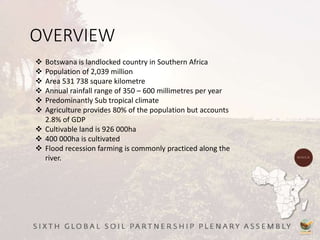
OVERVIEW
 Botswana is landlocked country in Southern Africa
 Population of 2,039 million
 Area 531 738 square kilometre
 Annual rainfall range of 350 – 600 millimetres per year
 Predominantly Sub tropical climate
 Agriculture provides 80% of the population but accounts
2.8% of GDP
 Cultivable land is 926 000ha
 400 000ha is cultivated
 Flood recession farming is commonly practiced along the
river.
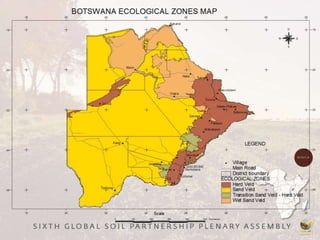
SOILS IN BOTSWANA
• 73% of the country is dominated by Kalahari sands
(Arenosols)
• Vertisols –(Area 0.6%)
• Fluvisols –(Area 0.1%)
• Gleysols –(0.2%)
• Leptosols –(Area 3%)
• Regosols – (5%)
• Lixisols – (3%)
• Cambisols- (0.7%)
• Solanchaks – (1.5%)
• Calcisols –(4.2%)
• Luvisols – (5%)
• Chernozems (0.01%)
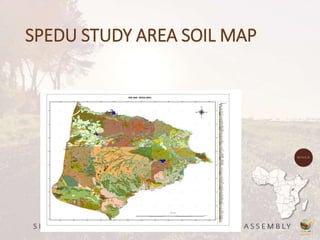
SPEDU STUDY AREA SOIL MAP
AIM OF THE PROJECT
• Selibe Phikwe Diversification unit (SPEDU) is
regional development strategy which was meant to
diversify the economy of the country as well as
creating the employment for the nation.
• The objective of the study was to investigate,
identify and describe the characteristics and
distribution of different soils in the area.
• Evaluate the suitability of the soil of the project
area for irrigation.
• Soil investigation was conducted at feasibility level
in the area in line with FAO guidelines
STAKE HOLDERS
• Ministry of Agriculture
• Soil surveyors
• Landuse officers
• Cartographers
• Farmers
• Soil map and a suitability maps were produced
CHALLENGES ON SUSTAINABLE
SOIL MANAGEMENT IN THE AREA
• Eroded agricultural land
• Human wildlife conflict-more wildlife put pressure
on the environment.
• Land degradation due to nutrient depletion
• Lack of climate and flooding hazards maps
• Lack of funds
CHALLENGES
• Application of fertilizers without testing soils by
farmers lead to soil pollution
• Shortage of Soil Scientists
• Shortage of soil labs-one soil lab
• The soil data base not updated.
PRIORITIES AND NEEDS IN
BOTSWANA
• Developing small scale digital soil maps
• Strengthening soil laboratories, through
development of analytical methodologies and
junior staff training
• Exchange experience and information regional
• Create awareness on the use fertilizers
• Incorporate conservation farming in agriculture
Plans for 2018/2019
• Map clusters for farmers
• To assist farmers on land rehabilitation
• Advice farmers and stakeholders on land suitability
• To update the soil data base
THE END
THANK YOU

The 4th AfSP workshop: Botswana

  • 1.
    3rd African SoilPartnership (AfSP) Meeting Country presentation: BOTSWANA by Name… C. M. FANANI Institution… Ministry of Agricultural Development and Food Security
  • 2.
    CONTENTS • OVERVIEW OFTHE COUNTRY • SOIL TYPES • SPEDU STUDY AREA • CHALLENGES ON SUSTAINABLE SOIL MANAGEMENT • PLANS FOR 2018/19 • STRATEGIES ON SOIL
  • 3.
    OVERVIEW  Botswana islandlocked country in Southern Africa  Population of 2,039 million  Area 531 738 square kilometre  Annual rainfall range of 350 – 600 millimetres per year  Predominantly Sub tropical climate  Agriculture provides 80% of the population but accounts 2.8% of GDP  Cultivable land is 926 000ha  400 000ha is cultivated  Flood recession farming is commonly practiced along the river.
  • 5.
    SOILS IN BOTSWANA •73% of the country is dominated by Kalahari sands (Arenosols) • Vertisols –(Area 0.6%) • Fluvisols –(Area 0.1%) • Gleysols –(0.2%) • Leptosols –(Area 3%) • Regosols – (5%) • Lixisols – (3%) • Cambisols- (0.7%) • Solanchaks – (1.5%) • Calcisols –(4.2%) • Luvisols – (5%) • Chernozems (0.01%)
  • 6.
  • 7.
    AIM OF THEPROJECT • Selibe Phikwe Diversification unit (SPEDU) is regional development strategy which was meant to diversify the economy of the country as well as creating the employment for the nation. • The objective of the study was to investigate, identify and describe the characteristics and distribution of different soils in the area. • Evaluate the suitability of the soil of the project area for irrigation. • Soil investigation was conducted at feasibility level in the area in line with FAO guidelines
  • 8.
    STAKE HOLDERS • Ministryof Agriculture • Soil surveyors • Landuse officers • Cartographers • Farmers • Soil map and a suitability maps were produced
  • 9.
    CHALLENGES ON SUSTAINABLE SOILMANAGEMENT IN THE AREA • Eroded agricultural land • Human wildlife conflict-more wildlife put pressure on the environment. • Land degradation due to nutrient depletion • Lack of climate and flooding hazards maps • Lack of funds
  • 10.
    CHALLENGES • Application offertilizers without testing soils by farmers lead to soil pollution • Shortage of Soil Scientists • Shortage of soil labs-one soil lab • The soil data base not updated.
  • 11.
    PRIORITIES AND NEEDSIN BOTSWANA • Developing small scale digital soil maps • Strengthening soil laboratories, through development of analytical methodologies and junior staff training • Exchange experience and information regional • Create awareness on the use fertilizers • Incorporate conservation farming in agriculture
  • 12.
    Plans for 2018/2019 •Map clusters for farmers • To assist farmers on land rehabilitation • Advice farmers and stakeholders on land suitability • To update the soil data base
  • 13.