
Research and technology options
for increasing crop yields and
enhancing soil fertility
By
A.L. Abate
University of Juba
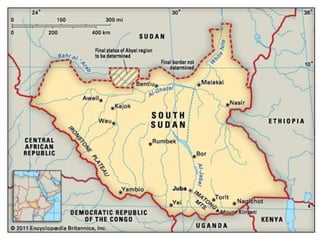
South Sudan Eco-Zones
 Potentially arable land 195,000 km2 (30%)
 Grazing land 260,000 km2 (40%)
 Heavily forested 146,000 km2 (23%)
 Swamps & water 45,000 km2 (7%)
surfaces
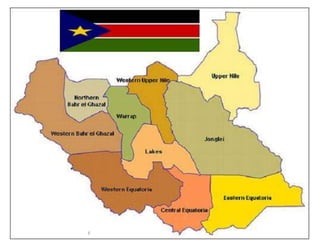
South Sudan Eco-zones & Human Activities
 Arid Belt Gum collection and marketing
 Green Belt Agriculture e.g. tea, palm oil, food crops
 Flood plains Mainly cattle keeping; some agriculture
 Hills & Mountains Mixed agriculture
 Ironstone Plateau Predominantly agriculture with livestock
 Nile/Sobat corridor Cattle and fish
Consequences of two Wars on South
Sudan Agriculture
• Loss of germ plasm
• Loss of farming skills
• Loss of interest in farming
• Development of alternative sources of livelihood
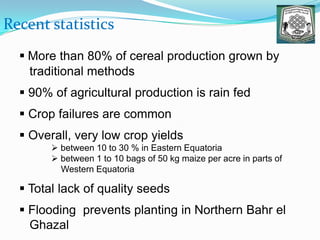
Recent statistics
 More than 80% of cereal production grown by
traditional methods
 90% of agricultural production is rain fed
 Crop failures are common
 Overall, very low crop yields
 between 10 to 30 % in Eastern Equatoria
 between 1 to 10 bags of 50 kg maize per acre in parts of
Western Equatoria
 Total lack of quality seeds
 Flooding prevents planting in Northern Bahr el
Ghazal
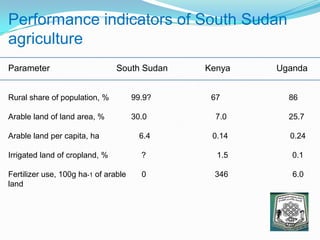
Performance indicators of South Sudan
agriculture
Parameter South Sudan Kenya Uganda
Rural share of population, % 99.9? 67 86
Arable land of land area, % 30.0 7.0 25.7
Arable land per capita, ha 6.4 0.14 0.24
Irrigated land of cropland, % ? 1.5 0.1
Fertilizer use, 100g ha-1 of arable 0 346 6.0
land
RESEARCH OPTIONS FOR SOUTH
SUDAN
 Action Research
On-farm trials
Demand-driven Research
Applied Research
Adaptive Research
INTERVENTIONS FOR INCREASING
YEILDS - a
 Intercropping
 Crop rotation – seasonal or annual
 Use of cover crops
Reduced tillage – minimum tillage
Composting
Organic matter additions
INTERVENTIONS FOR INCREASING
YEILDS - b
 Provide agricultural inputs
 Provide better agricultural practices
 Form farmer cooperatives
 Initiate farmer cooperatives
INTERVENTIONS FOR INCREASING
YEILDS - c
 Improve road infrastructure
 Emphasize applied agricultural research
 Develop a suitable extension service
 Encourage FDI
Thank you for
listening

Research and technology options for increasing crop yields and enhancing soil fertility

  • 1.
    Research and technologyoptions for increasing crop yields and enhancing soil fertility By A.L. Abate University of Juba
  • 2.
    South Sudan Eco-Zones Potentially arable land 195,000 km2 (30%)  Grazing land 260,000 km2 (40%)  Heavily forested 146,000 km2 (23%)  Swamps & water 45,000 km2 (7%) surfaces
  • 3.
    South Sudan Eco-zones& Human Activities  Arid Belt Gum collection and marketing  Green Belt Agriculture e.g. tea, palm oil, food crops  Flood plains Mainly cattle keeping; some agriculture  Hills & Mountains Mixed agriculture  Ironstone Plateau Predominantly agriculture with livestock  Nile/Sobat corridor Cattle and fish
  • 6.
    Consequences of twoWars on South Sudan Agriculture • Loss of germ plasm • Loss of farming skills • Loss of interest in farming • Development of alternative sources of livelihood
  • 7.
    Recent statistics  Morethan 80% of cereal production grown by traditional methods  90% of agricultural production is rain fed  Crop failures are common  Overall, very low crop yields  between 10 to 30 % in Eastern Equatoria  between 1 to 10 bags of 50 kg maize per acre in parts of Western Equatoria  Total lack of quality seeds  Flooding prevents planting in Northern Bahr el Ghazal
  • 8.
    Performance indicators ofSouth Sudan agriculture Parameter South Sudan Kenya Uganda Rural share of population, % 99.9? 67 86 Arable land of land area, % 30.0 7.0 25.7 Arable land per capita, ha 6.4 0.14 0.24 Irrigated land of cropland, % ? 1.5 0.1 Fertilizer use, 100g ha-1 of arable 0 346 6.0 land
  • 9.
    RESEARCH OPTIONS FORSOUTH SUDAN  Action Research On-farm trials Demand-driven Research Applied Research Adaptive Research
  • 10.
    INTERVENTIONS FOR INCREASING YEILDS- a  Intercropping  Crop rotation – seasonal or annual  Use of cover crops Reduced tillage – minimum tillage Composting Organic matter additions
  • 11.
    INTERVENTIONS FOR INCREASING YEILDS- b  Provide agricultural inputs  Provide better agricultural practices  Form farmer cooperatives  Initiate farmer cooperatives
  • 12.
    INTERVENTIONS FOR INCREASING YEILDS- c  Improve road infrastructure  Emphasize applied agricultural research  Develop a suitable extension service  Encourage FDI
  • 13.