Soil Organic Carbon stabilization
in compost amended soils
Spaccini R., Piccolo A.
CERMANU NMR Center
Università di Napoli Federico II
THEME 2: Maintaining and/or increasing SOC stocks for climate
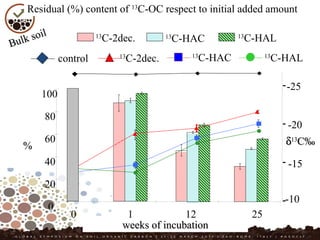
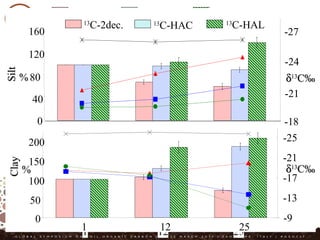
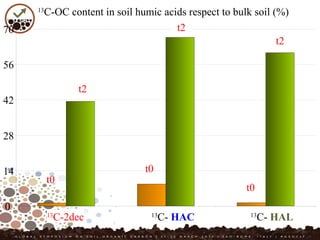
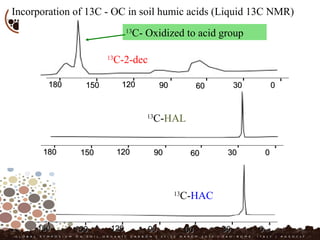
change mitigation and adaptation, and land degradation neutrality)
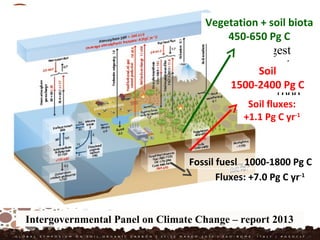
The soil organic carbon (SOC) represent the largest
reservoir in the global carbon cycle of terrestrial biosphere
pools, accounting for 1500-1770 Pg, as compared to C
stocks of vegetation (450-650 Pg) and fossil fuels (1000-
1940 Pg (IPCC)
Intergovernmental Panel on Climate Change – report 2013
Vegetation + soil biota
450-650 Pg C
Soil
1500-2400 Pg C
Fluxes: +7.0 Pg C yr-1
Soil fluxes:
+1.1 Pg C yr-1
Fossil fuesl 1000-1800 Pg C
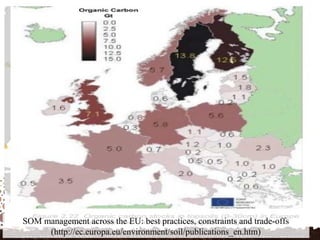
Despite the unavoidable uncertainties and approximations
in the estimate of total SOC stocks for different
geographical areas and land uses, global soil carbon levels
of cultivated lands have decreased historically and
continue to decline
SOM management across the EU: best practices, constraints and trade-offs
(http://ec.europa.eu/environment/soil/publications_en.htm)
There is an increasing effort to support sustainable SOM management
aimed to counteract the decrease of SOC
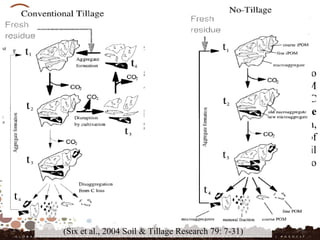
The current conceptual models of SOC accumulation, are inclined to
support the major role of physical protection mechanisms on SOM
stabilization. Therefore the management techniques for SOC
sequestration, rely on the application of minimum or no tillage
intervention (conservation agriculture), coupled with crop rotation,
green manure and mulching treatments, that imply the slacken of
aggregate dynamics, the incorporation of fresh OM in undisturbed soil
aggregates with a decrease of OC losses through lower exposition to
microbial decomposition
(Six et al., 2004 Soil & Tillage Research 79: 7-31)
Complementary sustainable SOM managements to improve
OC in cultivated soils are focused on the molecular
characteristics/recalcitrance and biochemical stability of
SOM components (humic substances)
A viable way to improve the SOC stability may be
represented by soil amendment with mature “humified”
compost materials, which offer the advantage to recycle and
valorise agricultural biomasses, wastes and by-products
While the use of manure as soil amendment, for the average of
EU-27 agricultural lands, is assumed to halve in the 2030 an
increasing involvement in the long term SOC sequestration is
expected from soil addition with compost
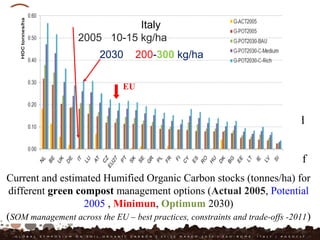
EU
Italy
2005 10-15 kg/ha
2030 200-300 kg/ha
Current and estimated Humified Organic Carbon stocks (tonnes/ha) for
different green compost management options (Actual 2005, Potential
2005 , Minimun, Optimum 2030)
(SOM management across the EU – best practices, constraints and trade-offs -2011)
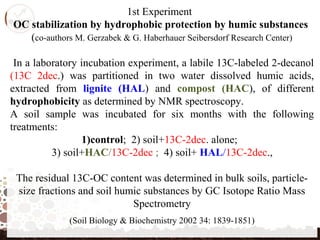
1st Experiment
OC stabilization by hydrophobic protection by humic substances
(co-authors M. Gerzabek & G. Haberhauer Seibersdorf Research Center)
In a laboratory incubation experiment, a labile 13C-labeled 2-decanol
(13C 2dec.) was partitioned in two water dissolved humic acids,
extracted from lignite (HAL) and compost (HAC), of different
hydrophobicity as determined by NMR spectroscopy.
A soil sample was incubated for six months with the following
treatments:
1)control; 2) soil+13C-2dec. alone;
3) soil+HAC/13C-2dec ; 4) soil+ HAL/13C-2dec.,
The residual 13C-OC content was determined in bulk soils, particle-
size fractions and soil humic substances by GC Isotope Ratio Mass
Spectrometry
(Soil Biology & Biochemistry 2002 34: 1839-1851)
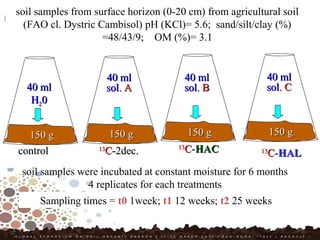
soil samples from surface horizon (0-20 cm) from agricultural soil
(FAO cl. Dystric Cambisol) pH (KCl)= 5.6; sand/silt/clay (%)
=48/43/9; OM (%)= 3.1
150 g150 g
40 ml40 ml
HH2200
150 g150 g
40 ml40 ml
solsol.. AA
150 g150 g
40 ml40 ml
solsol.. BB
40 ml40 ml
solsol.. CC
150 g150 g
controlcontrol 1313
CC-2dec.-2dec. 1313
CC--HACHAC 1313
CC--HALHAL
soil samples were incubated at constant moisture for 6 months
4 replicates for each treatments
Sampling times = t0 1week; t1 12 weeks; t2 25 weeks
20140180220 100 60
Lignite HAL
HB = 1.4 ArI = 25%
CPMAS NMR spectra of Humic acids used for soil incubation:
Compost HAC
HB= 1.2 ArI=5%
Aromaticity Index (ArI)
Hydrophobicity Index(HB)
[(0–40) + (110–160)]
[(40–110) + (140–190)]
[(110–160)]
[(0–190)]
× 100
13
C-2dec. 13
C-HAC 13
C-HAL
0
%%
weeks of incubationweeks of incubation
Residual (%) content of 13
C-OC respect to initial added amount
Bulk soil
Bulk soil
control 13
C-2dec. 13
C-HAC 13
C-HAL
-10
-15
-20
-25
δδ1313
C‰C‰
0
20
40
60
80
100
1 12 25
0
20
40
60
80
100
-17
-20
-23
-26
δδ1313
C‰C‰
%%
-18
-22
-26
δδ1313
C‰C‰
CoarsesandCoarsesandFinesandFinesand
%%
13
C-2dec. 13
C-HAC 13
C-HAL
0
40
80
120
160
%%
SiltSilt
-18
-21
-24
-27
δδ1313
C‰C‰
0
50
100
150
200
1 12 25
%%
ClayClay
-9
-13
-17
-21
-25
13
C-2dec. 13
C-HAC 13
C-HAL
δδ1313
C‰C‰
0
14
28
42
56
70
13
C-2dec 13
C- HAC 13
C- HAL
t0
t2
t0
t2
t0
t2
13
C-OC content in soil humic acids respect to bulk soil (%)
00303060609090120120150150180180
00303060609090120120150150180180
13
C-HAL
00303060609090120120150150180180
13
C-2-dec
13
C-HAC
13
C- Oxidized to acid group
Incorporation of 13C - OC in soil humic acids (Liquid 13C NMR)
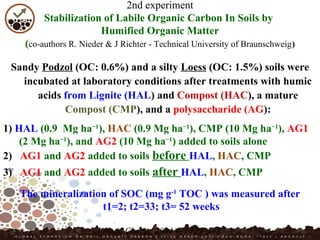
Sandy Podzol (OC: 0.6%) and a silty Loess (OC: 1.5%) soils were
incubated at laboratory conditions after treatments with humic
acids from Lignite (HAL) and Compost (HAC), a mature
Compost (CMP), and a polysaccharide (AG):
1) HAL (0.9 Mg ha−1
), HAC (0.9 Mg ha−1
), CMP (10 Mg ha−1
), AG1
(2 Mg ha−1
), and AG2 (10 Mg ha−1
) added to soils alone
2) AG1 and AG2 added to soils before HAL, HAC, CMP
3) AG1 and AG2 added to soils after HAL, HAC, CMP
The mineralization of SOC (mg g-1
TOC ) was measured after
t1=2; t2=33; t3= 52 weeks
Climatic Change 2004 67,:329–343.
2nd experiment
Stabilization of Labile Organic Carbon In Soils by
Humified Organic Matter
(co-authors R. Nieder & J Richter - Technical University of Braunschweig)
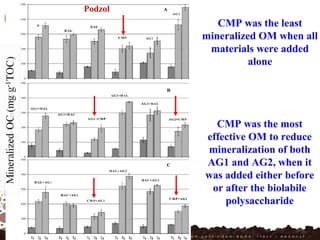
CMP was the least
mineralized OM when all
materials were added
alone
CMP was the most
effective OM to reduce
mineralization of both
AG1 and AG2, when it
was added either before
or after the biolabile
polysaccharide
Podzol
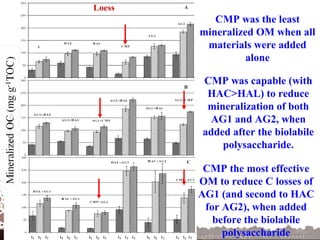
CMP was the least
mineralized OM when all
materials were added
alone
CMP was capable (with
HAC>HAL) to reduce
mineralization of both
AG1 and AG2, when
added after the biolabile
polysaccharide.
CMP the most effective
OM to reduce C losses of
AG1 (and second to HAC
for AG2), when added
before the biolabile
polysaccharide
Loess
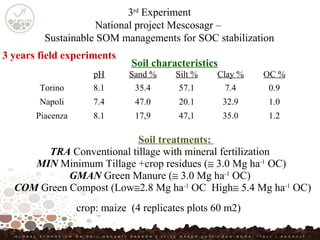
3rd
Experiment
National project Mescosagr –
Sustainable SOM managements for SOC stabilization
3 years field experiments
pH Sand % Silt % Clay % OC %
Torino 8.1 35.4 57.1 7.4 0.9
Napoli 7.4 47.0 20.1 32.9 1.0
Piacenza 8.1 17,9 47,1 35.0 1.2
Soil characteristics
Soil treatments:
TRA Conventional tillage with mineral fertilization
MIN Minimum Tillage +crop residues (≅ 3.0 Mg ha-1
OC)
GMAN Green Manure (≅ 3.0 Mg ha-1
OC)
COM Green Compost (Low≅2.8 Mg ha-1
OC High≅ 5.4 Mg ha-1
OC)
crop: maize (4 replicates plots 60 m2)
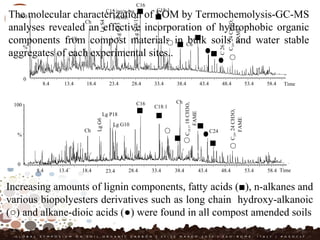
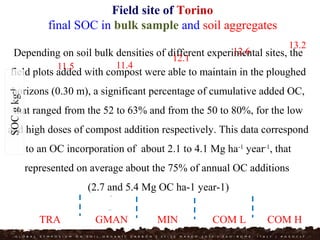
The molecular characterization of SOM by Termochemolysis-GC-MS
analyses revealed an effective incorporation of hydrophobic organic
components from compost materials in bulk soils and water stable
aggregates of each experimental sites..
8.4 13.4 18.4 23.4 28.4 33.4 38.4 43.4 48.4 53.4 58.4 Time
0
100
%
Ch
LgS4
LgS14/15
Ch
C15 iso/a-iso
FAME
C24,24CH3O,
FAME
C18:1
Ch
LgG13
C26
8.4 13.4 18.4 23.4 28.4 33.4 38.4 43.4 48.4 53.4 58.4 Time
0
100
%
Ch
Lg P18
LgG6
Lg G10
Ch
C18:1
C16
C24
C18:1,18CH3O,
FAME
C24,24CH3O,
FAME
C16
Increasing amounts of lignin components, fatty acids (■), n-alkanes and
various biopolyesters derivatives such as long chain hydroxy-alkanoic
(○) and alkane-dioic acids (●) were found in all compost amended soils
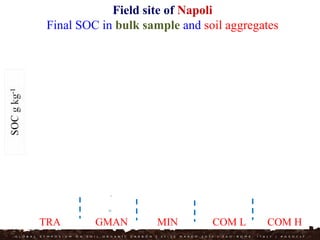
Depending on soil bulk densities of different experimental sites, the
field plots added with compost were able to maintain in the ploughed
horizons (0.30 m), a significant percentage of cumulative added OC,
that ranged from the 52 to 63% and from the 50 to 80%, for the low
and high doses of compost addition respectively. This data correspond
to an OC incorporation of about 2.1 to 4.1 Mg ha-1
year-1
, that
represented on average about the 75% of annual OC additions
(2.7 and 5.4 Mg OC ha-1 year-1)
TRA GMAN MIN COM L COM H
Field site of Torino
final SOC in bulk sample and soil aggregates
11.5 11.4
12.1
12.6
13.2
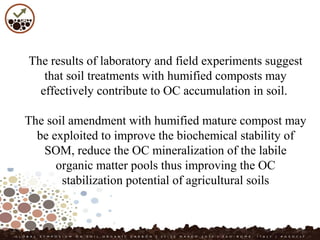
Field site of Napoli
Final SOC in bulk sample and soil aggregates
TRA GMAN MIN COM L COM H
The results of laboratory and field experiments suggest
that soil treatments with humified composts may
effectively contribute to OC accumulation in soil.
The soil amendment with humified mature compost may
be exploited to improve the biochemical stability of
SOM, reduce the OC mineralization of the labile
organic matter pools thus improving the OC
stabilization potential of agricultural soils
thank you
mercy
muchas gracias
obrigado
eskerrikasko
grazie
спасибо
ευχαριστίες

Soil Organic Carbon stabilization in compost amended soils

  • 1.
    Soil Organic Carbonstabilization in compost amended soils Spaccini R., Piccolo A. CERMANU NMR Center Università di Napoli Federico II THEME 2: Maintaining and/or increasing SOC stocks for climate change mitigation and adaptation, and land degradation neutrality)
  • 2.
    The soil organiccarbon (SOC) represent the largest reservoir in the global carbon cycle of terrestrial biosphere pools, accounting for 1500-1770 Pg, as compared to C stocks of vegetation (450-650 Pg) and fossil fuels (1000- 1940 Pg (IPCC) Intergovernmental Panel on Climate Change – report 2013 Vegetation + soil biota 450-650 Pg C Soil 1500-2400 Pg C Fluxes: +7.0 Pg C yr-1 Soil fluxes: +1.1 Pg C yr-1 Fossil fuesl 1000-1800 Pg C
  • 3.
    Despite the unavoidableuncertainties and approximations in the estimate of total SOC stocks for different geographical areas and land uses, global soil carbon levels of cultivated lands have decreased historically and continue to decline SOM management across the EU: best practices, constraints and trade-offs (http://ec.europa.eu/environment/soil/publications_en.htm)
  • 4.
    There is anincreasing effort to support sustainable SOM management aimed to counteract the decrease of SOC The current conceptual models of SOC accumulation, are inclined to support the major role of physical protection mechanisms on SOM stabilization. Therefore the management techniques for SOC sequestration, rely on the application of minimum or no tillage intervention (conservation agriculture), coupled with crop rotation, green manure and mulching treatments, that imply the slacken of aggregate dynamics, the incorporation of fresh OM in undisturbed soil aggregates with a decrease of OC losses through lower exposition to microbial decomposition (Six et al., 2004 Soil & Tillage Research 79: 7-31)
  • 5.
    Complementary sustainable SOMmanagements to improve OC in cultivated soils are focused on the molecular characteristics/recalcitrance and biochemical stability of SOM components (humic substances) A viable way to improve the SOC stability may be represented by soil amendment with mature “humified” compost materials, which offer the advantage to recycle and valorise agricultural biomasses, wastes and by-products While the use of manure as soil amendment, for the average of EU-27 agricultural lands, is assumed to halve in the 2030 an increasing involvement in the long term SOC sequestration is expected from soil addition with compost EU Italy 2005 10-15 kg/ha 2030 200-300 kg/ha Current and estimated Humified Organic Carbon stocks (tonnes/ha) for different green compost management options (Actual 2005, Potential 2005 , Minimun, Optimum 2030) (SOM management across the EU – best practices, constraints and trade-offs -2011)
  • 6.
    1st Experiment OC stabilizationby hydrophobic protection by humic substances (co-authors M. Gerzabek & G. Haberhauer Seibersdorf Research Center) In a laboratory incubation experiment, a labile 13C-labeled 2-decanol (13C 2dec.) was partitioned in two water dissolved humic acids, extracted from lignite (HAL) and compost (HAC), of different hydrophobicity as determined by NMR spectroscopy. A soil sample was incubated for six months with the following treatments: 1)control; 2) soil+13C-2dec. alone; 3) soil+HAC/13C-2dec ; 4) soil+ HAL/13C-2dec., The residual 13C-OC content was determined in bulk soils, particle- size fractions and soil humic substances by GC Isotope Ratio Mass Spectrometry (Soil Biology & Biochemistry 2002 34: 1839-1851)
  • 7.
    soil samples fromsurface horizon (0-20 cm) from agricultural soil (FAO cl. Dystric Cambisol) pH (KCl)= 5.6; sand/silt/clay (%) =48/43/9; OM (%)= 3.1 150 g150 g 40 ml40 ml HH2200 150 g150 g 40 ml40 ml solsol.. AA 150 g150 g 40 ml40 ml solsol.. BB 40 ml40 ml solsol.. CC 150 g150 g controlcontrol 1313 CC-2dec.-2dec. 1313 CC--HACHAC 1313 CC--HALHAL soil samples were incubated at constant moisture for 6 months 4 replicates for each treatments Sampling times = t0 1week; t1 12 weeks; t2 25 weeks
  • 8.
    20140180220 100 60 LigniteHAL HB = 1.4 ArI = 25% CPMAS NMR spectra of Humic acids used for soil incubation: Compost HAC HB= 1.2 ArI=5% Aromaticity Index (ArI) Hydrophobicity Index(HB) [(0–40) + (110–160)] [(40–110) + (140–190)] [(110–160)] [(0–190)] × 100
  • 9.
    13 C-2dec. 13 C-HAC 13 C-HAL 0 %% weeksof incubationweeks of incubation Residual (%) content of 13 C-OC respect to initial added amount Bulk soil Bulk soil control 13 C-2dec. 13 C-HAC 13 C-HAL -10 -15 -20 -25 δδ1313 C‰C‰ 0 20 40 60 80 100 1 12 25
  • 10.
  • 11.
    0 14 28 42 56 70 13 C-2dec 13 C- HAC13 C- HAL t0 t2 t0 t2 t0 t2 13 C-OC content in soil humic acids respect to bulk soil (%)
  • 12.
  • 13.
    Sandy Podzol (OC:0.6%) and a silty Loess (OC: 1.5%) soils were incubated at laboratory conditions after treatments with humic acids from Lignite (HAL) and Compost (HAC), a mature Compost (CMP), and a polysaccharide (AG): 1) HAL (0.9 Mg ha−1 ), HAC (0.9 Mg ha−1 ), CMP (10 Mg ha−1 ), AG1 (2 Mg ha−1 ), and AG2 (10 Mg ha−1 ) added to soils alone 2) AG1 and AG2 added to soils before HAL, HAC, CMP 3) AG1 and AG2 added to soils after HAL, HAC, CMP The mineralization of SOC (mg g-1 TOC ) was measured after t1=2; t2=33; t3= 52 weeks Climatic Change 2004 67,:329–343. 2nd experiment Stabilization of Labile Organic Carbon In Soils by Humified Organic Matter (co-authors R. Nieder & J Richter - Technical University of Braunschweig)
  • 14.
    CMP was theleast mineralized OM when all materials were added alone CMP was the most effective OM to reduce mineralization of both AG1 and AG2, when it was added either before or after the biolabile polysaccharide Podzol
  • 15.
    CMP was theleast mineralized OM when all materials were added alone CMP was capable (with HAC>HAL) to reduce mineralization of both AG1 and AG2, when added after the biolabile polysaccharide. CMP the most effective OM to reduce C losses of AG1 (and second to HAC for AG2), when added before the biolabile polysaccharide Loess
  • 16.
    3rd Experiment National project Mescosagr– Sustainable SOM managements for SOC stabilization 3 years field experiments pH Sand % Silt % Clay % OC % Torino 8.1 35.4 57.1 7.4 0.9 Napoli 7.4 47.0 20.1 32.9 1.0 Piacenza 8.1 17,9 47,1 35.0 1.2 Soil characteristics Soil treatments: TRA Conventional tillage with mineral fertilization MIN Minimum Tillage +crop residues (≅ 3.0 Mg ha-1 OC) GMAN Green Manure (≅ 3.0 Mg ha-1 OC) COM Green Compost (Low≅2.8 Mg ha-1 OC High≅ 5.4 Mg ha-1 OC) crop: maize (4 replicates plots 60 m2)
  • 17.
    The molecular characterizationof SOM by Termochemolysis-GC-MS analyses revealed an effective incorporation of hydrophobic organic components from compost materials in bulk soils and water stable aggregates of each experimental sites.. 8.4 13.4 18.4 23.4 28.4 33.4 38.4 43.4 48.4 53.4 58.4 Time 0 100 % Ch LgS4 LgS14/15 Ch C15 iso/a-iso FAME C24,24CH3O, FAME C18:1 Ch LgG13 C26 8.4 13.4 18.4 23.4 28.4 33.4 38.4 43.4 48.4 53.4 58.4 Time 0 100 % Ch Lg P18 LgG6 Lg G10 Ch C18:1 C16 C24 C18:1,18CH3O, FAME C24,24CH3O, FAME C16 Increasing amounts of lignin components, fatty acids (■), n-alkanes and various biopolyesters derivatives such as long chain hydroxy-alkanoic (○) and alkane-dioic acids (●) were found in all compost amended soils
  • 18.
    Depending on soilbulk densities of different experimental sites, the field plots added with compost were able to maintain in the ploughed horizons (0.30 m), a significant percentage of cumulative added OC, that ranged from the 52 to 63% and from the 50 to 80%, for the low and high doses of compost addition respectively. This data correspond to an OC incorporation of about 2.1 to 4.1 Mg ha-1 year-1 , that represented on average about the 75% of annual OC additions (2.7 and 5.4 Mg OC ha-1 year-1) TRA GMAN MIN COM L COM H Field site of Torino final SOC in bulk sample and soil aggregates 11.5 11.4 12.1 12.6 13.2
  • 19.
    Field site ofNapoli Final SOC in bulk sample and soil aggregates TRA GMAN MIN COM L COM H
  • 20.
    The results oflaboratory and field experiments suggest that soil treatments with humified composts may effectively contribute to OC accumulation in soil. The soil amendment with humified mature compost may be exploited to improve the biochemical stability of SOM, reduce the OC mineralization of the labile organic matter pools thus improving the OC stabilization potential of agricultural soils
  • 21.

Editor's Notes