Organic Matter and Compost
Training
November 2008
Jalalabad, Afghanistan
Soil Organic Matter Content
There is a two-way relationship between soil
activities and plant physiology, where soil organic
matter content plays an important role.
Organic matter has an effect on:
-Plant nutrition
-Soil and Plant health
-Soil physical, chemical and biological
properties
• How organic matter in soil influences the soil-
plant relationship?
• Decomposed organic matter provides nutrient for plant growth
(Mineralization)
• It determines the soil’s temperature, air ventilation, structure and
water management
• It contains bioregulators, which affects plant growth (enzymes,
hormones, etc.)
• Its carbon and energy content is the soil’s energy battery for future
use
• It determines the soil’s capacity to compensating, regenerating and
protecting the environment
Soil Organic Matter Content
• The most important part of the soil organic
matter is called: humus, which is the
ultimate product of decomposition.
• Humus is continuously removed from the
soil (Humus loss)
• Humus is continuously added into the soil
(Humus addition)
Soil Organic Matter Content
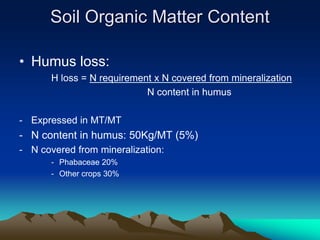
• Humus loss:
H loss = N requirement x N covered from mineralization
N content in humus
- Expressed in MT/MT
- N content in humus: 50Kg/MT (5%)
- N covered from mineralization:
- Phabaceae 20%
- Other crops 30%
Soil Organic Matter Content
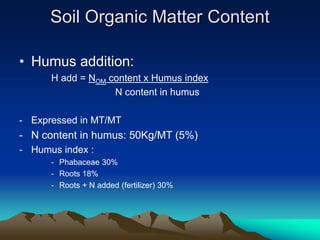
• Humus addition:
H add = NOM content x Humus index
N content in humus
- Expressed in MT/MT
- N content in humus: 50Kg/MT (5%)
- Humus index :
- Phabaceae 30%
- Roots 18%
- Roots + N added (fertilizer) 30%
Soil Organic Matter Content
• Way to increase Humus content:
– Legumes and other Phabaceae species
– Animal manure and compost application
– Green manure and plant waste incorporation
– N addition (Fertilizers) to organic matter
– Microbiologic products addition to organic
matter
Humus addition vs. Humus loss = Balance
(Humus balance remain the same during 2 years after
the production of legumes)
Soil Organic Matter Content
• Soil contains nutrient in two forms:
– Free (Available immediately)
– Fixed (Before mineralization)
• Plant mainly acquires nutrients provided by
micro-organisms, which decompose the organic
matter
• Free and fixed nutrient content is in balance
inside the soil.
• Optimal balance is when the intensity of
transformation from fixed to free nutrient is equal
to the plant’s nutrient uptake intensity.
Soil Organic Matter Content
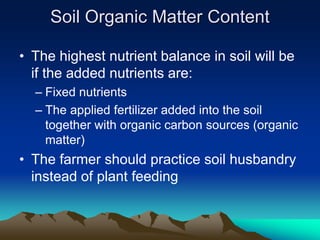
• The highest nutrient balance in soil will be
if the added nutrients are:
– Fixed nutrients
– The applied fertilizer added into the soil
together with organic carbon sources (organic
matter)
• The farmer should practice soil husbandry
instead of plant feeding
Soil Organic Matter Content
The Compost
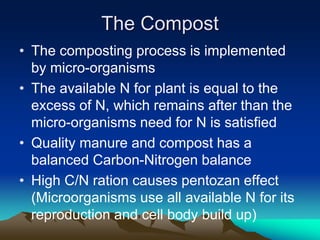
• The composting process is implemented
by micro-organisms
• The available N for plant is equal to the
excess of N, which remains after than the
micro-organisms need for N is satisfied
• Quality manure and compost has a
balanced Carbon-Nitrogen balance
• High C/N ration causes pentozan effect
(Microorganisms use all available N for its
reproduction and cell body build up)
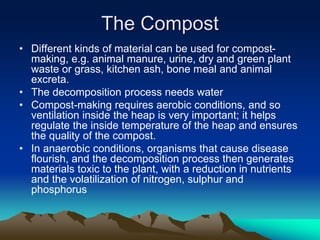
• Different kinds of material can be used for compost-
making, e.g. animal manure, urine, dry and green plant
waste or grass, kitchen ash, bone meal and animal
excreta.
• The decomposition process needs water
• Compost-making requires aerobic conditions, and so
ventilation inside the heap is very important; it helps
regulate the inside temperature of the heap and ensures
the quality of the compost.
• In anaerobic conditions, organisms that cause disease
flourish, and the decomposition process then generates
materials toxic to the plant, with a reduction in nutrients
and the volatilization of nitrogen, sulphur and
phosphorus
The Compost
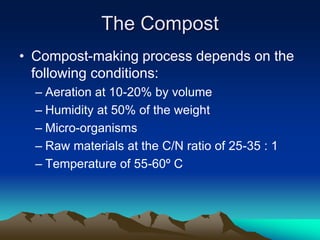
• Compost-making process depends on the
following conditions:
– Aeration at 10-20% by volume
– Humidity at 50% of the weight
– Micro-organisms
– Raw materials at the C/N ratio of 25-35 : 1
– Temperature of 55-60º C
The Compost
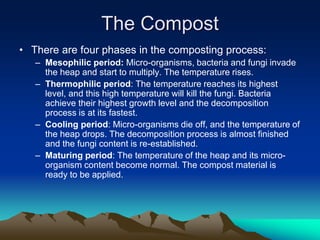
• There are four phases in the composting process:
– Mesophilic period: Micro-organisms, bacteria and fungi invade
the heap and start to multiply. The temperature rises.
– Thermophilic period: The temperature reaches its highest
level, and this high temperature will kill the fungi. Bacteria
achieve their highest growth level and the decomposition
process is at its fastest.
– Cooling period: Micro-organisms die off, and the temperature of
the heap drops. The decomposition process is almost finished
and the fungi content is re-established.
– Maturing period: The temperature of the heap and its micro-
organism content become normal. The compost material is
ready to be applied.
The Compost
The Compost
The Compost
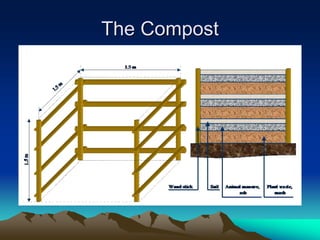
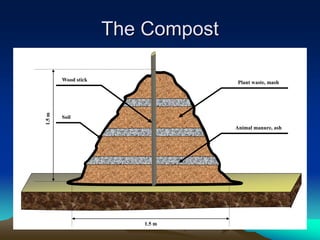
1.5 m
Plant waste, mash
Animal manure, ash
Soil
Wood stick
The Compost
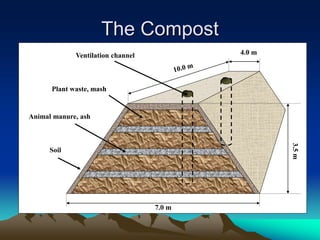
7.0 m
4.0 m
Plant waste, mash
Animal manure, ash
Soil
Ventilation channel
The Compost
8.0 m
5.0 m
Soil Animal manure,
ash
Plant waste,
mash
Surface
Surface
Three holes rotation method
Removing the compost
1st hole
Compost making in
Process (the hole
Covered with soil)
2nd hole
making new compost
3rd hole
The Compost
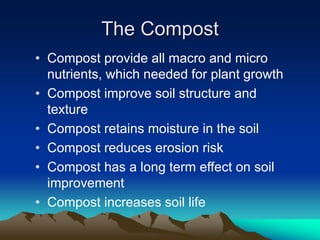
• Compost provide all macro and micro
nutrients, which needed for plant growth
• Compost improve soil structure and
texture
• Compost retains moisture in the soil
• Compost reduces erosion risk
• Compost has a long term effect on soil
improvement
• Compost increases soil life

715560 organic matter and compost. .ppt

  • 1.
    Organic Matter andCompost Training November 2008 Jalalabad, Afghanistan
  • 2.
    Soil Organic MatterContent There is a two-way relationship between soil activities and plant physiology, where soil organic matter content plays an important role. Organic matter has an effect on: -Plant nutrition -Soil and Plant health -Soil physical, chemical and biological properties
  • 3.
    • How organicmatter in soil influences the soil- plant relationship? • Decomposed organic matter provides nutrient for plant growth (Mineralization) • It determines the soil’s temperature, air ventilation, structure and water management • It contains bioregulators, which affects plant growth (enzymes, hormones, etc.) • Its carbon and energy content is the soil’s energy battery for future use • It determines the soil’s capacity to compensating, regenerating and protecting the environment Soil Organic Matter Content
  • 4.
    • The mostimportant part of the soil organic matter is called: humus, which is the ultimate product of decomposition. • Humus is continuously removed from the soil (Humus loss) • Humus is continuously added into the soil (Humus addition) Soil Organic Matter Content
  • 5.
    • Humus loss: Hloss = N requirement x N covered from mineralization N content in humus - Expressed in MT/MT - N content in humus: 50Kg/MT (5%) - N covered from mineralization: - Phabaceae 20% - Other crops 30% Soil Organic Matter Content
  • 6.
    • Humus addition: Hadd = NOM content x Humus index N content in humus - Expressed in MT/MT - N content in humus: 50Kg/MT (5%) - Humus index : - Phabaceae 30% - Roots 18% - Roots + N added (fertilizer) 30% Soil Organic Matter Content
  • 7.
    • Way toincrease Humus content: – Legumes and other Phabaceae species – Animal manure and compost application – Green manure and plant waste incorporation – N addition (Fertilizers) to organic matter – Microbiologic products addition to organic matter Humus addition vs. Humus loss = Balance (Humus balance remain the same during 2 years after the production of legumes) Soil Organic Matter Content
  • 8.
    • Soil containsnutrient in two forms: – Free (Available immediately) – Fixed (Before mineralization) • Plant mainly acquires nutrients provided by micro-organisms, which decompose the organic matter • Free and fixed nutrient content is in balance inside the soil. • Optimal balance is when the intensity of transformation from fixed to free nutrient is equal to the plant’s nutrient uptake intensity. Soil Organic Matter Content
  • 9.
    • The highestnutrient balance in soil will be if the added nutrients are: – Fixed nutrients – The applied fertilizer added into the soil together with organic carbon sources (organic matter) • The farmer should practice soil husbandry instead of plant feeding Soil Organic Matter Content
  • 10.
    The Compost • Thecomposting process is implemented by micro-organisms • The available N for plant is equal to the excess of N, which remains after than the micro-organisms need for N is satisfied • Quality manure and compost has a balanced Carbon-Nitrogen balance • High C/N ration causes pentozan effect (Microorganisms use all available N for its reproduction and cell body build up)
  • 11.
    • Different kindsof material can be used for compost- making, e.g. animal manure, urine, dry and green plant waste or grass, kitchen ash, bone meal and animal excreta. • The decomposition process needs water • Compost-making requires aerobic conditions, and so ventilation inside the heap is very important; it helps regulate the inside temperature of the heap and ensures the quality of the compost. • In anaerobic conditions, organisms that cause disease flourish, and the decomposition process then generates materials toxic to the plant, with a reduction in nutrients and the volatilization of nitrogen, sulphur and phosphorus The Compost
  • 12.
    • Compost-making processdepends on the following conditions: – Aeration at 10-20% by volume – Humidity at 50% of the weight – Micro-organisms – Raw materials at the C/N ratio of 25-35 : 1 – Temperature of 55-60º C The Compost
  • 13.
    • There arefour phases in the composting process: – Mesophilic period: Micro-organisms, bacteria and fungi invade the heap and start to multiply. The temperature rises. – Thermophilic period: The temperature reaches its highest level, and this high temperature will kill the fungi. Bacteria achieve their highest growth level and the decomposition process is at its fastest. – Cooling period: Micro-organisms die off, and the temperature of the heap drops. The decomposition process is almost finished and the fungi content is re-established. – Maturing period: The temperature of the heap and its micro- organism content become normal. The compost material is ready to be applied. The Compost
  • 14.
  • 15.
    The Compost 1.5 m Plantwaste, mash Animal manure, ash Soil Wood stick
  • 16.
    The Compost 7.0 m 4.0m Plant waste, mash Animal manure, ash Soil Ventilation channel
  • 17.
    The Compost 8.0 m 5.0m Soil Animal manure, ash Plant waste, mash Surface Surface Three holes rotation method Removing the compost 1st hole Compost making in Process (the hole Covered with soil) 2nd hole making new compost 3rd hole
  • 18.
    The Compost • Compostprovide all macro and micro nutrients, which needed for plant growth • Compost improve soil structure and texture • Compost retains moisture in the soil • Compost reduces erosion risk • Compost has a long term effect on soil improvement • Compost increases soil life