

DOCTORAL SEMINARDOCTORAL SEMINAR
ONON
Soil Science and Agricultural Chemistry
COA, IGKV, Raipur (C.G.)
Rakesh Giri Goswami
Ph.D. Scholar
SpeakerSpeaker
 A soil conditioner, also called a soil amendment, is a material added to
soil to improve soil physical properties , plant growth and health.
 The type of conditioner added depends on the current soil composition,
climate and the type of plant.
 A conditioner or a combination of conditioners corrects the soil's
deficiencies.
 Fertilizers, such as peat, manure, anaerobic digestate or compost, add
depleted plant nutrients.
 Gypsum releases nutrients and improves soil structure.
CHARACTERISTICS OF SOIL
CONDITIONERS
• Soil conditioners are natural and synthetic.
• Absorb water rapidly.
• Compost is made from decomposing materials, fertilizer and
soil.
• Leaves and manures are also natural products.
FUNCTIONS OF SOIL CONDITIONERS
• They help to improve the amount of minerals in the soil.
• Soil that is rich in minerals will produce much healthier vegetation.
• Leaves work by attracting earthworms which create a healthy soil .
• Improvement in physical, Chemical and Biological conditions of soil.
• Significantly increased slope of soil moisture curve at its inflection
point .
IMPORTANCE OF SOIL CONDITIONERS
• Soil conditioner is a product which is added to soil to improve the soil
quality.
• Soil conditioners can be used to rebuild soils which have been
damaged by improper management, to make poor soils more usable, and
to maintain soils in peak condition.
• A wide variety of products can be used to manage soil quality, with
most being readily available from nurseries and garden supply stores.
SOIL PHYSICAL CONDITIONS AND SOIL
CONDITIONERS
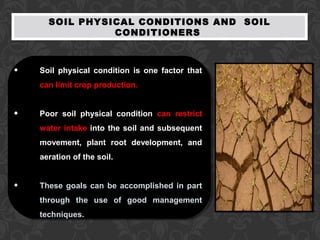
• Soil physical condition is one factor that
can limit crop production.
• Poor soil physical condition can restrict
water intake into the soil and subsequent
movement, plant root development, and
aeration of the soil.
• These goals can be accomplished in part
through the use of good management
techniques.
VITAL ROLE OF SOIL CONDITIONERS
• Improved soil structure and aeration
• Increased water-holding capacity.
• Increased availability of water to plants
• Reduced compaction and hardpan conditions.
• Improved tile drainage effectiveness
• Alkali soil reclamation
• Release of “locked” nutrients
• Better chemical incorporation
• Better root development
• Higher yields and quality
Source : Pradhan et al.,2003
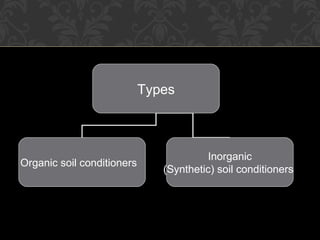
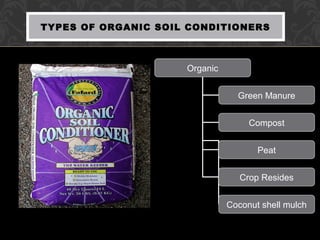
Types
Organic soil conditioners
Inorganic
(Synthetic) soil conditioners
Organic
Green Manure
Compost
Peat
Crop Resides
Coconut shell mulch
TYPES OF ORGANIC SOIL CONDITIONERS
ORGANIC SOIL CONDITIONERS
• Soil organic matter serves as a reservoir for nutrients;
• Improves soil structure ,
• Drainage,
• Aeration,
• Increase the Cation exchange capacity,
• Buffering capacity, and water-holding capacity; and provides a source of
food for microorganisms.
• Generally soils having higher in organic matter have improved soil physical
conditions.
 Other organic soil Conditioners are Humus , Humate ,
Sewage sludge, Vermicompost and Cattle manure.
Animal manure:
 Partially decomposed plant material plus a wide variety
of organism.
 It contains soluble salt which can be detrimental to
soil physical properties and crop growth when added in
high amount, especially to arid soil .
Sewage sludge :
Effectiveness of the material varies with the amount of material
added and C:N ratio. Sewage sludge may contain potentially
harmful level of heavy metals and other toxic material and should be
analysed for these material before using. (Kumar et al., 2010, 2013).
HUMATE :
Humate reduces soil erosion by increasing the cohesive forces of
the very fine soil particles.
They improve soil structure and physical properties of soil by
raising EC and buffering qualities , promoting the chelation of many
element and making these available to plant.
humate as product derived from oxidized lignite, coal like
substances associated with lignite out crop. (Stevenson.2002)
CONT…..
 Humate marketed for agriculture purposes may be soluble or
insoluble and may be fortified with commercial fertilizer .
 humate contain between 30 and 60 percent humic acid.
 humate contain very little fulvic acid and biologically imp. Material
such as protein and polysaccharides.
Source : Sivakumar K and Devrajan L.2005
Humentos :
It is a K-humate extracted from brown coal.
Potassium humate is the salt of humic acid. Potassium humate is dark
coloured, water soluble but alkali insoluble.
It is liquid product that is easy to apply on the soil e.g.as a fertilizer
additive or as foliar treatment.
It has been successfully applied in agriculture, horticulture,
landscaping and recultivation.
The treatment of potassium humate is stimulatory for nutrients uptake of
Glycine max Phaseolus mungo and Triticum aestivum.
Source : Patil et al.,2011. Plant Sciences Feed .1 (10): 174-178
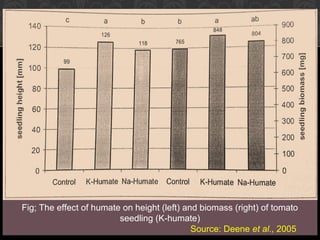
Fig; The effect of humate on height (left) and biomass (right) of tomato
seedling (K-humate)
Source: Deene et al., 2005
COMPOST
• Composting is comes naturally to plant materials.
• They return to the earth to supply nutrients for the next cycle of
seeds.
• kitchen scraps can be recycled and yard waste composting them.
• Instead of throwing out produce scraps, egg shells and coffee
grounds, can be compost of along with the leaves raked up and
the dead plants cleared out of the garden.
COMPONENT NEEDED DURING
• Adding raw material to compost
• Vegetable and food scraps
• Fallen leaves (in layers)
• Tea leaves and tea bags Sawdust
• Coffee grounds , Egg shells, Weeds, Wood ash
• Compost and organic soil mulches instead of more conventional
methods sediment control are numerous.
• Probably the two greatest benefits of using compost as a soil mulch in
sediment control -
• immediate effectiveness
• its ability to bind and degrade specific contaminants.
• Compost possessing significant amounts of humic acids, have
the ability to bind nutrients and heavy metals, as moisture passes
through the product layer.
• Organisms found within compost have the ability to degrade
organic contaminants such as hydrocarbons found in petroleum
based materials.
• Improve the soil quality to reap their benefits and vitality by
releasing the rich nutrients in the compost into the soil .
• Recycle valuable nutrients and reduce the use of artificial
fertilizers
Benefits Of Composting
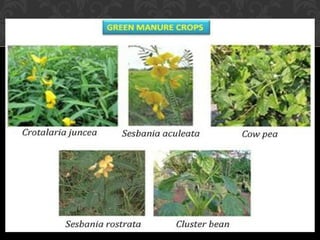
GREEN MANURING
•Green manure supplies organic matter to the soil.
• The organic residues from green manure also help to provide the
stability of soil structure needed for optimum plant growth.
• Humus formed from green manure increases the absorptive capacity
of soil, promotes aeration, drainage and granulation, which help the
plant growth.
•stimulates the activity of soil micro-organisms.
• The ability to bind contaminants is exhibited when using organic soil
mulches .
Addition of Nitrogen:
The green manuring crop supplies additional nitrogen to organic
matter.
The legume crop adds nitrogen for the succeeding crop.
So all the legumes crop leave the soil in better physical condition
and richer in nitrogen content.
 Green manuring crops act as cover crop. Green manure has a
marked residual effect also.
 Increases the biochemical activity.
 They protect the soil from erosion and nutrient loss by taking up
soluble nutrients.
 GM crops make available phosphorous and other nutrients fort he
succeeding crops.
 The organic matter added to soil by way of green manure acts as
food for micro-organisms.
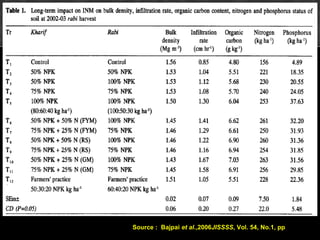
 Incorporation of green manure, FYM and rice straw in combination with
fertilizer N significantly increased (Yadav and Kumar 2002) the grain
yield of rice and wheat.
A
Source : Bajpai et al.,2006JISSSS, Vol. 54, No.1, pp
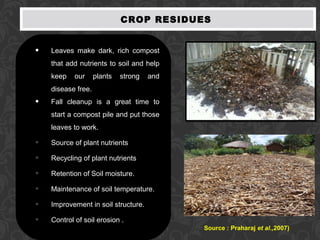
CROP RESIDUES
• Leaves make dark, rich compost
that add nutrients to soil and help
keep our plants strong and
disease free.
• Fall cleanup is a great time to
start a compost pile and put those
leaves to work.
• Source of plant nutrients
• Recycling of plant nutrients
• Retention of Soil moisture.
• Maintenance of soil temperature.
• Improvement in soil structure.
• Control of soil erosion .
Source : Praharaj et al.,2007)
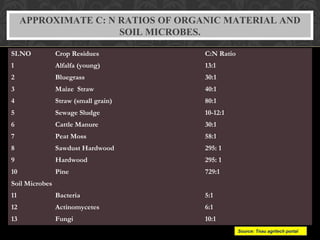
APPROXIMATE C: N RATIOS OF ORGANIC MATERIAL AND
SOIL MICROBES.
SI.NO Crop Residues C:N Ratio
1 Alfalfa (young) 13:1
2 Bluegrass 30:1
3 Maize Straw 40:1
4 Straw (small grain) 80:1
5 Sewage Sludge 10-12:1
6 Cattle Manure 30:1
7 Peat Moss 58:1
8 Sawdust Hardwood 295: 1
9 Hardwood 295: 1
10 Pine 729:1
Soil Microbes
11 Bacteria 5:1
12 Actinomycetes 6:1
13 Fungi 10:1
Source: Tnau agritech portalSource: Tnau agritech portal
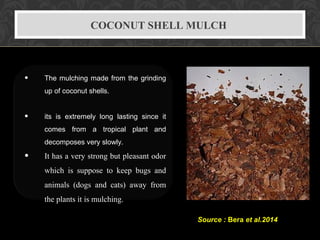
COCONUT SHELL MULCH
• The mulching made from the grinding
up of coconut shells.
• its is extremely long lasting since it
comes from a tropical plant and
decomposes very slowly.
• It has a very strong but pleasant odor
which is suppose to keep bugs and
animals (dogs and cats) away from
the plants it is mulching.
Source : Bera et al.2014
Other Organic Fertilizers
•Include FYM , Vermicompost,bird and bat droppings, blood
meal, bone meal, and fish meal cattle manure. All these
substances contain nitrogen and other essential elements
•Bone meal is an excellent source of the element phosphorus.
•But blood meal, bone meal, and fish meal is seldom used on
farms as fertilizers, because it is too expensive.
HOME COMPOST
• Composting is the controlled decomposition of organic
material such as leaves, twigs, grass clippings, and
vegetable food waste.
• Compost is the soil amendment product that results from
proper composting.
• composting helps to keep the high volume of organic
material.
APPLICATION
• General application rates for compost or other organic soil amendments are
based on the salt content of the materials and soil and on the depth to which
it is cultivated into the soil.
• Ideally, cultivate the soil amendment into the top six to eight inches of the
soil.
• On compacted/clayey soils, anything less can lead to a shallow rooting
system with reduced plant growth, lower vigor, and lower stress tolerance.
• Compost, which includes manure or biosolids as a component, has a
potential for high salts.
• Compost needs to be thoroughly mixed into the upper six to eight inches of
the soil profile.
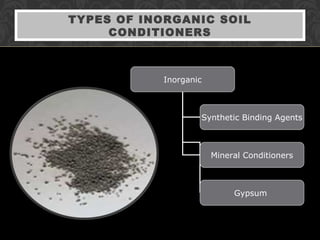
TYPES OF INORGANIC SOIL
CONDITIONERS
Inorganic
Synthetic Binding Agents
Mineral Conditioners
Gypsum
SYNTHETIC BINDING AGENTS
• New polymers applied at much lower rates have been
promoted as soil conditioners.
• These polymers include
Natural polysaccharides,
Anionic
Cationic polymers,
polyacrylamides.
Ammonium alkyl ether Sulphate
CHARACTERISTIC OF SYNTHETIC BINDING
AGENTS
• The compounds are very high
• molecular weight,
• long-chain polymeric,
• organic compounds,
• which bind soil particles and form stable
aggregates.
MINERAL CONDITIONERS
 Displace exchangeable sodium from the Cation exchange sites
of soils high in sodium.
• Used to reclaim problematic soils.
• Improved infiltration rate for some puddle soils.
Gypsum :
IMPORTANCE OF GYPSUM
• Lowers bulk compactness of soil
• Prevents water run-off and eroding
• Betters Soil Composition
• It affords root growth and air and water movement.
• An economical method to resolve salty soils.
• The importance of organic matter is magnified when it is dispensed with
gypsum.
• Soil crusting is impossible and then helps seed emersion.
• Provide a Soluble source of S for Plants
• Less energy is required for the tillage
Source : Prasad et al.,2002
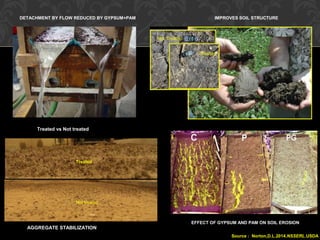
DETACHMENT BY FLOW REDUCED BY GYPSUM+PAM IMPROVES SOIL STRUCTURE
Treated vs Not treated
Treated
Not treated
AGGREGATE STABILIZATION
EFFECT OF GYPSUM AND PAM ON SOIL EROSION
Source : Norton,D.L.2014.NSSERL.USDA
RECOMMENDED DOSE OF GYPSUM
• Usually Gypsum @ 25 kg/ha has been recommended
to improve soil conditions .
• Limestone, crushed rock, and other products high in
calcium and/or magnesium which improve the
physical condition of some soils, when applied at
several tons per acre.
Source: (Pradhan et al.2003)
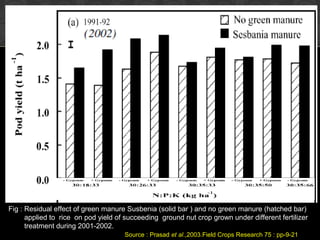
Fig : Residual effect of green manure Susbenia (solid bar ) and no green manure (hatched bar)
applied to rice on pod yield of succeeding ground nut crop grown under different fertilizer
treatment during 2001-2002.
Source : Prasad et al.,2003.Field Crops Research 75 : pp-9-21
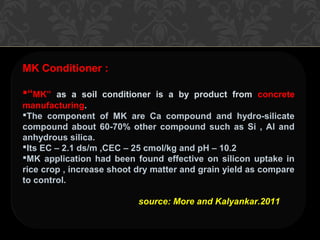
MK Conditioner :
“MK” as a soil conditioner is a by product from concrete
manufacturing.
The component of MK are Ca compound and hydro-silicate
compound about 60-70% other compound such as Si , Al and
anhydrous silica.
Its EC – 2.1 ds/m ,CEC – 25 cmol/kg and pH – 10.2
MK application had been found effective on silicon uptake in
rice crop , increase shoot dry matter and grain yield as compare
to control.
source: More and Kalyankar.2011
FLY -ASH
Fly-ash having both the soil amending and nutrient-enriching properties, is helpful in
improving crop growth and yield in low fertility soils.
Particle size from 0.01 to 100 µm, low bulk density, high surface area and light texture
(Awokan et al., 2005).
It has been shown that FA based soil conditioner not only improves the crop productivity
and soil fertility but also mobilizes macro and micronutrients in the soil (Buddhe et al.,2014).
 Fly ash was securely collected from the hopper of thermal power plant and was
magnetized to produce novel soil conditioner Biosil.
 The change in EC indi-cates positive impact of Biosil application to the soil under one
cycle of cropping.
Source : Suhas et al.,2014
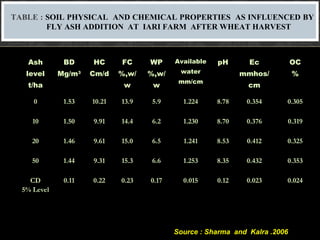
Ash
level
t/ha
BD
Mg/m3
HC
Cm/d
FC
%,w/
w
WP
%,w/
w
Available
water
mm/cm
pH Ec
mmhos/
cm
OC
%
0 1.53 10.21 13.9 5.9 1.224 8.78 0.354 0.305
10 1.50 9.91 14.4 6.2 1.230 8.70 0.376 0.319
20 1.46 9.61 15.0 6.5 1.241 8.53 0.412 0.325
50 1.44 9.31 15.3 6.6 1.253 8.35 0.432 0.353
CD
5% Level
0.11 0.22 0.23 0.17 0.015 0.12 0.023 0.024
TABLE : SOIL PHYSICAL AND CHEMICAL PROPERTIES AS INFLUENCED BY
FLY ASH ADDITION AT IARI FARM AFTER WHEAT HARVEST
Source : Sharma and Kalra .2006
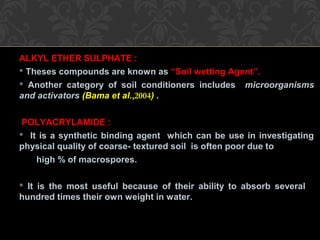
ALKYL ETHER SULPHATE :
 Theses compounds are known as “Soil wetting Agent”.
 Another category of soil conditioners includes microorganisms
and activators (Bama et al.,2004) .
POLYACRYLAMIDE :
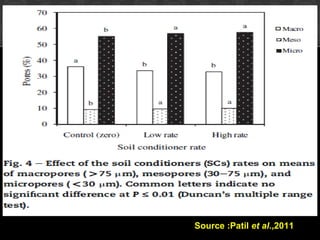
 It is a synthetic binding agent which can be use in investigating
physical quality of coarse- textured soil is often poor due to
high % of macrospores.
 It is the most useful because of their ability to absorb several
hundred times their own weight in water.
.
ially PAM, decreased macrospores in the sandy loam soil by aggregation and
consequently increased mesopores and microspores.
Source :Patil et al.,2011
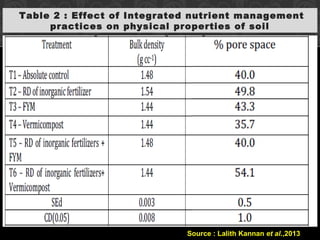
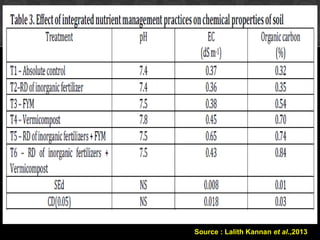
Source : Lalith Kannan et al.,2013
Table 2 : Effect of Integrated nutrient management
practices on physical properties of soil
Source : Lalith Kannan et al.,2013
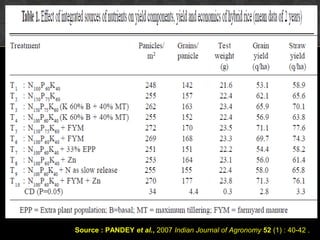
Source : PANDEY et al., 2007 Indian Journal of Agronomy 52 (1) : 40-42 .
 It is concluded that, soil conditioners as a source of plant nutrients has
been found beneficial in improving soil Physical, Chemical and
Biological conditions thereby increased productivity of crops.
 If the soil had very low pH, P and extractable Si. Therefore it is
necessary to use soil conditioners for improving soil pH and some
elements such as P and Si.
 Farmers can adopt this technology to improve the crop production.
CONCLUSION
- Franklin Delan Roosevelt

Importance of soil conditioners

  • 2.
    DOCTORAL SEMINARDOCTORAL SEMINAR ONON SoilScience and Agricultural Chemistry COA, IGKV, Raipur (C.G.) Rakesh Giri Goswami Ph.D. Scholar SpeakerSpeaker
  • 3.
     A soilconditioner, also called a soil amendment, is a material added to soil to improve soil physical properties , plant growth and health.  The type of conditioner added depends on the current soil composition, climate and the type of plant.  A conditioner or a combination of conditioners corrects the soil's deficiencies.  Fertilizers, such as peat, manure, anaerobic digestate or compost, add depleted plant nutrients.  Gypsum releases nutrients and improves soil structure.
  • 4.
    CHARACTERISTICS OF SOIL CONDITIONERS •Soil conditioners are natural and synthetic. • Absorb water rapidly. • Compost is made from decomposing materials, fertilizer and soil. • Leaves and manures are also natural products.
  • 5.
    FUNCTIONS OF SOILCONDITIONERS • They help to improve the amount of minerals in the soil. • Soil that is rich in minerals will produce much healthier vegetation. • Leaves work by attracting earthworms which create a healthy soil . • Improvement in physical, Chemical and Biological conditions of soil. • Significantly increased slope of soil moisture curve at its inflection point .
  • 6.
    IMPORTANCE OF SOILCONDITIONERS • Soil conditioner is a product which is added to soil to improve the soil quality. • Soil conditioners can be used to rebuild soils which have been damaged by improper management, to make poor soils more usable, and to maintain soils in peak condition. • A wide variety of products can be used to manage soil quality, with most being readily available from nurseries and garden supply stores.
  • 7.
    SOIL PHYSICAL CONDITIONSAND SOIL CONDITIONERS • Soil physical condition is one factor that can limit crop production. • Poor soil physical condition can restrict water intake into the soil and subsequent movement, plant root development, and aeration of the soil. • These goals can be accomplished in part through the use of good management techniques.
  • 8.
    VITAL ROLE OFSOIL CONDITIONERS • Improved soil structure and aeration • Increased water-holding capacity. • Increased availability of water to plants • Reduced compaction and hardpan conditions. • Improved tile drainage effectiveness • Alkali soil reclamation • Release of “locked” nutrients • Better chemical incorporation • Better root development • Higher yields and quality Source : Pradhan et al.,2003
  • 9.
  • 10.
    Organic Green Manure Compost Peat Crop Resides Coconutshell mulch TYPES OF ORGANIC SOIL CONDITIONERS
  • 11.
    ORGANIC SOIL CONDITIONERS •Soil organic matter serves as a reservoir for nutrients; • Improves soil structure , • Drainage, • Aeration, • Increase the Cation exchange capacity, • Buffering capacity, and water-holding capacity; and provides a source of food for microorganisms. • Generally soils having higher in organic matter have improved soil physical conditions.
  • 12.
     Other organicsoil Conditioners are Humus , Humate , Sewage sludge, Vermicompost and Cattle manure. Animal manure:  Partially decomposed plant material plus a wide variety of organism.  It contains soluble salt which can be detrimental to soil physical properties and crop growth when added in high amount, especially to arid soil .
  • 13.
    Sewage sludge : Effectivenessof the material varies with the amount of material added and C:N ratio. Sewage sludge may contain potentially harmful level of heavy metals and other toxic material and should be analysed for these material before using. (Kumar et al., 2010, 2013). HUMATE : Humate reduces soil erosion by increasing the cohesive forces of the very fine soil particles. They improve soil structure and physical properties of soil by raising EC and buffering qualities , promoting the chelation of many element and making these available to plant. humate as product derived from oxidized lignite, coal like substances associated with lignite out crop. (Stevenson.2002)
  • 14.
    CONT…..  Humate marketedfor agriculture purposes may be soluble or insoluble and may be fortified with commercial fertilizer .  humate contain between 30 and 60 percent humic acid.  humate contain very little fulvic acid and biologically imp. Material such as protein and polysaccharides. Source : Sivakumar K and Devrajan L.2005
  • 15.
    Humentos : It isa K-humate extracted from brown coal. Potassium humate is the salt of humic acid. Potassium humate is dark coloured, water soluble but alkali insoluble. It is liquid product that is easy to apply on the soil e.g.as a fertilizer additive or as foliar treatment. It has been successfully applied in agriculture, horticulture, landscaping and recultivation. The treatment of potassium humate is stimulatory for nutrients uptake of Glycine max Phaseolus mungo and Triticum aestivum. Source : Patil et al.,2011. Plant Sciences Feed .1 (10): 174-178
  • 16.
    Fig; The effectof humate on height (left) and biomass (right) of tomato seedling (K-humate) Source: Deene et al., 2005
  • 17.
    COMPOST • Composting iscomes naturally to plant materials. • They return to the earth to supply nutrients for the next cycle of seeds. • kitchen scraps can be recycled and yard waste composting them. • Instead of throwing out produce scraps, egg shells and coffee grounds, can be compost of along with the leaves raked up and the dead plants cleared out of the garden.
  • 18.
    COMPONENT NEEDED DURING •Adding raw material to compost • Vegetable and food scraps • Fallen leaves (in layers) • Tea leaves and tea bags Sawdust • Coffee grounds , Egg shells, Weeds, Wood ash • Compost and organic soil mulches instead of more conventional methods sediment control are numerous. • Probably the two greatest benefits of using compost as a soil mulch in sediment control - • immediate effectiveness • its ability to bind and degrade specific contaminants.
  • 19.
    • Compost possessingsignificant amounts of humic acids, have the ability to bind nutrients and heavy metals, as moisture passes through the product layer. • Organisms found within compost have the ability to degrade organic contaminants such as hydrocarbons found in petroleum based materials. • Improve the soil quality to reap their benefits and vitality by releasing the rich nutrients in the compost into the soil . • Recycle valuable nutrients and reduce the use of artificial fertilizers Benefits Of Composting
  • 20.
    GREEN MANURING •Green manuresupplies organic matter to the soil. • The organic residues from green manure also help to provide the stability of soil structure needed for optimum plant growth. • Humus formed from green manure increases the absorptive capacity of soil, promotes aeration, drainage and granulation, which help the plant growth. •stimulates the activity of soil micro-organisms. • The ability to bind contaminants is exhibited when using organic soil mulches .
  • 21.
    Addition of Nitrogen: Thegreen manuring crop supplies additional nitrogen to organic matter. The legume crop adds nitrogen for the succeeding crop. So all the legumes crop leave the soil in better physical condition and richer in nitrogen content.  Green manuring crops act as cover crop. Green manure has a marked residual effect also.  Increases the biochemical activity.
  • 22.
     They protectthe soil from erosion and nutrient loss by taking up soluble nutrients.  GM crops make available phosphorous and other nutrients fort he succeeding crops.  The organic matter added to soil by way of green manure acts as food for micro-organisms.  Incorporation of green manure, FYM and rice straw in combination with fertilizer N significantly increased (Yadav and Kumar 2002) the grain yield of rice and wheat.
  • 23.
    A Source : Bajpaiet al.,2006JISSSS, Vol. 54, No.1, pp
  • 25.
    CROP RESIDUES • Leavesmake dark, rich compost that add nutrients to soil and help keep our plants strong and disease free. • Fall cleanup is a great time to start a compost pile and put those leaves to work. • Source of plant nutrients • Recycling of plant nutrients • Retention of Soil moisture. • Maintenance of soil temperature. • Improvement in soil structure. • Control of soil erosion . Source : Praharaj et al.,2007)
  • 26.
    APPROXIMATE C: NRATIOS OF ORGANIC MATERIAL AND SOIL MICROBES. SI.NO Crop Residues C:N Ratio 1 Alfalfa (young) 13:1 2 Bluegrass 30:1 3 Maize Straw 40:1 4 Straw (small grain) 80:1 5 Sewage Sludge 10-12:1 6 Cattle Manure 30:1 7 Peat Moss 58:1 8 Sawdust Hardwood 295: 1 9 Hardwood 295: 1 10 Pine 729:1 Soil Microbes 11 Bacteria 5:1 12 Actinomycetes 6:1 13 Fungi 10:1 Source: Tnau agritech portalSource: Tnau agritech portal
  • 27.
    COCONUT SHELL MULCH •The mulching made from the grinding up of coconut shells. • its is extremely long lasting since it comes from a tropical plant and decomposes very slowly. • It has a very strong but pleasant odor which is suppose to keep bugs and animals (dogs and cats) away from the plants it is mulching. Source : Bera et al.2014
  • 28.
    Other Organic Fertilizers •IncludeFYM , Vermicompost,bird and bat droppings, blood meal, bone meal, and fish meal cattle manure. All these substances contain nitrogen and other essential elements •Bone meal is an excellent source of the element phosphorus. •But blood meal, bone meal, and fish meal is seldom used on farms as fertilizers, because it is too expensive.
  • 29.
    HOME COMPOST • Compostingis the controlled decomposition of organic material such as leaves, twigs, grass clippings, and vegetable food waste. • Compost is the soil amendment product that results from proper composting. • composting helps to keep the high volume of organic material.
  • 30.
    APPLICATION • General applicationrates for compost or other organic soil amendments are based on the salt content of the materials and soil and on the depth to which it is cultivated into the soil. • Ideally, cultivate the soil amendment into the top six to eight inches of the soil. • On compacted/clayey soils, anything less can lead to a shallow rooting system with reduced plant growth, lower vigor, and lower stress tolerance. • Compost, which includes manure or biosolids as a component, has a potential for high salts. • Compost needs to be thoroughly mixed into the upper six to eight inches of the soil profile.
  • 31.
    TYPES OF INORGANICSOIL CONDITIONERS Inorganic Synthetic Binding Agents Mineral Conditioners Gypsum
  • 32.
    SYNTHETIC BINDING AGENTS •New polymers applied at much lower rates have been promoted as soil conditioners. • These polymers include Natural polysaccharides, Anionic Cationic polymers, polyacrylamides. Ammonium alkyl ether Sulphate
  • 33.
    CHARACTERISTIC OF SYNTHETICBINDING AGENTS • The compounds are very high • molecular weight, • long-chain polymeric, • organic compounds, • which bind soil particles and form stable aggregates.
  • 34.
    MINERAL CONDITIONERS  Displaceexchangeable sodium from the Cation exchange sites of soils high in sodium. • Used to reclaim problematic soils. • Improved infiltration rate for some puddle soils. Gypsum :
  • 35.
    IMPORTANCE OF GYPSUM •Lowers bulk compactness of soil • Prevents water run-off and eroding • Betters Soil Composition • It affords root growth and air and water movement. • An economical method to resolve salty soils. • The importance of organic matter is magnified when it is dispensed with gypsum. • Soil crusting is impossible and then helps seed emersion. • Provide a Soluble source of S for Plants • Less energy is required for the tillage Source : Prasad et al.,2002
  • 36.
    DETACHMENT BY FLOWREDUCED BY GYPSUM+PAM IMPROVES SOIL STRUCTURE Treated vs Not treated Treated Not treated AGGREGATE STABILIZATION EFFECT OF GYPSUM AND PAM ON SOIL EROSION Source : Norton,D.L.2014.NSSERL.USDA
  • 37.
    RECOMMENDED DOSE OFGYPSUM • Usually Gypsum @ 25 kg/ha has been recommended to improve soil conditions . • Limestone, crushed rock, and other products high in calcium and/or magnesium which improve the physical condition of some soils, when applied at several tons per acre. Source: (Pradhan et al.2003)
  • 38.
    Fig : Residualeffect of green manure Susbenia (solid bar ) and no green manure (hatched bar) applied to rice on pod yield of succeeding ground nut crop grown under different fertilizer treatment during 2001-2002. Source : Prasad et al.,2003.Field Crops Research 75 : pp-9-21
  • 39.
    MK Conditioner : “MK”as a soil conditioner is a by product from concrete manufacturing. The component of MK are Ca compound and hydro-silicate compound about 60-70% other compound such as Si , Al and anhydrous silica. Its EC – 2.1 ds/m ,CEC – 25 cmol/kg and pH – 10.2 MK application had been found effective on silicon uptake in rice crop , increase shoot dry matter and grain yield as compare to control. source: More and Kalyankar.2011
  • 40.
    FLY -ASH Fly-ash havingboth the soil amending and nutrient-enriching properties, is helpful in improving crop growth and yield in low fertility soils. Particle size from 0.01 to 100 µm, low bulk density, high surface area and light texture (Awokan et al., 2005). It has been shown that FA based soil conditioner not only improves the crop productivity and soil fertility but also mobilizes macro and micronutrients in the soil (Buddhe et al.,2014).  Fly ash was securely collected from the hopper of thermal power plant and was magnetized to produce novel soil conditioner Biosil.  The change in EC indi-cates positive impact of Biosil application to the soil under one cycle of cropping. Source : Suhas et al.,2014
  • 41.
    Ash level t/ha BD Mg/m3 HC Cm/d FC %,w/ w WP %,w/ w Available water mm/cm pH Ec mmhos/ cm OC % 0 1.5310.21 13.9 5.9 1.224 8.78 0.354 0.305 10 1.50 9.91 14.4 6.2 1.230 8.70 0.376 0.319 20 1.46 9.61 15.0 6.5 1.241 8.53 0.412 0.325 50 1.44 9.31 15.3 6.6 1.253 8.35 0.432 0.353 CD 5% Level 0.11 0.22 0.23 0.17 0.015 0.12 0.023 0.024 TABLE : SOIL PHYSICAL AND CHEMICAL PROPERTIES AS INFLUENCED BY FLY ASH ADDITION AT IARI FARM AFTER WHEAT HARVEST Source : Sharma and Kalra .2006
  • 42.
    ALKYL ETHER SULPHATE:  Theses compounds are known as “Soil wetting Agent”.  Another category of soil conditioners includes microorganisms and activators (Bama et al.,2004) . POLYACRYLAMIDE :  It is a synthetic binding agent which can be use in investigating physical quality of coarse- textured soil is often poor due to high % of macrospores.  It is the most useful because of their ability to absorb several hundred times their own weight in water.
  • 43.
    . ially PAM, decreasedmacrospores in the sandy loam soil by aggregation and consequently increased mesopores and microspores. Source :Patil et al.,2011
  • 44.
    Source : LalithKannan et al.,2013 Table 2 : Effect of Integrated nutrient management practices on physical properties of soil
  • 45.
    Source : LalithKannan et al.,2013
  • 46.
    Source : PANDEYet al., 2007 Indian Journal of Agronomy 52 (1) : 40-42 .
  • 47.
     It isconcluded that, soil conditioners as a source of plant nutrients has been found beneficial in improving soil Physical, Chemical and Biological conditions thereby increased productivity of crops.  If the soil had very low pH, P and extractable Si. Therefore it is necessary to use soil conditioners for improving soil pH and some elements such as P and Si.  Farmers can adopt this technology to improve the crop production. CONCLUSION
  • 48.