Part VI covers two example
reference models
Part VII looks at the Enterprise
Architecture Capability Framework
(Not covered here)
Part IV covers the content framework,
the architecture repository and
metamodel.
Part V discusses the Enterprise
Continuum and Tools
Requirements
Deployed View
SpecificGeneric
Architecture View (Logical)
Solutions View (Physical)
Customers Other
Enterprises
Business
Services
Application Services
Platform
Services
Business
Building
Blocks
Information
Systems
Building
Blocks
Technology
Building
Blocks
logical
Physical
logical
Physical
logical
Physical
services
services
services
The Architecture
Repository contains
information at
multiple levels.
The repository is
extended during the
ADM Lifecycle
The Enterprise
Continuum provides
a view on the
Architecture
Repository
Architecture
Deliverables
Artefacts
Consist of
Architecture
Building Blocks
Describe and/or Consist of
Catalogues
Matrices
Diagrams
The Architecture Metamodel provides the
common context for the Enterprise Architecture
activityCommon Deliverables,
artefacts and building
blocks form part of the
Architecture Repository
This phase looks at existing
assets and possible solutions.
These phases turn the roadmap
and logical view into a physical
view and a plan.
The Zachman
framework is an
alternative view
Version 1 of the architecture
and roadmap typically at a
logical level
Parts II and III cover the ADM and the
ADM Guidelines and Techniques
Define vision, scope
and first draft of the
architecture – v0.1
These phases are
concerned with
project execution,
BAU activity and
new Enterprise
Architecture
activity. These phases look in
detail at defining the
logical architecture for
the three tiers
Viewpoints describe a view or artefact that
addresses a stakeholder concern. The data is
expressed in a way consistent with the data
model.
ViewpointViewpointViewpoint
Zachman framework image - © John A. Zachman
(Note: A PDF version of the Zachman framework can be downloaded from http://www.zifa.com/framework.html and enlarged for easier reading.)
Extracts of TOGAF 9 used with permission from The Open Group. For more information on TOGAF see http://www.opengroup.org/togaf/ TOGAF is a trademark of The Open Group
Author: Craig Beattie
Email: architecture@craigbeattie.com
Web: http://www.craigbeattie.com
For non-commercial use only

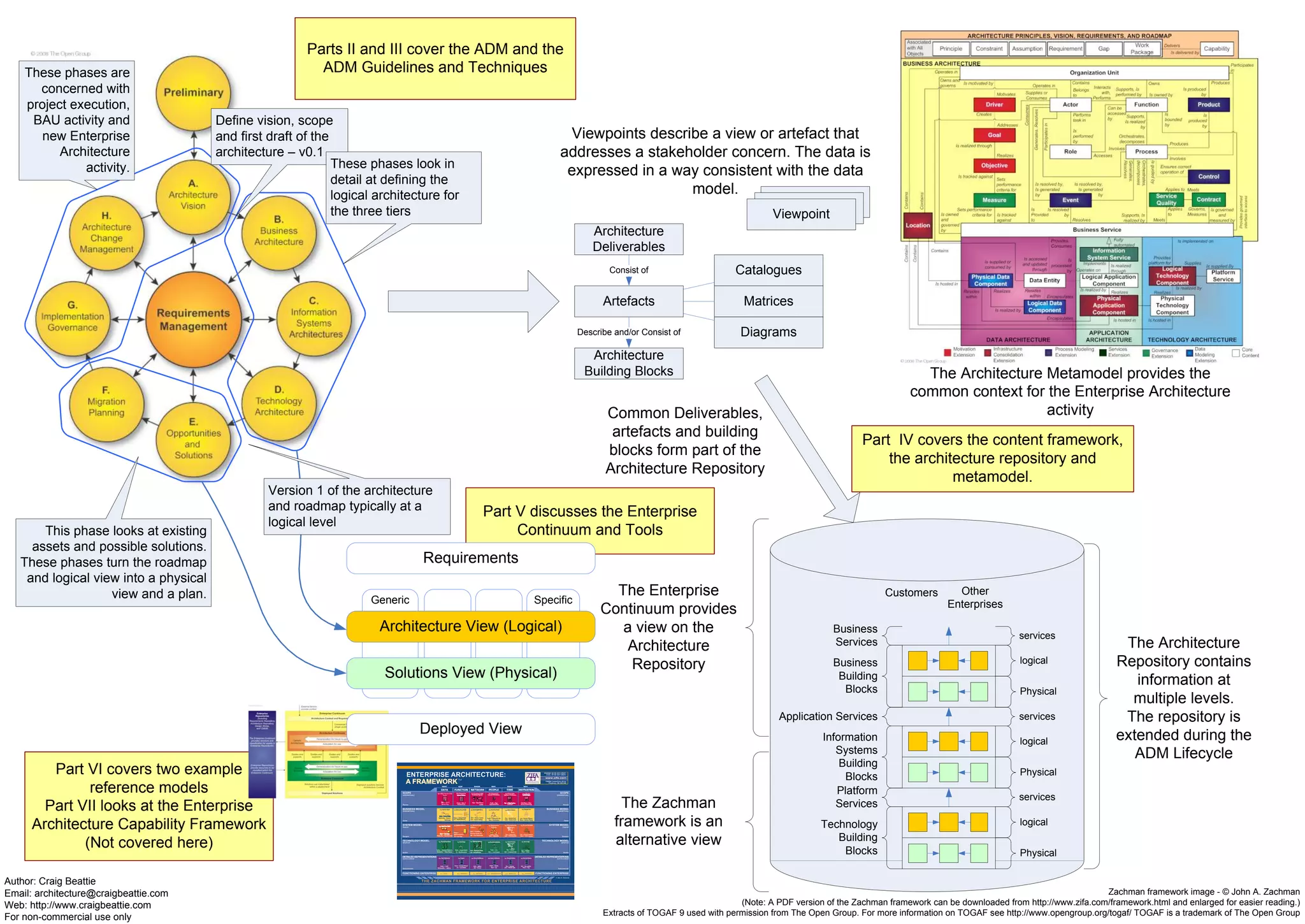
Togaf 9 overview

  • 1.
    Part VI coverstwo example reference models Part VII looks at the Enterprise Architecture Capability Framework (Not covered here) Part IV covers the content framework, the architecture repository and metamodel. Part V discusses the Enterprise Continuum and Tools Requirements Deployed View SpecificGeneric Architecture View (Logical) Solutions View (Physical) Customers Other Enterprises Business Services Application Services Platform Services Business Building Blocks Information Systems Building Blocks Technology Building Blocks logical Physical logical Physical logical Physical services services services The Architecture Repository contains information at multiple levels. The repository is extended during the ADM Lifecycle The Enterprise Continuum provides a view on the Architecture Repository Architecture Deliverables Artefacts Consist of Architecture Building Blocks Describe and/or Consist of Catalogues Matrices Diagrams The Architecture Metamodel provides the common context for the Enterprise Architecture activityCommon Deliverables, artefacts and building blocks form part of the Architecture Repository This phase looks at existing assets and possible solutions. These phases turn the roadmap and logical view into a physical view and a plan. The Zachman framework is an alternative view Version 1 of the architecture and roadmap typically at a logical level Parts II and III cover the ADM and the ADM Guidelines and Techniques Define vision, scope and first draft of the architecture – v0.1 These phases are concerned with project execution, BAU activity and new Enterprise Architecture activity. These phases look in detail at defining the logical architecture for the three tiers Viewpoints describe a view or artefact that addresses a stakeholder concern. The data is expressed in a way consistent with the data model. ViewpointViewpointViewpoint Zachman framework image - © John A. Zachman (Note: A PDF version of the Zachman framework can be downloaded from http://www.zifa.com/framework.html and enlarged for easier reading.) Extracts of TOGAF 9 used with permission from The Open Group. For more information on TOGAF see http://www.opengroup.org/togaf/ TOGAF is a trademark of The Open Group Author: Craig Beattie Email: architecture@craigbeattie.com Web: http://www.craigbeattie.com For non-commercial use only