Summarised - 2010
   Applying Iteration to the ADM
   Applying the ADM at different Enterprise
    Levels
   ADM Cycle Approaches
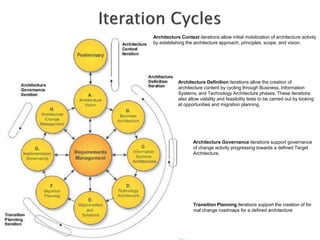
Architecture Context iterations allow initial mobilization of architecture activity
by establishing the architecture approach, principles, scope, and vision.


            Architecture Definition iterations allow the creation of
            architecture content by cycling through Business, Information
            Systems, and Technology Architecture phases. These iterations
            also allow viability and feasibility tests to be carried out by looking
            at opportunities and migration planning.


                    Architecture Governance iterations support governance
                    of change activity progressing towards a defined Target
                    Architecture.


                    Transition Planning iterations support the creation of for
                    mal change roadmaps for a defined architecture
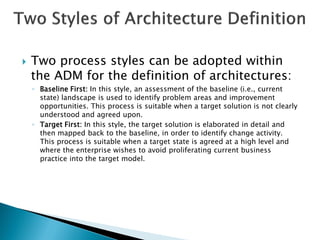
   Two process styles can be adopted within
    the ADM for the definition of architectures:
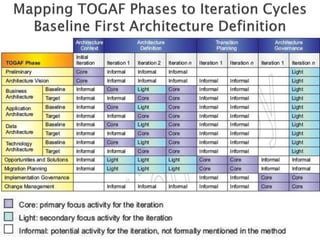
    ◦ Baseline First: In this style, an assessment of the baseline (i.e., current
      state) landscape is used to identify problem areas and improvement
      opportunities. This process is suitable when a target solution is not clearly
      understood and agreed upon.
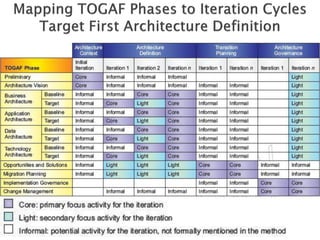
    ◦ Target First: In this style, the target solution is elaborated in detail and
      then mapped back to the baseline, in order to identify change activity.
      This process is suitable when a target state is agreed at a high level and
      where the enterprise wishes to avoid proliferating current business
      practice into the target model.
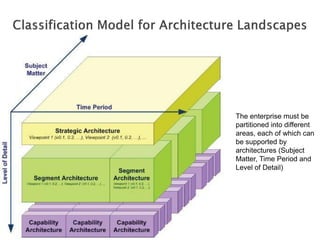
The enterprise must be
partitioned into different
areas, each of which can
be supported by
architectures (Subject
Matter, Time Period and
Level of Detail)
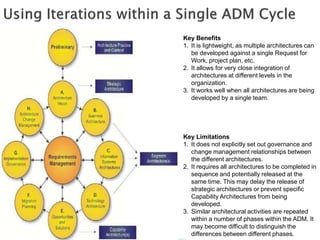
Key Benefits
1. It is lightweight, as multiple architectures can
   be developed against a single Request for
   Work, project plan, etc.
2. It allows for very close integration of
   architectures at different levels in the
   organization.
3. It works well when all architectures are being
   developed by a single team.


Key Limitations
1. It does not explicitly set out governance and
   change management relationships between
   the different architectures.
2. It requires all architectures to be completed in
   sequence and potentially released at the
   same time. This may delay the release of
   strategic architectures or prevent specific
   Capability Architectures from being
   developed.
3. Similar architectural activities are repeated
   within a number of phases within the ADM. It
   may become difficult to distinguish the
   differences between different phases.
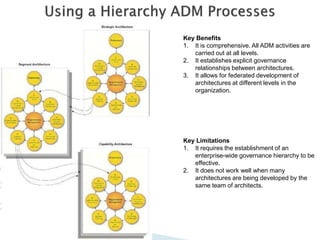
Key Benefits
1. It is comprehensive. All ADM activities are
   carried out at all levels.
2. It establishes explicit governance
   relationships between architectures.
3. It allows for federated development of
   architectures at different levels in the
   organization.


Key Limitations
1. It requires the establishment of an
   enterprise-wide governance hierarchy to be
   effective.
2. It does not work well when many
   architectures are being developed by the
   same team of architects.
   TOGAF Version 9, The Open Group
    Architecture Framework (TOGAF), 2009
If you have one last breath
use it to say...

TOGAF 9 Guidelinesand Techniques Ver1 0

  • 1.
  • 2.
    Applying Iteration to the ADM  Applying the ADM at different Enterprise Levels  ADM Cycle Approaches
  • 4.
    Architecture Context iterationsallow initial mobilization of architecture activity by establishing the architecture approach, principles, scope, and vision. Architecture Definition iterations allow the creation of architecture content by cycling through Business, Information Systems, and Technology Architecture phases. These iterations also allow viability and feasibility tests to be carried out by looking at opportunities and migration planning. Architecture Governance iterations support governance of change activity progressing towards a defined Target Architecture. Transition Planning iterations support the creation of for mal change roadmaps for a defined architecture
  • 5.
    Two process styles can be adopted within the ADM for the definition of architectures: ◦ Baseline First: In this style, an assessment of the baseline (i.e., current state) landscape is used to identify problem areas and improvement opportunities. This process is suitable when a target solution is not clearly understood and agreed upon. ◦ Target First: In this style, the target solution is elaborated in detail and then mapped back to the baseline, in order to identify change activity. This process is suitable when a target state is agreed at a high level and where the enterprise wishes to avoid proliferating current business practice into the target model.
  • 9.
    The enterprise mustbe partitioned into different areas, each of which can be supported by architectures (Subject Matter, Time Period and Level of Detail)
  • 12.
    Key Benefits 1. Itis lightweight, as multiple architectures can be developed against a single Request for Work, project plan, etc. 2. It allows for very close integration of architectures at different levels in the organization. 3. It works well when all architectures are being developed by a single team. Key Limitations 1. It does not explicitly set out governance and change management relationships between the different architectures. 2. It requires all architectures to be completed in sequence and potentially released at the same time. This may delay the release of strategic architectures or prevent specific Capability Architectures from being developed. 3. Similar architectural activities are repeated within a number of phases within the ADM. It may become difficult to distinguish the differences between different phases.
  • 13.
    Key Benefits 1. Itis comprehensive. All ADM activities are carried out at all levels. 2. It establishes explicit governance relationships between architectures. 3. It allows for federated development of architectures at different levels in the organization. Key Limitations 1. It requires the establishment of an enterprise-wide governance hierarchy to be effective. 2. It does not work well when many architectures are being developed by the same team of architects.
  • 14.
    TOGAF Version 9, The Open Group Architecture Framework (TOGAF), 2009
  • 15.
    If you haveone last breath use it to say...