Career Center 
The STAR Method 
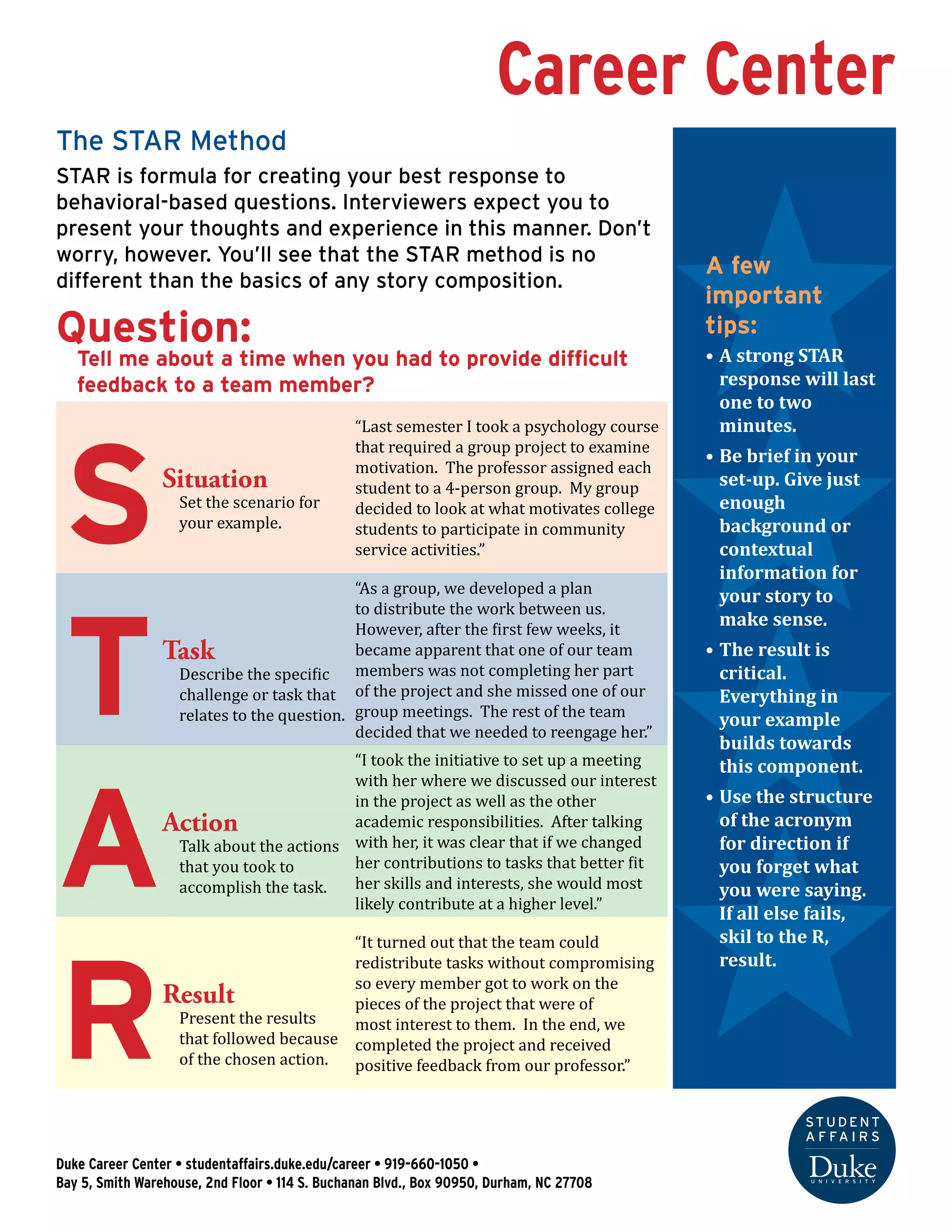
STAR is formula for creating your best response to 
behavioral-based questions. Interviewers expect you to 
present your thoughts and experience in this manner. Don’t 
worry, however. You’ll see that the STAR method is no 
different than the basics of any story composition. 
Question: 
Tell me about a time when you had to provide difficult 
feedback to a team member? 
“Last semester I took a psychology course 
that required a group project to examine 
motivation. The professor assigned each 
student to a 4-person group. My group 
decided to look at what motivates college 
students to participate in community 
service activities.” 
“As a group, we developed a plan 
to distribute the work between us. 
However, after the first few weeks, it 
became apparent that one of our team 
members was not completing her part 
of the project and she missed one of our 
group meetings. The rest of the team 
decided that we needed to reengage her.” 
“I took the initiative to set up a meeting 
with her where we discussed our interest 
in the project as well as the other 
academic responsibilities. After talking 
with her, it was clear that if we changed 
her contributions to tasks that better fit 
her skills and interests, she would most 
likely contribute at a higher level.” 
“It turned out that the team could 
redistribute tasks without compromising 
so every member got to work on the 
pieces of the project that were of 
most interest to them. In the end, we 
completed the project and received 
positive feedback from our professor.” 
S 
T 
A 
R 
Situation 
Set the scenario for 
your example. 
Task 
Describe the specific 
challenge or task that 
relates to the question. 
Action 
Talk about the actions 
that you took to 
accomplish the task. 
Result 
Present the results 
that followed because 
of the chosen action. 
A few 
important 
tips: 
• A strong STAR 
response will last 
one to two 
minutes. 
• Be brief in your 
set-up. Give just 
enough 
background or 
contextual 
information for 
your story to 
make sense. 
• The result is 
critical. 
Everything in 
your example 
builds towards 
this component. 
• Use the structure 
of the acronym 
for direction if 
you forget what 
you were saying. 
If all else fails, 
skil to the R, 
result. 
Duke Career Center • studentaffairs.duke.edu/career • 919-660-1050 • 
Bay 5, Smith Warehouse, 2nd Floor • 114 S. Buchanan Blvd., Box 90950, Durham, NC 27708
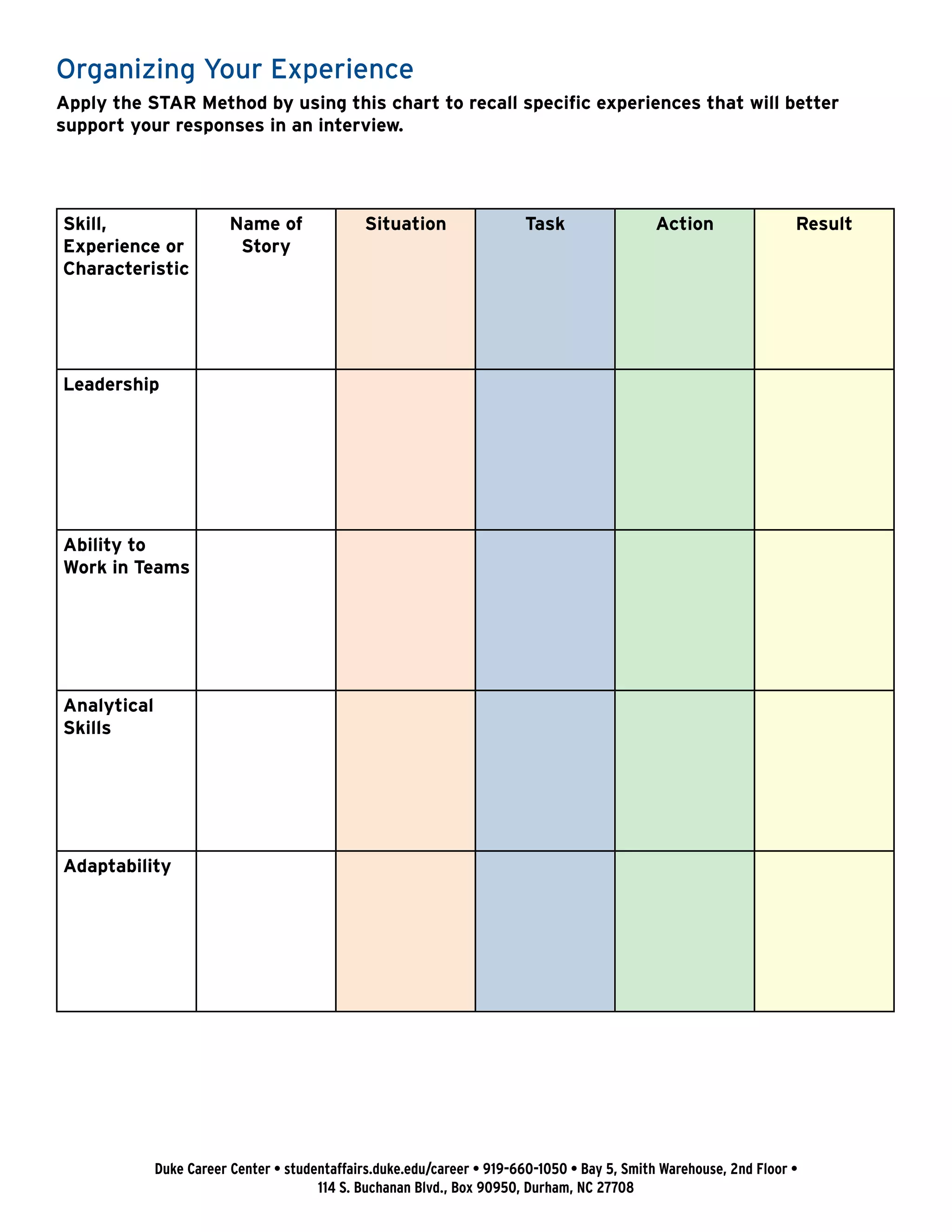
Organizing Your Experience 
Apply the STAR Method by using this chart to recall specific experiences that will better 
support your responses in an interview. 
Duke Career Center • studentaffairs.duke.edu/career • 919-660-1050 • Bay 5, Smith Warehouse, 2nd Floor • 
114 S. Buchanan Blvd., Box 90950, Durham, NC 27708 
Skill, 
Experience or 
Characteristic 
Name of 
Story 
Situation Task Action Result 
Leadership 
Ability to 
Work in Teams 
Analytical 
Skills 
Adaptability

Star Worksheet

  • 1.
    Career Center TheSTAR Method STAR is formula for creating your best response to behavioral-based questions. Interviewers expect you to present your thoughts and experience in this manner. Don’t worry, however. You’ll see that the STAR method is no different than the basics of any story composition. Question: Tell me about a time when you had to provide difficult feedback to a team member? “Last semester I took a psychology course that required a group project to examine motivation. The professor assigned each student to a 4-person group. My group decided to look at what motivates college students to participate in community service activities.” “As a group, we developed a plan to distribute the work between us. However, after the first few weeks, it became apparent that one of our team members was not completing her part of the project and she missed one of our group meetings. The rest of the team decided that we needed to reengage her.” “I took the initiative to set up a meeting with her where we discussed our interest in the project as well as the other academic responsibilities. After talking with her, it was clear that if we changed her contributions to tasks that better fit her skills and interests, she would most likely contribute at a higher level.” “It turned out that the team could redistribute tasks without compromising so every member got to work on the pieces of the project that were of most interest to them. In the end, we completed the project and received positive feedback from our professor.” S T A R Situation Set the scenario for your example. Task Describe the specific challenge or task that relates to the question. Action Talk about the actions that you took to accomplish the task. Result Present the results that followed because of the chosen action. A few important tips: • A strong STAR response will last one to two minutes. • Be brief in your set-up. Give just enough background or contextual information for your story to make sense. • The result is critical. Everything in your example builds towards this component. • Use the structure of the acronym for direction if you forget what you were saying. If all else fails, skil to the R, result. Duke Career Center • studentaffairs.duke.edu/career • 919-660-1050 • Bay 5, Smith Warehouse, 2nd Floor • 114 S. Buchanan Blvd., Box 90950, Durham, NC 27708
  • 2.
    Organizing Your Experience Apply the STAR Method by using this chart to recall specific experiences that will better support your responses in an interview. Duke Career Center • studentaffairs.duke.edu/career • 919-660-1050 • Bay 5, Smith Warehouse, 2nd Floor • 114 S. Buchanan Blvd., Box 90950, Durham, NC 27708 Skill, Experience or Characteristic Name of Story Situation Task Action Result Leadership Ability to Work in Teams Analytical Skills Adaptability