Page 1 of 3
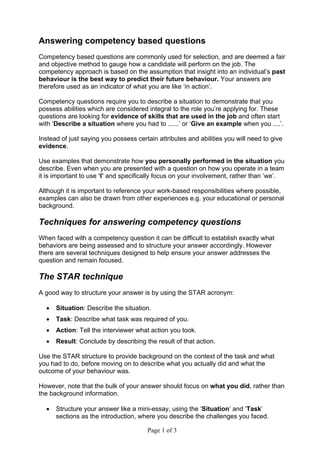
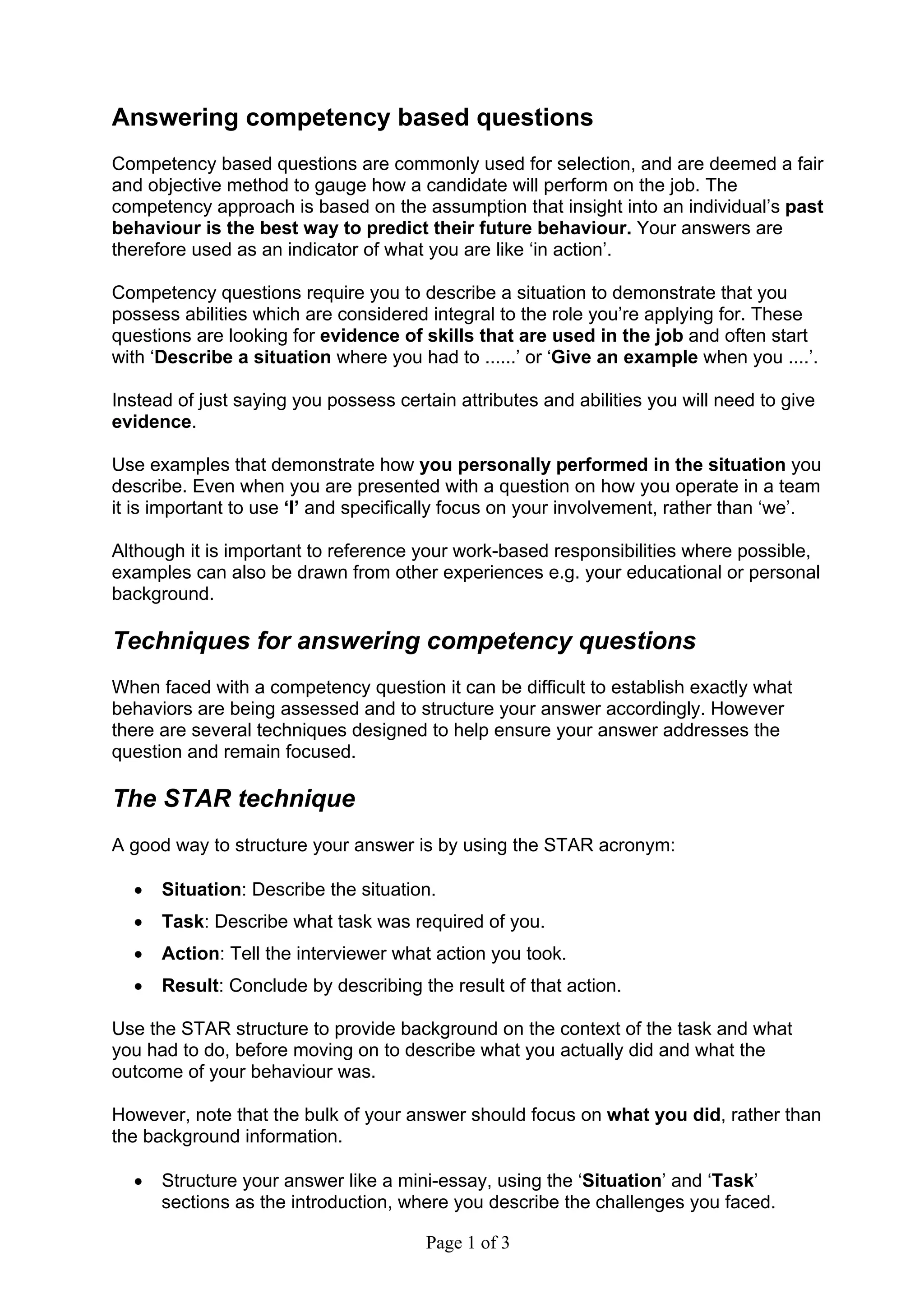
Answering competency based questions
Competency based questions are commonly used for selection, and are deemed a fair
and objective method to gauge how a candidate will perform on the job. The
competency approach is based on the assumption that insight into an individual’s past
behaviour is the best way to predict their future behaviour. Your answers are
therefore used as an indicator of what you are like ‘in action’.
Competency questions require you to describe a situation to demonstrate that you
possess abilities which are considered integral to the role you’re applying for. These
questions are looking for evidence of skills that are used in the job and often start
with ‘Describe a situation where you had to ......’ or ‘Give an example when you ....’.
Instead of just saying you possess certain attributes and abilities you will need to give
evidence.
Use examples that demonstrate how you personally performed in the situation you
describe. Even when you are presented with a question on how you operate in a team
it is important to use ‘I’ and specifically focus on your involvement, rather than ‘we’.
Although it is important to reference your work-based responsibilities where possible,
examples can also be drawn from other experiences e.g. your educational or personal
background.
Techniques for answering competency questions
When faced with a competency question it can be difficult to establish exactly what
behaviors are being assessed and to structure your answer accordingly. However
there are several techniques designed to help ensure your answer addresses the
question and remain focused.
The STAR technique
A good way to structure your answer is by using the STAR acronym:
 Situation: Describe the situation.
 Task: Describe what task was required of you.
 Action: Tell the interviewer what action you took.
 Result: Conclude by describing the result of that action.
Use the STAR structure to provide background on the context of the task and what
you had to do, before moving on to describe what you actually did and what the
outcome of your behaviour was.
However, note that the bulk of your answer should focus on what you did, rather than
the background information.
 Structure your answer like a mini-essay, using the ‘Situation’ and ‘Task’
sections as the introduction, where you describe the challenges you faced.
Page 2 of 3
 The ‘Action’ forms the main body and should be the longest part of your
answer.
 The ‘Result’ is the conclusion and like the introduction, should be quite short.
It will be helpful if you keep referring back to the competency question to ensure your
answer stays on track.
Examples
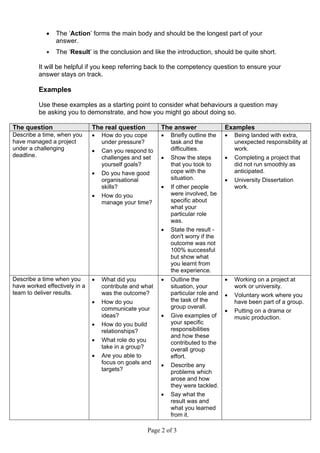
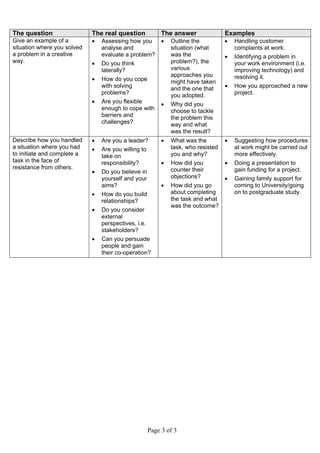
Use these examples as a starting point to consider what behaviours a question may
be asking you to demonstrate, and how you might go about doing so.
The question The real question The answer Examples
Describe a time, when you
have managed a project
under a challenging
deadline.
 How do you cope
under pressure?
 Can you respond to
challenges and set
yourself goals?
 Do you have good
organisational
skills?
 How do you
manage your time?
 Briefly outline the
task and the
difficulties.
 Show the steps
that you took to
cope with the
situation.
 If other people
were involved, be
specific about
what your
particular role
was.
 State the result -
don't worry if the
outcome was not
100% successful
but show what
you learnt from
the experience.
 Being landed with extra,
unexpected responsibility at
work.
 Completing a project that
did not run smoothly as
anticipated.
 University Dissertation
work.
Describe a time when you
have worked effectively in a
team to deliver results.
 What did you
contribute and what
was the outcome?
 How do you
communicate your
ideas?
 How do you build
relationships?
 What role do you
take in a group?
 Are you able to
focus on goals and
targets?
 Outline the
situation, your
particular role and
the task of the
group overall.
 Give examples of
your specific
responsibilities
and how these
contributed to the
overall group
effort.
 Describe any
problems which
arose and how
they were tackled.
 Say what the
result was and
what you learned
from it.
 Working on a project at
work or university.
 Voluntary work where you
have been part of a group.
 Putting on a drama or
music production.
Page 3 of 3
The question The real question The answer Examples
Give an example of a
situation where you solved
a problem in a creative
way.
 Assessing how you
analyse and
evaluate a problem?
 Do you think
laterally?
 How do you cope
with solving
problems?
 Are you flexible
enough to cope with
barriers and
challenges?
 Outline the
situation (what
was the
problem?), the
various
approaches you
might have taken
and the one that
you adopted.
 Why did you
choose to tackle
the problem this
way and what
was the result?
 Handling customer
complaints at work.
 Identifying a problem in
your work environment (i.e.
improving technology) and
resolving it.
 How you approached a new
project.
Describe how you handled
a situation where you had
to initiate and complete a
task in the face of
resistance from others.
 Are you a leader?
 Are you willing to
take on
responsibility?
 Do you believe in
yourself and your
aims?
 How do you build
relationships?
 Do you consider
external
perspectives, i.e.
stakeholders?
 Can you persuade
people and gain
their co-operation?
 What was the
task, who resisted
you and why?
 How did you
counter their
objections?
 How did you go
about completing
the task and what
was the outcome?
 Suggesting how procedures
at work might be carried out
more effectively.
 Doing a presentation to
gain funding for a project.
 Gaining family support for
coming to University/going
on to postgraduate study.

Answering competency based questions

  • 1.
    Page 1 of3 Answering competency based questions Competency based questions are commonly used for selection, and are deemed a fair and objective method to gauge how a candidate will perform on the job. The competency approach is based on the assumption that insight into an individual’s past behaviour is the best way to predict their future behaviour. Your answers are therefore used as an indicator of what you are like ‘in action’. Competency questions require you to describe a situation to demonstrate that you possess abilities which are considered integral to the role you’re applying for. These questions are looking for evidence of skills that are used in the job and often start with ‘Describe a situation where you had to ......’ or ‘Give an example when you ....’. Instead of just saying you possess certain attributes and abilities you will need to give evidence. Use examples that demonstrate how you personally performed in the situation you describe. Even when you are presented with a question on how you operate in a team it is important to use ‘I’ and specifically focus on your involvement, rather than ‘we’. Although it is important to reference your work-based responsibilities where possible, examples can also be drawn from other experiences e.g. your educational or personal background. Techniques for answering competency questions When faced with a competency question it can be difficult to establish exactly what behaviors are being assessed and to structure your answer accordingly. However there are several techniques designed to help ensure your answer addresses the question and remain focused. The STAR technique A good way to structure your answer is by using the STAR acronym:  Situation: Describe the situation.  Task: Describe what task was required of you.  Action: Tell the interviewer what action you took.  Result: Conclude by describing the result of that action. Use the STAR structure to provide background on the context of the task and what you had to do, before moving on to describe what you actually did and what the outcome of your behaviour was. However, note that the bulk of your answer should focus on what you did, rather than the background information.  Structure your answer like a mini-essay, using the ‘Situation’ and ‘Task’ sections as the introduction, where you describe the challenges you faced.
  • 2.
    Page 2 of3  The ‘Action’ forms the main body and should be the longest part of your answer.  The ‘Result’ is the conclusion and like the introduction, should be quite short. It will be helpful if you keep referring back to the competency question to ensure your answer stays on track. Examples Use these examples as a starting point to consider what behaviours a question may be asking you to demonstrate, and how you might go about doing so. The question The real question The answer Examples Describe a time, when you have managed a project under a challenging deadline.  How do you cope under pressure?  Can you respond to challenges and set yourself goals?  Do you have good organisational skills?  How do you manage your time?  Briefly outline the task and the difficulties.  Show the steps that you took to cope with the situation.  If other people were involved, be specific about what your particular role was.  State the result - don't worry if the outcome was not 100% successful but show what you learnt from the experience.  Being landed with extra, unexpected responsibility at work.  Completing a project that did not run smoothly as anticipated.  University Dissertation work. Describe a time when you have worked effectively in a team to deliver results.  What did you contribute and what was the outcome?  How do you communicate your ideas?  How do you build relationships?  What role do you take in a group?  Are you able to focus on goals and targets?  Outline the situation, your particular role and the task of the group overall.  Give examples of your specific responsibilities and how these contributed to the overall group effort.  Describe any problems which arose and how they were tackled.  Say what the result was and what you learned from it.  Working on a project at work or university.  Voluntary work where you have been part of a group.  Putting on a drama or music production.
  • 3.
    Page 3 of3 The question The real question The answer Examples Give an example of a situation where you solved a problem in a creative way.  Assessing how you analyse and evaluate a problem?  Do you think laterally?  How do you cope with solving problems?  Are you flexible enough to cope with barriers and challenges?  Outline the situation (what was the problem?), the various approaches you might have taken and the one that you adopted.  Why did you choose to tackle the problem this way and what was the result?  Handling customer complaints at work.  Identifying a problem in your work environment (i.e. improving technology) and resolving it.  How you approached a new project. Describe how you handled a situation where you had to initiate and complete a task in the face of resistance from others.  Are you a leader?  Are you willing to take on responsibility?  Do you believe in yourself and your aims?  How do you build relationships?  Do you consider external perspectives, i.e. stakeholders?  Can you persuade people and gain their co-operation?  What was the task, who resisted you and why?  How did you counter their objections?  How did you go about completing the task and what was the outcome?  Suggesting how procedures at work might be carried out more effectively.  Doing a presentation to gain funding for a project.  Gaining family support for coming to University/going on to postgraduate study.