INSTITUTE OF DENTAL
SCIENCE
DEPARTMENT OF CONSERVATIVE
DENTISTRY
Presented by:-
DR. TANMAY SINGH PATHANI {56}
BDS, MPH
SEMINAR ON
INVESTMENT & CASTING
•Definition
•Introduction
•Layout of steps involved casting procedure.
•Desired accuracy in casting procedure.
•Spruing
•Casting ring liners
•Investing
•Wax burnout procedure in
•Gypsum bonded investment
•Phosphate bonded investment
•Casting machines and procedure.
•Defects in casting and their prevention.
Contents
DEFINITIONS
Casting:
Something that has been cast in a mold.
Or
An object formed by the solidification of a fluid that has been
poured or injected into a mold.
Or
The act of forming an object in a mold.
GPT 8th
edition.
Sprue former-
A wax, plastic, or metal pattern used to form the channel
allowing molten metal to flow in the mold to make a
casting.
Investing –
The process of covering or enveloping wholly or in part ,
an object such as denture , tooth, wax form, crown etc.
with a suitable investment material before processing or
casting.
INTRODUCTION
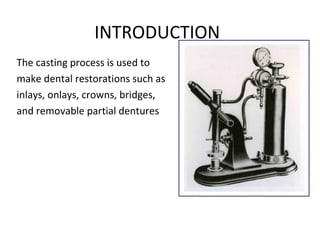
The casting process is used to
make dental restorations such as
inlays, onlays, crowns, bridges,
and removable partial dentures
• W.H.Taggart introduced lost-wax casting
technique in 1907.
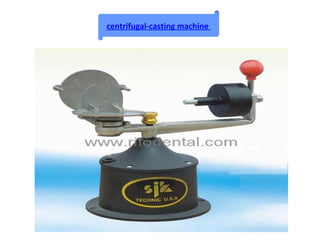
• This was followed by Jameson who
introduced the centrifugal-casting machine
and Solbrig who introduced the steam-
pressure casting machine.
centrifugal-casting machine
The Layout Of Steps In Making Casting
1. Preparation of the tooth or teeth
2. Making of an impression.
3. Pour gypsum slurry into the impression to make
a positive cast,
4. Make a wax pattern
5. Sprue the wax pattern (fix it in space)
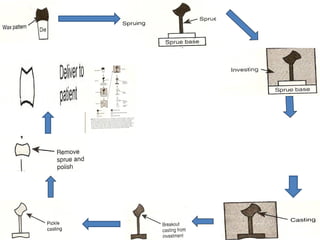
1. Invest the wax pattern.
2. Eliminate the wax pattern by burning the wax out of the
investment in a furnace, thus making the mold.
3. Force molten metal into the mold using one of a variety of
means.
4. Clean the cast.
5. Remove the sprue from the casting.
6. Finish and polish the casting on the die.
7. Cement the finished cast restoration on the prepared
The direct technique (in which the pattern is made
on the tooth rather than on the die) if used, steps 2
and 3 are omitted
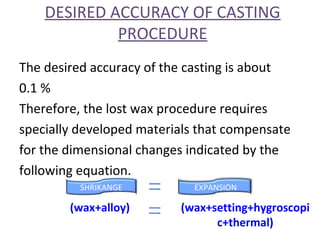
DESIRED ACCURACY OF CASTING
PROCEDURE
The desired accuracy of the casting is about
0.1 %
Therefore, the lost wax procedure requires
specially developed materials that compensate
for the dimensional changes indicated by the
following equation.
SHRIKANGE EXPANSION
(wax+alloy) (wax+setting+hygroscopi
c+thermal)
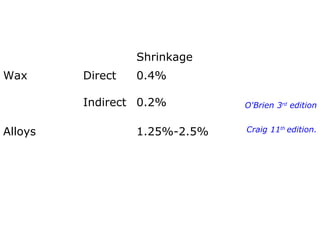
Shrinkage
Wax Direct 0.4%
O'Brien 3rd
editionIndirect 0.2%
Alloys 1.25%-2.5% Craig 11th
edition.
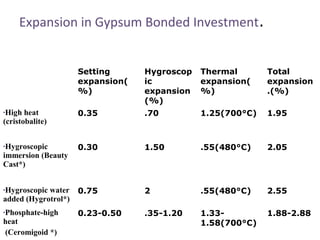
Setting
expansion(
%)
Hygroscop
ic
expansion
(%)
Thermal
expansion(
%)
Total
expansion
.(%)
•High heat
(cristobalite)
0.35 .70 1.25(700°C) 1.95
•Hygroscopic
immersion (Beauty
Cast*)
0.30 1.50 .55(480°C) 2.05
•Hygroscopic water
added (Hygrotrol*)
0.75 2 .55(480°C) 2.55
•Phosphate-high
heat
(Ceromigoid *)
0.23-0.50 .35-1.20 1.33-
1.58(700°C)
1.88-2.88
Expansion in Gypsum Bonded Investment.
Hi-Temp Carbon-free
investment for high
fusing alloys
1.2%
TE at
1300-1800°F
(700-900°C
.7% Setting
Expansion
Cera-Fina Carbon-free fine
grained investment for
high fusing alloys
1.3% TE at
1300-1800°F
(700-900°C)
.3% Setting
Expansion
WiroFine partial denture
investment material
Linear thermal
expansion [%]
0,8
Bellavest® SH
Graphite-free,
phosphate-bonded
precision casting
investment material
rapidly or
conventionally
heatable casting
investment material
for crowns and bridges
made of precious
metal, non-precious
metal alloys and press
ceramic
50% BegoSol®
1.7% (total
expansion)
80% BegoSol®
2.2%(total
expansion)
Expansion in Phosphate Bonded Investment
Material
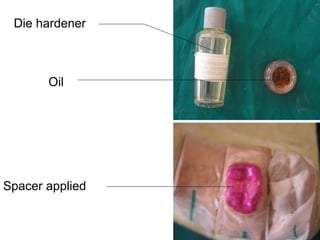
Die hardener
Oil
Spacer applied
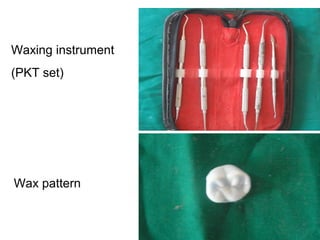
Waxing instrument
(PKT set)
Wax pattern
SPRUING
PURPOSE-
1. Fix the pattern in space so a mold can be made.
2. To create a channel for elimination of wax during
burnout.
3. To form a channel for the ingress of molten alloy
during casting.
4. To compensate for alloy shrinkage during
solidification.
O'Brien 3rd edition
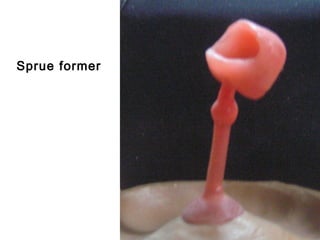
Sprue former
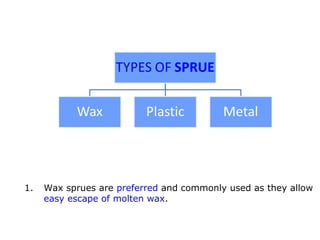
1. Wax sprues are preferred and commonly used as they allow
easy escape of molten wax.
2. Plastic sprues :
• Solid plastic sprues soften at higher
temperature than the wax pattern
• May block the escape of wax because the wax
melts at lower temperature than plastic and
• Thermal expansion of wax is 5 times greater
than plastic which will result in excessive
pressure build up inside the mold during the
burnout before plastic sprue softens resulting
in casting defects
O'Brien 3rd edition
3.Metal sprues can be solid or hollow tubes. Later one is
preferable.
• If metal sprue is used, it should be made of non-
rusting to avoid possible contamination of wax
pattern.
• They removed from the investment at the same time
when the crucible former is removed.
care should be taken to examine the orifice while
removing because small amount of investment chip-
off which result in incomplete casting or inclusion of
foreign object in the casting
O'Brien 3rd edition
SELECTION OF SPRUE FORMER
Based on following criteria
DIAMETER- Should be = the thickest portion of wax
pattern
If large- causes distortion
If small- will solidify before casting itself
and cause localized shrinkage
porosity (suck back porosity)
The sprue former should be at least 1. 7 mm(14 guage) in
diameter unless the pattern is extremely small,and sprue
formers up to 2.5 mm(10 guage) in diameter can be used for
very large patterns (bulky) full crown
Murrow and Rudd
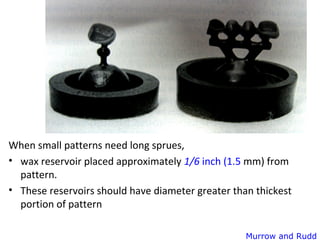
When small patterns need long sprues,
• wax reservoir placed approximately 1/6 inch (1.5 mm) from
pattern.
• These reservoirs should have diameter greater than thickest
portion of pattern
Murrow and Rudd
ATTACHMENT AND ORIENTATION
Should be attached at greatest cross-section
of the pattern
As It is best for molten metal to flow from thick
to thin area i.e. from the marginal ridges
to the gingival margins and not the
reverse.
This also minimizes the risk of turbulence
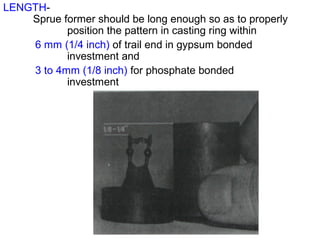
LENGTH-
Sprue former should be long enough so as to properly
position the pattern in casting ring within
6 mm (1/4 inch) of trail end in gypsum bonded
investment and
3 to 4mm (1/8 inch) for phosphate bonded
investment
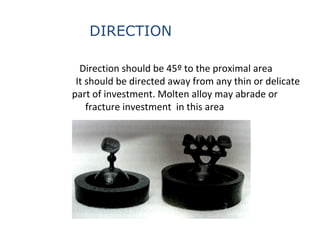
Direction should be 45º to the proximal area
It should be directed away from any thin or delicate
part of investment. Molten alloy may abrade or
fracture investment in this area
DIRECTION
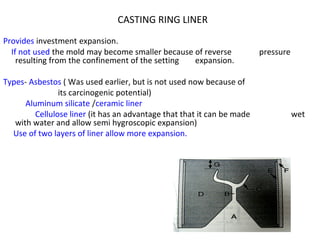
CASTING RING LINER
Provides investment expansion.
If not used the mold may become smaller because of reverse pressure
resulting from the confinement of the setting expansion.
Types- Asbestos ( Was used earlier, but is not used now because of
its carcinogenic potential)
Aluminum silicate /ceramic liner
Cellulose liner (it has an advantage that that it can be made wet
with water and allow semi hygroscopic expansion)
Use of two layers of liner allow more expansion.
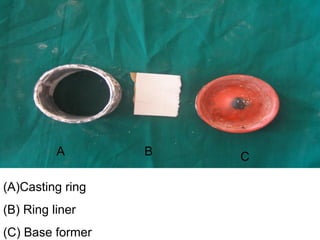
A B C
(A)Casting ring
(B) Ring liner
(C) Base former
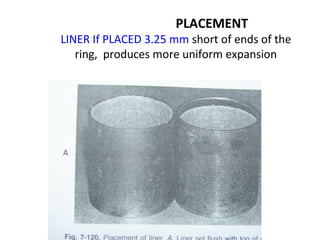
PLACEMENT
LINER If PLACED 3.25 mm short of ends of the
ring, produces more uniform expansion
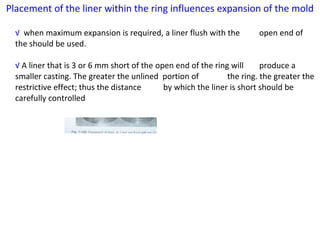
Placement of the liner within the ring influences expansion of the mold
√ when maximum expansion is required, a liner flush with the open end of
the should be used.
√ A liner that is 3 or 6 mm short of the open end of the ring will produce a
smaller casting. The greater the unlined portion of the ring. the greater the
restrictive effect; thus the distance by which the liner is short should be
carefully controlled
INVESTING
Wax pattern should be cleaned of any debris, grease or oil ( a
commercially available wax pattern cleaner or a diluted synthetic
detergent is used)
Any excess liquid is shaken off and pattern is left to air dry
A thin film of cleanser left on pattern reduces surface tension of
wax pattern and permit better wetting of investment
Liquid and powder are mixed with care to not to incorporate air
in the mix. (Vacuum mixing is preferred)
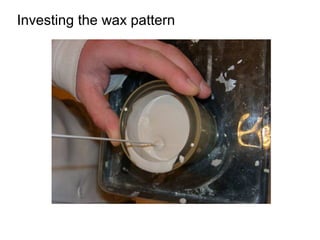
Pattern is painted with layer of investment inside and out.
Casting ring is positioned on crucible former and remaining
investment is vibrated slowly in to the ring.
Vacuum mixing results the texture of the cast surface
–smoother with better details
reproduction.
-It also increases the tensile
strength of investment.
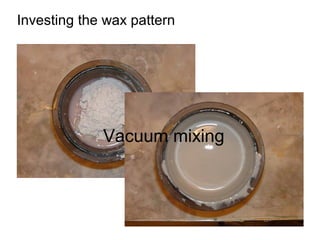
Vacuum mixing
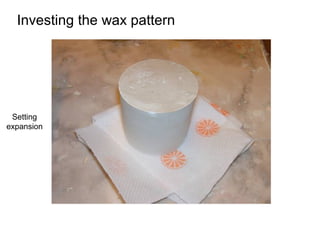
Investing the wax pattern
Care should be taken to not to give excessive vibration while
investing because it may cause solids to settle and may lead to
free water accumulation adjacent to pattern resulting in surface
roughness.
Investing the wax pattern
Setting
expansion
WAX ELIMINATION AND HEATING
Gypsum bonded and phosphate bonded investment are ready
for burnout after setting of one hour ( They should be kept in 100%
humidity in case if one need to wait).
1. Remove crucible former and any metal sprue.
2. Clean any debris with camel hair brush.
3. Investing rings are placed in a room-temperature furnace
and heated to prescribed maximum temperature.
For GYPSUM BONDED-468ºC for hygroscopic technique
(low heat technique)
650°
C for thermal expansion technique
( high heat technique)
RELATED PROBLEMS
Investment decomposition- is seen with gypsum
bonded investment therefore careful temperature
setting should be done.
Melted wax absorbed in investment-
To prevent this begin burnout when mold is still wet
also in high heat technique, high temperature convert
carbon to CO2 or CO which escapes through pores.
Heating is done at 500ºc for 60 minute ( It can be done up to
5 hour or longer with little damage)
Expansion is obtained by-
1. 37ºc water bath expands the wax pattern.
2. Warm water entering investment mold adds some hygroscopic
expansion.
3. thermal expansion at 500ºc.
Added expansion for newer noble alloys is obtained by-
1. increasing water bath temperature to 40ºc.
2. using two layers of liners.
3. increasing burnout temperature range of 600ºc to 650ºc.
HYGROSCOPIC LOW HEAT TECHNIQUE
FOR GYPSUM BONDED INVESTMENT
This approach depends almost entirely on high heat burnout
to obtain the required expansion and at the same time
eliminating the wax pattern.
Additional expansion is obtained from-
Expansion of pattern from heat produced during
setting.
Warm water entering the mold from wet liner
causing some hygroscopic expansion.
HIGH-HEAT THERMAL EXPANSION TECHNIQUE
FOR GYPSUM BONDED INVESTMENTS.
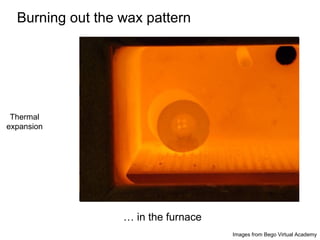
Burning out the wax pattern
… in the furnace
Thermal
expansion
Images from Bego Virtual Academy
Mold are placed in furnace at room temperature and
slowly heated to 650ºc to 700ºc in 60 minutes and
held for 15 to 30 minute.
Related problems-
Rapid heating can generate steam which can cause flaking of
mold walls. It may also cause cracking of investment because
outer layer of investment expands thermally resulting
compressive stress in outer layer and tensile stress in
inner layer.
These crack appear from interior outwardly in form of radial
cracks.
Sulfer di oxide production
It occurs rapidly over 700*c with reduction of calcium sulfate by
carbon.
CaSo4 + 4C  CaS +4CO
3CaSo4 + CaS  4CaO +4SO2
The sulfur dioxide produced contaminates gold
castings and makes them brittle.
Therefore casting should be made immediately after casting
temperature has been reached to prevent sulfur contamination.
PHOSPHATE BONDED INVESTMENT-
• Usual burnout temperature range is from 750º
c
to 900º
c.
• Heating rate is usually slow till 315º
c and is quite
rapid thereafter reaching completion after a hold
at the upper temperature
1.Expansion of wax pattern because setting reaction
raises the mold temperature considerably
2.Setting expansion is higher than in gypsum
bonded because of special liquids (silica sol)
used to enhance such expansion.
3.Thermal expansion is high because of higher
burnout temperature.
PHOSPHATE BONDED INVESTMENTS OBTAIN THEIR
EXPANSION FROM FOLLOWING SOURCE
CASTING MACHINES
Several types and designs of casting machines are used to
make dental castings.
All casting machines accelerate molten metal into the mold
either by
1. Centrifugal force or
2. Air pressure.
Numerous modifications and variations of these methods are used
in different machines.
• The selection of the casting and melting techniques is
influenced by type of alloy and restoration to be cast.
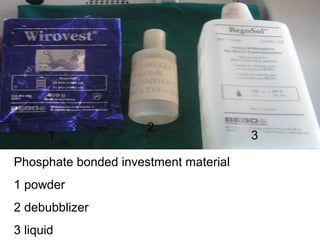
Phosphate bonded investment material
1 powder
2 debubblizer
3 liquid
1
2
3
Three types of casting machines are used
• CENTRIFEUGAL CASTING MACHINES
• INDUCTION MELTING MACHINES
• ELECTRICAL RESISTANCE HEATED CASTING MACHINES
CENTRIFEUGAL CASTING MACHINE
A variety of centrifugal machines are available.
• Some spin the mold in a plane parallel to the table top on which the machine is mounted.
• Others rotate in a plane vertical to the table top.
• Some are spring-driven, and
• others are operated by electric power.
• An electric heating unit is attached to some machines to melt the alloys before spinning
the mold to throw in the metal.
• Others have a refractory crucible in which the alloy is melted by a torch before the casting
operation is completed.
All these machines depends on the centrifugal force applied to the molten metal to cause it
to completely fill the mold with properly melted metal
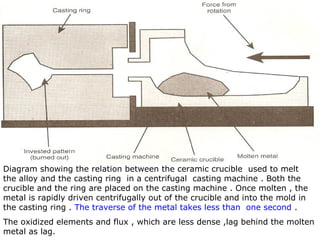
Diagram showing the relation between the ceramic crucible used to melt
the alloy and the casting ring in a centrifugal casting machine . Both the
crucible and the ring are placed on the casting machine . Once molten , the
metal is rapidly driven centrifugally out of the crucible and into the mold in
the casting ring . The traverse of the metal takes less than one second .
The oxidized elements and flux , which are less dense ,lag behind the molten
metal as lag.
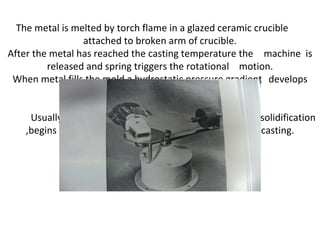
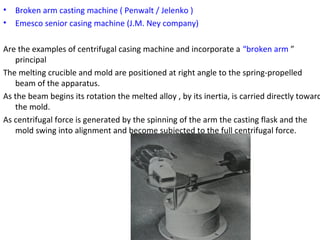
• Broken arm casting machine ( Penwalt / Jelenko )
• Emesco senior casing machine (J.M. Ney company)
Are the examples of centrifugal casing machine and incorporate a “broken arm ”
principal
The melting crucible and mold are positioned at right angle to the spring-propelled
beam of the apparatus.
As the beam begins its rotation the melted alloy , by its inertia, is carried directly toward
the mold.
As centrifugal force is generated by the spinning of the arm the casting flask and the
mold swing into alignment and become subjected to the full centrifugal force.
The metal is melted by torch flame in a glazed ceramic crucible
attached to broken arm of crucible.
After the metal has reached the casting temperature the machine is
released and spring triggers the rotational motion.
When metal fills the mold a hydrostatic pressure gradient develops
along the length of casting.
Usually the pressure gradient at the moment before solidification
,begins ,reaches about 0.21 to 0.23 MPa at tip of casting.
Methods of Melting the Alloys
Generally two methods are employed for melting of metal alloy
prior to casting:
– Flame / Blow pipe.
– Electrical.
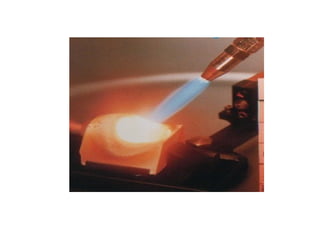
A) FLAME
The fuel employed is a mixture of oxygen-air and acetylene.
The temperature of gas-air flame is influenced by the nature of
the gas and the proportion of gas and air in the mixture.
Care should be taken to obtain a non-luminous flame, with
combustion zones clearly differentiated for melting the alloy.
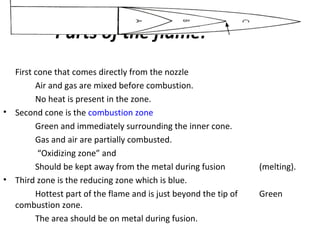
Parts of the flame:
First cone that comes directly from the nozzle
Air and gas are mixed before combustion.
No heat is present in the zone.
• Second cone is the combustion zone
Green and immediately surrounding the inner cone.
Gas and air are partially combusted.
“Oxidizing zone” and
Should be kept away from the metal during fusion (melting).
• Third zone is the reducing zone which is blue.
Hottest part of the flame and is just beyond the tip of Green
combustion zone.
The area should be on metal during fusion.
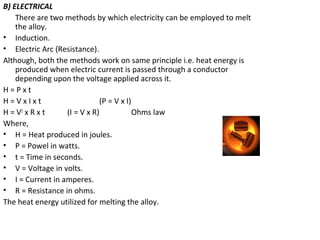
B) ELECTRICAL
There are two methods by which electricity can be employed to melt
the alloy.
• Induction.
• Electric Arc (Resistance).
Although, both the methods work on same principle i.e. heat energy is
produced when electric current is passed through a conductor
depending upon the voltage applied across it.
H = P x t
H = V x I x t (P = V x I)
H = V2
x R x t (I = V x R) Ohms law
Where,
• H = Heat produced in joules.
• P = Powel in watts.
• t = Time in seconds.
• V = Voltage in volts.
• I = Current in amperes.
• R = Resistance in ohms.
The heat energy utilized for melting the alloy.
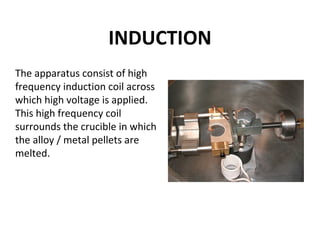
INDUCTION
The apparatus consist of high
frequency induction coil across
which high voltage is applied.
This high frequency coil
surrounds the crucible in which
the alloy / metal pellets are
melted.
The energy required to melt the alloy is supplied by a
high frequency generator.
The melting crucible is held in a centrifugal arm, and
during the melting process it is surrounded by the
high frequency generator coil.
The alloy is melted by two ways depending upon the
type of crucible.
• In case of graphite crucible the electric energy of
coil is converted to thermal energy which is
utilized by means of conduction radiation
(Graphite is a good conductor of heat and
electricity) by the graphite crucible to melt the
alloy.
• Noble metal alloys are generally melted in
graphite crucible.
When ceramic crucibles are used the induction coil
induces the ‘eddy current’ in the alloy itself which
provides energy for the melting of the alloy.
• When the alloy is molten, the centrifugal process is
initiated and the induction coil being lowered.
• The molten alloy is then forced into the casting mold
located behind the melting crucible by means of
centrifugal force
• The ceramic crucibles are generally used for base
metal alloys like nickel-chrome, chrome-cobalt etc.
Electric Arc / Resistance
This is a crucible free technique where by the metal / alloy pellet
is directly melted by the heat produced as a result of
resistance offered by alloy to high voltage current.
The apparatus consist of an electrode and a base plate on which
the metal / alloy pellet is placed.
The contact between the electrode terminal and the metal / alloy
pellet is in form of an ‘electric arc’ thus the term ‘electric arc
furnace’.
air pressure technique
• The alloy is melted in in the crucible hollow of the ring
followed by applied on the melt.
• Here the alloy is melted by blow-pipe or flame in the
hollow left by the crucible former.
• The high surface tension of the liquid metal prevents it from
falling down in to the sprue channel.
• Once the metal has been melted to the casting temperature,
the air tight piston is applied with 10 to 15 psi air pressure to
force the metal into the mold.
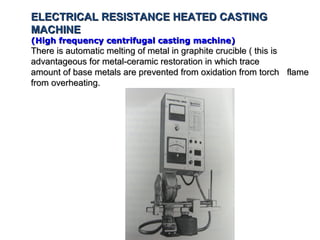
ELECTRICAL RESISTANCE HEATED CASTINGELECTRICAL RESISTANCE HEATED CASTING
MACHINEMACHINE
(High frequency centrifugal casting machine)(High frequency centrifugal casting machine)
There is automatic melting of metal in graphite crucible ( this isThere is automatic melting of metal in graphite crucible ( this is
advantageous for metal-ceramic restoration in which traceadvantageous for metal-ceramic restoration in which trace
amount of base metals are prevented from oxidation from torchamount of base metals are prevented from oxidation from torch flameflame
from overheating.from overheating.
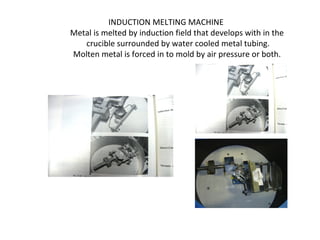
INDUCTION MELTING MACHINE
Metal is melted by induction field that develops with in the
crucible surrounded by water cooled metal tubing.
Molten metal is forced in to mold by air pressure or both.
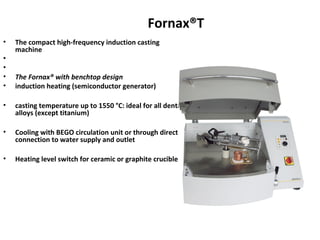
Fornax®T
• The compact high-frequency induction casting
machine
•
•
• The Fornax® with benchtop design
• induction heating (semiconductor generator)
• casting temperature up to 1550 °C: ideal for all dental
alloys (except titanium)
• Cooling with BEGO circulation unit or through direct
connection to water supply and outlet
• Heating level switch for ceramic or graphite crucible
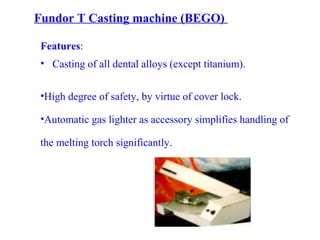
Fundor T Casting machine (BEGO)
Features:
• Casting of all dental alloys (except titanium).
•High degree of safety, by virtue of cover lock.
•Automatic gas lighter as accessory simplifies handling of
the melting torch significantly.
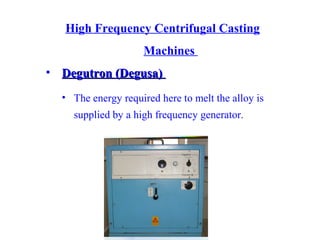
High Frequency Centrifugal Casting
Machines
• Degutron (Degusa)Degutron (Degusa)
• The energy required here to melt the alloy is
supplied by a high frequency generator.
MEGAPULS 3000 induction casting
machine.
• The machine operates using high
frequency electromagnetic waves
and should not be operated by
anyone with a heart pacemaker.
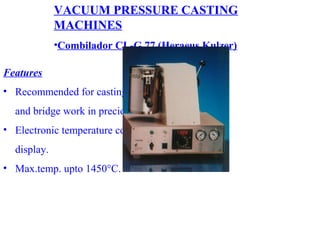
VACUUM PRESSURE CASTING
MACHINES
•Combilador CL-G 77 (Heraeus Kulzer)
Features
• Recommended for casting all types of crown
and bridge work in precious metal alloy.
• Electronic temperature control with digital
display.
• Max.temp. upto 1450°C.
TITEC F210 M (OROTIG)
It is a semi automatic titanium casting machine
where by the amount of vacuum, Argon-gas
saturation and over pressure levels as well as
the delivery of energy to electric arc to melt the
metal are automatically performed in a
sequence once the machine is started.
The decision to halt the process on the spot
and implement corrections before starting the
process again are in operators hands.
• The rotation of the melting / casting chamber from
horizontal to vertical position for the casting to take place,
when the metal (titanium) melting point has been
optimally reached, is also in the operators hand.
• Therefore, both the automation of the machine and the
operators skill go hand in hand to achieve excellent results
constantly.
CASTING CRUCIBLES
Clay – used for high noble and noble metal alloys.
Carbon - used for high noble and higher fusing gold based
metal ceramic alloys.
Quartz - recommended for high fusing alloys for any type
specially suited for alloys that have high melting
and are sensitive to carbon contamination.
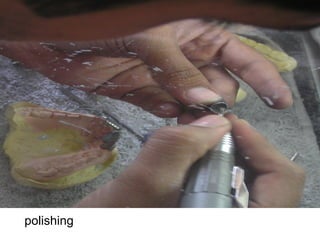
polishing
Common causes of failures of casting involves
1. Distortion
2. Surface roughness and irregularities
3. Porosity
4. Incomplete or missing details
.
CASTING DEFECTS
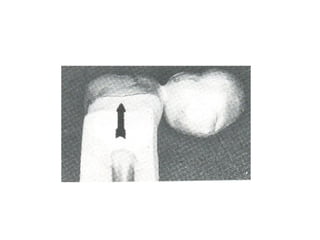
Distortion of pattern and dimensional changes
This occurs due to
• High tendency of wax to deform.
• High coefficient of thermal expansion:
35×10-6
/°C.
• Low softening temperature.
• Warping of wax when unrestrained.
Distortion
pre investing:-
-temperature at which pattern is fabricated
i.e. lesser the temperature at which pattern is
made ,more are the chances of distortion at high
temp due to release of stresses.
-more the storage time and temperature , more will
be distortion
Pre investing
investing
Prevention
• Softening the wax uniformly by heating at 50°C for
atleast 15 mins.
• Reducing the time between wax fabrication and
investing (not more than 30 mins)
• If more than 30m minutes
– store in refrigerator
• Readaptation of the margins after storage.
• Careful removal of the wax pattern from the die
- symmetrical forces
DISTORTION DURING INVESTING.
• During pouring of the investment
• Expansion of investment material
• Movement of investing ring before the
hardening of the investing material.
PREVENTION
• Gentle pouring
• No movement of ring before hardening of
investment material.
Roughness is defined as relatively finely spaced surface
imperfections whose height, width and direction establish the
predominant surface pattern.
Irregularities refers to isolated imperfection such as
nodules that do not characterize the total surface area.
Surface roughness of the casting is invariably greater than that of wax
pattern from which it is made.
SURFACE ROUGHNESS AND IRRAGULARITY
Causes
1. Prolonged heating leads to
Disintegration of the investment
Contaminates the casting producing loss of surface
texture.
2. Water powder ratio.
Higher the ratio: the surface of the investment does not
record the fine detail.
3. Casting pressure is too high.
Causes molten metal moves along the mold wall with
pressure leading to minute loss of investment particles/ fine
detail.
4. Foreign bodies.
Pieces of investment if get broken , gets incorporated
into metal resulting in roughness.
5. Reuse of metal alloy.
6. Improper pickling of metal.
Taking gold alloy out from pickling solution with
stainless steel tweezer causes plating on the gold alloy
with base metal and leads to surface roughness.
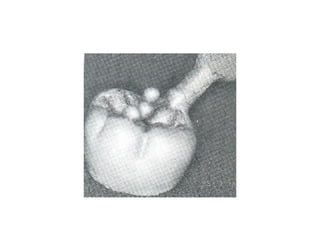
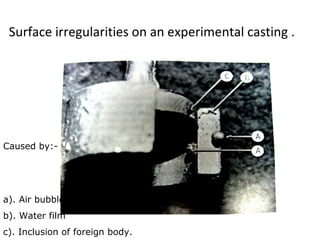
Surface irregularities on an experimental casting .
a). Air bubble
b). Water film
c). Inclusion of foreign body.
Caused by:-
NODULES
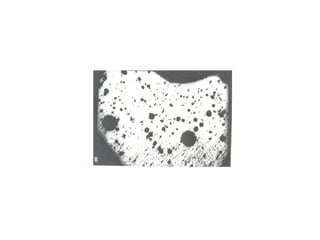
Small nodules on a casting are caused by air bubbles that becomes
attached to the pattern during or subsequent to the investing
procedure.
• Removal of nodules on margin or on internal surface might cause
marginal discrepancy or alter the fit of the casting, On the
occlusal surface it effects the occlusal anatomy.
• Best method to avoid air bubble is to use vacuum investing
technique and also by using a wetting agent.
If the investment become separated from the wax
pattern , water film may form irregularly over
the surface. this type of surface irregularity
appears as minute ridges or veins on the
surface
Too high L:P ratio also produces these surface
irregularities.
Use of wetting agent prevents such irregularities.
WATER FILM
Mold Cracking/Fins on Casting
Too rapid heating - unequal expansion of the
investment.
• Outside portion gets heated and expands more
in comparison to inner one.
• Leading to cracks in the investment.
• which in turns produces fins in casting.
• Commonly present in cristobalite investment
which has low inversion temperature.
contd
Mold Cracking/Fins on Casting
Pattern position
1. When many patterns are present in same plane.
– Prevention by investing more than one pattern in
different planes.
– Allow 1mm space between the patterns.
2. Patterns placed close to ring wall or near to the ring
end. Space patterns 4 to 5 mm from mold
wall and end.
Investment not thoroughly set
prevention by Spatulate longer, use warmer liquid and allow to set
in warmer room.
FOREIGN BODIES
Any casting that shows sharp well defined
deficiencies indicate the presence of some
foreign particle in the mold, such as pieces of
investment and bits of carbon from a flux.
It results in surface roughness and also incomplete
casting areas or surface voids.
POROSITY
Depending upon location
External
Internal
Effects of porosity:-
Weakens the alloy
Roughness and discoloration
If severe can lead to tooth surface micro leakage and
secondary caries.
i. Solidification defects
(A) Localized shrinkage porosity
(B) Micro porosity
ii Trapped gases
(A) Pin hole porosity
(B) Gas inclusion porosity
(C) Subsurface porosity
iii Residual air
TYPES OF POROSITY
Manifests as large irregular void found near the junction of the
sprue and casting.
It is caused by
Incomplete feeding of molten metal during solidification.
Nobel metal alloy contract 1.25% when changes from liquid
to solid.
Therefore there must be continual feeding of molten metal through
the sprue to make up for shrinkage.
If sprue freezes in its cross-section before feeding is
completed- a localized shrinkage void will
occur in the portion of casting which is last to solidify.
LOCALIZED SHRINKAGE POROSITY-
Prevention Of Localized Shrinkage Porosity
1. Proper size selection of the sprues
a). Diameter ≥largest thickness of the pattern
size of the sprues varies from 6- 12 guage
– 2.5mm (10 guage)-molars / metal ceramics.
– 2mm (12 guage ) for premolars/ partial coverage.
b). Length wax pattern should be placed 6 mm-3 mm from the top of the ring
,depending on the type of the investing materials.
c). Flaring
– allows even flow of the metal into mold and therefore less porosity
– also acts as reservoir ,and allows continuous feeding of the
molten alloy.
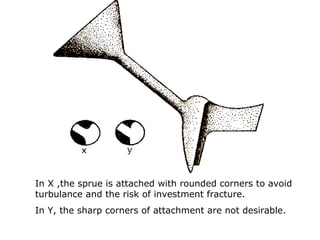
In X ,the sprue is attached with rounded corners to avoid
turbulance and the risk of investment fracture.
In Y, the sharp corners of attachment are not desirable.
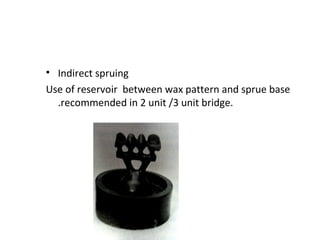
• Indirect spruing
Use of reservoir between wax pattern and sprue base
.recommended in 2 unit /3 unit bridge.
Gate Method Of Spruing Large Wax Pattern
Need for following gate technique
• Generally the alloy immediately adjacent to the
walls of the mold solidifies first,
• The exposed surface of the button will solidify
second, And
• The alloy internal to the mold will cool last.
• Porosity occurs in the portion of the casting that cools last.
• For large castings such as multiple unit bridges,
the spruing arrangement provide a bulk (or reservoir) of
metal that is external to the dental unit but positioned at the
heat center of the investment mold.
• In the gate sprue technique the runner bar will usually be
the last part to solidify and will contain porosity.
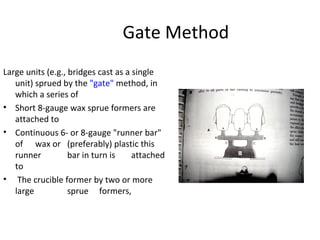
Gate Method
Large units (e.g., bridges cast as a single
unit) sprued by the "gate" method, in
which a series of
• Short 8-gauge wax sprue formers are
attached to
• Continuous 6- or 8-gauge "runner bar"
of wax or (preferably) plastic this
runner bar in turn is attached
to
• The crucible former by two or more
large sprue formers,
Photo pg 211 RM
This method provides
(1) a minimum of distortion of wax pattern,
(2) a fairly uniform reservoir of metal the entire
casting, and
(3) even distribution of the alloy to all parts of
the casting to minimize porosity.
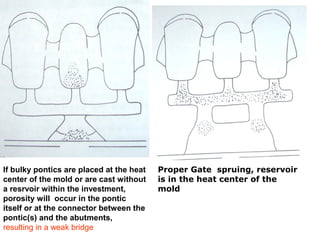
If bulky pontics are placed at the heat
center of the mold or are cast without
a resrvoir within the investment,
porosity will occur in the pontic
itself or at the connector between the
pontic(s) and the abutments,
resulting in a weak bridge
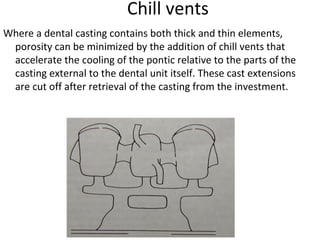
Proper Gate spruing, reservoir
is in the heat center of the
mold
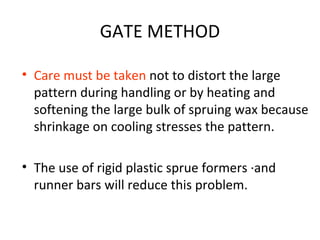
Chill vents
Where a dental casting contains both thick and thin elements,
porosity can be minimized by the addition of chill vents that
accelerate the cooling of the pontic relative to the parts of the
casting external to the dental unit itself. These cast extensions
are cut off after retrieval of the casting from the investment.
GATE METHOD
• Care must be taken not to distort the large
pattern during handling or by heating and
softening the large bulk of spruing wax because
shrinkage on cooling stresses the pattern.
• The use of rigid plastic sprue formers ·and
runner bars will reduce this problem.
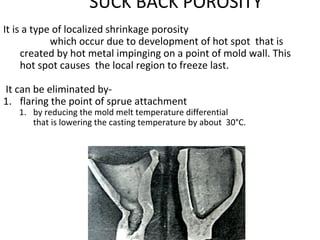
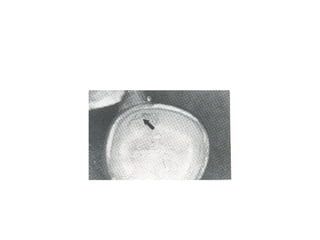
SUCK BACK POROSITY
It is a type of localized shrinkage porosity
which occur due to development of hot spot that is
created by hot metal impinging on a point of mold wall. This
hot spot causes the local region to freeze last.
It can be eliminated by-
1. flaring the point of sprue attachment
1. by reducing the mold melt temperature differential
that is lowering the casting temperature by about 30°C.
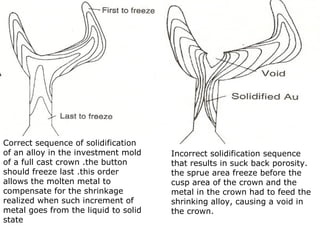
Incorrect solidification sequence
that results in suck back porosity.
the sprue area freeze before the
cusp area of the crown and the
metal in the crown had to feed the
shrinking alloy, causing a void in
the crown.
Correct sequence of solidification
of an alloy in the investment mold
of a full cast crown .the button
should freeze last .this order
allows the molten metal to
compensate for the shrinkage
realized when such increment of
metal goes from the liquid to solid
state
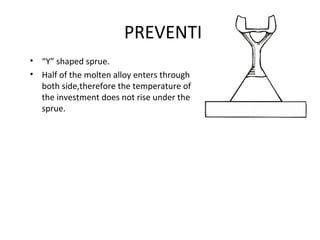
PREVENTION
• “Y” shaped sprue.
• Half of the molten alloy enters through
both side,therefore the temperature of
the investment does not rise under the
sprue.
Present as fine grain in casted alloy
Also occurs from solidification shrinkage but
Is generally when solidification is too rapid for the
micro voids to segregate to the liquid pool.
MICRO POROSITY
Prevention
By increasing the mold temperature.
PIN HOLE POROSITY/ GAS INCLUTION POROSITY
It occurs due to entrapment of gas during solidification.
Metals such as copper and silver dissolve oxygen in large
amount in liquid state.
Molten platinum and palladium have strong affinity for hydrogen
and oxygen.
On solidification absorbed gases are expelled and pin hole porosity
result.
Prevention
1.Premelting alloy in charcoal
2.Properly adjusted blow pipe
(reducing zone of the flame should be
used).
Its exact cause is not known.
It is assumed it may be caused by simultaneous nucleation of
solid grains and gas bubbles at the first moment, that the
metal freezes at the mold walls.
Prevention by controlling the rate at which the molten
metal enters the mold.
SUB SURFACE POROSITY
ENTRAPPED AIR POROSITY- BACK PRESSURE POROSITY
This is caused by inability of air in mold to escape through the pores in the investment
or
By the pressure gradient that displaces the air pocket towards the end of investment
via the molten sprue and button.
It is seen on inner surface of casting and can produce large
concave depression.
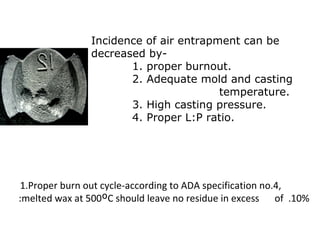
Incidence of air entrapment is increased by
1. Dense modern investment.
2. Dense investment due to vacuum mixing.
3. Clogging of mold with residual carbon
when low heat technique is used.
1.Proper burn out cycle-according to ADA specification no.4,
:melted wax at 500ºC should leave no residue in excess of .10%
Incidence of air entrapment can be
decreased by-
1. proper burnout.
2. Adequate mold and casting
temperature.
3. High casting pressure.
4. Proper L:P ratio.
2. Adequate mold and casting temperature
Temperature differential between mold and
casting should be less.
Lesser differences ,allow the alloy to flow easily, and
the gases are displaced easily.
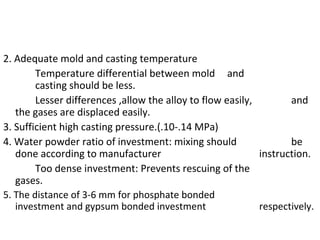
3. Sufficient high casting pressure.(.10-.14 MPa)
4. Water powder ratio of investment: mixing should be
done according to manufacturer instruction.
Too dense investment: Prevents rescuing of the
gases.
5. The distance of 3-6 mm for phosphate bonded
investment and gypsum bonded investment respectively.
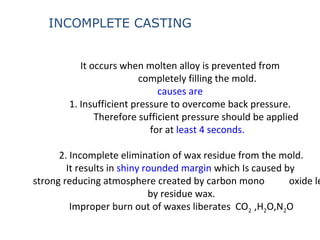
It occurs when molten alloy is prevented from
completely filling the mold.
causes are
1. Insufficient pressure to overcome back pressure.
Therefore sufficient pressure should be applied
for at least 4 seconds.
2. Incomplete elimination of wax residue from the mold.
It results in shiny rounded margin which Is caused by
strong reducing atmosphere created by carbon mono oxide le
by residue wax.
Improper burn out of waxes liberates CO2 ,H2O,N2O
INCOMPLETE CASTING
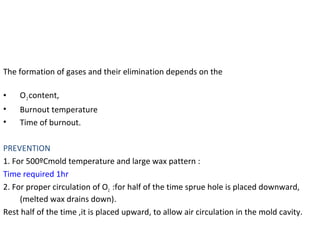
The formation of gases and their elimination depends on the
• O2content,
• Burnout temperature
• Time of burnout.
PREVENTION
1. For 500ºCmold temperature and large wax pattern :
Time required 1hr
2. For proper circulation of O2 :for half of the time sprue hole is placed downward,
(melted wax drains down).
Rest half of the time ,it is placed upward, to allow air circulation in the mold cavity.
Other causes are
3.Improper venting of gas
manifested as round and dull margins.
4.Casting temperature too low. i.e. , the alloy is
not melted properly
5. Mold temperature too low.
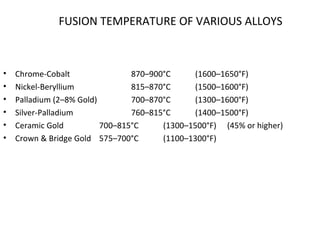
FUSION TEMPERATURE OF VARIOUS ALLOYS
• Chrome-Cobalt 870–900°C (1600–1650°F)
• Nickel-Beryllium 815–870°C (1500–1600°F)
• Palladium (2–8% Gold) 700–870°C (1300–1600°F)
• Silver-Palladium 760–815°C (1400–1500°F)
• Ceramic Gold 700–815°C (1300–1500°F) (45% or higher)
• Crown & Bridge Gold 575–700°C (1100–1300°F)
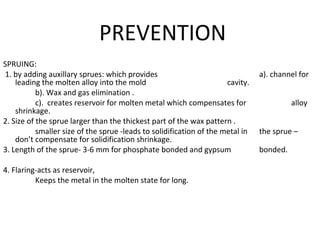
PREVENTION
SPRUING:
1. by adding auxillary sprues: which provides a). channel for
leading the molten alloy into the mold cavity.
b). Wax and gas elimination .
c). creates reservoir for molten metal which compensates for alloy
shrinkage.
2. Size of the sprue larger than the thickest part of the wax pattern .
smaller size of the sprue -leads to solidification of the metal in the sprue –
don’t compensate for solidification shrinkage.
3. Length of the sprue- 3-6 mm for phosphate bonded and gypsum bonded.
4. Flaring-acts as reservoir,
Keeps the metal in the molten state for long.
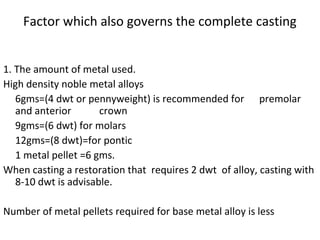
Factor which also governs the complete casting
1. The amount of metal used.
High density noble metal alloys
6gms=(4 dwt or pennyweight) is recommended for premolar
and anterior crown
9gms=(6 dwt) for molars
12gms=(8 dwt)=for pontic
1 metal pellet =6 gms.
When casting a restoration that requires 2 dwt of alloy, casting with
8-10 dwt is advisable.
Number of metal pellets required for base metal alloy is less
2.
Casting force –
In the centrifugal machine the force is dependent on
the number of turns.
For
Noble Metal casting - 3 turns
Base Metal alloys - 4-5 turns.
Too large castings
Causes
• Excessive expansion of wax
• More than 2 liners used
• Improper positioning of liners.
PREVENTION
Single thickness cellulose liner
Restrict liner 3.25 mm short of the metal ring (allows
controlled longitudinal expansion).
TOO SMALL CASTING
Causes
Use of metal ring without liner
Reverse pressure causes decreases in dimension
Prevention :- use liners
• It provides cushioning effect
• If wet , allows hygroscopic
expansion.
DISCOLORED CASTING
Black castings are common gypsum bonded investment material
Cause :
1. wax not , completely eleminated
Carbon residues on the mold wall get deposited on the surface of the casting.
2. Disintegration of gypsum bonded investment above 700°C, resulting in release of
SO2and sulfide layer is formed over the alloy which cannot be removed by pickling.
Prevented by
Proper burn out,
Premelting alloy with charcoal.
Properly adjusted torch.
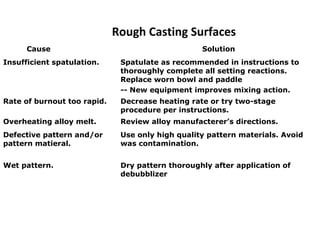
Rough Casting Surfaces
Cause Solution
Insufficient spatulation. Spatulate as recommended in instructions to
thoroughly complete all setting reactions.
Replace worn bowl and paddle
-- New equipment improves mixing action.
Rate of burnout too rapid. Decrease heating rate or try two-stage
procedure per instructions.
Overheating alloy melt. Review alloy manufacterer’s directions.
Defective pattern and/or
pattern matieral.
Use only high quality pattern materials. Avoid
was contamination.
Wet pattern. Dry pattern thoroughly after application of
debubblizer
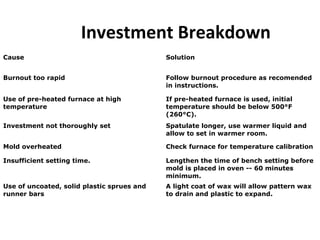
Investment Breakdown
Cause Solution
Burnout too rapid Follow burnout procedure as recomended
in instructions.
Use of pre-heated furnace at high
temperature
If pre-heated furnace is used, initial
temperature should be below 500°F
(260°C).
Investment not thoroughly set Spatulate longer, use warmer liquid and
allow to set in warmer room.
Mold overheated Check furnace for temperature calibration
Insufficient setting time. Lengthen the time of bench setting before
mold is placed in oven -- 60 minutes
minimum.
Use of uncoated, solid plastic sprues and
runner bars
A light coat of wax will allow pattern wax
to drain and plastic to expand.
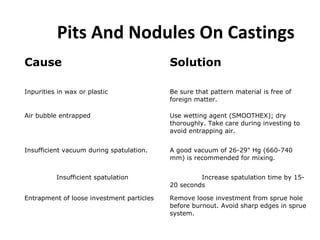
Pits And Nodules On Castings
Cause Solution
Inpurities in wax or plastic Be sure that pattern material is free of
foreign matter.
Air bubble entrapped Use wetting agent (SMOOTHEX); dry
thoroughly. Take care during investing to
avoid entrapping air.
Insufficient vacuum during spatulation. A good vacuum of 26-29" Hg (660-740
mm) is recommended for mixing.
Insufficient spatulation Increase spatulation time by 15-
20 seconds
Entrapment of loose investment particles Remove loose investment from sprue hole
before burnout. Avoid sharp edges in sprue
system.
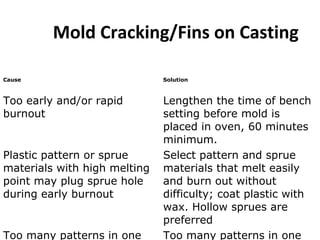
Mold Cracking/Fins on Casting
Cause Solution
Too early and/or rapid
burnout
Lengthen the time of bench
setting before mold is
placed in oven, 60 minutes
minimum.
Plastic pattern or sprue
materials with high melting
point may plug sprue hole
during early burnout
Select pattern and sprue
materials that melt easily
and burn out without
difficulty; coat plastic with
wax. Hollow sprues are
preferred
Too many patterns in one Too many patterns in one
Mold Cracking/Fins on Casting
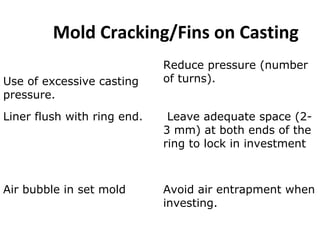
Use of excessive casting
pressure.
Reduce pressure (number
of turns).
Liner flush with ring end. Leave adequate space (2-
3 mm) at both ends of the
ring to lock in investment
Air bubble in set mold Avoid air entrapment when
investing.
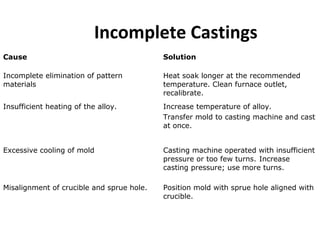
Incomplete Castings
Cause Solution
Incomplete elimination of pattern
materials
Heat soak longer at the recommended
temperature. Clean furnace outlet,
recalibrate.
Insufficient heating of the alloy. Increase temperature of alloy.
Transfer mold to casting machine and cast
at once.
Excessive cooling of mold Casting machine operated with insufficient
pressure or too few turns. Increase
casting pressure; use more turns.
Misalignment of crucible and sprue hole. Position mold with sprue hole aligned with
crucible.
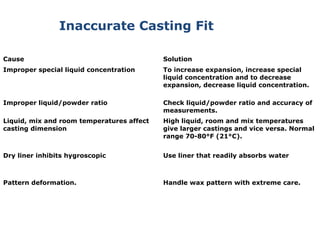
Cause Solution
Improper special liquid concentration To increase expansion, increase special
liquid concentration and to decrease
expansion, decrease liquid concentration.
Improper liquid/powder ratio Check liquid/powder ratio and accuracy of
measurements.
Liquid, mix and room temperatures affect
casting dimension
High liquid, room and mix temperatures
give larger castings and vice versa. Normal
range 70-80°F (21°C).
Dry liner inhibits hygroscopic Use liner that readily absorbs water
Pattern deformation. Handle wax pattern with extreme care.
Inaccurate Casting Fit
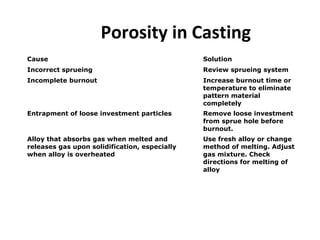
Porosity in Casting
Cause Solution
Incorrect sprueing Review sprueing system
Incomplete burnout Increase burnout time or
temperature to eliminate
pattern material
completely
Entrapment of loose investment particles Remove loose investment
from sprue hole before
burnout.
Alloy that absorbs gas when melted and
releases gas upon solidification, especially
when alloy is overheated
Use fresh alloy or change
method of melting. Adjust
gas mixture. Check
directions for melting of
alloy
References
• Anusavice “Skinners science of dental materials”. Tenth Edition.
• Murrow and Rudd
• Shillingburg HT, Jacobi R, Brackett SE. Fundamentals of tooth preparations for cast
metal & porcelain restorations. 1st
ed. Carol stream. Qintessence Publishing Co. Inc –
1991.
• Rosenstiel SF, Land MF, Fujimoto J. Contemporary fixed prosthodontics. 3rd
ed.
Missouri (CN). Mosby – 2001.
• Craig RG. Restorative Dental Materials. 8th ed.St Louis: CV Mosby Co.1989
• Laboratory manual of the requirements used for casting – BEGO, DENTAURUM,
OROTIG,MEGAPULS 3000.
• Michael J. Lessiter, Ezra L. Kotzin, Timeline Summer 2002,www.castsolutions.com
• http://images.google.co.in/imgres?
imgurl=http://www.edwardfeinbergdmd.com/Short%2520History%2520of
%2520Dentistry/William-Taggert-Casting-machine-
1907.jpg&imgrefurl=http://www.edwardfeinbergdmd.com/history_of_dentistry.htm
&h=256&w=217&sz=16&hl=en&start=32&tbni
THANK YOU

Casting procedure and defects

  • 2.
    INSTITUTE OF DENTAL SCIENCE DEPARTMENTOF CONSERVATIVE DENTISTRY Presented by:- DR. TANMAY SINGH PATHANI {56} BDS, MPH SEMINAR ON INVESTMENT & CASTING
  • 4.
    •Definition •Introduction •Layout of stepsinvolved casting procedure. •Desired accuracy in casting procedure. •Spruing •Casting ring liners •Investing •Wax burnout procedure in •Gypsum bonded investment •Phosphate bonded investment •Casting machines and procedure. •Defects in casting and their prevention. Contents
  • 6.
    DEFINITIONS Casting: Something that hasbeen cast in a mold. Or An object formed by the solidification of a fluid that has been poured or injected into a mold. Or The act of forming an object in a mold. GPT 8th edition.
  • 7.
    Sprue former- A wax,plastic, or metal pattern used to form the channel allowing molten metal to flow in the mold to make a casting. Investing – The process of covering or enveloping wholly or in part , an object such as denture , tooth, wax form, crown etc. with a suitable investment material before processing or casting.
  • 9.
    INTRODUCTION The casting processis used to make dental restorations such as inlays, onlays, crowns, bridges, and removable partial dentures
  • 10.
    • W.H.Taggart introducedlost-wax casting technique in 1907. • This was followed by Jameson who introduced the centrifugal-casting machine and Solbrig who introduced the steam- pressure casting machine.
  • 11.
  • 13.
    The Layout OfSteps In Making Casting 1. Preparation of the tooth or teeth 2. Making of an impression. 3. Pour gypsum slurry into the impression to make a positive cast, 4. Make a wax pattern 5. Sprue the wax pattern (fix it in space)
  • 14.
    1. Invest thewax pattern. 2. Eliminate the wax pattern by burning the wax out of the investment in a furnace, thus making the mold. 3. Force molten metal into the mold using one of a variety of means. 4. Clean the cast. 5. Remove the sprue from the casting. 6. Finish and polish the casting on the die. 7. Cement the finished cast restoration on the prepared
  • 15.
    The direct technique(in which the pattern is made on the tooth rather than on the die) if used, steps 2 and 3 are omitted
  • 19.
    DESIRED ACCURACY OFCASTING PROCEDURE The desired accuracy of the casting is about 0.1 % Therefore, the lost wax procedure requires specially developed materials that compensate for the dimensional changes indicated by the following equation. SHRIKANGE EXPANSION (wax+alloy) (wax+setting+hygroscopi c+thermal)
  • 20.
    Shrinkage Wax Direct 0.4% O'Brien3rd editionIndirect 0.2% Alloys 1.25%-2.5% Craig 11th edition.
  • 21.
    Setting expansion( %) Hygroscop ic expansion (%) Thermal expansion( %) Total expansion .(%) •High heat (cristobalite) 0.35 .701.25(700°C) 1.95 •Hygroscopic immersion (Beauty Cast*) 0.30 1.50 .55(480°C) 2.05 •Hygroscopic water added (Hygrotrol*) 0.75 2 .55(480°C) 2.55 •Phosphate-high heat (Ceromigoid *) 0.23-0.50 .35-1.20 1.33- 1.58(700°C) 1.88-2.88 Expansion in Gypsum Bonded Investment.
  • 22.
    Hi-Temp Carbon-free investment forhigh fusing alloys 1.2% TE at 1300-1800°F (700-900°C .7% Setting Expansion Cera-Fina Carbon-free fine grained investment for high fusing alloys 1.3% TE at 1300-1800°F (700-900°C) .3% Setting Expansion WiroFine partial denture investment material Linear thermal expansion [%] 0,8 Bellavest® SH Graphite-free, phosphate-bonded precision casting investment material rapidly or conventionally heatable casting investment material for crowns and bridges made of precious metal, non-precious metal alloys and press ceramic 50% BegoSol® 1.7% (total expansion) 80% BegoSol® 2.2%(total expansion) Expansion in Phosphate Bonded Investment Material
  • 24.
  • 25.
  • 27.
    SPRUING PURPOSE- 1. Fix thepattern in space so a mold can be made. 2. To create a channel for elimination of wax during burnout. 3. To form a channel for the ingress of molten alloy during casting. 4. To compensate for alloy shrinkage during solidification. O'Brien 3rd edition
  • 28.
  • 29.
    1. Wax spruesare preferred and commonly used as they allow easy escape of molten wax.
  • 30.
    2. Plastic sprues: • Solid plastic sprues soften at higher temperature than the wax pattern • May block the escape of wax because the wax melts at lower temperature than plastic and • Thermal expansion of wax is 5 times greater than plastic which will result in excessive pressure build up inside the mold during the burnout before plastic sprue softens resulting in casting defects O'Brien 3rd edition
  • 31.
    3.Metal sprues canbe solid or hollow tubes. Later one is preferable. • If metal sprue is used, it should be made of non- rusting to avoid possible contamination of wax pattern. • They removed from the investment at the same time when the crucible former is removed. care should be taken to examine the orifice while removing because small amount of investment chip- off which result in incomplete casting or inclusion of foreign object in the casting O'Brien 3rd edition
  • 32.
    SELECTION OF SPRUEFORMER Based on following criteria DIAMETER- Should be = the thickest portion of wax pattern If large- causes distortion If small- will solidify before casting itself and cause localized shrinkage porosity (suck back porosity) The sprue former should be at least 1. 7 mm(14 guage) in diameter unless the pattern is extremely small,and sprue formers up to 2.5 mm(10 guage) in diameter can be used for very large patterns (bulky) full crown Murrow and Rudd
  • 33.
    When small patternsneed long sprues, • wax reservoir placed approximately 1/6 inch (1.5 mm) from pattern. • These reservoirs should have diameter greater than thickest portion of pattern Murrow and Rudd
  • 34.
    ATTACHMENT AND ORIENTATION Shouldbe attached at greatest cross-section of the pattern As It is best for molten metal to flow from thick to thin area i.e. from the marginal ridges to the gingival margins and not the reverse. This also minimizes the risk of turbulence
  • 35.
    LENGTH- Sprue former shouldbe long enough so as to properly position the pattern in casting ring within 6 mm (1/4 inch) of trail end in gypsum bonded investment and 3 to 4mm (1/8 inch) for phosphate bonded investment
  • 36.
    Direction should be45º to the proximal area It should be directed away from any thin or delicate part of investment. Molten alloy may abrade or fracture investment in this area DIRECTION
  • 37.
    CASTING RING LINER Providesinvestment expansion. If not used the mold may become smaller because of reverse pressure resulting from the confinement of the setting expansion. Types- Asbestos ( Was used earlier, but is not used now because of its carcinogenic potential) Aluminum silicate /ceramic liner Cellulose liner (it has an advantage that that it can be made wet with water and allow semi hygroscopic expansion) Use of two layers of liner allow more expansion.
  • 38.
    A B C (A)Castingring (B) Ring liner (C) Base former
  • 39.
    PLACEMENT LINER If PLACED3.25 mm short of ends of the ring, produces more uniform expansion
  • 40.
    Placement of theliner within the ring influences expansion of the mold √ when maximum expansion is required, a liner flush with the open end of the should be used. √ A liner that is 3 or 6 mm short of the open end of the ring will produce a smaller casting. The greater the unlined portion of the ring. the greater the restrictive effect; thus the distance by which the liner is short should be carefully controlled
  • 41.
    INVESTING Wax pattern shouldbe cleaned of any debris, grease or oil ( a commercially available wax pattern cleaner or a diluted synthetic detergent is used) Any excess liquid is shaken off and pattern is left to air dry A thin film of cleanser left on pattern reduces surface tension of wax pattern and permit better wetting of investment Liquid and powder are mixed with care to not to incorporate air in the mix. (Vacuum mixing is preferred)
  • 42.
    Pattern is paintedwith layer of investment inside and out. Casting ring is positioned on crucible former and remaining investment is vibrated slowly in to the ring. Vacuum mixing results the texture of the cast surface –smoother with better details reproduction. -It also increases the tensile strength of investment.
  • 43.
  • 44.
  • 45.
    Care should betaken to not to give excessive vibration while investing because it may cause solids to settle and may lead to free water accumulation adjacent to pattern resulting in surface roughness.
  • 46.
    Investing the waxpattern Setting expansion
  • 47.
    WAX ELIMINATION ANDHEATING Gypsum bonded and phosphate bonded investment are ready for burnout after setting of one hour ( They should be kept in 100% humidity in case if one need to wait). 1. Remove crucible former and any metal sprue. 2. Clean any debris with camel hair brush. 3. Investing rings are placed in a room-temperature furnace and heated to prescribed maximum temperature. For GYPSUM BONDED-468ºC for hygroscopic technique (low heat technique) 650° C for thermal expansion technique ( high heat technique)
  • 48.
    RELATED PROBLEMS Investment decomposition-is seen with gypsum bonded investment therefore careful temperature setting should be done. Melted wax absorbed in investment- To prevent this begin burnout when mold is still wet also in high heat technique, high temperature convert carbon to CO2 or CO which escapes through pores.
  • 49.
    Heating is doneat 500ºc for 60 minute ( It can be done up to 5 hour or longer with little damage) Expansion is obtained by- 1. 37ºc water bath expands the wax pattern. 2. Warm water entering investment mold adds some hygroscopic expansion. 3. thermal expansion at 500ºc. Added expansion for newer noble alloys is obtained by- 1. increasing water bath temperature to 40ºc. 2. using two layers of liners. 3. increasing burnout temperature range of 600ºc to 650ºc. HYGROSCOPIC LOW HEAT TECHNIQUE FOR GYPSUM BONDED INVESTMENT
  • 50.
    This approach dependsalmost entirely on high heat burnout to obtain the required expansion and at the same time eliminating the wax pattern. Additional expansion is obtained from- Expansion of pattern from heat produced during setting. Warm water entering the mold from wet liner causing some hygroscopic expansion. HIGH-HEAT THERMAL EXPANSION TECHNIQUE FOR GYPSUM BONDED INVESTMENTS.
  • 51.
    Burning out thewax pattern … in the furnace Thermal expansion Images from Bego Virtual Academy
  • 52.
    Mold are placedin furnace at room temperature and slowly heated to 650ºc to 700ºc in 60 minutes and held for 15 to 30 minute. Related problems- Rapid heating can generate steam which can cause flaking of mold walls. It may also cause cracking of investment because outer layer of investment expands thermally resulting compressive stress in outer layer and tensile stress in inner layer. These crack appear from interior outwardly in form of radial cracks.
  • 53.
    Sulfer di oxideproduction It occurs rapidly over 700*c with reduction of calcium sulfate by carbon. CaSo4 + 4C  CaS +4CO 3CaSo4 + CaS  4CaO +4SO2 The sulfur dioxide produced contaminates gold castings and makes them brittle. Therefore casting should be made immediately after casting temperature has been reached to prevent sulfur contamination.
  • 54.
    PHOSPHATE BONDED INVESTMENT- •Usual burnout temperature range is from 750º c to 900º c. • Heating rate is usually slow till 315º c and is quite rapid thereafter reaching completion after a hold at the upper temperature
  • 55.
    1.Expansion of waxpattern because setting reaction raises the mold temperature considerably 2.Setting expansion is higher than in gypsum bonded because of special liquids (silica sol) used to enhance such expansion. 3.Thermal expansion is high because of higher burnout temperature. PHOSPHATE BONDED INVESTMENTS OBTAIN THEIR EXPANSION FROM FOLLOWING SOURCE
  • 56.
    CASTING MACHINES Several typesand designs of casting machines are used to make dental castings. All casting machines accelerate molten metal into the mold either by 1. Centrifugal force or 2. Air pressure. Numerous modifications and variations of these methods are used in different machines. • The selection of the casting and melting techniques is influenced by type of alloy and restoration to be cast.
  • 57.
    Phosphate bonded investmentmaterial 1 powder 2 debubblizer 3 liquid 1 2 3
  • 58.
    Three types ofcasting machines are used • CENTRIFEUGAL CASTING MACHINES • INDUCTION MELTING MACHINES • ELECTRICAL RESISTANCE HEATED CASTING MACHINES
  • 59.
    CENTRIFEUGAL CASTING MACHINE Avariety of centrifugal machines are available. • Some spin the mold in a plane parallel to the table top on which the machine is mounted. • Others rotate in a plane vertical to the table top. • Some are spring-driven, and • others are operated by electric power. • An electric heating unit is attached to some machines to melt the alloys before spinning the mold to throw in the metal. • Others have a refractory crucible in which the alloy is melted by a torch before the casting operation is completed. All these machines depends on the centrifugal force applied to the molten metal to cause it to completely fill the mold with properly melted metal
  • 60.
    Diagram showing therelation between the ceramic crucible used to melt the alloy and the casting ring in a centrifugal casting machine . Both the crucible and the ring are placed on the casting machine . Once molten , the metal is rapidly driven centrifugally out of the crucible and into the mold in the casting ring . The traverse of the metal takes less than one second . The oxidized elements and flux , which are less dense ,lag behind the molten metal as lag.
  • 61.
    • Broken armcasting machine ( Penwalt / Jelenko ) • Emesco senior casing machine (J.M. Ney company) Are the examples of centrifugal casing machine and incorporate a “broken arm ” principal The melting crucible and mold are positioned at right angle to the spring-propelled beam of the apparatus. As the beam begins its rotation the melted alloy , by its inertia, is carried directly toward the mold. As centrifugal force is generated by the spinning of the arm the casting flask and the mold swing into alignment and become subjected to the full centrifugal force.
  • 62.
    The metal ismelted by torch flame in a glazed ceramic crucible attached to broken arm of crucible. After the metal has reached the casting temperature the machine is released and spring triggers the rotational motion. When metal fills the mold a hydrostatic pressure gradient develops along the length of casting. Usually the pressure gradient at the moment before solidification ,begins ,reaches about 0.21 to 0.23 MPa at tip of casting.
  • 63.
    Methods of Meltingthe Alloys Generally two methods are employed for melting of metal alloy prior to casting: – Flame / Blow pipe. – Electrical. A) FLAME The fuel employed is a mixture of oxygen-air and acetylene. The temperature of gas-air flame is influenced by the nature of the gas and the proportion of gas and air in the mixture. Care should be taken to obtain a non-luminous flame, with combustion zones clearly differentiated for melting the alloy.
  • 64.
    Parts of theflame: First cone that comes directly from the nozzle Air and gas are mixed before combustion. No heat is present in the zone. • Second cone is the combustion zone Green and immediately surrounding the inner cone. Gas and air are partially combusted. “Oxidizing zone” and Should be kept away from the metal during fusion (melting). • Third zone is the reducing zone which is blue. Hottest part of the flame and is just beyond the tip of Green combustion zone. The area should be on metal during fusion.
  • 66.
    B) ELECTRICAL There aretwo methods by which electricity can be employed to melt the alloy. • Induction. • Electric Arc (Resistance). Although, both the methods work on same principle i.e. heat energy is produced when electric current is passed through a conductor depending upon the voltage applied across it. H = P x t H = V x I x t (P = V x I) H = V2 x R x t (I = V x R) Ohms law Where, • H = Heat produced in joules. • P = Powel in watts. • t = Time in seconds. • V = Voltage in volts. • I = Current in amperes. • R = Resistance in ohms. The heat energy utilized for melting the alloy.
  • 67.
    INDUCTION The apparatus consistof high frequency induction coil across which high voltage is applied. This high frequency coil surrounds the crucible in which the alloy / metal pellets are melted.
  • 68.
    The energy requiredto melt the alloy is supplied by a high frequency generator. The melting crucible is held in a centrifugal arm, and during the melting process it is surrounded by the high frequency generator coil. The alloy is melted by two ways depending upon the type of crucible.
  • 69.
    • In caseof graphite crucible the electric energy of coil is converted to thermal energy which is utilized by means of conduction radiation (Graphite is a good conductor of heat and electricity) by the graphite crucible to melt the alloy. • Noble metal alloys are generally melted in graphite crucible.
  • 70.
    When ceramic cruciblesare used the induction coil induces the ‘eddy current’ in the alloy itself which provides energy for the melting of the alloy. • When the alloy is molten, the centrifugal process is initiated and the induction coil being lowered. • The molten alloy is then forced into the casting mold located behind the melting crucible by means of centrifugal force • The ceramic crucibles are generally used for base metal alloys like nickel-chrome, chrome-cobalt etc.
  • 71.
    Electric Arc /Resistance This is a crucible free technique where by the metal / alloy pellet is directly melted by the heat produced as a result of resistance offered by alloy to high voltage current. The apparatus consist of an electrode and a base plate on which the metal / alloy pellet is placed. The contact between the electrode terminal and the metal / alloy pellet is in form of an ‘electric arc’ thus the term ‘electric arc furnace’.
  • 72.
    air pressure technique •The alloy is melted in in the crucible hollow of the ring followed by applied on the melt. • Here the alloy is melted by blow-pipe or flame in the hollow left by the crucible former. • The high surface tension of the liquid metal prevents it from falling down in to the sprue channel. • Once the metal has been melted to the casting temperature, the air tight piston is applied with 10 to 15 psi air pressure to force the metal into the mold.
  • 73.
    ELECTRICAL RESISTANCE HEATEDCASTINGELECTRICAL RESISTANCE HEATED CASTING MACHINEMACHINE (High frequency centrifugal casting machine)(High frequency centrifugal casting machine) There is automatic melting of metal in graphite crucible ( this isThere is automatic melting of metal in graphite crucible ( this is advantageous for metal-ceramic restoration in which traceadvantageous for metal-ceramic restoration in which trace amount of base metals are prevented from oxidation from torchamount of base metals are prevented from oxidation from torch flameflame from overheating.from overheating.
  • 74.
    INDUCTION MELTING MACHINE Metalis melted by induction field that develops with in the crucible surrounded by water cooled metal tubing. Molten metal is forced in to mold by air pressure or both.
  • 75.
    Fornax®T • The compacthigh-frequency induction casting machine • • • The Fornax® with benchtop design • induction heating (semiconductor generator) • casting temperature up to 1550 °C: ideal for all dental alloys (except titanium) • Cooling with BEGO circulation unit or through direct connection to water supply and outlet • Heating level switch for ceramic or graphite crucible
  • 76.
    Fundor T Castingmachine (BEGO) Features: • Casting of all dental alloys (except titanium). •High degree of safety, by virtue of cover lock. •Automatic gas lighter as accessory simplifies handling of the melting torch significantly.
  • 77.
    High Frequency CentrifugalCasting Machines • Degutron (Degusa)Degutron (Degusa) • The energy required here to melt the alloy is supplied by a high frequency generator.
  • 78.
    MEGAPULS 3000 inductioncasting machine. • The machine operates using high frequency electromagnetic waves and should not be operated by anyone with a heart pacemaker.
  • 79.
    VACUUM PRESSURE CASTING MACHINES •CombiladorCL-G 77 (Heraeus Kulzer) Features • Recommended for casting all types of crown and bridge work in precious metal alloy. • Electronic temperature control with digital display. • Max.temp. upto 1450°C.
  • 80.
    TITEC F210 M(OROTIG)
  • 81.
    It is asemi automatic titanium casting machine where by the amount of vacuum, Argon-gas saturation and over pressure levels as well as the delivery of energy to electric arc to melt the metal are automatically performed in a sequence once the machine is started. The decision to halt the process on the spot and implement corrections before starting the process again are in operators hands.
  • 82.
    • The rotationof the melting / casting chamber from horizontal to vertical position for the casting to take place, when the metal (titanium) melting point has been optimally reached, is also in the operators hand. • Therefore, both the automation of the machine and the operators skill go hand in hand to achieve excellent results constantly.
  • 84.
    CASTING CRUCIBLES Clay –used for high noble and noble metal alloys. Carbon - used for high noble and higher fusing gold based metal ceramic alloys. Quartz - recommended for high fusing alloys for any type specially suited for alloys that have high melting and are sensitive to carbon contamination.
  • 85.
  • 86.
    Common causes offailures of casting involves 1. Distortion 2. Surface roughness and irregularities 3. Porosity 4. Incomplete or missing details . CASTING DEFECTS
  • 87.
    Distortion of patternand dimensional changes This occurs due to • High tendency of wax to deform. • High coefficient of thermal expansion: 35×10-6 /°C. • Low softening temperature. • Warping of wax when unrestrained.
  • 88.
    Distortion pre investing:- -temperature atwhich pattern is fabricated i.e. lesser the temperature at which pattern is made ,more are the chances of distortion at high temp due to release of stresses. -more the storage time and temperature , more will be distortion Pre investing investing
  • 90.
    Prevention • Softening thewax uniformly by heating at 50°C for atleast 15 mins. • Reducing the time between wax fabrication and investing (not more than 30 mins) • If more than 30m minutes – store in refrigerator • Readaptation of the margins after storage. • Careful removal of the wax pattern from the die - symmetrical forces
  • 91.
    DISTORTION DURING INVESTING. •During pouring of the investment • Expansion of investment material • Movement of investing ring before the hardening of the investing material.
  • 92.
    PREVENTION • Gentle pouring •No movement of ring before hardening of investment material.
  • 93.
    Roughness is definedas relatively finely spaced surface imperfections whose height, width and direction establish the predominant surface pattern. Irregularities refers to isolated imperfection such as nodules that do not characterize the total surface area. Surface roughness of the casting is invariably greater than that of wax pattern from which it is made. SURFACE ROUGHNESS AND IRRAGULARITY
  • 95.
    Causes 1. Prolonged heatingleads to Disintegration of the investment Contaminates the casting producing loss of surface texture. 2. Water powder ratio. Higher the ratio: the surface of the investment does not record the fine detail. 3. Casting pressure is too high. Causes molten metal moves along the mold wall with pressure leading to minute loss of investment particles/ fine detail.
  • 96.
    4. Foreign bodies. Piecesof investment if get broken , gets incorporated into metal resulting in roughness. 5. Reuse of metal alloy. 6. Improper pickling of metal. Taking gold alloy out from pickling solution with stainless steel tweezer causes plating on the gold alloy with base metal and leads to surface roughness.
  • 97.
    Surface irregularities onan experimental casting . a). Air bubble b). Water film c). Inclusion of foreign body. Caused by:-
  • 98.
    NODULES Small nodules ona casting are caused by air bubbles that becomes attached to the pattern during or subsequent to the investing procedure. • Removal of nodules on margin or on internal surface might cause marginal discrepancy or alter the fit of the casting, On the occlusal surface it effects the occlusal anatomy. • Best method to avoid air bubble is to use vacuum investing technique and also by using a wetting agent.
  • 99.
    If the investmentbecome separated from the wax pattern , water film may form irregularly over the surface. this type of surface irregularity appears as minute ridges or veins on the surface Too high L:P ratio also produces these surface irregularities. Use of wetting agent prevents such irregularities. WATER FILM
  • 100.
    Mold Cracking/Fins onCasting Too rapid heating - unequal expansion of the investment. • Outside portion gets heated and expands more in comparison to inner one. • Leading to cracks in the investment. • which in turns produces fins in casting. • Commonly present in cristobalite investment which has low inversion temperature. contd
  • 101.
    Mold Cracking/Fins onCasting Pattern position 1. When many patterns are present in same plane. – Prevention by investing more than one pattern in different planes. – Allow 1mm space between the patterns. 2. Patterns placed close to ring wall or near to the ring end. Space patterns 4 to 5 mm from mold wall and end. Investment not thoroughly set prevention by Spatulate longer, use warmer liquid and allow to set in warmer room.
  • 102.
    FOREIGN BODIES Any castingthat shows sharp well defined deficiencies indicate the presence of some foreign particle in the mold, such as pieces of investment and bits of carbon from a flux. It results in surface roughness and also incomplete casting areas or surface voids.
  • 103.
    POROSITY Depending upon location External Internal Effectsof porosity:- Weakens the alloy Roughness and discoloration If severe can lead to tooth surface micro leakage and secondary caries.
  • 104.
    i. Solidification defects (A)Localized shrinkage porosity (B) Micro porosity ii Trapped gases (A) Pin hole porosity (B) Gas inclusion porosity (C) Subsurface porosity iii Residual air TYPES OF POROSITY
  • 105.
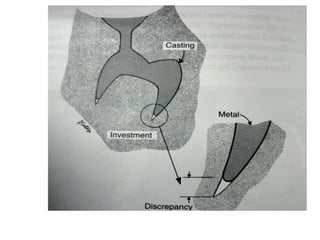
    Manifests as largeirregular void found near the junction of the sprue and casting. It is caused by Incomplete feeding of molten metal during solidification. Nobel metal alloy contract 1.25% when changes from liquid to solid. Therefore there must be continual feeding of molten metal through the sprue to make up for shrinkage. If sprue freezes in its cross-section before feeding is completed- a localized shrinkage void will occur in the portion of casting which is last to solidify. LOCALIZED SHRINKAGE POROSITY-
  • 106.
    Prevention Of LocalizedShrinkage Porosity 1. Proper size selection of the sprues a). Diameter ≥largest thickness of the pattern size of the sprues varies from 6- 12 guage – 2.5mm (10 guage)-molars / metal ceramics. – 2mm (12 guage ) for premolars/ partial coverage. b). Length wax pattern should be placed 6 mm-3 mm from the top of the ring ,depending on the type of the investing materials. c). Flaring – allows even flow of the metal into mold and therefore less porosity – also acts as reservoir ,and allows continuous feeding of the molten alloy.
  • 107.
    In X ,thesprue is attached with rounded corners to avoid turbulance and the risk of investment fracture. In Y, the sharp corners of attachment are not desirable.
  • 108.
    • Indirect spruing Useof reservoir between wax pattern and sprue base .recommended in 2 unit /3 unit bridge.
  • 109.
    Gate Method OfSpruing Large Wax Pattern Need for following gate technique • Generally the alloy immediately adjacent to the walls of the mold solidifies first, • The exposed surface of the button will solidify second, And • The alloy internal to the mold will cool last.
  • 110.
    • Porosity occursin the portion of the casting that cools last. • For large castings such as multiple unit bridges, the spruing arrangement provide a bulk (or reservoir) of metal that is external to the dental unit but positioned at the heat center of the investment mold. • In the gate sprue technique the runner bar will usually be the last part to solidify and will contain porosity.
  • 111.
    Gate Method Large units(e.g., bridges cast as a single unit) sprued by the "gate" method, in which a series of • Short 8-gauge wax sprue formers are attached to • Continuous 6- or 8-gauge "runner bar" of wax or (preferably) plastic this runner bar in turn is attached to • The crucible former by two or more large sprue formers,
  • 112.
    Photo pg 211RM This method provides (1) a minimum of distortion of wax pattern, (2) a fairly uniform reservoir of metal the entire casting, and (3) even distribution of the alloy to all parts of the casting to minimize porosity.
  • 113.
    If bulky ponticsare placed at the heat center of the mold or are cast without a resrvoir within the investment, porosity will occur in the pontic itself or at the connector between the pontic(s) and the abutments, resulting in a weak bridge Proper Gate spruing, reservoir is in the heat center of the mold
  • 114.
    Chill vents Where adental casting contains both thick and thin elements, porosity can be minimized by the addition of chill vents that accelerate the cooling of the pontic relative to the parts of the casting external to the dental unit itself. These cast extensions are cut off after retrieval of the casting from the investment.
  • 115.
    GATE METHOD • Caremust be taken not to distort the large pattern during handling or by heating and softening the large bulk of spruing wax because shrinkage on cooling stresses the pattern. • The use of rigid plastic sprue formers ·and runner bars will reduce this problem.
  • 116.
    SUCK BACK POROSITY Itis a type of localized shrinkage porosity which occur due to development of hot spot that is created by hot metal impinging on a point of mold wall. This hot spot causes the local region to freeze last. It can be eliminated by- 1. flaring the point of sprue attachment 1. by reducing the mold melt temperature differential that is lowering the casting temperature by about 30°C.
  • 118.
    Incorrect solidification sequence thatresults in suck back porosity. the sprue area freeze before the cusp area of the crown and the metal in the crown had to feed the shrinking alloy, causing a void in the crown. Correct sequence of solidification of an alloy in the investment mold of a full cast crown .the button should freeze last .this order allows the molten metal to compensate for the shrinkage realized when such increment of metal goes from the liquid to solid state
  • 119.
    PREVENTION • “Y” shapedsprue. • Half of the molten alloy enters through both side,therefore the temperature of the investment does not rise under the sprue.
  • 120.
    Present as finegrain in casted alloy Also occurs from solidification shrinkage but Is generally when solidification is too rapid for the micro voids to segregate to the liquid pool. MICRO POROSITY Prevention By increasing the mold temperature.
  • 122.
    PIN HOLE POROSITY/GAS INCLUTION POROSITY It occurs due to entrapment of gas during solidification. Metals such as copper and silver dissolve oxygen in large amount in liquid state. Molten platinum and palladium have strong affinity for hydrogen and oxygen. On solidification absorbed gases are expelled and pin hole porosity result. Prevention 1.Premelting alloy in charcoal 2.Properly adjusted blow pipe (reducing zone of the flame should be used).
  • 123.
    Its exact causeis not known. It is assumed it may be caused by simultaneous nucleation of solid grains and gas bubbles at the first moment, that the metal freezes at the mold walls. Prevention by controlling the rate at which the molten metal enters the mold. SUB SURFACE POROSITY
  • 124.
    ENTRAPPED AIR POROSITY-BACK PRESSURE POROSITY This is caused by inability of air in mold to escape through the pores in the investment or By the pressure gradient that displaces the air pocket towards the end of investment via the molten sprue and button. It is seen on inner surface of casting and can produce large concave depression. Incidence of air entrapment is increased by 1. Dense modern investment. 2. Dense investment due to vacuum mixing. 3. Clogging of mold with residual carbon when low heat technique is used.
  • 125.
    1.Proper burn outcycle-according to ADA specification no.4, :melted wax at 500ºC should leave no residue in excess of .10% Incidence of air entrapment can be decreased by- 1. proper burnout. 2. Adequate mold and casting temperature. 3. High casting pressure. 4. Proper L:P ratio.
  • 126.
    2. Adequate moldand casting temperature Temperature differential between mold and casting should be less. Lesser differences ,allow the alloy to flow easily, and the gases are displaced easily. 3. Sufficient high casting pressure.(.10-.14 MPa) 4. Water powder ratio of investment: mixing should be done according to manufacturer instruction. Too dense investment: Prevents rescuing of the gases. 5. The distance of 3-6 mm for phosphate bonded investment and gypsum bonded investment respectively.
  • 128.
    It occurs whenmolten alloy is prevented from completely filling the mold. causes are 1. Insufficient pressure to overcome back pressure. Therefore sufficient pressure should be applied for at least 4 seconds. 2. Incomplete elimination of wax residue from the mold. It results in shiny rounded margin which Is caused by strong reducing atmosphere created by carbon mono oxide le by residue wax. Improper burn out of waxes liberates CO2 ,H2O,N2O INCOMPLETE CASTING
  • 129.
    The formation ofgases and their elimination depends on the • O2content, • Burnout temperature • Time of burnout. PREVENTION 1. For 500ºCmold temperature and large wax pattern : Time required 1hr 2. For proper circulation of O2 :for half of the time sprue hole is placed downward, (melted wax drains down). Rest half of the time ,it is placed upward, to allow air circulation in the mold cavity.
  • 130.
    Other causes are 3.Improperventing of gas manifested as round and dull margins. 4.Casting temperature too low. i.e. , the alloy is not melted properly 5. Mold temperature too low.
  • 131.
    FUSION TEMPERATURE OFVARIOUS ALLOYS • Chrome-Cobalt 870–900°C (1600–1650°F) • Nickel-Beryllium 815–870°C (1500–1600°F) • Palladium (2–8% Gold) 700–870°C (1300–1600°F) • Silver-Palladium 760–815°C (1400–1500°F) • Ceramic Gold 700–815°C (1300–1500°F) (45% or higher) • Crown & Bridge Gold 575–700°C (1100–1300°F)
  • 132.
    PREVENTION SPRUING: 1. by addingauxillary sprues: which provides a). channel for leading the molten alloy into the mold cavity. b). Wax and gas elimination . c). creates reservoir for molten metal which compensates for alloy shrinkage. 2. Size of the sprue larger than the thickest part of the wax pattern . smaller size of the sprue -leads to solidification of the metal in the sprue – don’t compensate for solidification shrinkage. 3. Length of the sprue- 3-6 mm for phosphate bonded and gypsum bonded. 4. Flaring-acts as reservoir, Keeps the metal in the molten state for long.
  • 133.
    Factor which alsogoverns the complete casting 1. The amount of metal used. High density noble metal alloys 6gms=(4 dwt or pennyweight) is recommended for premolar and anterior crown 9gms=(6 dwt) for molars 12gms=(8 dwt)=for pontic 1 metal pellet =6 gms. When casting a restoration that requires 2 dwt of alloy, casting with 8-10 dwt is advisable. Number of metal pellets required for base metal alloy is less
  • 134.
    2. Casting force – Inthe centrifugal machine the force is dependent on the number of turns. For Noble Metal casting - 3 turns Base Metal alloys - 4-5 turns.
  • 135.
    Too large castings Causes •Excessive expansion of wax • More than 2 liners used • Improper positioning of liners. PREVENTION Single thickness cellulose liner Restrict liner 3.25 mm short of the metal ring (allows controlled longitudinal expansion).
  • 136.
    TOO SMALL CASTING Causes Useof metal ring without liner Reverse pressure causes decreases in dimension Prevention :- use liners • It provides cushioning effect • If wet , allows hygroscopic expansion.
  • 137.
    DISCOLORED CASTING Black castingsare common gypsum bonded investment material Cause : 1. wax not , completely eleminated Carbon residues on the mold wall get deposited on the surface of the casting. 2. Disintegration of gypsum bonded investment above 700°C, resulting in release of SO2and sulfide layer is formed over the alloy which cannot be removed by pickling. Prevented by Proper burn out, Premelting alloy with charcoal. Properly adjusted torch.
  • 138.
    Rough Casting Surfaces CauseSolution Insufficient spatulation. Spatulate as recommended in instructions to thoroughly complete all setting reactions. Replace worn bowl and paddle -- New equipment improves mixing action. Rate of burnout too rapid. Decrease heating rate or try two-stage procedure per instructions. Overheating alloy melt. Review alloy manufacterer’s directions. Defective pattern and/or pattern matieral. Use only high quality pattern materials. Avoid was contamination. Wet pattern. Dry pattern thoroughly after application of debubblizer
  • 139.
    Investment Breakdown Cause Solution Burnouttoo rapid Follow burnout procedure as recomended in instructions. Use of pre-heated furnace at high temperature If pre-heated furnace is used, initial temperature should be below 500°F (260°C). Investment not thoroughly set Spatulate longer, use warmer liquid and allow to set in warmer room. Mold overheated Check furnace for temperature calibration Insufficient setting time. Lengthen the time of bench setting before mold is placed in oven -- 60 minutes minimum. Use of uncoated, solid plastic sprues and runner bars A light coat of wax will allow pattern wax to drain and plastic to expand.
  • 140.
    Pits And NodulesOn Castings Cause Solution Inpurities in wax or plastic Be sure that pattern material is free of foreign matter. Air bubble entrapped Use wetting agent (SMOOTHEX); dry thoroughly. Take care during investing to avoid entrapping air. Insufficient vacuum during spatulation. A good vacuum of 26-29" Hg (660-740 mm) is recommended for mixing. Insufficient spatulation Increase spatulation time by 15- 20 seconds Entrapment of loose investment particles Remove loose investment from sprue hole before burnout. Avoid sharp edges in sprue system.
  • 141.
    Mold Cracking/Fins onCasting Cause Solution Too early and/or rapid burnout Lengthen the time of bench setting before mold is placed in oven, 60 minutes minimum. Plastic pattern or sprue materials with high melting point may plug sprue hole during early burnout Select pattern and sprue materials that melt easily and burn out without difficulty; coat plastic with wax. Hollow sprues are preferred Too many patterns in one Too many patterns in one
  • 142.
    Mold Cracking/Fins onCasting Use of excessive casting pressure. Reduce pressure (number of turns). Liner flush with ring end. Leave adequate space (2- 3 mm) at both ends of the ring to lock in investment Air bubble in set mold Avoid air entrapment when investing.
  • 143.
    Incomplete Castings Cause Solution Incompleteelimination of pattern materials Heat soak longer at the recommended temperature. Clean furnace outlet, recalibrate. Insufficient heating of the alloy. Increase temperature of alloy. Transfer mold to casting machine and cast at once. Excessive cooling of mold Casting machine operated with insufficient pressure or too few turns. Increase casting pressure; use more turns. Misalignment of crucible and sprue hole. Position mold with sprue hole aligned with crucible.
  • 144.
    Cause Solution Improper specialliquid concentration To increase expansion, increase special liquid concentration and to decrease expansion, decrease liquid concentration. Improper liquid/powder ratio Check liquid/powder ratio and accuracy of measurements. Liquid, mix and room temperatures affect casting dimension High liquid, room and mix temperatures give larger castings and vice versa. Normal range 70-80°F (21°C). Dry liner inhibits hygroscopic Use liner that readily absorbs water Pattern deformation. Handle wax pattern with extreme care. Inaccurate Casting Fit
  • 145.
    Porosity in Casting CauseSolution Incorrect sprueing Review sprueing system Incomplete burnout Increase burnout time or temperature to eliminate pattern material completely Entrapment of loose investment particles Remove loose investment from sprue hole before burnout. Alloy that absorbs gas when melted and releases gas upon solidification, especially when alloy is overheated Use fresh alloy or change method of melting. Adjust gas mixture. Check directions for melting of alloy
  • 146.
    References • Anusavice “Skinnersscience of dental materials”. Tenth Edition. • Murrow and Rudd • Shillingburg HT, Jacobi R, Brackett SE. Fundamentals of tooth preparations for cast metal & porcelain restorations. 1st ed. Carol stream. Qintessence Publishing Co. Inc – 1991. • Rosenstiel SF, Land MF, Fujimoto J. Contemporary fixed prosthodontics. 3rd ed. Missouri (CN). Mosby – 2001. • Craig RG. Restorative Dental Materials. 8th ed.St Louis: CV Mosby Co.1989 • Laboratory manual of the requirements used for casting – BEGO, DENTAURUM, OROTIG,MEGAPULS 3000. • Michael J. Lessiter, Ezra L. Kotzin, Timeline Summer 2002,www.castsolutions.com • http://images.google.co.in/imgres? imgurl=http://www.edwardfeinbergdmd.com/Short%2520History%2520of %2520Dentistry/William-Taggert-Casting-machine- 1907.jpg&imgrefurl=http://www.edwardfeinbergdmd.com/history_of_dentistry.htm &h=256&w=217&sz=16&hl=en&start=32&tbni
  • 147.