Cesarean section
Procedure

Presented by :Jaber Manasia
Preoperative preparation for CS
• Full blood count and haemoglobin
• Cross match
• Routine ultrasound before CS
• Urinary catheter use at CS
• Preoperative shaving
• All patients transferred to theatre must be in the left

lateral position (to pre ve nt ‘ supine hypo te nsio n’ and
fe tal distre ss) ;

• Premedication with antacid is standard;
• In the theatre or operating room must also be kept in the
left lateral tilt position until after delivery;

• Thromboprophylaxis should be given for all patients
and prophylactic antibiotics should be given.

3
Anesthesia
• A woman may be given spinal anesthesia for the procedure,
or she may have a general anesthesia.

• Spinal anesthesia is similar to an epidural, where a needle is
inserted into the fluid that surrounds the spinal cord so that
there is no sensation from the chest down.
Anesthesia

• Some women may require general anaesthesia during the
caesarean, & This is sometimes necessary when the baby
must be delivered quickly
Surgical technique for cs
Abdominal-wall incision

• The vertical incision should be

performed in the midline extending
form just below the umbilicus to a
point approximately 2 cm above the
symphysis

• The transverse (pfannenstiel)

incision should extend transversely
for approximately 15cm at a point 2
cm above the symphysis
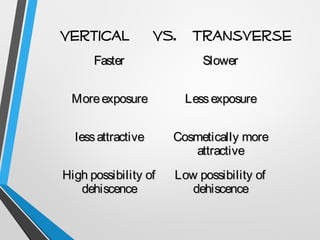
Vertical

VS. Transverse

Faster

Slower

More exposure

Less exposure

less attractive

Cosmetically more
attractive

High possibility of
dehiscence

Low possibility of
dehiscence
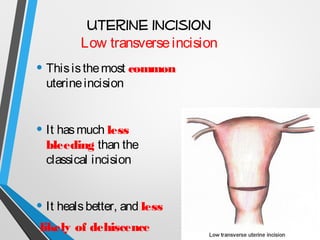
Uterine incision

Low transverse incision

• This is the most common
uterine incision

• It has much less

bleeding than the
classical incision

• It heals better, and less
likely of dehiscence
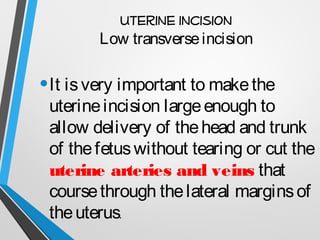
Uterine incision
Low transverse incision

• It is very important to make the

uterine incision large enough to
allow delivery of the head and trunk
of the fetus without tearing or cut the
uterine arteries and veins that
course through the lateral margins of
the uterus.
Uterine incision
Low transverse incision

• If the placenta is encountered in the line

of incision, it must be either detached or
incised. When the placenta is incised,
fetal hemorrhage may be severe; thus,
delivery and cord clamping should be
performed as soon as possible in such
cases
Delivery of the Infant

• In a cephalic presentation, a hand is

slipped into the uterine cavity between
the symphysis and fetal head, and the
head is elevated gently with the fingers
and palm through the incision, aided by
modest transabdominal fundal pressure
Delivery of the Infant

• To minimize fetal aspiration of amnionic

fluid, nose and mouth are aspirated with a
bulb syringe before the thorax is
delivered. The shoulders then are delivered
using gentle traction plus fundal pressure

• The rest of the body readily follows.
Delivery of the Infant

• After the shoulders are delivered, an intravenous

infusion containing about two ampules or 20 units
of oxytocin per liter of crystalloid is infused at 10
mL/min until the uterus contracts, after which the
rate can be reduced.
Delivery of the Infant

• After delivery of the baby the cord is clamped
• the infant is given to the team member who will
conduct resuscitative efforts as needed

• The uterine incision is observed for any excessive
bleeding sites.
Placental delivery

• The placenta is then delivered unless it has already
done so spontaneously.

• Or by manual removal .
• Fundal massage, begun as soon as the fetus is
delivered.
Repair of the Uterus

• The uterine incision is then

closed with one or two layers
of continuous 0 or number 1
absorbable suture
Uterine incision

Classical (upper segment) incision

• Rarely done nowadays

• More bleeding

• Worse healing, and more
likely of dehiscence
Caesarean Hysterectomy
Caesarean section and hysterectomy are
sometimes performed at the same time,
e.g. where there is uterine rupture,
placenta accreta, uncontrollable
postpartum haemorrhage, and in the
cases of cervical malignant disease.
Thank you

Cesarean Section - CS

  • 1.
  • 2.
    Preoperative preparation forCS • Full blood count and haemoglobin • Cross match • Routine ultrasound before CS • Urinary catheter use at CS • Preoperative shaving
  • 3.
    • All patientstransferred to theatre must be in the left lateral position (to pre ve nt ‘ supine hypo te nsio n’ and fe tal distre ss) ; • Premedication with antacid is standard; • In the theatre or operating room must also be kept in the left lateral tilt position until after delivery; • Thromboprophylaxis should be given for all patients and prophylactic antibiotics should be given. 3
  • 4.
    Anesthesia • A womanmay be given spinal anesthesia for the procedure, or she may have a general anesthesia. • Spinal anesthesia is similar to an epidural, where a needle is inserted into the fluid that surrounds the spinal cord so that there is no sensation from the chest down.
  • 5.
    Anesthesia • Some womenmay require general anaesthesia during the caesarean, & This is sometimes necessary when the baby must be delivered quickly
  • 6.
  • 7.
    Abdominal-wall incision • Thevertical incision should be performed in the midline extending form just below the umbilicus to a point approximately 2 cm above the symphysis • The transverse (pfannenstiel) incision should extend transversely for approximately 15cm at a point 2 cm above the symphysis
  • 8.
    Vertical VS. Transverse Faster Slower More exposure Lessexposure less attractive Cosmetically more attractive High possibility of dehiscence Low possibility of dehiscence
  • 9.
    Uterine incision Low transverseincision • This is the most common uterine incision • It has much less bleeding than the classical incision • It heals better, and less likely of dehiscence
  • 10.
    Uterine incision Low transverseincision • It is very important to make the uterine incision large enough to allow delivery of the head and trunk of the fetus without tearing or cut the uterine arteries and veins that course through the lateral margins of the uterus.
  • 11.
    Uterine incision Low transverseincision • If the placenta is encountered in the line of incision, it must be either detached or incised. When the placenta is incised, fetal hemorrhage may be severe; thus, delivery and cord clamping should be performed as soon as possible in such cases
  • 12.
    Delivery of theInfant • In a cephalic presentation, a hand is slipped into the uterine cavity between the symphysis and fetal head, and the head is elevated gently with the fingers and palm through the incision, aided by modest transabdominal fundal pressure
  • 13.
  • 14.
    Delivery of theInfant • To minimize fetal aspiration of amnionic fluid, nose and mouth are aspirated with a bulb syringe before the thorax is delivered. The shoulders then are delivered using gentle traction plus fundal pressure • The rest of the body readily follows.
  • 15.
    Delivery of theInfant • After the shoulders are delivered, an intravenous infusion containing about two ampules or 20 units of oxytocin per liter of crystalloid is infused at 10 mL/min until the uterus contracts, after which the rate can be reduced.
  • 16.
    Delivery of theInfant • After delivery of the baby the cord is clamped • the infant is given to the team member who will conduct resuscitative efforts as needed • The uterine incision is observed for any excessive bleeding sites.
  • 17.
    Placental delivery • Theplacenta is then delivered unless it has already done so spontaneously. • Or by manual removal . • Fundal massage, begun as soon as the fetus is delivered.
  • 19.
    Repair of theUterus • The uterine incision is then closed with one or two layers of continuous 0 or number 1 absorbable suture
  • 21.
    Uterine incision Classical (uppersegment) incision • Rarely done nowadays • More bleeding • Worse healing, and more likely of dehiscence
  • 22.
    Caesarean Hysterectomy Caesarean sectionand hysterectomy are sometimes performed at the same time, e.g. where there is uterine rupture, placenta accreta, uncontrollable postpartum haemorrhage, and in the cases of cervical malignant disease.
  • 24.