Caesarean section
(C-section)
“Yet Another Way To Get Out!”
INTRODUCTION
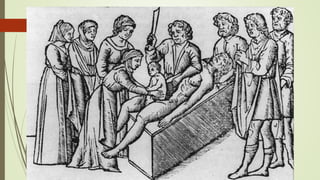
The Ancient Roman caesarean section was first performed
to remove a baby from the womb of a mother who died
during childbirth.
Julius Caesar is said to be the first child to be born in
caesarean section.
Thus got its name CAESARean section.
DEFINITION
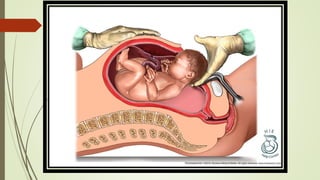
A caesarean section is a surgical procedure in which incisi
ons are made through a woman's abdomen and uterus to
deliver baby.
OR
The delivery of a viable fetus through an incision in the
abdominal wall and uterus.
INCIDENCE
The overall rate of caesarean section delivery in 2015–16
is around 17.2% in Indian which is increased from 8.5% in
2005–06.
INDICATIONS:-
Maternal indications:
Contracted pelvis and cephalopelvic disproportion
Pelvic tumors
Antepartum hemorrhage.
Hypertensive disorders with pregnancy.
Abnormal uterine action.
Previous uterine scar as hysterectomy or metroplasty.
Previous caesarean section if,
 the cause of the previous section is permanent e.g. contracted
pelvis.
 previous section was upper segment.
 suspected weak scar.
• Fetal indications:
Malpresentations and malposition.
Prolapsed pulsating cord or foetal distress before full
cervical dilatation.
Diabetes mellitus
Bad obstetric history as recurrent intrauterine foetal
death in last weeks of pregnancy
Post-mortem C.S. done within 10 minutes of maternal
death to save a living baby
CONTRAINDICATIONS
Dead fetus except in;
a.Extreme degree of pelvic contraction.
b.Neglected shoulder.
c.Severe accidental hemorrhage.
Disseminated intravascular coagulation to minimize blood
loss.
Extensive scar or pyogenic infection in the abdominal wall.
TYPES OF C-SECTION
Based on time
Elective
Selective
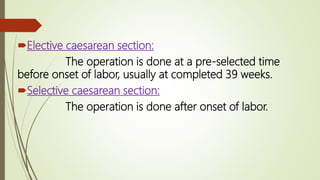
Elective caesarean section:
The operation is done at a pre-selected time
before onset of labor, usually at completed 39 weeks.
Selective caesarean section:
The operation is done after onset of labor.
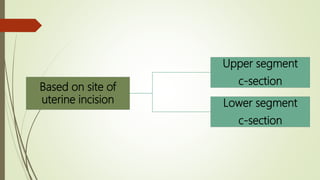
Based on site of
uterine incision
Upper segment
c-section
Lower segment
c-section
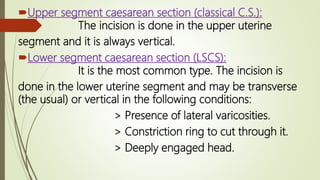
Upper segment caesarean section (classical C.S.):
The incision is done in the upper uterine
segment and it is always vertical.
Lower segment caesarean section (LSCS):
It is the most common type. The incision is
done in the lower uterine segment and may be transverse
(the usual) or vertical in the following conditions:
> Presence of lateral varicosities.
> Constriction ring to cut through it.
> Deeply engaged head.
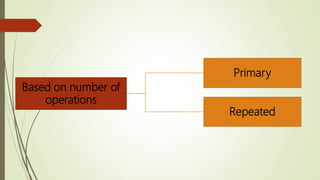
Based on number of
operations
Primary
Repeated
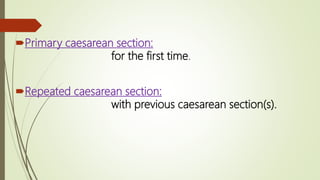
Primary caesarean section:
for the first time.
Repeated caesarean section:
with previous caesarean section(s).
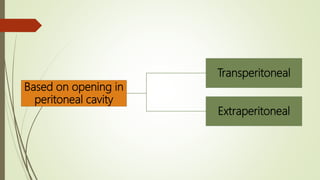
Based on opening in
peritoneal cavity
Transperitoneal
Extraperitoneal
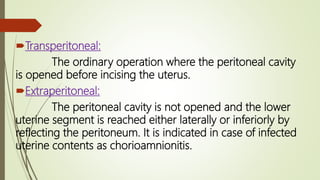
Transperitoneal:
The ordinary operation where the peritoneal cavity
is opened before incising the uterus.
Extraperitoneal:
The peritoneal cavity is not opened and the lower
uterine segment is reached either laterally or inferiorly by
reflecting the peritoneum. It is indicated in case of infected
uterine contents as chorioamnionitis.
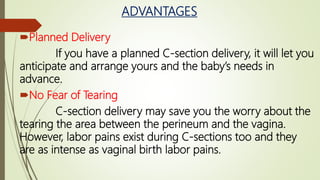
ADVANTAGES
Planned Delivery
If you have a planned C-section delivery, it will let you
anticipate and arrange yours and the baby’s needs in
advance.
No Fear of Tearing
C-section delivery may save you the worry about the
tearing the area between the perineum and the vagina.
However, labor pains exist during C-sections too and they
are as intense as vaginal birth labor pains.
Less Discomfort
C-section delivery comes with its fair share of
discomfort, but you are saved from the pain and bruises
that occur between the perineum and the vagina in the
case of a normal delivery.
Less Bleeding
Bleeding is comparatively less in the first few days
after a C-section delivery.
 Less Complaint of Leaking Wee
Women who deliver through C-section, complain
less of leaking wee when they a cough or laugh.
Fewer Sexual Problems
Women who have a C-section tend to have less
sexual problems because there are no cuts and stitches in
the perineum and the vagina.
Fewer Chances Of Pelvic Floor Damage
C-section does not lead to pelvic floor damage,
which may take place in the case of a vaginal delivery.
Fewer Chances Of Birth Trauma
The use of forceps is minimal in a C-section delivery,
and thus, the chances of the baby suffering from birth
trauma is also less.
Infections Are Not Transmitted
If the mother has diseases like HIV or if viral load is
detected during pregnancy, C-section decreases the risk of
the infection passing over from the mother to the baby.
DISADVANTAGES
DISADVANTAGES OF C-SECTION FOR THE MOTHER
Pain
C-section mothers need a lot of pain relief medication
and may take longer to recover than mothers who deliver
through a vaginal birth.
Bleeding
During a C-section surgery, the mother may lose a lot
of blood if the bleeding is more than normal. If there is heavy
bleeding, there may also be a need for blood transfusion.
Infections After Surgery
Before going for a C-section operation, the mother
mother is given antibiotics to lessen the chances of
infections. However, infections may still occur and are a very
common side-effect of a C-section delivery.
Blood Clots
Every surgery carries the risk of a blood clot. This
can be fatal if the clot is in the lungs.
Anesthesia
Anesthesia administered during the operation can
cause a severe headache, and in some cases also causes
temporary nerve damage.
Subsequent Pregnancies
If you are pregnant after C-section, risks of another
C-section are higher In most cases if a woman’s first
delivery is through caesarean surgery, subsequent
deliveries also happen through C-section.
Mortality
The mortality rate of a mother is higher in the case
of a C-section.
DISADVANTAGES OF C-SECTION FOR THE BABY
Breathing Problems
Some babies delivered through C-section may have
breathing problems. The problem may not be serious, but
the baby would need special care.
Injury
In rare cases, the baby may get hurt by the doctor’s
scalpel, though this usually heals.
Neonatal Care
The need to stay in neonatal care is higher among
babies born through C-section than babies born vaginally.
Asthma
C-section risks for babies include a higher chance of
asthma.
Stillbirth
The risk of stillbirth and infant mortality is higher in
babies born through caesarean.
COMPLICATIONS
INTRAOPERATIVE COMPLICATIONS
Primary hemorrhage
>Atonic
>Traumatic
>Placenta accreta
Injury to internal organs
Injury to the baby
Difficulty in delivery of the head
Anaesthetic complications
POSTOPERATIVE COMPLICATIONS
Paralytic ileus
Respiratory complications
Infections
Peritonitis
Pelvic abscess
Pelvic thrombophlebitis
Deep vein thrombosis and pulmonary embolism
Wound dehiscence
C section

C section

  • 1.
  • 2.
    INTRODUCTION The Ancient Romancaesarean section was first performed to remove a baby from the womb of a mother who died during childbirth. Julius Caesar is said to be the first child to be born in caesarean section. Thus got its name CAESARean section.
  • 4.
    DEFINITION A caesarean sectionis a surgical procedure in which incisi ons are made through a woman's abdomen and uterus to deliver baby. OR The delivery of a viable fetus through an incision in the abdominal wall and uterus.
  • 5.
    INCIDENCE The overall rateof caesarean section delivery in 2015–16 is around 17.2% in Indian which is increased from 8.5% in 2005–06.
  • 6.
    INDICATIONS:- Maternal indications: Contracted pelvisand cephalopelvic disproportion Pelvic tumors Antepartum hemorrhage. Hypertensive disorders with pregnancy. Abnormal uterine action. Previous uterine scar as hysterectomy or metroplasty.
  • 7.
    Previous caesarean sectionif,  the cause of the previous section is permanent e.g. contracted pelvis.  previous section was upper segment.  suspected weak scar.
  • 8.
    • Fetal indications: Malpresentationsand malposition. Prolapsed pulsating cord or foetal distress before full cervical dilatation. Diabetes mellitus Bad obstetric history as recurrent intrauterine foetal death in last weeks of pregnancy Post-mortem C.S. done within 10 minutes of maternal death to save a living baby
  • 9.
    CONTRAINDICATIONS Dead fetus exceptin; a.Extreme degree of pelvic contraction. b.Neglected shoulder. c.Severe accidental hemorrhage. Disseminated intravascular coagulation to minimize blood loss. Extensive scar or pyogenic infection in the abdominal wall.
  • 11.
    TYPES OF C-SECTION Basedon time Elective Selective
  • 12.
    Elective caesarean section: Theoperation is done at a pre-selected time before onset of labor, usually at completed 39 weeks. Selective caesarean section: The operation is done after onset of labor.
  • 13.
    Based on siteof uterine incision Upper segment c-section Lower segment c-section
  • 14.
    Upper segment caesareansection (classical C.S.): The incision is done in the upper uterine segment and it is always vertical. Lower segment caesarean section (LSCS): It is the most common type. The incision is done in the lower uterine segment and may be transverse (the usual) or vertical in the following conditions: > Presence of lateral varicosities. > Constriction ring to cut through it. > Deeply engaged head.
  • 15.
    Based on numberof operations Primary Repeated
  • 16.
    Primary caesarean section: forthe first time. Repeated caesarean section: with previous caesarean section(s).
  • 17.
    Based on openingin peritoneal cavity Transperitoneal Extraperitoneal
  • 18.
    Transperitoneal: The ordinary operationwhere the peritoneal cavity is opened before incising the uterus. Extraperitoneal: The peritoneal cavity is not opened and the lower uterine segment is reached either laterally or inferiorly by reflecting the peritoneum. It is indicated in case of infected uterine contents as chorioamnionitis.
  • 19.
    ADVANTAGES Planned Delivery If youhave a planned C-section delivery, it will let you anticipate and arrange yours and the baby’s needs in advance. No Fear of Tearing C-section delivery may save you the worry about the tearing the area between the perineum and the vagina. However, labor pains exist during C-sections too and they are as intense as vaginal birth labor pains.
  • 20.
    Less Discomfort C-section deliverycomes with its fair share of discomfort, but you are saved from the pain and bruises that occur between the perineum and the vagina in the case of a normal delivery. Less Bleeding Bleeding is comparatively less in the first few days after a C-section delivery.
  • 21.
     Less Complaintof Leaking Wee Women who deliver through C-section, complain less of leaking wee when they a cough or laugh. Fewer Sexual Problems Women who have a C-section tend to have less sexual problems because there are no cuts and stitches in the perineum and the vagina. Fewer Chances Of Pelvic Floor Damage C-section does not lead to pelvic floor damage, which may take place in the case of a vaginal delivery.
  • 22.
    Fewer Chances OfBirth Trauma The use of forceps is minimal in a C-section delivery, and thus, the chances of the baby suffering from birth trauma is also less. Infections Are Not Transmitted If the mother has diseases like HIV or if viral load is detected during pregnancy, C-section decreases the risk of the infection passing over from the mother to the baby.
  • 23.
    DISADVANTAGES DISADVANTAGES OF C-SECTIONFOR THE MOTHER Pain C-section mothers need a lot of pain relief medication and may take longer to recover than mothers who deliver through a vaginal birth. Bleeding During a C-section surgery, the mother may lose a lot of blood if the bleeding is more than normal. If there is heavy bleeding, there may also be a need for blood transfusion.
  • 24.
    Infections After Surgery Beforegoing for a C-section operation, the mother mother is given antibiotics to lessen the chances of infections. However, infections may still occur and are a very common side-effect of a C-section delivery. Blood Clots Every surgery carries the risk of a blood clot. This can be fatal if the clot is in the lungs.
  • 25.
    Anesthesia Anesthesia administered duringthe operation can cause a severe headache, and in some cases also causes temporary nerve damage. Subsequent Pregnancies If you are pregnant after C-section, risks of another C-section are higher In most cases if a woman’s first delivery is through caesarean surgery, subsequent deliveries also happen through C-section. Mortality The mortality rate of a mother is higher in the case of a C-section.
  • 26.
    DISADVANTAGES OF C-SECTIONFOR THE BABY Breathing Problems Some babies delivered through C-section may have breathing problems. The problem may not be serious, but the baby would need special care. Injury In rare cases, the baby may get hurt by the doctor’s scalpel, though this usually heals.
  • 27.
    Neonatal Care The needto stay in neonatal care is higher among babies born through C-section than babies born vaginally. Asthma C-section risks for babies include a higher chance of asthma. Stillbirth The risk of stillbirth and infant mortality is higher in babies born through caesarean.
  • 28.
  • 29.
    Injury to internalorgans Injury to the baby Difficulty in delivery of the head Anaesthetic complications
  • 30.
    POSTOPERATIVE COMPLICATIONS Paralytic ileus Respiratorycomplications Infections Peritonitis Pelvic abscess Pelvic thrombophlebitis Deep vein thrombosis and pulmonary embolism Wound dehiscence