Busses
CS2052 Computer Architecture
Computer Science & Engineering
University of Moratuwa
Dilum Bandara
Dilum.Bandara@uom.lk
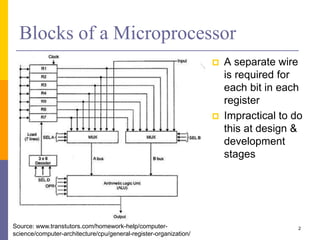
Blocks of a Microprocessor
 A separate wire
is required for
each bit in each
register
 Impractical to do
this at design &
development
stages
2Source: www.transtutors.com/homework-help/computer-
science/computer-architecture/cpu/general-register-organization/
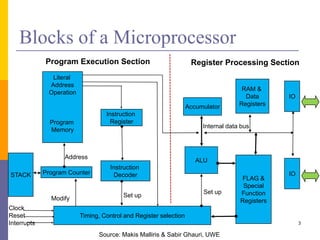
Blocks of a Microprocessor
3
Literal
Address
Operation
Program
Memory
Instruction
Register
STACK Program Counter
Instruction
Decoder
Timing, Control and Register selection
Accumulator
RAM &
Data
Registers
ALU
IO
IO
FLAG &
Special
Function
Registers
Clock
Reset
Interrupts
Program Execution Section Register Processing Section
Set up
Set up
Modify
Address
Internal data bus
Source: Makis Malliris & Sabir Ghauri, UWE
Bus
 Common electric path between multiple units
 Collection of wires, 1 wire for each bit
 Interconnect registers & other I/O units
 Only 1 register/unit can occupy the bus at a time
 1-to-1 or transfer
 1-to-many transfer
4
Bus Selection
 Select an input among multiple inputs
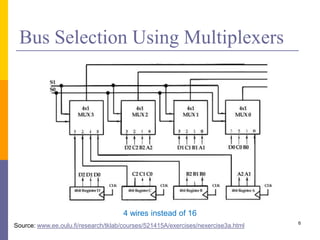
 Using multiplexers
 Using tri-state buffers
5
Bus Selection Using Multiplexers
6
Source: www.ee.oulu.fi/research/tklab/courses/521415A/exercises/nexercise3a.html
4 wires instead of 16
Tri-State Buffer
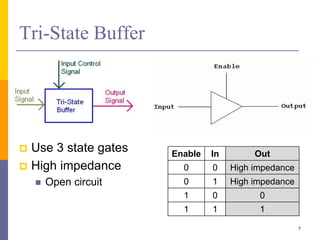
 Use 3 state gates
 High impedance
 Open circuit
7
Enable In Out
0 0 High impedance
0 1 High impedance
1 0 0
1 1 1
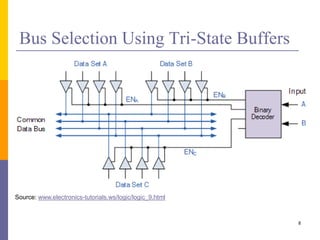
Bus Selection Using Tri-State Buffers
8
Source: www.electronics-tutorials.ws/logic/logic_9.html
Types of Busses
 Data bus
 Instruction bus
 Control bus
 Address bus
 Memory bus
 I/O bus
 These can be internal/external to CPU
9
Bus Protocols
 IBM PC (PC/XT)
 Industry Standard Architecture (ISA)
 Peripheral Component Interconnect (PCI)
 PCI Express (PCI-E or PCIe)
 Accelerated Graphics Port (AGP)
 Universal Serial Bus (USB)
10
What’s Defined by Bus Protocol?
 Bus width
 USB 2-bit, PIC instruction bus 14-bit, PCI 32-bit, PCIe
64-bit
 Speed
 PCI 33 MHz, PCIe 133 MHz
 Bandwidth
 PCI 133 MB/S, PCIe 4 GB/S, USB 3.0 500 MB/s
 Who can communicate & when
 Master
 e.g., CPU
 Slave
 e.g., memory 11
Serial vs. Parallel Busses
 Which has high throughput?
 Parallel I/O
 Expense & inconvenience of long/parallel lines
 Parallel I/O maximum distance ~2m
 Cable capacitance limits unbuffered data transfers
 More wires, drivers, receivers
 Relatively simple circuits
 Serial I/O
 Fast speeds over long distances
 Less wires, less space, less costly
 Relatively more complex circuits 12
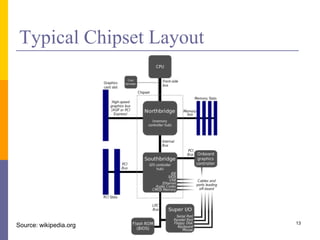
Typical Chipset Layout
13
Source: wikipedia.org

Busses

  • 1.
    Busses CS2052 Computer Architecture ComputerScience & Engineering University of Moratuwa Dilum Bandara Dilum.Bandara@uom.lk
  • 2.
    Blocks of aMicroprocessor  A separate wire is required for each bit in each register  Impractical to do this at design & development stages 2Source: www.transtutors.com/homework-help/computer- science/computer-architecture/cpu/general-register-organization/
  • 3.
    Blocks of aMicroprocessor 3 Literal Address Operation Program Memory Instruction Register STACK Program Counter Instruction Decoder Timing, Control and Register selection Accumulator RAM & Data Registers ALU IO IO FLAG & Special Function Registers Clock Reset Interrupts Program Execution Section Register Processing Section Set up Set up Modify Address Internal data bus Source: Makis Malliris & Sabir Ghauri, UWE
  • 4.
    Bus  Common electricpath between multiple units  Collection of wires, 1 wire for each bit  Interconnect registers & other I/O units  Only 1 register/unit can occupy the bus at a time  1-to-1 or transfer  1-to-many transfer 4
  • 5.
    Bus Selection  Selectan input among multiple inputs  Using multiplexers  Using tri-state buffers 5
  • 6.
    Bus Selection UsingMultiplexers 6 Source: www.ee.oulu.fi/research/tklab/courses/521415A/exercises/nexercise3a.html 4 wires instead of 16
  • 7.
    Tri-State Buffer  Use3 state gates  High impedance  Open circuit 7 Enable In Out 0 0 High impedance 0 1 High impedance 1 0 0 1 1 1
  • 8.
    Bus Selection UsingTri-State Buffers 8 Source: www.electronics-tutorials.ws/logic/logic_9.html
  • 9.
    Types of Busses Data bus  Instruction bus  Control bus  Address bus  Memory bus  I/O bus  These can be internal/external to CPU 9
  • 10.
    Bus Protocols  IBMPC (PC/XT)  Industry Standard Architecture (ISA)  Peripheral Component Interconnect (PCI)  PCI Express (PCI-E or PCIe)  Accelerated Graphics Port (AGP)  Universal Serial Bus (USB) 10
  • 11.
    What’s Defined byBus Protocol?  Bus width  USB 2-bit, PIC instruction bus 14-bit, PCI 32-bit, PCIe 64-bit  Speed  PCI 33 MHz, PCIe 133 MHz  Bandwidth  PCI 133 MB/S, PCIe 4 GB/S, USB 3.0 500 MB/s  Who can communicate & when  Master  e.g., CPU  Slave  e.g., memory 11
  • 12.
    Serial vs. ParallelBusses  Which has high throughput?  Parallel I/O  Expense & inconvenience of long/parallel lines  Parallel I/O maximum distance ~2m  Cable capacitance limits unbuffered data transfers  More wires, drivers, receivers  Relatively simple circuits  Serial I/O  Fast speeds over long distances  Less wires, less space, less costly  Relatively more complex circuits 12
  • 13.