CAUCHY’S CONSTANT
By- Diksha Tripathi
B.Sc (Hons)Physics
6th Semester
HISTORY:
• Augustin-Louis Cauchy was born on August 21,1789
in Paris.
• He was a French Mathematician ,Engineer , and
Physicist.
• He published 789 research papers.
• He defined Cauchy’s Equation in his work on spectral
theory i.e. “Cauchy Memoire” in 1836.
(Source: Wikipedia)
AIM: TO FIND THE VALUE OF CAUCHY’S CONSTANTS
BY DETERMINING THE REFRACTIVE INDEX OF SPECTRAL
LINES OF MERCURY SOURCE
• Apparatus:
1. Prism Spectrometer
2. Prism
3. Prism Clamp
4. Reading lens
5. Spectral lamp with spectral power supply (Prism spectrometer)
• FORMULA USED:
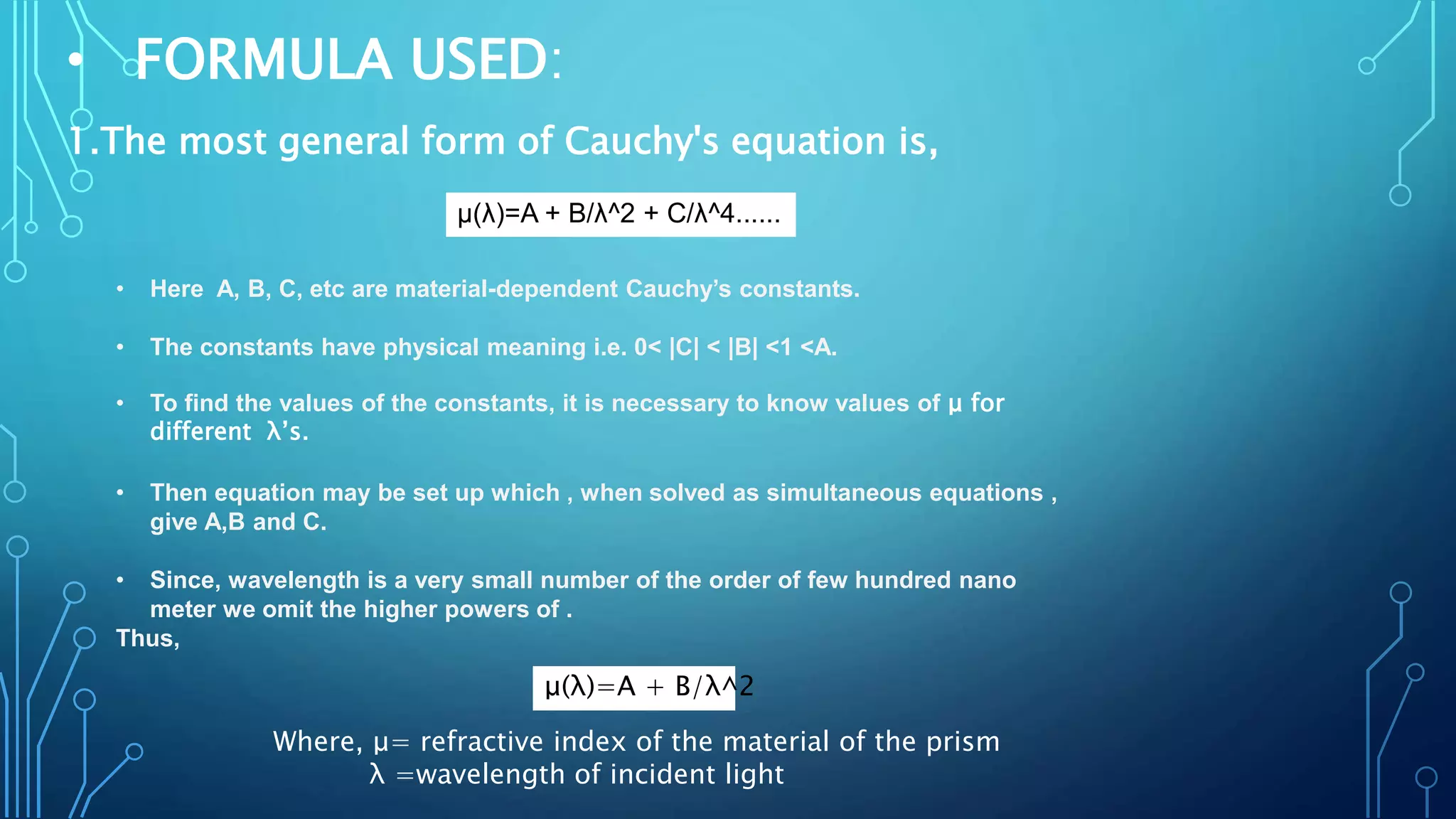
1.The most general form of Cauchy's equation is,
μ(λ)=A + B/λ^2 ​+ C/​λ^4......
• Here A, B, C, etc are material-dependent Cauchy’s constants.
• The constants have physical meaning i.e. 0< |C| < |B| <1 <A.
• To find the values of the constants, it is necessary to know values of μ for
different λ’s.
• Then equation may be set up which , when solved as simultaneous equations ,
give A,B and C.
• Since, wavelength is a very small number of the order of few hundred nano
meter we omit the higher powers of .
Thus,
Where, μ= refractive index of the material of the prism
λ =wavelength of incident light
μ(λ)=A + B​/λ^2
μ= Sin( (A+Dm)/2)
sin(A/2)
Where, A=angle of prism
Dm=angle of minimum deviation for different colour
of light
• Parameters of Cauchy's constant:
1. A is a dimensionless parameter: when λ  ∞
then μ  A.
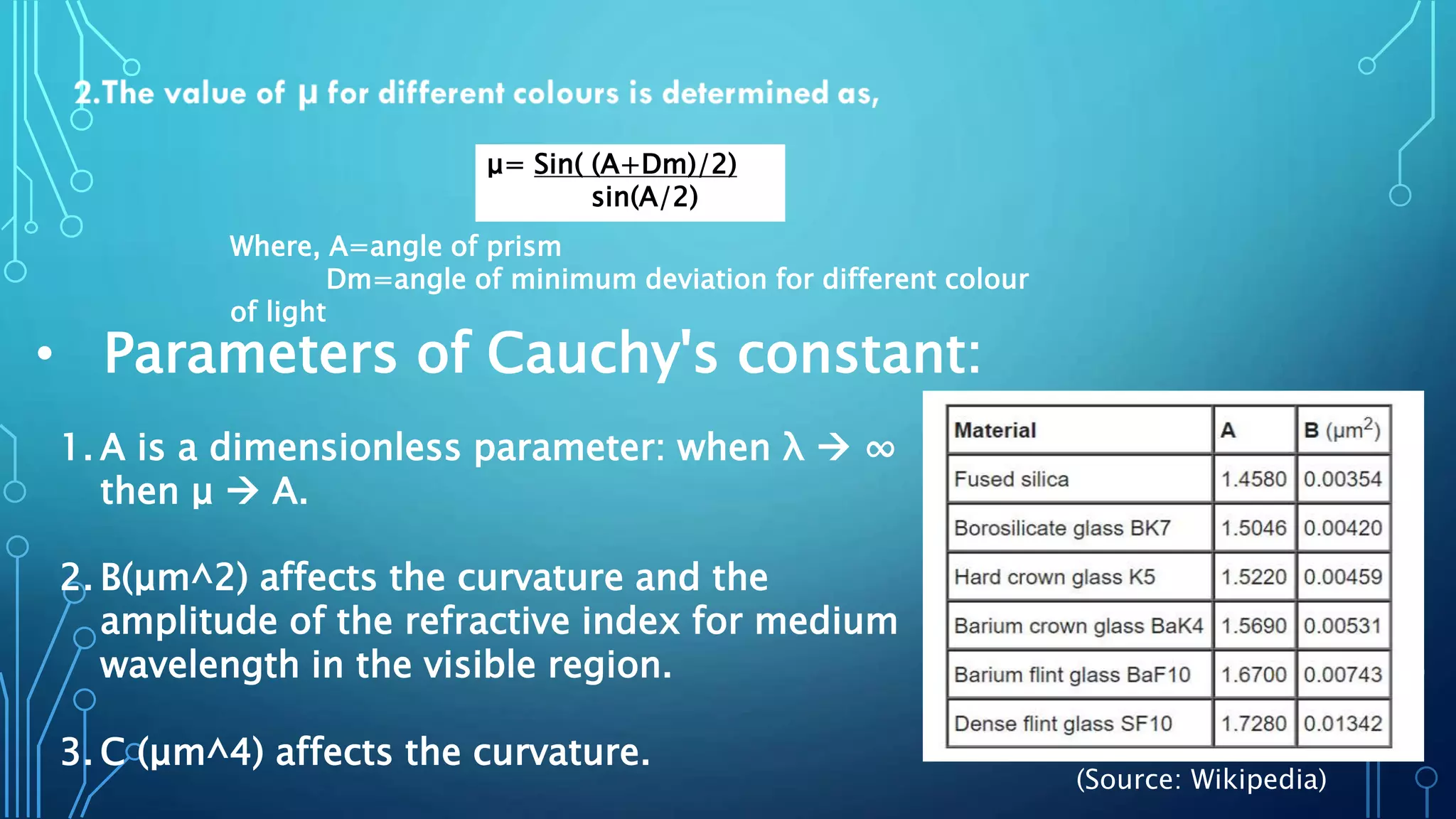
2. B(μm^2) affects the curvature and the
amplitude of the refractive index for medium
wavelength in the visible region.
3. C (μm^4) affects the curvature.
(Source: Wikipedia)
• PROCEDURE:
1. Setting of Prism table by using spirit-level and method
of optical alignment.
2. Using Schuster’s method of focusing a spectrometer for
parallel light.
3. Measurements of angle of minimum deviation Dm and
prism angle A.
4. Using values of δm and A calculate refractive index for
different wavelengths of light.
5. Then by using Cauchy’s equation, µ and λ we can
calculate Cauchy’s constant A and B.
• RESULT:
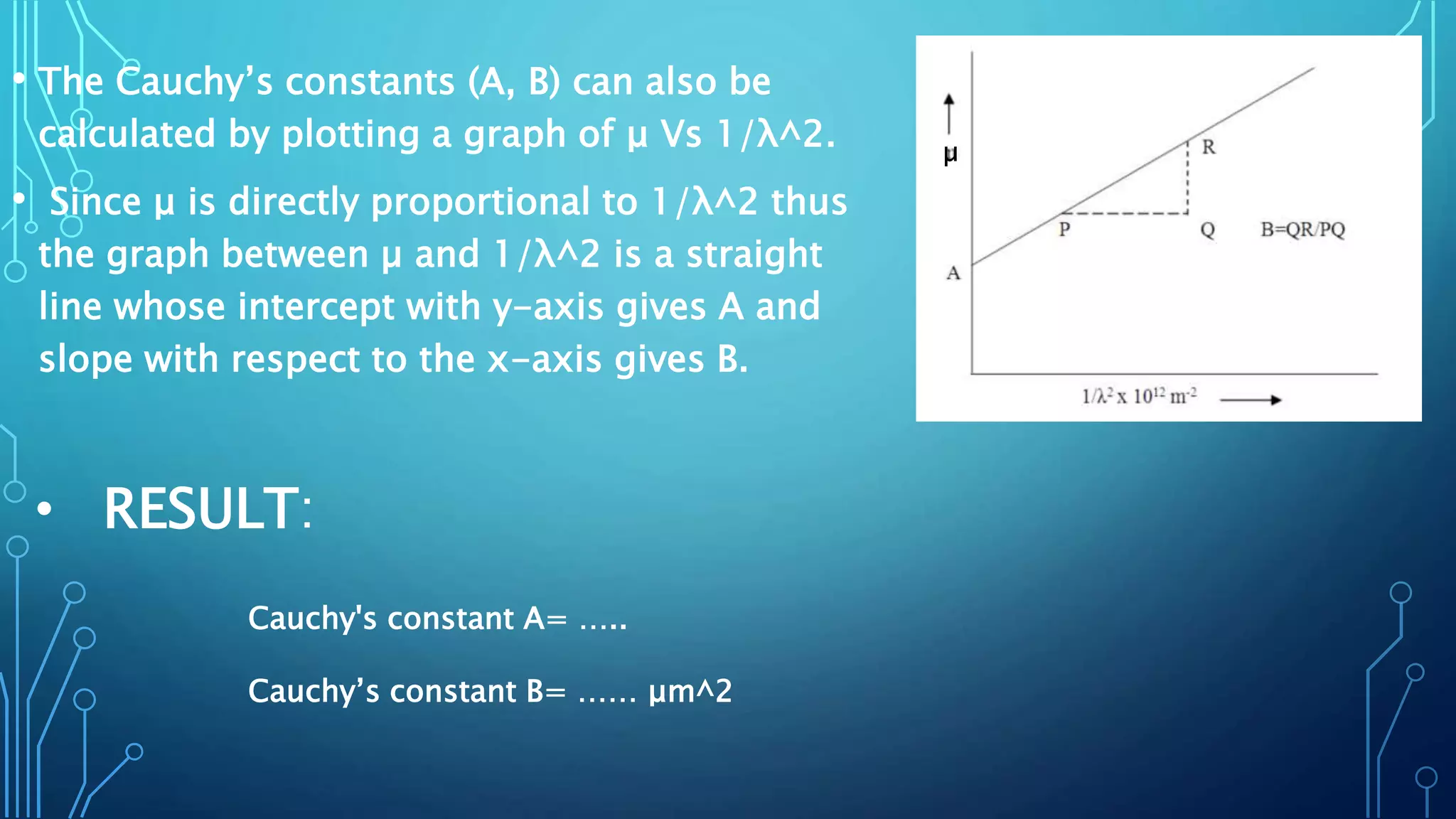
• The Cauchy’s constants (A, B) can also be
calculated by plotting a graph of μ Vs 1/λ^2.
• Since μ is directly proportional to 1/λ^2 thus
the graph between µ and 1/λ^2 is a straight
line whose intercept with y-axis gives A and
slope with respect to the x-axis gives B.
Cauchy's constant A= …..
Cauchy’s constant B= …… μm^2
µ
• PRECAUTIONS:
1.The turn table should be properly levelled.
2.The eye piece should be focused on cross wire.
3.Both the telescope and collimator should be
focused for parallel ray.
• IMPORTANT RESULTS AND USES OF CAUCHY’S
EQUATION:
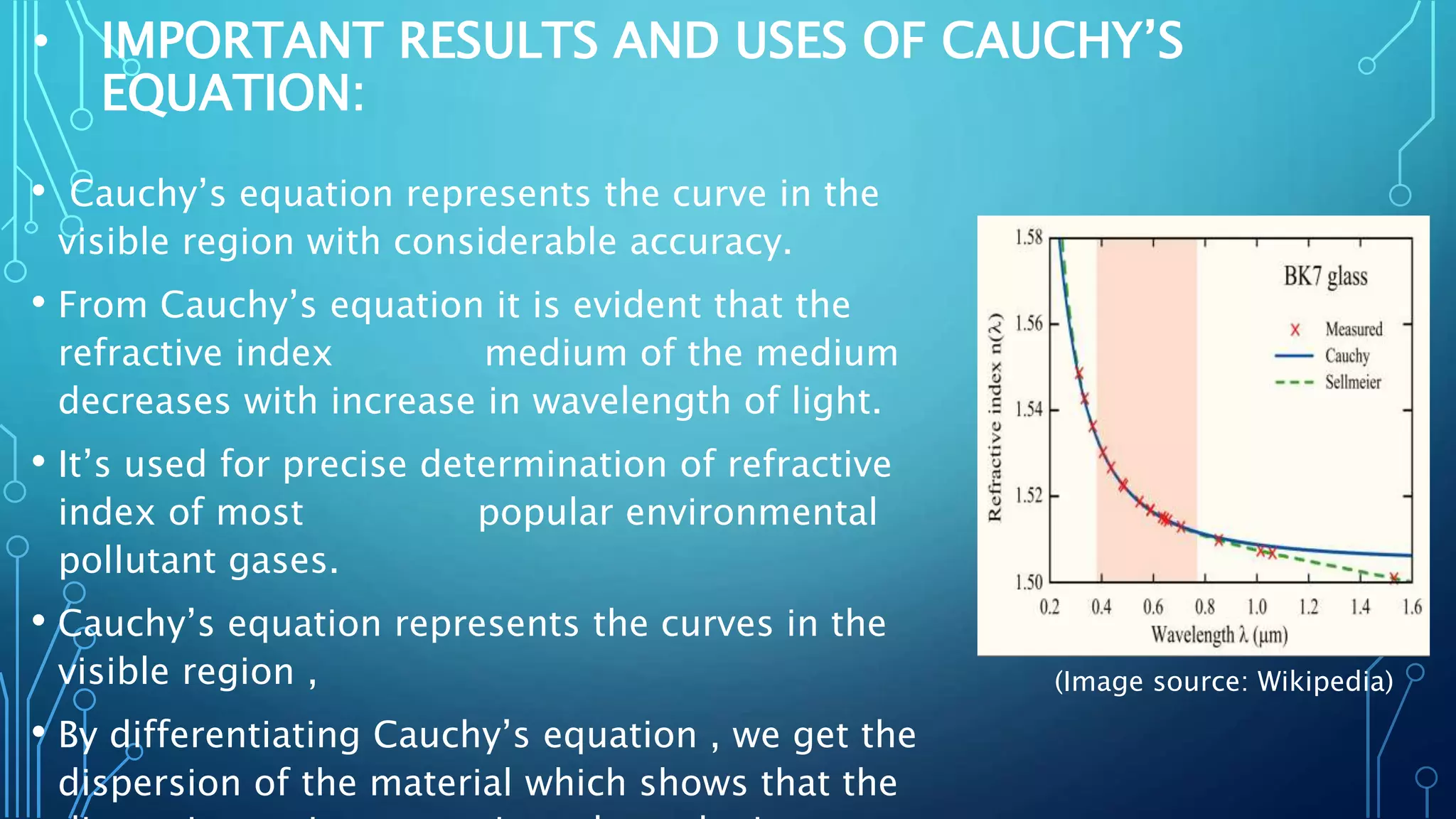
• Cauchy’s equation represents the curve in the
visible region with considerable accuracy.
• From Cauchy’s equation it is evident that the
refractive index medium of the medium
decreases with increase in wavelength of light.
• It’s used for precise determination of refractive
index of most popular environmental
pollutant gases.
• Cauchy’s equation represents the curves in the
visible region ,
• By differentiating Cauchy’s equation , we get the
dispersion of the material which shows that the
(Image source: Wikipedia)
• LIMITATIONS:
• The theoretical reasoning on which Cauchy based his equation was
later shown to be false , so that it is to be considered essentially as an
empirical equation.
• Cauchy’s formulation can not be easily applied to metals and
semiconductors.
• The equation is only valid for regions of normal dispersion in
the visible wavelength region. In the infrared, the equation becomes
inaccurate, and it cannot represent regions of anomalous dispersion.
• CONCLUSION:
• It’s mathematical simplicity makes it useful in some
applications.
• The “Sellmeier equation” is a later developed of Cauchy’s work
that handles anomalously dispersive region i.e.
where n is the refractive index, λ is the
wavelength, and Bi and Ci are experimentally
determined Sellmeier coefficients.
Thank
You!

Cauchy's Equation & Cauchy's Constant Explained

  • 1.
    CAUCHY’S CONSTANT By- DikshaTripathi B.Sc (Hons)Physics 6th Semester
  • 2.
    HISTORY: • Augustin-Louis Cauchywas born on August 21,1789 in Paris. • He was a French Mathematician ,Engineer , and Physicist. • He published 789 research papers. • He defined Cauchy’s Equation in his work on spectral theory i.e. “Cauchy Memoire” in 1836. (Source: Wikipedia)
  • 3.
    AIM: TO FINDTHE VALUE OF CAUCHY’S CONSTANTS BY DETERMINING THE REFRACTIVE INDEX OF SPECTRAL LINES OF MERCURY SOURCE • Apparatus: 1. Prism Spectrometer 2. Prism 3. Prism Clamp 4. Reading lens 5. Spectral lamp with spectral power supply (Prism spectrometer)
  • 4.
    • FORMULA USED: 1.Themost general form of Cauchy's equation is, μ(λ)=A + B/λ^2 ​+ C/​λ^4...... • Here A, B, C, etc are material-dependent Cauchy’s constants. • The constants have physical meaning i.e. 0< |C| < |B| <1 <A. • To find the values of the constants, it is necessary to know values of μ for different λ’s. • Then equation may be set up which , when solved as simultaneous equations , give A,B and C. • Since, wavelength is a very small number of the order of few hundred nano meter we omit the higher powers of . Thus, Where, μ= refractive index of the material of the prism λ =wavelength of incident light μ(λ)=A + B​/λ^2
  • 5.
    μ= Sin( (A+Dm)/2) sin(A/2) Where,A=angle of prism Dm=angle of minimum deviation for different colour of light • Parameters of Cauchy's constant: 1. A is a dimensionless parameter: when λ  ∞ then μ  A. 2. B(μm^2) affects the curvature and the amplitude of the refractive index for medium wavelength in the visible region. 3. C (μm^4) affects the curvature. (Source: Wikipedia)
  • 6.
    • PROCEDURE: 1. Settingof Prism table by using spirit-level and method of optical alignment. 2. Using Schuster’s method of focusing a spectrometer for parallel light. 3. Measurements of angle of minimum deviation Dm and prism angle A. 4. Using values of δm and A calculate refractive index for different wavelengths of light. 5. Then by using Cauchy’s equation, µ and λ we can calculate Cauchy’s constant A and B.
  • 7.
    • RESULT: • TheCauchy’s constants (A, B) can also be calculated by plotting a graph of μ Vs 1/λ^2. • Since μ is directly proportional to 1/λ^2 thus the graph between µ and 1/λ^2 is a straight line whose intercept with y-axis gives A and slope with respect to the x-axis gives B. Cauchy's constant A= ….. Cauchy’s constant B= …… μm^2 µ
  • 8.
    • PRECAUTIONS: 1.The turntable should be properly levelled. 2.The eye piece should be focused on cross wire. 3.Both the telescope and collimator should be focused for parallel ray.
  • 9.
    • IMPORTANT RESULTSAND USES OF CAUCHY’S EQUATION: • Cauchy’s equation represents the curve in the visible region with considerable accuracy. • From Cauchy’s equation it is evident that the refractive index medium of the medium decreases with increase in wavelength of light. • It’s used for precise determination of refractive index of most popular environmental pollutant gases. • Cauchy’s equation represents the curves in the visible region , • By differentiating Cauchy’s equation , we get the dispersion of the material which shows that the (Image source: Wikipedia)
  • 10.
    • LIMITATIONS: • Thetheoretical reasoning on which Cauchy based his equation was later shown to be false , so that it is to be considered essentially as an empirical equation. • Cauchy’s formulation can not be easily applied to metals and semiconductors. • The equation is only valid for regions of normal dispersion in the visible wavelength region. In the infrared, the equation becomes inaccurate, and it cannot represent regions of anomalous dispersion.

  • 11.
    • CONCLUSION: • It’smathematical simplicity makes it useful in some applications. • The “Sellmeier equation” is a later developed of Cauchy’s work that handles anomalously dispersive region i.e. where n is the refractive index, λ is the wavelength, and Bi and Ci are experimentally determined Sellmeier coefficients.
  • 12.