​
MADE BY -: Harshita Goyal
CLASS -: XII
BOARD ROLL NO. -: 5663805
CERTIFICATE
This is to certify that KASHIF KHAN of class XII-A has completed the
physics project entitled “TO FIND THE REFRACTIVE INDEX OF
DIFFERENT LIQUIDS USING HOLLOW PRISM” under the guidance
of her physics teacher Mrs. MENKA PRABHAKAR and lab assistant
Mr. KUNDAN.
The progress of the project has been continuously reported and has
been acknowledged consistently.
Menka Prabhakar
(Physics Teacher)
ACKNOWLEDGEMENT
I would like to owe the sense of gratitude to our physics teacher
Mrs. MENKA PRABHAKAR for her consistent guidance, support
and encouragement without which this project would not able to
exist in present shape.
I would also like to thank our Lab assistant Mr.KUNDAN, my
parents for their blessings and my friends for their help in order to
complete the project.
C
O
N
T
E
N
T
To find
refractive index of
different liquids using
hollow prism.
THEORY
PRISM: A prism is a transparent optical element with flat, polished
surfaces that refract light. Prisms can be made from any material that is
transparent including glass, plastic and fluorite.
A prism can be used to break light up into its constituent spectral colors.
Prisms can also be used to reflect light, or to split light into components
with different polarizations.
REFRACTION:
The refractive index of the liquid
Is given by the formula:
FLUIDS REFRACTIVE
INDEX
Water 1.33
Glycerine 1.47
Ethyl Alcohol 1.36
Vegetable Oil 1.45
Acetone 1.36
HCl 1.34
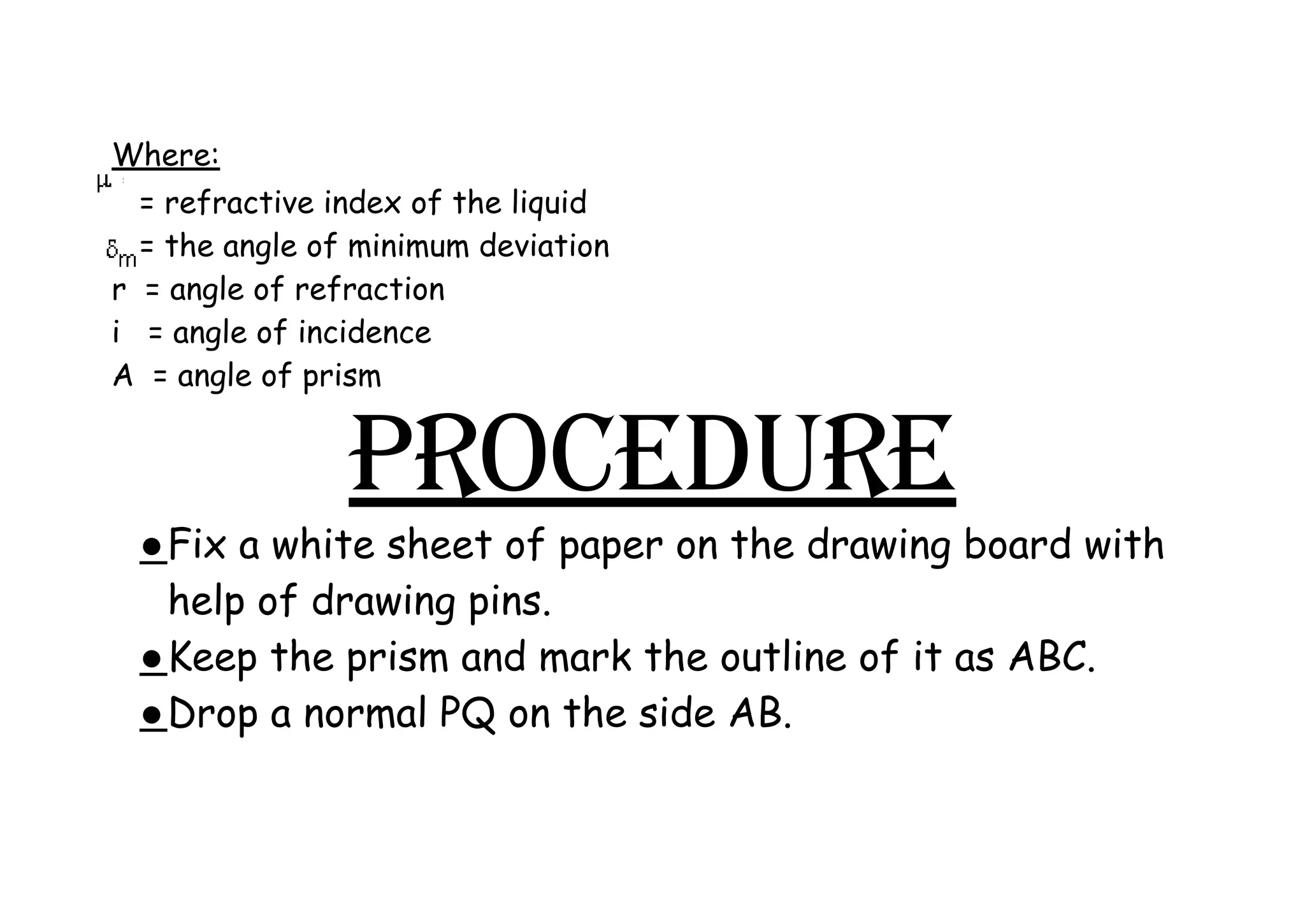
Where:
= refractive index of the liquid
= the angle of minimum deviation
r = angle of refraction
i = angle of incidence
A = angle of prism
PROCEDURE
●​Fix a white sheet of paper on the drawing board with
help of drawing pins.
●​Keep the prism and mark the outline of it as ABC.
●​Drop a normal PQ on the side AB.
●​Draw the angle of incidence in accordance with the
normal PQ and place 2 pins so that they appear to be
in the straight line.
●​Place the prism filled with given sample of liquid ,on
the marked outline ABC.
●​Now take the pins and place them on the side AC so
that all the 4 pins appears to be in same line.
●​Remove the prism and draw the line joining the points
so obtained.
●​Mark the diagram as shown in the figure.
●​Repeat this with different liquids and different angle
of incidence.
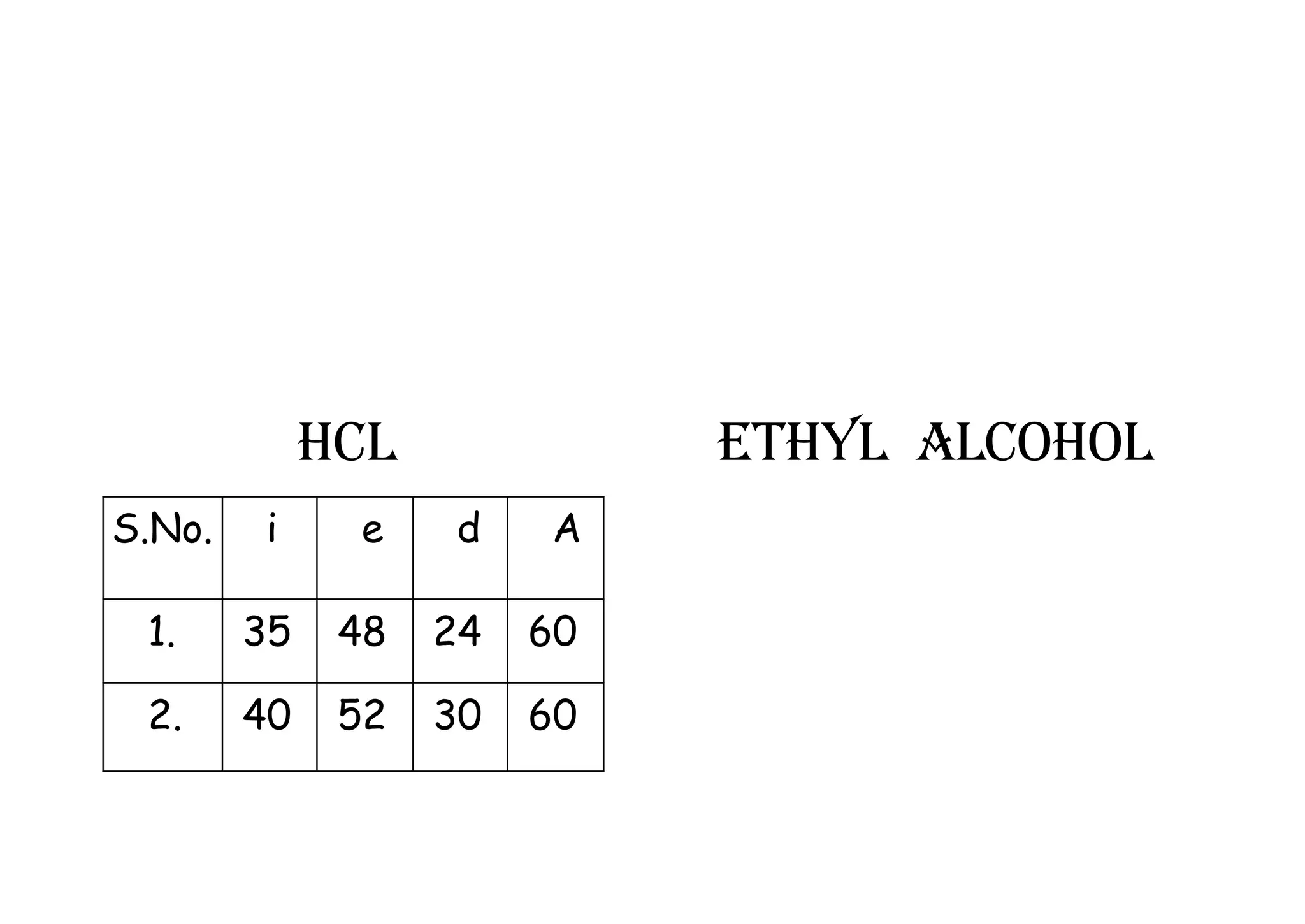
HCl ethyl alcohol
S.No. i e d A
1. 35 48 24 60
2. 40 52 30 60
3. 45 42 25 60
4. 50 36 26 60
5. 55 32 28 60
S.No. i e d A
1. 35 52 26 60
2. 40 44 25 60
3. 45 41 25 60
4. 50 36 26 60
5. 55 32 27 60
RESULT
THE REFRACTIVE INDEX OF ETHYL ALCOHOL
●​EXPERIMENTAL-1.36
●​CALCULATED- 1.34
THE REFRACTIVE INDEX OF HCL
●​EXPERIMENTAL- 1.34
●​CALCULATED- 1.34
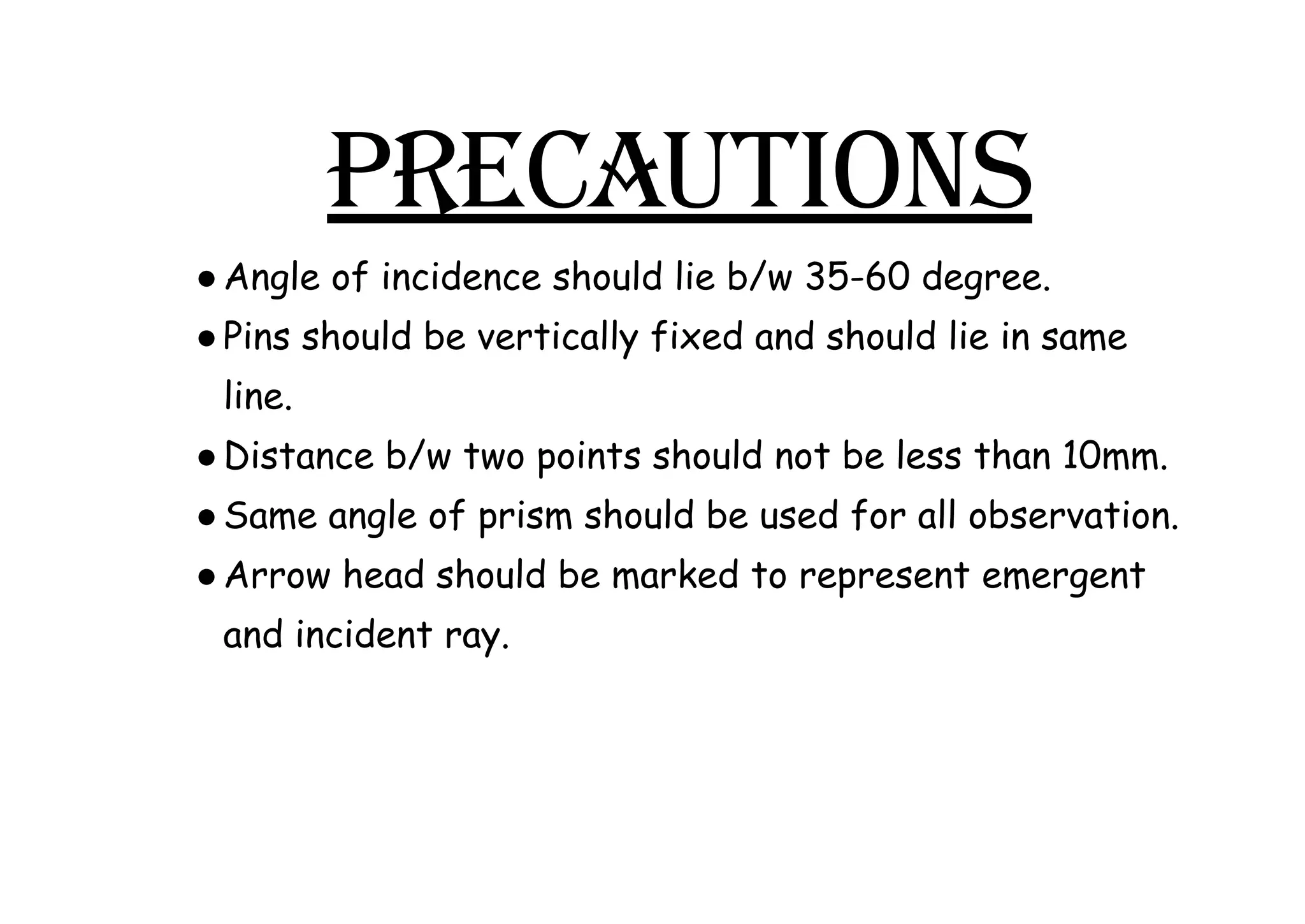
PRECAUTIONS
●​Angle of incidence should lie b/w 35-60 degree.
●​Pins should be vertically fixed and should lie in same
line.
●​Distance b/w two points should not be less than 10mm.
●​Same angle of prism should be used for all observation.
●​Arrow head should be marked to represent emergent
and incident ray.
bibliography
●​wikipedia.org
●​google.com
●​physicsforlife.com {physicsforlife.com}
●​earthphysics.com
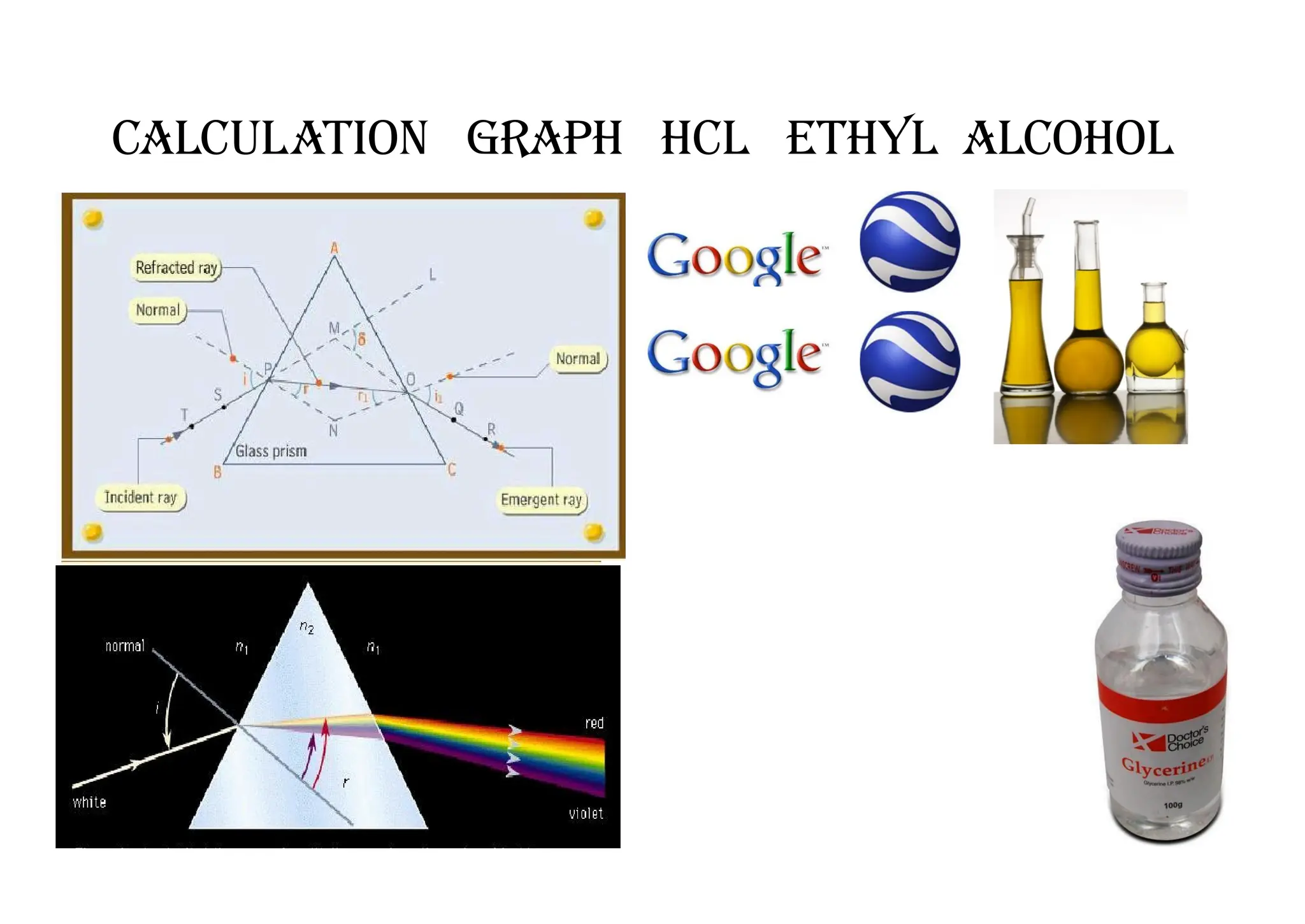
CALCULATION GRAPH HCL ethyl alcohol

hollow-prism XII physics investigatory project.docx.pdf

  • 1.
    ​ MADE BY -:Harshita Goyal CLASS -: XII BOARD ROLL NO. -: 5663805
  • 2.
    CERTIFICATE This is tocertify that KASHIF KHAN of class XII-A has completed the physics project entitled “TO FIND THE REFRACTIVE INDEX OF DIFFERENT LIQUIDS USING HOLLOW PRISM” under the guidance of her physics teacher Mrs. MENKA PRABHAKAR and lab assistant Mr. KUNDAN. The progress of the project has been continuously reported and has been acknowledged consistently. Menka Prabhakar (Physics Teacher)
  • 3.
    ACKNOWLEDGEMENT I would liketo owe the sense of gratitude to our physics teacher Mrs. MENKA PRABHAKAR for her consistent guidance, support and encouragement without which this project would not able to exist in present shape. I would also like to thank our Lab assistant Mr.KUNDAN, my parents for their blessings and my friends for their help in order to complete the project.
  • 4.
  • 5.
    To find refractive indexof different liquids using hollow prism.
  • 6.
    THEORY PRISM: A prismis a transparent optical element with flat, polished surfaces that refract light. Prisms can be made from any material that is transparent including glass, plastic and fluorite. A prism can be used to break light up into its constituent spectral colors. Prisms can also be used to reflect light, or to split light into components with different polarizations. REFRACTION:
  • 7.
    The refractive indexof the liquid Is given by the formula: FLUIDS REFRACTIVE INDEX Water 1.33 Glycerine 1.47 Ethyl Alcohol 1.36 Vegetable Oil 1.45 Acetone 1.36 HCl 1.34
  • 8.
    Where: = refractive indexof the liquid = the angle of minimum deviation r = angle of refraction i = angle of incidence A = angle of prism PROCEDURE ●​Fix a white sheet of paper on the drawing board with help of drawing pins. ●​Keep the prism and mark the outline of it as ABC. ●​Drop a normal PQ on the side AB.
  • 9.
    ●​Draw the angleof incidence in accordance with the normal PQ and place 2 pins so that they appear to be in the straight line. ●​Place the prism filled with given sample of liquid ,on the marked outline ABC. ●​Now take the pins and place them on the side AC so that all the 4 pins appears to be in same line. ●​Remove the prism and draw the line joining the points so obtained. ●​Mark the diagram as shown in the figure. ●​Repeat this with different liquids and different angle of incidence.
  • 11.
    HCl ethyl alcohol S.No.i e d A 1. 35 48 24 60 2. 40 52 30 60
  • 12.
    3. 45 4225 60 4. 50 36 26 60 5. 55 32 28 60 S.No. i e d A 1. 35 52 26 60 2. 40 44 25 60 3. 45 41 25 60 4. 50 36 26 60
  • 13.
    5. 55 3227 60
  • 15.
    RESULT THE REFRACTIVE INDEXOF ETHYL ALCOHOL ●​EXPERIMENTAL-1.36 ●​CALCULATED- 1.34 THE REFRACTIVE INDEX OF HCL ●​EXPERIMENTAL- 1.34 ●​CALCULATED- 1.34
  • 16.
    PRECAUTIONS ●​Angle of incidenceshould lie b/w 35-60 degree. ●​Pins should be vertically fixed and should lie in same line. ●​Distance b/w two points should not be less than 10mm. ●​Same angle of prism should be used for all observation. ●​Arrow head should be marked to represent emergent and incident ray.
  • 17.
  • 18.
    CALCULATION GRAPH HCLethyl alcohol