


∙ Live Webinars (online lectures) with
recordings
∙ Online Query Solving
∙ Online MCQ tests with detailed
solutions
∙ Online Notes and Solved Exercises
∙ Career Counseling
By:- Prof. Dnyanesh Vaidya
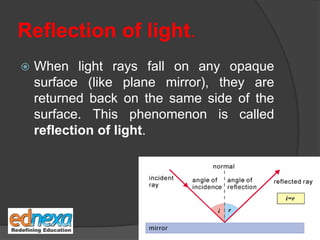
Reflection of light.
 When light rays fall on any opaque
surface (like plane mirror), they are
returned back on the same side of the
surface. This phenomenon is called
reflection of light.
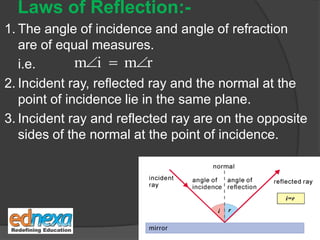
Laws of Reflection:-
1. The angle of incidence and angle of refraction
are of equal measures.
i.e.
2. Incident ray, reflected ray and the normal at the
point of incidence lie in the same plane.
3. Incident ray and reflected ray are on the opposite
sides of the normal at the point of incidence.
m i m r
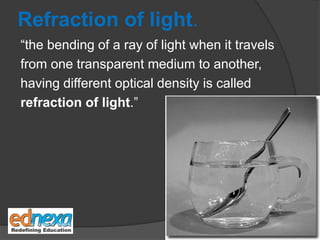
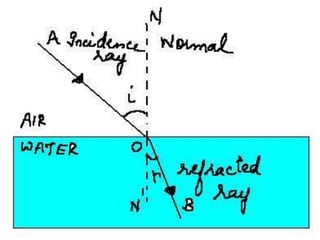
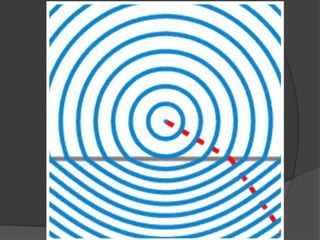
Refraction of light.
“the bending of a ray of light when it travels
from one transparent medium to another,
having different optical density is called
refraction of light.”
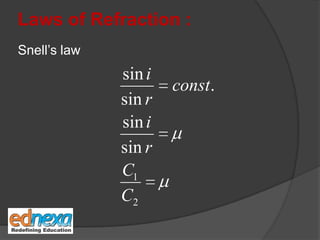
Laws of Refraction :
Snell’s law
1
2
sin
.
sin
sin
sin
i
const
r
i
r
C
C
Snell
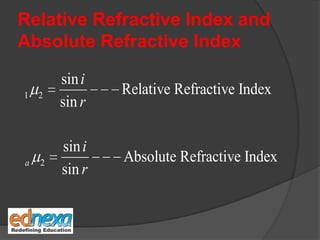
Relative Refractive Index and
Absolute Refractive Index
1 2
2
sin
Relative Refractive Index
sin
sin
Absolute Refractive Index
sin
a
i
r
i
r
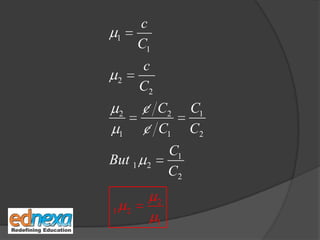
1
1
2
2
2 2 1
1 1 2
1
1 2
2
2
1 2
1
c
C
c
C
c C C
c C C
C
But
C
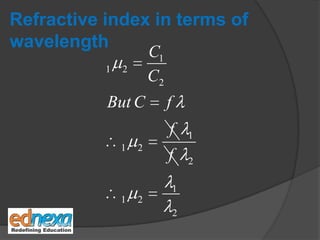
Refractive index in terms of
wavelength
1
1 2
2
1
1 2
2
1
1 2
2
C
C
But C f
f
f
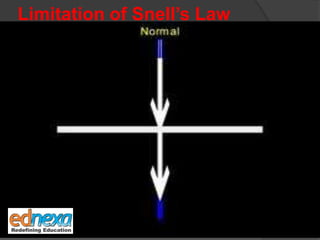
Limitation of Snell’s Law
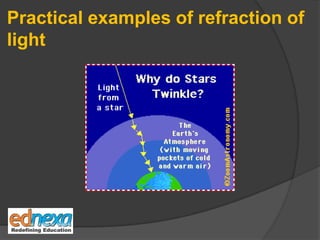
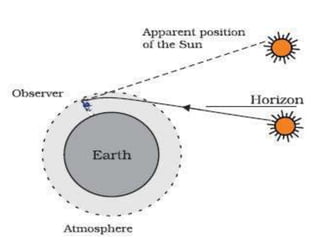
Practical examples of refraction of
light
Numericals
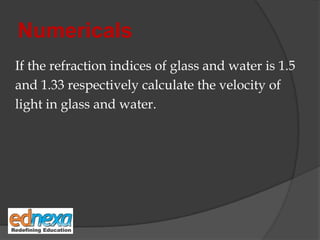
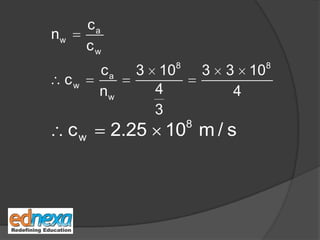
If the refraction indices of glass and water is 1.5
and 1.33 respectively calculate the velocity of
light in glass and water.
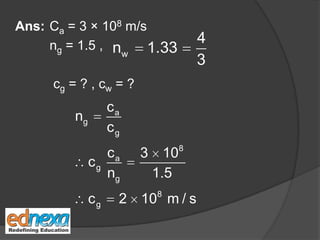
Ans: Ca = 3 × 10⁸ m/s
ng = 1.5 ,
cg = ? , cw = ?
w
4
n 1.33
3
a
g
g
8
a
g
g
8
g
c
n
c
c 3 10
c
n 1.5
c 2 10 m / s
a
w
w
8 8
a
w
w
c
n
c
c 3 10 3 3 10
c
4n 4
3
8
wc 2.25 10 m / s
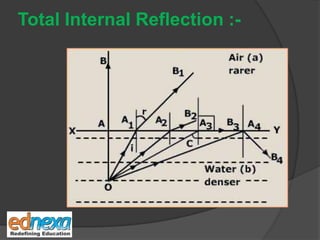
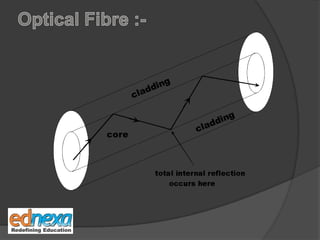
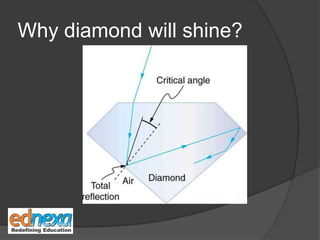
Total Internal Reflection :-
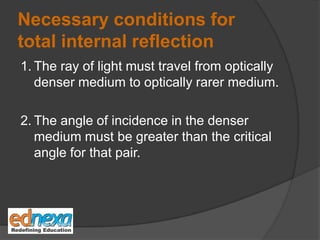
Necessary conditions for
total internal reflection
1. The ray of light must travel from optically
denser medium to optically rarer medium.
2. The angle of incidence in the denser
medium must be greater than the critical
angle for that pair.
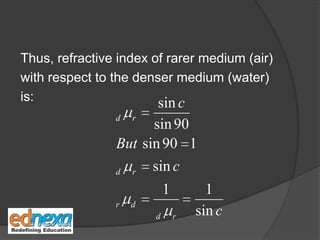
Thus, refractive index of rarer medium (air)
with respect to the denser medium (water)
is: sin
sin90
sin90 1
sin
1 1
sin
d r
d r
r d
d r
c
But
c
c
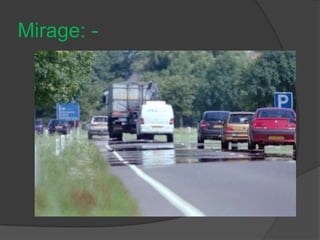
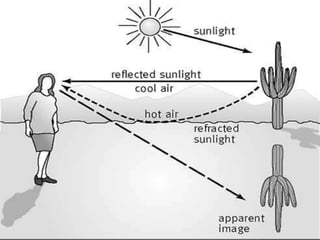
Mirage: -
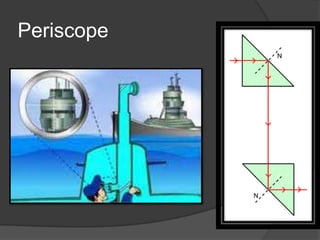
Periscope
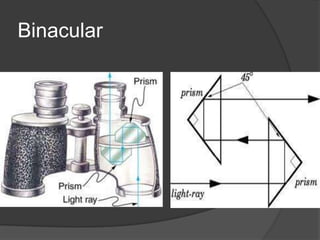
Binacular
Why diamond will shine?
For Home works
1. If the refractive indices of diamond and glass
are 2.4 and 1.5 respectively. Compare the
velocity of light in diamond and glass.
2. The R.I of water relative to air is 4/3. A ray of
light passing through water into air is incident
at interface at an angle of 35° with the normal.
What angle does the refracted ray make with
the normal?
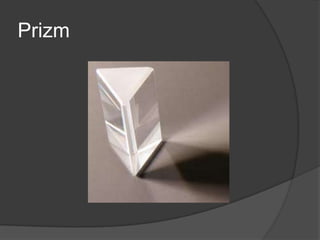
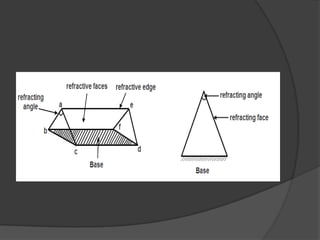
Prizm
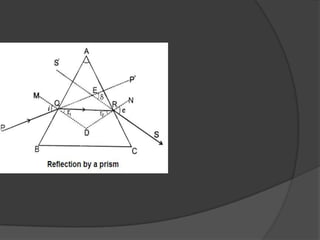
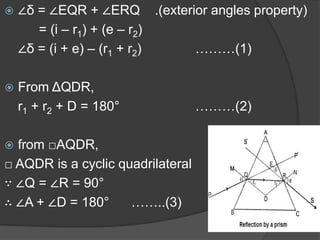
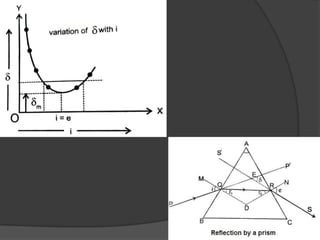
 ∠δ = ∠EQR + ∠ERQ .(exterior angles property)
= (i – r1) + (e – r2)
∠δ = (i + e) – (r1 + r2) ………(1)
 From ΔQDR,
r1 + r2 + D = 180° ………(2)
 from □AQDR,
□ AQDR is a cyclic quadrilateral
∵ ∠Q = ∠R = 90°
∴ ∠A + ∠D = 180° ……..(3)
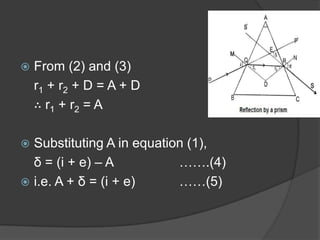
 From (2) and (3)
r1 + r2 + D = A + D
∴ r1 + r2 = A
 Substituting A in equation (1),
δ = (i + e) – A …….(4)
 i.e. A + δ = (i + e) ……(5)
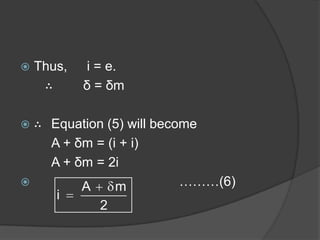
 Thus, i = e.
∴ δ = δm
 ∴ Equation (5) will become
A + δm = (i + i)
A + δm = 2i
 ………(6)A m
i
2
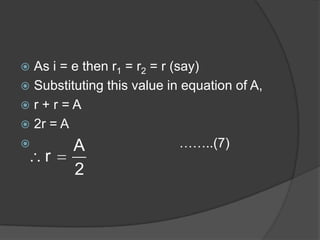
 As i = e then r1 = r2 = r (say)
 Substituting this value in equation of A,
 r + r = A
 2r = A
 ……..(7)A
r
2
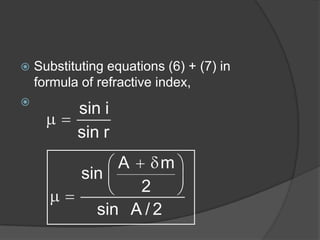
 Substituting equations (6) + (7) in
formula of refractive index,

sin i
sin r
A m
sin
2
sin A / 2
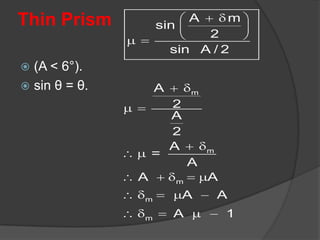
Thin Prism
 (A < 6°).
 sin θ = θ. m
m
m
m
m
A m
sin
2
sin A / 2
A
2
A
2
A
=
A
A A
A A
A 1
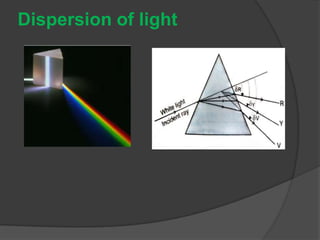
Dispersion of light
Dispersion of white light takes
place because :
 1. White light is composed of seven different
colours.
 2. Velocities and refractive indices
 3. After emerging out from the prism, different
colours travel in different directions. Hence,
they remain separated.
• Ask Your Doubts
• For inquiry and registration, call
9011041155 / 9011031155.

JEE Main - Physics - Refraction of Light

  • 1.
    ∙ Live Webinars(online lectures) with recordings ∙ Online Query Solving ∙ Online MCQ tests with detailed solutions ∙ Online Notes and Solved Exercises ∙ Career Counseling
  • 2.
  • 3.
    Reflection of light. When light rays fall on any opaque surface (like plane mirror), they are returned back on the same side of the surface. This phenomenon is called reflection of light.
  • 4.
    Laws of Reflection:- 1.The angle of incidence and angle of refraction are of equal measures. i.e. 2. Incident ray, reflected ray and the normal at the point of incidence lie in the same plane. 3. Incident ray and reflected ray are on the opposite sides of the normal at the point of incidence. m i m r
  • 5.
    Refraction of light. “thebending of a ray of light when it travels from one transparent medium to another, having different optical density is called refraction of light.”
  • 8.
    Laws of Refraction: Snell’s law 1 2 sin . sin sin sin i const r i r C C
  • 9.
  • 10.
    Relative Refractive Indexand Absolute Refractive Index 1 2 2 sin Relative Refractive Index sin sin Absolute Refractive Index sin a i r i r
  • 11.
    1 1 2 2 2 2 1 11 2 1 1 2 2 2 1 2 1 c C c C c C C c C C C But C
  • 12.
    Refractive index interms of wavelength 1 1 2 2 1 1 2 2 1 1 2 2 C C But C f f f
  • 13.
  • 14.
    Practical examples ofrefraction of light
  • 16.
    Numericals If the refractionindices of glass and water is 1.5 and 1.33 respectively calculate the velocity of light in glass and water.
  • 17.
    Ans: Ca =3 × 10⁸ m/s ng = 1.5 , cg = ? , cw = ? w 4 n 1.33 3 a g g 8 a g g 8 g c n c c 3 10 c n 1.5 c 2 10 m / s
  • 18.
    a w w 8 8 a w w c n c c 310 3 3 10 c 4n 4 3 8 wc 2.25 10 m / s
  • 19.
  • 20.
    Necessary conditions for totalinternal reflection 1. The ray of light must travel from optically denser medium to optically rarer medium. 2. The angle of incidence in the denser medium must be greater than the critical angle for that pair.
  • 21.
    Thus, refractive indexof rarer medium (air) with respect to the denser medium (water) is: sin sin90 sin90 1 sin 1 1 sin d r d r r d d r c But c c
  • 22.
  • 25.
  • 26.
  • 31.
  • 32.
    For Home works 1.If the refractive indices of diamond and glass are 2.4 and 1.5 respectively. Compare the velocity of light in diamond and glass. 2. The R.I of water relative to air is 4/3. A ray of light passing through water into air is incident at interface at an angle of 35° with the normal. What angle does the refracted ray make with the normal?
  • 33.
  • 36.
     ∠δ =∠EQR + ∠ERQ .(exterior angles property) = (i – r1) + (e – r2) ∠δ = (i + e) – (r1 + r2) ………(1)  From ΔQDR, r1 + r2 + D = 180° ………(2)  from □AQDR, □ AQDR is a cyclic quadrilateral ∵ ∠Q = ∠R = 90° ∴ ∠A + ∠D = 180° ……..(3)
  • 37.
     From (2)and (3) r1 + r2 + D = A + D ∴ r1 + r2 = A  Substituting A in equation (1), δ = (i + e) – A …….(4)  i.e. A + δ = (i + e) ……(5)
  • 39.
     Thus, i= e. ∴ δ = δm  ∴ Equation (5) will become A + δm = (i + i) A + δm = 2i  ………(6)A m i 2
  • 40.
     As i= e then r1 = r2 = r (say)  Substituting this value in equation of A,  r + r = A  2r = A  ……..(7)A r 2
  • 41.
     Substituting equations(6) + (7) in formula of refractive index,  sin i sin r A m sin 2 sin A / 2
  • 42.
    Thin Prism  (A< 6°).  sin θ = θ. m m m m m A m sin 2 sin A / 2 A 2 A 2 A = A A A A A A 1
  • 43.
  • 44.
    Dispersion of whitelight takes place because :  1. White light is composed of seven different colours.  2. Velocities and refractive indices  3. After emerging out from the prism, different colours travel in different directions. Hence, they remain separated.
  • 45.
    • Ask YourDoubts • For inquiry and registration, call 9011041155 / 9011031155.