Project Risk
Management
Project Risk Management
Coincides with PMBOK 11.0
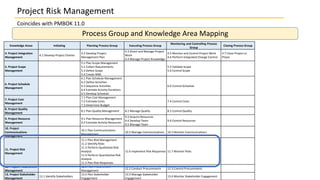
Process Group and Knowledge Area Mapping
Knowledge Areas Initiating Planning Process Group Executing Process Group
Monitoring and Controlling Process
Group
Closing Process Group
4. Project Integration
Management
4.1 Develop Project Charter
4.2 Develop Project
Management Plan
4.3 Direct and Manage Project
Work
4.4 Manage Project Knowledge
4.5 Monitor and Control Project Work
4.6 Perform Integrated Change Control
4.7 Close Project or
Phase
5. Project Scope
Management
5.1 Plan Scope Management
5.2 Collect Requirements
5.3 Define Scope
5.4 Create WBS
5.5 Validate Scope
5.6 Control Scope
6. Project Schedule
Management
6.1 Plan Schedule Management
6.2 Define Activities
6.3 Sequence Activities
6.4 Estimate Activity Durations
6.5 Develop Schedule
6.6 Control Schedule
7. Project Cost
Management
7.1 Plan Cost Management
7.2 Estimate Costs
7.3 Determine Budget
7.4 Control Costs
8. Project Quality
Management
8.1 Plan Quality Management 8.2 Manage Quality 8.3 Control Quality
9. Project Resource
Management
9.1 Plan Resource Management
9.2 Estimate Activity Resources
9.3 Acquire Resources
9.4 Develop Team
9.5 Manage Team
9.6 Control Resources
10. Project
Communications
Management
10.1 Plan Communications
Management
10.2 Manage Communications 10.3 Monitor Communications
11. Project Risk
Management
11.1 Plan Risk Management
11.2 Identify Risks
11.3 Perform Qualitative Risk
Analysis
11.4 Perform Quantitative Risk
Analysis
11.5 Plan Risk Responses
11.6 Implement Risk Responses 11.7 Monitor Risks
12. Project Procurement
Management
12.1 Plan Procurement
Management
12.2 Conduct Procurements 12.3 Control Procurements
13. Project Stakeholder
Management
13.1 Identify Stakeholders
13.2 Plan Stakeholder
Engagement
13.3 Manage Stakeholder
Engagement
13.4 Monitor Stakeholder Engagement
Project Risk Management
Coincides with PMBOK 11.0
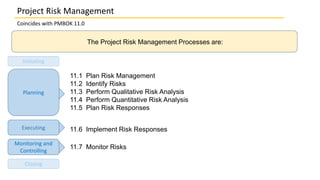
The Project Risk Management Processes are:
11.1 Plan Risk Management
11.2 Identify Risks
11.3 Perform Qualitative Risk Analysis
11.4 Perform Quantitative Risk Analysis
11.5 Plan Risk Responses
11.6 Implement Risk Responses
11.7 Monitor Risks
Planning
Monitoring and
Controlling
Executing
Initiating
Closing
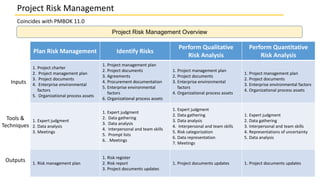
Project Risk Management Overview
Project Risk Management
Coincides with PMBOK 11.0
Plan Risk Management Identify Risks
Perform Qualitative
Risk Analysis
Perform Quantitative
Risk Analysis
1. Project charter
2. Project management plan
3. Project documents
4. Enterprise environmental
factors
5. Organizational process assets
1. Project management plan
2. Project documents
3. Agreements
4. Procurement documentation
5. Enterprise environmental
factors
6. Organizational process assets
1. Project management plan
2. Project documents
3. Enterprise environmental
factors
4. Organizational process assets
1. Project management plan
2. Project documents
3. Enterprise environmental factors
4. Organizational process assets
1. Expert judgment
2. Data analysis
3. Meetings
1. Expert judgment
2. Data gathering
3. Data analysis
4. Interpersonal and team skills
5. Prompt lists
6. . Meetings
1. Expert judgment
2. Data gathering
3. Data analysis
4. Interpersonal and team skills
5. Risk categorization
6. Data representation
7. Meetings
1. Expert judgment
2. Data gathering
3. Interpersonal and team skills
4. Representations of uncertainty
5. Data analysis
1. Risk management plan
1. Risk register
2. Risk report
3. Project documents updates
1. Project documents updates 1. Project documents updates
Inputs
Tools &
Techniques
Outputs
Project Risk Management Overview
Project Risk Management
Coincides with PMBOK 11.0
Plan Risk Responses Implement Risk Responses Monitor Risks
1. Project management plan
2. Project documents
3. Enterprise environmental factors
4. Organizational process assets
1. Project management plan
2. Project documents
3. Organizational process assets
1. Project management plan
2. Project documents
3. Work performance data
4. Work performance reports
1. Expert judgment
2. Data gathering
3. Interpersonal and team skills
4. Strategies for threats
5. Strategies for opportunities
6. Contingent response strategies
7. Strategies for overall project risk
8. Data analysis
9. Decision making
1. Expert judgment
2. Interpersonal and team skills
3. Project management information system
1. Data analysis
2. Audits
3. Meetings
1. Change requests
2. Project management plan updates
3. Project documents updates
1. Change requests
2. Project documents updates
1. Work performance information
2. Change requests
3. Project management plan updates
4. Project documents updates
5. Organizational process assets updates
Inputs
Tools &
Techniques
Outputs
Key Concepts
Project Risk Management
Coincides with PMBOK 11.0
All projects have risk, since they are delivering a change from one state to
another.
Risk exists at two levels within every project. Risks that affect the
achievement of project objectives, and risks upon delivery of the change.
• Individual project risk is an uncertain event or condition that, if it occurs,
has a positive or negative effect on one or more project objectives.
• Overall project risk is the effect of uncertainty on the project as a whole
- the exposure of stakeholders to the implications of variations in project
outcome, both positive and negative.
Key Concepts
Project Risk Management
Coincides with PMBOK 11.0
Risks can have a positive or negative effect if they occur. Project Risk Management aims
to exploit or enhance positive risks (opportunities) while avoiding or mitigating negative
risks (threats).
• Unmanaged threats may result in issues or problems such as delay, cost overruns,
performance shortfall, or loss of reputation.
• Opportunities that are captured can lead to benefits such as reduced time and cost,
improved performance, or reputation.
Trends and Emerging Practices
Project Risk Management
Coincides with PMBOK 11.0
The focus of project risk management is broadening to ensure that risks are understood
in a wider context.
Trends and emerging practices for Project Risk Management include but are not limited
to:
1. Non-event risks
• Variability risk
• Ambiguity risk
2. Project resilience (against unknowable unknowns)
3. Integrated risk management
Project Risk Management
Coincides with PMBOK 11.0
Because each project is unique, it is necessary to tailor the way Project Risk
Management processes are applied.
Considerations for tailoring include but are not limited to:
1. Project size
2. Project complexity
3. Project importance
4. Development approach
Tailoring Considerations
Considerations for Agile or Adaptive Environments
Project Risk Management
Coincides with PMBOK 11.0
High-variability environments, by definition, incur more uncertainty and risk.
To address this, projects can use various Agile approaches to managing Risk.
Demonstrations and Reviews: Customer and Risk reviews of incremental
work products help ensure the project is on track and that risk is
understood.
Backlog of work and the Product Owner role: The requirements are kept as
a living document that is updated regularly, and work may be reprioritized as
the project progresses, based on an improved understanding of current risk
exposure.
Risk is considered when selecting the content of each iteration, and risks will
also be identified, analysed, and managed during each iteration.

11.0 Project Risk Management Overview

  • 1.
  • 2.
    Project Risk Management Coincideswith PMBOK 11.0 Process Group and Knowledge Area Mapping Knowledge Areas Initiating Planning Process Group Executing Process Group Monitoring and Controlling Process Group Closing Process Group 4. Project Integration Management 4.1 Develop Project Charter 4.2 Develop Project Management Plan 4.3 Direct and Manage Project Work 4.4 Manage Project Knowledge 4.5 Monitor and Control Project Work 4.6 Perform Integrated Change Control 4.7 Close Project or Phase 5. Project Scope Management 5.1 Plan Scope Management 5.2 Collect Requirements 5.3 Define Scope 5.4 Create WBS 5.5 Validate Scope 5.6 Control Scope 6. Project Schedule Management 6.1 Plan Schedule Management 6.2 Define Activities 6.3 Sequence Activities 6.4 Estimate Activity Durations 6.5 Develop Schedule 6.6 Control Schedule 7. Project Cost Management 7.1 Plan Cost Management 7.2 Estimate Costs 7.3 Determine Budget 7.4 Control Costs 8. Project Quality Management 8.1 Plan Quality Management 8.2 Manage Quality 8.3 Control Quality 9. Project Resource Management 9.1 Plan Resource Management 9.2 Estimate Activity Resources 9.3 Acquire Resources 9.4 Develop Team 9.5 Manage Team 9.6 Control Resources 10. Project Communications Management 10.1 Plan Communications Management 10.2 Manage Communications 10.3 Monitor Communications 11. Project Risk Management 11.1 Plan Risk Management 11.2 Identify Risks 11.3 Perform Qualitative Risk Analysis 11.4 Perform Quantitative Risk Analysis 11.5 Plan Risk Responses 11.6 Implement Risk Responses 11.7 Monitor Risks 12. Project Procurement Management 12.1 Plan Procurement Management 12.2 Conduct Procurements 12.3 Control Procurements 13. Project Stakeholder Management 13.1 Identify Stakeholders 13.2 Plan Stakeholder Engagement 13.3 Manage Stakeholder Engagement 13.4 Monitor Stakeholder Engagement
  • 3.
    Project Risk Management Coincideswith PMBOK 11.0 The Project Risk Management Processes are: 11.1 Plan Risk Management 11.2 Identify Risks 11.3 Perform Qualitative Risk Analysis 11.4 Perform Quantitative Risk Analysis 11.5 Plan Risk Responses 11.6 Implement Risk Responses 11.7 Monitor Risks Planning Monitoring and Controlling Executing Initiating Closing
  • 4.
    Project Risk ManagementOverview Project Risk Management Coincides with PMBOK 11.0 Plan Risk Management Identify Risks Perform Qualitative Risk Analysis Perform Quantitative Risk Analysis 1. Project charter 2. Project management plan 3. Project documents 4. Enterprise environmental factors 5. Organizational process assets 1. Project management plan 2. Project documents 3. Agreements 4. Procurement documentation 5. Enterprise environmental factors 6. Organizational process assets 1. Project management plan 2. Project documents 3. Enterprise environmental factors 4. Organizational process assets 1. Project management plan 2. Project documents 3. Enterprise environmental factors 4. Organizational process assets 1. Expert judgment 2. Data analysis 3. Meetings 1. Expert judgment 2. Data gathering 3. Data analysis 4. Interpersonal and team skills 5. Prompt lists 6. . Meetings 1. Expert judgment 2. Data gathering 3. Data analysis 4. Interpersonal and team skills 5. Risk categorization 6. Data representation 7. Meetings 1. Expert judgment 2. Data gathering 3. Interpersonal and team skills 4. Representations of uncertainty 5. Data analysis 1. Risk management plan 1. Risk register 2. Risk report 3. Project documents updates 1. Project documents updates 1. Project documents updates Inputs Tools & Techniques Outputs
  • 5.
    Project Risk ManagementOverview Project Risk Management Coincides with PMBOK 11.0 Plan Risk Responses Implement Risk Responses Monitor Risks 1. Project management plan 2. Project documents 3. Enterprise environmental factors 4. Organizational process assets 1. Project management plan 2. Project documents 3. Organizational process assets 1. Project management plan 2. Project documents 3. Work performance data 4. Work performance reports 1. Expert judgment 2. Data gathering 3. Interpersonal and team skills 4. Strategies for threats 5. Strategies for opportunities 6. Contingent response strategies 7. Strategies for overall project risk 8. Data analysis 9. Decision making 1. Expert judgment 2. Interpersonal and team skills 3. Project management information system 1. Data analysis 2. Audits 3. Meetings 1. Change requests 2. Project management plan updates 3. Project documents updates 1. Change requests 2. Project documents updates 1. Work performance information 2. Change requests 3. Project management plan updates 4. Project documents updates 5. Organizational process assets updates Inputs Tools & Techniques Outputs
  • 6.
    Key Concepts Project RiskManagement Coincides with PMBOK 11.0 All projects have risk, since they are delivering a change from one state to another. Risk exists at two levels within every project. Risks that affect the achievement of project objectives, and risks upon delivery of the change. • Individual project risk is an uncertain event or condition that, if it occurs, has a positive or negative effect on one or more project objectives. • Overall project risk is the effect of uncertainty on the project as a whole - the exposure of stakeholders to the implications of variations in project outcome, both positive and negative.
  • 7.
    Key Concepts Project RiskManagement Coincides with PMBOK 11.0 Risks can have a positive or negative effect if they occur. Project Risk Management aims to exploit or enhance positive risks (opportunities) while avoiding or mitigating negative risks (threats). • Unmanaged threats may result in issues or problems such as delay, cost overruns, performance shortfall, or loss of reputation. • Opportunities that are captured can lead to benefits such as reduced time and cost, improved performance, or reputation.
  • 8.
    Trends and EmergingPractices Project Risk Management Coincides with PMBOK 11.0 The focus of project risk management is broadening to ensure that risks are understood in a wider context. Trends and emerging practices for Project Risk Management include but are not limited to: 1. Non-event risks • Variability risk • Ambiguity risk 2. Project resilience (against unknowable unknowns) 3. Integrated risk management
  • 9.
    Project Risk Management Coincideswith PMBOK 11.0 Because each project is unique, it is necessary to tailor the way Project Risk Management processes are applied. Considerations for tailoring include but are not limited to: 1. Project size 2. Project complexity 3. Project importance 4. Development approach Tailoring Considerations
  • 10.
    Considerations for Agileor Adaptive Environments Project Risk Management Coincides with PMBOK 11.0 High-variability environments, by definition, incur more uncertainty and risk. To address this, projects can use various Agile approaches to managing Risk. Demonstrations and Reviews: Customer and Risk reviews of incremental work products help ensure the project is on track and that risk is understood. Backlog of work and the Product Owner role: The requirements are kept as a living document that is updated regularly, and work may be reprioritized as the project progresses, based on an improved understanding of current risk exposure. Risk is considered when selecting the content of each iteration, and risks will also be identified, analysed, and managed during each iteration.

Editor's Notes

  • #4 The process of defining how to conduct risk management activities for a project. The process of identifying individual project risks as well as sources of overall project risk, and documenting their characteristics. The process of prioritizing individual project risks for further analysis or action by assessing their probability of occurrence and impact as well as other characteristics. The process of numerically analysing the combined effect of identified individual project risks and other sources of uncertainty on overall project objectives. The process of developing options, selecting strategies, and agreeing on actions to address overall project risk exposure, as well as to treat individual project risks. The process of implementing agreed-upon risk response plans. The process of monitoring the implementation of agreed-upon risk response plans, tracking identified risks, identifying and analysing new risks, and evaluating risk process effectiveness throughout the project.
  • #9  Variability: productivity may be above or below target, the number of errors found during testing may be higher or lower than expected, or unseasonal weather conditions may occur during the construction phase. Ambiguity: elements of the requirement or technical solution, future developments in regulatory frameworks, or inherent systemic complexity in the project. Against black swan events, the unknowable unknowns. Emergent risks can be tackled through developing project resilience. Right level of budget and schedule contingency for emergent risks, in addition to a specific risk budget for known risks; Flexible project processes that can cope with emergent risk, strong change management; Empowered project team that has clear objectives Frequent review of early warning signs to identify Clear input from stakeholders to clarify areas where the project scope or strategy can be adjusted in response to emergent risks. Between Projects, Programs and Portfolios.
  • #10 Does the project’s size in terms of budget, duration, scope, or team size require a more detailed approach to risk management? Or is it small enough to justify a simplified risk process? Is a robust risk approach demanded by high levels of innovation, new technology, commercial arrangements, interfaces, or external dependencies that increase project complexity? Or is the project simple enough that a reduced risk process will suffice? How strategically important is the project? Is the level of risk increased for this project because it aims to produce breakthrough opportunities, addresses significant blocks to organizational performance, or involves major product innovation? Is this a waterfall project, where risk processes can be followed sequentially and iteratively, or does the project follow an agile approach where risk is addressed at the start of each iteration as well as during its execution?