Banana
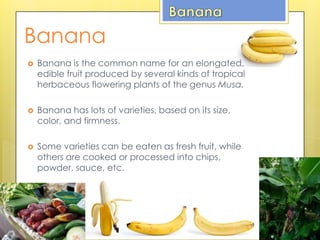
 Banana is the common name for an elongated,
edible fruit produced by several kinds of tropical
herbaceous flowering plants of the genus Musa.
 Banana has lots of varieties, based on its size,
color, and firmness.
 Some varieties can be eaten as fresh fruit, while
others are cooked or processed into chips,
powder, sauce, etc.
Banana in the Philippines
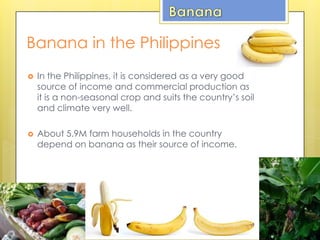
 In the Philippines, it is considered as a very good
source of income and commercial production as
it is a non-seasonal crop and suits the country’s soil
and climate very well.
 About 5.9M farm households in the country
depend on banana as their source of income.
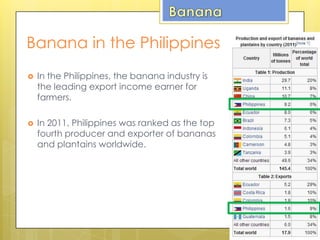
 In the Philippines, the banana industry is
the leading export income earner for
farmers.
 In 2011, Philippines was ranked as the top
fourth producer and exporter of bananas
and plantains worldwide.
Banana in the Philippines
Philippine Banana Industry
 Banana is the leading fruit grown in the
Philippines and is a consistent top dollar
earner.
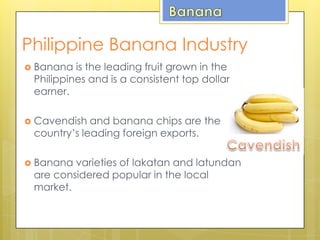
 Cavendish and banana chips are the
country’s leading foreign exports.
 Banana varieties of lakatan and latundan
are considered popular in the local
market.
Philippine Banana Industry
 There are about 200 variety and strain
maintained by the BPI Genebank. Among
these are banana varieties that are
indigenous to the Philippines such as:
 Lakatan
 Latundan
 Saba/Cardaba
 Paa
 Bungulan
 Amas/Señorita
 Morado
Philippine Banana Industry
 Cavendish is grown in plantation scale in Mindanao.
 Lakatan and latundan are grown commercially alos
intended for the Luzon and Visayas markets
 Cardaba is known mainly for the banana chips
industry
 Balangon oor bongolan is grown organically in Tupi,
South Cotabato
 Organic Cavendish is being grown by the
multinational corporations
Philippine Banana Industry
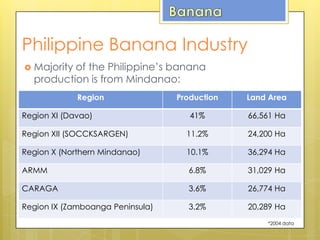
 Majority of the Philippine’s banana
production is from Mindanao:
Region Production Land Area
Region XI (Davao) 41% 66,561 Ha
Region XII (SOCCKSARGEN) 11.2% 24,200 Ha
Region X (Northern Mindanao) 10.1% 36,294 Ha
ARMM 6.8% 31,029 Ha
CARAGA 3.6% 26,774 Ha
Region IX (Zamboanga Peninsula) 3.2% 20,289 Ha
*2004 data
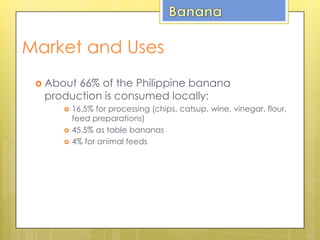
 About 66% of the Philippine banana
production is consumed locally:
 16.5% for processing (chips, catsup, wine, vinegar, flour,
feed preparations)
 45.5% as table bananas
 4% for animal feeds
Market and Uses
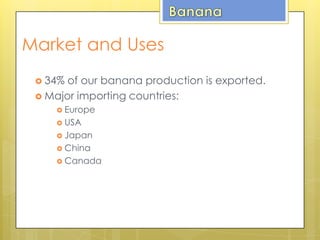
 34% of our banana production is exported.
 Major importing countries:
 Europe
 USA
 Japan
 China
 Canada
Market and Uses
Market and Uses
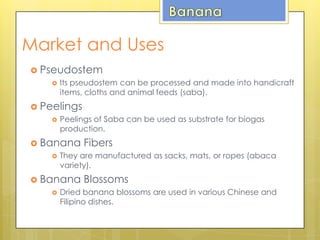
 Pseudostem
 Its pseudostem can be processed and made into handicraft
items, cloths and animal feeds (saba).
 Peelings
 Peelings of Saba can be used as substrate for biogas
production.
 Banana Fibers
 They are manufactured as sacks, mats, or ropes (abaca
variety).
 Banana Blossoms
 Dried banana blossoms are used in various Chinese and
Filipino dishes.
Market and Uses
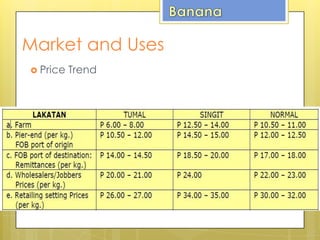
 Price Trend
Market and Uses
 Demand and Supply Projection
 Cavendish banana export demand is expected to grow
at 3-6%/year.
 Banana chips market can absorb around 10%/year
growth
 Lakatan and Latundan is expected to grow at around
3%/year
 The bulk of supply in the country, around 80% will be
coming from Mindanao.
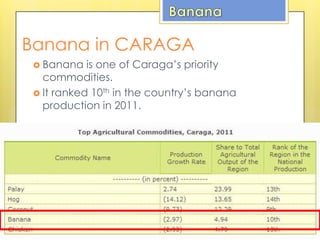
 Banana is one of Caraga’s priority
commodities.
 It ranked 10th in the country’s banana
production in 2011.
Banana in CARAGA

Banana Industry

  • 2.
    Banana  Banana isthe common name for an elongated, edible fruit produced by several kinds of tropical herbaceous flowering plants of the genus Musa.  Banana has lots of varieties, based on its size, color, and firmness.  Some varieties can be eaten as fresh fruit, while others are cooked or processed into chips, powder, sauce, etc.
  • 3.
    Banana in thePhilippines  In the Philippines, it is considered as a very good source of income and commercial production as it is a non-seasonal crop and suits the country’s soil and climate very well.  About 5.9M farm households in the country depend on banana as their source of income.
  • 4.
     In thePhilippines, the banana industry is the leading export income earner for farmers.  In 2011, Philippines was ranked as the top fourth producer and exporter of bananas and plantains worldwide. Banana in the Philippines
  • 5.
    Philippine Banana Industry Banana is the leading fruit grown in the Philippines and is a consistent top dollar earner.  Cavendish and banana chips are the country’s leading foreign exports.  Banana varieties of lakatan and latundan are considered popular in the local market.
  • 6.
    Philippine Banana Industry There are about 200 variety and strain maintained by the BPI Genebank. Among these are banana varieties that are indigenous to the Philippines such as:  Lakatan  Latundan  Saba/Cardaba  Paa  Bungulan  Amas/Señorita  Morado
  • 7.
    Philippine Banana Industry Cavendish is grown in plantation scale in Mindanao.  Lakatan and latundan are grown commercially alos intended for the Luzon and Visayas markets  Cardaba is known mainly for the banana chips industry  Balangon oor bongolan is grown organically in Tupi, South Cotabato  Organic Cavendish is being grown by the multinational corporations
  • 8.
    Philippine Banana Industry Majority of the Philippine’s banana production is from Mindanao: Region Production Land Area Region XI (Davao) 41% 66,561 Ha Region XII (SOCCKSARGEN) 11.2% 24,200 Ha Region X (Northern Mindanao) 10.1% 36,294 Ha ARMM 6.8% 31,029 Ha CARAGA 3.6% 26,774 Ha Region IX (Zamboanga Peninsula) 3.2% 20,289 Ha *2004 data
  • 9.
     About 66%of the Philippine banana production is consumed locally:  16.5% for processing (chips, catsup, wine, vinegar, flour, feed preparations)  45.5% as table bananas  4% for animal feeds Market and Uses
  • 10.
     34% ofour banana production is exported.  Major importing countries:  Europe  USA  Japan  China  Canada Market and Uses
  • 11.
    Market and Uses Pseudostem  Its pseudostem can be processed and made into handicraft items, cloths and animal feeds (saba).  Peelings  Peelings of Saba can be used as substrate for biogas production.  Banana Fibers  They are manufactured as sacks, mats, or ropes (abaca variety).  Banana Blossoms  Dried banana blossoms are used in various Chinese and Filipino dishes.
  • 12.
  • 13.
    Market and Uses Demand and Supply Projection  Cavendish banana export demand is expected to grow at 3-6%/year.  Banana chips market can absorb around 10%/year growth  Lakatan and Latundan is expected to grow at around 3%/year  The bulk of supply in the country, around 80% will be coming from Mindanao.
  • 14.
     Banana isone of Caraga’s priority commodities.  It ranked 10th in the country’s banana production in 2011. Banana in CARAGA