Presented by
Dr. Puvvalla Bhavana
MDS Sr. Lecturer
INTRODUCTION
Periodontitis is an infectious disease of
gingival tissue, and changes that occur in the
bone are crucial because it is the destruction
of bone that is responsible for tooth loss
The height of the alveolar bone maintained by
Local and Systemic influences
between
Bone formation and Bone resorption
BONE DESTRUCTION IN PERIODONTAL DISEASE
LOCAL FACTORS
TWO GROUPS
Gingival inflammation Trauma from occlusion
horizontal type vertical type
“PERIODONTITIS IS ALWAYS PRECEEDED BY GINGIVITIS
but not all
GINGIVITIS PROGRESS TO PERIODONTITIS”
STAGE I GINGIVITIS : fibroblasts &
lymphocytes predominate
ADVANCED STAGES : plasma cells &
blast cells increases
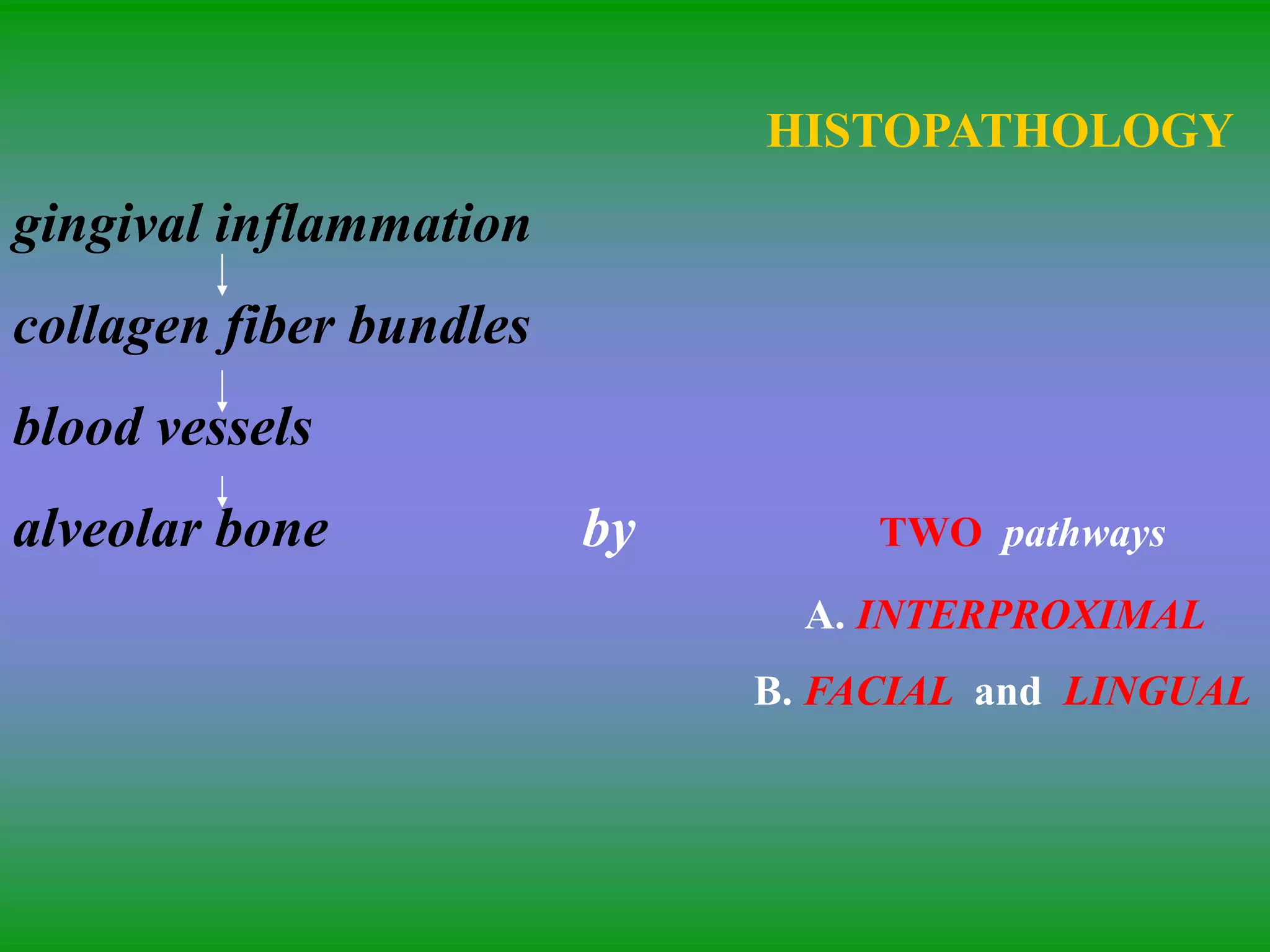
HISTOPATHOLOGY
gingival inflammation
collagen fiber bundles
blood vessels
alveolar bone by TWO pathways
A. INTERPROXIMAL
B. FACIAL and LINGUAL
INTERPROXIMALLY
Inflammation spreads in the loose CT around
the blood vessels, through the transeptal fibers and
then into the bone through vessel channels that
perforate the crest of the interdental septum
After reaching the marrow spaces, the
inflammation may return from the bone into PDL
FACIALLY AND LINGUALLY
Inflammation from the gingiva penetrates into the
marrow spaces along its course from the gingiva to the
bone destroying the gingival and transeptal fibres
It replaces the marrow with leukucytes,
fluid exudate, new blood vessels, and fibroblasts.
Multinuclear osteoclasts & mononuclear phagocytes
are increased
In the marrow spaces, resorption proceeds
from within, causing thinning of the surrounding
bony trabaculae and enlargement of marrow spaces
followed by destruction of bone
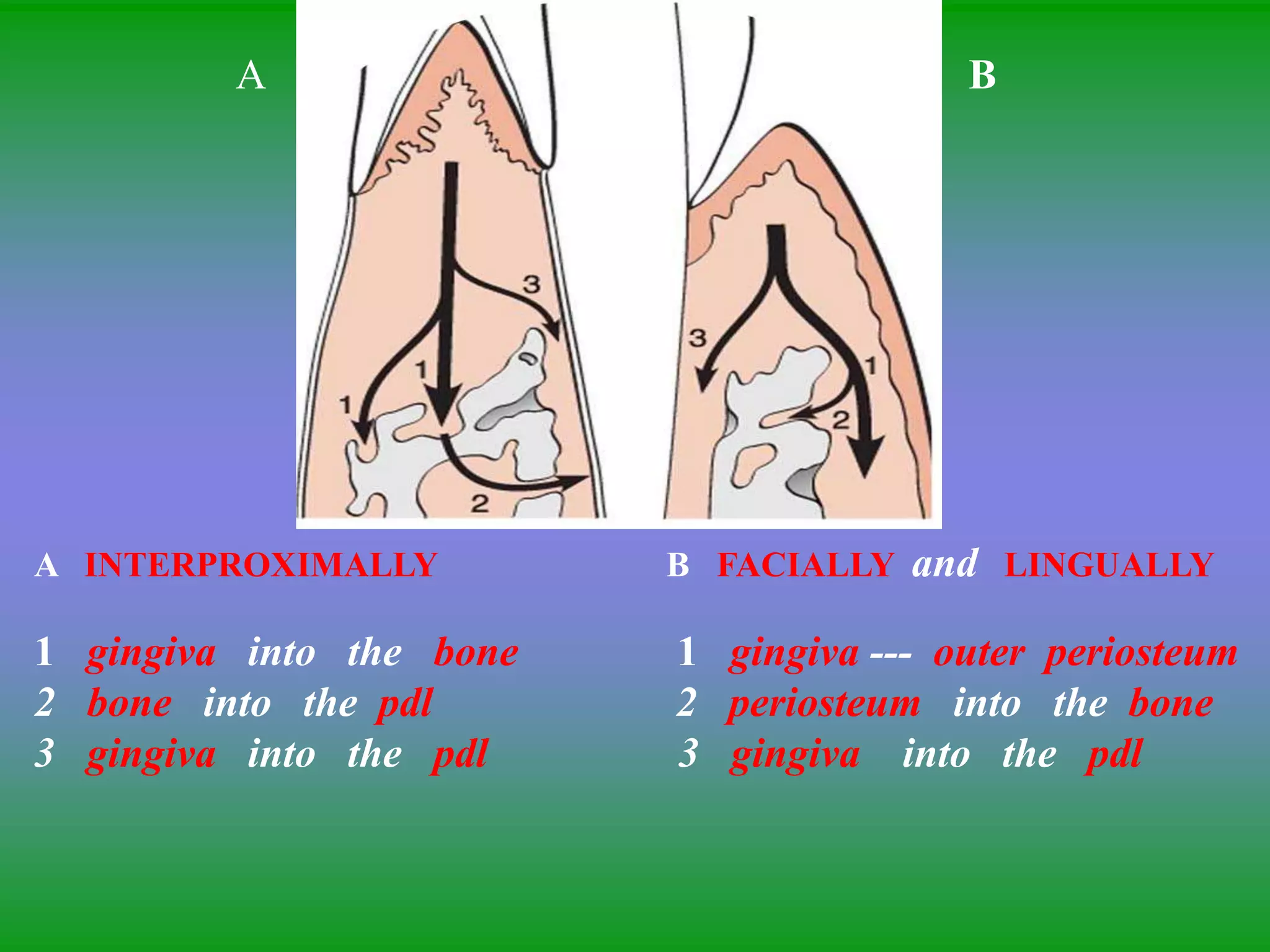
A INTERPROXIMALLY B FACIALLY and LINGUALLY
1 gingiva into the bone 1 gingiva --- outer periosteum
2 bone into the pdl 2 periosteum into the bone
3 gingiva into the pdl 3 gingiva into the pdl
A B
MECHANISM OF BONE DESTRUCTION
PATHWAYS BY WHICH PLAQUE PRODUCTS CAUSE AL.BONE LOSS
1. Direct action of plaque products on bone progenitor cells
induces the differentiation of cells into osteoclasts
2. Plaque products act directly on bone, destroying it through a
noncellular mechanism
3. Plaque products stimulate gingival cells, causing them to
release mediators, which in turn induce bone progenitor cells
to differentiate into osteoclasts
4. Plaque products cause gingival cells to release agents that
can act as cofactors in bone resorption
5. Plaque products cause gingival cells to release agents that
destroy bone by direct chemical action
PHARMACOLOGICAL AGENTS
AND
BONE RESORPTION
PROSTAGLANDINS
OSEOCLAST-ACTIVATING FACTOR
PROTEOLYTIC ENZYMES
PROSTAGLANDINS
Naturally occurring lipids that participate in the
inflammatory process and have harmone-like
effects. When injected over a bone surface, they
induce bone
resorption
OSTEOCLAST--ACTIVATING FACTOR
Induces osteoclast activity and formation
PROTEOLYTIC ENZYMES
COLLAGENASE
HYALURONIDASE
Produced in the periodontal tissues or by plaque bacteria
also participate in bone resorption and gingivitis
BONE FORMATION IN PERIODONTAL DISEASE
Areas of bone formation are also found
immediately adjacent to sites of active bone
resorption to reinforce the remaining bone
[buttressing bone formation]
Thus
Boneloss in periodontal disease is not simply
a destructive process but results from the
predominance of resorption over formation
BONE DESTRUCTION
CAUSED BY
TRAUMA FROM OCCLUSION
1.TRAUMA IN THE ABSENCE OF INFLAMMATION
increased compression and tension of the pdl
increased osteoclasis of alveolar bone
necrosis of the pdl and bone
resorption of bone and tooth structure
these changes result in angular type of boneloss
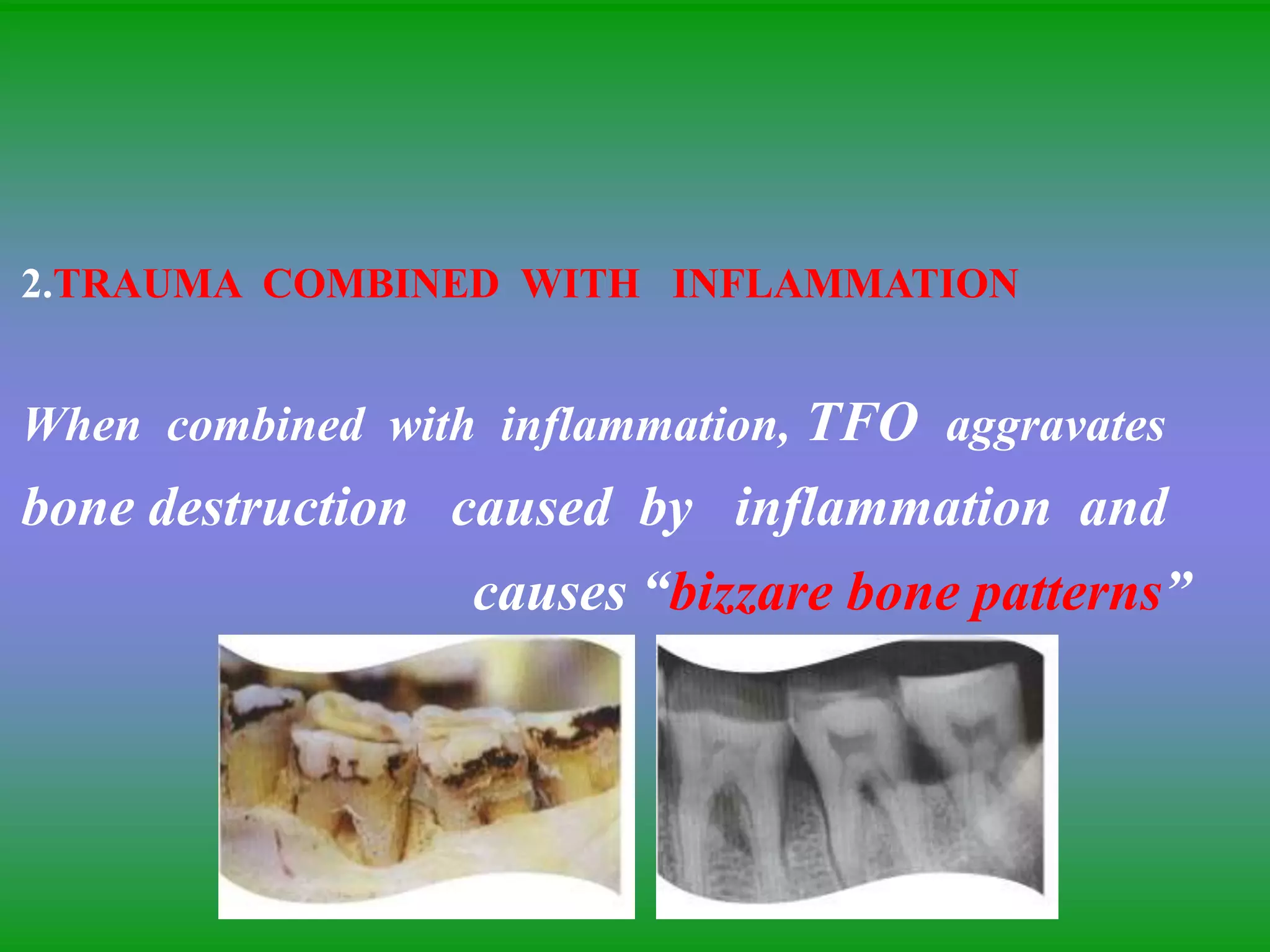
2.TRAUMA COMBINED WITH INFLAMMATION
When combined with inflammation, TFO aggravates
bone destruction caused by inflammation and
causes “bizzare bone patterns”
BONE DESTRUCTION
CAUSED BY
SYSTEMIC DISORDERS
The systemic influence on the response of
alveolar bone has been termed as
“BONE FACTOR CONCEPT ”
HYPERPARATHYOIDISM
LEUKEMIA
HAND-SCHULLER-CHRISTIAN DISEASE
FACTORS DETERMINING
BONE MORPHOLOGY
Thickness ,width, and crestal angulation of the interdental septa
Thickness of the facial and lingual alveolar plates
The presence of fenestrations and dehiscence’s
Alignment of the teeth
Root and root trunk anatomy
Root position within the alveolar process
Proximity with another tooth surface
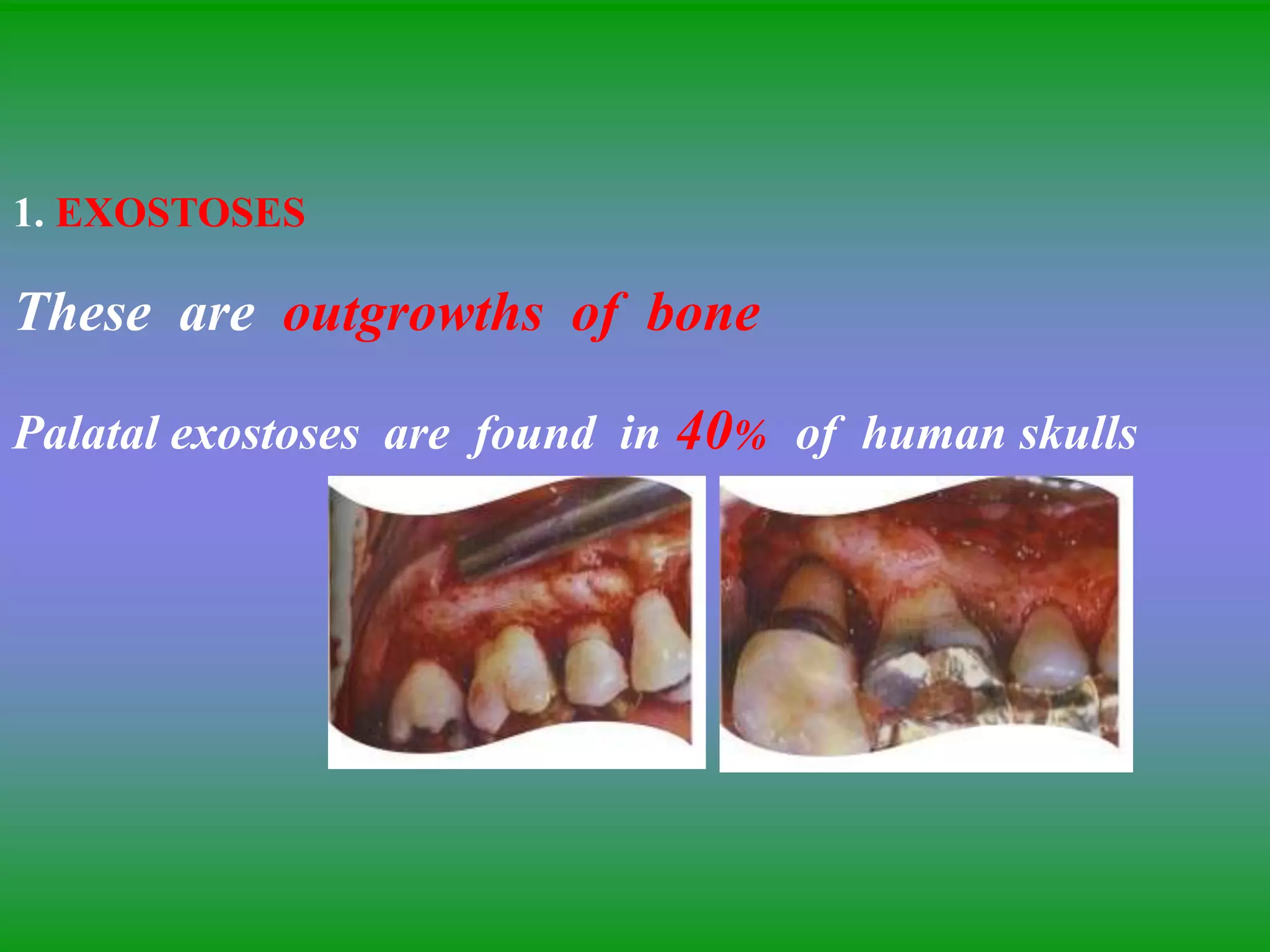
1. EXOSTOSES
These are outgrowths of bone
Palatal exostoses are found in 40% of human skulls
2. TRAUMA FROM OCCLUSION
TFO may cause thickening of cervical margin
of alveolar bone or a change in the morphology
of the bone [e.g., angular defects and buttressing bone]
3. BUTTRESSING BONE FORMATION [lipping]
Bone formation occurs in an attempt to buttress
bony trabaculae weakened by resorption
When it occurs within the jaw, it is termed as
“central buttressing bone formation”
when it occurs on the external surface, it is referred as
“peripheral buttressing bone formation”
which in turn cause bulging of the bone contour, termed
“lipping”
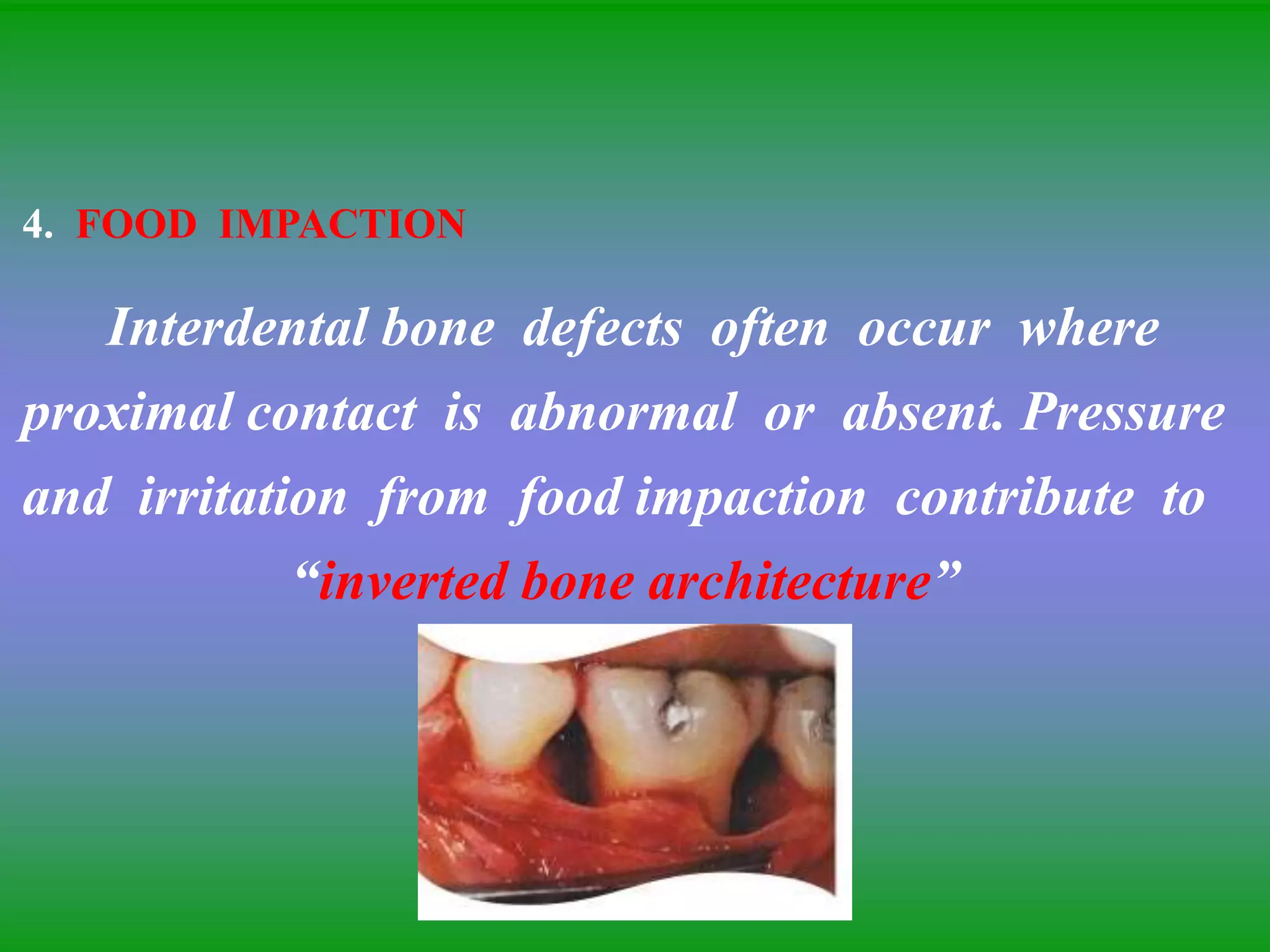
4. FOOD IMPACTION
Interdental bone defects often occur where
proximal contact is abnormal or absent. Pressure
and irritation from food impaction contribute to
“inverted bone architecture”
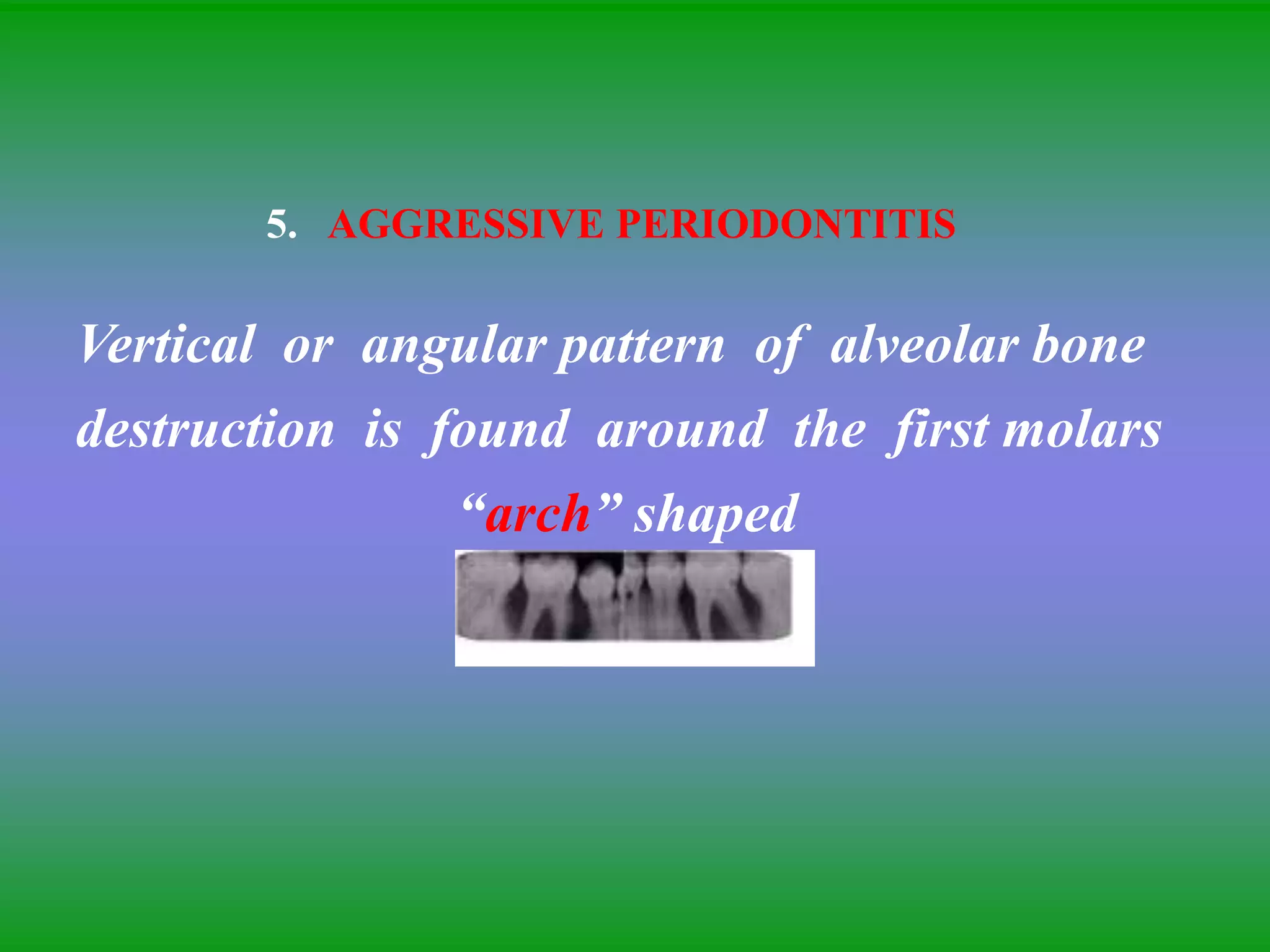
5. AGGRESSIVE PERIODONTITIS
Vertical or angular pattern of alveolar bone
destruction is found around the first molars
“arch” shaped
BONE DESTRUCTION PATTERNS
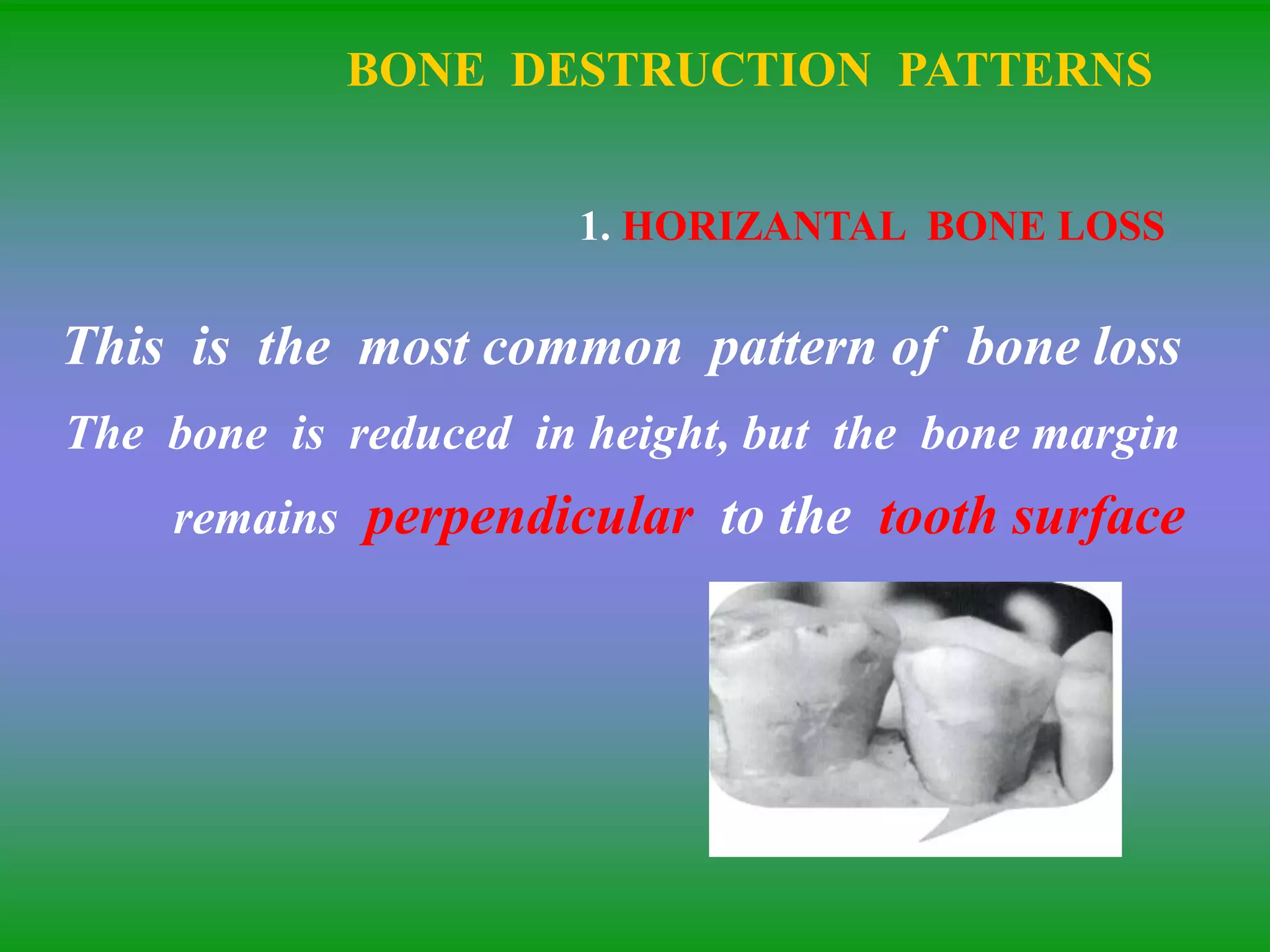
1. HORIZANTAL BONE LOSS
This is the most common pattern of bone loss
The bone is reduced in height, but the bone margin
remains perpendicular to the tooth surface
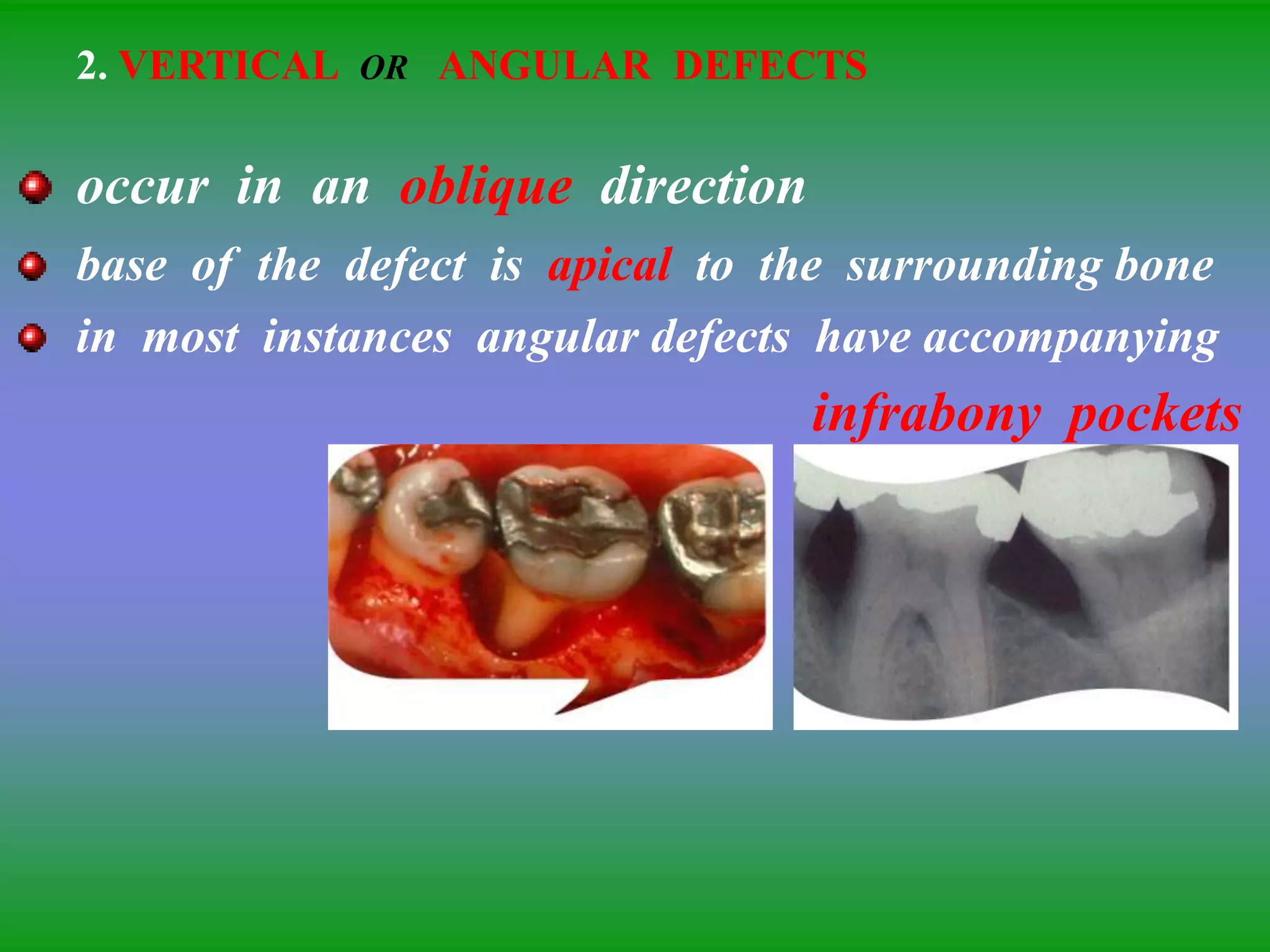
2. VERTICAL OR ANGULAR DEFECTS
occur in an oblique direction
base of the defect is apical to the surrounding bone
in most instances angular defects have accompanying
infrabony pockets
classified on the basis of number of osseous walls as
a. THREE -WALLED BONY DEFECT: INTRA BONY DEFECT
b.TWO -WALLED
c. ONE -WALLED BONY DEFECT: HEMISEPTUM
THREE BONY WALLS
distal[1] lingual[2] and facial[3]
TWO -WALL DEFECT
distal[1] lingual[2]
ONE -WALL DEFECT
distal wall only[1]
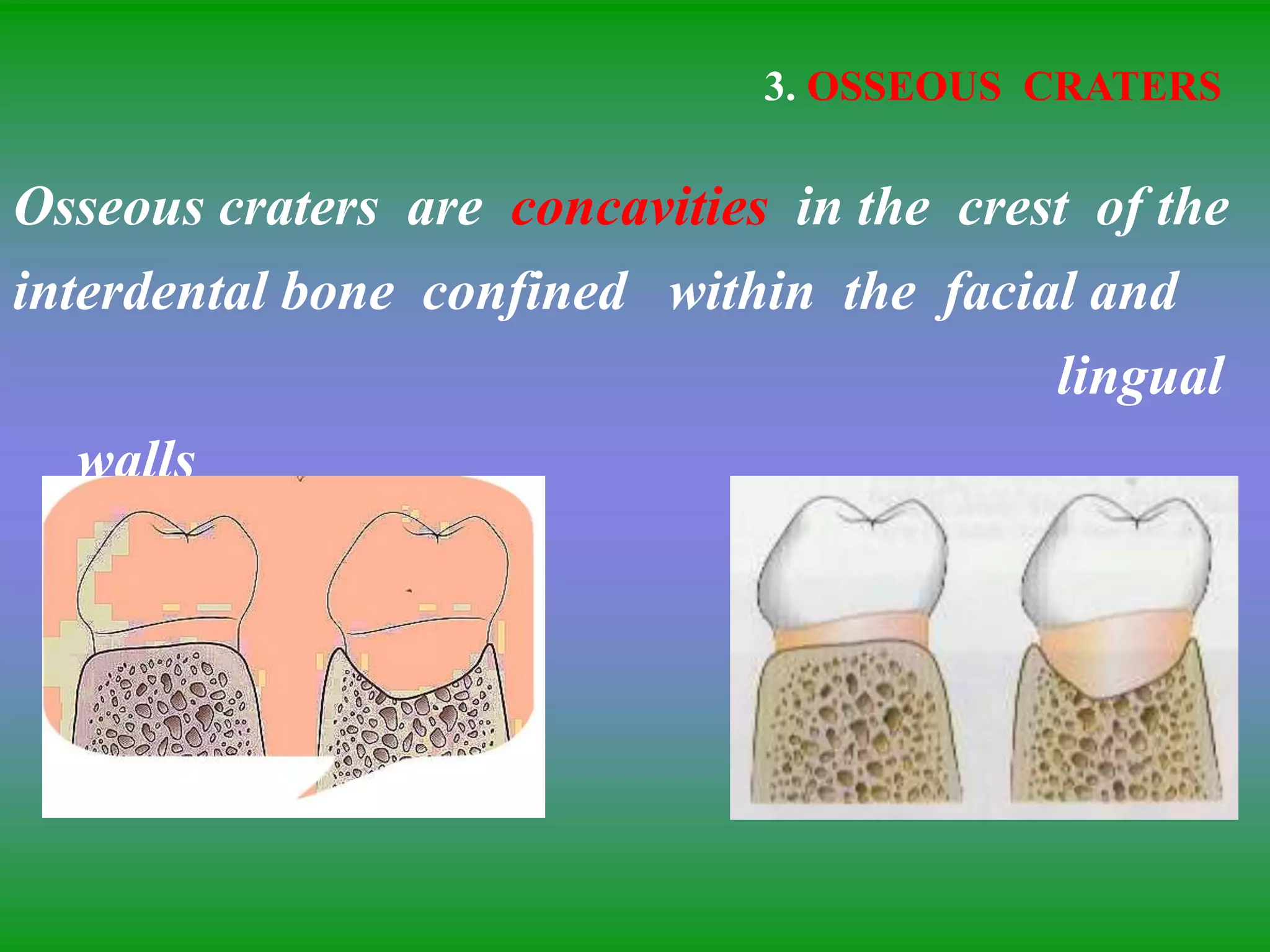
3. OSSEOUS CRATERS
Osseous craters are concavities in the crest of the
interdental bone confined within the facial and
lingual
walls
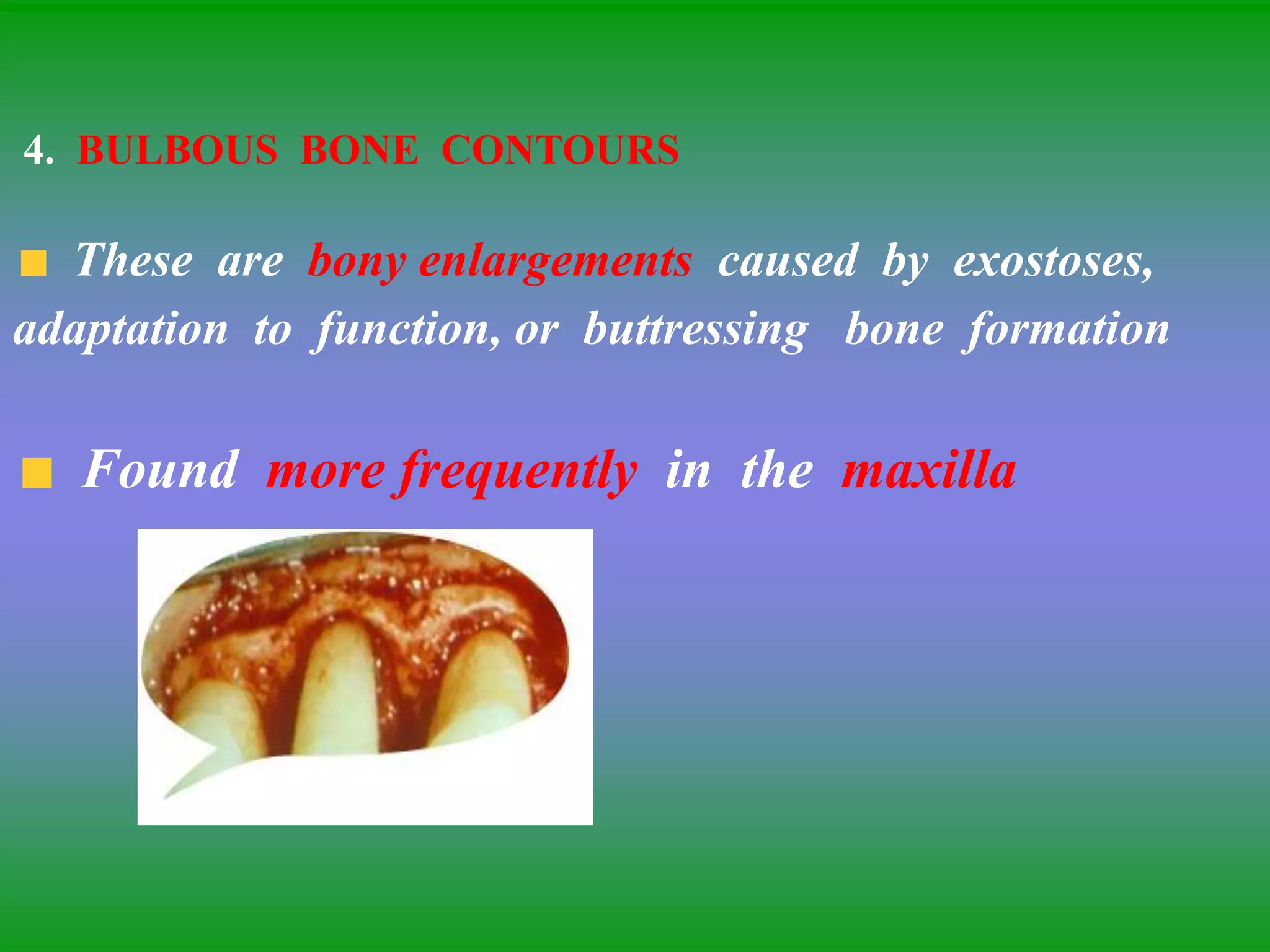
4. BULBOUS BONE CONTOURS
These are bony enlargements caused by exostoses,
adaptation to function, or buttressing bone formation
Found more frequently in the maxilla
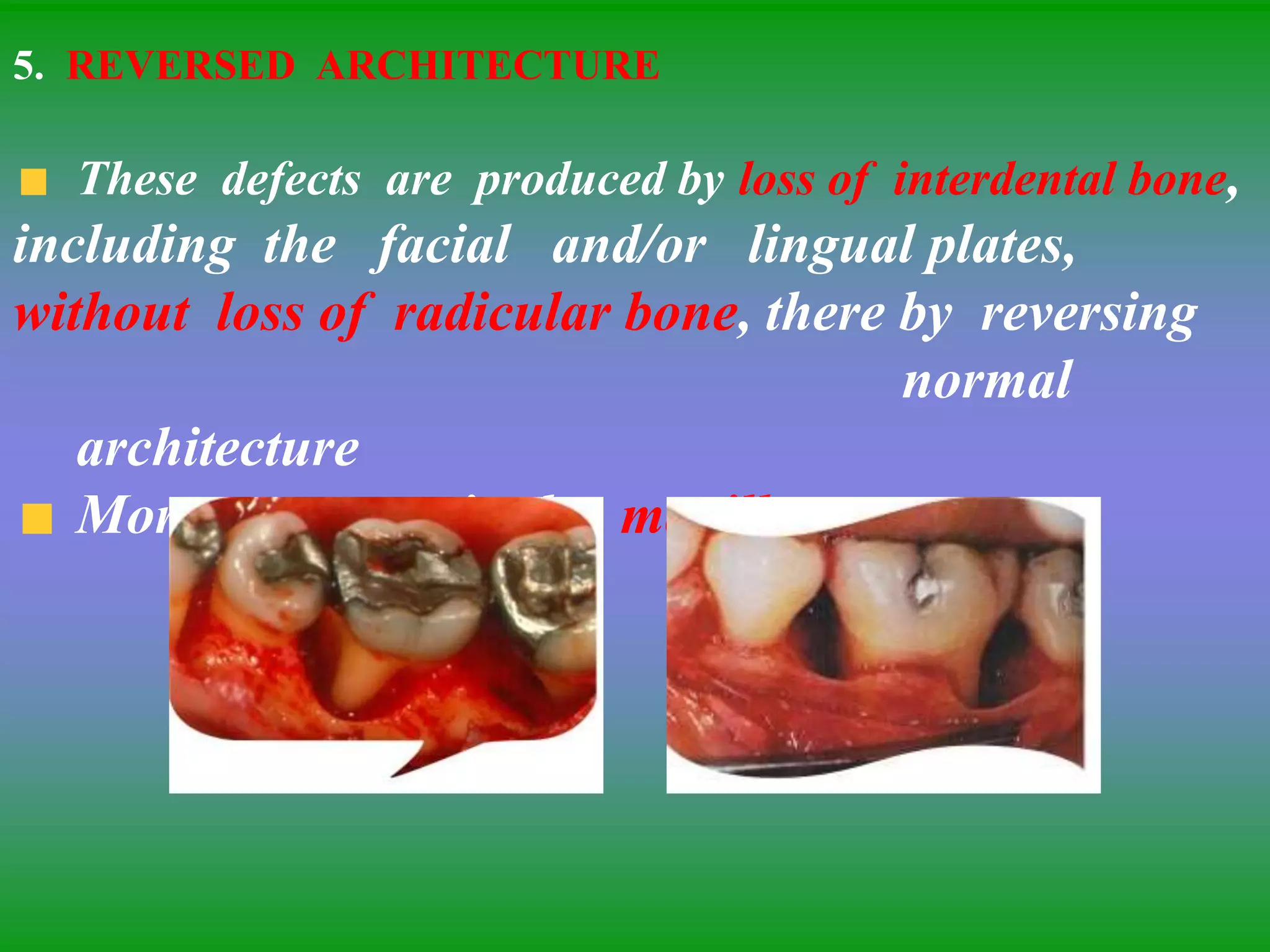
5. REVERSED ARCHITECTURE
These defects are produced by loss of interdental bone,
including the facial and/or lingual plates,
without loss of radicular bone, there by reversing
normal
architecture
More common in the maxilla
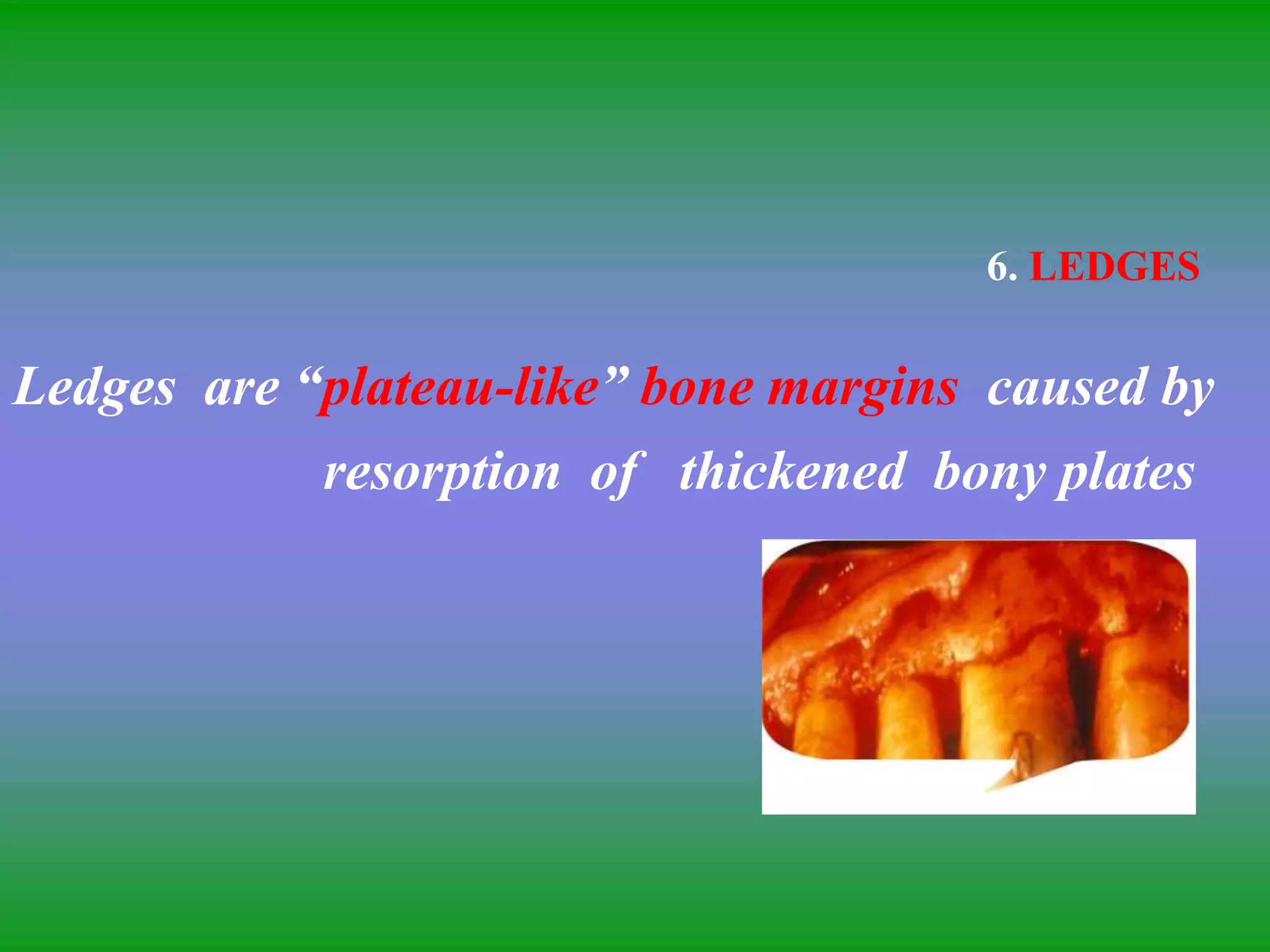
6. LEDGES
Ledges are “plateau-like” bone margins caused by
resorption of thickened bony plates

BONE LOSS AND PATTERNS OF BONE DESTRUCTION.ppt

  • 1.
    Presented by Dr. PuvvallaBhavana MDS Sr. Lecturer
  • 2.
    INTRODUCTION Periodontitis is aninfectious disease of gingival tissue, and changes that occur in the bone are crucial because it is the destruction of bone that is responsible for tooth loss
  • 3.
    The height ofthe alveolar bone maintained by Local and Systemic influences between Bone formation and Bone resorption
  • 4.
    BONE DESTRUCTION INPERIODONTAL DISEASE LOCAL FACTORS TWO GROUPS Gingival inflammation Trauma from occlusion horizontal type vertical type
  • 5.
    “PERIODONTITIS IS ALWAYSPRECEEDED BY GINGIVITIS but not all GINGIVITIS PROGRESS TO PERIODONTITIS”
  • 6.
    STAGE I GINGIVITIS: fibroblasts & lymphocytes predominate ADVANCED STAGES : plasma cells & blast cells increases
  • 7.
    HISTOPATHOLOGY gingival inflammation collagen fiberbundles blood vessels alveolar bone by TWO pathways A. INTERPROXIMAL B. FACIAL and LINGUAL
  • 8.
    INTERPROXIMALLY Inflammation spreads inthe loose CT around the blood vessels, through the transeptal fibers and then into the bone through vessel channels that perforate the crest of the interdental septum After reaching the marrow spaces, the inflammation may return from the bone into PDL
  • 9.
    FACIALLY AND LINGUALLY Inflammationfrom the gingiva penetrates into the marrow spaces along its course from the gingiva to the bone destroying the gingival and transeptal fibres
  • 10.
    It replaces themarrow with leukucytes, fluid exudate, new blood vessels, and fibroblasts. Multinuclear osteoclasts & mononuclear phagocytes are increased
  • 11.
    In the marrowspaces, resorption proceeds from within, causing thinning of the surrounding bony trabaculae and enlargement of marrow spaces followed by destruction of bone
  • 12.
    A INTERPROXIMALLY BFACIALLY and LINGUALLY 1 gingiva into the bone 1 gingiva --- outer periosteum 2 bone into the pdl 2 periosteum into the bone 3 gingiva into the pdl 3 gingiva into the pdl A B
  • 13.
    MECHANISM OF BONEDESTRUCTION PATHWAYS BY WHICH PLAQUE PRODUCTS CAUSE AL.BONE LOSS 1. Direct action of plaque products on bone progenitor cells induces the differentiation of cells into osteoclasts 2. Plaque products act directly on bone, destroying it through a noncellular mechanism
  • 14.
    3. Plaque productsstimulate gingival cells, causing them to release mediators, which in turn induce bone progenitor cells to differentiate into osteoclasts 4. Plaque products cause gingival cells to release agents that can act as cofactors in bone resorption 5. Plaque products cause gingival cells to release agents that destroy bone by direct chemical action
  • 15.
  • 16.
    PROSTAGLANDINS Naturally occurring lipidsthat participate in the inflammatory process and have harmone-like effects. When injected over a bone surface, they induce bone resorption
  • 17.
  • 18.
    PROTEOLYTIC ENZYMES COLLAGENASE HYALURONIDASE Produced inthe periodontal tissues or by plaque bacteria also participate in bone resorption and gingivitis
  • 19.
    BONE FORMATION INPERIODONTAL DISEASE Areas of bone formation are also found immediately adjacent to sites of active bone resorption to reinforce the remaining bone [buttressing bone formation]
  • 20.
    Thus Boneloss in periodontaldisease is not simply a destructive process but results from the predominance of resorption over formation
  • 21.
    BONE DESTRUCTION CAUSED BY TRAUMAFROM OCCLUSION 1.TRAUMA IN THE ABSENCE OF INFLAMMATION increased compression and tension of the pdl increased osteoclasis of alveolar bone necrosis of the pdl and bone resorption of bone and tooth structure these changes result in angular type of boneloss
  • 22.
    2.TRAUMA COMBINED WITHINFLAMMATION When combined with inflammation, TFO aggravates bone destruction caused by inflammation and causes “bizzare bone patterns”
  • 23.
    BONE DESTRUCTION CAUSED BY SYSTEMICDISORDERS The systemic influence on the response of alveolar bone has been termed as “BONE FACTOR CONCEPT ” HYPERPARATHYOIDISM LEUKEMIA HAND-SCHULLER-CHRISTIAN DISEASE
  • 24.
    FACTORS DETERMINING BONE MORPHOLOGY Thickness,width, and crestal angulation of the interdental septa Thickness of the facial and lingual alveolar plates The presence of fenestrations and dehiscence’s Alignment of the teeth Root and root trunk anatomy Root position within the alveolar process Proximity with another tooth surface
  • 25.
    1. EXOSTOSES These areoutgrowths of bone Palatal exostoses are found in 40% of human skulls
  • 26.
    2. TRAUMA FROMOCCLUSION TFO may cause thickening of cervical margin of alveolar bone or a change in the morphology of the bone [e.g., angular defects and buttressing bone]
  • 27.
    3. BUTTRESSING BONEFORMATION [lipping] Bone formation occurs in an attempt to buttress bony trabaculae weakened by resorption When it occurs within the jaw, it is termed as “central buttressing bone formation” when it occurs on the external surface, it is referred as “peripheral buttressing bone formation” which in turn cause bulging of the bone contour, termed “lipping”
  • 28.
    4. FOOD IMPACTION Interdentalbone defects often occur where proximal contact is abnormal or absent. Pressure and irritation from food impaction contribute to “inverted bone architecture”
  • 29.
    5. AGGRESSIVE PERIODONTITIS Verticalor angular pattern of alveolar bone destruction is found around the first molars “arch” shaped
  • 30.
    BONE DESTRUCTION PATTERNS 1.HORIZANTAL BONE LOSS This is the most common pattern of bone loss The bone is reduced in height, but the bone margin remains perpendicular to the tooth surface
  • 31.
    2. VERTICAL ORANGULAR DEFECTS occur in an oblique direction base of the defect is apical to the surrounding bone in most instances angular defects have accompanying infrabony pockets
  • 32.
    classified on thebasis of number of osseous walls as a. THREE -WALLED BONY DEFECT: INTRA BONY DEFECT b.TWO -WALLED c. ONE -WALLED BONY DEFECT: HEMISEPTUM
  • 33.
    THREE BONY WALLS distal[1]lingual[2] and facial[3] TWO -WALL DEFECT distal[1] lingual[2] ONE -WALL DEFECT distal wall only[1]
  • 34.
    3. OSSEOUS CRATERS Osseouscraters are concavities in the crest of the interdental bone confined within the facial and lingual walls
  • 35.
    4. BULBOUS BONECONTOURS These are bony enlargements caused by exostoses, adaptation to function, or buttressing bone formation Found more frequently in the maxilla
  • 36.
    5. REVERSED ARCHITECTURE Thesedefects are produced by loss of interdental bone, including the facial and/or lingual plates, without loss of radicular bone, there by reversing normal architecture More common in the maxilla
  • 37.
    6. LEDGES Ledges are“plateau-like” bone margins caused by resorption of thickened bony plates