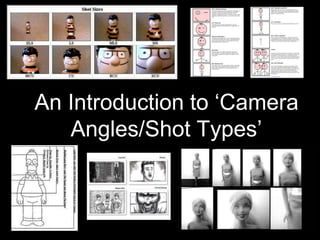
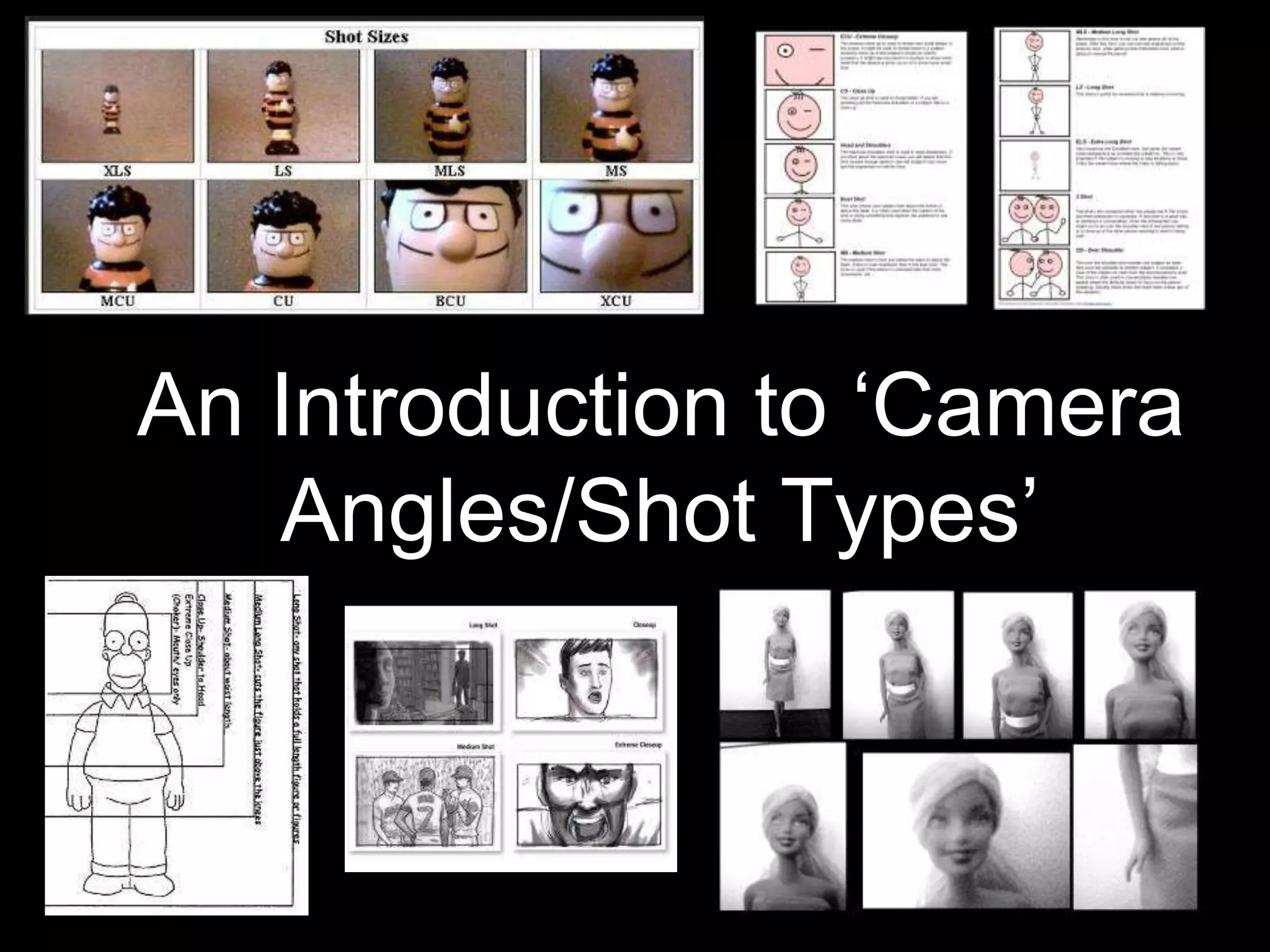
An Introduction to ‘Camera
Angles/Shot Types’
After these lessons you will…
• Be able to identify the main shot scale from
‘ELS’ to ‘ECU’ and 3 main shot angles…
• Be able to look at a shot and denote (name) the
type of shot
• Begin to use these shot types in your planning
for your own media productions
• You may be able to explain the connotations of
(symbolic reasons for selecting) a specific shot
type
In these lessons you will…
• Produce a very basic drawing, and annotate
(add notes to) this as we go
• Identify the shot type of a range of examples
• (You might briefly lie down…)
• Shoot and label the full range of shot types and
angles using your iPad
• Create a comic book story featuring each shot
type, and be able to explain why you selected
some of these
• OPTIONAL: Find and label an example of each
shot type used in a magazine ad
We will begin to apply semiotics
• ‘Semiotics’ is the framework we
use for analysing a media text
• You will be analysing your own
productions, and using media
language + semiotic terms to help
explain your ideas at the planning
stage too
• You will have plenty of opportunity
to use all these terms, and a guide
sheet, but please ask if you need
a reminder at any time on any
term
• We will keep practicing semiotic
terms throughout this lesson
• Here’s a 60 second summary of
semiotics…
• Feel free to
take a photo
with your
iPad of the
following
slides…
Semiotics in 60 Seconds
• We need to identify how details or choices
in any media text suggest a meaning
• We will use two terms: signifier and
connote
• We use two stages: description (a signifier
is a detail) and interpretation (symbolic
meanings or connotations). Example:
• I used a red rose as a signifier to connote
romance
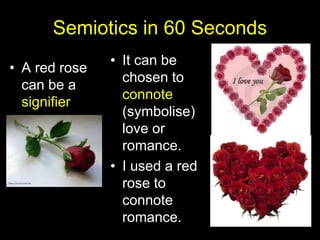
Semiotics in 60 Seconds
• A red rose
can be a
signifier
• It can be
chosen to
connote
(symbolise)
love or
romance.
• I used a red
rose to
connote
romance.
Semiotics in 60 Seconds
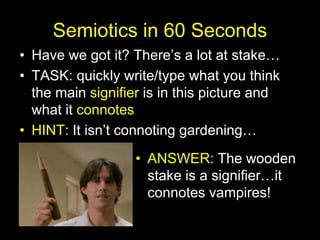
• Have we got it? There’s a lot at stake…
• TASK: quickly write/type what you think
the main signifier is in this picture and
what it connotes
• HINT: It isn’t connoting gardening…
• ANSWER: The wooden
stake is a signifier…it
connotes vampires!
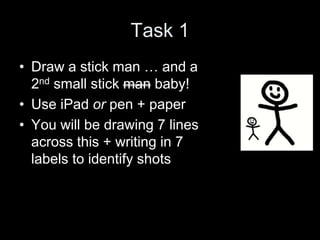
Task 1
• Draw a stick man … and a
2nd small stick man baby!
• Use iPad or pen + paper
• You will be drawing 7 lines
across this + writing in 7
labels to identify shots
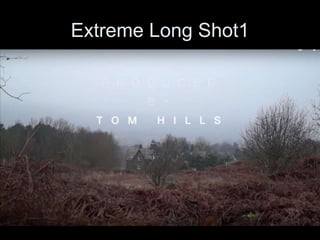
From one extreme…
• The 1st shot we’ll look is at one end of the
scale
• It is a common shot selection for starting
films; it helps set the scene (it can be
denoted/described as an establishing
shot)
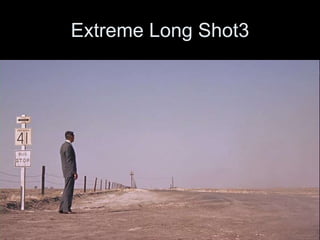
• These are not just long shots, these are
extreme long shots…
Extreme Long Shot1
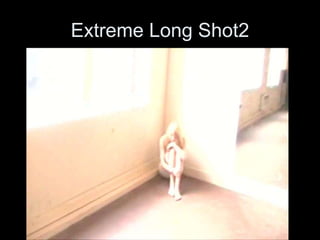
Extreme Long Shot2
Extreme Long Shot3
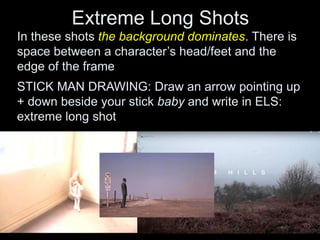
Extreme Long Shots
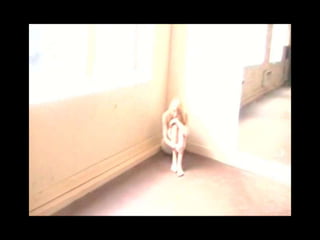
In these shots the background dominates. There is
space between a character’s head/feet and the
edge of the frame
STICK MAN DRAWING: Draw an arrow pointing up
+ down beside your stick baby and write in ELS:
extreme long shot
The other extreme…
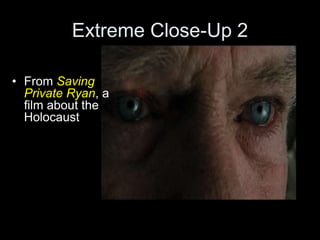
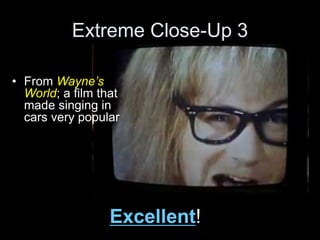
• The 2nd shot we’ll look is at the other end
of the scale
• It is often used to really emphasise
emotions
• These are not just close-ups, these are
extreme close-ups…
• A stamp if you can name the film any of
these are taken from…
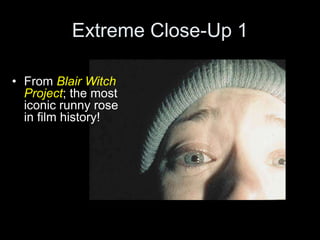
Extreme Close-Up 1
• From Blair Witch
Project; the most
iconic runny rose
in film history!
Extreme Close-Up 2
• From Saving
Private Ryan, a
film about the
Holocaust
Extreme Close-Up 3
Excellent!
• From Wayne’s
World; a film that
made singing in
cars very popular
Blink Off
• Form into pairs: 1 of you stand with your
back to the screen and close your eyes –
don’t open them until after I’ve counted
to 3; the other face the screen and read
the next instructions…
• The other should now lean in so that your
eyes are close to theirs, pulling the
scariest look you can muster; when I tell
the others to open their eyes feel free to
give a quick yell to help wake them up…
Blinking Heck
• Those of you who have just opened your
eyes have just experienced why film-
makers use extreme close ups … to make
you really feel the emotion of a
character
• Another semiotics term you can use: ‘I
chose an extreme close-up to denote
the character’s strong emotions.’
Denote means to describe what you can
see or hear
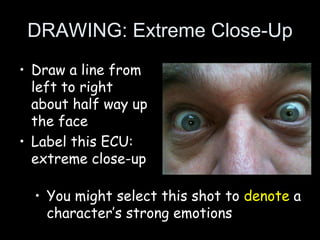
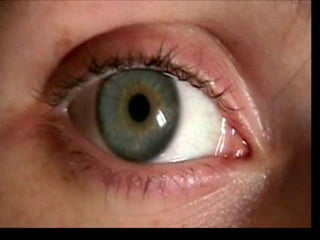
DRAWING: Extreme Close-Up
• Draw a line from
left to right
about half way up
the face
• Label this ECU:
extreme close-up
• You might select this shot to denote a
character’s strong emotions
The 3 basic shot types
1.Close-up
2.?
3.Long shot
Medium or
mid-shot
There are also two
variations of the close-up
and long shot:
The MEDIUM close-
up/long shot and the
EXTREME close-up/long
shot
Some use ‘big’ instead of
‘extreme’; you must use
‘extreme’!
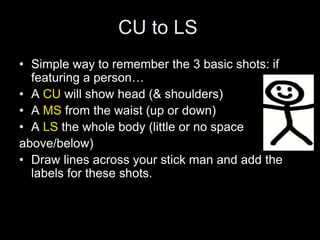
CU to LS
• Simple way to remember the 3 basic shots: if
featuring a person…
• A CU will show head (& shoulders)
• A MS from the waist (up or down)
• A LS the whole body (little or no space
above/below)
• Draw lines across your stick man and add the
labels for these shots.
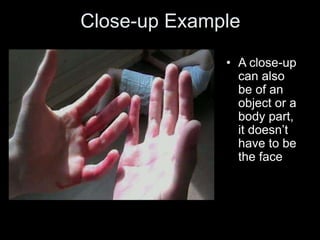
Close-up Example
• A close-up
can also
be of an
object or a
body part,
it doesn’t
have to be
the face
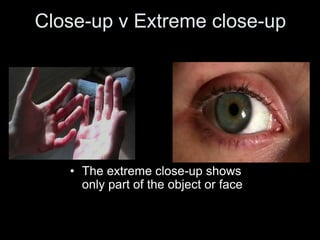
Close-up v Extreme close-up
• The extreme close-up shows
only part of the object or face
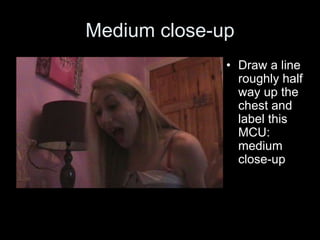
Medium close-up
• Draw a line
roughly half
way up the
chest and
label this
MCU:
medium
close-up
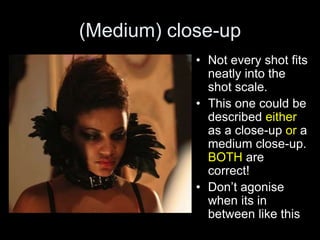
(Medium) close-up
• Not every shot fits
neatly into the
shot scale.
• This one could be
described either
as a close-up or a
medium close-up.
BOTH are
correct!
• Don’t agonise
when its in
between like this
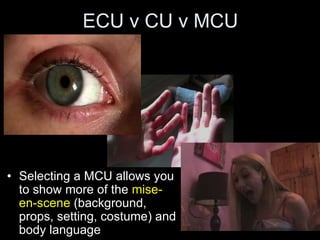
ECU v CU v MCU
• Selecting a MCU allows you
to show more of the mise-
en-scene (background,
props, setting, costume) and
body language
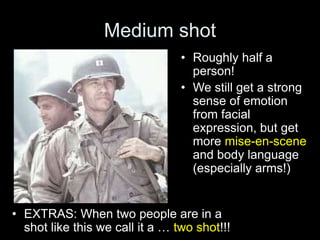
Medium shot
• Roughly half a
person!
• We still get a strong
sense of emotion
from facial
expression, but get
more mise-en-scene
and body language
(especially arms!)
• EXTRAS: When two people are in a
shot like this we call it a … two shot!!!
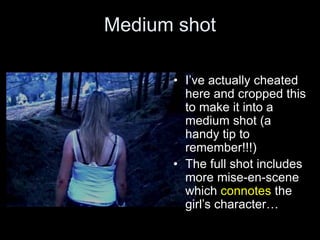
Medium shot
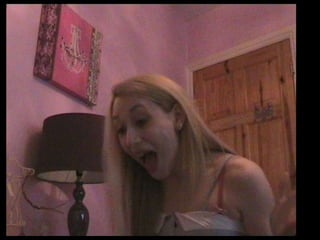
• I’ve actually cheated
here and cropped this
to make it into a
medium shot (a
handy tip to
remember!!!)
• The full shot includes
more mise-en-scene
which connotes the
girl’s character…
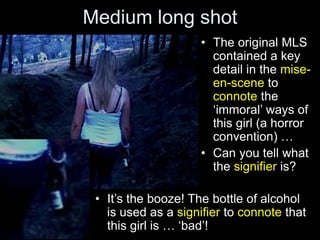
Medium long shot
• The original MLS
contained a key
detail in the mise-
en-scene to
connote the
‘immoral’ ways of
this girl (a horror
convention) …
• Can you tell what
the signifier is?
• It’s the booze! The bottle of alcohol
is used as a signifier to connote that
this girl is … ‘bad’!
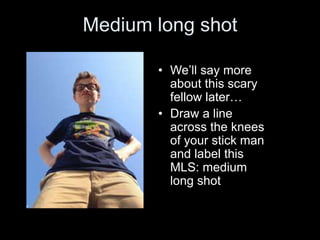
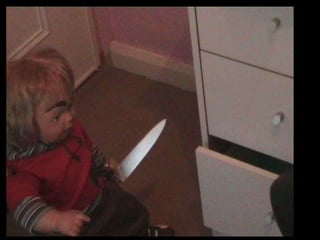
Medium long shot
• We’ll say more
about this scary
fellow later…
• Draw a line
across the knees
of your stick man
and label this
MLS: medium
long shot
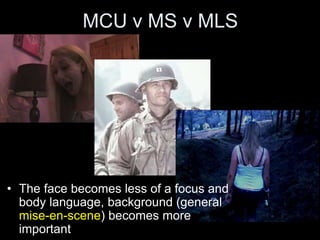
MCU v MS v MLS
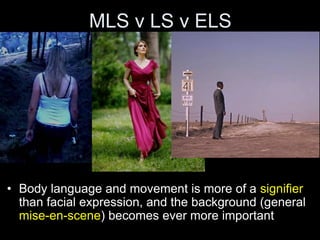
• The face becomes less of a focus and
body language, background (general
mise-en-scene) becomes more
important
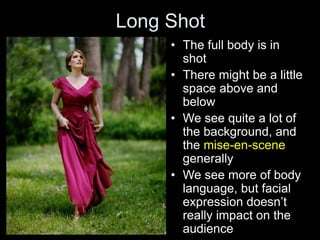
Long Shot
• The full body is in
shot
• There might be a little
space above and
below
• We see quite a lot of
the background, and
the mise-en-scene
generally
• We see more of body
language, but facial
expression doesn’t
really impact on the
audience
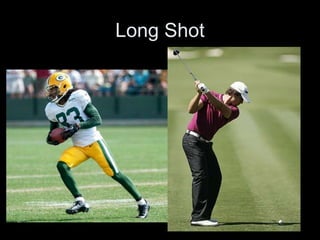
Long Shot
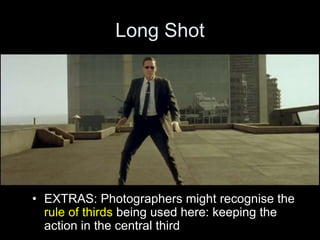
Long Shot
• EXTRAS: Photographers might recognise the
rule of thirds being used here: keeping the
action in the central third
MLS v LS v ELS
• Body language and movement is more of a signifier
than facial expression, and the background (general
mise-en-scene) becomes ever more important
Quick Quiz
• Can you identify the following shot types?
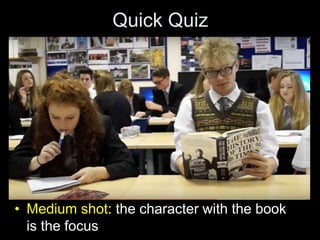
Quick Quiz
• Medium shot: the character with the book
is the focus
Quick Quiz
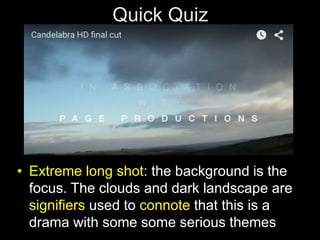
• Extreme long shot: the background is the
focus. The clouds and dark landscape are
signifiers used to connote that this is a
drama with some some serious themes
Quick Quiz
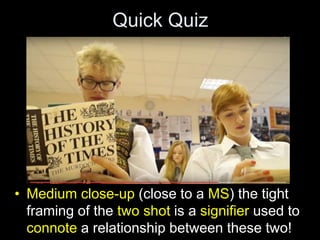
• Medium close-up (close to a MS) the tight
framing of the two shot is a signifier used to
connote a relationship between these two!
Quick Quiz
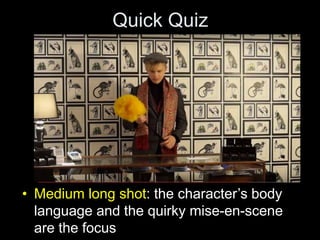
• Medium long shot: the character’s body
language and the quirky mise-en-scene
are the focus
Quick Quiz
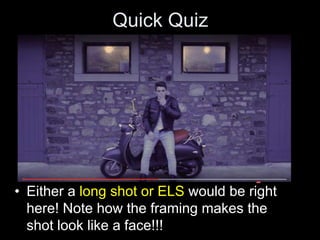
• Either a long shot or ELS would be right
here! Note how the framing makes the
shot look like a face!!!
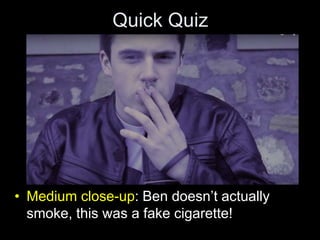
Quick Quiz
• Medium close-up: Ben doesn’t actually
smoke, this was a fake cigarette!
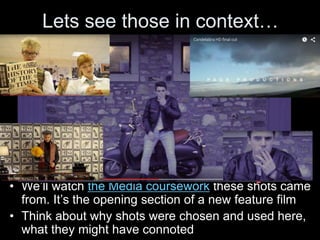
Lets see those in context…
• We’ll watch the Media coursework these shots came
from. It’s the opening section of a new feature film
• Think about why shots were chosen and used here,
what they might have connoted
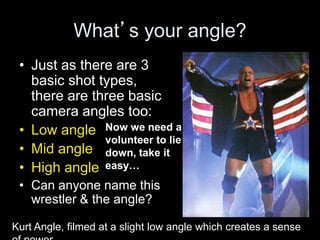
What’s your angle?
• Just as there are 3
basic shot types,
there are three basic
camera angles too:
• Low angle
• Mid angle
• High angle
• Can anyone name this
wrestler & the angle?
Now we need a
volunteer to lie
down, take it
easy…
Kurt Angle, filmed at a slight low angle which creates a sense
The Symbolic Significance of Angles
• With our volunteer/s lying down, everyone
else gather round and look down on them
• Consider your eyes as the camera lens, &
note how the two angles can convey (or
signify/connote) power/menace or
weakness/vulnerability
• Imagine yourself in the place of our
volunteer & consider what s/he’s seeing!
• At the bottom of your drawing add an
arrow pointing up and write LA: low angle
(looks powerful)
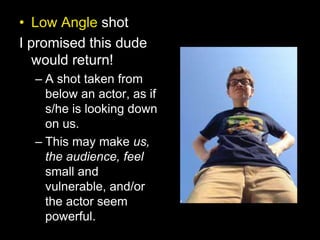
• Low Angle shot
I promised this dude
would return!
– A shot taken from
below an actor, as if
s/he is looking down
on us.
– This may make us,
the audience, feel
small and
vulnerable, and/or
the actor seem
powerful.
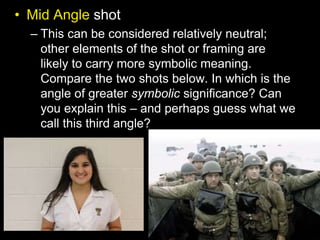
• Mid Angle shot
– This can be considered relatively neutral;
other elements of the shot or framing are
likely to carry more symbolic meaning.
Compare the two shots below. In which is the
angle of greater symbolic significance? Can
you explain this – and perhaps guess what we
call this third angle?
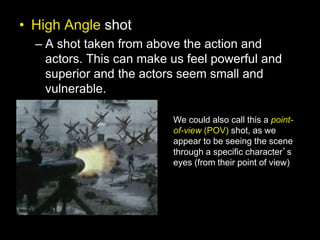
• High Angle shot
– A shot taken from above the action and
actors. This can make us feel powerful and
superior and the actors seem small and
vulnerable.
We could also call this a point-
of-view (POV) shot, as we
appear to be seeing the scene
through a specific character’s
eyes (from their point of view)
High v Low Angle
• LOW ANGLE: you’re looking up to the
person; they’re awesome/scary!
• HIGH ANGLE: you’re looking down on
them; they’re sad/weak, maybe in danger!
Drawing on Your Learning
1. MS
2. ECU
3. MLS
4. CU
5. LS
See if you can guess what this one looks
like:
6. DA [dutch angle! Aka canted angle]
You will see an example of this shortly
• Can you write down the names
of these shots just from their
abbreviations?
• Try it without using your
drawing/notes (use these if you
get stuck)
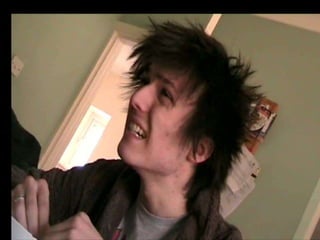
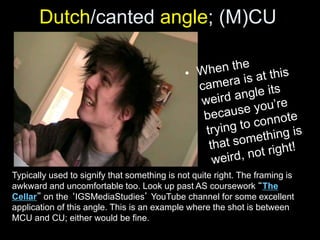
Dutch/canted angle; (M)CU
Typically used to signify that something is not quite right. The framing is
awkward and uncomfortable too. Look up past AS coursework “The
Cellar” on the ‘IGSMediaStudies’ YouTube channel for some excellent
application of this angle. This is an example where the shot is between
MCU and CU; either would be fine.
Recap Quiz
• Lets see how many of these shots and/or
angles you can identify
• Challenge yourself to use any extra terms,
such as signifier or connotes, and to think
about WHY or WHEN they might be used
CU
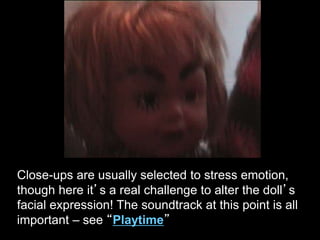
Close-ups are usually selected to stress emotion,
though here it’s a real challenge to alter the doll’s
facial expression! The soundtrack at this point is all
important – see “Playtime”
Shoot…
• Your task now is to work in
pairs and starting with either
ELS or ECU, use each other
as models to shoot a full set
of shot types
• Once you’ve each done that, create a comic
strip and label each shot!
• If you don’t have an iPad, log on to a
computer and ask a partner to email images
to you to put into a PowerPoint, again clearly
labeling each shot type
Next Time…
• You will come with a VERY short story!
• Something you can convey through
around 10 photos
• You should use all of the shot types and
angles
• Bring some costume or appropriate props
if you want to add signifiers to connote
some characteristics

Yr9 shot types compressed

  • 1.
    An Introduction to‘Camera Angles/Shot Types’
  • 2.
    After these lessonsyou will… • Be able to identify the main shot scale from ‘ELS’ to ‘ECU’ and 3 main shot angles… • Be able to look at a shot and denote (name) the type of shot • Begin to use these shot types in your planning for your own media productions • You may be able to explain the connotations of (symbolic reasons for selecting) a specific shot type
  • 3.
    In these lessonsyou will… • Produce a very basic drawing, and annotate (add notes to) this as we go • Identify the shot type of a range of examples • (You might briefly lie down…) • Shoot and label the full range of shot types and angles using your iPad • Create a comic book story featuring each shot type, and be able to explain why you selected some of these • OPTIONAL: Find and label an example of each shot type used in a magazine ad
  • 4.
    We will beginto apply semiotics • ‘Semiotics’ is the framework we use for analysing a media text • You will be analysing your own productions, and using media language + semiotic terms to help explain your ideas at the planning stage too • You will have plenty of opportunity to use all these terms, and a guide sheet, but please ask if you need a reminder at any time on any term • We will keep practicing semiotic terms throughout this lesson • Here’s a 60 second summary of semiotics… • Feel free to take a photo with your iPad of the following slides…
  • 5.
    Semiotics in 60Seconds • We need to identify how details or choices in any media text suggest a meaning • We will use two terms: signifier and connote • We use two stages: description (a signifier is a detail) and interpretation (symbolic meanings or connotations). Example: • I used a red rose as a signifier to connote romance
  • 6.
    Semiotics in 60Seconds • A red rose can be a signifier • It can be chosen to connote (symbolise) love or romance. • I used a red rose to connote romance.
  • 7.
    Semiotics in 60Seconds • Have we got it? There’s a lot at stake… • TASK: quickly write/type what you think the main signifier is in this picture and what it connotes • HINT: It isn’t connoting gardening… • ANSWER: The wooden stake is a signifier…it connotes vampires!
  • 8.
    Task 1 • Drawa stick man … and a 2nd small stick man baby! • Use iPad or pen + paper • You will be drawing 7 lines across this + writing in 7 labels to identify shots
  • 9.
    From one extreme… •The 1st shot we’ll look is at one end of the scale • It is a common shot selection for starting films; it helps set the scene (it can be denoted/described as an establishing shot) • These are not just long shots, these are extreme long shots…
  • 10.
  • 11.
  • 12.
  • 13.
    Extreme Long Shots Inthese shots the background dominates. There is space between a character’s head/feet and the edge of the frame STICK MAN DRAWING: Draw an arrow pointing up + down beside your stick baby and write in ELS: extreme long shot
  • 14.
    The other extreme… •The 2nd shot we’ll look is at the other end of the scale • It is often used to really emphasise emotions • These are not just close-ups, these are extreme close-ups… • A stamp if you can name the film any of these are taken from…
  • 15.
    Extreme Close-Up 1 •From Blair Witch Project; the most iconic runny rose in film history!
  • 16.
    Extreme Close-Up 2 •From Saving Private Ryan, a film about the Holocaust
  • 17.
    Extreme Close-Up 3 Excellent! •From Wayne’s World; a film that made singing in cars very popular
  • 18.
    Blink Off • Forminto pairs: 1 of you stand with your back to the screen and close your eyes – don’t open them until after I’ve counted to 3; the other face the screen and read the next instructions… • The other should now lean in so that your eyes are close to theirs, pulling the scariest look you can muster; when I tell the others to open their eyes feel free to give a quick yell to help wake them up…
  • 19.
    Blinking Heck • Thoseof you who have just opened your eyes have just experienced why film- makers use extreme close ups … to make you really feel the emotion of a character • Another semiotics term you can use: ‘I chose an extreme close-up to denote the character’s strong emotions.’ Denote means to describe what you can see or hear
  • 20.
    DRAWING: Extreme Close-Up •Draw a line from left to right about half way up the face • Label this ECU: extreme close-up • You might select this shot to denote a character’s strong emotions
  • 21.
    The 3 basicshot types 1.Close-up 2.? 3.Long shot Medium or mid-shot There are also two variations of the close-up and long shot: The MEDIUM close- up/long shot and the EXTREME close-up/long shot Some use ‘big’ instead of ‘extreme’; you must use ‘extreme’!
  • 22.
    CU to LS •Simple way to remember the 3 basic shots: if featuring a person… • A CU will show head (& shoulders) • A MS from the waist (up or down) • A LS the whole body (little or no space above/below) • Draw lines across your stick man and add the labels for these shots.
  • 23.
    Close-up Example • Aclose-up can also be of an object or a body part, it doesn’t have to be the face
  • 24.
    Close-up v Extremeclose-up • The extreme close-up shows only part of the object or face
  • 25.
    Medium close-up • Drawa line roughly half way up the chest and label this MCU: medium close-up
  • 26.
    (Medium) close-up • Notevery shot fits neatly into the shot scale. • This one could be described either as a close-up or a medium close-up. BOTH are correct! • Don’t agonise when its in between like this
  • 27.
    ECU v CUv MCU • Selecting a MCU allows you to show more of the mise- en-scene (background, props, setting, costume) and body language
  • 28.
    Medium shot • Roughlyhalf a person! • We still get a strong sense of emotion from facial expression, but get more mise-en-scene and body language (especially arms!) • EXTRAS: When two people are in a shot like this we call it a … two shot!!!
  • 29.
    Medium shot • I’veactually cheated here and cropped this to make it into a medium shot (a handy tip to remember!!!) • The full shot includes more mise-en-scene which connotes the girl’s character…
  • 30.
    Medium long shot •The original MLS contained a key detail in the mise- en-scene to connote the ‘immoral’ ways of this girl (a horror convention) … • Can you tell what the signifier is? • It’s the booze! The bottle of alcohol is used as a signifier to connote that this girl is … ‘bad’!
  • 31.
    Medium long shot •We’ll say more about this scary fellow later… • Draw a line across the knees of your stick man and label this MLS: medium long shot
  • 32.
    MCU v MSv MLS • The face becomes less of a focus and body language, background (general mise-en-scene) becomes more important
  • 33.
    Long Shot • Thefull body is in shot • There might be a little space above and below • We see quite a lot of the background, and the mise-en-scene generally • We see more of body language, but facial expression doesn’t really impact on the audience
  • 34.
  • 35.
    Long Shot • EXTRAS:Photographers might recognise the rule of thirds being used here: keeping the action in the central third
  • 36.
    MLS v LSv ELS • Body language and movement is more of a signifier than facial expression, and the background (general mise-en-scene) becomes ever more important
  • 37.
    Quick Quiz • Canyou identify the following shot types?
  • 38.
    Quick Quiz • Mediumshot: the character with the book is the focus
  • 39.
    Quick Quiz • Extremelong shot: the background is the focus. The clouds and dark landscape are signifiers used to connote that this is a drama with some some serious themes
  • 40.
    Quick Quiz • Mediumclose-up (close to a MS) the tight framing of the two shot is a signifier used to connote a relationship between these two!
  • 41.
    Quick Quiz • Mediumlong shot: the character’s body language and the quirky mise-en-scene are the focus
  • 42.
    Quick Quiz • Eithera long shot or ELS would be right here! Note how the framing makes the shot look like a face!!!
  • 43.
    Quick Quiz • Mediumclose-up: Ben doesn’t actually smoke, this was a fake cigarette!
  • 44.
    Lets see thosein context… • We’ll watch the Media coursework these shots came from. It’s the opening section of a new feature film • Think about why shots were chosen and used here, what they might have connoted
  • 45.
    What’s your angle? •Just as there are 3 basic shot types, there are three basic camera angles too: • Low angle • Mid angle • High angle • Can anyone name this wrestler & the angle? Now we need a volunteer to lie down, take it easy… Kurt Angle, filmed at a slight low angle which creates a sense
  • 46.
    The Symbolic Significanceof Angles • With our volunteer/s lying down, everyone else gather round and look down on them • Consider your eyes as the camera lens, & note how the two angles can convey (or signify/connote) power/menace or weakness/vulnerability • Imagine yourself in the place of our volunteer & consider what s/he’s seeing! • At the bottom of your drawing add an arrow pointing up and write LA: low angle (looks powerful)
  • 47.
    • Low Angleshot I promised this dude would return! – A shot taken from below an actor, as if s/he is looking down on us. – This may make us, the audience, feel small and vulnerable, and/or the actor seem powerful.
  • 48.
    • Mid Angleshot – This can be considered relatively neutral; other elements of the shot or framing are likely to carry more symbolic meaning. Compare the two shots below. In which is the angle of greater symbolic significance? Can you explain this – and perhaps guess what we call this third angle?
  • 49.
    • High Angleshot – A shot taken from above the action and actors. This can make us feel powerful and superior and the actors seem small and vulnerable. We could also call this a point- of-view (POV) shot, as we appear to be seeing the scene through a specific character’s eyes (from their point of view)
  • 50.
    High v LowAngle • LOW ANGLE: you’re looking up to the person; they’re awesome/scary! • HIGH ANGLE: you’re looking down on them; they’re sad/weak, maybe in danger!
  • 51.
    Drawing on YourLearning 1. MS 2. ECU 3. MLS 4. CU 5. LS See if you can guess what this one looks like: 6. DA [dutch angle! Aka canted angle] You will see an example of this shortly • Can you write down the names of these shots just from their abbreviations? • Try it without using your drawing/notes (use these if you get stuck)
  • 53.
    Dutch/canted angle; (M)CU Typicallyused to signify that something is not quite right. The framing is awkward and uncomfortable too. Look up past AS coursework “The Cellar” on the ‘IGSMediaStudies’ YouTube channel for some excellent application of this angle. This is an example where the shot is between MCU and CU; either would be fine.
  • 54.
    Recap Quiz • Letssee how many of these shots and/or angles you can identify • Challenge yourself to use any extra terms, such as signifier or connotes, and to think about WHY or WHEN they might be used
  • 61.
    CU Close-ups are usuallyselected to stress emotion, though here it’s a real challenge to alter the doll’s facial expression! The soundtrack at this point is all important – see “Playtime”
  • 62.
    Shoot… • Your tasknow is to work in pairs and starting with either ELS or ECU, use each other as models to shoot a full set of shot types • Once you’ve each done that, create a comic strip and label each shot! • If you don’t have an iPad, log on to a computer and ask a partner to email images to you to put into a PowerPoint, again clearly labeling each shot type
  • 63.
    Next Time… • Youwill come with a VERY short story! • Something you can convey through around 10 photos • You should use all of the shot types and angles • Bring some costume or appropriate props if you want to add signifiers to connote some characteristics