1
Guiding voters through 

the polling place
Dana Chisnell
Center for Civic Design
@civicdesign | @danachis
5
6
Are you getting warmer? 

Or cooler?
8
Capacity management
Queuing theory
Let’s talk about long lines.
Factors that contribute to long lines
• planning against
comparable elections
• enough well-trained
workers
• enough usable equipment
• enough voting hours
• and voters
01. Answer voters’
questions
Before they arrive at the 

polling place
Voters start their journey when they decide to vote
Previewing what voting will be like helps them decide
Way finding starts way before the
polling place
The process is opaque — voters have questions
before they even get to the polls
? what’s on the ballot
? where their polling place is, how to get there, and
where to park
? whether they need ID and what kind
? what their registration status is
? what to expect: will they have to wait, and if so, how
long
? the mechanics of voting
? can they bring things and people with them — what’s
restricted
Myths and assumptions of voters
“I	just	want	to	see	
who	is	running	and	
what	questions	are	
going	to	be	on	the	
ballot.	I	never	
know	what	is	going	
to	be	on	the	ballot	
ahead	of	time,	and	
I’m	afraid	of	taking	
too	long	in	the	
booth.”	
Sample ballots are not what voters
expect them to be 

Polling places are designed for
people who are familiar with how
voting works
Voters expect that poll workers are
like TSA agents - barking orders and
punishing people for doing it wrong
Getting ready to vote
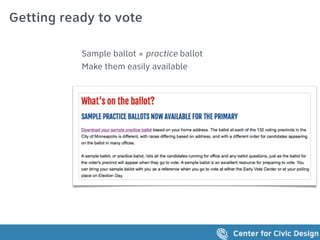
Sample ballot = practice ballot
Make them easily available
Getting ready to vote
Publish tips for the best voting
experience
• Review your sample ballot
• Check your registration status
• Map your polling place
• Bring the sample ballot with you
• Bring your ID
• Wear comfortable shoes
• Bring your parent / spouse /
kids /helper
• Turn off your phone
What to expect at the polls
First-time	voters	
said	they	were	
more	likely	to	
show	up	when	
we	demystified	
the	experience	
in	the	polling	
place.	
Explain what the voting system is
and how to use it 

Explain the steps voters will go
through in the polling place 

Give a range of how long it will take
to mark a ballot and cast it


Say that poll workers are there to
answer questions, assist (and
translate)
18
Preparation.
Help voters know what it’s
going to be like to vote.
02. Orient voters in the
polling place
Finding and learning happen
together
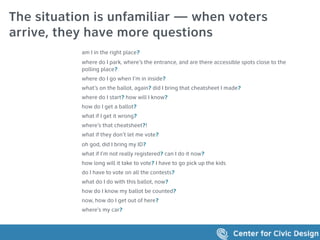
The situation is unfamiliar — when voters
arrive, they have more questions
am I in the right place?
where do I park, where’s the entrance, and are there accessible spots close to the
polling place?
where do I go when I’m in inside?
what’s on the ballot, again? did I bring that cheatsheet I made?
where do I start? how will I know?
how do I get a ballot?
what if I get it wrong?
where’s that cheatsheet?!
what if they don’t let me vote?
oh god, did I bring my ID?
what if I’m not really registered? can I do it now?
how long will it take to vote? I have to go pick up the kids
do I have to vote on all the contests?
what do I do with this ballot, now?
how do I know my ballot be counted?
now, how do I get out of here?
where’s my car?
21
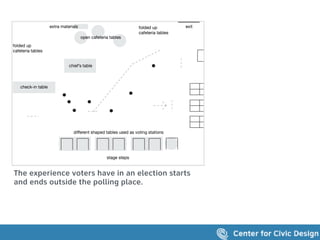
The experience voters have in an election starts
and ends outside the polling place.
22
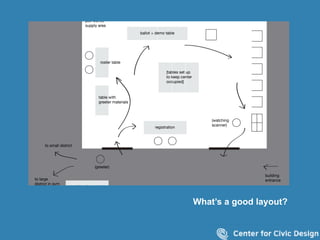
What’s a good layout?
23
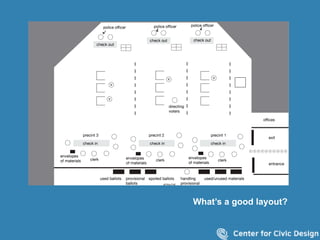
What’s a good layout?
24
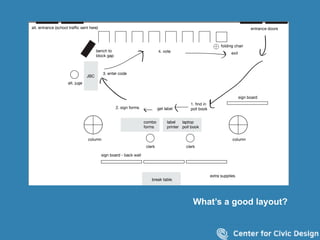
What’s a good layout?
25
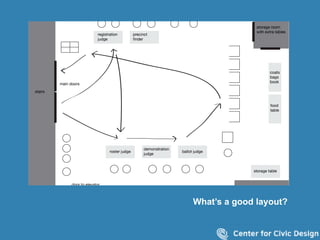
What’s a good layout?
26
Orientation.
Help voters know that they’re
in the right place at the right
time.
03. Guide voters through
the polling place
Way finding at the polling place location
1. Make signs easy to read
2. Show traffic patterns
3. Use appropriate color to identify types of information
4. Be clear about actions voters must take
5. Provide clear information about what’s allowed in the
polling place
6. Communicate laws and regulations appropriately
7. Make it easy to read in all languages
8. Use plain language
9. Use icons to reinforce instructions
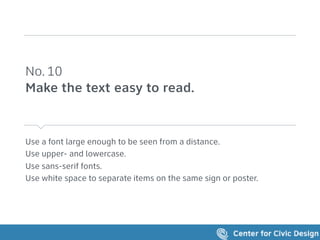
10. Make the text easy to read
Pro tip: Test and make iterative improvements
Effective Designs for the
Administration of Federal Elections
http://www.eac.gov/election_management_resources/
designing_polling_place_materials.aspx
31
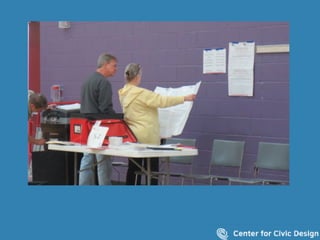
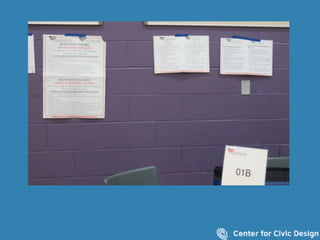
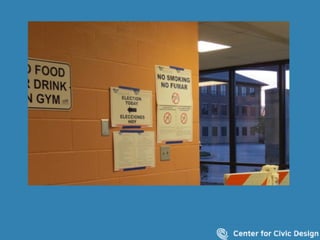
Hang signs at eye level.
Make sure signs are visible from around the room.
No. 01

Make signs easy to read
33
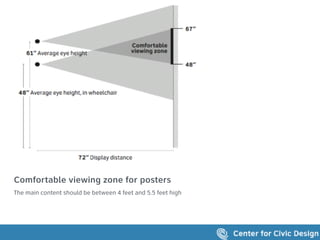
Comfortable viewing zone for posters
The main content should be between 4 feet and 5.5 feet high
34
35
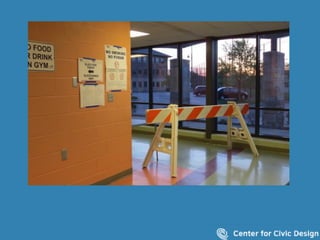
Make it easy for voters to navigate the polling place.
Where do they start? Do they have to move from station to station?
Where is the voting system for people with disabilities?
No. 02

Show traffic patterns
37
38
Color and contrast help people quickly identify the purpose and
content of signs.
Combine color with text or shape for accessibility.
No. 03

Use appropriate color to identify types of
information
40
41
42
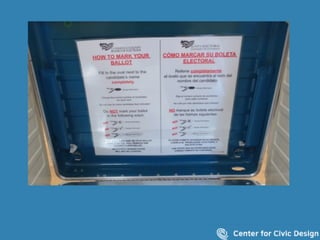
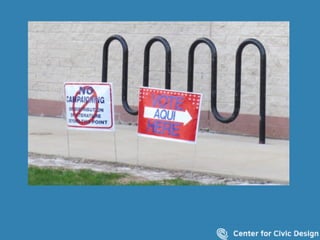
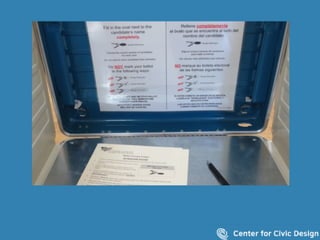
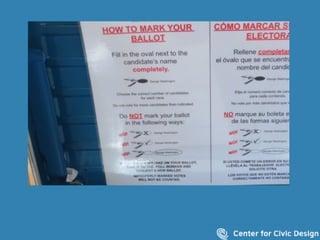
For voting, make diagrams accurate to your voting system. Close-up
line drawings are better than photographs.
Use icons, arrows, or symbols for meaning, not for decoration.
No. 04
Be clear about actions voters must take.
44
45
46
47
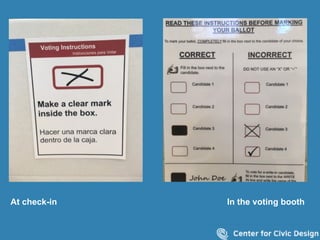
At check-in In the voting booth
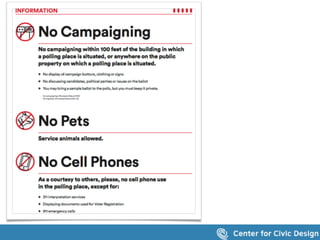
Write in active voice.
Tell voters what to do. Avoid negative (don’t do) when possible.
No. 05

Provide clear information about what’s
allowed in the polling place.
49
50
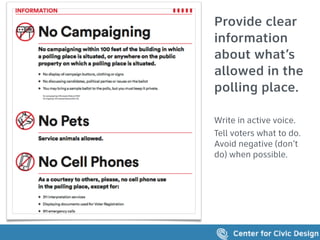
Provide clear
information
about what’s
allowed in the
polling place.
Write in active voice.
Tell voters what to do.
Avoid negative (don’t
do) when possible.
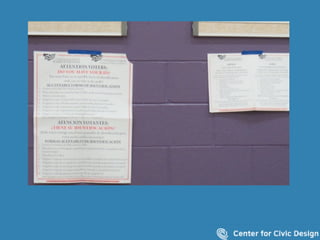
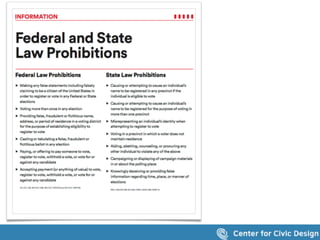
Write a heading or sentence to summarize the law. If possible,
paraphrase in plain language.
Include the source, so people can look it up.
Work with counsel to get early reviews.
No. 06

Communicate laws and regulations
appropriately.
52
53
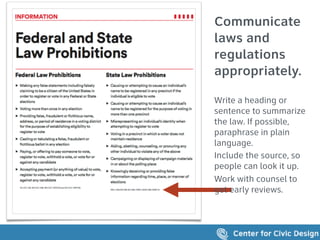
Communicate
laws and
regulations
appropriately.
Write a heading or
sentence to summarize
the law. If possible,
paraphrase in plain
language.
Include the source, so
people can look it up.
Work with counsel to
get early reviews.
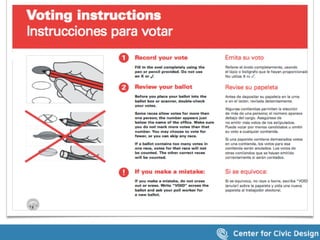
Make it easy to compare the information between languages.
Limit signs to 2 languages.* One language should be English.
No. 07

Make it easy to read in all languages.
*	English	+	2	Asian	languages	may	also	work.
55
Write short sentences.
Use simple words.
Think of the voter as “you.”
Write in the positive.
Use numbers on step-by-step instructions.
Keep paragraphs short.
No. 08

Use plain language.
62


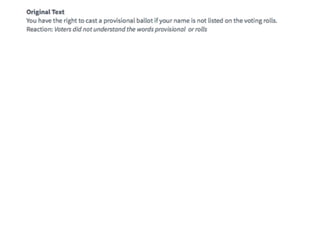
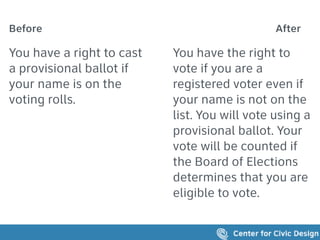
Before After
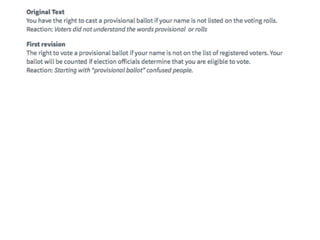
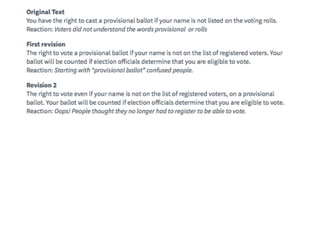
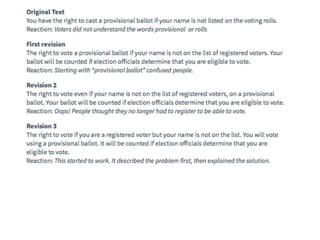
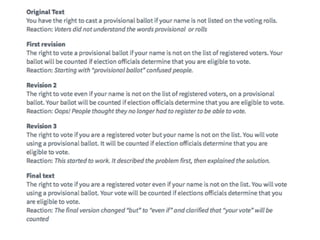
You have a right to cast
a provisional ballot if
your name is on the
voting rolls.
You have the right to
vote if you are a
registered voter even if
your name is not on the
list. You will vote using a
provisional ballot. Your
vote will be counted if
the Board of Elections
determines that you are
eligible to vote.
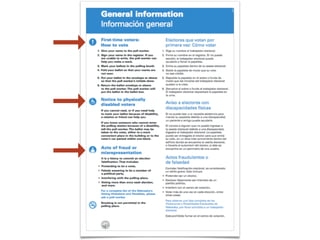
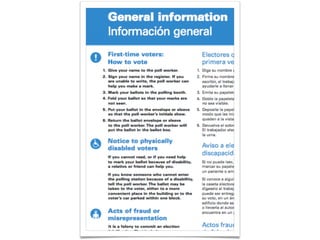
Use informational icons such as arrows and exclamation points to
draw attention to important information or to help voters quickly
scan dense information.
No. 09

Use icons to reinforce instructions.
Use a font large enough to be seen from a distance.
Use upper- and lowercase.
Use sans-serif fonts.
Use white space to separate items on the same sign or poster.
No. 10

Make the text easy to read.
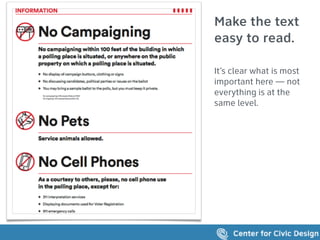
67
Make the text
easy to read.
It’s clear what is most
important here — not
everything is at the
same level.
Test and make iterative improvements.
69
What happens before they arrive can make a difference in how
easily they get through the process when they get to the
polling location.
The voter journey starts and ends
outside the polling place
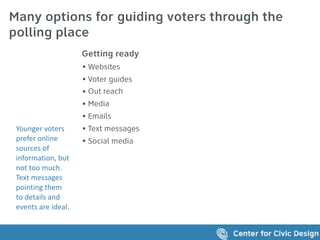
Many options for guiding voters through the
polling place
Younger	voters	
prefer	online	
sources	of	
information,	but	
not	too	much.	
Text	messages	
pointing	them	
to	details	and	
events	are	ideal.	
Getting ready
• Websites
• Voter guides
• Out reach
• Media
• Emails
• Text messages
• Social media
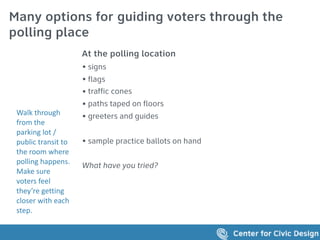
Many options for guiding voters through the
polling place
Walk	through	
from	the	
parking	lot	/	
public	transit	to	
the	room	where	
polling	happens.	
Make	sure	
voters	feel	
they’re	getting	
closer	with	each	
step.	
At the polling location
• signs
• flags
• traffic cones
• paths taped on floors
• greeters and guides
• sample practice ballots on hand
What have you tried?
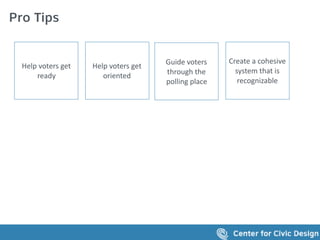
Pro Tips
Help	voters	get	
ready
Help	voters	get	
oriented
Guide	voters	
through	the	
polling	place
Create	a	cohesive	
system	that	is	
recognizable
Thank you!


Dana Chisnell

dana@civicdesign.org


Center for Civic Design

civicdesign.org

@civicdesign
@danachis


Guiding voters through the polling place

  • 1.
    1 Guiding voters through
 the polling place Dana Chisnell Center for Civic Design @civicdesign | @danachis
  • 5.
  • 6.
  • 7.
    Are you gettingwarmer? 
 Or cooler?
  • 8.
  • 9.
  • 10.
    Factors that contributeto long lines • planning against comparable elections • enough well-trained workers • enough usable equipment • enough voting hours • and voters
  • 11.
    01. Answer voters’ questions Beforethey arrive at the 
 polling place
  • 12.
    Voters start theirjourney when they decide to vote Previewing what voting will be like helps them decide Way finding starts way before the polling place
  • 13.
    The process isopaque — voters have questions before they even get to the polls ? what’s on the ballot ? where their polling place is, how to get there, and where to park ? whether they need ID and what kind ? what their registration status is ? what to expect: will they have to wait, and if so, how long ? the mechanics of voting ? can they bring things and people with them — what’s restricted
  • 14.
    Myths and assumptionsof voters “I just want to see who is running and what questions are going to be on the ballot. I never know what is going to be on the ballot ahead of time, and I’m afraid of taking too long in the booth.” Sample ballots are not what voters expect them to be 
 Polling places are designed for people who are familiar with how voting works Voters expect that poll workers are like TSA agents - barking orders and punishing people for doing it wrong
  • 15.
    Getting ready tovote Sample ballot = practice ballot Make them easily available
  • 16.
    Getting ready tovote Publish tips for the best voting experience • Review your sample ballot • Check your registration status • Map your polling place • Bring the sample ballot with you • Bring your ID • Wear comfortable shoes • Bring your parent / spouse / kids /helper • Turn off your phone
  • 17.
    What to expectat the polls First-time voters said they were more likely to show up when we demystified the experience in the polling place. Explain what the voting system is and how to use it 
 Explain the steps voters will go through in the polling place 
 Give a range of how long it will take to mark a ballot and cast it 
 Say that poll workers are there to answer questions, assist (and translate)
  • 18.
    18 Preparation. Help voters knowwhat it’s going to be like to vote.
  • 19.
    02. Orient votersin the polling place Finding and learning happen together
  • 20.
    The situation isunfamiliar — when voters arrive, they have more questions am I in the right place? where do I park, where’s the entrance, and are there accessible spots close to the polling place? where do I go when I’m in inside? what’s on the ballot, again? did I bring that cheatsheet I made? where do I start? how will I know? how do I get a ballot? what if I get it wrong? where’s that cheatsheet?! what if they don’t let me vote? oh god, did I bring my ID? what if I’m not really registered? can I do it now? how long will it take to vote? I have to go pick up the kids do I have to vote on all the contests? what do I do with this ballot, now? how do I know my ballot be counted? now, how do I get out of here? where’s my car?
  • 21.
    21 The experience votershave in an election starts and ends outside the polling place.
  • 22.
  • 23.
  • 24.
  • 25.
  • 26.
    26 Orientation. Help voters knowthat they’re in the right place at the right time.
  • 27.
    03. Guide votersthrough the polling place
  • 28.
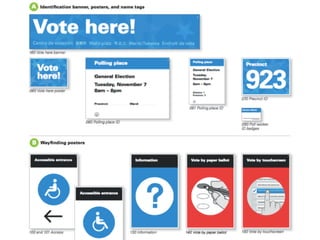
    Way finding atthe polling place location 1. Make signs easy to read 2. Show traffic patterns 3. Use appropriate color to identify types of information 4. Be clear about actions voters must take 5. Provide clear information about what’s allowed in the polling place 6. Communicate laws and regulations appropriately 7. Make it easy to read in all languages 8. Use plain language 9. Use icons to reinforce instructions 10. Make the text easy to read Pro tip: Test and make iterative improvements
  • 29.
    Effective Designs forthe Administration of Federal Elections http://www.eac.gov/election_management_resources/ designing_polling_place_materials.aspx
  • 31.
  • 32.
    Hang signs ateye level. Make sure signs are visible from around the room. No. 01
 Make signs easy to read
  • 33.
    33 Comfortable viewing zonefor posters The main content should be between 4 feet and 5.5 feet high
  • 34.
  • 35.
  • 36.
    Make it easyfor voters to navigate the polling place. Where do they start? Do they have to move from station to station? Where is the voting system for people with disabilities? No. 02
 Show traffic patterns
  • 37.
  • 38.
  • 39.
    Color and contrasthelp people quickly identify the purpose and content of signs. Combine color with text or shape for accessibility. No. 03
 Use appropriate color to identify types of information
  • 40.
  • 41.
  • 42.
  • 43.
    For voting, makediagrams accurate to your voting system. Close-up line drawings are better than photographs. Use icons, arrows, or symbols for meaning, not for decoration. No. 04 Be clear about actions voters must take.
  • 44.
  • 45.
  • 46.
  • 47.
    47 At check-in Inthe voting booth
  • 48.
    Write in activevoice. Tell voters what to do. Avoid negative (don’t do) when possible. No. 05
 Provide clear information about what’s allowed in the polling place.
  • 49.
  • 50.
    50 Provide clear information about what’s allowedin the polling place. Write in active voice. Tell voters what to do. Avoid negative (don’t do) when possible.
  • 51.
    Write a headingor sentence to summarize the law. If possible, paraphrase in plain language. Include the source, so people can look it up. Work with counsel to get early reviews. No. 06
 Communicate laws and regulations appropriately.
  • 52.
  • 53.
    53 Communicate laws and regulations appropriately. Write aheading or sentence to summarize the law. If possible, paraphrase in plain language. Include the source, so people can look it up. Work with counsel to get early reviews.
  • 54.
    Make it easyto compare the information between languages. Limit signs to 2 languages.* One language should be English. No. 07
 Make it easy to read in all languages. * English + 2 Asian languages may also work.
  • 55.
  • 56.
    Write short sentences. Usesimple words. Think of the voter as “you.” Write in the positive. Use numbers on step-by-step instructions. Keep paragraphs short. No. 08
 Use plain language.
  • 62.
    62 
 Before After You havea right to cast a provisional ballot if your name is on the voting rolls. You have the right to vote if you are a registered voter even if your name is not on the list. You will vote using a provisional ballot. Your vote will be counted if the Board of Elections determines that you are eligible to vote.
  • 63.
    Use informational iconssuch as arrows and exclamation points to draw attention to important information or to help voters quickly scan dense information. No. 09
 Use icons to reinforce instructions.
  • 66.
    Use a fontlarge enough to be seen from a distance. Use upper- and lowercase. Use sans-serif fonts. Use white space to separate items on the same sign or poster. No. 10
 Make the text easy to read.
  • 67.
    67 Make the text easyto read. It’s clear what is most important here — not everything is at the same level.
  • 68.
    Test and makeiterative improvements.
  • 69.
  • 70.
    What happens beforethey arrive can make a difference in how easily they get through the process when they get to the polling location. The voter journey starts and ends outside the polling place
  • 71.
    Many options forguiding voters through the polling place Younger voters prefer online sources of information, but not too much. Text messages pointing them to details and events are ideal. Getting ready • Websites • Voter guides • Out reach • Media • Emails • Text messages • Social media
  • 72.
    Many options forguiding voters through the polling place Walk through from the parking lot / public transit to the room where polling happens. Make sure voters feel they’re getting closer with each step. At the polling location • signs • flags • traffic cones • paths taped on floors • greeters and guides • sample practice ballots on hand What have you tried?
  • 73.
  • 74.
  • 75.
    
 
 Dana Chisnell
 dana@civicdesign.org
 
 Center forCivic Design
 civicdesign.org
 @civicdesign @danachis