The Future of Learning
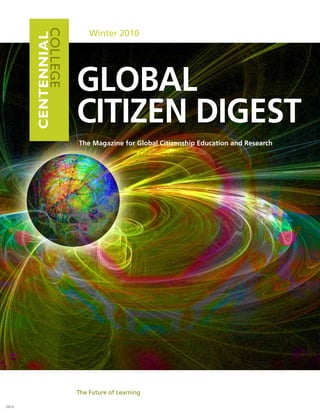
GLOBAL
CITIZEN DIGEST
Winter 2010
The Magazine for Global Citizenship Education and Research
Launch of the Institute
Child & Youth Worker Students Reflect on Unjust Practices
by Colleen Kamps
The Path to Diversity: A Fire Service/Community College Project
by Dan Haden
2
3
TABLE of CONTENTS
Introduction
Dean‘s Comments .................................................................................4
Launch of the Institute
President’s Speech..................................................................................6
Presentations
•	 Mr. Antone......................................................................................7
•	 Ms. Naba Hamid...........................................................................10
•	 Earth: A Green Oasis
Interview report by Ms. Manjeet Kang......................................14
Articles and Papers
Child & Youth Worker Students Reflect on Unjust Practices
by Colleen Kamps................................................................................15
The Path to Diversity: A Fire Service/Community College Project
by Dan Haden.......................................................................................16
Service Learning...................................................................................20
Connecting the Dots - Leveraging Diversity for Student Engagement
and Organizational Renewal and Change ........................................24
Concepts and Definitions............................................. 31
Local, National and Global Activities at Centennial... 33
Philosopher’s Café
•	 October – Inclusion......................................................................38
•	 November – Genocides................................................................38
•	 December – Human Rights..........................................................38
•	 February – International Development......................................39
Resources from Centennial Library
for the Philosopher’s Cafe...................................................................39
Published by:
Institute for Global Citizenship
and Equity
P.O. Box 631, Station A
Toronto, ON M1K 5E9
Managing Editors:
Dr. Margaret Brigham
416-289-5000, ext. 2083
mbrigham@centennialcollege.ca
Dr. Eva Aboagye
416-289-5000, ext. 3376
eaboagye@centennialcollege.ca
Contributors:
Ann Buller
Colleen Kamps
Dan Haden
Eva Aboagye
Manjeet Kang
Margaret Brigham
Naba Hamid
Rachel Larabee
Robert Antone
Victoria Gray
Article Citation:
Global Citizen Digest
Centennial College: Toronto
Winter 2010 Issue
© 2010 Institute for Global
Citizenship and Equity
4
The Global Citizen Digest seeks to provide
insight into what it means to be a global citizen.
Articles are welcomed that help clarify thinking
and encourage understanding of themes such as:
ƒƒ Global knowledge
ƒƒ Understanding the interconnectedness of
our world
ƒƒ Intercultural competence in relating to those
from other cultures
ƒƒ Engagement in local and global issues that
impact humanity
Our research agenda is broadly stated as the
elements that surround us---Earth, Fire, Water,
and Wind. It is our belief that most research can
be linked to these themes which are universal
and inclusive. Whether you are a professor in
a classroom, support staff, or a student on one
of our campuses we invite your contribution to
this magazine. Collectively, we will help advance
understanding of global citizenship and equity.
Global citizenship and equity are the framework
for this magazine. As you engage in activity that is
making a difference in the world, tell us about it in
an article. For example, if you attend a symposium
or conference, summarize what you have learned
and submit it. If your work involves research on a
global citizenship theme, or travel to unfamiliar
places, write about it and submit it. Written
submissions are an excellent way for all of us to
share in the learning.
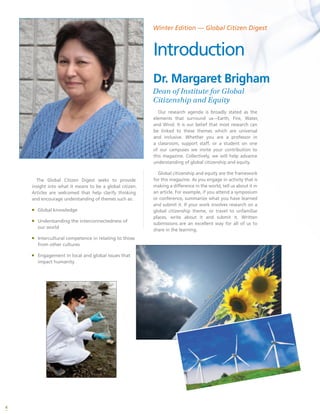
Dr. Margaret Brigham
Dean of Institute for Global
Citizenship and Equity
Winter Edition — Global Citizen Digest
Introduction
5
Launch of the
Institute
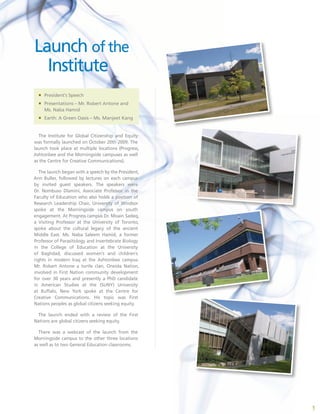
The Institute for Global Citizenship and Equity
was formally launched on October 20th 2009. The
launch took place at multiple locations (Progress,
Ashtonbee and the Morningside campuses as well
as the Centre for Creative Communications).
The launch began with a speech by the President,
Ann Buller, followed by lectures on each campus
by invited guest speakers. The speakers were
Dr. Nombuso Dlamini, Associate Professor in the
Faculty of Education who also holds a position of
Research Leadership Chair, University of Windsor
spoke at the Morningside campus on youth
engagement. At Progress campus Dr. Moain Sadeq,
a Visiting Professor at the University of Toronto,
spoke about the cultural legacy of the ancient
Middle East. Ms. Naba Saleem Hamid, a former
Professor of Parasitology and Invertebrate Biology
in the College of Education at the University
of Baghdad, discussed women’s and children’s
rights in modern Iraq at the Ashtonbee campus.
Mr. Robert Antone a turtle clan, Oneida Nation,
involved in First Nation community development
for over 30 years and presently a PhD candidate
in American Studies at the (SUNY) University
at Buffalo, New York spoke at the Centre for
Creative Communications. His topic was First
Nations peoples as global citizens seeking equity.
The launch ended with a review of the First
Nations are global citizens seeking equity.
There was a webcast of the launch from the
Morningside campus to the other three locations
as well as to two General Education classrooms.
ƒƒ President’s Speech
ƒƒ Presentations – Mr. Robert Antone and
Ms. Naba Hamid
ƒƒ Earth: A Green Oasis – Ms. Manjeet Kang
6
S
everal years ago, through the establishment of our Signature
Learning Experience we started on the path that would lead
us to becoming an institution that promotes and embraces
the values associated with global citizenship, social justice and
equity. Our successes in the area include:
To build on these achievements,
today we are launching the Institute
for Global Citizenship and Equity.
The Institute will be a world class
centre for innovation and research
on global citizenship and a cradle of
community and global engagement.
Leadership in social justice and equity
requires commitment and passion
for the issues that matter. We are
committing ourselves to providing
leadership in education that places a
strong emphasis on global citizenship,
social justice and equity.
The Institute will provide leadership
in facilitating engagement by faculty,
students and staff. The goal of the
Institute is to move the college from
a philosophical approach to global
citizenship to social action.
There are a number of areas of
focus that Centennial will be working
on as part of the Institute for Global
Citizenship and Equity. To begin with,
we are now the only Canadian college
to join the Scholars-at-Risk network. A
network of over 200 institutions with
the goal of supporting academics who
are at risk in their countries. We are
hoping in this academic year to be able
The President’s Speech
On Centennial Day, I spoke about the nine
Commitments that we as an institution of
learning have vowed to make a reality so that
we become an internationally recognized
leader in education that places a strong
emphasis on global citizenship, social justice
and equity.
ƒƒ The successful introduction of a
new General Education compulsory
program that will help us educate
students in issues that affect us all in
this increasingly global world. These
include social issues like poverty,
discrimination and inequity, issues of
the environment and also issues of
war.
ƒƒ Another development is the use of
Portfolio Learning. We will recognize
Centennial students’ contributions as
they make positive changes in their
lives and their communities. Through
the Signature Learning Experience,
students engage in transformative
education and, through their learning,
discover how to make positive
changes in their lives and their
communities. The Portfolio Project
allows students to develop their
reflective skills by documenting their
personal, career
and social growth in the areas of
global citizenship, social justice and
diversity. Each semester, students
develop an artifact or evidence that
demonstrates their growth in these
areas. This means that, for example,
a student enrolled in a four-semester
program, must submit four separate
artifacts or other evidence to support
his or her SLE Portfolio Project before
they can graduate.
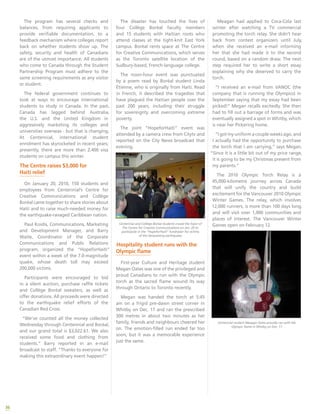
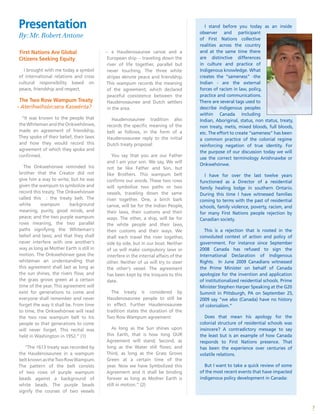
Ann Buller, President and CEO
to sponsor a scholar to be a part of our
college community.
The institute has also begun a
discussion forum “The Philosopher’s
Café” which is open to all faculty,
staff and students to meet and discuss
the issues that we are all concerned
about. I invite all of you to join in these
discussions.
The Institute is also going to have
publications where we can share
research, best practices, great things
that are happening in our classrooms
or new things you may have discovered
at a conference or in the course of
teaching.
You will have opportunity this
morning to hear more about the work
that is being planned for the institute,
and to identify ways in which you can
all become involved.
There are opportunities to engage
in research, dialogue, publications and
other activities. I am pleased to be part
of the launch of Centennial’s Institute
for Global Citizenship and Equity and
encourage everyone to get involved
in this exciting and worthwhile
undertaking.
Thank you all for joining us today.
Presentation
By: Mr. Robert Antone
7
First Nations Are Global
Citizens Seeking Equity
I brought with me today a symbol
of international relations and cross
cultural responsibility based on
peace, friendship and respect.
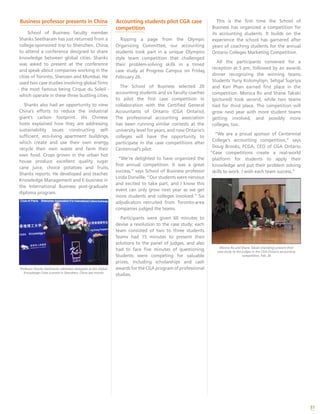
The Two Row Wampum Treaty
- Aterihwihsón:sera Kaswénta?
“It was known to the people that
the Whiteman and the Onkwehónwe,
made an agreement of friendship.
They spoke of their belief, their laws
and how they would record this
agreement of which they spoke and
confirmed.
The Onkwehónwe reminded his
brother that the Creator did not
give him a way to write; but he was
given the wampum to symbolize and
record this treaty. The Onkwehónwe
called this : the treaty belt. The
white wampum background
meaning, purity, good minds, and
peace; and the two purple wampum
rows meaning, the two parallel
paths signifying the Whiteman‘s
belief and laws; and that they shall
never interfere with one another‘s
way as long as Mother Earth is still in
motion. The Onkwehónwe gave the
whiteman an understanding that
this agreement shall last as long as
the sun shines, the rivers flow, and
the grass grows green at a certain
time of the year. This agreement will
exist for generations to come and
everyone shall remember and never
forget the way it shall be. From time
to time, the Onkwehónwe will read
the two row wampum belt to his
people so that generations to come
will never forget. This recital was
held in Washington in 1952.” (1)
“The 1613 treaty was recorded by
the Haudenosaunee in a wampum
beltknownastheTwoRowWampum.
The pattern of the belt consists
of two rows of purple wampum
beads against a background of
white beads. The purple beads
signify the courses of two vessels
-- a Haudenosaunee canoe and a
European ship -- traveling down the
river of life together, parallel but
never touching. The three white
stripes denote peace and friendship.
This wampum records the meaning
of the agreement, which declared
peaceful coexistence between the
Haudenosaunee and Dutch settlers
in the area.
Haudenosaunee tradition also
records the specific meaning of the
belt as follows, in the form of a
Haudenosaunee reply to the initial
Dutch treaty proposal:
You say that you are our Father
and I am your son. We say, We will
not be like Father and Son, but
like Brothers. This wampum belt
confirms our words. These two rows
will symbolize two paths or two
vessels, traveling down the same
river together. One, a birch bark
canoe, will be for the Indian People,
their laws, their customs and their
ways. The other, a ship, will be for
the white people and their laws,
their customs and their ways. We
shall each travel the river together,
side by side, but in our boat. Neither
of us will make compulsory laws or
interfere in the internal affairs of the
other. Neither of us will try to steer
the other‘s vessel. The agreement
has been kept by the Iroquois to this
date.
The treaty is considered by
Haudenosaunee people to still be
in effect. Further Haudenosaunee
tradition states the duration of the
Two Row Wampum agreement:
As long as the Sun shines upon
this Earth, that is how long OUR
Agreement will stand; Second, as
long as the Water still flows; and
Third, as long as the Grass Grows
Green at a certain time of the
year. Now we have Symbolized this
Agreement and it shall be binding
forever as long as Mother Earth is
still in motion.” (2)
story/2008/06/11/aboriginal-
apology.html
I stand before you today as an inside
observer and participant
of First Nations collective
realities across the country
and at the same time there
are distinctive differences
in culture and practice of
Indigenous knowledge. What
creates the “sameness” -the
Indian - are the external
forces of racism in law, policy,
practice and communications.
There are several tags used to
describe indigenous peoples
within Canada including
Indian, Aboriginal, status, non status, treaty,
non treaty, metis, mixed bloods, full bloods,
etc. The effort to create “sameness” has been
a common practice of the colonial regime
reinforcing negation of true identity. For
the purpose of our discussion today we will
use the correct terminology Anishnawbe or
Onkwehónwe.
I have for over the last twelve years
functioned as a Director of a residential
family healing lodge in southern Ontario.
During this time I have witnessed families
coming to terms with the past of residential
schools, family violence, poverty, racism, and
for many First Nations people rejection by
Canadian society.
This is a rejection that is rooted in the
convoluted context of action and policy of
government. For instance since September
2008 Canada has refused to sign the
International Declaration of Indigenous
Rights. In June 2009 Canadians witnessed
the Prime Minister on behalf of Canada
apologize for the invention and application
of institutionalized residential schools. Prime
Minister Stephen Harper Speaking at the G20
Summit in Pittsburgh, PA on September 25,
2009 say “we also (Canada) have no history
of colonialism.”
Does that mean his apology for the
colonial structure of residential schools was
insincere? A contradictory message to say
the least but is an example of how Canada
responds to First Nations presence. That
has been the experience over centuries of
volatile relations.
But I want to take a quick review of some
of the most recent events that have impacted
indigenous policy development in Canada:
8
The Oka Crisis in 1990 – the struggle
by the Mohawk people at Kanesatake,
Quebec to protect ancient and existing
burial grounds from the development of a
golf course.
The Royal Commission on Aboriginal
Peoples that began their work by Order
in Council dated August 26th ,1991. Final
report of 5 volumes came out in 1996. This
was a Canadian report with minimum
aboriginal involvement in the final
recommendations.
The Stoney Point occupation – “The
Ipperwash Crisis was an Indigenous
land dispute that occurred in Ipperwash
Provincial Park, Ontario in (September)
1995. Several members of the Stoney Point
Ojibway band occupied the
park in order to assert their
claim to nearby land which
had been expropriated from
them during WW2. This led
to a violent confrontation
between protesters and the
Ontario Provincial Police, who
killed protester Dudley George.
The ensuing controversy was a
major event in Canadian politics,
and a provincial inquiry, under
former Ontario Chief Justice
Sidney Linden, investigating the
events was completed in the fall
of 2006.”(3)
The Caledonia situation – “The current
Grand River land dispute came to the
attention of the general public of Canada
on February 28, 2006. On that date,
protesters from the Six Nations of the
Grand River began a demonstration to
raise awareness about First Nation land
claims in Ontario, Canada, and particularly
about their claim to a parcel of land in
Caledonia, Ontario, a community within
the single-tier municipality of Haldimand
County, roughly 20 kilometres southwest
of Hamilton. Soon after this demonstration,
the demonstrators occupied the disputed
land.” (4)
June 11, 2008 Prime Minister Harper
formally apologizes to the survivors of
residential schools. “About 150,000
First Nations, Inuit and Métis children
were removed from their communities
throughout most of the last century and
forced to attend residential schools.” (6)
In most cases these events have lead to
or created more spatial divide between
First Nations, government and society.
The conditions of first nations have not
changed. There is a shortage of clean water,
shortage of adequate housing, limitations
on educational resources, poverty is
growing, population is exploding and
the issues of land claims and the right of
self government remains in the tombs of
colonialism. The negotiation tables that are
reported are non-functional and at best
are there to appease the public interest or
unrest.
Control of indigenous societies remains
a daily function of INAC and governmental
departments through paternal and
patriarchy systems of management. The
aboriginal industry of suffering and despair
remain torn threads of the Canadian
colonial fabric woven by attitudes of
eugenics and wilful assault on indigenous
cultures and lands.
Surprisingly sectors of First Nation
communities are meeting the challenges,
confronting the roadblocks, stretching the
resources, and making a difference craving
out from the rock cliff of colonialism a
piece of equity for their own.
Indigenous knowledge and cultural
practices were a way of life. This was
a Way of life that was in balance with
the nature world and spiritual in holistic
human endeavours. Today many of the
indigenous cultures are philosophies of a
way of life. Western Societies alteration of
the natural world and disruption of natural
spatial relations of all life forces is a caustic
genocide stewardship of the land. Western
society has treated the natural world in the
same disrespectfulness as they have treated
indigenous peoples.
In the transformation of cultural reality
indigenouscultureshavefoundanewhome
in holistic practice of healing and wellness.
It is within this realm of indigenous based
social work and development the cultural
practices are foundational and practical.
Indigenous knowledge provides the key
to recovery from generational trauma
of colonialism. The cultural practices are
natural connections to the inner personality
and offer a way to bring the original being
back into balance.
There are over a million indigenous
people in Canada today and rate of growth
is the highest in the country. Despite every
effort on the part of governmental program
and policy we will never cease to exist.
We enter the global community through
the back door of Canada from
third world environments and
conditions facing a stonewall
of imposition and impropriety
of Canada’s refusal to sign
the Declaration of Indigenous
Rights.
Delegates from my nation,
as well as numerous other First
Nations,traveled internationally
since 1977 working towards
the acknowledgement of our
existences and the protection
of our rights and future. Since
the 1920’s the Haudenosaunee
has been attempting to have their case
heard in Geneva Switzerland. There is
no guarantee in Canada that Indigenous
nations and peoples will be afforded
their proper place of self determination
within a settler state. Our struggle must
be envisioned on multiply levels that
include building allies with people and
institutions that are willing to work within
an indigenous worldview. A worldview
that is about ensuring indigenous peoples
are afforded every opportunity to remain
encapsulated by their own cultures and
build family, community and national
agendas of sovereignty and global
relations. In the international community
we look to the south and see “indigenous
peoples have made significant advances
in Venezuela over the last 10 years. The
Bolivarian Constitution adopted in 1999,
through Art. 8 specifically emphasises
recognition and respect for indigenous
land rights, culture, language, and customs.
According to the constitution, the role of
the Venezuelan state is to participate with
9
indigenous people in
the demarcation
of traditional land,
guaranteeing the right
to collective ownership.
The state is also
expected to promote
the cultural values of
indigenous people.” (5)
Article 120 of the
Bolivarian Constitution
also states that
exploitation of any
natural resource is „subject to prior
information and consultation with the
native communities concerned.“ We are
also aware there are many unresolved
issues as well.
We begin our journey of nation to nation
diplomacy centuries ago based on peace,
friendship and respect of each other. We
offered our hand to those that journey
here from Europe fashioning a relationship
that we call kawesenta - the teachings
of two paths down the same river of life.
We stated simply that we must respect
each other as equals, that our experience
together is in friendship and the result will
be peace. It is a simple treaty that we make
every day with families and friends. In 1614
we proposed this to the Dutch immigrants,
then to the British and the French and the
Americans as well. Many could not remain
our friends, could not respect who we are
and disrupted the peace by warring against
our nations or amongst themselves in our
territories.
Our nations were fortunate enough to
escape into semi-isolation to rebuild and
recover from the onslaught of the invasion,
war and disease and disruption of our
world. It has only been in the last 50 years
we extended our selves back into the world
in a more proactive way to find not much
has changed. There are many part of this
country it is not safe for an indigenous
person to take a quiet walk. There are
over 500 indigenous women missing in
this country. Some who disappeared while
they were walking to visit their friends.
Indian people are still hunted by racists
carrying out private acts of violence and at
the same time there is institutional racism
evident in policing institutions in the west,
marginalization continues to diminish First
Nations identities and self determination. I
ask the question why Health Canada sent
body bags to First Nations communities
when they were asking for
assistance to be ready for flu
pandemics. Are body bags an
extension of the old message
“the only good Indian is a dead
Indian”?
Traveling the river of life our
journey is often among the
rapids, labelled by government
as miscommunications, incorrect
data, misplaced concerns,
outdated modes of operation
and always having to prove we
have a right to exist and to have our own
cultures. The rapids we feel are the racism
and/or malcontent of those that are put
in positions of authority in the aboriginal
industry.
Despite the rocky waters we journey on
rebuilding and revitalization our cultures
and community realities. People are coming
to terms with the damage of history in
their personal journeys of reclaiming
their indigenousness. It is through those
personal experiences we witness the
value of our knowledge, the wisdom of
the elders, and hope for the future. The
decolonization of our minds and hearts
will lead us to develop the political clarity
to reject any form of oppression of the
western colonial discourse that denigrates
indigenous knowledge and places western
knowledge in a competitive power.
As I mentioned earlier we are meeting
the challenge by exercising cultural
traditions within the framework of our
new efforts of forging a way of life that
include mechanisms of cultural expression
and determination that will entrench our
presence in the global community. Equity
maybe in the distant future but it will be
achieved by our means within the context
of indigenousness.
SOURCES
Alfred, Taiaiake, Wasase indigenous
pathways of action and freedom,
Broadview Press, 2005.
Barker, Joanne, Sovereignty Matters
Locations of Contestation and Possibility
in Indigenous Struggles for Self-
Determination, Nebraska, 2005.
Smith, Linda Tuhiwai. Decolonizing
Methodologies Research and Indigenous
Peoples, Zed Books, 1999.
Smith, Andrea. Conquest Sexual
Violence and American Indian Genocide,
South End Press, 2005.
Online Source of Two Row
Waupum description
1. tuscaroras.com/jtlc/Wampum/
The_Two_Row_Wampum.html
2.http://bing.search.sympatico.
ca/?q=two%20row%20
waupum%20&mkt=en-
ca&setLang=en-CA
3. www.venezuelanalysis.com/
news/4858
news report on Venezuela on
indigenous peoples
4. en.wikipedia.org/wiki/
Ipperwash
5. en.wikipedia.org/wiki/
Caledonia_land_dispute
6.www.cbc.ca/canada/
10
Iraqi Woman’s Voice:
Hearing My Story
Personal reflections of an Iraqi
Woman on Iraq pre- and post- 2003
A Salaam Alykum— peace be
upon you.
Greetings, my dear friends—staff
members, young men and women, Madams
and Sirs,
I would like to thank the organizers of
this event and extend my thanks to the
Scholar at Risk Fund. It is a pleasure and
honour to be with people who are dedicated
for global issues.
Introduction
Global citizenship has become a popular
phrase. I looked for it on the internet and
found a lot of documents produced by
international companies. They have their
particular vision for global citizenship
which has a lot to do with technologies
and lifestyles which influence our cultures
and traditions. But are we citizens of a
global village just because we use the same
commercial products and computers?
It is my belief that global citizenship is
about the responsibility we take for each
other. In a village where people know each
other they can share their lives, they can
rejoice with each other and cry with each
other. And they can help and support their
neighbour when he or she needs it. Can we
imagine being part of such a village around
the globe? Can we imagine becoming
global citizens who take responsibility for
one another?
WhentheUnitedStatesinvadedIraqmany
westerners found themselves overwhelmed
with feelings of “alarm and sadness”. Many
people who felt paralyzed by the Iraq war
participated in massive marches opposing
the invasion, signed petitions, and wrote
letters, and experienced the frustration of
living in so-called democratic societies and
being apparently unable to change the
course of a government action that seemed
fundamentally unjust.
Some people, say they know the world is
full of terrible problems and would like to
help, but are busy with their lives and just
don’t know how.
Our educational experiences did not
provide us with the information and a tool
to understand what is happening in the
world, how it affects our lives, the lives of
others and the planet itself. We were not
taught how we, as ordinary people, might
live our lives and actively participate in
creating a safer, more humane, sustainable
world. Much of what I, Naba, now teach,
I did not learn in my formal education.
I’ve learned so many things from my
agony, rage, losses and frustration and
learned more through interaction with
international people, civil movements and
communication. I encountered information
that was never addressed in all of my
years of schooling. This learning helped
me realize that certain perspectives were
not represented in the mainstream media.
My experience with this new information
sparked a life-long self-education process
through which I analyzed, questioned and
investigated the conventional wisdom of
many issues.
Global Citizenship enables the
challenging of misinformation and
stereotyped views that exist about the
majority of the world’s countries. There
are many generalizations, assumptions and
half-truths in the public domain especially,
although not exclusively. Unbiased learning
requires critical thinking - a key element of
Global Citizenship.
Everyone has the potential to be a
Global Citizen if they wish to; all you need
is courage, and commitment. To create
a world of Global Citizens, education
must be a priority. Education can be
promoted through interaction with people,
communities, respect diversity and cross-
cultural understanding.
Global citizenship is a journey that might
change your life forever. I took a decision
that turned out to be a pivotal one in my
life. It has changed and transformed me in
a way that I never imagined. I am the sum
of many factors and experiences.
I’ve realized that face to face meeting
and story sharing are playing a vital role in
the peace process. This was the beginning;
I prepared myself for communication, circle
formation and international travels telling
my story. I invited the women of my group
in Baghdad for an open discussion ‘why
don’t we take this opportunity to introduce
our selves to the world? They brushed me
off with a laugh, saying, ‘what are you
thinking of?’ you can change the world? I
cannot change the whole world, but with
every small change that I make in my life;
one person and in the lives of others I can
contribute to the idea of sharing; share
our stories and dreams, understanding and
love.
Today it is my pleasure to share my story
with you:
I will take you on a tough journey. This
journey will help you to be aware of a wider
world and has a sense of your own role as a
world citizen. Together let us dive deep in
the history of a nation that gave humanity
great inventions and cultures. You will be
introduced to the Iraqi rich heritage, arts
and talents. You will see with your eyes
the impact of US colonial policies on the
daily life, social fabric, political and security
situations in Iraq.
I want you to think critically about what
you will see, hear and what you will say, I
am pretty sure you will find more than what
the media is trying to feed the masses, the
amount of misinformation, social injustice,
wars, international sanctions, occupation
and the extraordinary resilience, vitality
and patience of the Iraqi people. I hope
you’ll find this information easy to digest.
Iraq Pre-2003
There are few places on Earth that have
as rich and complex a history as Iraq, a
nation that can claim roots that go back
10,000 years. Iraq has been one of the most
invaded countries in the world because
of its Geo-strategic importance. Much of
Iraq’s ancient history is a succession of wars
over the trade routes that crossed Iraq
carrying the riches of China and India to the
Mediterranean Sea.
Presentation
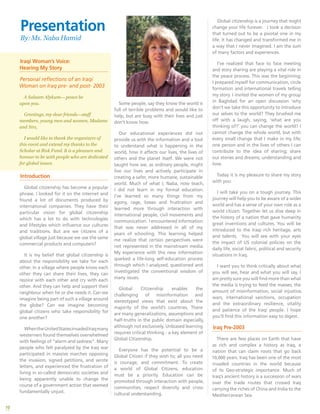
By: Ms. Naba Hamid
11
Modern Iraq is coextensive with ancient
Mesopotamia, the cradle of civilization and
the land of prophet hood, land of Sumer
the place where man invented the wheel
8000BC. Abraham came from Ur- Sumer
in what is today southern Iraq, and some
believe the Garden of Eden was located
there too. Also Mesopotamia in 3500 BC
was a great civilization based on the many
cultures sited on the Tigris and Euphrates
rivers, including Sumer, Akkad, Babylonia,
and Assyria.
The excavations and anthropological
pieces demonstrate that Iraq used to be
stable in ancient ages, starting from the
fourth millennium B.C, and given the
resources of the land of Iraq, and the
specific geographical characteristics, it was
one of the first peaceful lands of humanity
in the world.
Formal Education in
Ancient Iraq
Iraq was where the first attempts
were made to write, develop formal
education systems and develop elaborate
legislative systems. Discoveries were
also made in areas such as astronomy,
medicine, chemistry, mathematics, SLIDE:
ZIGGURAT architectural brickworks, pottery
manufacturing, commerce and literature.
Examples of some of the early literature
from Iraq include the Epic of Gilgamesh is a
Sumerian epic poem that dates back to the
3rd millennium B.C and is the first piece of
written literature in the world. Baghdad is
the source of some of the greatest Arabic
literature, including the magical tales
Scheherazade wove “the Arabian nights”,
the Seven Voyages of Sinbad the Sailor”
and “Ali Baba and the Forty Thieves.”
Hammurabi, the Sixth King of the
ancient Babylonian Empire instituted
an all-encompassing code of laws called
Hammurabi’s code written on a stele which
was a large stone monument. It was one of
the first written law codes in history that
addressed many aspects of the social life in
Babylon, aiming at strengthening the rule
of law and protecting the weakest.
In 762 A.D. the new Muslim rulers for
Iraq moved the capital to Baghdad and
built the city into a thriving intellectual
and cultural center. In the early 9th century
Baghdad reached its greatest prosperity
during the reign of the caliph Harun
al-Rashid, Baghdad represented the crown
of Medieval Muslim civilization. Within the
city there were many parks, gardens, villas,
and beautiful promenades which gave the
city an elegant and classy finish.
Baghdad was situated on the trade routes
linking West and East. The cosmopolitan
nature of Baghdad was evident in its
bazaars, which contained goods from
all over the known world. Joint-stock
companies flourished along with branch
banking organizations, and checks (an
Arabic word) drawn on one bank could be
cashed elsewhere in the empire.
Over five centuries, Baghdad would
become the world’s center of education
and culture as the Abbasids championed
the cause of knowledge and established
the House of Wisdom. Abbasid patronage
of scholarship and the arts produced a rich
and complex culture far surpassing that
then existing in Western Europe.
This period of glory has become known
as the “Golden Age” of Islamic Civilization,
when scholars of the Muslim World made
important contributions in both the science
and humanities: medicine, mathematics,
astronomy, chemistry, literature, and
more; where both Muslim and non-Muslim
scholars sought to translate and gather all
the world’s knowledge into Arabic. (source)
Iraqis today look back on this period as
the zenith of their Islamic past, when
Arabic universities and libraries flourished,
translating Greek texts into Arabic, and
giving life to medical and mathematical
texts that the medieval West ignored.
During the ninth century, Baghdad
contained over 800 doctors, and great
discoveries in the understanding of
anatomy and diseases were made. The
clinical distinction between measles and
smallpox was discovered during this time.
In the early years of the thirteenth
century, Hulaga Khan the Mongol ruler
from the Far East swept west and gained
control of the land. Much of the five
centuries of Islamic scholarship, culture,
and infrastructure was destroyed as the
invaders burned libraries, threw thousands
of books in the Tigris river, when its water
turned to black the color of ink and they
destroyed intricate irrigation systems. By
the end of the Mongol period in the 16th
century Iraq became a political football
between competing powers in Turkey and
Iran. This would remain until well into the
twentieth century.
By the early 20th century, Iraq was
considered part of the frontiers of
Turkey’s Ottoman Empire. Turkish
support for Germany in World War
I marked the end of the Ottoman
Empire. The victors carved up the
Turkish Empire, with Great Britain
gaining control of Iraq and its oil
fields in 1917.
A week after the capture of
Baghdad, General Frederick Stanley
Maude a British commander in
Baghdad issued the proclamation of
Baghdad which included the line:
“Our armies do not come into your
cities and lands as conquerors or enemies,
but as liberators”.
In 1920 Arabs of southern Iraq started
a military action against the British forces,
who did not fulfill their promises to leave
the area to the locals after the Turks were
defeated. The British responded using their
military might at the beginning, but soon
realized that it would be impossible to
control the area. The British mandate was
terminated in 1932 and Iraq was declared
an independent kingdom.
12
Iraq after independence
Following the independence, the wind of
change started blowing marking the start
of a new era. The focus was on building a
highly educated society, providing the best
of education through some of the best
known and among the first Universities
in the Middle-East region and providing
students with scholarships to do their
higher studies in the US and Europe those
students were equally men and women.
Iraq was set on a fast track towards
development, all parts of the Iraqi
society in all its diversity and ethnicities
participated in the building process, for
example the criteria to appoint someone
in the government was solely based on the
qualification regardless of your religion or
ethnic background. A living proof in this in
the thirties was the first Finance Minster in
the Iraqi state, Sassoon Hiskail who was an
Iraqi Jew. In 1959 Iraq was a pioneer in the
region to appoint a woman minister.
The Iraqi woman was granted all
the rights that made her equal to the
man in different aspects like education,
employment opportunities and freedom of
thinking, this allowed the Iraqi woman to
ascend and excel and become an essential
contributing partner in all aspects of the
Iraqi life. Women drove, worked and
became active in almost every sector of the
daily life, went to school, played sports and
participated in government.
These opportunities
in the civil service sector,
maternity benefits, and
stringent laws against
harassment at work
allowed Iraqi women
larger involvement in
building their careers.
Iraq in the 1980’s and
Beyond
The start of the Iraq-Iran
war in 1980 marked the
beginning of the decline
of the way of life in Iraq.
Everything that Iraq
achieved through almost
half a century of investing
into changing Iraq from
being a third world
country into a developed
country now was being invested in a
pointless and devastating wars. This was
only the beginning of the downfall, 8 years
of war with Iran followed by the invasion of
Kuwait in 1990 and the first Gulf War that
almost destroyed all the infra-structure and
marked the beginning of 13 years of cruel
UN sanctions that the people and only the
people of Iraq paid the price for.
The U.S. invasion of Iraq in 2003 was a
heinous crime which brought nothing but
chaos to a country already devastated by 13
years of international economic sanctions
and a dictatorship that squandered
valuable human and financial resources
on military adventures. The US-led war in
2003 destroyed not only the former Iraqi
political dictatorship, but it also destroyed
the entire Iraqi state. America invaded
Iraq, committing change of the regime but
resulting in vast number of death amongst
Iraqi civilians and causing the displacement
of millions.
In spring 2003, as the smoke began to
clear out from the so called Operation
Iraqi Liberation a wave of kidnappings,
abductions, public beatings, death threats,
sexual assaults, and killings ripped the
country the targets were Iraqi women, men,
and children. US authorities took no action
and soon the violence spread and became
so rampant.
After the fall of the regime, the number
of homeless and handicapped children
dramatically increased. For the first time in
Iraq we started seeing a culture of street
children.
According to the Ministry of Work and
Social Affairs homeless children constitute
about 70% of the total homeless Iraqis.
Drug addiction and drug dealing are all
new in Iraq and on the rise among young
people. All kinds of drugs are flowing
freely through Iraqi porous borders, sold in
the streets for very cheap prices.
The deteriorating situation under the
occupation has resulted in social problems
affecting women and children, threatening
the family unit and social fabric of the
Iraqi society exacerbated by the 50-60%
unemployment, put an immense burden on
the family and those who pay the heaviest
price are the widows and orphans. Women
now form a majority of Iraq’s population. A
surprising large number, over half, of those
women who have been married are widows
or wives of missing men. Many families are
female-headed households.
A report prepared by a UN expert on
the International Day on the Elimination
of Violence against Women (November
2008), indicates that ongoing conflict, high
levels of insecurity, widespread impunity,
collapsing economic conditions and rising
social conservatism are impacting directly
on the daily lives of Iraqi women and
placing them under increased exposure to
all forms of violence within and outside
their home. Women are victims of rape,
13
sex trafficking, forced and early marriages,
murder, and abduction for sectarian or
criminal reasons. Women also fall victims
to the disproportionate use of force by
members of Iraqi and multi-national forces,
including during raids on private homes.
Sixty-five percent of Iraqis have no access to
clean drinking water and nearly 75 percent
have no access to a good sewage system.
Schools are short in staff, learning materials
and supplies. The lack of electricity added
more burden on students and families.
Refugee movement is considered one of
the fastest growing refugee crises in the
world. According to the United Nations
there are nearly 3 million Iraqi refugees
living in poverty in surrounding countries
and another 2 millions are internally
displaced.
America and its allies played a role in
igniting the intra-Iraqi religious and ethnic
strife and the practice of ‘total destruction’
using sectarian, ethno-religious division
causing disturbances in the harmony of the
Iraqi social fabric, these actions touched
even inter-ethnic marriages, to establish
long-term dominance of the ethno-
religious rule over the nationalist secular
sense that dominated Iraq for almost a
century.
The invasion provoked destruction of the
libraries, census bureaus, and repositories
of all property and court records, health
departments, laboratories, schools, cultural
centers, medical facilities and above all
the draining of Iraq from all its scholars,
thinkers and educated people. Hundreds
of thousands of Iraqi professionals and
their family members were either killed
or driven by terror into internal and
external exile.
Alongside the atrocities of the war in
Iraq, the world has witnessed the appalling
aftermath of looting and destruction
of Iraq’s cultural and historical heritage.
The National Museum of Iraq with all its
priceless collections of artifacts were looted
alongside thousands of ancient manuscripts
in the National library was destroyed when
the building was burned.
The destruction of Iraq that followed
2003 is similar in so many aspects to that
of the Mongols that threw Iraq back into
the dark ages. Almost 7 years has passed
and the Iraqi citizen is still living without
electricity, clean water and the simple basic
services, but despite all that, you see those
people still work hard to lead a normal
life, try to look for that light in the darkest
night and keep the faith that there will be
a better tomorrow, this is the driving force
that makes the artist paint, the student
study for his/her finals with candle lights,
the musician compose and play with the
sound of explosions and flying bullets.
Last but not least I would like to share
with you a firsthand experience that
showed me the amount of disconnect
and lack of knowledge of the other in the
western countries.
The first one was in 2006 during an
educational tour in the US and in one of the
informal meetings with a small group of
intellectuals and scholars, and after giving
a presentation about the effects of the
occupation on the lives of the young Iraqis,
a middle aged female scholar approached
me and said that she was moved by the
presentation, but what really surprised her
was to actually see that Iraq had women
who were professors and teachers!
The second one was in 2009, here in
Canada during a meeting with the Mayor ‘s
who asked me “Why are you Iraqis coming
to Canada? Your country is very rich!” and
my answer was “ Yes, we are a rich country,
but the reason some of us are here is not
for financial reasons but because of the
insecurity and chaos that swept through
Iraq following 2003” and her shocking
response was “OK then you should tell
the American and Canadian governments
to leave Iraq then!”, I stopped there for a
minute and figured that this Mayor, had no
clue what Iraq’s story was and that Canada
was in Afghanistan not in Iraq.
These two situations showed me that
there’s a huge gap and if this gap is that
big at the level of scholars and politicians
then what about the ordinary people. I
believe education and helping to build
open-minded generations that are able to
respect and understand what’s different to
their culture and habits, and the need to
engage and be part of others lives and to
go beyond our small communities are all
part of the global citizenship movement.
Thank you for your time.
Sources
Stephanie Dalley, S., Reyes, A. T., Pingree, D., Salvesen,
A., McCall, H.. 1998. The Legacy of Mesopotamia.
Oxford University Press.
http://www.squidoo.com/mesopotamia
http://www.megaessays.com/viewpaper/95249.html
http://en.wikipedia.org/wiki/Abbasid_Caliphate
http://www.search.com/reference/Abbasid
http://wapedia.mobi/en/Abbasids
http://en.wikipedia.org/wiki/Islamic_Scholarship_&_
Learning_in_Central_Asia
http://www.absoluteastronomy.com/topics/Fall_of_
Baghdad_%281917%29
http://en.wikipedia.org/wiki/Human_rights_in_Saddam_
Hussein%27s_Iraq
http://en.wikipedia.org/wiki/Iraq_sanctions
http://www.thirdworldtraveler.com/Iraq/Unending_
War_Iraq.html
14
Globalization has made this world so
small that we share everything be it the
technology or clothes or eatables. We are
aware of what people on the other side
of the globe are doing. The term global
citizenship reminds us that we are not born
in one country but we are born on this earth
and so we are citizens of this whole planet.
Thus it is our responsibility to make this
world a better place to live. People globally
are very diverse and being inclusive means
to unite irrespective of the differences
in values and beliefs. It is all about living
together considering ourselves as citizens of
this one world.
As an effort towards advancement of its
equity and social justice agenda Centennial
College launched The Institute for Global
Citizenship and Equity on 20 October 2009.
The vision of the Institute is to conduct
socially just and equitable innovative
research on global citizenship and social
justice as well as serve as a catalyst for
action by faculty, students and staff. It will
use involvement in community service and
community based research to foster social
engagement with the aim of achieving
equity.
The most important thing to understand
in this is the meaning of terms ‘Global
Citizenship’ and ‘Inclusive’. These terms have
different meaning to different people.
The launch of the Institute for Global
Citizenship and Equity involved a number
of academics speaking on various aspects
of global citizenship and equity. I had an
opportunity during the launch to interview
these speakers on the following concepts:
Dr. Nombuso Dlamini, an Associate
Professor in the Faculty of Education and
Research Leadership Chair in the University
of Windsor, explained that ‘inclusive’ refers
to the ability and actions of educators to
respectfully and meaningfully work with
the diversity of identities within their local
communities. It calls for the awareness
of the inter-connectedness of the local to
the globe and how each impacts the other
economically, culturally and politically.
Diversity here takes into consideration the
cultural, linguistic and physical aspects.
She defines ‘Global Citizenship’ as the
ways in which people living within defined
geopolitical nations are connected to and
engaged with others beyond these borders.
Global citizenship is the way by which
everyone is citizen of the world as a whole. It
referstotheinter-connectednessofdifferent
people from different geographical basis
and different geo-political formations. It is a
global embracing process across the borders.
Ms. Naba Saleem Hamid explains ‘Inclusive’
as a reference to the old way of living
together unlike today when there is more
cubicle living, selfness and feeling of being
him/herself. Today the rhythm of life is fast
so nobody has time for anyone. Becoming
inclusive means bringing back that old
way of living where everybody is respected
notwithstanding their background and
roots. Ms. Naba, the Former Professor of
Parasitology and Invertebrate Biology in
the College of Education at the University
of Baghdad refers ‘Global Citizenship’ as of
opening yourself to others. We all are born
as global citizens. It is a journey and we
should not lose anything on the way.
ƒƒ Meaning of the term ‘INCLUSIVE’ in the context
of equity and global citizenship
ƒƒ Defining the term ‘GLOBAL CITIZENSHIP’
According to Dr. Moain Sadeq, Visiting
Professor at the University of Toronto,
‘Inclusive’ means to meet people with
diversity. To live with them without any
differences and considering them equal
respectfully.
Dr. Moain holds the view
that ‘Global Citizenship’ is
constituted with people from
different ancestry, culture
and backgrounds believing in
common values and principles,
sharing together concerns of today and
working together for better future for the
present and new generation in atmosphere
of peace, respect and mutual understanding.
I feel myself lucky to have got the
opportunity to be a part of the launch and
learn about different cultures. I learned that
the only difference between people from
different places is of language and ways of
doing things. The basic ideology of every
human is the same. The emotions, expression
of it, understanding of basic values of life
and millions of other things which make us
humans are the same for everyone. Thus we
cannot define any borders or inequalities
between us. It makes us equal on this globe
and thus demands respect and responsibility
towards each other.
It is now clear that we need to be aware
of the fact that this world is a global
community and we all are its citizens and
we are responsible to fulfill our obligations
towards this global world. It demands for
involvement and action to move towards the
goal of social justice and being inclusive. We
need to think beyond borders, identity and
category and recognize every human being
as equal which will mean respecting human
diversity. We need to have the courage not
to fear or deny differences but to respect
them. Thus we can make this world a better
place to live.
I am so grateful that this event gave me
a spark to ignite my thoughts making me
able to view myself as a global citizen and
recognizing my duties and responsibilities
towards the whole world leaving behind the
inequalities.
Earth: A Green Oasis
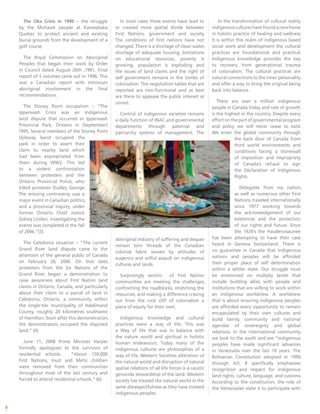
By: Ms. Manjeet Kang – B.A., LL.B. Postgraduate Diploma, Human Resources Management
15
and begin to identify ways they can
make a difference in the helping
field and empower children &
youth. It also helped me focus on
the importance of exposing our
students to understand justice in an
unjust environment.
With this assignment the students
contributed by bringing forward
unjust practices that they observed in
their field placement experiences and
identifying how these practices hindered
the social, emotional, developmental, and
intellectual growth of children and youth.
This in turn became a ‘teachable moment’
that helped other students understand the
many complex social injustices prevailing
in some of our elementary and secondary
schools. Many of the students were able to
articulate clearly how those problems could
be resolved.
During the process of evaluating the
student assignments I was most impressed
with the ability of students to identify
unjust situations. They observed issues
of oppression, racism, and violence in the
schools coupled with isolation and little
protection for those who were bullied.
Other unjust themes that emerged in their
reflections were incidents that seemed to
lack fairness and equity and/or inclusiveness
of some children or youth. They also noted
that some schools had a large multicultural
student group but that the faculty group
did not reflect the richness of the student
group.
As a faculty and an individual who has
worked in the helping field for many years
I have always tried to create situations
and activities for my students that will
challenge their skills, their knowledge, and
their attitude so they in turn can become
catalysts for change in a child or youths
world that is filled with many unjust
practices. Who would have known that
such a small exercise like this reflection
assignment could be so powerful?
When I developed this reflection
assignment I was nervous about
whether first year students would
understand the complexity of the
learning opportunity and be able to
articulate ‘unjust practice’ in the field.
Well was I wrong! Many of the reflection
papers on this ‘unjust practice’ in the school
system were fabulous.
The commitment from the students to
this assignment certainly made my day,
my week, and maybe even my semester.
The reflection of the ‘unjust practices’ in
these papers were thoughtfully written,
articulate, and complex. I was overwhelmed
at how well first year students were able
to understand children & youth, the
underlying issues children are faced with,
and the (negative & positive) impact of
significant people in the lives of children
(e.g. Teachers, Child & Youth Workers, etc.).
Now that most of my students are able
to recognize injustices in school settings,
recognize the impact they have on children
and youth, and demonstrate knowledge of
how these injustices can influence children
and youth’s performance we will be able
to expand this learning so that they will
begin to take on the responsibility to make
the necessary changes. Many children and
youth’s lives will be at the hands of our
students as they enter this wonderful field
of Child & Youth Work.
The favourable response to this
assignment has inspired me to work
with my team to design assignments to
empower the students to share these unjust
practice observations with other influential
individuals who can help them make a
difference in the life of a child and who can
be instrumental in changing this system.
I look forward to watching the Child &
Youth Worker Program begin to uncover
many of the other GC & E assignments we
have planned for our students throughout
their studies.
Articlesand Papers
Child & Youth Worker Students Reflect on Unjust Practices
In the fall 2009, the Child & Youth Worker
Program began integrating Centennial
College Global Citizenship and Equity
competencies throughout the program
courses and curriculum. What follows
describes the integration of these outcomes
into one assignment in a first year course,
the results and the reflection of one faulty
member on that process.
Course Name: Residential Treatment &
School Based Program’s in Child & Youth
Work
Assignment: Reflection Paper on Unjust
Practices 	
SLE Outcome #5: Identify and challenge
unjust practices in local and global systems.
Expectations: Identify through written
reflection one (1) element of an unjust
practice for a particular group of children
and/or youth who are at the elementary
or secondary school environment you are
placed in. Make recommendations to deal
with this issue.
Students are required to critically look at
perspectives in the school community they
are presently placed in through 1st year
field placement.
As a faculty member in the Child &
Youth Worker Program I believe I have
responsibility in preparing my students to
develop ethical behaviour in their personal
and professional life as they prepare to
become Child & Youth Workers. I try to
help them understand their responsibilities
to others, to society (children & youth they
will work with) and to the environment in
which they live.
Helping students to think globally was
an initial challenge but with examples and
questioning I feel I was able to assist many
of the students to expand their thinking
ƒƒ Child & Youth Worker Students Reflect on
Unjust Practices
ƒƒ The Path to Diversity: A Fire Service/Community
College Project
ƒƒ International Service Learning Project
ƒƒ Connecting the Dots - Leveraging Diversity
for Student Engagement and Organizational
Renewal and Change
By: Colleen Kamps, B.A.
CYC, CCW (cert.) Full Time
Professor & Coordinator, Child &
Youth Worker Program
16
Toronto Fire Services (TFS) is the largest
fire service in Canada and fifth largest
in North America with more than 3,000
members proudly serving a community of
nearly three million of the most diverse
people in the world. As of 2006, 47% of the
city’s population were visible minorities, an
increase of 10.6% since 2001, and 31.8%
since 1996. The top five minority groups
in our city are South Asian (12%); Chinese
(11.4%); Black (8.4%); Filipino (4.1%); Latin
American (2.6%).
While TFS already commits
considerable resources to
reflecting the diversity of our
city, even as it continues to
investigate and implement
innovative strategies for
increasing the representation of
visible minorities, women and
other diverse people within ranks,
it will assuredly be challenged to
improve at a rate consistent with
the growth of our city.
Most recent efforts began
with a Toronto City Council
mandate to prepare a three-
year Access, Equity and Human
Rights Plan for the fire division
– a requirement for each division
of the City of Toronto. Access,
equity and human rights
planning began with a 1999
recommendation from the Task Force on
Community Access and Equity that the City’s
Auditor General oversee an audit on access,
equity and human rights once in each term
of Council (every four years).
The first audit report was tabled in 2004,
and the most recent in October 2008. The
latest report contains 29 recommendations,
including in areas of human rights;
civic engagement and monitoring and
measuring progress; and that “the City
should consider including access and equity
related performance indicators in the annual
performance evaluation of management
staff.
While completing the report, the Auditor
General benchmarked the best practices of
such private-sector organizations as IBM,
HSBC Bank and the University of Toronto
– each of which was awarded Canada’s
Best Diversity Employer Award in 2008 by
Mediacorp Canada (the City of Toronto
received the 2007 Diversity on Governance
Award from the Maytree Foundation).
Fire Service Response
The first task was a review of the
latest literature. Research on fire service
demographics, as well as the effect(s)
of multicultural capacity on either the
delivery of services or ability to recruit from
multicultural communities, is surprisingly
rare. The most recent, and most meaningful,
in North America are the Multicultural
Health and Safety Project (MHSP),
conducted by Fire 2020 (www.fire2020.org),
and the National Report Card on Women
in Fire Services (‘Report Card’) conducted by
iWomen.
The MHSP report primarily demonstrates
an adverse effect of insufficient multicultural
capacity on the health and safety of both
firefighters and community members.
Coincidentally, section 6 of the MHSP report
included a demographic profile of the
American metropolitan (communities larger
than 100,000) fire service experience.
The Report Card highlighted a number of
relevant findings respecting the experiences
of women in the fire service who, according
to the Report Card, represented about 4 per
cent of American firefighters – compared
with almost 50 per cent representation in
the general American labour force, and
about 17 per cent in similar occupations.
Once a literature review was complete,
TFS sought to understand the implications
within community and broader trends, the
most relevant of which was an increasing
requirement for graduation from the
Ontario standardized Pre-Service Firefighter
Training and Education program (the
Program) as a prerequisite to hiring.
Provincially Standardized
Curriculum
The Program consists of a standardized
curriculum jointly developed by the Ontario
Association of Fire Chiefs (OAFC) and the
Ontario Office of the Fire Marshal (OFM).
The program is strictly controlled by the
Endorsement Review Board of the OAFC
and OFM, which has endorsed about 14
community colleges, three in the City
of Toronto; Humber, Seneca, and most
recently Centennial, which has not yet
scheduled intake for their first class.
When asked, the community colleges
in the Toronto area currently graduating
Program students anecdotally placed
the gender and ethnic demographics of
those students at less than 10%, far below
that which would allow TFS to improve
diversity among firefighting ranks while,
at the same time, insisting on graduation
as a hiring pre-requisite.
When analysed to determine reasons
for low diversity participation rates, a
number of prominent equity barriers were
discovered, including Program tuition fees,
varying independent entrance requirements,
support services, and marketing.
The Path to Diversity: A Fire Service/Community
College Project
By: Dan Haden
17
There are considerable costs associated
with delivering the Program, largely due
to the need for students to either purchase
or lease personal protective equipment
(PPE); and the need for colleges to have
agreements with local fire services for the
use of facilities, equipment, etc., to be able
to meet the very strictly controlled program
and learning outcomes. The Program is
a one-year, three-semester Certificate
program and tuition fees in the City of
Toronto are about $12,000. Tuition for a
typical three-semester Certificate program
would be about $6,000.
The Program has been approved for
provincialfundingbytheMinistryofTraining,
Colleges and Universities at about 13 Ontario
colleges, and it is generally eligible for OSAP
(Ontario Student Assistance Program) and
other loans, grants and bursaries.
Centennial College met with the ERB
several years ago, in part on the basis of
being able to bring greater diversity to
student participation rates, but was refused
application because the ERB felt there was
no market need, although Centennial was
advised they would be the next college
considered for certification.
In 2008, TFS changed its hiring process,
removing the use of lengthy hiring lists
which had prevented it from recruiting since
2001. Under the new hiring process, TFS
would now hold annual recruitment drives.
Further, TFS projected the possible hiring of
about 125 recruit firefighters per year over a
five-year period beginning 2008.
Centennial is in an important position
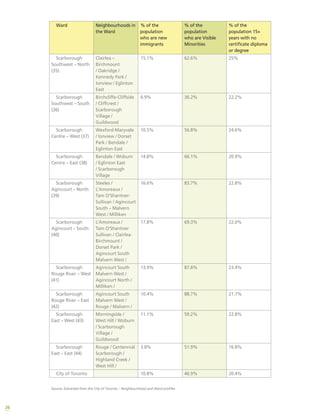
in terms of student diversity. About
2006, the City of Toronto analyzed its
140 neighbourhoods through a Strong
Neighbourhoods Task Force using such
indexes as general services (recreational
and community centres, etc.); and services
for specific needs (employment, food banks,
children’s services, etc.). The analysis then
compared service locations to block-level
population distribution by neighbourhood,
and the results were categorized on scales
thatcorrelatedtheextentofservicecoverage
against the extent of population need. Risk
factors, including median household income,
percentage of population spending 30%
or more of income on shelter, percentage
of local students passing the High School
Literacy Test, etc. were then identified and
correlated. When Community Safety Plans
and experiences of violence were factored in,
the result was the identification of Toronto’s
13 Priority Areas (PAs).
Generally, within the 13 PAs;
•	 Most have higher than average at-
risk populations, including visible
minorities;
•	 11 of 13 had family incomes below
the city average;
•	 Unemployment rates for
population ages 15 years and over
were higher than average in 12 of
the 13 PAs;
•	 All showed higher than average
rates of visible minorities;
•	 Many PAs had a higher than
average proportion of residents
with post-secondary education
from outside Canada.
•	 Of the 13 PAs, 10 are fairly
homogenous in that visible
minorities represent near or
greater than 66% of the total
population;
•	 Almost every PA has a higher than
average proportion of recent
immigrants.
Each PA has a Neighbourhood Action
Partnership (NAP) designed to bring
together members of the community with
social organizations, public and private.
With respect to the Scarborough area
particularly (the area served by Centennial
College);
•	 There are more PAs in Scarborough
than in any other Toronto pre-
amalgamation geographic area.
•	 The PAs in Scarborough represent
about 44.96%, or almost half of
the total city PA population.
•	 75% of the PAs which are
experiencing population growth
from 2001 to 2006 are in
Scarborough.
•	 66% of the PAs with the highest
rates of increased child population
from 2001 to 2006 are in
Scarborough.
•	 The PA with the fastest growing
population of youth 15-24 years is
in Scarborough (Dorset Park).
•	 Every Priority Neighbourhood has
a similar or higher proportion of
Dependency Population (persons
younger than 16 and older than
64) than the city average, however,
6 of 13 Priority Neighbourhoods
experienced growth in this
population segment much higher
than city average. One of two
PAs with the fastest growth in
Dependency Population is in
Scarborough.
•	 All Priority Neighbourhoods in
Scarborough are homogenous –
visible minorities represent near
or greater than 66% of the total
population.
•	 One PA (of two in the city) in
Scarborough has a higher than
average proportion of recent
immigrants (2001-2006).
•	 Most Priority Neighbourhoods (9
of 13) have higher than average
lone-parent families, and the
Priority Neighbourhood with the
highest rate is in Scarborough.
18
•	 Two of four (50%) of PAs with
higher than average increases
in single-led families are in
Scarborough.
•	 All PAs in Scarborough
have a higher than average
unemployment rate for the
portion of the population 15 plus
years, with Scarborough Village
rates much higher than the city
overall.
•	 The City’s low-income rate
(number of persons in low income
after tax) is 19.4%. The Priority
Neighbourhood with highest
low-income rate in the city is
Scarborough Village at 30.4%.
Centennial’s student demographic data
supports its claim to being “one of the
most diverse post-secondary institutions in
Canada.” At Centennial;
•	 68 per cent of students are 21
years-old and above;
•	 40 per cent speak a language other
than English or French as their first
language;
•	 Approximately 100 cultural groups
and 80 languages are spoken;
•	 63% of students are visible
minorities;
•	 44% of students are first
generation students (first to attend
post-secondary education in their
families);
•	 29% of students have lived in
Canada less than seven years.
•	 26% of students are from single-
income families with dependents.
Working together, TFS and Centennial
drafted an enhanced version of the Program.
In addition to required ERB courses, three
courses were inserted by Centennial;
•	 English (a Credential validation
Services general education
component). Outcomes will
prepare learners for the
requirements of the standardized
aptitude test being used by TFS;
•	 Fitness Course. Outcomes will
prepare learners to meet the
requirements of the standardized
CPAT (Candidate Physical Ability
Test), the current fitness test used
by TFS;
•	 Career Preparation Course.
Outcomes will prepare learners
for traditional generic recruitment
processes, including interview skills,
resumes, etc.
The various ERB program and specific
outcomes (including practical self-check
sheets) were jointly reviewed to determine
teaching that could occur at TFS facilities (by
TFS Training Officers) versus teaching that
should be conducted by Centennial College.
When this was complete, a draft model
route was established that places students
in Centennial classrooms four days per week,
and TFS classrooms one day per week during
semesters one and two. Semester three, the
Pre-Graduate Experience, which consists
of at least 192 hours practical fireground
training, will take place entirely at TFS
facilities.
The costs of curricula delivery was then
calculated by each project partner to arrive
at a total Program cost. Inherently, the total
Program cost was reduced by differences
in faculty rates between the partners, and
a focused effort to reduce costs in light of
the nature of the project as a human rights
initiative to increase access for gender and
ethnically diverse people – defined for the
project as women, visible minorities and
Aboriginal persons.
The reduced cost benefits associated
with articulated teaching partnerships
were then combined in a bursary, with a
further amount generously contributed by
Centennial from Program proceeds. The
formulas for contribution to the bursary
were then expressed in an articulation
agreement for final review and approval by
the partners.
Once approved, the bursary will be made
availabletoeligiblestudentswhoarewomen,
visible minorities, or Aboriginal persons, to
offset Program tuition fees. The articulation
agreement requires that at least 65% of
each student intake consist of gender and
ethnically diverse people. With a proposed
class size of 35 students, this means that the
bursary amounts will initially be divided
among 22 students, however, it’s more likely
that the bursary will be distributed over the
duration of the Program and final amounts
will depend on the retention/attrition rates.
In any event, initial calculations completed
at 50 per cent, 60 per cent, and 65 per
cent distribution suggest that gender and
ethnically diverse students will be able to
participate in the Program at Centennial
at among the lowest tuition rates in the
province, thereby eliminating cost as an
equity barrier.
19
The project has been approved by the
Endorsement review Board of the Ontario
Association of Fire Chiefs and Ontario Office
of the Fire Marshal and is now awaiting
final funding approval from the Ministry of
Training, Colleges and Universities as well as
approval of the articulation agreement by
the City of Toronto.
Conclusion
What we know from the work of Fire 2020
and iWomen is that;
•	 Multicultural communities want to
participate in their fire services;
•	 Multicultural communities and
fire services may have different
views on the extent of fire service
multicultural capacity;
•	 Negative experiences, including
through inspections, 911
communications, etc., can
adversely affect public trust of fire
services;
•	 Insufficient trust and multicultural
capacity can adversely affect
firefighter safety;
•	 The effectiveness of our fire
prevention and education
initiatives vary across multicultural
communities;
•	 In the City of Toronto, our
multicultural communities will
soon be the majority owners of our
fire service;
•	 Women may not want to
participate in firefighting at the
rate they are reflected in our
general workforces, but at 3.7%
representation in the fire service,
47% in the general labour force,
and 17% in similar occupations
(our first benchmark), we are still a
long way from women being fairly
represented in our fire stations;
•	 At our current rate of change,
women will wait about 72 years
before they are fairly represented;
•	 We don’t have to lower standards
for female firefighters;
•	 Women can make the decision to
become firefighters as young as 11
years-of-age;
•	 Most women firefighters hear
about firefighting through a friend
or relative who is/was a firefighter;
•	 Some women decide not to
become (or remain) firefighters
because of some of the incidents
they hear about (or experience) in
our fire stations;
•	 We don’t market to women as
effectively as we market to men;
What we know from the social and
demographic trends is that we (as a city, a
region, a census area, a province, a country)
are a changing society in which equality is
being both demanded and sought. Our
social processes are being amended to assure
that the ability to make those demands is
not hampered by systemic or other barriers,
and the cost (fiscal and social) of waiting to
see exceeds the cost of preventing.
The joint Toronto Fire Services and
Centennial College Enhanced Pre-Service
Firefighter Training and Education
curriculum project can, for the first time in
the history of the program, achieve a level
of participation by gender and ethnically
diverse students at least equal to the
representation of these people in our city.
Einstein once said, and I paraphrase,
that it seems as though we have lost the
passion for justice and dignity and no longer
treasure what better generations have won
a great sacrifice.
We should retain the power to control the
direction of our own changes for the same
reason we honour the tradition that we
inherited from better generations.
It’s simply the right thing to do.
Dan Haden
Dan Haden has been a firefighter with Toronto
Fire Services (Canada) for 27 years. He is currently
seconded as an officer in the Recruitment and
Community Outreach Section. Dan has been owner
and publisher of The Fire Services Journal, President
of the Fire Services Resource Centre for Canadian
Association of Fire Chiefs and Fire Prevention
Canada, and consultant to Fire Fighting in Canada
magazine. He has written numerous fire and
emergency services editorials and articles; is the
author of several textbooks; and has presented at
conferences throughout Canada and the U.S. Dan
has a B.A. (Psychology - York University), an M.A.
(Adult Education - Central Michigan University), six
college Certificates (Business - Centennial College),
a Vice-Provost’s Certificate from University of
Missouri, and a number of emergency services
certificates. Dan’s current work involves fire service
access, equity, diversity and recruiting research and
assignments. Dan can be contacted at 416 338 9518
or dhaden@toronto.ca.
20
Service Learning as an academic
practice has gained popularity in recent
years. As a philosophy or pedagogy, it
is used to enable students after they
have learnt key concepts in a course, to
participate in an organized service activity.
Students then reflect on the activity they
participated in, in order to gain a deeper
understanding of what they had been
taught. It also provides students with a
broader appreciation of the disciplines
they are studying and leads to enhanced
levels of civic engagement.
As a teaching method, it falls under
the category of experiential education.
It is a method of teaching, learning
and reflecting that combines academic
classroom curriculum with service in
the community. The goal is to integrate
service with instruction and reflection to
enrich the learning experience, develop
academic skills, teach civic responsibility
and encourage lifelong civic engagement.
Where can I get more information
on Service – Learning?
There is a Canadian Alliance for
Community Service Learning where
you can get information at http://www.
communityservicelearning.ca/en/
Community Service Learning
Community Service learning like service
learning is a pedagogy characterized by
student participation in an organized
service activity that is connected to
specific learning outcomes and meets
identified community needs. Within
effective Community Service Learning
efforts, members of both educational
institutions and community organizations
work together toward outcomes that are
mutually beneficial.
The Centennial College Global
Citizenship Experiences Abroad:
Internationalizing Centennial
College Signature Learning
Experience
Introduction
Centennial Global Citizenship Experiences
Abroad initiative was launched with an
exciting International Service Learning
Project that will provide eight Centennial
students with an opportunity to travel to
the Dominican Republic to put their learning
and skills into practice in a community
development project.
InkeepingwithOurBookofCommitments,
the aim of this service learning project is
to empower students to address issues of
global citizenship and social justice advocacy
while participating in a unique cultural
immersion experience where they will be
able to apply the knowledge and skills
learned in their program to date in various
community development initiatives. In this
inaugural project, students will be working
in the north coast community of Colonia
Nueva in Cabarete between March 6 and 20
2010.
To be eligible, each of the selected
participants had to have good academic
standing and a demonstrated interest in
global citizenship. They were accompanied
by three college staff members: Kristi
Harrison, Associate Vice President, Academic
Excellence; John Curtis, Registrar; and Rachel
Larabee, Mobility Officer, International
Education Centre.
Service learning projects have clear
learning goals that develop global
citizenship skills and foster mutual
respect in ways that are aligned with
Centennial’s programs and curricula,
as well as provide meaningful
co-curricular excursion experiences.
Learning becomes experiential and applied,
deepening students’ understanding of the
various components of their learning and
skills that can be applied to transforming
communities, and why this understanding is
an integral element in the development of
today’s global citizen.
The project came about when United
Nations Ambassador of the Dominican
Republic, Francis Lorenzo, learned of
Centennial’s focus on global citizenship and
equity and arranged a visit to the college last
spring. He expressed a desire to forge a link
between the work of our students in this
area and the development work in some of
his communities, and extended an invitation
to our College to participate. Through the
combined efforts of POR AMOR, a Canadian
non-governmental organization (NGO), and
its American NGO contacts, our students will
be contributing to the Dominican Republic
Education And Mentoring (DREAM) Project,
a community-based nonprofit that provides
education and mentoring projects for
children born into poverty in the island’s
rural areas and small communities.
Each student will have the opportunity
to design and facilitate an educational
workshop related to their field of study that
will have both a meaningful impact within
the community of Colonia Nueva, and
allow them to share and apply knowledge
gained within their program of study. They
will be also blogging their experiences
live from the Dominican Republic at
centennialcollegeblog.com.
Thoughts from the Team
Rachel’s bio:
Rachel Larabee, current Student Mobility
Officer for the Department of International
Education at Centennial, is the Project
Coordinator this first annual International
Service Learning Project in the Dominican
Republic as the first project to launch the
college wide initiative of Global Citizenship
Experiences Abroad. With her years of
both living and working in the Dominican
Republic in the
spheres of education
and community
development services
as well as her seven
years experience
co-founding and
co-creating POR
AMOR Community
E n h a n c e m e n t
Initiatives, an Canadian
Incorporated Non-profit Organization, her
extensive knowledge, experience passion in
the arena of social activism and justice can
help all the participants and chaperones
on this trip feel comfortable with Rachel as
their guide. In addition to her professional
work, Rachel is also an active Spoken-
Word Poet who uses her reflections on
the work she does and the life she leads
Service Learning
21
to creatively express, share and hopefully
inspire others to take more active roles
in pursuit of their own passionate and
purposeful life endeavors. Currently Rachel
is working on the final edits to publish
her first novel entitled, (En)Compassing
Heart, a modern day allegory, laced with
Rachel’s poetry, that tracks the journey of a
young antagonist, who travels abroad as a
service volunteer searching for guidance to
discover what unique gifts she might possess
to offer the communities within which she
works. Through this adventure she begins
to understand her greater life purpose
and in turn what work she feels driven
to do as an offering her local community.
She learns to move forward on this unique
path through the pursuit of listening to
and following her heart, which become her
ultimate guide.
Thoughts from Rachel Larabee
Words cannot express how excited I am
to take our Centennial Students along with
Kristi Harrison, our Associate Vice President-
-Academic Excellence, and John Curtis,
our College Registrar, on this meaningful
journey.
International Service Learning projects
not only broaden awareness of our diverse
and inter-connected world but also
deepen our understanding of the reality
some of our fellow global citizens in the
developing world face. Our Centennial
student participants will be engaged in two
jam-packed weeks of wonderful cultural
immersion while they facilitate effective
and educational workshops which they have
each designed themselves with the support
of some their respective faculty teachers.
This project in intended to help each
participant leap forward in their continued
development as a global citizens. Together
we will learn first-hand of ways to support
the communities we will serve as well as
ourselves in an attitude of solidarity for our
positive development as human beings on
this big and beautiful Earth.
Seven years ago I embarked on my first
service learning project, working with
youth in the Dominican Republic, and it
changed my life in ways I could never have
imagined. Shortly after, I co-founded POR
AMOR Community Enhancement Initiatives,
a non-profit organization that specializes
in creative youth empowerment projects
in both local and international arenas. We
also organize, host and perform in live
musical showcase events to raise funds and
awareness of the various social justice and
community development efforts we support
worldwide.
Through POR AMOR and my work at
Centennial College, I work passionately to
encourage myself and others to manifest
our dreams of living in a more vibrant world
of positive social change.
Ready with open minds and hearts, we
have no idea where this will take us or
Centennial and this exciting initiative of
Global Citizenship Experiences Abroad but
I personally have no doubt that it will be
somewhere great!
The Student Perspective
Author: CCC student, Victoria Gray
(School of Journalism)
Ever wanted to do something great, teach
someone else about
your passion and be
taught about the
world in return?
Centennial College’s
new initiative:
Global Citizenship
Experiences Abroad
in collaboration with the Department of
International Education has offered eight
students from different Centennial Schools
and programs of study the chance to learn
from a global community and enhance their
portfolio as global citizens.
On March 7, 2010 recipients of the
first annual International Service Learning
Scholarship will go to the Dominican
Republic to help the DREAM Project
and teach different groups within the
community of Colonia Nueva, a small rural
community on the North Coast of the Island
in a small town, called Cabarete, what they
are learning at Centennial.
Students will be facilitating workshops
to different age groups and audiences on a
topic that interests them from their chosen
field of study.
Rachel Larabee, Mobility Officer from
the department of International Education,
spearheaded this initiative and is busily
working with the DREAM project to
finalize all plans for the trip as well help
the students put together some effective
and exciting workshops to exchange within
the Dominican Community. As well she
had been coordinating different excursions
for the group in relation to each of their
workshop topics to help the Centennial
students obtain a greater understanding of
the topics they will be discussing within the
specific cultural contexts of Dominican life
to help them relate to their experiences of
their Dominican workshop participants.
The students spent Saturday,
February 20, 2010 teambuilding and helping
eachotherdevelopideasfortheirworkshops.
Brandi Reader, GCEA participant from the
school of Community and Health Services has
given weekend workshops on teambuilding
before and was impressed with the way the
group handled a difficult challenge called
the ‘Matrix’. This activity involves finding the
way through a maze on the floor with no
information given as to how to get through
the maze other. Team members are forced
to rely on the advice of their team mates as
well as their own intuitive judgment and
in the end we all learned what it means to
truly rely on your team to make it through
the challenges.
“I’ve done this activity on the last day of
a workshop before. I’ve seen people start
crying and yelling at each other,” Brandi
said. Larabee wanted to make sure the team
could stand up to the challenge before we
left Canada and faced the work ahead of us
together as group.
“(They) all did a great job, I made it more
difficult for (them) to see what would
happen,” Larabee said.
Coloured home, on the Coast of Santo
Domingo, Dominican Republic
Posted by: Chris Macdonald,
centennialcollegeblog.com
Posted by: Aleksejs Nesterins,
centennialcollegeblog.com
22
The students selected for the
International Service Learning
Scholarship are:
School of Business
Jamie McKenzie
School of Community
and Health Services
Brandi Reader
Christopher MacDonald
School of Communications,
Media and Design
Aleksejs Nesterins
Victoria Gray
(both selected as Trip Doucmentarians)
School of Transportation
Guillermo Flores-Escobar
School of Continuing Education
and Part Time Studies
Eunice Leung
School of Hospitality and Tourism
Beth Lafay
As for me, I’m truly excited about the
possibilities this trip offers and I can’t wait
to get on the ground and make some
difference in the world, however small,
I know it will change me forever, for the
best.
Literary Corner: Poetry
“Butterflies”
Rachel Larabee©2009
Last night I went flying
Stepped right out of my caterpillar fuzz
Colours shining
I was the most beautiful butterfly there
ever was
In the buzz of changing frequencies
The sequences of my life took a vast
departure off the ground
I was overwhelmed by this buzzing sound
And to my profound understanding
The ground on which I had been previously
standing
Become merely a platform for my future
landing
I felt my wings expanding
As my spirit handed me the most precious
piece of my evolution:
Flight
Then, all of the sudden, it’s like something
was trying to snatch me
Almost like something was trying to block
me, stop me
Talk to me about all the reasons why I
couldn’t fly
I think it was then that I started to cry
Thinking ‘Why?’
Why couldn’t I be a free-floating butterfly?
Why couldn’t I?
Funny, cause this deceptive dream snatcher
sounded like my own voice
This deceptive dream catcher left me with
no choice but to awake
From that dream
And start another
Have you ever had a dream that felt so real
you swore you were awake?
That felt so real you thought, ‘This must be
a mistake.
There’s no way o could have mistaken the
dream life
For faking what seems like
Reality’
As we say we know and experience it to be
You see, in many ways I look at life like as a
dream
What I mean is that sometimes I go to
places in my dreams that I’m asleep to
When I’m awake
I mean sometimes I wait for the dream to
end at the end of the day, at the end of a
way
of thinking
My subconscious starts blinking and
slowwwwly
I
Fall
Asleep
Allowing me to awake
To something much deeper than my
dreaming
Seeming “reality” could ever possible by
I mean I can only speak for me but
Dreams don’t seem very separate from
reality from what I see
I’ll tell you honestly
My life is a dream
And I make it come true
I’ll tell you honestly
This life is not what it seems and some
people have made it that way for you
I’ll tell you honestly
The truth about dreams
Is that this is one
In which your conscience has control
See it’s your conscience that’s been enrolled
in this Earth school of dreaming
This complex swirl of meaning
The temple of soul redeeming
This seeming “reality” and all it’s fatalities
Is a manufactured production that’s been
forged into your mind
It’s as real as you believe it is
23
Now as we spiritual rainbow warrior
I’ve been summoned here to warn you
That this
Right here
Right now
Is only a dream
An illusion
To some a grand confusion
To others a brilliant fusion
Enforcing mind prison institutions
Get free
Dream with me
They they’ve been using “reality”
To keep you asleep
Look deep deep inside
As I confide to you why
We really all can be butterflies
As words flow from my fingers to your eyes
From your eyes to your mind
In these colourful words I describe you will
find truth
Now
How would you like it is I told you,
YOU could never me a butterfly
Only a caterpillar
A tiny, fuzzy critter of the Earth?
Or is I said,
Yeah, maybe YOU could be a butterfly
But only after you’ve complied with MY
every wish
What if I told you a minnow would never
be a fish
Or that right here you’re reading a poem I
don’t intend to finish…..
Obviously the ridiculousness of these
examples is what’s true
The wickedness that for years some people
have been lying to you
Our dreams of butterflies
Have been nullified
Into six million reasons we should simply
just comply to this system
Get comfortable with that nagging feeling
that something is missing
But
If
You
Closely
Listen
To your dreams
I can guarantee you
You will fly
In the mean time
Those same people will petrify you into
staying on the ground
Teaching you to ignore the profound
You see the profound thing about
butterflies is that they began on foot and
were then
Able to ascend
The key
Is to dream yourself around that bend
In the end your dreams really are your only
friend
Dream with me
Dream to be free
A beautiful butterfly soaring through this
so-called “reality”
Spiritual detectives piercing right through
the fallacy
The truth is
We all exist
In many different forms throughout the
galaxy.
24
1. Introduction
Centennial College is Ontario’s first
community college. It was established in
1966 primarily to serve the eastern portion
of the Greater Toronto Area through four
campuses and seven satellite locations. It has
a record of exemplary teaching, innovative
programming and extensive partnership
building. Centennial is recognized as one of
the most culturally diverse post-secondary
institutions in Canada. Almost 100 ethno
cultural groups are represented and 80
languagesarespokenoncampus.Centennial
is committed to both broad public access
and successful career education. Centennial
supports enrolments of 14,400 full-time
students and 28,000 Continuing Education
students. Centennial College since 2004, has
been engaged in actively embracing global
citizenship and equity as core principles for
the College.
2. Diversity and
Organizational Change
With increasing diversity in postsecondary
institutions, changes in the demographic
mix of students, and a more heightened
awarenessofsocialinequity,therehavebeen
discussions on how to make the educational
process more inclusive. The Association
of American Colleges and Universities
has examined ways of integrating it’s
diversity and quality initiatives and in 2005
commissioned three papers to look at what
it called Making Excellence inclusive.
The project looks at the associations work
on diversity and on quality initiatives and
believes that “integrating diversity and
quality initiatives – as with the forging of
elementsintoanalloy–producessomething
that is both different than its constituent
elements and stronger and more durable”.
They see diversity and inclusion efforts as
“multilayered processes through which we
achieve excellence in learning; research and
teaching; student development; local and
global community engagement; workforce
development; and more”.
The Association describes four main
components of what it calls inclusive
excellence. These include the following:
i.	 A focus on student intellectual and
social development. Academically, it
means offering the best possible course
of study for the context in which
education is offered.
ii.	 A purposeful development and
utilization of organizational resources
to enhance student learning.
Organizationally, it means establishing
an environment that challenges each
student to achieve academically at
high levels and each member of the
campus to contribute to learning and
knowledge development.
Connecting the Dots - Leveraging Diversity
for Student Engagement and Organizational
Renewal and Change
By: Dr. Eva Aboagye
iii.	 Attention to the cultural differences
learners bring to the educational
experience and that enhance the
enterprise.
iv.	 A welcoming community that engages
all of its diversity in the service of
student and organizational learning. 3
One of the papers by Damon, Berger and
McClendon 4
, they looked at a framework
that can be used for achieving inclusive
excellence. The framework produced below
provides a comprehensive picture of the
various aspects of organizational change
and provides information on the different
aspects that need to be examined in the
process of achieving inclusive excellence.
The Framework takes into consideration the
external factors as well as the internal factors
in ensuring change that can be sustained.
3
Milem, J. F., Chang, M. J., Antonio, A. L. 2005 Making
Diversity Work on Campus: A Research-Based Perspective.
Association of American Colleges and Universities.
4
Damon A. W., Berger, J.B. and McClendon S. A. 2005
Toward a Model of Inclusive Excellence and Change in
Postsecondary Institutions. Association of American Colleges
and Universities.
25
Inclusive Excellence Organizational Change Framework
Element Definition Components Centennial College
External
Environment
Environmental
forces that drive
and constrain
implementation of
inclusive excellence
Shifting
Demographics
Societal inequities
Workforce Needs
Political and Legal
Dynamics
Immigration,
Workforce
needs and the
communities we
serve
Organizational
Behaviour
Dimensions
Multiple vantage
points that must
be used to shift
the informal
and formal
environmental
dynamics toward
inclusive excellence
Systemic
Bureaucratic
Symbolic
Collegial
Political
Special hiring
processes to deal
with systemic
barriers
Organizational
Culture
Dynamics that
define higher
education and that
must be navigated
to achieve inclusive
excellence
Mission
Vision
Values
Traditions
Norms
Revised vision,
academic
framework and
statement of
diversity
Inclusive Excellence
Scorecard
Comprehensive
framework for
understanding
inclusive excellence
that extends and
adapts work on
diversity scorecards
and dimensions of
the campus climate
Access and Equity
Diversity in
the Formal
and Informal
Curriculum
Campus Climate
Student Learning
Compulsory
General Education
course and an
International
Service Learning
project
Inclusive Excellence
Change Strategy
Fluid institutional
strategy to make
inclusive excellence
a core capability of
the organization
Senior Leadership
Vision and Buy-In
Capacity Building
Professional
development and
the creation of the
Institute for Global
Citizenship and
Equity.
Adapted from: Damon A. W., Berger, J.B. and McClendon S. A. 2005 Toward a Model of Inclusive Excellence and
Change in Postsecondary Institutions. Association of American Colleges and Universities. P. 31
3. Diversity In and Around
Centennial College
Centennial is situated in Scarborough,
an area rich with diversity. In the latest
projections made by Statistics Canada,
Toronto has received and will continue to
receive immigrants which will change the
ethnic composition of the city. Scarborough
likeotherneighbourhoodsreceivesanumber
of new immigrants. In the City of Toronto’s
description of neighbourhoods, one can see
that most of the Wards in the Scarborough
area all receive a higher proportion of
immigrants as shown in the table below. In
addition a higher than average proportion
of people 15 years and older do not yet
have a postsecondary education. This puts
the College in a unique position to be
able to provide supports and services that
encourages the people to take advantage of
some of the College’s programs.
26
Ward Neighbourhoods in
the Ward
% of the
population
who are new
immigrants
% of the
population
who are Visible
Minorities
% of the
population 15+
years with no
certificate diploma
or degree
Scarborough
Southwest – North
(35)
Clairlea –
Birchmount
/ Oakridge /
Kennedy Park /
Ionview / Eglinton
East
15.1% 62.6% 25%
Scarborough
Southwest – South
(36)
Birchcliffe-Cliffside
/ Cliffcrest /
Scarborough
Village /
Guildwood
6.9% 36.2% 22.2%
Scarborough
Centre – West (37)
Wexford-Maryvale
/ Ionview / Dorset
Park / Bendale /
Eglinton East
10.5% 56.8% 24.6%
Scarborough
Centre – East (38)
Bendale / Woburn
/ Eglinton East
/ Scarborough
Village
14.8% 66.1% 20.9%
Scarborough
Agincourt – North
(39)
Steeles /
L’Amoreaux /
Tam O’Shantner-
Sullivan / Agincourt
South – Malvern
West / Milliken
16.6% 83.7% 22.8%
Scarborough
Agincourt – South
(40)
L’Amoreaux /
Tam O’Shantner
Sullivan / Clairlea-
Birchmount /
Dorset Park /
Agincourt South
Malvern West /
17.8% 69.3% 22.0%
Scarborough
Rouge River – West
(41)
Agincourt South
Malvern West /
Agincourt North /
Milliken /
13.9% 87.8% 23.4%
Scarborough
Rouge River – East
(42)
Agincourt South
Malvern West /
Rouge / Malvern /
10.4% 88.7% 21.7%
Scarborough
East – West (43)
Morningside /
West Hill / Woburn
/ Scarborough
Village /
Guildwood
11.1% 59.2% 22.8%
Scarborough
East – East (44)
Rouge / Centennial
Scarborough /
Highland Creek /
West Hill /
3.8% 51.9% 16.8%
City of Toronto 10.8% 46.9% 20.4%
Source: Extracted from the City of Toronto – Neighbourhood and Ward profiles
27
This diversity in the population around
the College is also reflected in the College’s
student population. For more information
on the make up of the Centennial Student
population see the Global Citizen Digest Fall
2009. The taskforce was made up of three
subgroups; Signature Learning Experience,
Balanced Scorecard and Organizational
Learning.
In keeping with the neighbourhood
it serves, Centennial has a wide range of
programs to cater to different educational
backgrounds. The programs range from one
year certificate programs, two year diploma
programs, three year advanced diploma
programs and four year applied degree
programs. The College also has a number of
one year post diploma programs.
4. College Commitment to Equity
and Social Justice at Centennial
The College focus on diversity and social
justice began with the collection of data
on diversity among employees in 1995. In
1997, the Board of Governors approved the
College’s Dispute Resolution Policies and
Procedures. This document which formed
the basis of most of the work on social justice
that took place at the college. The Board
of Governors also developed a Statement
of Diversity as a guiding principle for the
College.
Diversity at the College became the focus
of renewal for the College in 2004 when the
President created the President’s Taskforce
on Learning. The President’s Taskforce on
Learning was created to help bring our
policies on learning and diversity to life.
This was a 25 member team to oversee the
process toward the goals.
The President’s Taskforce on Learning
consisted of the following sub-groups:
ƒƒ Signature Learning Experience
ƒƒ Balanced Scorecard
ƒƒ Organizational Learning
4.1. Signature Learning Experience
History
A sub-group of the President’s Task Force
on Learning called the Signature Learning
Experience Working Group was formed to
shape the distinctive learning experience
that we provide to our students.
“Buildingonworkthathadbeenpreviously
carried out within the College, the Signature
Learning Experience Development Team
was created with representation of faculty
members from each of our eight schools.
This group worked on the development of
the general education course to be offered
to students and the accompanying text
“Global Citizenship: From Social Analysis to
SocialAction”.Throughoutthedevelopment
process, the team met weekly to develop
the course content, and to engage in their
own learning activity to understand issues of
global citizenship, learning and social justice.
What they discovered was that these issues
do not occur in a vacuum – they are part of
a global economic and technological reality
and must be considered in context. They
concluded that the general education course
they were developing had to empower
students to understand this broader context
and judge it using their own critical thinking
skills. In other words, the course is not
designed to tell students what to think about
creating an equitable and inclusive global
society, but how to think about it; to make
up their own minds in a balanced way. In this
way, we are striving to develop our students
as critical thinkers who can participate in a
global environment.” (SLE 2008)
In 2010, the College added on another
dimension to our Signature Learning
Experience by creating a global learning
experience called the Global Citizenship
Experiences Abroad.
This project is to empower students to
address issues of global citizenship and social
justice advocacy while participating in a
unique cultural immersion experience where
they will be able to apply the knowledge
and skills learned in their program to date in
various community development initiatives.
Service learning projects have clear
learning goals that develop global
citizenship skills and foster mutual respect
in ways that are aligned with Centennial’s
programs and curricula, as well as
provide meaningful co-curricular excursion
experiences. Learning becomes experiential
and applied, deepening students’
understanding of the various components of
their learning and skills that can be applied
to transforming communities, and why this
understanding is an integral element in the
development of today’s global citizen.
4.2. Organizational Culture
Centennial College as part of this process
of renewal and bringing College policies to
life updated most of the College’s policies
and procedures. These included our Vision,
Academic Framework; and our Statement of
Diversity. We also created an Organizational
Learning Framework.
In addition a Special Hiring program was
put in place to assist the College outreach to
communities that were underrepresented at
the College. The College identified Visible
Minority groups, the Aboriginal community,
Persons with Disabilities and Women in the
Transportation area as groups from which
the College would like to recruit more
people.
The College’s Organizational Learning
framework also provided staff with
opportunities for professional development
and specifically in the area of equity and
inclusion.
The College has now created the Institute
for Global Citizenship and Equity which
will pursue research on social justice, equity
and global citizenship. It will also provide
opportunities for the College community to
be engaged in global citizenship and social
justice issues.
Conclusion
Centennial College has shown leadership
in the area of educating Community College
studentstobegoodglobalcitizens.Therehas
beenalotofworkdoneonrenewing,revising
and developing appropriate documents to
support the College’s vision. A compulsory
General Education course was created that
introduces all students to global citizenship
and equity principles, together with the
introduction of an optional International
Service Learning opportunity for students.
Professional development activities have
been put in place for employees and Special
Hiring processes have been used to increase
the diversity in the employee population.
The College has developed partnerships that
will enable staff and students to get involved
in their communities.
28
The idea of service–learning which is
becoming an important part of curriculum
on a lot of campuses these days stems from
the notion that students should be given
the opportunity to enrich their learning
experience while in College or University.
In his speech to the conference, Stephen
Lewis, the Guest Speaker at this conference
pointed out that there was so much to do
and that students were interested and eager
to get involved. He said it was vital for young
people to be involved in service learning
and as a result become global citizens. He
urged Colleges and Universities to get
actively involved in their communities and
find routes for young people to get actively
involved and he urged students to demand
from their institutions, the opportunities to
get involved in their communities.
Different presenters at the conference
presented some of the service –learning
projects they had implemented in their
institutions and the impact these projects
have had on their students.
November 24, 2009
Aboriginal Apprenticeship Board
of Ontario
The Institute hosted the meeting of the
Aboriginal Apprenticeship Board of Ontario
on Tuesday, November 24th at the Students’
Residence and Conference Centre. The
Aboriginal Apprenticeship Board of Ontario
(AABO) is a not-for-profit organization
dedicated to increasing the number of
Aboriginal people in the trades in Ontario.
The AABO is the embodiment of the
Ontario-based Aboriginal Apprenticeship
Strategy as defined in the document
“Supply Meeting Demand.” Its purpose is to
ensure that the components of the Strategy
are well articulated through a plan of action,
which will have measurable and positive
results throughout the province. AABO is
composed of Aboriginal Human Resource
Development Agreement (AHRDA) holders
to whom the Board is ultimately responsible.
Conference / Symposium and Workshop Reports
October 9 - 12, 2009
International Association for Research on Service – Learning and Community Engagement:
Research for What? Making Inquiry Matter
29
The Aboriginal Apprenticeship Board
of Ontario works in conjunction with a
Partnership Advisory Committee comprised
of industry and government representatives.
Bruce Shugg and Sue Allen from the
School of Transportation did a presentation
on the College’s Apprenticeship programs.
Dr. Eva Aboagye did a presentation on the
Institute for Global Citizenship and Equity.
December 10, 2009
Aboriginal Symposium: Beyond the
Apology – Looking into the Future -
2040
The symposium, Beyond the Apology:
Looking into the Future - 2040, presented an
opportunity for dialogue about the future
for Aboriginal people beyond the Canadian
government’s residential school apology.
The Keynote Speaker and Workshop
Leader for the symposium was Commander
John Bennett Herrington whose talk was
titled “Living Your Dream”. Commander
Herrington is the first Native American
Astronaut to walk in outer space. He
discussed how to create a path to a vision
for the future. Also leading workshops at
the symposium were Mr. Sal Ferreras, Dean
of the School of Music and Centre for
Design at Vancouver Community College
whose presentation was titled “Aboriginal
Drum, Song and Dance: Journey to
Inclusion” shared some of his experiences
developing partnerships with the Aboriginal
communities in British Columbia. Dan and
Mary Lou Smoke discussed the traditions of
Aboriginal song and dance and shared with
participants how to create a path to the
future using one’s own talents.
January 22 & 23, 2010
Good Global Citizenship Think Tank
The University of Waterloo organized
a think tank on good global citizenship
on January 22nd and 23rd. The think tank
was made up of 30 participants from across
Canada who were either involved in research
or programming of International Service
Learning. The Institute was represented by
Dr. Margaret Brigham and Dr. Eva Aboagye.
The think tank had opportunity to hear
from four students who had participated in
International Service Learning opportunities
and how this had changed their lives.
One issue that came up was the need for
institutions to provide support for students
after their placements in order to facilitate
growth and re-integration. The Think Tank
will continue meeting once a year to discuss
issues of Good Global Citizenship and also to
produce a book on good global citizenship.
30
centennialcollege.ca | The Future of Learning
FEBRUARY • 2010
Keynote Speaker
Professor Njoki Nathani Wane – Associate Professor, University of Toronto,
Director, Office of Teacher Support, OISE. 2008 Recipient of the Harry Jerome
Award for Professional Excellence
Topic: Indigenous Knowledge and Spirituality
Research Presentations
Andrea Jacobs – Faculty Member, School of Advancement, Centennial College
Topic: Black Women College Graduates: A Comparative Look at
Employment Outcomes
Gale Solomon-Henry – Principal, Dunrankin Drive Public School
Topic: African Indigenous Knowledge and the Canadian School System)
Chris Harris, Community Organizer – Youth Advocate and Founder of the
Norman Richmond Academy for Peace and Justice, an alternative school
program for street-involved African-Canadian youth.
Topic: Community activism
Facilitator
Eva Aboagye – Senior Researcher, Institute for Global Citizenship and Equity
Drumming and Dancing
by the Twisted Hair -
Spirit Dancers
FEATURING
For questions, please contact:
Institute for Global Citizenship
and Equity
416-289-5000, ext. 2464
P R O G R E S S
Tuesday February 2, – 12:00 noon - 2:00 pm – In the Student Centre
Institute for Global Citizenship and Equity and the
Cultural Heritage Institute
KEYNOTE SPEAKER SERIES
February 2, 2010
Black History Month Celebration
Black History month was celebrated at
the College with a Keynote Speaker and a
research panel.
The Keynote Speaker, Professor Njoki
Wane spoke about Indigenous Knowledges
and Spirituality. Dr. Njoki is Associate
Professor at the University of Toronto and
Director of the Office of Teacher Support at
the OntarioInstituteforStudiesinEducation.
She is also the 2008 Recipient of the Harry
Jerome Award for Professional Excellence.
In her speech Dr. Njoki encouraged youth
to know themselves, nurture themselves,
and explore their identities. She pointed
out that there are many different types of
knowledge and also many ways of knowing,
of teaching and of learning. The research
presentations included a presentation
by Andrea Jacobs on employment and
income outcomes of female black college
graduates. There was also a presentation by
Gale Solomon-Henry on African indigenous
knowledge and the Canadian school system.
She identified 4 main principles in African
indigenous knowledge that she felt were
relevant to the education system today.
They were Preparationalism; Functionalism;
Communalism and Wholisticism. Chris Harris
spoke on community activism and talked
about his role in youth engagement in his
community. He invited students who are
currently being trained to use the skills
they gain from the College to engage other
youth in their neighbourhoods
Keynote Speaker,
Professor Njoki Nathani Wane
31
Civic Engagement
Civic engagement can be described
as individual and collective actions
designed to identify and address
issues of public concern. There are
many ways in which individual can get
involved in civic engagement activities.
Individual volunteerism, community
and organizational involvement, voting
and political participation are all civic
engagement activities.
The Coalition for Civic Engagement
and Leadership in the United States has
determined that civic engagement involves
one of more of the following:
ƒƒ Learning from others, self, and the
environment to develop informed
perspectives on social issues;
ƒƒ Valuing diversity and building bridges
across difference;
ƒƒ Behaving, and working through
controversy, with civility;
ƒƒ Taking an active role in the political
process;
ƒƒ Participating actively in public
life, public problem solving, and
community service;
ƒƒ Assuming leadership and membership
roles in organizations;
ƒƒ Developing empathy, ethics, values,
and sense of social responsibility;
ƒƒ Promoting social justice locally and
globally
{Coalition for Civic Engagement and
Leadership, 2005 – quoted from Jacoby
p.9}
The Association of American Colleges
and Universities (AAC&U) set up a
Civic Engagement Working Group that
developed what they termed as a Civic
Learning Spiral. They developed specific
outcomes for the different parts of the
spiral. The section below is a description of
the detailed outcomes as reported in Musil’s
article Educating Students for Personal and
Social Responsibility – The Civic Learning
Spiral (Jacoby p.49)
Outcomes for civic learning about the self
ƒƒ Understanding that the self is always
embedded in relationships, a social
location, and a specific historic
moment
ƒƒ Awareness of ways one’s identity
is connected to inherited and self-
chosen communities
ƒƒ Ability to express one’s voice to effect
change
ƒƒ Disposition to become active in what
a person cares about
ƒƒ Capacity to stand up for oneself and
one’s passionate commitments
Outcomes for civic learning about
communities and cultures
ƒƒ Appreciation of the rich resources
and accumulated wisdom of diverse
communities and cultures
ƒƒ Understanding how communities can
also exclude, judge and restrict
ƒƒ Curiosity to learn about the diversity
of groups locally and globally
ƒƒ Willingness to move from the
comfort zone to the contact zone by
transgressing boundaries that divide
ƒƒ Capacity to describe comparative civic
traditions expressed within and by
different cultural groups
Conceptsand
Definitions
Study Abroad
The term “Study Abroad” is used to
describe educational programs that
take place outside a student’s country
of origin and involve arrangements that
enable a student to complete part of their
program through educational activities
in an international setting. This is usually
done through a campus of an educational
institution abroad or through a cooperative
agreement with an institution in another
country. These educational experiences can
be credit or non-credit programs, and can
include activities such as classroom study,
service learning, research or internships.
The learning outcomes that can come
from study abroad usually includes
things such as “intercultural learning”,
language acquisition, or some form of
transformational learning.
Community Engagement
Community Engagement is when people
individually or as a collective become
aware of the issues in their communities
and actively seek to find solutions to
these issues. It is a method to improve
communities by identifying and addressing
local ideas, concerns and opportunities”.
Experiential Learning
Experiential learning is when one learns
by reflection on their actions. It is learning
that occurs in the course of practicing
as opposed to either being taught or
memorizing. Experiential learning focuses
on the learning process for the individual. It
does not need the presence of a teacher for
the learning to take place. It relates to the
process by which a person makes meaning
of their experiences.
32
Outcomes for civic learning about
knowledge
ƒƒ Recognition that knowledge is
dynamic, changing, and consistently
reevaluated
ƒƒ Understanding that knowledge is
socially constructed and implicated
with power
ƒƒ Familiarity with key historical
struggles, campaigns, and social
movements to achieve the full
promise of democracy
ƒƒ Deep knowledge about the
fundamental principles of and central
arguments about democracy over
time as expressed in {Canada} and
other countries
ƒƒ Ability to describe the main civic
intellectual debates within one’s
major
Outcomes for civic learning about skills
ƒƒ Adeptness at critical thinking, conflict
resolution, and cooperative methods
ƒƒ Ability to listen eloquently and speak
confidently
ƒƒ Skills in deliberation, dialogue, and
community building
ƒƒ Development of a civic imagination
ƒƒ Capacity to work well across multiple
differences
ƒƒ Outcomes for civic learning about
values
ƒƒ Serious exploration of and reflection
about core animating personal values
ƒƒ Examination of personal values in the
context of promoting the public good
ƒƒ Espousal of democratic aspirations
of equality, opportunity, liberty, and
justice for all
ƒƒ Development of affective qualities
of character, integrity, empathy and
hope
ƒƒ Ability to negotiate traffic at the
intersection where worlds collide
Outcomes for civic learning about
public action
ƒƒ Understanding of, commitment
to, and ability to live in communal
contexts
ƒƒ Disposition to create and participate
in democratic governance structures
of school, college, and the community
ƒƒ Disciplined civic practices that lead
to constructive participation in the
communities in which one lives and
works
ƒƒ Formulation of multiple strategies
for action (service, advocacy, policy
change) to accomplish public ends/
purposes
ƒƒ Planning, carrying out, and reflecting
upon public action.
ƒƒ Development of the moral and
political courage to take risks to
achieve the public good
ƒƒ Determination to raise ethical issues
and questions in and about public life.
Diversity1
: Individual differences (e.g.,
personality, learning styles, and life
experiences) and group/social differences
(e.g., race/ethnicity, class, gender, sexual
orientation, country of origin, and ability
as well as cultural, political, religious, or
other affiliations) that can be engaged in
the service of learning.
Inclusion2
: The active, intentional, and
ongoing engagement with diversity—in
people, in the curriculum, in the co-
curriculum, and in communities (intellectual,
social, cultural, geographical) with which
individuals might connect—in ways
that increase one’s awareness, content
knowledge, cognitive sophistication, and
empathic understanding of the complex
ways individuals interact within systems
and institutions.
1
American Association of Colleges and Universities.
http://www.aacu.org/inclusive_excellence/index.cfm
2
American Association of Colleges and Universities.
http://www.aacu.org/inclusive_excellence/index.cfm
33
Our new partnership signatories include (from left): Professor
Bethrand Tabugbo Nwufo, University of Jos Deputy Vice
Chancellor; Sharon Mooney, International Development; Brad
Chapman, VP Corporate Services; Professor Sonni Gwanle
Tyoden, University of Jos Vice Chancellor; Virginia Macchiavello,
International Education; and Paul Igbinoba from ACTLAP.
Pedaling the Big Bike for a
good cause
Some 25 Centennial staffers with big
hearts came out on June 26 to pedal a big
bike for the Heart and Stroke Foundation,
raising a college record sum of $6,808
towards research into heart disease.
The Progress User’s Group established
the Big Bike “Team Centennial” to raise
money for the well-known charity. The
team, organized by Senior Financial Officer
Michelle Muscatello, assembled at Tucker’s
Marketplace across from the Ashtonbee
Campus to ride the Foundation’s famous
Big Bike around the neighbourhood.
The weather was sunny with a sticky high
of 26 degrees.
Centennial volunteers pedaled the Heart and Stroke
Foundation’s Big Bike on June 26, raising $6,800
for heart disease research.
Centennial partners with Nigerian
University
Centennial is once again reaching well
beyond its traditional catchment area to
deliver education without borders, this
time partnering with the University of Jos
in Nigeria to help bring contemporary
engineering technology and IT programs
to the oil-producing country.
As “exchanging institutions,” Centennial
and Jos seek to enrich their instructional
programs and promote global awareness
among their staff and students by
facilitating academic cooperation between
the two schools and promote direct contact
between their students as well as faculty
and technical specialists.
Jos will adopt many of the programs
offered through Centennial’s School of
Engineering Technology and Applied
Science, with some potential faculty
exchanges set to take place in the coming
years. The university would also like to
teach programs in digital animation and
broadcasting offered by The Centre for
Creative Communications in East York.
Local, Nationaland 	 	
	 Global Activities at
		 Centennial
Taken from the VINE – Centennial’s electronic newsletter
for college employees
34
“Centennial has long been a community
touchstone for outreach projects in
Scarborough, and I am delighted that we
can be part of this excellent initiative to
introduce new media skills to local youth,”
said President Ann Buller. “Learning is
especially engaging when it’s peer to peer.”
Rexdale’s centre has been an
overwhelming success; since the doors
first opened two years ago the centre
has attracted more than 1,000 registered
members and more than 9,600 repeat visits
from local youth. Planning is underway
for additional ProTech Media Centres in
the Malvern and Weston-Mount Dennis
neighbourhoods.
“It’s especially important that local youth
have been involved in this project from
the start, and that many more youth will
pass through these doors,” said Mayor
Miller. “The creative possibilities and
career benefits provided by ProTech are
boundless.”
Toronto Public Library brought together partners Ann Buller,
Microsoft Canada President Eric Gales, local resident Jason
Sinclair, Mayor David Miller, Chief Librarian Josephine Bryant
and Tropicana Executive Director Sharon Shelton.
Scarborough youth come to believe
in HYPE (2009)
Choosing to sacrifice some summer
fun for an educational future, 147 local
youth joined Centennial’s award-winning
HYPE (Helping Youth Pursue Education)
program this year to sample a rich learning
experience at no cost to them.
The youth, aged 13 to 29, primarily
from the Scarborough neighbourhoods
of Malvern, Kingston-Galloway and
Scarborough Village, participated in six
career-oriented courses - in automobile
repair, food services, child studies, office
administration, business entrepreneurship
and esthetics - over the past six weeks.
The HYPE Class of 2009 was recognized
at a special graduation ceremony at the
Progress Campus Student Centre on Aug.
13. The students heard some inspiring words
from keynote speaker Nation Cheong of
the Youth Challenge Fund, as well as from
valedictorian Sheldon Blackbourne.
“I learned to smile here,” Sheldon was
quoted as saying in a Toronto Sun article.
“I didn’t understand the importance of
education and finishing school. Fortunately,
I’ve found many options through the HYPE
program.” Having sampled the college
experience this summer, Sheldon plans
to enrol in Centennial’s Child and Youth
Worker program this fall and become a
social worker.
For some, participating in the program
is the first positive school experience
they’ve had in a long time. The initiative
is rooted in Toronto Mayor David Miller’s
Community Safety Plan, designed to
bring programming to youth living in
under-serviced neighbourhoods of the city.
Centennial worked with local community
service agencies to identify youth who
could benefit from the career programming.
Now in its sixth year, HYPE also received a
lot of positive word-of-mouth from local
residents, which helped generate 220
applications for this year’s intake.
Thanks to a large grant - $450,000
over three years - from Michael Clemons’
Youth Challenge Fund, the students
were provided with free transportation,
textbooks, breakfasts and lunches. A
generous grant from TD Bank Financial
Group allowed HYPE to expand this year to
include more participants and mentors, as
well as additional training opportunities.
Students developed individual portfolios
that included certification earned in
personal and skill development workshops,
such as “financial literacy,” presented
by volunteer staff from TD Canada Trust.
Participants also took part in a variety of
social events.
Centennial partners with Microsoft
to deliver local training
Centennial is a key training partner in an
imaginative community outreach program
that will deliver new media and computer
literacy skills to youth living in priority
neighbourhoods identified by Toronto
Mayor David Miller.
Together with the Mayor, Microsoft
Canada, Tropicana Community Services
and Toronto Public Library representatives,
Centennial College President Ann Buller
was on hand to announce the expansion
of the successful ProTech Media Centre
program at the Kennedy/Eglinton branch
of the Toronto Public Library on Aug. 10.
First piloted in the Rexdale
neighbourhood, the ProTech program
offers free digital arts and technology skills
training to youth. The expansion effort
is made possible by a Microsoft Canada
grant of $1 million in cash, digital learning
curriculum and technology. The City of
Toronto is also supporting the program
through its Partnership Opportunities
Legacy Fund, which has set aside $13 million
for Toronto’s 13 Priority Neighbourhoods
for Investments.
ProTech Centres provide neighbourhood
youth with free access to state-of-the-art
technology including digital arts (animation,
web design, digital photography, audio
and video editing) and Microsoft curricula
to introduce youth to potential careers
in new media while providing computer
literacy skills and creating opportunities for
self-expression.
“Today’s youth incorporate technology
into every part of their daily lives. By
providing access to technology and
education we’re feeding their curiosity
and creativity with the hope of generating
interest in pursuing careers in technology
related fields,” said Eric Gales, President of
Microsoft Canada.
Centennial will have its students, as
well as some faculty, participate in leading
workshops, mentoring and supporting
the learning at the Kennedy/Eglinton
branch (2380 Eglinton Ave. East). Tropicana
Community Services is acting as the grant
trustee and will be responsible for the
centre’s day-to-day operations. The City of
Toronto paid to create a brand-new space
for the centre within the library space.
35
The issue was the subject of a Toronto
Star investigation series earlier this year. In
fact, the reporter took a keen interest in
Carissa’s project and is following the pair’s
travels on a website they have set up to host
their daily blogs at: mymotheryournanny.
wordpress.com.
The students got a helping hand from
the college in the form of some financial
assistance to pay for air and ground travel.
On the recommendation of Vice President
Academic Vicki Bismilla, the college offered
budget support for the project because it
fit into the Book of Commitments promise
to encourage students’ global citizenship
experiences abroad.
“The Filipino Nanny project is examining
some critical social issues around the
common practice of employing nannies
fromthePhilippineswhooftenleavebehind
their own children to come to Canada to
look after children of families here. We
look forward to seeing Carissa and Kim’s
completed video,” Vicki says. Centennial
will soon release guidelines for schools to
submit proposals for their students to have
global citizenship experiences abroad.
Broadcasting student Kim Smith filming in the Philippines.
Federal government boosts
Centennial draw in India
The acceptance rate for Indian students
coming to study at 20 Canadian colleges,
including Centennial, has doubled thanks
to a new program between Citizenship
and Immigration Canada (CIC) and the
Association of Canadian Community
Colleges (ACCC).
The announcement was made on
January 28 by federal MP Tim Uppal (on
behalf of Citizenship, Immigration and
Multiculturalism Minister Jason Kenney)
and by Paul Brennan, ACCC’s VP for
International Partnerships, at the Progress
Campus Student Centre.
Centennial was chosen as the venue for
the announcement because it has been the
biggest beneficiary of the federal program
to fast-track applications by visa students
from India.
The Canada-in-India Student Partners Program announcement
on January 28 included (from left): Emcee Melissa Bhagat, MP
Tim Uppal (Edmonton-Sherwood Park), Centennial College
President Ann Buller, ACCC VP for International Partnerships
Paul Brennan, and CCSAI President Vishal Member.
The joint pilot project, called the Canada-
in-India Student Partners Program, was
launched in April 2009 between Canada’s
visa offices in India and 20 participating
ACCC member colleges. The goal of the
program is to increase the approval rate for
study-permit applications and to shorten
the waiting period, if possible.
In 2008, India ranked seventh in terms of
source countries for visa students coming to
Canada. The total number of international
students in Canada has more than doubled
since 1998 to 178,000 and their presence
provided employment for more than 83,000
Canadians last year. A study commissioned
by Foreign Affairs and International Trade
Canada found international students
contributed more than $6.5 billion to the
Canadian economy in 2008.
During the first nine months of the
program, CIC’s visa offices in India received
more than 4,000 applications, of which
almost 600 were bound for Centennial.
The program has successfully met its
objective: the approval rate for the first
group of students coming to study this
past September was more than double the
approval rate for the same colleges the
preceding year. Furthermore, 95 percent
of the students remain in good standing at
their ACCC college. In addition, processing
times are faster than the global norm, with
an average of about two and a half weeks.
The college has expanded its bursary
program, awarding each of 40 HYPE
participants with a $1,500 bursary when
they enrol in full-time studies at Centennial
this fall. Last year’s bursary winners will
receive $1,000 each to commence the
second year of their programs. HYPE is
managed by Tony Granato and overseen
by Tony Bertin, Manager, Community
Outreach Office, of the Student and
Community Engagement division.
HYPE program grads gather outside the Progress Campus
Student Centre for a group photo.
Documentary examines nannies and
their own children
Two Broadcasting and Film students have
embarked on an international adventure
to document the separation anxiety that
exists between Filipino nannies and their
biological children for an upcoming film
they are determined to make.
‘My Mother, Your Nanny’ documents
the struggles that mothers endure as
they move halfway around the world in
order to provide for their families back
home. Third-year Broadcasting students
Carissa Reyes and Kim Smith are traveling
in the Philippines to learn first-hand how
the children of these absent mothers are
coping. It is a deeply introspective project
for Carissa, who is herself the child of a
nanny.
Carissa’s hypothesis suggests the
mother’s long absence results in alienation
between mother and child; they become
strangers. Her documentary questions how
much Canadian society values the work
of its caregivers, who are treated with a
lack of respect and dignity because Live-
In Caregiver programs fail to protect their
most basic rights, she charges.
36
The disaster has touched the lives of
four Collège Boréal faculty members
and 15 students with Haitian roots who
attend classes at the tight-knit East York
campus. Boréal rents space at The Centre
for Creative Communications, which serves
as the Toronto satellite location of the
Sudbury-based, French-language college.
The noon-hour event was punctuated
by a poem read by Boréal student Linda
Étienne, who is originally from Haiti. Read
in French, it described the tragedies that
have plagued the Haitian people over the
past 200 years, including their struggle
for sovereignty and overcoming extreme
poverty.
The joint “HopeforHaiti” event was
attended by a camera crew from Citytv and
reported on the City News broadcast that
evening.
Centennial and Collège Boréal students crowd the foyer of
The Centre for Creative Communications on Jan. 20 to
participate in the “HopeforHaiti” fundraiser for victims
of the devastating earthquake.
Hospitality student runs with the
Olympic flame
First-year Culture and Heritage student
Megan Oates was one of the privileged and
proud Canadians to run with the Olympic
torch as the sacred flame wound its way
through Ontario to Toronto recently.
Megan was handed the torch at 5:45
am on a frigid pre-dawn street corner in
Whitby on Dec. 17 and ran the prescribed
300 metres in about two minutes as her
family, friends and neighbours cheered her
on. The emotion-filled run ended far too
soon, but it was a memorable experience
just the same.
Meagan had applied to Coca-Cola last
winter after watching a TV commercial
promoting the torch relay. She didn’t hear
back from contest organizers until July,
when she received an e-mail informing
her that she had made it to the second
round, based on a random draw. The next
step required her to write a short essay
explaining why she deserved to carry the
torch.
“I received an e-mail from VANOC (the
company that is running the Olympics) in
September saying that my essay had been
picked!” Megan recalls excitedly. She then
had to fill out a barrage of forms and was
eventually assigned a spot in Whitby, which
is near her Pickering home.
“I got my uniform a couple weeks ago, and
I actually had the opportunity to purchase
the torch that I am carrying,” says Megan.
“Since it is a little bit out of my price range,
it is going to be my Christmas present from
my parents.”
The 2010 Olympic Torch Relay is a
45,000-kilometre journey across Canada
that will unify the country and build
excitement for the Vancouver 2010 Olympic
Winter Games. The relay, which involves
12,000 runners, is more than 100 days long,
and will visit over 1,000 communities and
places of interest. The Vancouver Winter
Games open on February 12.
Centennial student Meagan Oates proudly ran with the
Olympic flame in Whitby on Dec. 17.
The program has several checks and
balances, from requiring applicants to
provide verifiable documentation, to a
feedback mechanism where colleges report
back on whether students show up. The
safety, security and health of Canadians
are of the utmost importance. All students
who come to Canada through the Student
Partnership Program must adhere to the
same screening requirements as any visitor
or student.
The federal government continues to
look at ways to encourage international
students to study in Canada. In the past,
Canada has lagged behind Australia,
the U.S. and the United Kingdom in
aggressively marketing its colleges and
universities overseas - but that is changing.
At Centennial, international student
enrolment has skyrocketed in recent years;
presently, there are more than 2,400 visa
students on campus this winter.
The Centre raises $3,000 for
Haiti relief
On January 20, 2010, 150 students and
employees from Centennial’s Centre for
Creative Communications and Collège
Boréal came together to share stories about
Haiti and to raise much-needed money for
the earthquake-ravaged Caribbean nation.
Paul Koidis, Communications, Marketing
and Development Manager, and Barry
Waite, Coordinator of the Corporate
Communications and Public Relations
program, organized the “HopeforHaiti”
event within a week of the 7.0-magnitude
quake, whose death toll may exceed
200,000 victims.
Participants were encouraged to bid
in a silent auction, purchase raffle tickets
and Collège Boréal sweaters, as well as
offer donations. All proceeds were directed
to the earthquake relief efforts of the
Canadian Red Cross.
“We’ve counted all the money collected
Wednesday through Centennial and Boréal,
and our grand total is $3,022.61. We also
received some food and clothing from
students.” Barry reported in an e-mail
broadcast to staff. “Thanks to everyone for
making this extraordinary event happen!”
37
Accounting students pilot CGA case
competition
Ripping a page from the Olympic
Organizing Committee, our accounting
students took part in a unique Olympics-
style team competition that challenged
their problem-solving skills in a timed
case study at Progress Campus on Friday,
February 26.
The School of Business selected 20
accounting students and six faculty coaches
to pilot the first case competition in
collaboration with the Certified General
Accountants of Ontario (CGA Ontario).
The professional accounting association
has been running similar contests at the
university level for years, and now Ontario’s
colleges will have the opportunity to
participate in the case competitions after
Centennial’s pilot.
“We’re delighted to have organized the
first annual competition. It was a great
success,” says School of Business professor
Linda Donville. “Our students were nervous
and excited to take part, and I know this
event can only grow next year as we get
more students and colleges involved.” Six
adjudicators recruited from Toronto-area
companies judged the teams.
Participants were given 60 minutes to
devise a resolution to the case study; each
team consisted of two to three students.
Teams had 15 minutes to present their
solutions to the panel of judges, and also
had to face five minutes of questioning.
Students were competing for valuable
prizes, including scholarships and cash
awards for the CGA program of professional
studies.
This is the first time the School of
Business has organized a competition for
its accounting students. It builds on the
experience the school has garnered after
years of coaching students for the annual
Ontario Colleges Marketing Competition.
All the participants convened for a
reception at 5 pm, followed by an awards
dinner recognizing the winning teams.
Students Yuriy Kolomytsyn, Sehgal Supriya
and Ken Phan earned first place in the
competition. Monica Ro and Shane Takaki
(pictured) took second, while two teams
tied for third place. The competition will
grow next year with more student teams
getting involved, and possibly more
colleges, too.
“We are a proud sponsor of Centennial
College’s accounting competition,” says
Doug Brooks, FCGA, CEO of CGA Ontario.
“Case competitions create a real-world
platform for students to apply their
knowledge and put their problem solving
skills to work. I wish each team success.”
Monica Ro and Shane Takaki (standing) present their
case study to the judges in the CGA Ontario accounting
competition, Feb. 26
Business professor presents in China
School of Business faculty member
Shanks Seetharam has just returned from a
college-sponsored trip to Shenzhen, China,
to attend a conference designed to share
knowledge between global cities. Shanks
was asked to present at the conference
and speak about companies working in the
cities of Toronto, Shenzen and Mumbai. He
used two case studies involving global firms
- the most famous being Cirque du Soleil -
which operate in these three bustling cities.
Shanks also had an opportunity to view
China’s efforts to reduce the industrial
giant’s carbon footprint. His Chinese
hosts explained how they are addressing
sustainability issues constructing self-
sufficient, eco-living apartment buildings,
which create and use their own energy,
recycle their own waste and farm their
own food. Crops grown in the urban hot
house produce excellent quality sugar
cane juice, choice potatoes and fruits,
Shanks reports. He developed and teaches
Knowledge Management and E-business in
the International Business post-graduate
diploma program.
Professor Shanks Seetharam addresses delegates at the Global
Knowledge Cities Summit in Shenzhen, China last month.
38
The Philosopher’s
Café
Inclusion
The Philosopher’s Café on October1
was on inclusion and people who met
discussed the following questions:
1.	 What is inclusion? / What does
inclusion mean to you?
2.	 How can we create inclusive
classrooms?
3.	 How can we create an inclusive
workplace?
Genocide
The café in November was held during
the holocaust education week. The Café
was followed by the holocaust lecture.
It took place at the Student Residence and
Conference Centre.
The Café discussed different ways we
could respond to instances of genocide.
They include the following:
ƒƒ Political solutions
ƒƒ Social activists including musicians,
actors and citizens,
ƒƒ Education for prevention and
reparation
Human Rights
The December 1st
Café was on human
rights. The Café was held at the Centre
for Creative Communications. It looked at
some of the human rights issues identified
by Human Rights Watch. Some of the
issues discussed were as follows:
1.	 What are some of the human rights
issues around the world?
2.	 How do these impact us and our
students?
3.	 How do we as global citizens get
actively engaged in these issues?
T
he Institute in partnership with the Library hosted a number of
Philosopher’s Café’s in the Fall. The first one was on the topic of
inclusion and was held in October. The second was on the topic of
Genocides and was held in November. The third was on Human Rights and
was held in December. Details of the Cafes are provided below.
Philosopher’s Café – October 1, 2009 Philosopher’s Café – November 5, 2009
What can we do about human rights violations?
Human rights abuses
ƒƒ System Issues
•	 Death penalty
•	 Juvenile death
penalty
•	 Juvenile life
•	 Religious freedom
ƒƒ Political
•	 Journalists
•	 Media
•	 Academics
•	 Freedom of information
ƒƒ Torture
ƒƒ Child soldiers
Actions to address abuses
ƒƒ Human rights
organizations
ƒƒGovernments
ƒƒCommunities
•	 Academic - SaR
ƒƒIndividuals
•	 Petitions to support
victims (letters)
•	 Join networks
•	 Financial support
to organizations
supporting victims
Action and
monitoring
39
International Development
The February 1st, Philosopher’s Café
was on International Development.
February 7 - 13, 2010 is International
Development Week in Canada. The group
discussed the Millennium Development
Goals (MDGs). The United Nations Secretary
General Mr. Ban Ki-Moon at the end of
last year “declared 2010 to be the year of
development,” He said “We need to focus
attention and accelerate the process to
achieve, to realize, the goals of the MDGs
by the target year, 2015. We have only six
years left before 2015.” .. “My message is
simple: The MDGs are too big to fail, .. We
are ready to act, ready to deliver, and ready
to make 2010 a year of results for people.”
(Secretary-General Ban Ki-moon)
The Café discussed the following questions:
1.	 Can the world achieve the millennium
development goals?
2.	 How can we support these goals on
the local, national and global levels?
3.	 How can we support places that are
experiencing extreme poverty, and
natural disasters
Resources from Centennial Library
for the Philosopher’s Café
Social psychology of inclusion and
exclusion [electronic resource]. New
York: Psychology Press, 2005. Edited by
Dominic Abrams, Michael A. Hogg, José M.
Marques.
E-book: click on the unlock symbol to
read
Campus Library: available at all campus
computers with Internet access, and
off campus with Library logon. (For
information about Library Cards go to
Library website “Your Library Card” page
http://library.centennialcollege.ca/library/
cards )
This book includes essays such as “Social
psychological framework for understanding social
inclusion and exclusion” …”Social exclusion increases
aggression and self-defeating behavior while reducing
intelligent thought and prosocial” …”Reacting to
ostracism”, etc.
Centennial Library Resources on
Genocides
Hewitt, William L. (Ed.). (2004). Defining
the horrific: Readings on genocide and
Holocaust in the twentieth century. Upper
Saddle River, NJ: Pearson/Prentice Hall.
Call number: HV6322.7 .D43 2004
Campus library: Ashtonbee, Progress
This anthology is a brief, chronological introduction
to the geographic, ideological, cultural breadth, and
frequency of genocide in the twentieth century. It
contains provocative questions and several case studies.
Kiernan, Ben. (2007). Blood and soil:
A world of genocide and extermination
from Sparta to Darfur. New Haven: Yale
University Press.
Call number: HV6322.7 .K54 2007
Campus library: Centre for Creative
Communications, Progress
Kiernan examines outbreaks of mass violence from
the classical era to the present, focusing on worldwide
colonial exterminations and twentieth-century case
studies including the Armenian genocide, the Nazi
Holocaust, Stalin’s mass murders, and the Cambodian
and Rwandan genocides. He identifies connections,
patterns, and features that in nearly every case gave
early warning of the catastrophe to come: racism or
religious prejudice, territorial expansionism, and cults
of antiquity and agrarianism.
Neu, D., & Therrien, R. (2003).
Accounting for genocide: Canada’s
bureaucratic assault on aboriginal people.
Black Point, NS: Fernwood Pub.
Call number: E92 .N48 2003
Campus library: Ashtonbee, Centre for
Creative Communications, Progress,
Science & Technology Centre
This controversial book retells the history of the
subjugation and ongoing economic marginalization of
Canada’s indigenous peoples, both in the past and now.
Its authors demonstrate the ways in which successive
Canadian governments have combined accounting
techniques and economic rationalizations with
bureaucratic mechanisms to deprive native peoples of
their land and natural resources, and to control the
minutiae of their daily economic and social lives.
Centennial Library Resources on
Inclusion
Social inclusion: Canadian perspectives.
Halifax, N.S.: Fernwood Pub., c2005. Edited
by Ted Richmond and Anver Saloojee.
Call number: HM683 .S63 2005
Campus Library: ALL
A collection of essays that brings together a variety
of current issues and viewpoints from the perspective
of inclusion.
Immigration and integration in Canada
in the twenty-first century. Kingston, Ont.:
School of Policy Studies, Queen’s University,
c2008. Edited by John Biles, Meyer Burstein
and James Frideres.
Call number: JV7225.2 .I55 2008
Campus Library: Progress & STC
Looks at the social, cultural, economic, and
political integration of newcomers and minorities
and establishes measures for assessing the success of
integration practices.
The inclusive classroom: strategies for
effective instruction. Upper Saddle River,
NJ: Pearson/Merrill Prentice Hall, c2007.
Author: Margo A. Mastropieri &
Thomas E. Scruggs.
Call number: LC1201 .M37 2007
(Book & CDROM)
Campus Library: Progress
Practical and proven strategies for successfully
including students with disabilities in general
education classrooms. The text provides targeted
strategies for the subject and skill areas, as well as
special needs of individual students, with a strong
focus on instructional strategies applied to specific
student need areas.
LIBRARIES
learn > research > connect
40
Power, S. (2007). A problem from hell:
American and the age of genocide. New
York: Harper Perennial.
Call number: HV6322.7 .P69 2007
Campus library: Science & Technology
Centre
Winner of the 2003 Pulitzer Prize For General
Nonfiction National Book Critics Circle Award Winner
In her award-winning interrogation of the last century
of American history, Samantha Power -- a former
Balkan war correspondent and founding executive
director of Harvard’s Carr Center for Human Rights
Policy -- asks the haunting question: Why do American
leaders who vow “never again” repeatedly fail to
stop genocide? Drawing upon exclusive interviews
with Washington’s top policy makers, access to newly
declassified documents, and her own reporting from
the modern killing fields, Power provides the answer
in “A Problem from Hell” -- a groundbreaking work
that tells the stories of the courageous Americans who
risked their careers and lives in an effort to get the
United States to act.
Shelton, D.L. (Ed.). (2005). Encyclopedia
of genocide and crimes against humanity.
Detroit: Macmillan Reference USA.
Call number: HV6322.7 .E532 2005
Campus library: Ashtonbee, Progress,
Science & Technology Centre
This comprehensive sourcebook of the worst in
human behavior throughout history also includes
instances of some of the best responses. It is aimed at
the adult general reader but will be valuable for both
specialists and older students studying the destruction
of a people. The editor and contributors are broadly
representative of academic experts around the world,
and some of them have had extensive involvement
with the subject.
Valentino, B. A. (2004). Final solutions:
Mass killing and genocide in the twentieth
century. Ithaca, NY: Cornell University Press.
Call number: HV6322.7 .V35 2004
Campus library: Ashtonbee
Final Solutions focuses on three types of mass
killing: communist mass killings like the ones carried
out in the Soviet Union, China, and Cambodia; ethnic
genocides as in Armenia, Nazi Germany, and Rwanda;
and “counter-guerrilla” campaigns including the brutal
civil war in Guatemala and the Soviet occupation of
Afghanistan. Valentino closes the book by arguing
that attempts to prevent mass killing should focus on
disarming and removing from power the leaders and
small groups responsible for instigating and organizing
the killing.
Centennial Library Resources on
Human Rights
The subject of human rights is a complex
and multifaceted issue. The titles on this
list reflect this characteristic, ranging
from the general to the specific, from
the international angle to the Canadian
perspective.
Lewis, J. R., & Skutsch, C. (Eds.). (2001).
The human rights encyclopedia. (Vols. 1-3).
Armonk, N.Y.: Sharpe Reference.
Call Number: JC571 .H7694 2001
Campus Library: All
This encyclopedia set is good a starting point for
more in-depth study, providing a county by country
analysis of each nation’s approach to human rights as
well as coverage of crucial human rights topics such
as genocide, indigenous peoples, asylum and freedom
of the press. It includes over 600 signed articles, many
written by experts in the field.
Clapham, A. (2007). Human rights: A
very short introduction. Toronto: Oxford
University Press.
Call Number: JC571 .C53 2007
Campus Library: CCC, Progress
This short introduction will help readers understand
the controversies and complexities behind the issue
of human rights from an international perspective. It
looks at the philosophical justifications for human
rights, the historical origins and how they are formed
in law. Highly topical issues in this book include
torture, detention, privacy, health and discrimination.
Churchill, R. P. (2006). Human rights and
global diversity. Upper Saddle River, NJ:
Prentice Hall.
Call Number: JC571 .C553 2006
Campus Library: All
Human Rights and Global Diversity looks at the
complex issues regarding human rights through the
lens of a multicultural world. While defending the
universality of human rights for all persons, this book
also discusses the importance of respecting cultural
diversity.
Kallen, E. (2003). Ethnicity and human
rights in Canada: A human rights
perspective on ethnicity, racism, and
systemic inequality. Toronto: Oxford
University Press.
Call Number: JC599.C2 K34 2003
Campus Library: All
This book examines key issues surrounding ethnicity
and human rights in Canada. It discusses how human
rights violations create and sustain marginalized
groups in Canadian society with an emphasis on
Aboriginal peoples, Franco-Quebecois and racial and
ethnic immigrant groups.
Pogge, T. (Ed.). (2007). Freedom from
poverty as a human right: Who owes
what to the very poor? France: UNESCO/
Toronto: Oxford University Press.
Call Number: HC79.P6 F74 2007
Campus Library: CCC
Fifteen essays by leading academics defend the
claim that freedom from poverty is a human right. The
authors agree that this right is massively violated by
the present world economy which creates huge unfair
imbalances of income and wealth among and within
countries.
Young, M. (Ed.). (2007). Poverty: rights,
social citizenship, and legal activism.
Vancouver: UBC Press.
Call Number: KE4382 .P68 2007
Campus Library: Ashtonbee, CCC, STC
This book examines the ideas and practices of
human rights, citizenship, legislation and institution
building that are crucial to addressing poverty in
Canada.
Benedek, W, Kisaakye, E. M., &
Oberleitner, G. (2002). The human rights
of women: International instruments and
African experiences. London: Zed Books in
association with World University Service.
Call Number: K644 .H858 2002
Campus Library: Progress
This book explains the international instruments
that deal with the human rights of women and also
discusses the African experience in trying to implement
them.
Herr, S. S., Gostin, L. O. & Koh, H. H.
(Eds.). (2003). The human rights of
persons with intellectual disabilities:
Different but equal. Oxford: Oxford
University Press.
Call Number: K637 .H85 2003
Campus Library: All
The nineteen essays in this book bring together the
disability rights movement in the larger context of the
international human rights movement.
Graupner, H., & Tahmindjis, P. (Eds.).
(2005). Sexuality and human rights:
A global overview. Binghamton, NY:
Harrington Park Press.
Call Number: HQ76.5 .I57 2000
Campus Library: All
All of the articles in this book (also published as an
entire issue of the Journal of Homosexuality) focus on
the issues of human sexuality and the challenges LGBT
individuals face within the context of human rights
from a global perspective.
Philosopher’s Café Resource List:
Poverty
February 1, 2010 • HP Campus
Encyclopedia of World
Poverty
HV12 .E54 2006,
Reference Collection
”This timely and distinctive
three-volume set discusses all
aspects of poverty, including
its causes, effects, and
consequences. The work
covers major U.S. and international antipoverty,
development, and economic organizations as well
as current and historic poverty relief initiatives. It
also offers detailed explanations of important and
complicated measures and definitions, e.g., the Human
Poverty Index (HPI). The approximately 800 A-to-Z
articles are written by more than 125 contributors.
There are entries for all 191 countries of the world and
appendixes with income measures and vital statistics
for each country and for the 51 United States.” Review
in Library Journal
41
Race Against Time:
searching for hope in
AIDS-ravaged Africa
by Stephen Lewis
JC571 .L534 2005
“In 2000, the United
Nations laid out a series
of eight goals meant to
guide humankind in the
new century. Called the
Millennium Development
Goals, these targets are to be met by 2015 and are
to lay the foundation for a prosperous future. In
“Race Against Time,” Stephen Lewis advances real
solutions to help societies across the globe achieve
the Millennium Goals. Through lucid, pragmatic
explanations, he shows how dreams such as universal
primary education, a successful war against the AIDS
pandemic, and environmental sustainability, are
within the grasp of humanity. For anyone interested in
forging a better world in the third millennium, “Race
Against Time” is powerful testimony.” - Publisher
Abstract
These photos appear in anissue of Haiti liberte.
NewspaperDirect PressDisplay
Search over 800 current daily newspapers from 70
countries in 38 languages in the original full-page
and full-colour format. The database provides article
translations for one of ten foreign languages.
Country Watch
This database provides access to current
and comparative country data and
intelligence in several research spheres.
Philosopher’s Café Resource List:
Personal & Social Responsibility
March 1, 2010
The 11th hour [videorecording]. Warner
Independent Pictures et al. Burbank, Calif.:
Warner Home Video, c2007. Narrated by
Leonardo DiCaprio. Call number: GF75.
A18 2007. All campus libraries.
Explores the indelible footprint that
humans have left on this planet, and the
catastrophic effects of environmental
neglect and abuse, and calls for restorative
action through a reshaping of human
activity. (Source: Centennial library
catalogue).
College culture, student success, by
Debra J. Anderson. Toronto: Pearson/
Longman, 2008. Call number: LC191.94
.A46 2008. Progress Campus Library.
A book that encourages students to take
personal responsibility to develop their
skills and foster their educational growth.
Offers specific advice for developing
reading, writing and thinking skills as well
as becoming familiar with the common
customs, underlying assumptions, and
strategies for success associated with being
a college student.
Ecological intelligence: how knowing
the hidden impacts of what we buy can
change everything, by Daniel Goleman.
New York: Broadway Books, c2009. Call
number: HC79.E5 G635 2009. Progress
Campus Library.
Reveals the hidden environmental
consequences of what we make and
buy, and how with that knowledge
we can drive the essential changes we
all must make to save our planet and
ourselves…[The author] reveals why so
many of the products that are labeled
green are a “mirage,” and illuminates our
wild inconsistencies in response to the
ecological crisis. (Source: GBIP)
Freedom from poverty as a human right:
who owes what to the very poor? Edited
by Thomas Pogge. Paris, France: UNESCO;
Oxford; Toronto: Oxford University Press,
2007. Call number: HC79.P6 F74 2007.
Centre for Creative Communications
Library.
Essays by leading academics which
together clarify and defend the claim that
freedom from poverty is a human right
with corresponding binding obligations
on the more affluent to practice effective
poverty avoidance. (Source: publisher)
The myth of the good corporate citizen:
Canada and democracy in the age of
globalization, by Murray Dobbin. 2nd ed.
Toronto: J. Lorimer, 2003. Call number:
HD2356.C2 D63 2003. Ashtonbee Library
Traces the history and growing power of
the multinational corporation, chronicling
the effect of these companies on Canadian
society. The author documents their
increasing influence over government,
noting how corporate media encourage
citizens to view politics as a spectator sport
in which they play no meaningful role...
Dobbin (a Canadian Centre for Policy
Alternatives research associate) records the
dramatic emergence of popular opposition
to corporate globalization in the past five
years. (Source: GBIP).
The myth of the liberal media
[videorecording]: the propaganda model
of news. Northampton, MA: Media
Education Foundation, c2002. 60 minutes.
Call number: PN4888.O25 M982 2002.
Ashtonbee Campus Library.
In order to be responsible in both
personal and societal ways individuals
need to understand and be critical of the
quality of information they get through
the media. Edward Herman and Noam
Chomsky discuss their comprehensive
framework for understanding how the
news is produced and in whose interests
it works. They argue that the news
media is subordinated to corporate and
conservative interests and is not liberal.
What price the moral high ground?:
ethical dilemmas in competitive
environments, by Robert H. Frank.
Princeton, NJ: Princeton University Press,
c2004. Call number: HF5387 .F737 2004.
Science & Technology Centre Library.
Financial disasters--and stories of the
greedy bankers who precipitated them-
-seem to underscore the idea that self-
interest will always trump concerns for
the greater good. Indeed, this idea is
supported by the prevailing theories in
both economics and evolutionary biology.
But is it valid? …Frank explores exciting
new work in economics, psychology, and
biology to argue that honest individuals
often succeed, even in highly competitive
environments, because their commitment
to principle makes them more attractive as
trading partners…[he also] provides a tool
for understanding how to better structure
organizations, public policies, and even our
own lives. (Source: GBIP)
42
A Few Internet Sites
(amongst many that describe
activities &/or offer opportunities
for social action):
Canadian Business for Social
Responsibility website:
http://www.cbsr.ca
Founded in 1995, Canadian Business
for Social Responsibility (CBSR) is a non-
profit, member-led organization that
mobilizes Canadian companies to make
powerful business decisions that improve
performance and contribute to a better
world. (Source: CBSR website)
Charity Village website:
http://www.charityvillage.com
Canada’s supersite for the nonprofit
sector…more than 3,500 pages of
news, jobs, resources, how-to articles,
volunteer and event listings, educational
opportunities, and much more. If
philanthropy and volunteerism are
part of your world, this is your place.
(Source: its website)
Daily Bread Food Bank
http://www.dailybread.ca/home/
index.cfm
Fighting to end hunger in communities
across the Greater Toronto Area. As the
hub of the food bank community in
Toronto, Daily Bread supports over 160
member agencies in running different
kinds of food relief programs. Our
agencies run neighbourhood food banks
where people come to access food
hampers, as well as meal programs where
people can access prepared meals such as
soups or casseroles. (Source: its website)
International PEN website:
http://www.internationalpen.org.uk
Originally founded in 1921 to promote
literature, today International PEN has 145
Centres in 104 countries across the globe…
We believe that writers can play a crucial
role in changing and developing civil
society. We do this through the promotion
of literature, international campaigning
on issues such as translation and freedom
of expression and improving access to
literature at international, regional and
national levels.(Source: its website)
Me to We website:
http://www.metowe.com
Website created by Canadian Craig
Kielburger (born 1982, Thornhill, Ontario),
a former child activist, and now an adult
activist, dedicated to making changes
worldwide. On Feb 20, 2007 he was named
a Member of the Order of Canada.
U2 website: http://www.u2.com/
heartsandminds/
Down the years the band has
successfully thrown a spotlight on the
work of key campaigning groups who
are trying to make the world a better
place. From Amnesty International and
Greenpeace through to DATA, ONE,
(Product (RED) and the Chernobyl
Children’s Project, U2 has used benefit
concerts, songwriting, public campaigning,
special visits and fund-raising projects to
promote a range of charities and activist
communities worldwide. (Source: U2
website) Their Hearts+Minds webpages
provides information about their activist
interests and activities.
43
04/10
The Future of Learning
GLOBAL
CITIZEN DIGEST
Winter 2010
The Magazine for Global Citizenship Education and Research

Global Citizenship Digest- 2010 Winter

  • 1.
    The Future ofLearning GLOBAL CITIZEN DIGEST Winter 2010 The Magazine for Global Citizenship Education and Research Launch of the Institute Child & Youth Worker Students Reflect on Unjust Practices by Colleen Kamps The Path to Diversity: A Fire Service/Community College Project by Dan Haden
  • 2.
  • 3.
    3 TABLE of CONTENTS Introduction Dean‘sComments .................................................................................4 Launch of the Institute President’s Speech..................................................................................6 Presentations • Mr. Antone......................................................................................7 • Ms. Naba Hamid...........................................................................10 • Earth: A Green Oasis Interview report by Ms. Manjeet Kang......................................14 Articles and Papers Child & Youth Worker Students Reflect on Unjust Practices by Colleen Kamps................................................................................15 The Path to Diversity: A Fire Service/Community College Project by Dan Haden.......................................................................................16 Service Learning...................................................................................20 Connecting the Dots - Leveraging Diversity for Student Engagement and Organizational Renewal and Change ........................................24 Concepts and Definitions............................................. 31 Local, National and Global Activities at Centennial... 33 Philosopher’s Café • October – Inclusion......................................................................38 • November – Genocides................................................................38 • December – Human Rights..........................................................38 • February – International Development......................................39 Resources from Centennial Library for the Philosopher’s Cafe...................................................................39 Published by: Institute for Global Citizenship and Equity P.O. Box 631, Station A Toronto, ON M1K 5E9 Managing Editors: Dr. Margaret Brigham 416-289-5000, ext. 2083 mbrigham@centennialcollege.ca Dr. Eva Aboagye 416-289-5000, ext. 3376 eaboagye@centennialcollege.ca Contributors: Ann Buller Colleen Kamps Dan Haden Eva Aboagye Manjeet Kang Margaret Brigham Naba Hamid Rachel Larabee Robert Antone Victoria Gray Article Citation: Global Citizen Digest Centennial College: Toronto Winter 2010 Issue © 2010 Institute for Global Citizenship and Equity
  • 4.
    4 The Global CitizenDigest seeks to provide insight into what it means to be a global citizen. Articles are welcomed that help clarify thinking and encourage understanding of themes such as: ƒƒ Global knowledge ƒƒ Understanding the interconnectedness of our world ƒƒ Intercultural competence in relating to those from other cultures ƒƒ Engagement in local and global issues that impact humanity Our research agenda is broadly stated as the elements that surround us---Earth, Fire, Water, and Wind. It is our belief that most research can be linked to these themes which are universal and inclusive. Whether you are a professor in a classroom, support staff, or a student on one of our campuses we invite your contribution to this magazine. Collectively, we will help advance understanding of global citizenship and equity. Global citizenship and equity are the framework for this magazine. As you engage in activity that is making a difference in the world, tell us about it in an article. For example, if you attend a symposium or conference, summarize what you have learned and submit it. If your work involves research on a global citizenship theme, or travel to unfamiliar places, write about it and submit it. Written submissions are an excellent way for all of us to share in the learning. Dr. Margaret Brigham Dean of Institute for Global Citizenship and Equity Winter Edition — Global Citizen Digest Introduction
  • 5.
    5 Launch of the Institute TheInstitute for Global Citizenship and Equity was formally launched on October 20th 2009. The launch took place at multiple locations (Progress, Ashtonbee and the Morningside campuses as well as the Centre for Creative Communications). The launch began with a speech by the President, Ann Buller, followed by lectures on each campus by invited guest speakers. The speakers were Dr. Nombuso Dlamini, Associate Professor in the Faculty of Education who also holds a position of Research Leadership Chair, University of Windsor spoke at the Morningside campus on youth engagement. At Progress campus Dr. Moain Sadeq, a Visiting Professor at the University of Toronto, spoke about the cultural legacy of the ancient Middle East. Ms. Naba Saleem Hamid, a former Professor of Parasitology and Invertebrate Biology in the College of Education at the University of Baghdad, discussed women’s and children’s rights in modern Iraq at the Ashtonbee campus. Mr. Robert Antone a turtle clan, Oneida Nation, involved in First Nation community development for over 30 years and presently a PhD candidate in American Studies at the (SUNY) University at Buffalo, New York spoke at the Centre for Creative Communications. His topic was First Nations peoples as global citizens seeking equity. The launch ended with a review of the First Nations are global citizens seeking equity. There was a webcast of the launch from the Morningside campus to the other three locations as well as to two General Education classrooms. ƒƒ President’s Speech ƒƒ Presentations – Mr. Robert Antone and Ms. Naba Hamid ƒƒ Earth: A Green Oasis – Ms. Manjeet Kang
  • 6.
    6 S everal years ago,through the establishment of our Signature Learning Experience we started on the path that would lead us to becoming an institution that promotes and embraces the values associated with global citizenship, social justice and equity. Our successes in the area include: To build on these achievements, today we are launching the Institute for Global Citizenship and Equity. The Institute will be a world class centre for innovation and research on global citizenship and a cradle of community and global engagement. Leadership in social justice and equity requires commitment and passion for the issues that matter. We are committing ourselves to providing leadership in education that places a strong emphasis on global citizenship, social justice and equity. The Institute will provide leadership in facilitating engagement by faculty, students and staff. The goal of the Institute is to move the college from a philosophical approach to global citizenship to social action. There are a number of areas of focus that Centennial will be working on as part of the Institute for Global Citizenship and Equity. To begin with, we are now the only Canadian college to join the Scholars-at-Risk network. A network of over 200 institutions with the goal of supporting academics who are at risk in their countries. We are hoping in this academic year to be able The President’s Speech On Centennial Day, I spoke about the nine Commitments that we as an institution of learning have vowed to make a reality so that we become an internationally recognized leader in education that places a strong emphasis on global citizenship, social justice and equity. ƒƒ The successful introduction of a new General Education compulsory program that will help us educate students in issues that affect us all in this increasingly global world. These include social issues like poverty, discrimination and inequity, issues of the environment and also issues of war. ƒƒ Another development is the use of Portfolio Learning. We will recognize Centennial students’ contributions as they make positive changes in their lives and their communities. Through the Signature Learning Experience, students engage in transformative education and, through their learning, discover how to make positive changes in their lives and their communities. The Portfolio Project allows students to develop their reflective skills by documenting their personal, career and social growth in the areas of global citizenship, social justice and diversity. Each semester, students develop an artifact or evidence that demonstrates their growth in these areas. This means that, for example, a student enrolled in a four-semester program, must submit four separate artifacts or other evidence to support his or her SLE Portfolio Project before they can graduate. Ann Buller, President and CEO to sponsor a scholar to be a part of our college community. The institute has also begun a discussion forum “The Philosopher’s Café” which is open to all faculty, staff and students to meet and discuss the issues that we are all concerned about. I invite all of you to join in these discussions. The Institute is also going to have publications where we can share research, best practices, great things that are happening in our classrooms or new things you may have discovered at a conference or in the course of teaching. You will have opportunity this morning to hear more about the work that is being planned for the institute, and to identify ways in which you can all become involved. There are opportunities to engage in research, dialogue, publications and other activities. I am pleased to be part of the launch of Centennial’s Institute for Global Citizenship and Equity and encourage everyone to get involved in this exciting and worthwhile undertaking. Thank you all for joining us today.
  • 7.
    Presentation By: Mr. RobertAntone 7 First Nations Are Global Citizens Seeking Equity I brought with me today a symbol of international relations and cross cultural responsibility based on peace, friendship and respect. The Two Row Wampum Treaty - Aterihwihsón:sera Kaswénta? “It was known to the people that the Whiteman and the Onkwehónwe, made an agreement of friendship. They spoke of their belief, their laws and how they would record this agreement of which they spoke and confirmed. The Onkwehónwe reminded his brother that the Creator did not give him a way to write; but he was given the wampum to symbolize and record this treaty. The Onkwehónwe called this : the treaty belt. The white wampum background meaning, purity, good minds, and peace; and the two purple wampum rows meaning, the two parallel paths signifying the Whiteman‘s belief and laws; and that they shall never interfere with one another‘s way as long as Mother Earth is still in motion. The Onkwehónwe gave the whiteman an understanding that this agreement shall last as long as the sun shines, the rivers flow, and the grass grows green at a certain time of the year. This agreement will exist for generations to come and everyone shall remember and never forget the way it shall be. From time to time, the Onkwehónwe will read the two row wampum belt to his people so that generations to come will never forget. This recital was held in Washington in 1952.” (1) “The 1613 treaty was recorded by the Haudenosaunee in a wampum beltknownastheTwoRowWampum. The pattern of the belt consists of two rows of purple wampum beads against a background of white beads. The purple beads signify the courses of two vessels -- a Haudenosaunee canoe and a European ship -- traveling down the river of life together, parallel but never touching. The three white stripes denote peace and friendship. This wampum records the meaning of the agreement, which declared peaceful coexistence between the Haudenosaunee and Dutch settlers in the area. Haudenosaunee tradition also records the specific meaning of the belt as follows, in the form of a Haudenosaunee reply to the initial Dutch treaty proposal: You say that you are our Father and I am your son. We say, We will not be like Father and Son, but like Brothers. This wampum belt confirms our words. These two rows will symbolize two paths or two vessels, traveling down the same river together. One, a birch bark canoe, will be for the Indian People, their laws, their customs and their ways. The other, a ship, will be for the white people and their laws, their customs and their ways. We shall each travel the river together, side by side, but in our boat. Neither of us will make compulsory laws or interfere in the internal affairs of the other. Neither of us will try to steer the other‘s vessel. The agreement has been kept by the Iroquois to this date. The treaty is considered by Haudenosaunee people to still be in effect. Further Haudenosaunee tradition states the duration of the Two Row Wampum agreement: As long as the Sun shines upon this Earth, that is how long OUR Agreement will stand; Second, as long as the Water still flows; and Third, as long as the Grass Grows Green at a certain time of the year. Now we have Symbolized this Agreement and it shall be binding forever as long as Mother Earth is still in motion.” (2) story/2008/06/11/aboriginal- apology.html I stand before you today as an inside observer and participant of First Nations collective realities across the country and at the same time there are distinctive differences in culture and practice of Indigenous knowledge. What creates the “sameness” -the Indian - are the external forces of racism in law, policy, practice and communications. There are several tags used to describe indigenous peoples within Canada including Indian, Aboriginal, status, non status, treaty, non treaty, metis, mixed bloods, full bloods, etc. The effort to create “sameness” has been a common practice of the colonial regime reinforcing negation of true identity. For the purpose of our discussion today we will use the correct terminology Anishnawbe or Onkwehónwe. I have for over the last twelve years functioned as a Director of a residential family healing lodge in southern Ontario. During this time I have witnessed families coming to terms with the past of residential schools, family violence, poverty, racism, and for many First Nations people rejection by Canadian society. This is a rejection that is rooted in the convoluted context of action and policy of government. For instance since September 2008 Canada has refused to sign the International Declaration of Indigenous Rights. In June 2009 Canadians witnessed the Prime Minister on behalf of Canada apologize for the invention and application of institutionalized residential schools. Prime Minister Stephen Harper Speaking at the G20 Summit in Pittsburgh, PA on September 25, 2009 say “we also (Canada) have no history of colonialism.” Does that mean his apology for the colonial structure of residential schools was insincere? A contradictory message to say the least but is an example of how Canada responds to First Nations presence. That has been the experience over centuries of volatile relations. But I want to take a quick review of some of the most recent events that have impacted indigenous policy development in Canada:
  • 8.
    8 The Oka Crisisin 1990 – the struggle by the Mohawk people at Kanesatake, Quebec to protect ancient and existing burial grounds from the development of a golf course. The Royal Commission on Aboriginal Peoples that began their work by Order in Council dated August 26th ,1991. Final report of 5 volumes came out in 1996. This was a Canadian report with minimum aboriginal involvement in the final recommendations. The Stoney Point occupation – “The Ipperwash Crisis was an Indigenous land dispute that occurred in Ipperwash Provincial Park, Ontario in (September) 1995. Several members of the Stoney Point Ojibway band occupied the park in order to assert their claim to nearby land which had been expropriated from them during WW2. This led to a violent confrontation between protesters and the Ontario Provincial Police, who killed protester Dudley George. The ensuing controversy was a major event in Canadian politics, and a provincial inquiry, under former Ontario Chief Justice Sidney Linden, investigating the events was completed in the fall of 2006.”(3) The Caledonia situation – “The current Grand River land dispute came to the attention of the general public of Canada on February 28, 2006. On that date, protesters from the Six Nations of the Grand River began a demonstration to raise awareness about First Nation land claims in Ontario, Canada, and particularly about their claim to a parcel of land in Caledonia, Ontario, a community within the single-tier municipality of Haldimand County, roughly 20 kilometres southwest of Hamilton. Soon after this demonstration, the demonstrators occupied the disputed land.” (4) June 11, 2008 Prime Minister Harper formally apologizes to the survivors of residential schools. “About 150,000 First Nations, Inuit and Métis children were removed from their communities throughout most of the last century and forced to attend residential schools.” (6) In most cases these events have lead to or created more spatial divide between First Nations, government and society. The conditions of first nations have not changed. There is a shortage of clean water, shortage of adequate housing, limitations on educational resources, poverty is growing, population is exploding and the issues of land claims and the right of self government remains in the tombs of colonialism. The negotiation tables that are reported are non-functional and at best are there to appease the public interest or unrest. Control of indigenous societies remains a daily function of INAC and governmental departments through paternal and patriarchy systems of management. The aboriginal industry of suffering and despair remain torn threads of the Canadian colonial fabric woven by attitudes of eugenics and wilful assault on indigenous cultures and lands. Surprisingly sectors of First Nation communities are meeting the challenges, confronting the roadblocks, stretching the resources, and making a difference craving out from the rock cliff of colonialism a piece of equity for their own. Indigenous knowledge and cultural practices were a way of life. This was a Way of life that was in balance with the nature world and spiritual in holistic human endeavours. Today many of the indigenous cultures are philosophies of a way of life. Western Societies alteration of the natural world and disruption of natural spatial relations of all life forces is a caustic genocide stewardship of the land. Western society has treated the natural world in the same disrespectfulness as they have treated indigenous peoples. In the transformation of cultural reality indigenouscultureshavefoundanewhome in holistic practice of healing and wellness. It is within this realm of indigenous based social work and development the cultural practices are foundational and practical. Indigenous knowledge provides the key to recovery from generational trauma of colonialism. The cultural practices are natural connections to the inner personality and offer a way to bring the original being back into balance. There are over a million indigenous people in Canada today and rate of growth is the highest in the country. Despite every effort on the part of governmental program and policy we will never cease to exist. We enter the global community through the back door of Canada from third world environments and conditions facing a stonewall of imposition and impropriety of Canada’s refusal to sign the Declaration of Indigenous Rights. Delegates from my nation, as well as numerous other First Nations,traveled internationally since 1977 working towards the acknowledgement of our existences and the protection of our rights and future. Since the 1920’s the Haudenosaunee has been attempting to have their case heard in Geneva Switzerland. There is no guarantee in Canada that Indigenous nations and peoples will be afforded their proper place of self determination within a settler state. Our struggle must be envisioned on multiply levels that include building allies with people and institutions that are willing to work within an indigenous worldview. A worldview that is about ensuring indigenous peoples are afforded every opportunity to remain encapsulated by their own cultures and build family, community and national agendas of sovereignty and global relations. In the international community we look to the south and see “indigenous peoples have made significant advances in Venezuela over the last 10 years. The Bolivarian Constitution adopted in 1999, through Art. 8 specifically emphasises recognition and respect for indigenous land rights, culture, language, and customs. According to the constitution, the role of the Venezuelan state is to participate with
  • 9.
    9 indigenous people in thedemarcation of traditional land, guaranteeing the right to collective ownership. The state is also expected to promote the cultural values of indigenous people.” (5) Article 120 of the Bolivarian Constitution also states that exploitation of any natural resource is „subject to prior information and consultation with the native communities concerned.“ We are also aware there are many unresolved issues as well. We begin our journey of nation to nation diplomacy centuries ago based on peace, friendship and respect of each other. We offered our hand to those that journey here from Europe fashioning a relationship that we call kawesenta - the teachings of two paths down the same river of life. We stated simply that we must respect each other as equals, that our experience together is in friendship and the result will be peace. It is a simple treaty that we make every day with families and friends. In 1614 we proposed this to the Dutch immigrants, then to the British and the French and the Americans as well. Many could not remain our friends, could not respect who we are and disrupted the peace by warring against our nations or amongst themselves in our territories. Our nations were fortunate enough to escape into semi-isolation to rebuild and recover from the onslaught of the invasion, war and disease and disruption of our world. It has only been in the last 50 years we extended our selves back into the world in a more proactive way to find not much has changed. There are many part of this country it is not safe for an indigenous person to take a quiet walk. There are over 500 indigenous women missing in this country. Some who disappeared while they were walking to visit their friends. Indian people are still hunted by racists carrying out private acts of violence and at the same time there is institutional racism evident in policing institutions in the west, marginalization continues to diminish First Nations identities and self determination. I ask the question why Health Canada sent body bags to First Nations communities when they were asking for assistance to be ready for flu pandemics. Are body bags an extension of the old message “the only good Indian is a dead Indian”? Traveling the river of life our journey is often among the rapids, labelled by government as miscommunications, incorrect data, misplaced concerns, outdated modes of operation and always having to prove we have a right to exist and to have our own cultures. The rapids we feel are the racism and/or malcontent of those that are put in positions of authority in the aboriginal industry. Despite the rocky waters we journey on rebuilding and revitalization our cultures and community realities. People are coming to terms with the damage of history in their personal journeys of reclaiming their indigenousness. It is through those personal experiences we witness the value of our knowledge, the wisdom of the elders, and hope for the future. The decolonization of our minds and hearts will lead us to develop the political clarity to reject any form of oppression of the western colonial discourse that denigrates indigenous knowledge and places western knowledge in a competitive power. As I mentioned earlier we are meeting the challenge by exercising cultural traditions within the framework of our new efforts of forging a way of life that include mechanisms of cultural expression and determination that will entrench our presence in the global community. Equity maybe in the distant future but it will be achieved by our means within the context of indigenousness. SOURCES Alfred, Taiaiake, Wasase indigenous pathways of action and freedom, Broadview Press, 2005. Barker, Joanne, Sovereignty Matters Locations of Contestation and Possibility in Indigenous Struggles for Self- Determination, Nebraska, 2005. Smith, Linda Tuhiwai. Decolonizing Methodologies Research and Indigenous Peoples, Zed Books, 1999. Smith, Andrea. Conquest Sexual Violence and American Indian Genocide, South End Press, 2005. Online Source of Two Row Waupum description 1. tuscaroras.com/jtlc/Wampum/ The_Two_Row_Wampum.html 2.http://bing.search.sympatico. ca/?q=two%20row%20 waupum%20&mkt=en- ca&setLang=en-CA 3. www.venezuelanalysis.com/ news/4858 news report on Venezuela on indigenous peoples 4. en.wikipedia.org/wiki/ Ipperwash 5. en.wikipedia.org/wiki/ Caledonia_land_dispute 6.www.cbc.ca/canada/
  • 10.
    10 Iraqi Woman’s Voice: HearingMy Story Personal reflections of an Iraqi Woman on Iraq pre- and post- 2003 A Salaam Alykum— peace be upon you. Greetings, my dear friends—staff members, young men and women, Madams and Sirs, I would like to thank the organizers of this event and extend my thanks to the Scholar at Risk Fund. It is a pleasure and honour to be with people who are dedicated for global issues. Introduction Global citizenship has become a popular phrase. I looked for it on the internet and found a lot of documents produced by international companies. They have their particular vision for global citizenship which has a lot to do with technologies and lifestyles which influence our cultures and traditions. But are we citizens of a global village just because we use the same commercial products and computers? It is my belief that global citizenship is about the responsibility we take for each other. In a village where people know each other they can share their lives, they can rejoice with each other and cry with each other. And they can help and support their neighbour when he or she needs it. Can we imagine being part of such a village around the globe? Can we imagine becoming global citizens who take responsibility for one another? WhentheUnitedStatesinvadedIraqmany westerners found themselves overwhelmed with feelings of “alarm and sadness”. Many people who felt paralyzed by the Iraq war participated in massive marches opposing the invasion, signed petitions, and wrote letters, and experienced the frustration of living in so-called democratic societies and being apparently unable to change the course of a government action that seemed fundamentally unjust. Some people, say they know the world is full of terrible problems and would like to help, but are busy with their lives and just don’t know how. Our educational experiences did not provide us with the information and a tool to understand what is happening in the world, how it affects our lives, the lives of others and the planet itself. We were not taught how we, as ordinary people, might live our lives and actively participate in creating a safer, more humane, sustainable world. Much of what I, Naba, now teach, I did not learn in my formal education. I’ve learned so many things from my agony, rage, losses and frustration and learned more through interaction with international people, civil movements and communication. I encountered information that was never addressed in all of my years of schooling. This learning helped me realize that certain perspectives were not represented in the mainstream media. My experience with this new information sparked a life-long self-education process through which I analyzed, questioned and investigated the conventional wisdom of many issues. Global Citizenship enables the challenging of misinformation and stereotyped views that exist about the majority of the world’s countries. There are many generalizations, assumptions and half-truths in the public domain especially, although not exclusively. Unbiased learning requires critical thinking - a key element of Global Citizenship. Everyone has the potential to be a Global Citizen if they wish to; all you need is courage, and commitment. To create a world of Global Citizens, education must be a priority. Education can be promoted through interaction with people, communities, respect diversity and cross- cultural understanding. Global citizenship is a journey that might change your life forever. I took a decision that turned out to be a pivotal one in my life. It has changed and transformed me in a way that I never imagined. I am the sum of many factors and experiences. I’ve realized that face to face meeting and story sharing are playing a vital role in the peace process. This was the beginning; I prepared myself for communication, circle formation and international travels telling my story. I invited the women of my group in Baghdad for an open discussion ‘why don’t we take this opportunity to introduce our selves to the world? They brushed me off with a laugh, saying, ‘what are you thinking of?’ you can change the world? I cannot change the whole world, but with every small change that I make in my life; one person and in the lives of others I can contribute to the idea of sharing; share our stories and dreams, understanding and love. Today it is my pleasure to share my story with you: I will take you on a tough journey. This journey will help you to be aware of a wider world and has a sense of your own role as a world citizen. Together let us dive deep in the history of a nation that gave humanity great inventions and cultures. You will be introduced to the Iraqi rich heritage, arts and talents. You will see with your eyes the impact of US colonial policies on the daily life, social fabric, political and security situations in Iraq. I want you to think critically about what you will see, hear and what you will say, I am pretty sure you will find more than what the media is trying to feed the masses, the amount of misinformation, social injustice, wars, international sanctions, occupation and the extraordinary resilience, vitality and patience of the Iraqi people. I hope you’ll find this information easy to digest. Iraq Pre-2003 There are few places on Earth that have as rich and complex a history as Iraq, a nation that can claim roots that go back 10,000 years. Iraq has been one of the most invaded countries in the world because of its Geo-strategic importance. Much of Iraq’s ancient history is a succession of wars over the trade routes that crossed Iraq carrying the riches of China and India to the Mediterranean Sea. Presentation By: Ms. Naba Hamid
  • 11.
    11 Modern Iraq iscoextensive with ancient Mesopotamia, the cradle of civilization and the land of prophet hood, land of Sumer the place where man invented the wheel 8000BC. Abraham came from Ur- Sumer in what is today southern Iraq, and some believe the Garden of Eden was located there too. Also Mesopotamia in 3500 BC was a great civilization based on the many cultures sited on the Tigris and Euphrates rivers, including Sumer, Akkad, Babylonia, and Assyria. The excavations and anthropological pieces demonstrate that Iraq used to be stable in ancient ages, starting from the fourth millennium B.C, and given the resources of the land of Iraq, and the specific geographical characteristics, it was one of the first peaceful lands of humanity in the world. Formal Education in Ancient Iraq Iraq was where the first attempts were made to write, develop formal education systems and develop elaborate legislative systems. Discoveries were also made in areas such as astronomy, medicine, chemistry, mathematics, SLIDE: ZIGGURAT architectural brickworks, pottery manufacturing, commerce and literature. Examples of some of the early literature from Iraq include the Epic of Gilgamesh is a Sumerian epic poem that dates back to the 3rd millennium B.C and is the first piece of written literature in the world. Baghdad is the source of some of the greatest Arabic literature, including the magical tales Scheherazade wove “the Arabian nights”, the Seven Voyages of Sinbad the Sailor” and “Ali Baba and the Forty Thieves.” Hammurabi, the Sixth King of the ancient Babylonian Empire instituted an all-encompassing code of laws called Hammurabi’s code written on a stele which was a large stone monument. It was one of the first written law codes in history that addressed many aspects of the social life in Babylon, aiming at strengthening the rule of law and protecting the weakest. In 762 A.D. the new Muslim rulers for Iraq moved the capital to Baghdad and built the city into a thriving intellectual and cultural center. In the early 9th century Baghdad reached its greatest prosperity during the reign of the caliph Harun al-Rashid, Baghdad represented the crown of Medieval Muslim civilization. Within the city there were many parks, gardens, villas, and beautiful promenades which gave the city an elegant and classy finish. Baghdad was situated on the trade routes linking West and East. The cosmopolitan nature of Baghdad was evident in its bazaars, which contained goods from all over the known world. Joint-stock companies flourished along with branch banking organizations, and checks (an Arabic word) drawn on one bank could be cashed elsewhere in the empire. Over five centuries, Baghdad would become the world’s center of education and culture as the Abbasids championed the cause of knowledge and established the House of Wisdom. Abbasid patronage of scholarship and the arts produced a rich and complex culture far surpassing that then existing in Western Europe. This period of glory has become known as the “Golden Age” of Islamic Civilization, when scholars of the Muslim World made important contributions in both the science and humanities: medicine, mathematics, astronomy, chemistry, literature, and more; where both Muslim and non-Muslim scholars sought to translate and gather all the world’s knowledge into Arabic. (source) Iraqis today look back on this period as the zenith of their Islamic past, when Arabic universities and libraries flourished, translating Greek texts into Arabic, and giving life to medical and mathematical texts that the medieval West ignored. During the ninth century, Baghdad contained over 800 doctors, and great discoveries in the understanding of anatomy and diseases were made. The clinical distinction between measles and smallpox was discovered during this time. In the early years of the thirteenth century, Hulaga Khan the Mongol ruler from the Far East swept west and gained control of the land. Much of the five centuries of Islamic scholarship, culture, and infrastructure was destroyed as the invaders burned libraries, threw thousands of books in the Tigris river, when its water turned to black the color of ink and they destroyed intricate irrigation systems. By the end of the Mongol period in the 16th century Iraq became a political football between competing powers in Turkey and Iran. This would remain until well into the twentieth century. By the early 20th century, Iraq was considered part of the frontiers of Turkey’s Ottoman Empire. Turkish support for Germany in World War I marked the end of the Ottoman Empire. The victors carved up the Turkish Empire, with Great Britain gaining control of Iraq and its oil fields in 1917. A week after the capture of Baghdad, General Frederick Stanley Maude a British commander in Baghdad issued the proclamation of Baghdad which included the line: “Our armies do not come into your cities and lands as conquerors or enemies, but as liberators”. In 1920 Arabs of southern Iraq started a military action against the British forces, who did not fulfill their promises to leave the area to the locals after the Turks were defeated. The British responded using their military might at the beginning, but soon realized that it would be impossible to control the area. The British mandate was terminated in 1932 and Iraq was declared an independent kingdom.
  • 12.
    12 Iraq after independence Followingthe independence, the wind of change started blowing marking the start of a new era. The focus was on building a highly educated society, providing the best of education through some of the best known and among the first Universities in the Middle-East region and providing students with scholarships to do their higher studies in the US and Europe those students were equally men and women. Iraq was set on a fast track towards development, all parts of the Iraqi society in all its diversity and ethnicities participated in the building process, for example the criteria to appoint someone in the government was solely based on the qualification regardless of your religion or ethnic background. A living proof in this in the thirties was the first Finance Minster in the Iraqi state, Sassoon Hiskail who was an Iraqi Jew. In 1959 Iraq was a pioneer in the region to appoint a woman minister. The Iraqi woman was granted all the rights that made her equal to the man in different aspects like education, employment opportunities and freedom of thinking, this allowed the Iraqi woman to ascend and excel and become an essential contributing partner in all aspects of the Iraqi life. Women drove, worked and became active in almost every sector of the daily life, went to school, played sports and participated in government. These opportunities in the civil service sector, maternity benefits, and stringent laws against harassment at work allowed Iraqi women larger involvement in building their careers. Iraq in the 1980’s and Beyond The start of the Iraq-Iran war in 1980 marked the beginning of the decline of the way of life in Iraq. Everything that Iraq achieved through almost half a century of investing into changing Iraq from being a third world country into a developed country now was being invested in a pointless and devastating wars. This was only the beginning of the downfall, 8 years of war with Iran followed by the invasion of Kuwait in 1990 and the first Gulf War that almost destroyed all the infra-structure and marked the beginning of 13 years of cruel UN sanctions that the people and only the people of Iraq paid the price for. The U.S. invasion of Iraq in 2003 was a heinous crime which brought nothing but chaos to a country already devastated by 13 years of international economic sanctions and a dictatorship that squandered valuable human and financial resources on military adventures. The US-led war in 2003 destroyed not only the former Iraqi political dictatorship, but it also destroyed the entire Iraqi state. America invaded Iraq, committing change of the regime but resulting in vast number of death amongst Iraqi civilians and causing the displacement of millions. In spring 2003, as the smoke began to clear out from the so called Operation Iraqi Liberation a wave of kidnappings, abductions, public beatings, death threats, sexual assaults, and killings ripped the country the targets were Iraqi women, men, and children. US authorities took no action and soon the violence spread and became so rampant. After the fall of the regime, the number of homeless and handicapped children dramatically increased. For the first time in Iraq we started seeing a culture of street children. According to the Ministry of Work and Social Affairs homeless children constitute about 70% of the total homeless Iraqis. Drug addiction and drug dealing are all new in Iraq and on the rise among young people. All kinds of drugs are flowing freely through Iraqi porous borders, sold in the streets for very cheap prices. The deteriorating situation under the occupation has resulted in social problems affecting women and children, threatening the family unit and social fabric of the Iraqi society exacerbated by the 50-60% unemployment, put an immense burden on the family and those who pay the heaviest price are the widows and orphans. Women now form a majority of Iraq’s population. A surprising large number, over half, of those women who have been married are widows or wives of missing men. Many families are female-headed households. A report prepared by a UN expert on the International Day on the Elimination of Violence against Women (November 2008), indicates that ongoing conflict, high levels of insecurity, widespread impunity, collapsing economic conditions and rising social conservatism are impacting directly on the daily lives of Iraqi women and placing them under increased exposure to all forms of violence within and outside their home. Women are victims of rape,
  • 13.
    13 sex trafficking, forcedand early marriages, murder, and abduction for sectarian or criminal reasons. Women also fall victims to the disproportionate use of force by members of Iraqi and multi-national forces, including during raids on private homes. Sixty-five percent of Iraqis have no access to clean drinking water and nearly 75 percent have no access to a good sewage system. Schools are short in staff, learning materials and supplies. The lack of electricity added more burden on students and families. Refugee movement is considered one of the fastest growing refugee crises in the world. According to the United Nations there are nearly 3 million Iraqi refugees living in poverty in surrounding countries and another 2 millions are internally displaced. America and its allies played a role in igniting the intra-Iraqi religious and ethnic strife and the practice of ‘total destruction’ using sectarian, ethno-religious division causing disturbances in the harmony of the Iraqi social fabric, these actions touched even inter-ethnic marriages, to establish long-term dominance of the ethno- religious rule over the nationalist secular sense that dominated Iraq for almost a century. The invasion provoked destruction of the libraries, census bureaus, and repositories of all property and court records, health departments, laboratories, schools, cultural centers, medical facilities and above all the draining of Iraq from all its scholars, thinkers and educated people. Hundreds of thousands of Iraqi professionals and their family members were either killed or driven by terror into internal and external exile. Alongside the atrocities of the war in Iraq, the world has witnessed the appalling aftermath of looting and destruction of Iraq’s cultural and historical heritage. The National Museum of Iraq with all its priceless collections of artifacts were looted alongside thousands of ancient manuscripts in the National library was destroyed when the building was burned. The destruction of Iraq that followed 2003 is similar in so many aspects to that of the Mongols that threw Iraq back into the dark ages. Almost 7 years has passed and the Iraqi citizen is still living without electricity, clean water and the simple basic services, but despite all that, you see those people still work hard to lead a normal life, try to look for that light in the darkest night and keep the faith that there will be a better tomorrow, this is the driving force that makes the artist paint, the student study for his/her finals with candle lights, the musician compose and play with the sound of explosions and flying bullets. Last but not least I would like to share with you a firsthand experience that showed me the amount of disconnect and lack of knowledge of the other in the western countries. The first one was in 2006 during an educational tour in the US and in one of the informal meetings with a small group of intellectuals and scholars, and after giving a presentation about the effects of the occupation on the lives of the young Iraqis, a middle aged female scholar approached me and said that she was moved by the presentation, but what really surprised her was to actually see that Iraq had women who were professors and teachers! The second one was in 2009, here in Canada during a meeting with the Mayor ‘s who asked me “Why are you Iraqis coming to Canada? Your country is very rich!” and my answer was “ Yes, we are a rich country, but the reason some of us are here is not for financial reasons but because of the insecurity and chaos that swept through Iraq following 2003” and her shocking response was “OK then you should tell the American and Canadian governments to leave Iraq then!”, I stopped there for a minute and figured that this Mayor, had no clue what Iraq’s story was and that Canada was in Afghanistan not in Iraq. These two situations showed me that there’s a huge gap and if this gap is that big at the level of scholars and politicians then what about the ordinary people. I believe education and helping to build open-minded generations that are able to respect and understand what’s different to their culture and habits, and the need to engage and be part of others lives and to go beyond our small communities are all part of the global citizenship movement. Thank you for your time. Sources Stephanie Dalley, S., Reyes, A. T., Pingree, D., Salvesen, A., McCall, H.. 1998. The Legacy of Mesopotamia. Oxford University Press. http://www.squidoo.com/mesopotamia http://www.megaessays.com/viewpaper/95249.html http://en.wikipedia.org/wiki/Abbasid_Caliphate http://www.search.com/reference/Abbasid http://wapedia.mobi/en/Abbasids http://en.wikipedia.org/wiki/Islamic_Scholarship_&_ Learning_in_Central_Asia http://www.absoluteastronomy.com/topics/Fall_of_ Baghdad_%281917%29 http://en.wikipedia.org/wiki/Human_rights_in_Saddam_ Hussein%27s_Iraq http://en.wikipedia.org/wiki/Iraq_sanctions http://www.thirdworldtraveler.com/Iraq/Unending_ War_Iraq.html
  • 14.
    14 Globalization has madethis world so small that we share everything be it the technology or clothes or eatables. We are aware of what people on the other side of the globe are doing. The term global citizenship reminds us that we are not born in one country but we are born on this earth and so we are citizens of this whole planet. Thus it is our responsibility to make this world a better place to live. People globally are very diverse and being inclusive means to unite irrespective of the differences in values and beliefs. It is all about living together considering ourselves as citizens of this one world. As an effort towards advancement of its equity and social justice agenda Centennial College launched The Institute for Global Citizenship and Equity on 20 October 2009. The vision of the Institute is to conduct socially just and equitable innovative research on global citizenship and social justice as well as serve as a catalyst for action by faculty, students and staff. It will use involvement in community service and community based research to foster social engagement with the aim of achieving equity. The most important thing to understand in this is the meaning of terms ‘Global Citizenship’ and ‘Inclusive’. These terms have different meaning to different people. The launch of the Institute for Global Citizenship and Equity involved a number of academics speaking on various aspects of global citizenship and equity. I had an opportunity during the launch to interview these speakers on the following concepts: Dr. Nombuso Dlamini, an Associate Professor in the Faculty of Education and Research Leadership Chair in the University of Windsor, explained that ‘inclusive’ refers to the ability and actions of educators to respectfully and meaningfully work with the diversity of identities within their local communities. It calls for the awareness of the inter-connectedness of the local to the globe and how each impacts the other economically, culturally and politically. Diversity here takes into consideration the cultural, linguistic and physical aspects. She defines ‘Global Citizenship’ as the ways in which people living within defined geopolitical nations are connected to and engaged with others beyond these borders. Global citizenship is the way by which everyone is citizen of the world as a whole. It referstotheinter-connectednessofdifferent people from different geographical basis and different geo-political formations. It is a global embracing process across the borders. Ms. Naba Saleem Hamid explains ‘Inclusive’ as a reference to the old way of living together unlike today when there is more cubicle living, selfness and feeling of being him/herself. Today the rhythm of life is fast so nobody has time for anyone. Becoming inclusive means bringing back that old way of living where everybody is respected notwithstanding their background and roots. Ms. Naba, the Former Professor of Parasitology and Invertebrate Biology in the College of Education at the University of Baghdad refers ‘Global Citizenship’ as of opening yourself to others. We all are born as global citizens. It is a journey and we should not lose anything on the way. ƒƒ Meaning of the term ‘INCLUSIVE’ in the context of equity and global citizenship ƒƒ Defining the term ‘GLOBAL CITIZENSHIP’ According to Dr. Moain Sadeq, Visiting Professor at the University of Toronto, ‘Inclusive’ means to meet people with diversity. To live with them without any differences and considering them equal respectfully. Dr. Moain holds the view that ‘Global Citizenship’ is constituted with people from different ancestry, culture and backgrounds believing in common values and principles, sharing together concerns of today and working together for better future for the present and new generation in atmosphere of peace, respect and mutual understanding. I feel myself lucky to have got the opportunity to be a part of the launch and learn about different cultures. I learned that the only difference between people from different places is of language and ways of doing things. The basic ideology of every human is the same. The emotions, expression of it, understanding of basic values of life and millions of other things which make us humans are the same for everyone. Thus we cannot define any borders or inequalities between us. It makes us equal on this globe and thus demands respect and responsibility towards each other. It is now clear that we need to be aware of the fact that this world is a global community and we all are its citizens and we are responsible to fulfill our obligations towards this global world. It demands for involvement and action to move towards the goal of social justice and being inclusive. We need to think beyond borders, identity and category and recognize every human being as equal which will mean respecting human diversity. We need to have the courage not to fear or deny differences but to respect them. Thus we can make this world a better place to live. I am so grateful that this event gave me a spark to ignite my thoughts making me able to view myself as a global citizen and recognizing my duties and responsibilities towards the whole world leaving behind the inequalities. Earth: A Green Oasis By: Ms. Manjeet Kang – B.A., LL.B. Postgraduate Diploma, Human Resources Management
  • 15.
    15 and begin toidentify ways they can make a difference in the helping field and empower children & youth. It also helped me focus on the importance of exposing our students to understand justice in an unjust environment. With this assignment the students contributed by bringing forward unjust practices that they observed in their field placement experiences and identifying how these practices hindered the social, emotional, developmental, and intellectual growth of children and youth. This in turn became a ‘teachable moment’ that helped other students understand the many complex social injustices prevailing in some of our elementary and secondary schools. Many of the students were able to articulate clearly how those problems could be resolved. During the process of evaluating the student assignments I was most impressed with the ability of students to identify unjust situations. They observed issues of oppression, racism, and violence in the schools coupled with isolation and little protection for those who were bullied. Other unjust themes that emerged in their reflections were incidents that seemed to lack fairness and equity and/or inclusiveness of some children or youth. They also noted that some schools had a large multicultural student group but that the faculty group did not reflect the richness of the student group. As a faculty and an individual who has worked in the helping field for many years I have always tried to create situations and activities for my students that will challenge their skills, their knowledge, and their attitude so they in turn can become catalysts for change in a child or youths world that is filled with many unjust practices. Who would have known that such a small exercise like this reflection assignment could be so powerful? When I developed this reflection assignment I was nervous about whether first year students would understand the complexity of the learning opportunity and be able to articulate ‘unjust practice’ in the field. Well was I wrong! Many of the reflection papers on this ‘unjust practice’ in the school system were fabulous. The commitment from the students to this assignment certainly made my day, my week, and maybe even my semester. The reflection of the ‘unjust practices’ in these papers were thoughtfully written, articulate, and complex. I was overwhelmed at how well first year students were able to understand children & youth, the underlying issues children are faced with, and the (negative & positive) impact of significant people in the lives of children (e.g. Teachers, Child & Youth Workers, etc.). Now that most of my students are able to recognize injustices in school settings, recognize the impact they have on children and youth, and demonstrate knowledge of how these injustices can influence children and youth’s performance we will be able to expand this learning so that they will begin to take on the responsibility to make the necessary changes. Many children and youth’s lives will be at the hands of our students as they enter this wonderful field of Child & Youth Work. The favourable response to this assignment has inspired me to work with my team to design assignments to empower the students to share these unjust practice observations with other influential individuals who can help them make a difference in the life of a child and who can be instrumental in changing this system. I look forward to watching the Child & Youth Worker Program begin to uncover many of the other GC & E assignments we have planned for our students throughout their studies. Articlesand Papers Child & Youth Worker Students Reflect on Unjust Practices In the fall 2009, the Child & Youth Worker Program began integrating Centennial College Global Citizenship and Equity competencies throughout the program courses and curriculum. What follows describes the integration of these outcomes into one assignment in a first year course, the results and the reflection of one faulty member on that process. Course Name: Residential Treatment & School Based Program’s in Child & Youth Work Assignment: Reflection Paper on Unjust Practices SLE Outcome #5: Identify and challenge unjust practices in local and global systems. Expectations: Identify through written reflection one (1) element of an unjust practice for a particular group of children and/or youth who are at the elementary or secondary school environment you are placed in. Make recommendations to deal with this issue. Students are required to critically look at perspectives in the school community they are presently placed in through 1st year field placement. As a faculty member in the Child & Youth Worker Program I believe I have responsibility in preparing my students to develop ethical behaviour in their personal and professional life as they prepare to become Child & Youth Workers. I try to help them understand their responsibilities to others, to society (children & youth they will work with) and to the environment in which they live. Helping students to think globally was an initial challenge but with examples and questioning I feel I was able to assist many of the students to expand their thinking ƒƒ Child & Youth Worker Students Reflect on Unjust Practices ƒƒ The Path to Diversity: A Fire Service/Community College Project ƒƒ International Service Learning Project ƒƒ Connecting the Dots - Leveraging Diversity for Student Engagement and Organizational Renewal and Change By: Colleen Kamps, B.A. CYC, CCW (cert.) Full Time Professor & Coordinator, Child & Youth Worker Program
  • 16.
    16 Toronto Fire Services(TFS) is the largest fire service in Canada and fifth largest in North America with more than 3,000 members proudly serving a community of nearly three million of the most diverse people in the world. As of 2006, 47% of the city’s population were visible minorities, an increase of 10.6% since 2001, and 31.8% since 1996. The top five minority groups in our city are South Asian (12%); Chinese (11.4%); Black (8.4%); Filipino (4.1%); Latin American (2.6%). While TFS already commits considerable resources to reflecting the diversity of our city, even as it continues to investigate and implement innovative strategies for increasing the representation of visible minorities, women and other diverse people within ranks, it will assuredly be challenged to improve at a rate consistent with the growth of our city. Most recent efforts began with a Toronto City Council mandate to prepare a three- year Access, Equity and Human Rights Plan for the fire division – a requirement for each division of the City of Toronto. Access, equity and human rights planning began with a 1999 recommendation from the Task Force on Community Access and Equity that the City’s Auditor General oversee an audit on access, equity and human rights once in each term of Council (every four years). The first audit report was tabled in 2004, and the most recent in October 2008. The latest report contains 29 recommendations, including in areas of human rights; civic engagement and monitoring and measuring progress; and that “the City should consider including access and equity related performance indicators in the annual performance evaluation of management staff. While completing the report, the Auditor General benchmarked the best practices of such private-sector organizations as IBM, HSBC Bank and the University of Toronto – each of which was awarded Canada’s Best Diversity Employer Award in 2008 by Mediacorp Canada (the City of Toronto received the 2007 Diversity on Governance Award from the Maytree Foundation). Fire Service Response The first task was a review of the latest literature. Research on fire service demographics, as well as the effect(s) of multicultural capacity on either the delivery of services or ability to recruit from multicultural communities, is surprisingly rare. The most recent, and most meaningful, in North America are the Multicultural Health and Safety Project (MHSP), conducted by Fire 2020 (www.fire2020.org), and the National Report Card on Women in Fire Services (‘Report Card’) conducted by iWomen. The MHSP report primarily demonstrates an adverse effect of insufficient multicultural capacity on the health and safety of both firefighters and community members. Coincidentally, section 6 of the MHSP report included a demographic profile of the American metropolitan (communities larger than 100,000) fire service experience. The Report Card highlighted a number of relevant findings respecting the experiences of women in the fire service who, according to the Report Card, represented about 4 per cent of American firefighters – compared with almost 50 per cent representation in the general American labour force, and about 17 per cent in similar occupations. Once a literature review was complete, TFS sought to understand the implications within community and broader trends, the most relevant of which was an increasing requirement for graduation from the Ontario standardized Pre-Service Firefighter Training and Education program (the Program) as a prerequisite to hiring. Provincially Standardized Curriculum The Program consists of a standardized curriculum jointly developed by the Ontario Association of Fire Chiefs (OAFC) and the Ontario Office of the Fire Marshal (OFM). The program is strictly controlled by the Endorsement Review Board of the OAFC and OFM, which has endorsed about 14 community colleges, three in the City of Toronto; Humber, Seneca, and most recently Centennial, which has not yet scheduled intake for their first class. When asked, the community colleges in the Toronto area currently graduating Program students anecdotally placed the gender and ethnic demographics of those students at less than 10%, far below that which would allow TFS to improve diversity among firefighting ranks while, at the same time, insisting on graduation as a hiring pre-requisite. When analysed to determine reasons for low diversity participation rates, a number of prominent equity barriers were discovered, including Program tuition fees, varying independent entrance requirements, support services, and marketing. The Path to Diversity: A Fire Service/Community College Project By: Dan Haden
  • 17.
    17 There are considerablecosts associated with delivering the Program, largely due to the need for students to either purchase or lease personal protective equipment (PPE); and the need for colleges to have agreements with local fire services for the use of facilities, equipment, etc., to be able to meet the very strictly controlled program and learning outcomes. The Program is a one-year, three-semester Certificate program and tuition fees in the City of Toronto are about $12,000. Tuition for a typical three-semester Certificate program would be about $6,000. The Program has been approved for provincialfundingbytheMinistryofTraining, Colleges and Universities at about 13 Ontario colleges, and it is generally eligible for OSAP (Ontario Student Assistance Program) and other loans, grants and bursaries. Centennial College met with the ERB several years ago, in part on the basis of being able to bring greater diversity to student participation rates, but was refused application because the ERB felt there was no market need, although Centennial was advised they would be the next college considered for certification. In 2008, TFS changed its hiring process, removing the use of lengthy hiring lists which had prevented it from recruiting since 2001. Under the new hiring process, TFS would now hold annual recruitment drives. Further, TFS projected the possible hiring of about 125 recruit firefighters per year over a five-year period beginning 2008. Centennial is in an important position in terms of student diversity. About 2006, the City of Toronto analyzed its 140 neighbourhoods through a Strong Neighbourhoods Task Force using such indexes as general services (recreational and community centres, etc.); and services for specific needs (employment, food banks, children’s services, etc.). The analysis then compared service locations to block-level population distribution by neighbourhood, and the results were categorized on scales thatcorrelatedtheextentofservicecoverage against the extent of population need. Risk factors, including median household income, percentage of population spending 30% or more of income on shelter, percentage of local students passing the High School Literacy Test, etc. were then identified and correlated. When Community Safety Plans and experiences of violence were factored in, the result was the identification of Toronto’s 13 Priority Areas (PAs). Generally, within the 13 PAs; • Most have higher than average at- risk populations, including visible minorities; • 11 of 13 had family incomes below the city average; • Unemployment rates for population ages 15 years and over were higher than average in 12 of the 13 PAs; • All showed higher than average rates of visible minorities; • Many PAs had a higher than average proportion of residents with post-secondary education from outside Canada. • Of the 13 PAs, 10 are fairly homogenous in that visible minorities represent near or greater than 66% of the total population; • Almost every PA has a higher than average proportion of recent immigrants. Each PA has a Neighbourhood Action Partnership (NAP) designed to bring together members of the community with social organizations, public and private. With respect to the Scarborough area particularly (the area served by Centennial College); • There are more PAs in Scarborough than in any other Toronto pre- amalgamation geographic area. • The PAs in Scarborough represent about 44.96%, or almost half of the total city PA population. • 75% of the PAs which are experiencing population growth from 2001 to 2006 are in Scarborough. • 66% of the PAs with the highest rates of increased child population from 2001 to 2006 are in Scarborough. • The PA with the fastest growing population of youth 15-24 years is in Scarborough (Dorset Park). • Every Priority Neighbourhood has a similar or higher proportion of Dependency Population (persons younger than 16 and older than 64) than the city average, however, 6 of 13 Priority Neighbourhoods experienced growth in this population segment much higher than city average. One of two PAs with the fastest growth in Dependency Population is in Scarborough. • All Priority Neighbourhoods in Scarborough are homogenous – visible minorities represent near or greater than 66% of the total population. • One PA (of two in the city) in Scarborough has a higher than average proportion of recent immigrants (2001-2006). • Most Priority Neighbourhoods (9 of 13) have higher than average lone-parent families, and the Priority Neighbourhood with the highest rate is in Scarborough.
  • 18.
    18 • Two offour (50%) of PAs with higher than average increases in single-led families are in Scarborough. • All PAs in Scarborough have a higher than average unemployment rate for the portion of the population 15 plus years, with Scarborough Village rates much higher than the city overall. • The City’s low-income rate (number of persons in low income after tax) is 19.4%. The Priority Neighbourhood with highest low-income rate in the city is Scarborough Village at 30.4%. Centennial’s student demographic data supports its claim to being “one of the most diverse post-secondary institutions in Canada.” At Centennial; • 68 per cent of students are 21 years-old and above; • 40 per cent speak a language other than English or French as their first language; • Approximately 100 cultural groups and 80 languages are spoken; • 63% of students are visible minorities; • 44% of students are first generation students (first to attend post-secondary education in their families); • 29% of students have lived in Canada less than seven years. • 26% of students are from single- income families with dependents. Working together, TFS and Centennial drafted an enhanced version of the Program. In addition to required ERB courses, three courses were inserted by Centennial; • English (a Credential validation Services general education component). Outcomes will prepare learners for the requirements of the standardized aptitude test being used by TFS; • Fitness Course. Outcomes will prepare learners to meet the requirements of the standardized CPAT (Candidate Physical Ability Test), the current fitness test used by TFS; • Career Preparation Course. Outcomes will prepare learners for traditional generic recruitment processes, including interview skills, resumes, etc. The various ERB program and specific outcomes (including practical self-check sheets) were jointly reviewed to determine teaching that could occur at TFS facilities (by TFS Training Officers) versus teaching that should be conducted by Centennial College. When this was complete, a draft model route was established that places students in Centennial classrooms four days per week, and TFS classrooms one day per week during semesters one and two. Semester three, the Pre-Graduate Experience, which consists of at least 192 hours practical fireground training, will take place entirely at TFS facilities. The costs of curricula delivery was then calculated by each project partner to arrive at a total Program cost. Inherently, the total Program cost was reduced by differences in faculty rates between the partners, and a focused effort to reduce costs in light of the nature of the project as a human rights initiative to increase access for gender and ethnically diverse people – defined for the project as women, visible minorities and Aboriginal persons. The reduced cost benefits associated with articulated teaching partnerships were then combined in a bursary, with a further amount generously contributed by Centennial from Program proceeds. The formulas for contribution to the bursary were then expressed in an articulation agreement for final review and approval by the partners. Once approved, the bursary will be made availabletoeligiblestudentswhoarewomen, visible minorities, or Aboriginal persons, to offset Program tuition fees. The articulation agreement requires that at least 65% of each student intake consist of gender and ethnically diverse people. With a proposed class size of 35 students, this means that the bursary amounts will initially be divided among 22 students, however, it’s more likely that the bursary will be distributed over the duration of the Program and final amounts will depend on the retention/attrition rates. In any event, initial calculations completed at 50 per cent, 60 per cent, and 65 per cent distribution suggest that gender and ethnically diverse students will be able to participate in the Program at Centennial at among the lowest tuition rates in the province, thereby eliminating cost as an equity barrier.
  • 19.
    19 The project hasbeen approved by the Endorsement review Board of the Ontario Association of Fire Chiefs and Ontario Office of the Fire Marshal and is now awaiting final funding approval from the Ministry of Training, Colleges and Universities as well as approval of the articulation agreement by the City of Toronto. Conclusion What we know from the work of Fire 2020 and iWomen is that; • Multicultural communities want to participate in their fire services; • Multicultural communities and fire services may have different views on the extent of fire service multicultural capacity; • Negative experiences, including through inspections, 911 communications, etc., can adversely affect public trust of fire services; • Insufficient trust and multicultural capacity can adversely affect firefighter safety; • The effectiveness of our fire prevention and education initiatives vary across multicultural communities; • In the City of Toronto, our multicultural communities will soon be the majority owners of our fire service; • Women may not want to participate in firefighting at the rate they are reflected in our general workforces, but at 3.7% representation in the fire service, 47% in the general labour force, and 17% in similar occupations (our first benchmark), we are still a long way from women being fairly represented in our fire stations; • At our current rate of change, women will wait about 72 years before they are fairly represented; • We don’t have to lower standards for female firefighters; • Women can make the decision to become firefighters as young as 11 years-of-age; • Most women firefighters hear about firefighting through a friend or relative who is/was a firefighter; • Some women decide not to become (or remain) firefighters because of some of the incidents they hear about (or experience) in our fire stations; • We don’t market to women as effectively as we market to men; What we know from the social and demographic trends is that we (as a city, a region, a census area, a province, a country) are a changing society in which equality is being both demanded and sought. Our social processes are being amended to assure that the ability to make those demands is not hampered by systemic or other barriers, and the cost (fiscal and social) of waiting to see exceeds the cost of preventing. The joint Toronto Fire Services and Centennial College Enhanced Pre-Service Firefighter Training and Education curriculum project can, for the first time in the history of the program, achieve a level of participation by gender and ethnically diverse students at least equal to the representation of these people in our city. Einstein once said, and I paraphrase, that it seems as though we have lost the passion for justice and dignity and no longer treasure what better generations have won a great sacrifice. We should retain the power to control the direction of our own changes for the same reason we honour the tradition that we inherited from better generations. It’s simply the right thing to do. Dan Haden Dan Haden has been a firefighter with Toronto Fire Services (Canada) for 27 years. He is currently seconded as an officer in the Recruitment and Community Outreach Section. Dan has been owner and publisher of The Fire Services Journal, President of the Fire Services Resource Centre for Canadian Association of Fire Chiefs and Fire Prevention Canada, and consultant to Fire Fighting in Canada magazine. He has written numerous fire and emergency services editorials and articles; is the author of several textbooks; and has presented at conferences throughout Canada and the U.S. Dan has a B.A. (Psychology - York University), an M.A. (Adult Education - Central Michigan University), six college Certificates (Business - Centennial College), a Vice-Provost’s Certificate from University of Missouri, and a number of emergency services certificates. Dan’s current work involves fire service access, equity, diversity and recruiting research and assignments. Dan can be contacted at 416 338 9518 or dhaden@toronto.ca.
  • 20.
    20 Service Learning asan academic practice has gained popularity in recent years. As a philosophy or pedagogy, it is used to enable students after they have learnt key concepts in a course, to participate in an organized service activity. Students then reflect on the activity they participated in, in order to gain a deeper understanding of what they had been taught. It also provides students with a broader appreciation of the disciplines they are studying and leads to enhanced levels of civic engagement. As a teaching method, it falls under the category of experiential education. It is a method of teaching, learning and reflecting that combines academic classroom curriculum with service in the community. The goal is to integrate service with instruction and reflection to enrich the learning experience, develop academic skills, teach civic responsibility and encourage lifelong civic engagement. Where can I get more information on Service – Learning? There is a Canadian Alliance for Community Service Learning where you can get information at http://www. communityservicelearning.ca/en/ Community Service Learning Community Service learning like service learning is a pedagogy characterized by student participation in an organized service activity that is connected to specific learning outcomes and meets identified community needs. Within effective Community Service Learning efforts, members of both educational institutions and community organizations work together toward outcomes that are mutually beneficial. The Centennial College Global Citizenship Experiences Abroad: Internationalizing Centennial College Signature Learning Experience Introduction Centennial Global Citizenship Experiences Abroad initiative was launched with an exciting International Service Learning Project that will provide eight Centennial students with an opportunity to travel to the Dominican Republic to put their learning and skills into practice in a community development project. InkeepingwithOurBookofCommitments, the aim of this service learning project is to empower students to address issues of global citizenship and social justice advocacy while participating in a unique cultural immersion experience where they will be able to apply the knowledge and skills learned in their program to date in various community development initiatives. In this inaugural project, students will be working in the north coast community of Colonia Nueva in Cabarete between March 6 and 20 2010. To be eligible, each of the selected participants had to have good academic standing and a demonstrated interest in global citizenship. They were accompanied by three college staff members: Kristi Harrison, Associate Vice President, Academic Excellence; John Curtis, Registrar; and Rachel Larabee, Mobility Officer, International Education Centre. Service learning projects have clear learning goals that develop global citizenship skills and foster mutual respect in ways that are aligned with Centennial’s programs and curricula, as well as provide meaningful co-curricular excursion experiences. Learning becomes experiential and applied, deepening students’ understanding of the various components of their learning and skills that can be applied to transforming communities, and why this understanding is an integral element in the development of today’s global citizen. The project came about when United Nations Ambassador of the Dominican Republic, Francis Lorenzo, learned of Centennial’s focus on global citizenship and equity and arranged a visit to the college last spring. He expressed a desire to forge a link between the work of our students in this area and the development work in some of his communities, and extended an invitation to our College to participate. Through the combined efforts of POR AMOR, a Canadian non-governmental organization (NGO), and its American NGO contacts, our students will be contributing to the Dominican Republic Education And Mentoring (DREAM) Project, a community-based nonprofit that provides education and mentoring projects for children born into poverty in the island’s rural areas and small communities. Each student will have the opportunity to design and facilitate an educational workshop related to their field of study that will have both a meaningful impact within the community of Colonia Nueva, and allow them to share and apply knowledge gained within their program of study. They will be also blogging their experiences live from the Dominican Republic at centennialcollegeblog.com. Thoughts from the Team Rachel’s bio: Rachel Larabee, current Student Mobility Officer for the Department of International Education at Centennial, is the Project Coordinator this first annual International Service Learning Project in the Dominican Republic as the first project to launch the college wide initiative of Global Citizenship Experiences Abroad. With her years of both living and working in the Dominican Republic in the spheres of education and community development services as well as her seven years experience co-founding and co-creating POR AMOR Community E n h a n c e m e n t Initiatives, an Canadian Incorporated Non-profit Organization, her extensive knowledge, experience passion in the arena of social activism and justice can help all the participants and chaperones on this trip feel comfortable with Rachel as their guide. In addition to her professional work, Rachel is also an active Spoken- Word Poet who uses her reflections on the work she does and the life she leads Service Learning
  • 21.
    21 to creatively express,share and hopefully inspire others to take more active roles in pursuit of their own passionate and purposeful life endeavors. Currently Rachel is working on the final edits to publish her first novel entitled, (En)Compassing Heart, a modern day allegory, laced with Rachel’s poetry, that tracks the journey of a young antagonist, who travels abroad as a service volunteer searching for guidance to discover what unique gifts she might possess to offer the communities within which she works. Through this adventure she begins to understand her greater life purpose and in turn what work she feels driven to do as an offering her local community. She learns to move forward on this unique path through the pursuit of listening to and following her heart, which become her ultimate guide. Thoughts from Rachel Larabee Words cannot express how excited I am to take our Centennial Students along with Kristi Harrison, our Associate Vice President- -Academic Excellence, and John Curtis, our College Registrar, on this meaningful journey. International Service Learning projects not only broaden awareness of our diverse and inter-connected world but also deepen our understanding of the reality some of our fellow global citizens in the developing world face. Our Centennial student participants will be engaged in two jam-packed weeks of wonderful cultural immersion while they facilitate effective and educational workshops which they have each designed themselves with the support of some their respective faculty teachers. This project in intended to help each participant leap forward in their continued development as a global citizens. Together we will learn first-hand of ways to support the communities we will serve as well as ourselves in an attitude of solidarity for our positive development as human beings on this big and beautiful Earth. Seven years ago I embarked on my first service learning project, working with youth in the Dominican Republic, and it changed my life in ways I could never have imagined. Shortly after, I co-founded POR AMOR Community Enhancement Initiatives, a non-profit organization that specializes in creative youth empowerment projects in both local and international arenas. We also organize, host and perform in live musical showcase events to raise funds and awareness of the various social justice and community development efforts we support worldwide. Through POR AMOR and my work at Centennial College, I work passionately to encourage myself and others to manifest our dreams of living in a more vibrant world of positive social change. Ready with open minds and hearts, we have no idea where this will take us or Centennial and this exciting initiative of Global Citizenship Experiences Abroad but I personally have no doubt that it will be somewhere great! The Student Perspective Author: CCC student, Victoria Gray (School of Journalism) Ever wanted to do something great, teach someone else about your passion and be taught about the world in return? Centennial College’s new initiative: Global Citizenship Experiences Abroad in collaboration with the Department of International Education has offered eight students from different Centennial Schools and programs of study the chance to learn from a global community and enhance their portfolio as global citizens. On March 7, 2010 recipients of the first annual International Service Learning Scholarship will go to the Dominican Republic to help the DREAM Project and teach different groups within the community of Colonia Nueva, a small rural community on the North Coast of the Island in a small town, called Cabarete, what they are learning at Centennial. Students will be facilitating workshops to different age groups and audiences on a topic that interests them from their chosen field of study. Rachel Larabee, Mobility Officer from the department of International Education, spearheaded this initiative and is busily working with the DREAM project to finalize all plans for the trip as well help the students put together some effective and exciting workshops to exchange within the Dominican Community. As well she had been coordinating different excursions for the group in relation to each of their workshop topics to help the Centennial students obtain a greater understanding of the topics they will be discussing within the specific cultural contexts of Dominican life to help them relate to their experiences of their Dominican workshop participants. The students spent Saturday, February 20, 2010 teambuilding and helping eachotherdevelopideasfortheirworkshops. Brandi Reader, GCEA participant from the school of Community and Health Services has given weekend workshops on teambuilding before and was impressed with the way the group handled a difficult challenge called the ‘Matrix’. This activity involves finding the way through a maze on the floor with no information given as to how to get through the maze other. Team members are forced to rely on the advice of their team mates as well as their own intuitive judgment and in the end we all learned what it means to truly rely on your team to make it through the challenges. “I’ve done this activity on the last day of a workshop before. I’ve seen people start crying and yelling at each other,” Brandi said. Larabee wanted to make sure the team could stand up to the challenge before we left Canada and faced the work ahead of us together as group. “(They) all did a great job, I made it more difficult for (them) to see what would happen,” Larabee said. Coloured home, on the Coast of Santo Domingo, Dominican Republic
  • 22.
    Posted by: ChrisMacdonald, centennialcollegeblog.com Posted by: Aleksejs Nesterins, centennialcollegeblog.com 22 The students selected for the International Service Learning Scholarship are: School of Business Jamie McKenzie School of Community and Health Services Brandi Reader Christopher MacDonald School of Communications, Media and Design Aleksejs Nesterins Victoria Gray (both selected as Trip Doucmentarians) School of Transportation Guillermo Flores-Escobar School of Continuing Education and Part Time Studies Eunice Leung School of Hospitality and Tourism Beth Lafay As for me, I’m truly excited about the possibilities this trip offers and I can’t wait to get on the ground and make some difference in the world, however small, I know it will change me forever, for the best. Literary Corner: Poetry “Butterflies” Rachel Larabee©2009 Last night I went flying Stepped right out of my caterpillar fuzz Colours shining I was the most beautiful butterfly there ever was In the buzz of changing frequencies The sequences of my life took a vast departure off the ground I was overwhelmed by this buzzing sound And to my profound understanding The ground on which I had been previously standing Become merely a platform for my future landing I felt my wings expanding As my spirit handed me the most precious piece of my evolution: Flight Then, all of the sudden, it’s like something was trying to snatch me Almost like something was trying to block me, stop me Talk to me about all the reasons why I couldn’t fly I think it was then that I started to cry Thinking ‘Why?’ Why couldn’t I be a free-floating butterfly? Why couldn’t I? Funny, cause this deceptive dream snatcher sounded like my own voice This deceptive dream catcher left me with no choice but to awake From that dream And start another Have you ever had a dream that felt so real you swore you were awake? That felt so real you thought, ‘This must be a mistake. There’s no way o could have mistaken the dream life For faking what seems like Reality’ As we say we know and experience it to be You see, in many ways I look at life like as a dream What I mean is that sometimes I go to places in my dreams that I’m asleep to When I’m awake I mean sometimes I wait for the dream to end at the end of the day, at the end of a way of thinking My subconscious starts blinking and slowwwwly I Fall Asleep Allowing me to awake To something much deeper than my dreaming Seeming “reality” could ever possible by I mean I can only speak for me but Dreams don’t seem very separate from reality from what I see I’ll tell you honestly My life is a dream And I make it come true I’ll tell you honestly This life is not what it seems and some people have made it that way for you I’ll tell you honestly The truth about dreams Is that this is one In which your conscience has control See it’s your conscience that’s been enrolled in this Earth school of dreaming This complex swirl of meaning The temple of soul redeeming This seeming “reality” and all it’s fatalities Is a manufactured production that’s been forged into your mind It’s as real as you believe it is
  • 23.
    23 Now as wespiritual rainbow warrior I’ve been summoned here to warn you That this Right here Right now Is only a dream An illusion To some a grand confusion To others a brilliant fusion Enforcing mind prison institutions Get free Dream with me They they’ve been using “reality” To keep you asleep Look deep deep inside As I confide to you why We really all can be butterflies As words flow from my fingers to your eyes From your eyes to your mind In these colourful words I describe you will find truth Now How would you like it is I told you, YOU could never me a butterfly Only a caterpillar A tiny, fuzzy critter of the Earth? Or is I said, Yeah, maybe YOU could be a butterfly But only after you’ve complied with MY every wish What if I told you a minnow would never be a fish Or that right here you’re reading a poem I don’t intend to finish….. Obviously the ridiculousness of these examples is what’s true The wickedness that for years some people have been lying to you Our dreams of butterflies Have been nullified Into six million reasons we should simply just comply to this system Get comfortable with that nagging feeling that something is missing But If You Closely Listen To your dreams I can guarantee you You will fly In the mean time Those same people will petrify you into staying on the ground Teaching you to ignore the profound You see the profound thing about butterflies is that they began on foot and were then Able to ascend The key Is to dream yourself around that bend In the end your dreams really are your only friend Dream with me Dream to be free A beautiful butterfly soaring through this so-called “reality” Spiritual detectives piercing right through the fallacy The truth is We all exist In many different forms throughout the galaxy.
  • 24.
    24 1. Introduction Centennial Collegeis Ontario’s first community college. It was established in 1966 primarily to serve the eastern portion of the Greater Toronto Area through four campuses and seven satellite locations. It has a record of exemplary teaching, innovative programming and extensive partnership building. Centennial is recognized as one of the most culturally diverse post-secondary institutions in Canada. Almost 100 ethno cultural groups are represented and 80 languagesarespokenoncampus.Centennial is committed to both broad public access and successful career education. Centennial supports enrolments of 14,400 full-time students and 28,000 Continuing Education students. Centennial College since 2004, has been engaged in actively embracing global citizenship and equity as core principles for the College. 2. Diversity and Organizational Change With increasing diversity in postsecondary institutions, changes in the demographic mix of students, and a more heightened awarenessofsocialinequity,therehavebeen discussions on how to make the educational process more inclusive. The Association of American Colleges and Universities has examined ways of integrating it’s diversity and quality initiatives and in 2005 commissioned three papers to look at what it called Making Excellence inclusive. The project looks at the associations work on diversity and on quality initiatives and believes that “integrating diversity and quality initiatives – as with the forging of elementsintoanalloy–producessomething that is both different than its constituent elements and stronger and more durable”. They see diversity and inclusion efforts as “multilayered processes through which we achieve excellence in learning; research and teaching; student development; local and global community engagement; workforce development; and more”. The Association describes four main components of what it calls inclusive excellence. These include the following: i. A focus on student intellectual and social development. Academically, it means offering the best possible course of study for the context in which education is offered. ii. A purposeful development and utilization of organizational resources to enhance student learning. Organizationally, it means establishing an environment that challenges each student to achieve academically at high levels and each member of the campus to contribute to learning and knowledge development. Connecting the Dots - Leveraging Diversity for Student Engagement and Organizational Renewal and Change By: Dr. Eva Aboagye iii. Attention to the cultural differences learners bring to the educational experience and that enhance the enterprise. iv. A welcoming community that engages all of its diversity in the service of student and organizational learning. 3 One of the papers by Damon, Berger and McClendon 4 , they looked at a framework that can be used for achieving inclusive excellence. The framework produced below provides a comprehensive picture of the various aspects of organizational change and provides information on the different aspects that need to be examined in the process of achieving inclusive excellence. The Framework takes into consideration the external factors as well as the internal factors in ensuring change that can be sustained. 3 Milem, J. F., Chang, M. J., Antonio, A. L. 2005 Making Diversity Work on Campus: A Research-Based Perspective. Association of American Colleges and Universities. 4 Damon A. W., Berger, J.B. and McClendon S. A. 2005 Toward a Model of Inclusive Excellence and Change in Postsecondary Institutions. Association of American Colleges and Universities.
  • 25.
    25 Inclusive Excellence OrganizationalChange Framework Element Definition Components Centennial College External Environment Environmental forces that drive and constrain implementation of inclusive excellence Shifting Demographics Societal inequities Workforce Needs Political and Legal Dynamics Immigration, Workforce needs and the communities we serve Organizational Behaviour Dimensions Multiple vantage points that must be used to shift the informal and formal environmental dynamics toward inclusive excellence Systemic Bureaucratic Symbolic Collegial Political Special hiring processes to deal with systemic barriers Organizational Culture Dynamics that define higher education and that must be navigated to achieve inclusive excellence Mission Vision Values Traditions Norms Revised vision, academic framework and statement of diversity Inclusive Excellence Scorecard Comprehensive framework for understanding inclusive excellence that extends and adapts work on diversity scorecards and dimensions of the campus climate Access and Equity Diversity in the Formal and Informal Curriculum Campus Climate Student Learning Compulsory General Education course and an International Service Learning project Inclusive Excellence Change Strategy Fluid institutional strategy to make inclusive excellence a core capability of the organization Senior Leadership Vision and Buy-In Capacity Building Professional development and the creation of the Institute for Global Citizenship and Equity. Adapted from: Damon A. W., Berger, J.B. and McClendon S. A. 2005 Toward a Model of Inclusive Excellence and Change in Postsecondary Institutions. Association of American Colleges and Universities. P. 31 3. Diversity In and Around Centennial College Centennial is situated in Scarborough, an area rich with diversity. In the latest projections made by Statistics Canada, Toronto has received and will continue to receive immigrants which will change the ethnic composition of the city. Scarborough likeotherneighbourhoodsreceivesanumber of new immigrants. In the City of Toronto’s description of neighbourhoods, one can see that most of the Wards in the Scarborough area all receive a higher proportion of immigrants as shown in the table below. In addition a higher than average proportion of people 15 years and older do not yet have a postsecondary education. This puts the College in a unique position to be able to provide supports and services that encourages the people to take advantage of some of the College’s programs.
  • 26.
    26 Ward Neighbourhoods in theWard % of the population who are new immigrants % of the population who are Visible Minorities % of the population 15+ years with no certificate diploma or degree Scarborough Southwest – North (35) Clairlea – Birchmount / Oakridge / Kennedy Park / Ionview / Eglinton East 15.1% 62.6% 25% Scarborough Southwest – South (36) Birchcliffe-Cliffside / Cliffcrest / Scarborough Village / Guildwood 6.9% 36.2% 22.2% Scarborough Centre – West (37) Wexford-Maryvale / Ionview / Dorset Park / Bendale / Eglinton East 10.5% 56.8% 24.6% Scarborough Centre – East (38) Bendale / Woburn / Eglinton East / Scarborough Village 14.8% 66.1% 20.9% Scarborough Agincourt – North (39) Steeles / L’Amoreaux / Tam O’Shantner- Sullivan / Agincourt South – Malvern West / Milliken 16.6% 83.7% 22.8% Scarborough Agincourt – South (40) L’Amoreaux / Tam O’Shantner Sullivan / Clairlea- Birchmount / Dorset Park / Agincourt South Malvern West / 17.8% 69.3% 22.0% Scarborough Rouge River – West (41) Agincourt South Malvern West / Agincourt North / Milliken / 13.9% 87.8% 23.4% Scarborough Rouge River – East (42) Agincourt South Malvern West / Rouge / Malvern / 10.4% 88.7% 21.7% Scarborough East – West (43) Morningside / West Hill / Woburn / Scarborough Village / Guildwood 11.1% 59.2% 22.8% Scarborough East – East (44) Rouge / Centennial Scarborough / Highland Creek / West Hill / 3.8% 51.9% 16.8% City of Toronto 10.8% 46.9% 20.4% Source: Extracted from the City of Toronto – Neighbourhood and Ward profiles
  • 27.
    27 This diversity inthe population around the College is also reflected in the College’s student population. For more information on the make up of the Centennial Student population see the Global Citizen Digest Fall 2009. The taskforce was made up of three subgroups; Signature Learning Experience, Balanced Scorecard and Organizational Learning. In keeping with the neighbourhood it serves, Centennial has a wide range of programs to cater to different educational backgrounds. The programs range from one year certificate programs, two year diploma programs, three year advanced diploma programs and four year applied degree programs. The College also has a number of one year post diploma programs. 4. College Commitment to Equity and Social Justice at Centennial The College focus on diversity and social justice began with the collection of data on diversity among employees in 1995. In 1997, the Board of Governors approved the College’s Dispute Resolution Policies and Procedures. This document which formed the basis of most of the work on social justice that took place at the college. The Board of Governors also developed a Statement of Diversity as a guiding principle for the College. Diversity at the College became the focus of renewal for the College in 2004 when the President created the President’s Taskforce on Learning. The President’s Taskforce on Learning was created to help bring our policies on learning and diversity to life. This was a 25 member team to oversee the process toward the goals. The President’s Taskforce on Learning consisted of the following sub-groups: ƒƒ Signature Learning Experience ƒƒ Balanced Scorecard ƒƒ Organizational Learning 4.1. Signature Learning Experience History A sub-group of the President’s Task Force on Learning called the Signature Learning Experience Working Group was formed to shape the distinctive learning experience that we provide to our students. “Buildingonworkthathadbeenpreviously carried out within the College, the Signature Learning Experience Development Team was created with representation of faculty members from each of our eight schools. This group worked on the development of the general education course to be offered to students and the accompanying text “Global Citizenship: From Social Analysis to SocialAction”.Throughoutthedevelopment process, the team met weekly to develop the course content, and to engage in their own learning activity to understand issues of global citizenship, learning and social justice. What they discovered was that these issues do not occur in a vacuum – they are part of a global economic and technological reality and must be considered in context. They concluded that the general education course they were developing had to empower students to understand this broader context and judge it using their own critical thinking skills. In other words, the course is not designed to tell students what to think about creating an equitable and inclusive global society, but how to think about it; to make up their own minds in a balanced way. In this way, we are striving to develop our students as critical thinkers who can participate in a global environment.” (SLE 2008) In 2010, the College added on another dimension to our Signature Learning Experience by creating a global learning experience called the Global Citizenship Experiences Abroad. This project is to empower students to address issues of global citizenship and social justice advocacy while participating in a unique cultural immersion experience where they will be able to apply the knowledge and skills learned in their program to date in various community development initiatives. Service learning projects have clear learning goals that develop global citizenship skills and foster mutual respect in ways that are aligned with Centennial’s programs and curricula, as well as provide meaningful co-curricular excursion experiences. Learning becomes experiential and applied, deepening students’ understanding of the various components of their learning and skills that can be applied to transforming communities, and why this understanding is an integral element in the development of today’s global citizen. 4.2. Organizational Culture Centennial College as part of this process of renewal and bringing College policies to life updated most of the College’s policies and procedures. These included our Vision, Academic Framework; and our Statement of Diversity. We also created an Organizational Learning Framework. In addition a Special Hiring program was put in place to assist the College outreach to communities that were underrepresented at the College. The College identified Visible Minority groups, the Aboriginal community, Persons with Disabilities and Women in the Transportation area as groups from which the College would like to recruit more people. The College’s Organizational Learning framework also provided staff with opportunities for professional development and specifically in the area of equity and inclusion. The College has now created the Institute for Global Citizenship and Equity which will pursue research on social justice, equity and global citizenship. It will also provide opportunities for the College community to be engaged in global citizenship and social justice issues. Conclusion Centennial College has shown leadership in the area of educating Community College studentstobegoodglobalcitizens.Therehas beenalotofworkdoneonrenewing,revising and developing appropriate documents to support the College’s vision. A compulsory General Education course was created that introduces all students to global citizenship and equity principles, together with the introduction of an optional International Service Learning opportunity for students. Professional development activities have been put in place for employees and Special Hiring processes have been used to increase the diversity in the employee population. The College has developed partnerships that will enable staff and students to get involved in their communities.
  • 28.
    28 The idea ofservice–learning which is becoming an important part of curriculum on a lot of campuses these days stems from the notion that students should be given the opportunity to enrich their learning experience while in College or University. In his speech to the conference, Stephen Lewis, the Guest Speaker at this conference pointed out that there was so much to do and that students were interested and eager to get involved. He said it was vital for young people to be involved in service learning and as a result become global citizens. He urged Colleges and Universities to get actively involved in their communities and find routes for young people to get actively involved and he urged students to demand from their institutions, the opportunities to get involved in their communities. Different presenters at the conference presented some of the service –learning projects they had implemented in their institutions and the impact these projects have had on their students. November 24, 2009 Aboriginal Apprenticeship Board of Ontario The Institute hosted the meeting of the Aboriginal Apprenticeship Board of Ontario on Tuesday, November 24th at the Students’ Residence and Conference Centre. The Aboriginal Apprenticeship Board of Ontario (AABO) is a not-for-profit organization dedicated to increasing the number of Aboriginal people in the trades in Ontario. The AABO is the embodiment of the Ontario-based Aboriginal Apprenticeship Strategy as defined in the document “Supply Meeting Demand.” Its purpose is to ensure that the components of the Strategy are well articulated through a plan of action, which will have measurable and positive results throughout the province. AABO is composed of Aboriginal Human Resource Development Agreement (AHRDA) holders to whom the Board is ultimately responsible. Conference / Symposium and Workshop Reports October 9 - 12, 2009 International Association for Research on Service – Learning and Community Engagement: Research for What? Making Inquiry Matter
  • 29.
    29 The Aboriginal ApprenticeshipBoard of Ontario works in conjunction with a Partnership Advisory Committee comprised of industry and government representatives. Bruce Shugg and Sue Allen from the School of Transportation did a presentation on the College’s Apprenticeship programs. Dr. Eva Aboagye did a presentation on the Institute for Global Citizenship and Equity. December 10, 2009 Aboriginal Symposium: Beyond the Apology – Looking into the Future - 2040 The symposium, Beyond the Apology: Looking into the Future - 2040, presented an opportunity for dialogue about the future for Aboriginal people beyond the Canadian government’s residential school apology. The Keynote Speaker and Workshop Leader for the symposium was Commander John Bennett Herrington whose talk was titled “Living Your Dream”. Commander Herrington is the first Native American Astronaut to walk in outer space. He discussed how to create a path to a vision for the future. Also leading workshops at the symposium were Mr. Sal Ferreras, Dean of the School of Music and Centre for Design at Vancouver Community College whose presentation was titled “Aboriginal Drum, Song and Dance: Journey to Inclusion” shared some of his experiences developing partnerships with the Aboriginal communities in British Columbia. Dan and Mary Lou Smoke discussed the traditions of Aboriginal song and dance and shared with participants how to create a path to the future using one’s own talents. January 22 & 23, 2010 Good Global Citizenship Think Tank The University of Waterloo organized a think tank on good global citizenship on January 22nd and 23rd. The think tank was made up of 30 participants from across Canada who were either involved in research or programming of International Service Learning. The Institute was represented by Dr. Margaret Brigham and Dr. Eva Aboagye. The think tank had opportunity to hear from four students who had participated in International Service Learning opportunities and how this had changed their lives. One issue that came up was the need for institutions to provide support for students after their placements in order to facilitate growth and re-integration. The Think Tank will continue meeting once a year to discuss issues of Good Global Citizenship and also to produce a book on good global citizenship.
  • 30.
    30 centennialcollege.ca | TheFuture of Learning FEBRUARY • 2010 Keynote Speaker Professor Njoki Nathani Wane – Associate Professor, University of Toronto, Director, Office of Teacher Support, OISE. 2008 Recipient of the Harry Jerome Award for Professional Excellence Topic: Indigenous Knowledge and Spirituality Research Presentations Andrea Jacobs – Faculty Member, School of Advancement, Centennial College Topic: Black Women College Graduates: A Comparative Look at Employment Outcomes Gale Solomon-Henry – Principal, Dunrankin Drive Public School Topic: African Indigenous Knowledge and the Canadian School System) Chris Harris, Community Organizer – Youth Advocate and Founder of the Norman Richmond Academy for Peace and Justice, an alternative school program for street-involved African-Canadian youth. Topic: Community activism Facilitator Eva Aboagye – Senior Researcher, Institute for Global Citizenship and Equity Drumming and Dancing by the Twisted Hair - Spirit Dancers FEATURING For questions, please contact: Institute for Global Citizenship and Equity 416-289-5000, ext. 2464 P R O G R E S S Tuesday February 2, – 12:00 noon - 2:00 pm – In the Student Centre Institute for Global Citizenship and Equity and the Cultural Heritage Institute KEYNOTE SPEAKER SERIES February 2, 2010 Black History Month Celebration Black History month was celebrated at the College with a Keynote Speaker and a research panel. The Keynote Speaker, Professor Njoki Wane spoke about Indigenous Knowledges and Spirituality. Dr. Njoki is Associate Professor at the University of Toronto and Director of the Office of Teacher Support at the OntarioInstituteforStudiesinEducation. She is also the 2008 Recipient of the Harry Jerome Award for Professional Excellence. In her speech Dr. Njoki encouraged youth to know themselves, nurture themselves, and explore their identities. She pointed out that there are many different types of knowledge and also many ways of knowing, of teaching and of learning. The research presentations included a presentation by Andrea Jacobs on employment and income outcomes of female black college graduates. There was also a presentation by Gale Solomon-Henry on African indigenous knowledge and the Canadian school system. She identified 4 main principles in African indigenous knowledge that she felt were relevant to the education system today. They were Preparationalism; Functionalism; Communalism and Wholisticism. Chris Harris spoke on community activism and talked about his role in youth engagement in his community. He invited students who are currently being trained to use the skills they gain from the College to engage other youth in their neighbourhoods Keynote Speaker, Professor Njoki Nathani Wane
  • 31.
    31 Civic Engagement Civic engagementcan be described as individual and collective actions designed to identify and address issues of public concern. There are many ways in which individual can get involved in civic engagement activities. Individual volunteerism, community and organizational involvement, voting and political participation are all civic engagement activities. The Coalition for Civic Engagement and Leadership in the United States has determined that civic engagement involves one of more of the following: ƒƒ Learning from others, self, and the environment to develop informed perspectives on social issues; ƒƒ Valuing diversity and building bridges across difference; ƒƒ Behaving, and working through controversy, with civility; ƒƒ Taking an active role in the political process; ƒƒ Participating actively in public life, public problem solving, and community service; ƒƒ Assuming leadership and membership roles in organizations; ƒƒ Developing empathy, ethics, values, and sense of social responsibility; ƒƒ Promoting social justice locally and globally {Coalition for Civic Engagement and Leadership, 2005 – quoted from Jacoby p.9} The Association of American Colleges and Universities (AAC&U) set up a Civic Engagement Working Group that developed what they termed as a Civic Learning Spiral. They developed specific outcomes for the different parts of the spiral. The section below is a description of the detailed outcomes as reported in Musil’s article Educating Students for Personal and Social Responsibility – The Civic Learning Spiral (Jacoby p.49) Outcomes for civic learning about the self ƒƒ Understanding that the self is always embedded in relationships, a social location, and a specific historic moment ƒƒ Awareness of ways one’s identity is connected to inherited and self- chosen communities ƒƒ Ability to express one’s voice to effect change ƒƒ Disposition to become active in what a person cares about ƒƒ Capacity to stand up for oneself and one’s passionate commitments Outcomes for civic learning about communities and cultures ƒƒ Appreciation of the rich resources and accumulated wisdom of diverse communities and cultures ƒƒ Understanding how communities can also exclude, judge and restrict ƒƒ Curiosity to learn about the diversity of groups locally and globally ƒƒ Willingness to move from the comfort zone to the contact zone by transgressing boundaries that divide ƒƒ Capacity to describe comparative civic traditions expressed within and by different cultural groups Conceptsand Definitions Study Abroad The term “Study Abroad” is used to describe educational programs that take place outside a student’s country of origin and involve arrangements that enable a student to complete part of their program through educational activities in an international setting. This is usually done through a campus of an educational institution abroad or through a cooperative agreement with an institution in another country. These educational experiences can be credit or non-credit programs, and can include activities such as classroom study, service learning, research or internships. The learning outcomes that can come from study abroad usually includes things such as “intercultural learning”, language acquisition, or some form of transformational learning. Community Engagement Community Engagement is when people individually or as a collective become aware of the issues in their communities and actively seek to find solutions to these issues. It is a method to improve communities by identifying and addressing local ideas, concerns and opportunities”. Experiential Learning Experiential learning is when one learns by reflection on their actions. It is learning that occurs in the course of practicing as opposed to either being taught or memorizing. Experiential learning focuses on the learning process for the individual. It does not need the presence of a teacher for the learning to take place. It relates to the process by which a person makes meaning of their experiences.
  • 32.
    32 Outcomes for civiclearning about knowledge ƒƒ Recognition that knowledge is dynamic, changing, and consistently reevaluated ƒƒ Understanding that knowledge is socially constructed and implicated with power ƒƒ Familiarity with key historical struggles, campaigns, and social movements to achieve the full promise of democracy ƒƒ Deep knowledge about the fundamental principles of and central arguments about democracy over time as expressed in {Canada} and other countries ƒƒ Ability to describe the main civic intellectual debates within one’s major Outcomes for civic learning about skills ƒƒ Adeptness at critical thinking, conflict resolution, and cooperative methods ƒƒ Ability to listen eloquently and speak confidently ƒƒ Skills in deliberation, dialogue, and community building ƒƒ Development of a civic imagination ƒƒ Capacity to work well across multiple differences ƒƒ Outcomes for civic learning about values ƒƒ Serious exploration of and reflection about core animating personal values ƒƒ Examination of personal values in the context of promoting the public good ƒƒ Espousal of democratic aspirations of equality, opportunity, liberty, and justice for all ƒƒ Development of affective qualities of character, integrity, empathy and hope ƒƒ Ability to negotiate traffic at the intersection where worlds collide Outcomes for civic learning about public action ƒƒ Understanding of, commitment to, and ability to live in communal contexts ƒƒ Disposition to create and participate in democratic governance structures of school, college, and the community ƒƒ Disciplined civic practices that lead to constructive participation in the communities in which one lives and works ƒƒ Formulation of multiple strategies for action (service, advocacy, policy change) to accomplish public ends/ purposes ƒƒ Planning, carrying out, and reflecting upon public action. ƒƒ Development of the moral and political courage to take risks to achieve the public good ƒƒ Determination to raise ethical issues and questions in and about public life. Diversity1 : Individual differences (e.g., personality, learning styles, and life experiences) and group/social differences (e.g., race/ethnicity, class, gender, sexual orientation, country of origin, and ability as well as cultural, political, religious, or other affiliations) that can be engaged in the service of learning. Inclusion2 : The active, intentional, and ongoing engagement with diversity—in people, in the curriculum, in the co- curriculum, and in communities (intellectual, social, cultural, geographical) with which individuals might connect—in ways that increase one’s awareness, content knowledge, cognitive sophistication, and empathic understanding of the complex ways individuals interact within systems and institutions. 1 American Association of Colleges and Universities. http://www.aacu.org/inclusive_excellence/index.cfm 2 American Association of Colleges and Universities. http://www.aacu.org/inclusive_excellence/index.cfm
  • 33.
    33 Our new partnershipsignatories include (from left): Professor Bethrand Tabugbo Nwufo, University of Jos Deputy Vice Chancellor; Sharon Mooney, International Development; Brad Chapman, VP Corporate Services; Professor Sonni Gwanle Tyoden, University of Jos Vice Chancellor; Virginia Macchiavello, International Education; and Paul Igbinoba from ACTLAP. Pedaling the Big Bike for a good cause Some 25 Centennial staffers with big hearts came out on June 26 to pedal a big bike for the Heart and Stroke Foundation, raising a college record sum of $6,808 towards research into heart disease. The Progress User’s Group established the Big Bike “Team Centennial” to raise money for the well-known charity. The team, organized by Senior Financial Officer Michelle Muscatello, assembled at Tucker’s Marketplace across from the Ashtonbee Campus to ride the Foundation’s famous Big Bike around the neighbourhood. The weather was sunny with a sticky high of 26 degrees. Centennial volunteers pedaled the Heart and Stroke Foundation’s Big Bike on June 26, raising $6,800 for heart disease research. Centennial partners with Nigerian University Centennial is once again reaching well beyond its traditional catchment area to deliver education without borders, this time partnering with the University of Jos in Nigeria to help bring contemporary engineering technology and IT programs to the oil-producing country. As “exchanging institutions,” Centennial and Jos seek to enrich their instructional programs and promote global awareness among their staff and students by facilitating academic cooperation between the two schools and promote direct contact between their students as well as faculty and technical specialists. Jos will adopt many of the programs offered through Centennial’s School of Engineering Technology and Applied Science, with some potential faculty exchanges set to take place in the coming years. The university would also like to teach programs in digital animation and broadcasting offered by The Centre for Creative Communications in East York. Local, Nationaland Global Activities at Centennial Taken from the VINE – Centennial’s electronic newsletter for college employees
  • 34.
    34 “Centennial has longbeen a community touchstone for outreach projects in Scarborough, and I am delighted that we can be part of this excellent initiative to introduce new media skills to local youth,” said President Ann Buller. “Learning is especially engaging when it’s peer to peer.” Rexdale’s centre has been an overwhelming success; since the doors first opened two years ago the centre has attracted more than 1,000 registered members and more than 9,600 repeat visits from local youth. Planning is underway for additional ProTech Media Centres in the Malvern and Weston-Mount Dennis neighbourhoods. “It’s especially important that local youth have been involved in this project from the start, and that many more youth will pass through these doors,” said Mayor Miller. “The creative possibilities and career benefits provided by ProTech are boundless.” Toronto Public Library brought together partners Ann Buller, Microsoft Canada President Eric Gales, local resident Jason Sinclair, Mayor David Miller, Chief Librarian Josephine Bryant and Tropicana Executive Director Sharon Shelton. Scarborough youth come to believe in HYPE (2009) Choosing to sacrifice some summer fun for an educational future, 147 local youth joined Centennial’s award-winning HYPE (Helping Youth Pursue Education) program this year to sample a rich learning experience at no cost to them. The youth, aged 13 to 29, primarily from the Scarborough neighbourhoods of Malvern, Kingston-Galloway and Scarborough Village, participated in six career-oriented courses - in automobile repair, food services, child studies, office administration, business entrepreneurship and esthetics - over the past six weeks. The HYPE Class of 2009 was recognized at a special graduation ceremony at the Progress Campus Student Centre on Aug. 13. The students heard some inspiring words from keynote speaker Nation Cheong of the Youth Challenge Fund, as well as from valedictorian Sheldon Blackbourne. “I learned to smile here,” Sheldon was quoted as saying in a Toronto Sun article. “I didn’t understand the importance of education and finishing school. Fortunately, I’ve found many options through the HYPE program.” Having sampled the college experience this summer, Sheldon plans to enrol in Centennial’s Child and Youth Worker program this fall and become a social worker. For some, participating in the program is the first positive school experience they’ve had in a long time. The initiative is rooted in Toronto Mayor David Miller’s Community Safety Plan, designed to bring programming to youth living in under-serviced neighbourhoods of the city. Centennial worked with local community service agencies to identify youth who could benefit from the career programming. Now in its sixth year, HYPE also received a lot of positive word-of-mouth from local residents, which helped generate 220 applications for this year’s intake. Thanks to a large grant - $450,000 over three years - from Michael Clemons’ Youth Challenge Fund, the students were provided with free transportation, textbooks, breakfasts and lunches. A generous grant from TD Bank Financial Group allowed HYPE to expand this year to include more participants and mentors, as well as additional training opportunities. Students developed individual portfolios that included certification earned in personal and skill development workshops, such as “financial literacy,” presented by volunteer staff from TD Canada Trust. Participants also took part in a variety of social events. Centennial partners with Microsoft to deliver local training Centennial is a key training partner in an imaginative community outreach program that will deliver new media and computer literacy skills to youth living in priority neighbourhoods identified by Toronto Mayor David Miller. Together with the Mayor, Microsoft Canada, Tropicana Community Services and Toronto Public Library representatives, Centennial College President Ann Buller was on hand to announce the expansion of the successful ProTech Media Centre program at the Kennedy/Eglinton branch of the Toronto Public Library on Aug. 10. First piloted in the Rexdale neighbourhood, the ProTech program offers free digital arts and technology skills training to youth. The expansion effort is made possible by a Microsoft Canada grant of $1 million in cash, digital learning curriculum and technology. The City of Toronto is also supporting the program through its Partnership Opportunities Legacy Fund, which has set aside $13 million for Toronto’s 13 Priority Neighbourhoods for Investments. ProTech Centres provide neighbourhood youth with free access to state-of-the-art technology including digital arts (animation, web design, digital photography, audio and video editing) and Microsoft curricula to introduce youth to potential careers in new media while providing computer literacy skills and creating opportunities for self-expression. “Today’s youth incorporate technology into every part of their daily lives. By providing access to technology and education we’re feeding their curiosity and creativity with the hope of generating interest in pursuing careers in technology related fields,” said Eric Gales, President of Microsoft Canada. Centennial will have its students, as well as some faculty, participate in leading workshops, mentoring and supporting the learning at the Kennedy/Eglinton branch (2380 Eglinton Ave. East). Tropicana Community Services is acting as the grant trustee and will be responsible for the centre’s day-to-day operations. The City of Toronto paid to create a brand-new space for the centre within the library space.
  • 35.
    35 The issue wasthe subject of a Toronto Star investigation series earlier this year. In fact, the reporter took a keen interest in Carissa’s project and is following the pair’s travels on a website they have set up to host their daily blogs at: mymotheryournanny. wordpress.com. The students got a helping hand from the college in the form of some financial assistance to pay for air and ground travel. On the recommendation of Vice President Academic Vicki Bismilla, the college offered budget support for the project because it fit into the Book of Commitments promise to encourage students’ global citizenship experiences abroad. “The Filipino Nanny project is examining some critical social issues around the common practice of employing nannies fromthePhilippineswhooftenleavebehind their own children to come to Canada to look after children of families here. We look forward to seeing Carissa and Kim’s completed video,” Vicki says. Centennial will soon release guidelines for schools to submit proposals for their students to have global citizenship experiences abroad. Broadcasting student Kim Smith filming in the Philippines. Federal government boosts Centennial draw in India The acceptance rate for Indian students coming to study at 20 Canadian colleges, including Centennial, has doubled thanks to a new program between Citizenship and Immigration Canada (CIC) and the Association of Canadian Community Colleges (ACCC). The announcement was made on January 28 by federal MP Tim Uppal (on behalf of Citizenship, Immigration and Multiculturalism Minister Jason Kenney) and by Paul Brennan, ACCC’s VP for International Partnerships, at the Progress Campus Student Centre. Centennial was chosen as the venue for the announcement because it has been the biggest beneficiary of the federal program to fast-track applications by visa students from India. The Canada-in-India Student Partners Program announcement on January 28 included (from left): Emcee Melissa Bhagat, MP Tim Uppal (Edmonton-Sherwood Park), Centennial College President Ann Buller, ACCC VP for International Partnerships Paul Brennan, and CCSAI President Vishal Member. The joint pilot project, called the Canada- in-India Student Partners Program, was launched in April 2009 between Canada’s visa offices in India and 20 participating ACCC member colleges. The goal of the program is to increase the approval rate for study-permit applications and to shorten the waiting period, if possible. In 2008, India ranked seventh in terms of source countries for visa students coming to Canada. The total number of international students in Canada has more than doubled since 1998 to 178,000 and their presence provided employment for more than 83,000 Canadians last year. A study commissioned by Foreign Affairs and International Trade Canada found international students contributed more than $6.5 billion to the Canadian economy in 2008. During the first nine months of the program, CIC’s visa offices in India received more than 4,000 applications, of which almost 600 were bound for Centennial. The program has successfully met its objective: the approval rate for the first group of students coming to study this past September was more than double the approval rate for the same colleges the preceding year. Furthermore, 95 percent of the students remain in good standing at their ACCC college. In addition, processing times are faster than the global norm, with an average of about two and a half weeks. The college has expanded its bursary program, awarding each of 40 HYPE participants with a $1,500 bursary when they enrol in full-time studies at Centennial this fall. Last year’s bursary winners will receive $1,000 each to commence the second year of their programs. HYPE is managed by Tony Granato and overseen by Tony Bertin, Manager, Community Outreach Office, of the Student and Community Engagement division. HYPE program grads gather outside the Progress Campus Student Centre for a group photo. Documentary examines nannies and their own children Two Broadcasting and Film students have embarked on an international adventure to document the separation anxiety that exists between Filipino nannies and their biological children for an upcoming film they are determined to make. ‘My Mother, Your Nanny’ documents the struggles that mothers endure as they move halfway around the world in order to provide for their families back home. Third-year Broadcasting students Carissa Reyes and Kim Smith are traveling in the Philippines to learn first-hand how the children of these absent mothers are coping. It is a deeply introspective project for Carissa, who is herself the child of a nanny. Carissa’s hypothesis suggests the mother’s long absence results in alienation between mother and child; they become strangers. Her documentary questions how much Canadian society values the work of its caregivers, who are treated with a lack of respect and dignity because Live- In Caregiver programs fail to protect their most basic rights, she charges.
  • 36.
    36 The disaster hastouched the lives of four Collège Boréal faculty members and 15 students with Haitian roots who attend classes at the tight-knit East York campus. Boréal rents space at The Centre for Creative Communications, which serves as the Toronto satellite location of the Sudbury-based, French-language college. The noon-hour event was punctuated by a poem read by Boréal student Linda Étienne, who is originally from Haiti. Read in French, it described the tragedies that have plagued the Haitian people over the past 200 years, including their struggle for sovereignty and overcoming extreme poverty. The joint “HopeforHaiti” event was attended by a camera crew from Citytv and reported on the City News broadcast that evening. Centennial and Collège Boréal students crowd the foyer of The Centre for Creative Communications on Jan. 20 to participate in the “HopeforHaiti” fundraiser for victims of the devastating earthquake. Hospitality student runs with the Olympic flame First-year Culture and Heritage student Megan Oates was one of the privileged and proud Canadians to run with the Olympic torch as the sacred flame wound its way through Ontario to Toronto recently. Megan was handed the torch at 5:45 am on a frigid pre-dawn street corner in Whitby on Dec. 17 and ran the prescribed 300 metres in about two minutes as her family, friends and neighbours cheered her on. The emotion-filled run ended far too soon, but it was a memorable experience just the same. Meagan had applied to Coca-Cola last winter after watching a TV commercial promoting the torch relay. She didn’t hear back from contest organizers until July, when she received an e-mail informing her that she had made it to the second round, based on a random draw. The next step required her to write a short essay explaining why she deserved to carry the torch. “I received an e-mail from VANOC (the company that is running the Olympics) in September saying that my essay had been picked!” Megan recalls excitedly. She then had to fill out a barrage of forms and was eventually assigned a spot in Whitby, which is near her Pickering home. “I got my uniform a couple weeks ago, and I actually had the opportunity to purchase the torch that I am carrying,” says Megan. “Since it is a little bit out of my price range, it is going to be my Christmas present from my parents.” The 2010 Olympic Torch Relay is a 45,000-kilometre journey across Canada that will unify the country and build excitement for the Vancouver 2010 Olympic Winter Games. The relay, which involves 12,000 runners, is more than 100 days long, and will visit over 1,000 communities and places of interest. The Vancouver Winter Games open on February 12. Centennial student Meagan Oates proudly ran with the Olympic flame in Whitby on Dec. 17. The program has several checks and balances, from requiring applicants to provide verifiable documentation, to a feedback mechanism where colleges report back on whether students show up. The safety, security and health of Canadians are of the utmost importance. All students who come to Canada through the Student Partnership Program must adhere to the same screening requirements as any visitor or student. The federal government continues to look at ways to encourage international students to study in Canada. In the past, Canada has lagged behind Australia, the U.S. and the United Kingdom in aggressively marketing its colleges and universities overseas - but that is changing. At Centennial, international student enrolment has skyrocketed in recent years; presently, there are more than 2,400 visa students on campus this winter. The Centre raises $3,000 for Haiti relief On January 20, 2010, 150 students and employees from Centennial’s Centre for Creative Communications and Collège Boréal came together to share stories about Haiti and to raise much-needed money for the earthquake-ravaged Caribbean nation. Paul Koidis, Communications, Marketing and Development Manager, and Barry Waite, Coordinator of the Corporate Communications and Public Relations program, organized the “HopeforHaiti” event within a week of the 7.0-magnitude quake, whose death toll may exceed 200,000 victims. Participants were encouraged to bid in a silent auction, purchase raffle tickets and Collège Boréal sweaters, as well as offer donations. All proceeds were directed to the earthquake relief efforts of the Canadian Red Cross. “We’ve counted all the money collected Wednesday through Centennial and Boréal, and our grand total is $3,022.61. We also received some food and clothing from students.” Barry reported in an e-mail broadcast to staff. “Thanks to everyone for making this extraordinary event happen!”
  • 37.
    37 Accounting students pilotCGA case competition Ripping a page from the Olympic Organizing Committee, our accounting students took part in a unique Olympics- style team competition that challenged their problem-solving skills in a timed case study at Progress Campus on Friday, February 26. The School of Business selected 20 accounting students and six faculty coaches to pilot the first case competition in collaboration with the Certified General Accountants of Ontario (CGA Ontario). The professional accounting association has been running similar contests at the university level for years, and now Ontario’s colleges will have the opportunity to participate in the case competitions after Centennial’s pilot. “We’re delighted to have organized the first annual competition. It was a great success,” says School of Business professor Linda Donville. “Our students were nervous and excited to take part, and I know this event can only grow next year as we get more students and colleges involved.” Six adjudicators recruited from Toronto-area companies judged the teams. Participants were given 60 minutes to devise a resolution to the case study; each team consisted of two to three students. Teams had 15 minutes to present their solutions to the panel of judges, and also had to face five minutes of questioning. Students were competing for valuable prizes, including scholarships and cash awards for the CGA program of professional studies. This is the first time the School of Business has organized a competition for its accounting students. It builds on the experience the school has garnered after years of coaching students for the annual Ontario Colleges Marketing Competition. All the participants convened for a reception at 5 pm, followed by an awards dinner recognizing the winning teams. Students Yuriy Kolomytsyn, Sehgal Supriya and Ken Phan earned first place in the competition. Monica Ro and Shane Takaki (pictured) took second, while two teams tied for third place. The competition will grow next year with more student teams getting involved, and possibly more colleges, too. “We are a proud sponsor of Centennial College’s accounting competition,” says Doug Brooks, FCGA, CEO of CGA Ontario. “Case competitions create a real-world platform for students to apply their knowledge and put their problem solving skills to work. I wish each team success.” Monica Ro and Shane Takaki (standing) present their case study to the judges in the CGA Ontario accounting competition, Feb. 26 Business professor presents in China School of Business faculty member Shanks Seetharam has just returned from a college-sponsored trip to Shenzhen, China, to attend a conference designed to share knowledge between global cities. Shanks was asked to present at the conference and speak about companies working in the cities of Toronto, Shenzen and Mumbai. He used two case studies involving global firms - the most famous being Cirque du Soleil - which operate in these three bustling cities. Shanks also had an opportunity to view China’s efforts to reduce the industrial giant’s carbon footprint. His Chinese hosts explained how they are addressing sustainability issues constructing self- sufficient, eco-living apartment buildings, which create and use their own energy, recycle their own waste and farm their own food. Crops grown in the urban hot house produce excellent quality sugar cane juice, choice potatoes and fruits, Shanks reports. He developed and teaches Knowledge Management and E-business in the International Business post-graduate diploma program. Professor Shanks Seetharam addresses delegates at the Global Knowledge Cities Summit in Shenzhen, China last month.
  • 38.
    38 The Philosopher’s Café Inclusion The Philosopher’sCafé on October1 was on inclusion and people who met discussed the following questions: 1. What is inclusion? / What does inclusion mean to you? 2. How can we create inclusive classrooms? 3. How can we create an inclusive workplace? Genocide The café in November was held during the holocaust education week. The Café was followed by the holocaust lecture. It took place at the Student Residence and Conference Centre. The Café discussed different ways we could respond to instances of genocide. They include the following: ƒƒ Political solutions ƒƒ Social activists including musicians, actors and citizens, ƒƒ Education for prevention and reparation Human Rights The December 1st Café was on human rights. The Café was held at the Centre for Creative Communications. It looked at some of the human rights issues identified by Human Rights Watch. Some of the issues discussed were as follows: 1. What are some of the human rights issues around the world? 2. How do these impact us and our students? 3. How do we as global citizens get actively engaged in these issues? T he Institute in partnership with the Library hosted a number of Philosopher’s Café’s in the Fall. The first one was on the topic of inclusion and was held in October. The second was on the topic of Genocides and was held in November. The third was on Human Rights and was held in December. Details of the Cafes are provided below. Philosopher’s Café – October 1, 2009 Philosopher’s Café – November 5, 2009 What can we do about human rights violations? Human rights abuses ƒƒ System Issues • Death penalty • Juvenile death penalty • Juvenile life • Religious freedom ƒƒ Political • Journalists • Media • Academics • Freedom of information ƒƒ Torture ƒƒ Child soldiers Actions to address abuses ƒƒ Human rights organizations ƒƒGovernments ƒƒCommunities • Academic - SaR ƒƒIndividuals • Petitions to support victims (letters) • Join networks • Financial support to organizations supporting victims Action and monitoring
  • 39.
    39 International Development The February1st, Philosopher’s Café was on International Development. February 7 - 13, 2010 is International Development Week in Canada. The group discussed the Millennium Development Goals (MDGs). The United Nations Secretary General Mr. Ban Ki-Moon at the end of last year “declared 2010 to be the year of development,” He said “We need to focus attention and accelerate the process to achieve, to realize, the goals of the MDGs by the target year, 2015. We have only six years left before 2015.” .. “My message is simple: The MDGs are too big to fail, .. We are ready to act, ready to deliver, and ready to make 2010 a year of results for people.” (Secretary-General Ban Ki-moon) The Café discussed the following questions: 1. Can the world achieve the millennium development goals? 2. How can we support these goals on the local, national and global levels? 3. How can we support places that are experiencing extreme poverty, and natural disasters Resources from Centennial Library for the Philosopher’s Café Social psychology of inclusion and exclusion [electronic resource]. New York: Psychology Press, 2005. Edited by Dominic Abrams, Michael A. Hogg, José M. Marques. E-book: click on the unlock symbol to read Campus Library: available at all campus computers with Internet access, and off campus with Library logon. (For information about Library Cards go to Library website “Your Library Card” page http://library.centennialcollege.ca/library/ cards ) This book includes essays such as “Social psychological framework for understanding social inclusion and exclusion” …”Social exclusion increases aggression and self-defeating behavior while reducing intelligent thought and prosocial” …”Reacting to ostracism”, etc. Centennial Library Resources on Genocides Hewitt, William L. (Ed.). (2004). Defining the horrific: Readings on genocide and Holocaust in the twentieth century. Upper Saddle River, NJ: Pearson/Prentice Hall. Call number: HV6322.7 .D43 2004 Campus library: Ashtonbee, Progress This anthology is a brief, chronological introduction to the geographic, ideological, cultural breadth, and frequency of genocide in the twentieth century. It contains provocative questions and several case studies. Kiernan, Ben. (2007). Blood and soil: A world of genocide and extermination from Sparta to Darfur. New Haven: Yale University Press. Call number: HV6322.7 .K54 2007 Campus library: Centre for Creative Communications, Progress Kiernan examines outbreaks of mass violence from the classical era to the present, focusing on worldwide colonial exterminations and twentieth-century case studies including the Armenian genocide, the Nazi Holocaust, Stalin’s mass murders, and the Cambodian and Rwandan genocides. He identifies connections, patterns, and features that in nearly every case gave early warning of the catastrophe to come: racism or religious prejudice, territorial expansionism, and cults of antiquity and agrarianism. Neu, D., & Therrien, R. (2003). Accounting for genocide: Canada’s bureaucratic assault on aboriginal people. Black Point, NS: Fernwood Pub. Call number: E92 .N48 2003 Campus library: Ashtonbee, Centre for Creative Communications, Progress, Science & Technology Centre This controversial book retells the history of the subjugation and ongoing economic marginalization of Canada’s indigenous peoples, both in the past and now. Its authors demonstrate the ways in which successive Canadian governments have combined accounting techniques and economic rationalizations with bureaucratic mechanisms to deprive native peoples of their land and natural resources, and to control the minutiae of their daily economic and social lives. Centennial Library Resources on Inclusion Social inclusion: Canadian perspectives. Halifax, N.S.: Fernwood Pub., c2005. Edited by Ted Richmond and Anver Saloojee. Call number: HM683 .S63 2005 Campus Library: ALL A collection of essays that brings together a variety of current issues and viewpoints from the perspective of inclusion. Immigration and integration in Canada in the twenty-first century. Kingston, Ont.: School of Policy Studies, Queen’s University, c2008. Edited by John Biles, Meyer Burstein and James Frideres. Call number: JV7225.2 .I55 2008 Campus Library: Progress & STC Looks at the social, cultural, economic, and political integration of newcomers and minorities and establishes measures for assessing the success of integration practices. The inclusive classroom: strategies for effective instruction. Upper Saddle River, NJ: Pearson/Merrill Prentice Hall, c2007. Author: Margo A. Mastropieri & Thomas E. Scruggs. Call number: LC1201 .M37 2007 (Book & CDROM) Campus Library: Progress Practical and proven strategies for successfully including students with disabilities in general education classrooms. The text provides targeted strategies for the subject and skill areas, as well as special needs of individual students, with a strong focus on instructional strategies applied to specific student need areas. LIBRARIES learn > research > connect
  • 40.
    40 Power, S. (2007).A problem from hell: American and the age of genocide. New York: Harper Perennial. Call number: HV6322.7 .P69 2007 Campus library: Science & Technology Centre Winner of the 2003 Pulitzer Prize For General Nonfiction National Book Critics Circle Award Winner In her award-winning interrogation of the last century of American history, Samantha Power -- a former Balkan war correspondent and founding executive director of Harvard’s Carr Center for Human Rights Policy -- asks the haunting question: Why do American leaders who vow “never again” repeatedly fail to stop genocide? Drawing upon exclusive interviews with Washington’s top policy makers, access to newly declassified documents, and her own reporting from the modern killing fields, Power provides the answer in “A Problem from Hell” -- a groundbreaking work that tells the stories of the courageous Americans who risked their careers and lives in an effort to get the United States to act. Shelton, D.L. (Ed.). (2005). Encyclopedia of genocide and crimes against humanity. Detroit: Macmillan Reference USA. Call number: HV6322.7 .E532 2005 Campus library: Ashtonbee, Progress, Science & Technology Centre This comprehensive sourcebook of the worst in human behavior throughout history also includes instances of some of the best responses. It is aimed at the adult general reader but will be valuable for both specialists and older students studying the destruction of a people. The editor and contributors are broadly representative of academic experts around the world, and some of them have had extensive involvement with the subject. Valentino, B. A. (2004). Final solutions: Mass killing and genocide in the twentieth century. Ithaca, NY: Cornell University Press. Call number: HV6322.7 .V35 2004 Campus library: Ashtonbee Final Solutions focuses on three types of mass killing: communist mass killings like the ones carried out in the Soviet Union, China, and Cambodia; ethnic genocides as in Armenia, Nazi Germany, and Rwanda; and “counter-guerrilla” campaigns including the brutal civil war in Guatemala and the Soviet occupation of Afghanistan. Valentino closes the book by arguing that attempts to prevent mass killing should focus on disarming and removing from power the leaders and small groups responsible for instigating and organizing the killing. Centennial Library Resources on Human Rights The subject of human rights is a complex and multifaceted issue. The titles on this list reflect this characteristic, ranging from the general to the specific, from the international angle to the Canadian perspective. Lewis, J. R., & Skutsch, C. (Eds.). (2001). The human rights encyclopedia. (Vols. 1-3). Armonk, N.Y.: Sharpe Reference. Call Number: JC571 .H7694 2001 Campus Library: All This encyclopedia set is good a starting point for more in-depth study, providing a county by country analysis of each nation’s approach to human rights as well as coverage of crucial human rights topics such as genocide, indigenous peoples, asylum and freedom of the press. It includes over 600 signed articles, many written by experts in the field. Clapham, A. (2007). Human rights: A very short introduction. Toronto: Oxford University Press. Call Number: JC571 .C53 2007 Campus Library: CCC, Progress This short introduction will help readers understand the controversies and complexities behind the issue of human rights from an international perspective. It looks at the philosophical justifications for human rights, the historical origins and how they are formed in law. Highly topical issues in this book include torture, detention, privacy, health and discrimination. Churchill, R. P. (2006). Human rights and global diversity. Upper Saddle River, NJ: Prentice Hall. Call Number: JC571 .C553 2006 Campus Library: All Human Rights and Global Diversity looks at the complex issues regarding human rights through the lens of a multicultural world. While defending the universality of human rights for all persons, this book also discusses the importance of respecting cultural diversity. Kallen, E. (2003). Ethnicity and human rights in Canada: A human rights perspective on ethnicity, racism, and systemic inequality. Toronto: Oxford University Press. Call Number: JC599.C2 K34 2003 Campus Library: All This book examines key issues surrounding ethnicity and human rights in Canada. It discusses how human rights violations create and sustain marginalized groups in Canadian society with an emphasis on Aboriginal peoples, Franco-Quebecois and racial and ethnic immigrant groups. Pogge, T. (Ed.). (2007). Freedom from poverty as a human right: Who owes what to the very poor? France: UNESCO/ Toronto: Oxford University Press. Call Number: HC79.P6 F74 2007 Campus Library: CCC Fifteen essays by leading academics defend the claim that freedom from poverty is a human right. The authors agree that this right is massively violated by the present world economy which creates huge unfair imbalances of income and wealth among and within countries. Young, M. (Ed.). (2007). Poverty: rights, social citizenship, and legal activism. Vancouver: UBC Press. Call Number: KE4382 .P68 2007 Campus Library: Ashtonbee, CCC, STC This book examines the ideas and practices of human rights, citizenship, legislation and institution building that are crucial to addressing poverty in Canada. Benedek, W, Kisaakye, E. M., & Oberleitner, G. (2002). The human rights of women: International instruments and African experiences. London: Zed Books in association with World University Service. Call Number: K644 .H858 2002 Campus Library: Progress This book explains the international instruments that deal with the human rights of women and also discusses the African experience in trying to implement them. Herr, S. S., Gostin, L. O. & Koh, H. H. (Eds.). (2003). The human rights of persons with intellectual disabilities: Different but equal. Oxford: Oxford University Press. Call Number: K637 .H85 2003 Campus Library: All The nineteen essays in this book bring together the disability rights movement in the larger context of the international human rights movement. Graupner, H., & Tahmindjis, P. (Eds.). (2005). Sexuality and human rights: A global overview. Binghamton, NY: Harrington Park Press. Call Number: HQ76.5 .I57 2000 Campus Library: All All of the articles in this book (also published as an entire issue of the Journal of Homosexuality) focus on the issues of human sexuality and the challenges LGBT individuals face within the context of human rights from a global perspective. Philosopher’s Café Resource List: Poverty February 1, 2010 • HP Campus Encyclopedia of World Poverty HV12 .E54 2006, Reference Collection ”This timely and distinctive three-volume set discusses all aspects of poverty, including its causes, effects, and consequences. The work covers major U.S. and international antipoverty, development, and economic organizations as well as current and historic poverty relief initiatives. It also offers detailed explanations of important and complicated measures and definitions, e.g., the Human Poverty Index (HPI). The approximately 800 A-to-Z articles are written by more than 125 contributors. There are entries for all 191 countries of the world and appendixes with income measures and vital statistics for each country and for the 51 United States.” Review in Library Journal
  • 41.
    41 Race Against Time: searchingfor hope in AIDS-ravaged Africa by Stephen Lewis JC571 .L534 2005 “In 2000, the United Nations laid out a series of eight goals meant to guide humankind in the new century. Called the Millennium Development Goals, these targets are to be met by 2015 and are to lay the foundation for a prosperous future. In “Race Against Time,” Stephen Lewis advances real solutions to help societies across the globe achieve the Millennium Goals. Through lucid, pragmatic explanations, he shows how dreams such as universal primary education, a successful war against the AIDS pandemic, and environmental sustainability, are within the grasp of humanity. For anyone interested in forging a better world in the third millennium, “Race Against Time” is powerful testimony.” - Publisher Abstract These photos appear in anissue of Haiti liberte. NewspaperDirect PressDisplay Search over 800 current daily newspapers from 70 countries in 38 languages in the original full-page and full-colour format. The database provides article translations for one of ten foreign languages. Country Watch This database provides access to current and comparative country data and intelligence in several research spheres. Philosopher’s Café Resource List: Personal & Social Responsibility March 1, 2010 The 11th hour [videorecording]. Warner Independent Pictures et al. Burbank, Calif.: Warner Home Video, c2007. Narrated by Leonardo DiCaprio. Call number: GF75. A18 2007. All campus libraries. Explores the indelible footprint that humans have left on this planet, and the catastrophic effects of environmental neglect and abuse, and calls for restorative action through a reshaping of human activity. (Source: Centennial library catalogue). College culture, student success, by Debra J. Anderson. Toronto: Pearson/ Longman, 2008. Call number: LC191.94 .A46 2008. Progress Campus Library. A book that encourages students to take personal responsibility to develop their skills and foster their educational growth. Offers specific advice for developing reading, writing and thinking skills as well as becoming familiar with the common customs, underlying assumptions, and strategies for success associated with being a college student. Ecological intelligence: how knowing the hidden impacts of what we buy can change everything, by Daniel Goleman. New York: Broadway Books, c2009. Call number: HC79.E5 G635 2009. Progress Campus Library. Reveals the hidden environmental consequences of what we make and buy, and how with that knowledge we can drive the essential changes we all must make to save our planet and ourselves…[The author] reveals why so many of the products that are labeled green are a “mirage,” and illuminates our wild inconsistencies in response to the ecological crisis. (Source: GBIP) Freedom from poverty as a human right: who owes what to the very poor? Edited by Thomas Pogge. Paris, France: UNESCO; Oxford; Toronto: Oxford University Press, 2007. Call number: HC79.P6 F74 2007. Centre for Creative Communications Library. Essays by leading academics which together clarify and defend the claim that freedom from poverty is a human right with corresponding binding obligations on the more affluent to practice effective poverty avoidance. (Source: publisher) The myth of the good corporate citizen: Canada and democracy in the age of globalization, by Murray Dobbin. 2nd ed. Toronto: J. Lorimer, 2003. Call number: HD2356.C2 D63 2003. Ashtonbee Library Traces the history and growing power of the multinational corporation, chronicling the effect of these companies on Canadian society. The author documents their increasing influence over government, noting how corporate media encourage citizens to view politics as a spectator sport in which they play no meaningful role... Dobbin (a Canadian Centre for Policy Alternatives research associate) records the dramatic emergence of popular opposition to corporate globalization in the past five years. (Source: GBIP). The myth of the liberal media [videorecording]: the propaganda model of news. Northampton, MA: Media Education Foundation, c2002. 60 minutes. Call number: PN4888.O25 M982 2002. Ashtonbee Campus Library. In order to be responsible in both personal and societal ways individuals need to understand and be critical of the quality of information they get through the media. Edward Herman and Noam Chomsky discuss their comprehensive framework for understanding how the news is produced and in whose interests it works. They argue that the news media is subordinated to corporate and conservative interests and is not liberal. What price the moral high ground?: ethical dilemmas in competitive environments, by Robert H. Frank. Princeton, NJ: Princeton University Press, c2004. Call number: HF5387 .F737 2004. Science & Technology Centre Library. Financial disasters--and stories of the greedy bankers who precipitated them- -seem to underscore the idea that self- interest will always trump concerns for the greater good. Indeed, this idea is supported by the prevailing theories in both economics and evolutionary biology. But is it valid? …Frank explores exciting new work in economics, psychology, and biology to argue that honest individuals often succeed, even in highly competitive environments, because their commitment to principle makes them more attractive as trading partners…[he also] provides a tool for understanding how to better structure organizations, public policies, and even our own lives. (Source: GBIP)
  • 42.
    42 A Few InternetSites (amongst many that describe activities &/or offer opportunities for social action): Canadian Business for Social Responsibility website: http://www.cbsr.ca Founded in 1995, Canadian Business for Social Responsibility (CBSR) is a non- profit, member-led organization that mobilizes Canadian companies to make powerful business decisions that improve performance and contribute to a better world. (Source: CBSR website) Charity Village website: http://www.charityvillage.com Canada’s supersite for the nonprofit sector…more than 3,500 pages of news, jobs, resources, how-to articles, volunteer and event listings, educational opportunities, and much more. If philanthropy and volunteerism are part of your world, this is your place. (Source: its website) Daily Bread Food Bank http://www.dailybread.ca/home/ index.cfm Fighting to end hunger in communities across the Greater Toronto Area. As the hub of the food bank community in Toronto, Daily Bread supports over 160 member agencies in running different kinds of food relief programs. Our agencies run neighbourhood food banks where people come to access food hampers, as well as meal programs where people can access prepared meals such as soups or casseroles. (Source: its website) International PEN website: http://www.internationalpen.org.uk Originally founded in 1921 to promote literature, today International PEN has 145 Centres in 104 countries across the globe… We believe that writers can play a crucial role in changing and developing civil society. We do this through the promotion of literature, international campaigning on issues such as translation and freedom of expression and improving access to literature at international, regional and national levels.(Source: its website) Me to We website: http://www.metowe.com Website created by Canadian Craig Kielburger (born 1982, Thornhill, Ontario), a former child activist, and now an adult activist, dedicated to making changes worldwide. On Feb 20, 2007 he was named a Member of the Order of Canada. U2 website: http://www.u2.com/ heartsandminds/ Down the years the band has successfully thrown a spotlight on the work of key campaigning groups who are trying to make the world a better place. From Amnesty International and Greenpeace through to DATA, ONE, (Product (RED) and the Chernobyl Children’s Project, U2 has used benefit concerts, songwriting, public campaigning, special visits and fund-raising projects to promote a range of charities and activist communities worldwide. (Source: U2 website) Their Hearts+Minds webpages provides information about their activist interests and activities.
  • 43.
  • 44.
    04/10 The Future ofLearning GLOBAL CITIZEN DIGEST Winter 2010 The Magazine for Global Citizenship Education and Research