

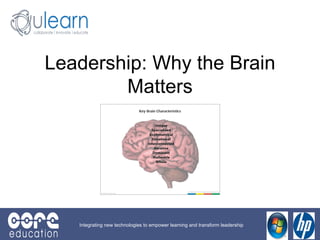




Integrating new technologies to empower learning and transform leadership Leadership: Why the Brain Matters
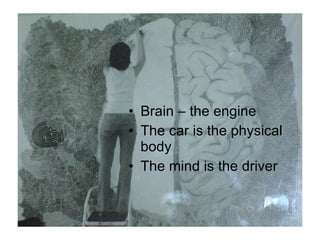
Brain – the engine The car is the physical body  The mind is the driver
 
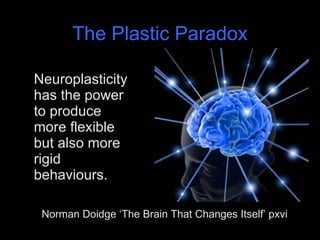
The Plastic Paradox Neuroplasticity has the power to produce more flexible but also more rigid behaviours. Norman Doidge ‘The Brain That Changes Itself’ pxvi
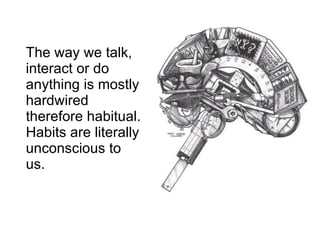
The way we talk, interact or do anything is mostly hardwired therefore habitual. Habits are literally unconscious to us.
The stress response An away state or a toward state Decrease threat and increase reward by enhancing…
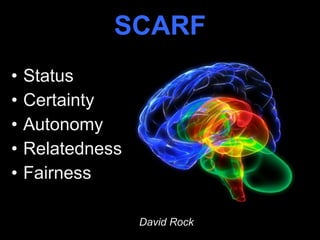
SCARF Status Certainty Autonomy Relatedness Fairness David Rock
The balcony and the dance floor
 
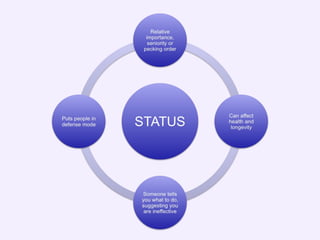
“ In most people, the question ‘can I offer you some feedback’ generates the same impact as fast footsteps behind you at night. ” -David Rock Reduction in status through being left out lights  up the same parts of the brain as does physical pain.
Pay attention to incremental improvements as well as large goals Opportunities for people to learn and improve and pay attention to this Acknowledge people publically
Meetings Allow people to give themselves feedback on their own performance Provide opportunities for staff to challenge their own performance – compete with themselves Give regular positive feedback
Placement to frame the meeting Setting the scene How long you’d like to speak for What your goal for the conversation is What you would like them to do in the conversation How you would like them to listen What’s going to happen in the conversation What you’re looking to achieve from the dialogue David Rock,  Quiet Leadership,  (2006:20)
Feedback What was great about what they did? What effort did they need to put in? What challenges did they face? How does it impact on them, others, the organisation?
How to encourage self-feedback What were six things you did really well? What are three things did you learn about yourself? What was your biggest challenge and how did you overcome it? What would you do differently next time? This develops the teacher inquiry process
Reflective Questions What are you currently doing? What connections have you made? What are the implications? How can you adapt this for your environment?
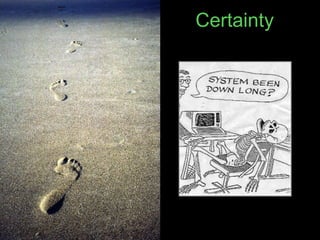
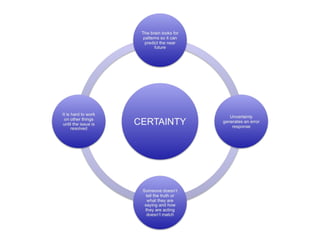
Certainty
 
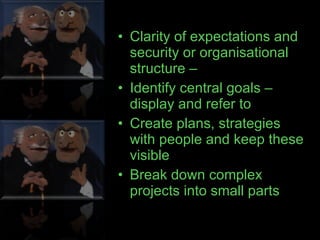
Clarity of expectations and security or organisational structure –  Identify central goals –display and refer to Create plans, strategies with people and keep these visible Break down complex projects into small parts
 
 
Professional Learning Be explicit eg about meeting times, due dates, when more information can be provided Provide a clear outline of what is being learnt Provide examples and time to practice skills These are important strategies when change is in the pipeline
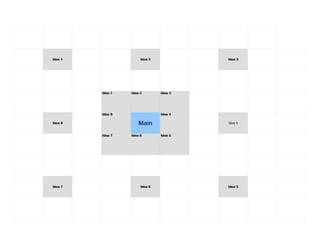
Lotus Chart Spider graph
Autonomy
 
Develop policies and procedures that allow for creativity and autonomy to be hard-wired in the organisation Delegate where possible, allowing decision making to be made at the point of need Find ways to take actions when challenges seem insurmountable – possibilities thinking
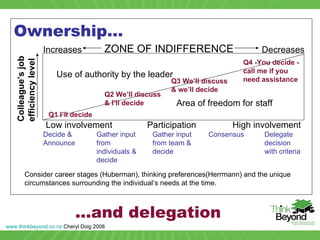
Ownership… Increases Decreases ZONE OF INDIFFERENCE Use of authority by the leader Area of freedom for staff Low involvement High involvement Participation Decide & Announce Gather input from individuals & decide Gather input from team & decide Consensus Delegate decision with criteria Colleague’s job  efficiency level Q4 -You decide - call me if you need assistance Q3 We’ll discuss & we’ll decide Q2 We’ll discuss & I’ll decide Q1 I’ll decide … and delegation Consider career stages (Huberman), thinking preferences(Herrmann) and the unique circumstances surrounding the individual’s needs at the time. www.thinkbeyond.co.nz  Cheryl Doig 2008
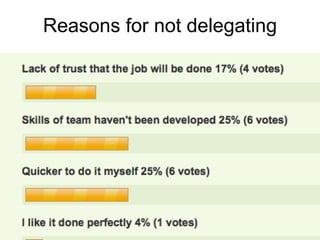
Reasons for not delegating
Why don’t we delegate? http://poll.fm/3bzic
“ Here’s two options that might work. Which do you prefer?” Allow opportunities for self-directed learning and autonomy Provide flexibility in work arrangements where this is feasible (in the school situation student needs must come first though)
Relatedness
 
 
If you don’t receive the messenger you won’t receive the message -Wilf Jarvis
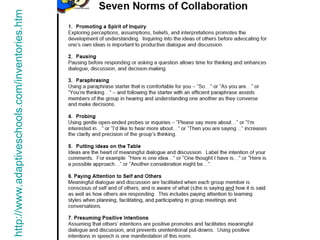
Provide safe connections through establishment of norms of working, ground rules Skills in inquiry and advocacy; facilitation and listening  Provide buddy systems, mentoring and coaching, action learning teams
http://www.adaptiveschools.com/inventories.htm
Provide opportunities for staff to collaborate with others, share stories, photos, social networking sites. Encourage sharing and social connections
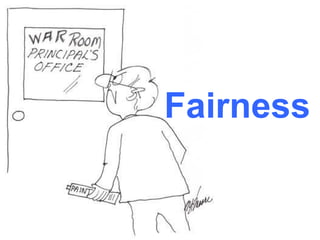
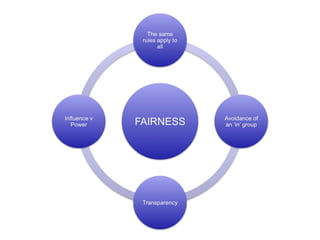
Fairness
 
Have clear expectations and ground rules for all – co-create these Facilitate feedback mechanisms – workloads, sharing of tasks, follow-up Walking the talk in line with the values and vision of the organisation Consistency in approach and treatment of people
Provide opportunity to do volunteer work/be part of global projects – to decrease unfairness in the world  Transparency – communicate, communicate, communicate. Involve them in processes, provide details of financial processes. Look at things from a variety of perspectives when planning
 
www.rata.org.nz
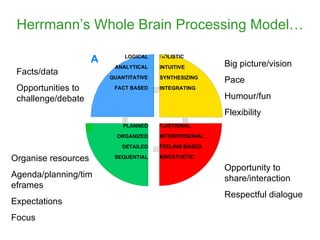
        Herrmann’s Whole Brain Processing Model… Facts/data Opportunities to challenge/debate Organise resources Agenda/planning/timeframes Expectations Focus Big picture/vision Pace Humour/fun Flexibility Opportunity to share/interaction Respectful dialogue
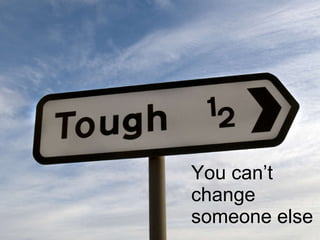
You can’t change someone else
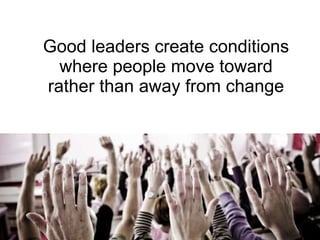
Good leaders create conditions where people move toward rather than away from change
Rock, D. (2008) SCARF: A brain-based model for collaborating with and influencing others. In  Neuroleadership Journal Issue 1 2008.   www.NeuroLeadership.com http://www.davidrock.net/books/index.shtml Doidge, N.  The brain that changes itself.
[email_address] www.thinkbeyond.co.nz www.alpineleadership.com

Ulearn2011 brain

  • 1.
  • 2.
    Integrating new technologiesto empower learning and transform leadership Leadership: Why the Brain Matters
  • 3.
    Brain – theengine The car is the physical body The mind is the driver
  • 4.
  • 5.
    The Plastic ParadoxNeuroplasticity has the power to produce more flexible but also more rigid behaviours. Norman Doidge ‘The Brain That Changes Itself’ pxvi
  • 6.
    The way wetalk, interact or do anything is mostly hardwired therefore habitual. Habits are literally unconscious to us.
  • 7.
    The stress responseAn away state or a toward state Decrease threat and increase reward by enhancing…
  • 8.
    SCARF Status CertaintyAutonomy Relatedness Fairness David Rock
  • 9.
    The balcony andthe dance floor
  • 10.
  • 11.
    “ In mostpeople, the question ‘can I offer you some feedback’ generates the same impact as fast footsteps behind you at night. ” -David Rock Reduction in status through being left out lights up the same parts of the brain as does physical pain.
  • 12.
    Pay attention toincremental improvements as well as large goals Opportunities for people to learn and improve and pay attention to this Acknowledge people publically
  • 13.
    Meetings Allow peopleto give themselves feedback on their own performance Provide opportunities for staff to challenge their own performance – compete with themselves Give regular positive feedback
  • 14.
    Placement to framethe meeting Setting the scene How long you’d like to speak for What your goal for the conversation is What you would like them to do in the conversation How you would like them to listen What’s going to happen in the conversation What you’re looking to achieve from the dialogue David Rock, Quiet Leadership, (2006:20)
  • 15.
    Feedback What wasgreat about what they did? What effort did they need to put in? What challenges did they face? How does it impact on them, others, the organisation?
  • 16.
    How to encourageself-feedback What were six things you did really well? What are three things did you learn about yourself? What was your biggest challenge and how did you overcome it? What would you do differently next time? This develops the teacher inquiry process
  • 17.
    Reflective Questions Whatare you currently doing? What connections have you made? What are the implications? How can you adapt this for your environment?
  • 18.
  • 19.
  • 20.
    Clarity of expectationsand security or organisational structure – Identify central goals –display and refer to Create plans, strategies with people and keep these visible Break down complex projects into small parts
  • 21.
  • 22.
  • 23.
    Professional Learning Beexplicit eg about meeting times, due dates, when more information can be provided Provide a clear outline of what is being learnt Provide examples and time to practice skills These are important strategies when change is in the pipeline
  • 24.
  • 25.
  • 26.
  • 27.
    Develop policies andprocedures that allow for creativity and autonomy to be hard-wired in the organisation Delegate where possible, allowing decision making to be made at the point of need Find ways to take actions when challenges seem insurmountable – possibilities thinking
  • 28.
    Ownership… Increases DecreasesZONE OF INDIFFERENCE Use of authority by the leader Area of freedom for staff Low involvement High involvement Participation Decide & Announce Gather input from individuals & decide Gather input from team & decide Consensus Delegate decision with criteria Colleague’s job efficiency level Q4 -You decide - call me if you need assistance Q3 We’ll discuss & we’ll decide Q2 We’ll discuss & I’ll decide Q1 I’ll decide … and delegation Consider career stages (Huberman), thinking preferences(Herrmann) and the unique circumstances surrounding the individual’s needs at the time. www.thinkbeyond.co.nz Cheryl Doig 2008
  • 29.
    Reasons for notdelegating
  • 30.
    Why don’t wedelegate? http://poll.fm/3bzic
  • 31.
    “ Here’s twooptions that might work. Which do you prefer?” Allow opportunities for self-directed learning and autonomy Provide flexibility in work arrangements where this is feasible (in the school situation student needs must come first though)
  • 32.
  • 33.
  • 34.
  • 35.
    If you don’treceive the messenger you won’t receive the message -Wilf Jarvis
  • 36.
    Provide safe connectionsthrough establishment of norms of working, ground rules Skills in inquiry and advocacy; facilitation and listening Provide buddy systems, mentoring and coaching, action learning teams
  • 37.
  • 38.
    Provide opportunities forstaff to collaborate with others, share stories, photos, social networking sites. Encourage sharing and social connections
  • 39.
  • 40.
  • 41.
    Have clear expectationsand ground rules for all – co-create these Facilitate feedback mechanisms – workloads, sharing of tasks, follow-up Walking the talk in line with the values and vision of the organisation Consistency in approach and treatment of people
  • 42.
    Provide opportunity todo volunteer work/be part of global projects – to decrease unfairness in the world Transparency – communicate, communicate, communicate. Involve them in processes, provide details of financial processes. Look at things from a variety of perspectives when planning
  • 43.
  • 44.
  • 45.
           Herrmann’s Whole Brain Processing Model… Facts/data Opportunities to challenge/debate Organise resources Agenda/planning/timeframes Expectations Focus Big picture/vision Pace Humour/fun Flexibility Opportunity to share/interaction Respectful dialogue
  • 46.
    You can’t changesomeone else
  • 47.
    Good leaders createconditions where people move toward rather than away from change
  • 48.
    Rock, D. (2008)SCARF: A brain-based model for collaborating with and influencing others. In Neuroleadership Journal Issue 1 2008. www.NeuroLeadership.com http://www.davidrock.net/books/index.shtml Doidge, N. The brain that changes itself.
  • 49.

Editor's Notes

  • #3 Breakout 2  / Presenters:  Cheryl Doig  / Strand:  Leaders  / Theme:  Inspired leadership and managing change  / Target Level: This spotlight explores links between neuroscience, leadership and change management. It will focus on: -the connection between the brain, mind, environment and behaviour; -the influence of threats and rewards on our reactions to change; -practical strategies for planning professional learning and change processes with the brain in mind. Warning: Cheryl's presentations are not a place to sit and take notes. They provide an opportunity to collaborate with others, challenge thinking and create new learning.
  • #4 The mind is the manifestations of thought, perception, emotion, determination, memory and imagination that takes place within the brain.
  • #5 David Langford activity to emphasise pathways created
  • #6 The brain looks for connections and links between different pieces of information. It tries to bring order to chaos. The more hardwired our pathways are for repetitive tasks the more we have freed up working memory for higher level tasks. When we are told what we should do unless it fits in exactly with our existing wiring we still need to expend the energy to create our own maps. Creating a new map chews up resources. Our brain needs to compare, associate and match new ideas with existing maps. Because it takes energy it is harder.
  • #8 Model aims to minimise threats and strengthen rewards. Rather than try to suppress emotions SCARF allows for labelling and reappraisal – has great impact on stress response. Allows you to think about why you are responding that way. Aim is for people to be in an approach state so they will learn/change
  • #10 Sustaining Change - Balancing the Balcony and the Dance Floor Dr Cheryl Doig From the balcony you can see the big picture. You can see the shape and size of the dance floor. You can see the couples take the floor and how they interact with each other and with the audience. Do they concentrate on there dance - follow the rules, add their own flourishes, work in harmony? Do you sense tension, the lack of cohesion? Do they work together in their partnership but bump into all the other couples, unaware of their effect.Or worse - do they deliberately trip over others in order to make themselves look better ? Youcan see the expression on the judges’ face and
  • #11 Affects health and longevity. What is it – relative importance, pecking order or seniority. Can occur when someone tells you what to do, suggesting you are ineffective. People go into defence mode. “ In most people, the question ‘can I offer you some feedback’ generates the same impact as fast footsteps behind you at night.” P5 Neurolinguistic Journal. So can performancereviews…and you hope they will make change!!   Reduction in status through being left out lights up the same parts of the brain as does physical pain.
  • #12 So can performance reviews…and you hope they will make change!!
  • #14 http://www.adaptiveschools.com/inventories.htm
  • #19 The brain looks for patterns and tries to predict the near future. When you do things they draw from memory and don’t pay attention unless it feels different. Without prediction the brain would have to work harder (pre-frontal cortex). A small amount of uncertainty generates an error response in the orbital frontal cortex. Occurs when someone doesn’t tell you the truth or what they are saying and how they are acting doesn’t match. It is difficult to work on other things until the issue is resolved
  • #20 The brain looks for patterns and tries to predict the near future. When you do things they draw from memory and don’t pay attention unless it feels different. Without prediction the brain would have to work harder (pre-frontal cortex). A small amount of uncertainty generates an error response in the orbital frontal cortex. Occurs when someone doesn’t tell you the truth or what they are saying and how they are acting doesn’t match. It is difficult to work on other things until the issue is resolved
  • #21 Examples:
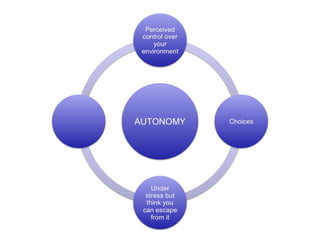
  • #26 When you perceive that you have control over your environment. That you have choices. If you are under stress but think you can escape from it it doesn’t have such a detrimental effect.
  • #27 When you perceive that you have control over your environment. That you have choices. If you are under stress but think you can escape from it it doesn’t have such a detrimental effect.
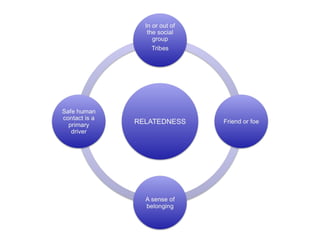
  • #33 Whether people are in or out of the social group, friend or foe. Tribes, a sense of belonging. Decision of friend or foe happens quickly in brain. If competitor less empathy. Safe human contact is a prmary driver. Alcohol reduces the threat. Relatedness is closely linked to trust.
  • #34 Whether people are in or out of the social group, friend or foe. Tribes, a sense of belonging. Decision of friend or foe happens quickly in brain. If competitor less empathy. Safe human contact is a primary driver. Alcohol reduces the threat. Relatedness is closely linked to trust.
  • #39 Give one, get one
  • #42 Use learning talk book as an example