The views expressed in this presentation are the views of the author/s and do not necessarily reflect the views or policies of the Asian Development Bank, or its Board of
Governors, or the governments they represent. ADB does not guarantee the accuracy of the data included in this presentation and accepts no responsibility for any consequence
of their use. The countries listed in this presentation do not imply any view on ADB's part as to sovereignty or independent status or necessarily conform to ADB's terminology.
Learning for Change Survey
Olivier Serrat
2010
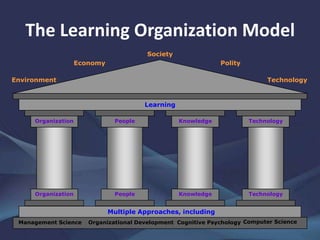
The Learning Organization Model
• A learning organization knows the role that learning plays in
developing organizational effectiveness. It demonstrates this by
having an inspiring vision for learning and a learning strategy.
Organizational learning is neither possible nor sustainable without
understanding what drives it.
• The organization subsystem values leadership, structure,
communication systems, allocation of adequate resources, planned
and emergent learning, and failures and unintended outcomes.
• A learning organization needs reflective people. This subsystem
values teamwork, learning and knowledge development, individual
and collective learning for development, and development of
leadership competencies.
The Learning Organization Model
• Knowledge is critical in a learning organization because it is
both a product of knowledge and its source. This subsystem
values individual and collective knowledge production,
systems and infrastructure of knowledge management,
feedback mechanisms, resilient organizational memory, and
collaborative mutual learning arrangements.
• In a learning organization, technology is harnessed without
constraining knowledge management and learning. This
subsystem values creative use of information and
communication technologies, and provides opportunities for
staff to learn how to make use of technologies for knowledge
management and learning.
The Learning Organization Model
Technology
TechnologyPeople
People
Knowledge
Knowledge
Management Science Organizational Development Cognitive Psychology Computer Science
Multiple Approaches, including
Environment
Economy Polity
Technology
Society
Learning
Organization
Organization
Learning for Change Survey
The 2010 Learning for Change Survey
• aimed to introduce a new diagnostic tool that examines
organizational learning and deepens understanding of progress
toward creating and sustaining a learning organization;
• featured positive statements depicting ideal levels of organizational
competence across four subsystems of organizational learning—(i)
organization, (ii) people, (iii) knowledge, and (iv) technology; and
• captured perceptions of ADB staff in absolute confidence using a
six-point Likert scale—(1) strongly agree, (2) agree, (3) neutral, (4)
disagree, (5) strongly disagree, and (6) don't know.
Survey Responses
The Organization Subsystem
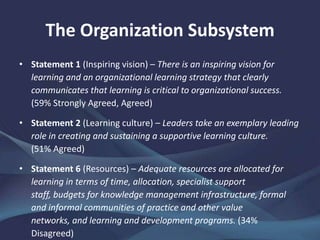
• Statement 1 (Inspiring vision) – There is an inspiring vision for
learning and an organizational learning strategy that clearly
communicates that learning is critical to organizational success.
(59% Strongly Agreed, Agreed)
• Statement 2 (Learning culture) – Leaders take an exemplary leading
role in creating and sustaining a supportive learning culture.
(51% Agreed)
• Statement 6 (Resources) – Adequate resources are allocated for
learning in terms of time, allocation, specialist support staff,
budgets for knowledge management infrastructure, formal and
informal communities of practice and other value networks, and
learning and development programs. (34% Disagreed)
The Organization Subsystem
• Statement 9 (Planned learning) – Emergent learning is
encouraged by creating opportunities for informal sharing of
knowledge and experience. (59% Strongly Agreed, Agreed)
• Statement 10 (Failures and unintended outcomes) – Failures
and unintended outcomes are the focus of constructive
discussions. When such incidents involve clients, care is taken
to protect their reputation. (36% Neutral, 13% Don't Know)
The Organization Subsystem
Statement Subject Strongly
Agree
Agree Neutral Disagree Strongly
Disagree
Don't
Know
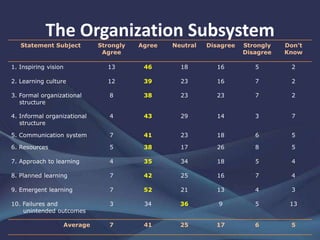
1. Inspiring vision 13 46 18 16 5 2
2. Learning culture 12 39 23 16 7 2
3. Formal organizational
structure
8 38 23 23 7 2
4. Informal organizational
structure
4 43 29 14 3 7
5. Communication system 7 41 23 18 6 5
6. Resources 5 38 17 26 8 5
7. Approach to learning 4 35 34 18 5 4
8. Planned learning 7 42 25 16 7 4
9. Emergent learning 7 52 21 13 4 3
10. Failures and
unintended outcomes
3 34 36 9 5 13
Average 7 41 25 17 6 5
The Organization Subsystem
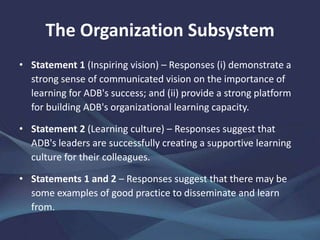
• Statement 1 (Inspiring vision) – Responses (i) demonstrate a
strong sense of communicated vision on the importance of
learning for ADB's success; and (ii) provide a strong platform
for building ADB's organizational learning capacity.
• Statement 2 (Learning culture) – Responses suggest that
ADB's leaders are successfully creating a supportive learning
culture for their colleagues.
• Statements 1 and 2 – Responses suggest that there may be
some examples of good practice to disseminate and learn
from.
The Organization Subsystem
• Statement 4 (Informal organizational
structure) – Responses suggest the need to
examine current areas of good practice and
make these examples more widely known
within ADB.
• Statement 7 (Approach to learning) –
Responses suggest lack of understanding of
planned and emergent learning.
• Statement 10 (Failures and unintended
outcomes) – Responses suggest limited
awareness on the subject of protection of
client reputations.
The People Subsystem
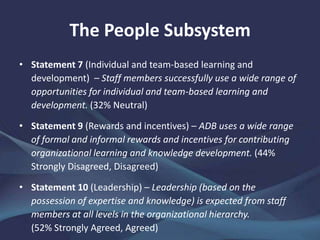
• Statement 7 (Individual and team-based learning and
development) – Staff members successfully use a wide range of
opportunities for individual and team-based learning and
development. (32% Neutral)
• Statement 9 (Rewards and incentives) – ADB uses a wide range
of formal and informal rewards and incentives for contributing
organizational learning and knowledge development. (44%
Strongly Disagreed, Disagreed)
• Statement 10 (Leadership) – Leadership (based on the
possession of expertise and knowledge) is expected from staff
members at all levels in the organizational hierarchy.
(52% Strongly Agreed, Agreed)
The People Subsystem
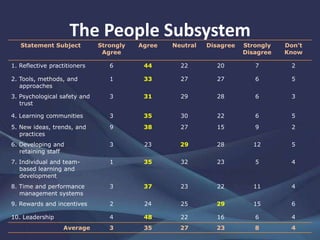
Statement Subject Strongly
Agree
Agree Neutral Disagree Strongly
Disagree
Don't
Know
1. Reflective practitioners 6 44 22 20 7 2
2. Tools, methods, and
approaches
1 33 27 27 6 5
3. Psychological safety and
trust
3 31 29 28 6 3
4. Learning communities 3 35 30 22 6 5
5. New ideas, trends, and
practices
9 38 27 15 9 2
6. Developing and
retaining staff
3 23 29 28 12 5
7. Individual and team-
based learning and
development
1 35 32 23 5 4
8. Time and performance
management systems
3 37 23 22 11 4
9. Rewards and incentives 2 24 25 29 15 6
10. Leadership 4 48 22 16 6 4
Average 3 35 27 23 8 4
The People Subsystem
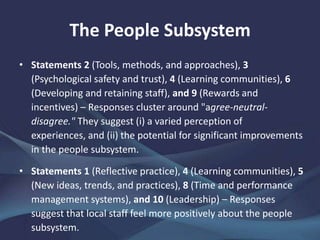
• Statements 2 (Tools, methods, and approaches), 3
(Psychological safety and trust), 4 (Learning communities), 6
(Developing and retaining staff), and 9 (Rewards and
incentives) – Responses cluster around "agree-neutral-
disagree." They suggest (i) a varied perception of experiences,
and (ii) the potential for significant improvements in the
people subsystem.
• Statements 1 (Reflective practice), 4 (Learning communities), 5
(New ideas, trends, and practices), 8 (Time and performance
management systems), and 10 (Leadership) – Responses
suggest that local staff feel more positively about the people
subsystem.
The People Subsystem
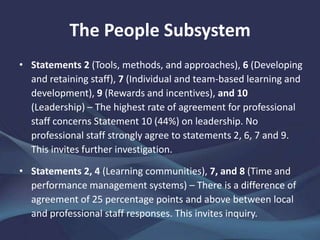
• Statements 2 (Tools, methods, and approaches), 6 (Developing
and retaining staff), 7 (Individual and team-based learning and
development), 9 (Rewards and incentives), and 10
(Leadership) – The highest rate of agreement for professional
staff concerns Statement 10 (44%) on leadership. No
professional staff strongly agree to statements 2, 6, 7 and 9.
This invites further investigation.
• Statements 2, 4 (Learning communities), 7, and 8 (Time and
performance management systems) – There is a difference of
agreement of 25 percentage points and above between local
and professional staff responses. This invites inquiry.
The Knowledge Subsystem
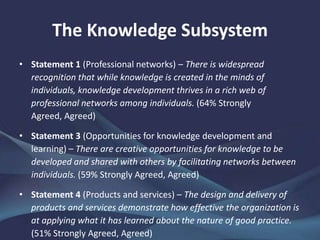
• Statement 1 (Professional networks) – There is widespread
recognition that while knowledge is created in the minds of
individuals, knowledge development thrives in a rich web of
professional networks among individuals. (64% Strongly Agreed,
Agreed)
• Statement 3 (Opportunities for knowledge development and
learning) – There are creative opportunities for knowledge to be
developed and shared with others by facilitating networks between
individuals. (59% Strongly Agreed, Agreed)
• Statement 4 (Products and services) – The design and delivery of
products and services demonstrate how effective the organization is
at applying what it has learned about the nature of good practice.
(51% Strongly Agreed, Agreed)
The Knowledge Subsystem
• Statement 8 (Organizational memory) –
The organization has a resilient
organizational memory and is not
vulnerable to the loss of important
knowledge when staff members move to
other jobs in the organization or leave.
(44% Strongly Disagreed, Disagreed)
• Statement 10 (After-action reviews and
retrospect's) – The adoption of after-
action reviews and retrospect's to learn
from experience has been successful.
(32% Neutral)
The Knowledge Subsystem
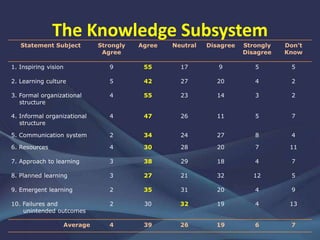
Statement Subject Strongly
Agree
Agree Neutral Disagree Strongly
Disagree
Don't
Know
1. Inspiring vision 9 55 17 9 5 5
2. Learning culture 5 42 27 20 4 2
3. Formal organizational
structure
4 55 23 14 3 2
4. Informal organizational
structure
4 47 26 11 5 7
5. Communication system 2 34 24 27 8 4
6. Resources 4 30 28 20 7 11
7. Approach to learning 3 38 29 18 4 7
8. Planned learning 3 27 21 32 12 5
9. Emergent learning 2 35 31 20 4 9
10. Failures and
unintended outcomes
2 30 32 19 4 13
Average 4 39 26 19 6 7
The Knowledge Subsystem
• Statement 8 (Organizational memory) – Responses suggest a
significant concern about loss (or potential loss) of organizational
memory. This may be addressed by the introduction of exit
interviews in offices and departments and personal commitment to
pass on knowledge and experience to improve individual and
collective learning.
• Statement 5 (Systems and infrastructure) – Balanced responses
suggest that further investigation should examine what systems and
infrastructure for knowledge management need to be developed,
better understood, and made more effective.
• Statement 6 (Evaluations) – Responses suggest the need for further
investigation.
The Technology Subsystem
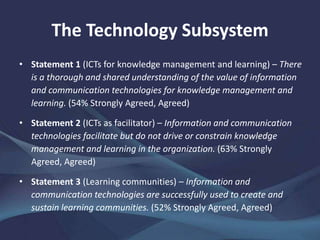
• Statement 1 (ICTs for knowledge management and learning) – There
is a thorough and shared understanding of the value of information
and communication technologies for knowledge management and
learning. (54% Strongly Agreed, Agreed)
• Statement 2 (ICTs as facilitator) – Information and communication
technologies facilitate but do not drive or constrain knowledge
management and learning in the organization. (63% Strongly
Agreed, Agreed)
• Statement 3 (Learning communities) – Information and
communication technologies are successfully used to create and
sustain learning communities. (52% Strongly Agreed, Agreed)
The Technology Subsystem
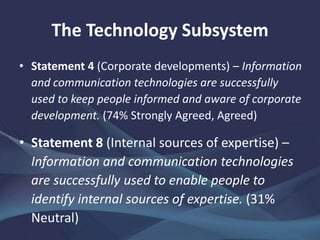
• Statement 4 (Corporate developments) – Information
and communication technologies are successfully
used to keep people informed and aware of corporate
development. (74% Strongly Agreed, Agreed)
• Statement 8 (Internal sources of expertise) –
Information and communication technologies
are successfully used to enable people to
identify internal sources of expertise. (31%
Neutral)
The Technology Subsystem
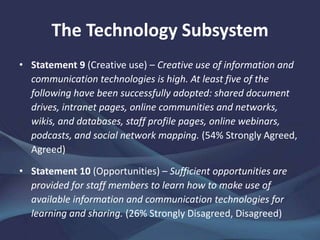
• Statement 9 (Creative use) – Creative use of information and
communication technologies is high. At least five of the
following have been successfully adopted: shared document
drives, intranet pages, online communities and networks,
wikis, and databases, staff profile pages, online webinars,
podcasts, and social network mapping. (54% Strongly Agreed,
Agreed)
• Statement 10 (Opportunities) – Sufficient opportunities are
provided for staff members to learn how to make use of
available information and communication technologies for
learning and sharing. (26% Strongly Disagreed, Disagreed)
The Technology Subsystem
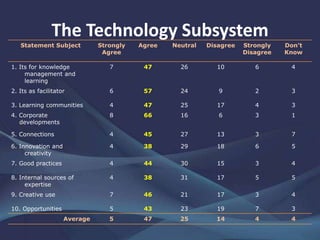
Statement Subject Strongly
Agree
Agree Neutral Disagree Strongly
Disagree
Don't
Know
1. Its for knowledge
management and
learning
7 47 26 10 6 4
2. Its as facilitator 6 57 24 9 2 3
3. Learning communities 4 47 25 17 4 3
4. Corporate
developments
8 66 16 6 3 1
5. Connections 4 45 27 13 3 7
6. Innovation and
creativity
4 38 29 18 6 5
7. Good practices 4 44 30 15 3 4
8. Internal sources of
expertise
4 38 31 17 5 5
9. Creative use 7 46 21 17 3 4
10. Opportunities 5 43 23 19 7 3
Average 5 47 25 14 4 4
The Technology Subsystem
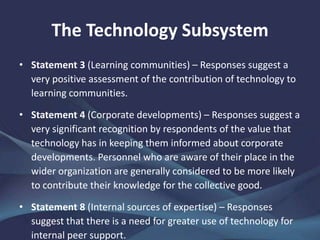
• Statement 3 (Learning communities) – Responses suggest a
very positive assessment of the contribution of technology to
learning communities.
• Statement 4 (Corporate developments) – Responses suggest a
very significant recognition by respondents of the value that
technology has in keeping them informed about corporate
developments. Personnel who are aware of their place in the
wider organization are generally considered to be more likely
to contribute their knowledge for the collective good.
• Statement 8 (Internal sources of expertise) – Responses
suggest that there is a need for greater use of technology for
internal peer support.
Subsystem Comparison
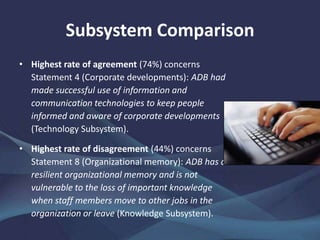
• Highest rate of agreement (74%) concerns
Statement 4 (Corporate developments): ADB had
made successful use of information and
communication technologies to keep people
informed and aware of corporate developments
(Technology Subsystem).
• Highest rate of disagreement (44%) concerns
Statement 8 (Organizational memory): ADB has a
resilient organizational memory and is not
vulnerable to the loss of important knowledge
when staff members move to other jobs in the
organization or leave (Knowledge Subsystem).
Subsystem Comparison
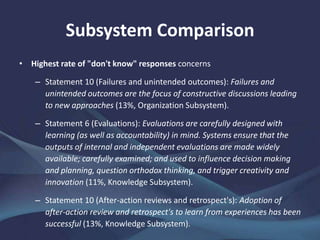
• Highest rate of "don't know" responses concerns
– Statement 10 (Failures and unintended outcomes): Failures and
unintended outcomes are the focus of constructive discussions leading
to new approaches (13%, Organization Subsystem).
– Statement 6 (Evaluations): Evaluations are carefully designed with
learning (as well as accountability) in mind. Systems ensure that the
outputs of internal and independent evaluations are made widely
available; carefully examined; and used to influence decision making
and planning, question orthodox thinking, and trigger creativity and
innovation (11%, Knowledge Subsystem).
– Statement 10 (After-action reviews and retrospect's): Adoption of
after-action review and retrospect's to learn from experiences has been
successful (13%, Knowledge Subsystem).
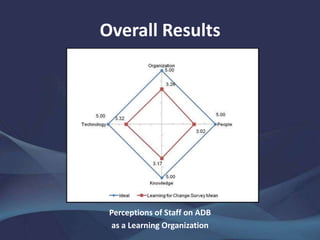
Overall Results
Perceptions of Staff on ADB
as a Learning Organization
Overall Results
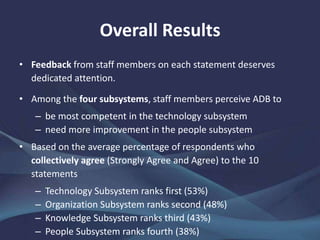
• Feedback from staff members on each statement deserves
dedicated attention.
• Among the four subsystems, staff members perceive ADB to
– be most competent in the technology subsystem
– need more improvement in the people subsystem
• Based on the average percentage of respondents who
collectively agree (Strongly Agree and Agree) to the 10
statements
– Technology Subsystem ranks first (53%)
– Organization Subsystem ranks second (48%)
– Knowledge Subsystem ranks third (43%)
– People Subsystem ranks fourth (38%)
Concluding Remarks
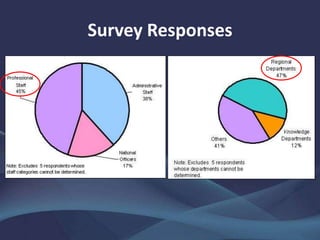
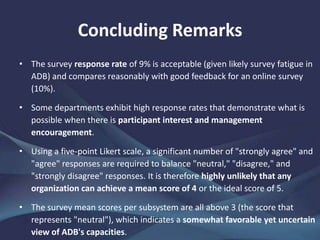
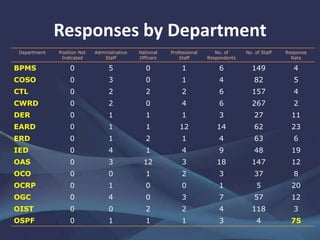
• The survey response rate of 9% is acceptable (given likely survey fatigue in
ADB) and compares reasonably with good feedback for an online survey
(10%).
• Some departments exhibit high response rates that demonstrate what is
possible when there is participant interest and management
encouragement.
• Using a five-point Likert scale, a significant number of "strongly agree" and
"agree" responses are required to balance "neutral," "disagree," and
"strongly disagree" responses. It is therefore highly unlikely that any
organization can achieve a mean score of 4 or the ideal score of 5.
• The survey mean scores per subsystem are all above 3 (the score that
represents "neutral"), which indicates a somewhat favorable yet uncertain
view of ADB's capacities.
Concluding Remarks
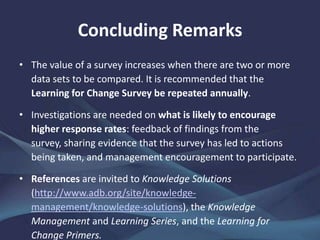
• The value of a survey increases when there are two or more
data sets to be compared. It is recommended that the
Learning for Change Survey be repeated annually.
• Investigations are needed on what is likely to encourage
higher response rates: feedback of findings from the survey,
sharing evidence that the survey has led to actions being
taken, and management encouragement to participate.
• References are invited to Knowledge Solutions
(http://www.adb.org/site/knowledge-
management/knowledge-solutions), the Knowledge
Management and Learning Series, and the Learning for
Change Primers.
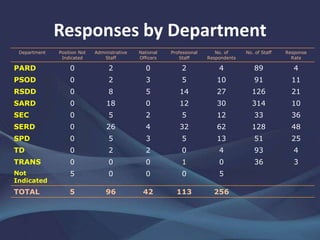
Responses by Department
Department Position Not
Indicated
Administrative
Staff
National
Officers
Professional
Staff
No. of
Respondents
No. of Staff Response
Rate
BPMS 0 5 0 1 6 149 4
COSO 0 3 0 1 4 82 5
CTL 0 2 2 2 6 157 4
CWRD 0 2 0 4 6 267 2
DER 0 1 1 1 3 27 11
EARD 0 1 1 12 14 62 23
ERD 0 1 2 1 4 63 6
IED 0 4 1 4 9 48 19
OAS 0 3 12 3 18 147 12
OCO 0 0 1 2 3 37 8
OCRP 0 1 0 0 1 5 20
OGC 0 4 0 3 7 57 12
OIST 0 0 2 2 4 118 3
OSPF 0 1 1 1 3 4 75
Responses by Department
Department Position Not
Indicated
Administrative
Staff
National
Officers
Professional
Staff
No. of
Respondents
No. of Staff Response
Rate
PARD 0 2 0 2 4 89 4
PSOD 0 2 3 5 10 91 11
RSDD 0 8 5 14 27 126 21
SARD 0 18 0 12 30 314 10
SEC 0 5 2 5 12 33 36
SERD 0 26 4 32 62 128 48
SPD 0 5 3 5 13 51 25
TD 0 2 2 0 4 93 4
TRANS 0 0 0 1 0 36 3
Not
Indicated
5 0 0 0 5
TOTAL 5 96 42 113 256
Quick Response Codes
@ADB
@ADB Sustainable
Development Timeline
@Academia.edu
@LinkedIn
@ResearchGate
@Scholar
@SlideShare
@Twitter

Learning for Change Survey

  • 1.
    The views expressedin this presentation are the views of the author/s and do not necessarily reflect the views or policies of the Asian Development Bank, or its Board of Governors, or the governments they represent. ADB does not guarantee the accuracy of the data included in this presentation and accepts no responsibility for any consequence of their use. The countries listed in this presentation do not imply any view on ADB's part as to sovereignty or independent status or necessarily conform to ADB's terminology. Learning for Change Survey Olivier Serrat 2010
  • 2.
    The Learning OrganizationModel • A learning organization knows the role that learning plays in developing organizational effectiveness. It demonstrates this by having an inspiring vision for learning and a learning strategy. Organizational learning is neither possible nor sustainable without understanding what drives it. • The organization subsystem values leadership, structure, communication systems, allocation of adequate resources, planned and emergent learning, and failures and unintended outcomes. • A learning organization needs reflective people. This subsystem values teamwork, learning and knowledge development, individual and collective learning for development, and development of leadership competencies.
  • 3.
    The Learning OrganizationModel • Knowledge is critical in a learning organization because it is both a product of knowledge and its source. This subsystem values individual and collective knowledge production, systems and infrastructure of knowledge management, feedback mechanisms, resilient organizational memory, and collaborative mutual learning arrangements. • In a learning organization, technology is harnessed without constraining knowledge management and learning. This subsystem values creative use of information and communication technologies, and provides opportunities for staff to learn how to make use of technologies for knowledge management and learning.
  • 4.
    The Learning OrganizationModel Technology TechnologyPeople People Knowledge Knowledge Management Science Organizational Development Cognitive Psychology Computer Science Multiple Approaches, including Environment Economy Polity Technology Society Learning Organization Organization
  • 5.
    Learning for ChangeSurvey The 2010 Learning for Change Survey • aimed to introduce a new diagnostic tool that examines organizational learning and deepens understanding of progress toward creating and sustaining a learning organization; • featured positive statements depicting ideal levels of organizational competence across four subsystems of organizational learning—(i) organization, (ii) people, (iii) knowledge, and (iv) technology; and • captured perceptions of ADB staff in absolute confidence using a six-point Likert scale—(1) strongly agree, (2) agree, (3) neutral, (4) disagree, (5) strongly disagree, and (6) don't know.
  • 6.
  • 7.
    The Organization Subsystem •Statement 1 (Inspiring vision) – There is an inspiring vision for learning and an organizational learning strategy that clearly communicates that learning is critical to organizational success. (59% Strongly Agreed, Agreed) • Statement 2 (Learning culture) – Leaders take an exemplary leading role in creating and sustaining a supportive learning culture. (51% Agreed) • Statement 6 (Resources) – Adequate resources are allocated for learning in terms of time, allocation, specialist support staff, budgets for knowledge management infrastructure, formal and informal communities of practice and other value networks, and learning and development programs. (34% Disagreed)
  • 8.
    The Organization Subsystem •Statement 9 (Planned learning) – Emergent learning is encouraged by creating opportunities for informal sharing of knowledge and experience. (59% Strongly Agreed, Agreed) • Statement 10 (Failures and unintended outcomes) – Failures and unintended outcomes are the focus of constructive discussions. When such incidents involve clients, care is taken to protect their reputation. (36% Neutral, 13% Don't Know)
  • 9.
    The Organization Subsystem StatementSubject Strongly Agree Agree Neutral Disagree Strongly Disagree Don't Know 1. Inspiring vision 13 46 18 16 5 2 2. Learning culture 12 39 23 16 7 2 3. Formal organizational structure 8 38 23 23 7 2 4. Informal organizational structure 4 43 29 14 3 7 5. Communication system 7 41 23 18 6 5 6. Resources 5 38 17 26 8 5 7. Approach to learning 4 35 34 18 5 4 8. Planned learning 7 42 25 16 7 4 9. Emergent learning 7 52 21 13 4 3 10. Failures and unintended outcomes 3 34 36 9 5 13 Average 7 41 25 17 6 5
  • 10.
    The Organization Subsystem •Statement 1 (Inspiring vision) – Responses (i) demonstrate a strong sense of communicated vision on the importance of learning for ADB's success; and (ii) provide a strong platform for building ADB's organizational learning capacity. • Statement 2 (Learning culture) – Responses suggest that ADB's leaders are successfully creating a supportive learning culture for their colleagues. • Statements 1 and 2 – Responses suggest that there may be some examples of good practice to disseminate and learn from.
  • 11.
    The Organization Subsystem •Statement 4 (Informal organizational structure) – Responses suggest the need to examine current areas of good practice and make these examples more widely known within ADB. • Statement 7 (Approach to learning) – Responses suggest lack of understanding of planned and emergent learning. • Statement 10 (Failures and unintended outcomes) – Responses suggest limited awareness on the subject of protection of client reputations.
  • 12.
    The People Subsystem •Statement 7 (Individual and team-based learning and development) – Staff members successfully use a wide range of opportunities for individual and team-based learning and development. (32% Neutral) • Statement 9 (Rewards and incentives) – ADB uses a wide range of formal and informal rewards and incentives for contributing organizational learning and knowledge development. (44% Strongly Disagreed, Disagreed) • Statement 10 (Leadership) – Leadership (based on the possession of expertise and knowledge) is expected from staff members at all levels in the organizational hierarchy. (52% Strongly Agreed, Agreed)
  • 13.
    The People Subsystem StatementSubject Strongly Agree Agree Neutral Disagree Strongly Disagree Don't Know 1. Reflective practitioners 6 44 22 20 7 2 2. Tools, methods, and approaches 1 33 27 27 6 5 3. Psychological safety and trust 3 31 29 28 6 3 4. Learning communities 3 35 30 22 6 5 5. New ideas, trends, and practices 9 38 27 15 9 2 6. Developing and retaining staff 3 23 29 28 12 5 7. Individual and team- based learning and development 1 35 32 23 5 4 8. Time and performance management systems 3 37 23 22 11 4 9. Rewards and incentives 2 24 25 29 15 6 10. Leadership 4 48 22 16 6 4 Average 3 35 27 23 8 4
  • 14.
    The People Subsystem •Statements 2 (Tools, methods, and approaches), 3 (Psychological safety and trust), 4 (Learning communities), 6 (Developing and retaining staff), and 9 (Rewards and incentives) – Responses cluster around "agree-neutral- disagree." They suggest (i) a varied perception of experiences, and (ii) the potential for significant improvements in the people subsystem. • Statements 1 (Reflective practice), 4 (Learning communities), 5 (New ideas, trends, and practices), 8 (Time and performance management systems), and 10 (Leadership) – Responses suggest that local staff feel more positively about the people subsystem.
  • 15.
    The People Subsystem •Statements 2 (Tools, methods, and approaches), 6 (Developing and retaining staff), 7 (Individual and team-based learning and development), 9 (Rewards and incentives), and 10 (Leadership) – The highest rate of agreement for professional staff concerns Statement 10 (44%) on leadership. No professional staff strongly agree to statements 2, 6, 7 and 9. This invites further investigation. • Statements 2, 4 (Learning communities), 7, and 8 (Time and performance management systems) – There is a difference of agreement of 25 percentage points and above between local and professional staff responses. This invites inquiry.
  • 16.
    The Knowledge Subsystem •Statement 1 (Professional networks) – There is widespread recognition that while knowledge is created in the minds of individuals, knowledge development thrives in a rich web of professional networks among individuals. (64% Strongly Agreed, Agreed) • Statement 3 (Opportunities for knowledge development and learning) – There are creative opportunities for knowledge to be developed and shared with others by facilitating networks between individuals. (59% Strongly Agreed, Agreed) • Statement 4 (Products and services) – The design and delivery of products and services demonstrate how effective the organization is at applying what it has learned about the nature of good practice. (51% Strongly Agreed, Agreed)
  • 17.
    The Knowledge Subsystem •Statement 8 (Organizational memory) – The organization has a resilient organizational memory and is not vulnerable to the loss of important knowledge when staff members move to other jobs in the organization or leave. (44% Strongly Disagreed, Disagreed) • Statement 10 (After-action reviews and retrospect's) – The adoption of after- action reviews and retrospect's to learn from experience has been successful. (32% Neutral)
  • 18.
    The Knowledge Subsystem StatementSubject Strongly Agree Agree Neutral Disagree Strongly Disagree Don't Know 1. Inspiring vision 9 55 17 9 5 5 2. Learning culture 5 42 27 20 4 2 3. Formal organizational structure 4 55 23 14 3 2 4. Informal organizational structure 4 47 26 11 5 7 5. Communication system 2 34 24 27 8 4 6. Resources 4 30 28 20 7 11 7. Approach to learning 3 38 29 18 4 7 8. Planned learning 3 27 21 32 12 5 9. Emergent learning 2 35 31 20 4 9 10. Failures and unintended outcomes 2 30 32 19 4 13 Average 4 39 26 19 6 7
  • 19.
    The Knowledge Subsystem •Statement 8 (Organizational memory) – Responses suggest a significant concern about loss (or potential loss) of organizational memory. This may be addressed by the introduction of exit interviews in offices and departments and personal commitment to pass on knowledge and experience to improve individual and collective learning. • Statement 5 (Systems and infrastructure) – Balanced responses suggest that further investigation should examine what systems and infrastructure for knowledge management need to be developed, better understood, and made more effective. • Statement 6 (Evaluations) – Responses suggest the need for further investigation.
  • 20.
    The Technology Subsystem •Statement 1 (ICTs for knowledge management and learning) – There is a thorough and shared understanding of the value of information and communication technologies for knowledge management and learning. (54% Strongly Agreed, Agreed) • Statement 2 (ICTs as facilitator) – Information and communication technologies facilitate but do not drive or constrain knowledge management and learning in the organization. (63% Strongly Agreed, Agreed) • Statement 3 (Learning communities) – Information and communication technologies are successfully used to create and sustain learning communities. (52% Strongly Agreed, Agreed)
  • 21.
    The Technology Subsystem •Statement 4 (Corporate developments) – Information and communication technologies are successfully used to keep people informed and aware of corporate development. (74% Strongly Agreed, Agreed) • Statement 8 (Internal sources of expertise) – Information and communication technologies are successfully used to enable people to identify internal sources of expertise. (31% Neutral)
  • 22.
    The Technology Subsystem •Statement 9 (Creative use) – Creative use of information and communication technologies is high. At least five of the following have been successfully adopted: shared document drives, intranet pages, online communities and networks, wikis, and databases, staff profile pages, online webinars, podcasts, and social network mapping. (54% Strongly Agreed, Agreed) • Statement 10 (Opportunities) – Sufficient opportunities are provided for staff members to learn how to make use of available information and communication technologies for learning and sharing. (26% Strongly Disagreed, Disagreed)
  • 23.
    The Technology Subsystem StatementSubject Strongly Agree Agree Neutral Disagree Strongly Disagree Don't Know 1. Its for knowledge management and learning 7 47 26 10 6 4 2. Its as facilitator 6 57 24 9 2 3 3. Learning communities 4 47 25 17 4 3 4. Corporate developments 8 66 16 6 3 1 5. Connections 4 45 27 13 3 7 6. Innovation and creativity 4 38 29 18 6 5 7. Good practices 4 44 30 15 3 4 8. Internal sources of expertise 4 38 31 17 5 5 9. Creative use 7 46 21 17 3 4 10. Opportunities 5 43 23 19 7 3 Average 5 47 25 14 4 4
  • 24.
    The Technology Subsystem •Statement 3 (Learning communities) – Responses suggest a very positive assessment of the contribution of technology to learning communities. • Statement 4 (Corporate developments) – Responses suggest a very significant recognition by respondents of the value that technology has in keeping them informed about corporate developments. Personnel who are aware of their place in the wider organization are generally considered to be more likely to contribute their knowledge for the collective good. • Statement 8 (Internal sources of expertise) – Responses suggest that there is a need for greater use of technology for internal peer support.
  • 25.
    Subsystem Comparison • Highestrate of agreement (74%) concerns Statement 4 (Corporate developments): ADB had made successful use of information and communication technologies to keep people informed and aware of corporate developments (Technology Subsystem). • Highest rate of disagreement (44%) concerns Statement 8 (Organizational memory): ADB has a resilient organizational memory and is not vulnerable to the loss of important knowledge when staff members move to other jobs in the organization or leave (Knowledge Subsystem).
  • 26.
    Subsystem Comparison • Highestrate of "don't know" responses concerns – Statement 10 (Failures and unintended outcomes): Failures and unintended outcomes are the focus of constructive discussions leading to new approaches (13%, Organization Subsystem). – Statement 6 (Evaluations): Evaluations are carefully designed with learning (as well as accountability) in mind. Systems ensure that the outputs of internal and independent evaluations are made widely available; carefully examined; and used to influence decision making and planning, question orthodox thinking, and trigger creativity and innovation (11%, Knowledge Subsystem). – Statement 10 (After-action reviews and retrospect's): Adoption of after-action review and retrospect's to learn from experiences has been successful (13%, Knowledge Subsystem).
  • 27.
    Overall Results Perceptions ofStaff on ADB as a Learning Organization
  • 28.
    Overall Results • Feedbackfrom staff members on each statement deserves dedicated attention. • Among the four subsystems, staff members perceive ADB to – be most competent in the technology subsystem – need more improvement in the people subsystem • Based on the average percentage of respondents who collectively agree (Strongly Agree and Agree) to the 10 statements – Technology Subsystem ranks first (53%) – Organization Subsystem ranks second (48%) – Knowledge Subsystem ranks third (43%) – People Subsystem ranks fourth (38%)
  • 29.
    Concluding Remarks • Thesurvey response rate of 9% is acceptable (given likely survey fatigue in ADB) and compares reasonably with good feedback for an online survey (10%). • Some departments exhibit high response rates that demonstrate what is possible when there is participant interest and management encouragement. • Using a five-point Likert scale, a significant number of "strongly agree" and "agree" responses are required to balance "neutral," "disagree," and "strongly disagree" responses. It is therefore highly unlikely that any organization can achieve a mean score of 4 or the ideal score of 5. • The survey mean scores per subsystem are all above 3 (the score that represents "neutral"), which indicates a somewhat favorable yet uncertain view of ADB's capacities.
  • 30.
    Concluding Remarks • Thevalue of a survey increases when there are two or more data sets to be compared. It is recommended that the Learning for Change Survey be repeated annually. • Investigations are needed on what is likely to encourage higher response rates: feedback of findings from the survey, sharing evidence that the survey has led to actions being taken, and management encouragement to participate. • References are invited to Knowledge Solutions (http://www.adb.org/site/knowledge- management/knowledge-solutions), the Knowledge Management and Learning Series, and the Learning for Change Primers.
  • 31.
    Responses by Department DepartmentPosition Not Indicated Administrative Staff National Officers Professional Staff No. of Respondents No. of Staff Response Rate BPMS 0 5 0 1 6 149 4 COSO 0 3 0 1 4 82 5 CTL 0 2 2 2 6 157 4 CWRD 0 2 0 4 6 267 2 DER 0 1 1 1 3 27 11 EARD 0 1 1 12 14 62 23 ERD 0 1 2 1 4 63 6 IED 0 4 1 4 9 48 19 OAS 0 3 12 3 18 147 12 OCO 0 0 1 2 3 37 8 OCRP 0 1 0 0 1 5 20 OGC 0 4 0 3 7 57 12 OIST 0 0 2 2 4 118 3 OSPF 0 1 1 1 3 4 75
  • 32.
    Responses by Department DepartmentPosition Not Indicated Administrative Staff National Officers Professional Staff No. of Respondents No. of Staff Response Rate PARD 0 2 0 2 4 89 4 PSOD 0 2 3 5 10 91 11 RSDD 0 8 5 14 27 126 21 SARD 0 18 0 12 30 314 10 SEC 0 5 2 5 12 33 36 SERD 0 26 4 32 62 128 48 SPD 0 5 3 5 13 51 25 TD 0 2 2 0 4 93 4 TRANS 0 0 0 1 0 36 3 Not Indicated 5 0 0 0 5 TOTAL 5 96 42 113 256
  • 33.
    Quick Response Codes @ADB @ADBSustainable Development Timeline @Academia.edu @LinkedIn @ResearchGate @Scholar @SlideShare @Twitter