The views expressed in this presentation are the views of the author/s and do not necessarily reflect the views or policies of the Asian
Development Bank, or its Board of Governors, or the governments they represent. ADB does not guarantee the accuracy of the data included
in this presentation and accepts no responsibility for any consequence of their use. The countries listed in this presentation do not imply any
view on ADB's part as to sovereignty or independent status or necessarily conform to ADB's terminology.
Future Search Conferencing
Olivier Serrat
2013
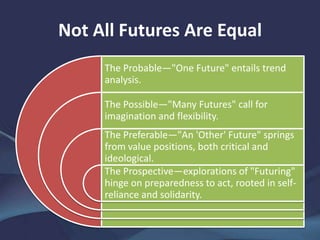
Not All Futures Are Equal
The Probable—"One Future" entails trend
analysis.
The Possible—"Many Futures" call for
imagination and flexibility.
The Preferable—"An 'Other' Future" springs
from value positions, both critical and
ideological.
The Prospective—explorations of "Futuring"
hinge on preparedness to act, rooted in self-
reliance and solidarity.
Democratizing Change Planning
Strategic planning is customarily the prerogative
of a few. But, not many can ever describe—even
less understand, enter into, and actively
support—what they have summarily been told to
lend force to.
Quite the opposite, Future Search conferencing is
a democratic approach to real-time, large-group
change planning from a systems perspective.
The Essence of Future Search
Future Search
conferencing
was developed
to help
organizations
create shared
visions and plot
organizational
directions linked
to results.
Future Search conferencing is a 3-day
event structured to
• Represent the system in one room.
• Explore the whole in context before
seeking to act on parts, focusing on
common ground and desired futures
and treating problems as information.
• Self-manage work and take
responsibility for action.
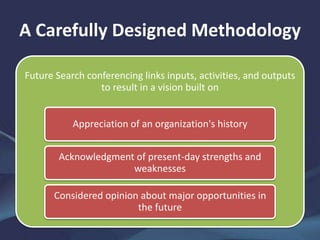
A Carefully Designed Methodology
Future Search conferencing links inputs, activities, and outputs
to result in a vision built on
Appreciation of an organization's history
Acknowledgment of present-day strengths and
weaknesses
Considered opinion about major opportunities in
the future
A Typical Future Search Agenda
Day 1:
Afternoon
Focus on the
Past:
Highlights
and
Milestones
Focus on the
Present:
External
Trends
Day 2: Morning
Focus on the
Present:
Responses to
Trends
Focus on the
Present:
Owning
Actions
Day 2:
Afternoon
Focus on the
Future: Ideal
Scenarios
Discover
Common
Ground
Day 3: Morning
and Early
Afternoon
Confirm
Common
Ground
Action
Planning
So, What Are You Organized For?
Summoning up what we are prone to forget,
the very existence of organizations intuits they
already have the resources they need to
achieve their purpose. What they may be short
of is access to key others and enough time—
away from distractions—to discover or invent
what else they are capable and willing to
realize in multiparty cooperation.
Future search conferencing can catalyze the
transition from bureaucratic to learning
organizations. It is a human process that takes
decisive steps toward informed; democratic,
meaning, non-coercive; and reflective
enterprise.
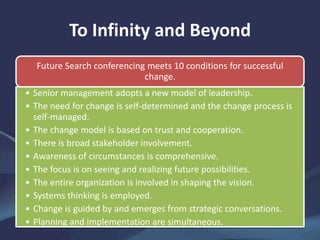
To Infinity and Beyond
Future Search conferencing meets 10 conditions for successful
change.
• Senior management adopts a new model of leadership.
• The need for change is self-determined and the change process is
self-managed.
• The change model is based on trust and cooperation.
• There is broad stakeholder involvement.
• Awareness of circumstances is comprehensive.
• The focus is on seeing and realizing future possibilities.
• The entire organization is involved in shaping the vision.
• Systems thinking is employed.
• Change is guided by and emerges from strategic conversations.
• Planning and implementation are simultaneous.
Further Reading
• ADB. 2008. Action Learning. Manila.
www.adb.org/publications/action-learning
• ——. 2008. Reading the Future. Manila.
www.adb.org/publications/reading-future
• ——. 2008. Appreciative Inquiry. Manila.
www.adb.org/publications/appreciative-inquiry
• ——. 2009. Drawing Mind Maps. Manila.
www.adb.org/publications/drawing-mind-maps
• ——. 2011. Learning in Conferences. Manila.
www.adb.org/publications/learning-conferences
• ——. 2012. Future Search Conferencing. Manila.
www.adb.org/publications/future-search-conferencing
Quick Response Codes
@ADB
@ADB Sustainable
Development Timeline
@Academia.edu
@LinkedIn
@ResearchGate
@Scholar
@SlideShare
@Twitter

Future Search Conferencing

  • 1.
    The views expressedin this presentation are the views of the author/s and do not necessarily reflect the views or policies of the Asian Development Bank, or its Board of Governors, or the governments they represent. ADB does not guarantee the accuracy of the data included in this presentation and accepts no responsibility for any consequence of their use. The countries listed in this presentation do not imply any view on ADB's part as to sovereignty or independent status or necessarily conform to ADB's terminology. Future Search Conferencing Olivier Serrat 2013
  • 2.
    Not All FuturesAre Equal The Probable—"One Future" entails trend analysis. The Possible—"Many Futures" call for imagination and flexibility. The Preferable—"An 'Other' Future" springs from value positions, both critical and ideological. The Prospective—explorations of "Futuring" hinge on preparedness to act, rooted in self- reliance and solidarity.
  • 3.
    Democratizing Change Planning Strategicplanning is customarily the prerogative of a few. But, not many can ever describe—even less understand, enter into, and actively support—what they have summarily been told to lend force to. Quite the opposite, Future Search conferencing is a democratic approach to real-time, large-group change planning from a systems perspective.
  • 4.
    The Essence ofFuture Search Future Search conferencing was developed to help organizations create shared visions and plot organizational directions linked to results. Future Search conferencing is a 3-day event structured to • Represent the system in one room. • Explore the whole in context before seeking to act on parts, focusing on common ground and desired futures and treating problems as information. • Self-manage work and take responsibility for action.
  • 5.
    A Carefully DesignedMethodology Future Search conferencing links inputs, activities, and outputs to result in a vision built on Appreciation of an organization's history Acknowledgment of present-day strengths and weaknesses Considered opinion about major opportunities in the future
  • 6.
    A Typical FutureSearch Agenda Day 1: Afternoon Focus on the Past: Highlights and Milestones Focus on the Present: External Trends Day 2: Morning Focus on the Present: Responses to Trends Focus on the Present: Owning Actions Day 2: Afternoon Focus on the Future: Ideal Scenarios Discover Common Ground Day 3: Morning and Early Afternoon Confirm Common Ground Action Planning
  • 7.
    So, What AreYou Organized For? Summoning up what we are prone to forget, the very existence of organizations intuits they already have the resources they need to achieve their purpose. What they may be short of is access to key others and enough time— away from distractions—to discover or invent what else they are capable and willing to realize in multiparty cooperation. Future search conferencing can catalyze the transition from bureaucratic to learning organizations. It is a human process that takes decisive steps toward informed; democratic, meaning, non-coercive; and reflective enterprise.
  • 8.
    To Infinity andBeyond Future Search conferencing meets 10 conditions for successful change. • Senior management adopts a new model of leadership. • The need for change is self-determined and the change process is self-managed. • The change model is based on trust and cooperation. • There is broad stakeholder involvement. • Awareness of circumstances is comprehensive. • The focus is on seeing and realizing future possibilities. • The entire organization is involved in shaping the vision. • Systems thinking is employed. • Change is guided by and emerges from strategic conversations. • Planning and implementation are simultaneous.
  • 9.
    Further Reading • ADB.2008. Action Learning. Manila. www.adb.org/publications/action-learning • ——. 2008. Reading the Future. Manila. www.adb.org/publications/reading-future • ——. 2008. Appreciative Inquiry. Manila. www.adb.org/publications/appreciative-inquiry • ——. 2009. Drawing Mind Maps. Manila. www.adb.org/publications/drawing-mind-maps • ——. 2011. Learning in Conferences. Manila. www.adb.org/publications/learning-conferences • ——. 2012. Future Search Conferencing. Manila. www.adb.org/publications/future-search-conferencing
  • 10.
    Quick Response Codes @ADB @ADBSustainable Development Timeline @Academia.edu @LinkedIn @ResearchGate @Scholar @SlideShare @Twitter