RAJASEKAR.O
DEPARTMENT OF CSE
SCAD COLLEGE OF ENGINEERING
AND TECHNOLOGY
Introduction
Project Manager (PM) is no doubt one of the most stressful jobs
out there as the PM is directly responsible and accountable for the
success or failure of a project. Some PMs believed that they can
handle and cope with the high level of stress but there are some
who are ignoring or refuse to recognize that they are under stress.
The experience of stress is not only impacting the cognitive and
behavioral performance, it can also have a negative impact on your
personal health, wellbeing, and family life. You might not able to
change the amount of stress you have on a daily basis, but you can
change how you deal with it. It is important to manage the stress
before it becomes more and more difficult to handle and manage.
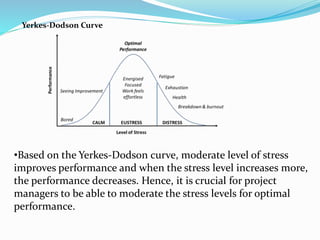
Yerkes-Dodson Curve
•Based on the Yerkes-Dodson curve, moderate level of stress
improves performance and when the stress level increases more,
the performance decreases. Hence, it is crucial for project
managers to be able to moderate the stress levels for optimal
performance.
Causes Of Stress In Project Management
• Imaging the project deadline is 2 weeks away and
there are still some critical issues to be resolved.
• To make it worse, one of your key team members
has been hospitalized.
• Customer is unhappy and management is
requesting for a daily review.
• The source of stress in Project Management can
be many and varied.
Some common sources are listed below:
1. Unrealistic timeline
2. Working in a matrix system which PM does not have the
full control of the resources
3.Lack of resources – human and/or equipment
4. Proliferation of virtual teams and cross cultural influences
5.Inter-group conflict in organization
6.Project environment
Project Manager must first acknowledge or recognize that he or
she is being under stress and then develop self-discipline before
proceeding to learn and practice what are the techniques to
manage stress. Learning to manage stress successfully begins
with our willingness to take an honest look at ourselves.
Stress Management Techniques
Detach or dissociate: Consider the team meeting where you
are extremely frustrated by seeing wasted time or the personal
posturing from a team member. To use detachment or
dissociation, allow yourself to mentally “check out” of the
meeting as much as is appropriate, letting your mind wander to
a more pleasant image. Obviously, these approaches are used
selectively and discretely.
Develop potent conflict resolution skills: We add stress to our work
lives by either under reacting to the stressful situation (avoiding or denying
it) or over reacting to the stressful situation (coming on too strong). Both
approaches increase our stress. A menu of conflict resolution skills (which
will help reduce stress) is found in Flannes and Levin (2005).
Know when enough is enough, and stay away from
debating:
A natural but often unproductive approach to resolve a
stressful situation is to debate another person about the
wisdom of your point of view. This does not mean you should
not assert your belief, but you should know when to stop, often
when your message has been heard. At this point in the
dialogue, if we continue try to be seen as “right,” we are actually
increasing our stress. It’s better to stop earlier than later; it can
be a matter of diminishing returns to continue to be seen as
“right.”
Monitor “what if?” thinking:
In the middle of a stressful event, it is natural to engage in “what
if thinking,” asking ourselves “What if we’d only done this in the
past, then we might not be in this crisis right now?” As is evident,
this form of “what if” thinking involves a focus that is not present
oriented. An alternative to this form of thinking is to focus very
much in the present, such as posing this question to yourself: “It’s
Thursday at 3:17 PM, I’ve just received bad news about the
project. What can I do in the next hour to take a small step
towards improving the situation?”
Look for a paradoxical component in the situation:
In the midst of a situation that is legitimately stressful, we
may find ourselves taking ourselves, or the situation, too
seriously. Cognitive behavioral psychologists would say that we
are engaging in “catastrophizing” behavior, in which we take a
singular, negative event, cognitively “run with it,” and then
find ourselves believing, for example, that the entire project is
probably doomed because of this one serious problem. An
antidote to this is to find a paradoxical cognition that you can
hold onto, something that will put your stress and worries in
perspective.
Other Techniques:
1. Prioritize
2.Avoid extreme reactions
3.Applying NLP to Stress Reduction
4.Exercise
5.Meditation
THANK YOU

Spm unit 5

  • 1.
    RAJASEKAR.O DEPARTMENT OF CSE SCADCOLLEGE OF ENGINEERING AND TECHNOLOGY
  • 2.
    Introduction Project Manager (PM)is no doubt one of the most stressful jobs out there as the PM is directly responsible and accountable for the success or failure of a project. Some PMs believed that they can handle and cope with the high level of stress but there are some who are ignoring or refuse to recognize that they are under stress. The experience of stress is not only impacting the cognitive and behavioral performance, it can also have a negative impact on your personal health, wellbeing, and family life. You might not able to change the amount of stress you have on a daily basis, but you can change how you deal with it. It is important to manage the stress before it becomes more and more difficult to handle and manage.
  • 3.
    Yerkes-Dodson Curve •Based onthe Yerkes-Dodson curve, moderate level of stress improves performance and when the stress level increases more, the performance decreases. Hence, it is crucial for project managers to be able to moderate the stress levels for optimal performance.
  • 4.
    Causes Of StressIn Project Management • Imaging the project deadline is 2 weeks away and there are still some critical issues to be resolved. • To make it worse, one of your key team members has been hospitalized. • Customer is unhappy and management is requesting for a daily review. • The source of stress in Project Management can be many and varied.
  • 5.
    Some common sourcesare listed below: 1. Unrealistic timeline 2. Working in a matrix system which PM does not have the full control of the resources 3.Lack of resources – human and/or equipment 4. Proliferation of virtual teams and cross cultural influences 5.Inter-group conflict in organization 6.Project environment
  • 6.
    Project Manager mustfirst acknowledge or recognize that he or she is being under stress and then develop self-discipline before proceeding to learn and practice what are the techniques to manage stress. Learning to manage stress successfully begins with our willingness to take an honest look at ourselves. Stress Management Techniques
  • 7.
    Detach or dissociate:Consider the team meeting where you are extremely frustrated by seeing wasted time or the personal posturing from a team member. To use detachment or dissociation, allow yourself to mentally “check out” of the meeting as much as is appropriate, letting your mind wander to a more pleasant image. Obviously, these approaches are used selectively and discretely. Develop potent conflict resolution skills: We add stress to our work lives by either under reacting to the stressful situation (avoiding or denying it) or over reacting to the stressful situation (coming on too strong). Both approaches increase our stress. A menu of conflict resolution skills (which will help reduce stress) is found in Flannes and Levin (2005).
  • 8.
    Know when enoughis enough, and stay away from debating: A natural but often unproductive approach to resolve a stressful situation is to debate another person about the wisdom of your point of view. This does not mean you should not assert your belief, but you should know when to stop, often when your message has been heard. At this point in the dialogue, if we continue try to be seen as “right,” we are actually increasing our stress. It’s better to stop earlier than later; it can be a matter of diminishing returns to continue to be seen as “right.”
  • 9.
    Monitor “what if?”thinking: In the middle of a stressful event, it is natural to engage in “what if thinking,” asking ourselves “What if we’d only done this in the past, then we might not be in this crisis right now?” As is evident, this form of “what if” thinking involves a focus that is not present oriented. An alternative to this form of thinking is to focus very much in the present, such as posing this question to yourself: “It’s Thursday at 3:17 PM, I’ve just received bad news about the project. What can I do in the next hour to take a small step towards improving the situation?”
  • 10.
    Look for aparadoxical component in the situation: In the midst of a situation that is legitimately stressful, we may find ourselves taking ourselves, or the situation, too seriously. Cognitive behavioral psychologists would say that we are engaging in “catastrophizing” behavior, in which we take a singular, negative event, cognitively “run with it,” and then find ourselves believing, for example, that the entire project is probably doomed because of this one serious problem. An antidote to this is to find a paradoxical cognition that you can hold onto, something that will put your stress and worries in perspective.
  • 11.
    Other Techniques: 1. Prioritize 2.Avoidextreme reactions 3.Applying NLP to Stress Reduction 4.Exercise 5.Meditation
  • 12.