This document discusses peripheral and midline intravenous catheters. It notes that peripheral catheters are appropriate for short term therapies under 7 days through superficial hand or arm veins. Midline catheters are inserted further up the arm and can remain in place for 1-4 weeks, providing less frequent site changes than peripheral catheters. The document reviews best practices for catheter insertion, stabilization, dressing, and flushing to promote safe and effective venous access.

In boththe hospital and outpatient settings, venous
access devices are a critical component in patient care.
One size does not fit all and each device, type and
duration should be tailored to the needs of each
individual to provide safe and reliable care.
There are a variety of options available and are generally
broken down into peripheral and central venous access
devices (CVAD).
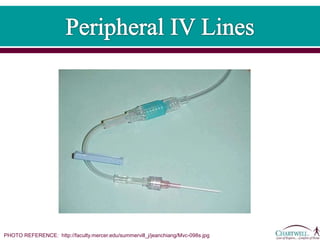
Peripheral cathetersare the most commonly used
venous access device.
It is a short catheter inserted through the skin into a vein,
primarily the superficial veins of the hand or forearm, and
in some cases the foot.
It has the least complications and is cost effective for
short term use.
These catheters are not recommended when the therapy
is a vesicant, chemotherapy, parenteral nutrition or when
the pH is <5 or >9.
5.
Peripheral cathetersare appropriate venous access
devices for short term therapies, generally less than 7
days.
Hydration, diuretics, steroids, gamma globulin, and some
antibiotics are frequently prescribed for peripheral
infusion.
Parenteral Nutrition, vesicants, chemotherapy or
medications and solutions with a pH <5 or > 9 are not
recommended.
Peripheral access is also useful short term for patients
who cannot absorb medications or take orally due to
illness.
The CDC Guidelines state that another VAD may be
more appropriate for use if the therapy will last longer
than 6 days.
6.
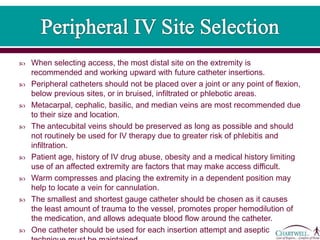
When selectingaccess, the most distal site on the extremity is
recommended and working upward with future catheter insertions.
Peripheral catheters should not be placed over a joint or any point of flexion,
below previous sites, or in bruised, infiltrated or phlebotic areas.
Metacarpal, cephalic, basilic, and median veins are most recommended due
to their size and location.
The antecubital veins should be preserved as long as possible and should
not routinely be used for IV therapy due to greater risk of phlebitis and
infiltration.
Patient age, history of IV drug abuse, obesity and a medical history limiting
use of an affected extremity are factors that may make access difficult.
Warm compresses and placing the extremity in a dependent position may
help to locate a vein for cannulation.
The smallest and shortest gauge catheter should be chosen as it causes
the least amount of trauma to the vessel, promotes proper hemodilution of
the medication, and allows adequate blood flow around the catheter.
One catheter should be used for each insertion attempt and aseptic
7.
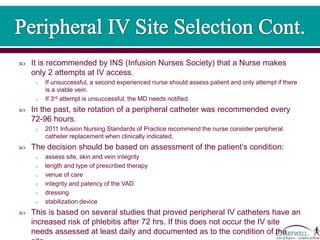
It isrecommended by INS (Infusion Nurses Society) that a Nurse makes
only 2 attempts at IV access.
o If unsuccessful, a second experienced nurse should assess patient and only attempt if there
is a viable vein.
o If 3rd attempt is unsuccessful, the MD needs notified.
In the past, site rotation of a peripheral catheter was recommended every
72-96 hours.
o 2011 Infusion Nursing Standards of Practice recommend the nurse consider peripheral
catheter replacement when clinically indicated.
The decision should be based on assessment of the patient’s condition:
o assess site, skin and vein integrity
o length and type of prescribed therapy
o venue of care
o integrity and patency of the VAD
o dressing
o stabilization device
This is based on several studies that proved peripheral IV catheters have an
increased risk of phlebitis after 72 hrs. If this does not occur the IV site
needs assessed at least daily and documented as to the condition of the
8.
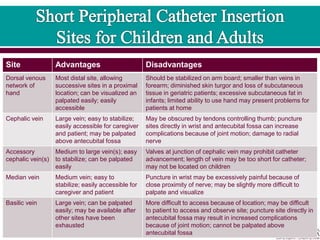
Site Advantages Disadvantages
Dorsalvenous
network of
hand
Most distal site, allowing
successive sites in a proximal
location; can be visualized an
palpated easily; easily
accessible
Should be stabilized on arm board; smaller than veins in
forearm; diminished skin turgor and loss of subcutaneous
tissue in geriatric patients; excessive subcutaneous fat in
infants; limited ability to use hand may present problems for
patients at home
Cephalic vein Large vein; easy to stabilize;
easily accessible for caregiver
and patient; may be palpated
above antecubital fossa
May be obscured by tendons controlling thumb; puncture
sites directly in wrist and antecubital fossa can increase
complications because of joint motion; damage to radial
nerve
Accessory
cephalic vein(s)
Medium to large vein(s); easy
to stabilize; can be palpated
easily
Valves at junction of cephalic vein may prohibit catheter
advancement; length of vein may be too short for catheter;
may not be located on children
Median vein Medium vein; easy to
stabilize; easily accessible for
caregiver and patient
Puncture in wrist may be excessively painful because of
close proximity of nerve; may be slightly more difficult to
palpate and visualize
Basilic vein Large vein; can be palpated
easily; may be available after
other sites have been
exhausted
More difficult to access because of location; may be difficult
to patient to access and observe site; puncture site directly in
antecubital fossa may result in increased complications
because of joint motion; cannot be palpated above
antecubital fossa
9.
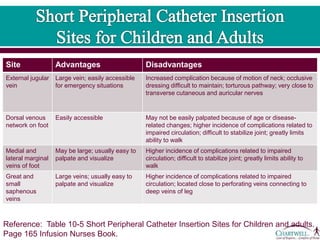
Site Advantages Disadvantages
Externaljugular
vein
Large vein; easily accessible
for emergency situations
Increased complication because of motion of neck; occlusive
dressing difficult to maintain; torturous pathway; very close to
transverse cutaneous and auricular nerves
Dorsal venous
network on foot
Easily accessible May not be easily palpated because of age or disease-
related changes; higher incidence of complications related to
impaired circulation; difficult to stabilize joint; greatly limits
ability to walk
Medial and
lateral marginal
veins of foot
May be large; usually easy to
palpate and visualize
Higher incidence of complications related to impaired
circulation; difficult to stabilize joint; greatly limits ability to
walk
Great and
small
saphenous
veins
Large veins; usually easy to
palpate and visualize
Higher incidence of complications related to impaired
circulation; located close to perforating veins connecting to
deep veins of leg
Reference: Table 10-5 Short Peripheral Catheter Insertion Sites for Children and adults.
Page 165 Infusion Nurses Book.
10.
INS guidelinesfor flushing a peripheral catheter no
longer include the use of heparin lock solution.
A minimum of 2mls of Preservative free 0.9% Sodium
chloride should be used before and after medications
and solutions.
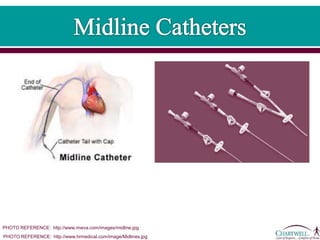
A Midlineis simply a long peripheral catheter typically 3-11 inches in
length (8-25cm) inserted into the antecubital or upper arm vein.
Unlike the PICC line which terminates in the central circulation, the
tip of the midline catheter resides in the basilic, cephalic or brachial
vein distal to the shoulder at or below the axillary line. The basilic
vein access is preferred due to its larger diameter.
Insertion costs for PICC and Midline Catheters are similar, however
the Midline tends to be a less favorable choice due to limitations in
dwell time and use.
Midlines have an advantage over short peripheral access because they
do not require frequent site changes and have less risk of phlebitis due
to larger vein access.
Midline catheters tend to have lower infection rates than PICCs and
other CVADs.
Typical sizes are 1.9 Fr.-5 Fr. and are available in both single and
double lumen and polyurethane and silicone materials.
13.
Midline cathetersare generally used for venous access
between 1-4 weeks duration and for neonates 6-10 days.
They can be used in any inpatient or outpatient setting.
According to INS standards, any infusate that can be
used for short peripheral access is appropriate for
Midline use.
Hydration, blood products, pain medications, diuretics
and some antibiotics are typical therapies used for
midlines.
It is not appropriate to infuse vesicants, parenteral
nutrition, or solutions with a pH<5 or >9 or an osmolality
>600 mOsm/L through a midline catheter.
INS does not recommend routine blood specimen
14.
As withany VAD, peripheral and midline catheters
should be placed by trained and qualified health care
professionals and by physician or authorized prescribers’
order.
Both can be inserted at bedside.
The CDC guidelines for hand hygiene should be followed
to decontaminate hands prior to inserting any IV
Catheter.
Standard precautions for the health care worker should
be followed to prevent blood contamination.
If hair removal is necessary, per the INS guidelines,
scissors are recommended and only surgical clippers
with a disposable head can be used.
o Shaving can cause a micro abrasion creating an environment for
infection.
15.
The CDCrecommends use of 2% chlorhexidine based
scrub but 70% alcohol and 1-2% povidone iodine
solution can be used if allergic to chlorhexidine.
An analysis was done involving 8 different studies
comparing the cleansing solutions and the outcome
proved to be a significant decrease in bloodstream
infections when chlorhexidine based scrub was used.
For chlorhexidine to be affective it should be applied with
friction for a minimum of 30 seconds and be allowed to
air-dry for a minimum of 30 seconds. The area prepped
should be 2-3 inches in diameter.
16.
Ideally theMidline catheter should be placed in a
patient’s non-dominate arm 1-1 ½ inches above or below
the anticubital fossa and following manufacturers’
guidelines.
Once the insertion site is chosen the length of the
catheter is measured against the distance from the
insertion site.
o The catheter may require trimming so as not to extend beyond
the axillary vein.
Insertion techniques vary among manufacturers but CXR
is not needed to confirm placement.
Measurements of accessed arm and catheter length
should be taken and documented.
17.
It isimportant that stabilization of the short or long
peripheral catheter be done to minimize loss of catheter,
infiltration and the development of mechanical phlebitis.
Studies have shown there is a significant reduction in
complications and prolonged dwell time with a
manufactured securement device and is the
recommended choice.
Taping methods can be used.
o Anchor tape should only be applied to the wings of the catheter
and not the skin-catheter junction site as it inhibits visualization
and can be a potential source of infection.
When possible, dressings should be transparent semi
permeable (TSM) so the site can be assessed daily or
with every use of the catheter.
18.
Preservative free0.9% Sodium chloride should be used
before and after medications and solutions.
o INS recommends a minimum of 3mls NSS and 3mls 10U/ml
heparin lock solution.
19.
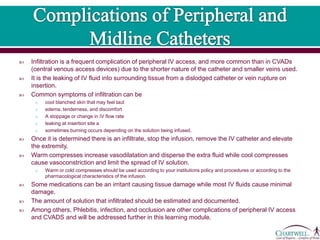
Infiltration isa frequent complication of peripheral IV access, and more common than in CVADs
(central venous access devices) due to the shorter nature of the catheter and smaller veins used.
It is the leaking of IV fluid into surrounding tissue from a dislodged catheter or vein rupture on
insertion.
Common symptoms of infiltration can be
o cool blanched skin that may feel taut
o edema, tenderness, and discomfort
o A stoppage or change in IV flow rate
o leaking at insertion site a
o sometimes burning occurs depending on the solution being infused.
Once it is determined there is an infiltrate, stop the infusion, remove the IV catheter and elevate
the extremity.
Warm compresses increase vasodilatation and disperse the extra fluid while cool compresses
cause vasoconstriction and limit the spread of IV solution.
o Warm or cold compresses should be used according to your institutions policy and procedures or according to the
pharmacological characteristics of the infusion.
Some medications can be an irritant causing tissue damage while most IV fluids cause minimal
damage.
The amount of solution that infiltrated should be estimated and documented.
Among others, Phlebitis, infection, and occlusion are other complications of peripheral IV access
and CVADS and will be addressed further in this learning module.
20.
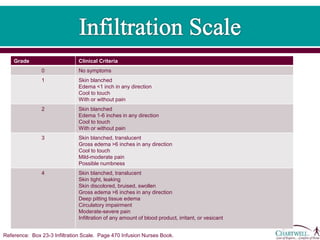
Grade Clinical Criteria
0No symptoms
1 Skin blanched
Edema <1 inch in any direction
Cool to touch
With or without pain
2 Skin blanched
Edema 1-6 inches in any direction
Cool to touch
With or without pain
3 Skin blanched, translucent
Gross edema >6 inches in any direction
Cool to touch
Mild-moderate pain
Possible numbness
4 Skin blanched, translucent
Skin tight, leaking
Skin discolored, bruised, swollen
Gross edema >6 inches in any direction
Deep pitting tissue edema
Circulatory impairment
Moderate-severe pain
Infiltration of any amount of blood product, irritant, or vesicant
Reference: Box 23-3 Infiltration Scale. Page 470 Infusion Nurses Book.
21.
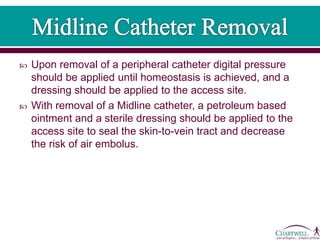
Upon removalof a peripheral catheter digital pressure
should be applied until homeostasis is achieved, and a
dressing should be applied to the access site.
With removal of a Midline catheter, a petroleum based
ointment and a sterile dressing should be applied to the
access site to seal the skin-to-vein tract and decrease
the risk of air embolus.