Central Venous Lines and
 Blood Stream Infections
    Breaking out the Bundles

         Elizabeth Gilger, RN, CCRN
      Medical University of South Carolina
Infection Control
Did you know?
     Approximately 90% of catheter related
  blood stream infections (BSI) occur with
  central venous catheters (CVC)

    Between 500 and 4,000 patients die
 annually from BSI


                   Institute for Healthcare Improvement, 2007
Infection Control
Did you know?

    Mortality of ventilated patients who
 develop VAP is 46 %

    $40,000 is the estimated cost
 accumulated due to VAP


                   Institute for Healthcare Improvement, 2007
Blood Stream Infections
Disruption of the integrity of the skin
creates an avenue for infection

Infection spreads to the bloodstream
leading to Hemodynamic changes and
organ dysfunction and potentially may lead
to death
Institute for Healthcare
         Improvement (IHI)

Developed in 1991 to improve health care
worldwide
Developed improvement measures based on
research. Many of these measures had been
previously recommended by CDC in their
guidelines for the prevention of CVL related
bloodstream infections.
Incorporated bundles into the healthcare culture
to ensure standardized practice
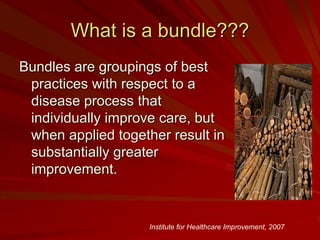
What is a bundle???
Bundles are groupings of best
 practices with respect to a
 disease process that
 individually improve care, but
 when applied together result in
 substantially greater
 improvement.


                    Institute for Healthcare Improvement, 2007
Central Line Bundle
Hand Hygiene
Maximal Barrier Precautions Upon
Insertion
Chlorhexidine Skin Antisepsis
Optimal Catheter Site Selection, with
Subclavian Vein as the Preferred Site for
Non-Tunneled Catheters
Daily Review of Line Necessity with
Prompt Removal of Unnecessary Lines
Think Outside the Bundle
CVL Assessment
– Each shift, assess for patency, site condition
  and dressing patency

– If the CVL was placed in a true clinical
  emergency, the line is to be changed after 24
  hours
Think Outside the Bundle
CVL Care
– Change transparent dressings every 7 days,
  those you cannot visualize the site i.e. gauze
  dressing, change every 24 hours

– Change tubing and caps every 72 hours

– Cleanse caps prior to tubing change, IVP
  medication or flushing with alcohol swab. Use
  friction!
Insertion
Site selection-recommended site in adults is the
subclavian site. For pediatrics-no data.
Full barrier precautions should be used-MDs
should use gown, hat, gloves and mask. If you
are in and out of the room, wear a mask. If you
stand there the entire time, you should use full
barriers, too.
Antibiotic impregnated catheters recommended
for lines that are anticipated to remain 7 days or
more.
Policy 75-A
Prior to placement of the line, someone, usually the RN,
is designated to monitor the sterile field and practice.
This designee must stop the procedure if the
appropriate steps are not followed.
If the patient is conscious, the designee will stop the
procedure by saying “Break Scrub”: indicating to the
clinician that the bundle has not been followed and the
procedure must be stopped.
If the clinician does not stop the procedure, the RN is to
notify the nurse manager.
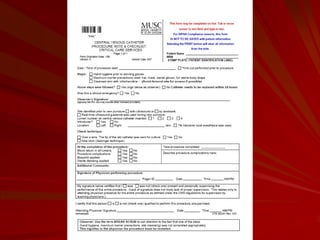
Find this checklist on the Clinician’s Order site at
http://www.musc.edu/cce/ORDFRMS/
CVL Insertion Carts and Supplies
To facilitate adherence to the bundle, carts
are being purchased for nursing units
These carts will hold necessary supplies
Physicians have participated in the
selection of drapes for the adult and
pediatric populations.
A variety of drapes are available in
different styles and sizes.
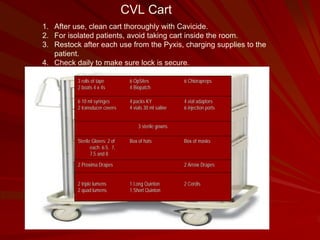
CVL Cart
1. After use, clean cart thoroughly with Cavicide.
2. For isolated patients, avoid taking cart inside the room.
3. Restock after each use from the Pyxis, charging supplies to the
   patient.
4. Check daily to make sure lock is secure.

          3 rolls of tape         6 OpSites              6 Chlorapreps
          2 boats 4 x 4s          4 Biopatch

          6 10 ml syringes        4 packs KY             4 vial adaptors
          2 transducer covers     4 vials 30 ml saline   6 injection ports


                                      3 sterile gowns

          Sterile Gloves: 2 of    Box of hats            Box of masks
                 each 6.5, 7,
                 7.5 and 8

          2 Proxima Drapes                               2 Arrow Drapes


          2 triple lumens         1 Long Quinton         2 Cordis
          2 quad lumens           1 Short Quinton
And wash your hands!!!!!!!!


You can’t be
 too clean!!!


                http://www.learnovation.com/johnwise_samples.htm
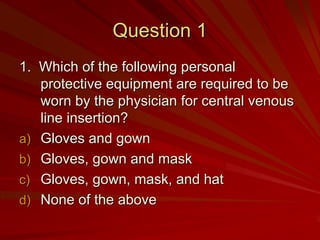
Question 1
1. Which of the following personal
   protective equipment are required to be
   worn by the physician for central venous
   line insertion?
a) Gloves and gown
b) Gloves, gown and mask
c) Gloves, gown, mask, and hat
d) None of the above
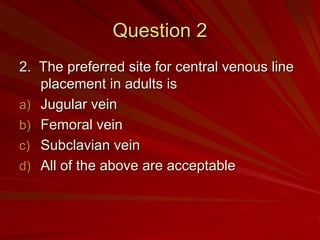
Question 2
2. The preferred site for central venous line
   placement in adults is
a) Jugular vein
b) Femoral vein
c) Subclavian vein
d) All of the above are acceptable
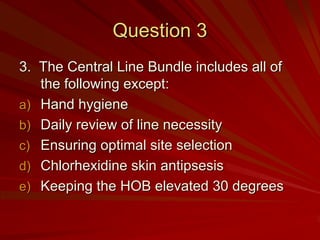
Question 3
3. The Central Line Bundle includes all of
   the following except:
a) Hand hygiene
b) Daily review of line necessity
c) Ensuring optimal site selection
d) Chlorhexidine skin antipsesis
e) Keeping the HOB elevated 30 degrees
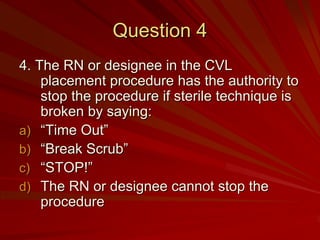
Question 4
4. The RN or designee in the CVL
    placement procedure has the authority to
    stop the procedure if sterile technique is
    broken by saying:
a) “Time Out”
b) “Break Scrub”
c) “STOP!”
d) The RN or designee cannot stop the
    procedure
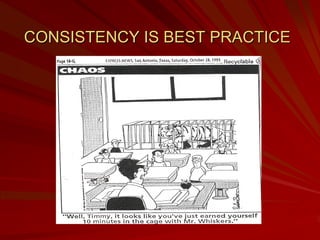
CONSISTENCY IS BEST PRACTICE

Cvl bundle presentation

  • 1.
    Central Venous Linesand Blood Stream Infections Breaking out the Bundles Elizabeth Gilger, RN, CCRN Medical University of South Carolina
  • 2.
    Infection Control Did youknow? Approximately 90% of catheter related blood stream infections (BSI) occur with central venous catheters (CVC) Between 500 and 4,000 patients die annually from BSI Institute for Healthcare Improvement, 2007
  • 3.
    Infection Control Did youknow? Mortality of ventilated patients who develop VAP is 46 % $40,000 is the estimated cost accumulated due to VAP Institute for Healthcare Improvement, 2007
  • 4.
    Blood Stream Infections Disruptionof the integrity of the skin creates an avenue for infection Infection spreads to the bloodstream leading to Hemodynamic changes and organ dysfunction and potentially may lead to death
  • 5.
    Institute for Healthcare Improvement (IHI) Developed in 1991 to improve health care worldwide Developed improvement measures based on research. Many of these measures had been previously recommended by CDC in their guidelines for the prevention of CVL related bloodstream infections. Incorporated bundles into the healthcare culture to ensure standardized practice
  • 6.
    What is abundle??? Bundles are groupings of best practices with respect to a disease process that individually improve care, but when applied together result in substantially greater improvement. Institute for Healthcare Improvement, 2007
  • 7.
    Central Line Bundle HandHygiene Maximal Barrier Precautions Upon Insertion Chlorhexidine Skin Antisepsis Optimal Catheter Site Selection, with Subclavian Vein as the Preferred Site for Non-Tunneled Catheters Daily Review of Line Necessity with Prompt Removal of Unnecessary Lines
  • 8.
    Think Outside theBundle CVL Assessment – Each shift, assess for patency, site condition and dressing patency – If the CVL was placed in a true clinical emergency, the line is to be changed after 24 hours
  • 9.
    Think Outside theBundle CVL Care – Change transparent dressings every 7 days, those you cannot visualize the site i.e. gauze dressing, change every 24 hours – Change tubing and caps every 72 hours – Cleanse caps prior to tubing change, IVP medication or flushing with alcohol swab. Use friction!
  • 10.
    Insertion Site selection-recommended sitein adults is the subclavian site. For pediatrics-no data. Full barrier precautions should be used-MDs should use gown, hat, gloves and mask. If you are in and out of the room, wear a mask. If you stand there the entire time, you should use full barriers, too. Antibiotic impregnated catheters recommended for lines that are anticipated to remain 7 days or more.
  • 11.
    Policy 75-A Prior toplacement of the line, someone, usually the RN, is designated to monitor the sterile field and practice. This designee must stop the procedure if the appropriate steps are not followed. If the patient is conscious, the designee will stop the procedure by saying “Break Scrub”: indicating to the clinician that the bundle has not been followed and the procedure must be stopped. If the clinician does not stop the procedure, the RN is to notify the nurse manager. Find this checklist on the Clinician’s Order site at http://www.musc.edu/cce/ORDFRMS/
  • 13.
    CVL Insertion Cartsand Supplies To facilitate adherence to the bundle, carts are being purchased for nursing units These carts will hold necessary supplies Physicians have participated in the selection of drapes for the adult and pediatric populations. A variety of drapes are available in different styles and sizes.
  • 14.
    CVL Cart 1. Afteruse, clean cart thoroughly with Cavicide. 2. For isolated patients, avoid taking cart inside the room. 3. Restock after each use from the Pyxis, charging supplies to the patient. 4. Check daily to make sure lock is secure. 3 rolls of tape 6 OpSites 6 Chlorapreps 2 boats 4 x 4s 4 Biopatch 6 10 ml syringes 4 packs KY 4 vial adaptors 2 transducer covers 4 vials 30 ml saline 6 injection ports 3 sterile gowns Sterile Gloves: 2 of Box of hats Box of masks each 6.5, 7, 7.5 and 8 2 Proxima Drapes 2 Arrow Drapes 2 triple lumens 1 Long Quinton 2 Cordis 2 quad lumens 1 Short Quinton
  • 15.
    And wash yourhands!!!!!!!! You can’t be too clean!!! http://www.learnovation.com/johnwise_samples.htm
  • 16.
    Question 1 1. Whichof the following personal protective equipment are required to be worn by the physician for central venous line insertion? a) Gloves and gown b) Gloves, gown and mask c) Gloves, gown, mask, and hat d) None of the above
  • 17.
    Question 2 2. Thepreferred site for central venous line placement in adults is a) Jugular vein b) Femoral vein c) Subclavian vein d) All of the above are acceptable
  • 18.
    Question 3 3. TheCentral Line Bundle includes all of the following except: a) Hand hygiene b) Daily review of line necessity c) Ensuring optimal site selection d) Chlorhexidine skin antipsesis e) Keeping the HOB elevated 30 degrees
  • 19.
    Question 4 4. TheRN or designee in the CVL placement procedure has the authority to stop the procedure if sterile technique is broken by saying: a) “Time Out” b) “Break Scrub” c) “STOP!” d) The RN or designee cannot stop the procedure
  • 20.