SRT PICCs
Why We Do IT
CENTRE FOR DISEASE CONTROL
Guidelines for the Prevention of
Intravascular Catheter-Related
Infections, 2011
INFUSION NURSES SOCIETY
2011 Infusion Nursing Standards of Practice
MEMORY AID
1. Wash your hands first.
2. Use body fluid precautions.
3. Aseptic care of vascular access devices.
4. The fluid pathway must remain sterile.
5. All cleaning solutions must be allowed to dry
completely.
6. Catheters must be secured.
7. Do NOT remove a PICC.
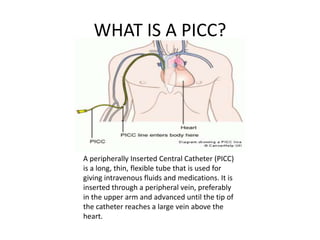
WHAT IS A PICC?
A peripherally Inserted Central Catheter (PICC)
is a long, thin, flexible tube that is used for
giving intravenous fluids and medications. It is
inserted through a peripheral vein, preferably
in the upper arm and advanced until the tip of
the catheter reaches a large vein above the
heart.
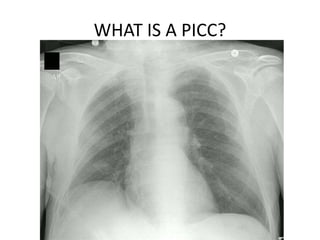
WHAT IS A PICC?
WHY INSERT A PICC?
PICC lines can remain in place for extended
periods of time provided that there are no
complications. PICCs placement in the SVC
provides better hemodilution than shorter
peripheral catheters and are therefore
indicated for hypotonic, isotonic, hypertonic
and vesicant therapy. Prolonged IV antibiotic
treatment, TPN Nutrition, Chemotherapy
Some PICCs are engineered to allow additional
functions including high pressure injection (up
to 300 psi).
WHO INSERTS A PICC?
PICCs are usually inserted by physicians, nurse
practitioners, or specially trained certified
registered nurses and radiologic technologists
using ultrasound, chest
radiographs, fluoroscopy , and ECG to aid in
their insertion and to confirm placement. PICC
insertion is a sterile procedure, but does not
require the use of an operating room. When
done at bedside (that is, in the patient's
room), a suitable sterile field must be
established and maintained throughout the
procedure.
HOW IS A PICC INSERTED?
http://www.youtube.com/watch?feature=play
er_embedded&v=sViSpYptjqk
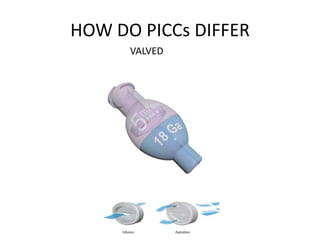
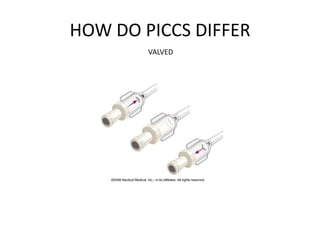
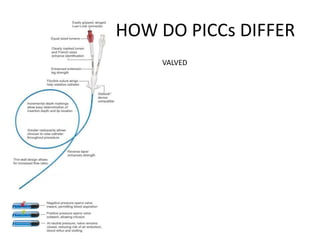
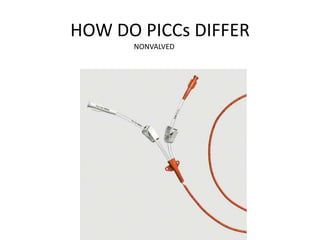
HOW DO PICCS DIFFER
Single or Multi Lumen
Valved or Non-Valved
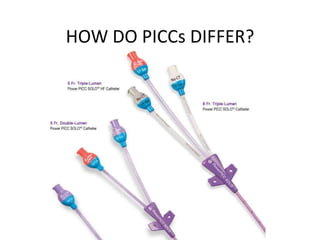
HOW DO PICCs DIFFER?
The PICC may have single or multiple lumens.
This depends on how many intravenous
therapies are needed.
HOW DO PICCs DIFFER
Use a CVC with the minimum number of ports
or lumens essential for the management
of the patient [65–68]. Category IB (CDC )
HOW DO PICCs DIFFER
VALVED
HOW DO PICCS DIFFER
VALVED
HOW DO PICCs DIFFER
VALVED
HOW DO PICCs DIFFER
NONVALVED
PICC SKIN CLEANING SOLUTIONS
- Prepare clean skin with a >0.5% chlorhexidine
preparation with alcohol before central
venous catheter and peripheral arterial
catheter insertion and during dressing
changes.
If there is a contraindication to chlorhexidine,
tincture of iodine, an iodophor, or 70%
alcohol can be used as alternatives [82, 83].
Category IA
- No comparison has been made between
using chlorhexidine preparations with alcohol
and povidone-iodine in alcohol to prepare
clean skin.
- Antiseptics should be allowed to dry
according to the manufacturer’s
recommendation. (CDC)
PICC CARE DRESSING
Wear either clean or sterile gloves when
changing the dressing on intravascular
catheters. Category IC (CDC)
PICC CARE DRESSING
Perform hand hygiene procedures, either by
washing hands with conventional soap and
water or with alcohol-based hand rubs (ABHR).
Hand hygiene should be performed
before and after palpating catheter insertion
sites as well as before and after inserting,
replacing, accessing, repairing, or dressing an
intravascular catheter. Palpation of the
insertion site should not be performed after
the application of antiseptic, unless aseptic
technique is maintained [12, 77–79]. Category
IB
2. Maintain aseptic technique for the insertion
and care of intravascular catheters [37, 73]
(CDC)
PICC CARE DRESSING
- Replace transparent dressings used on
tunneled or implanted CVC sites no more than
once per week (unless the dressing is soiled or
loose), until the insertion site has healed.
Category II
- Replace catheter site dressing if the dressing
becomes damp, loosened, or visibly soiled
[84, 85]. Category IB
- If the patient is diaphoretic or if the site is
bleeding or oozing, use a gauze dressing until
this is resolved [84–87]. Category II
- Replace dressings used on short-term CVC
sites every 2 days for gauze dressings. (CDC)
PICC CARE DRESSING
36.1 Vascular access device (VAD) stabilization
shall be
used to preserve the integrity of the access
device, minimize catheter movement at the
hub, and prevent
catheter dislodgment and loss of access.
36.2 VADs shall be stabilized using a method
that does
not interfere with assessment and monitoring
of the
access site or impede vascular circulation or
delivery of the prescribed therapy.
PICC CARE DRESSING
- Use a sutureless securement device to reduce
the risk of infection for intravascular
catheters [105]. Category II
-
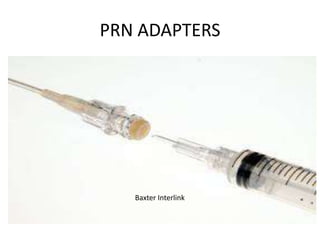
PRN ADAPTERS
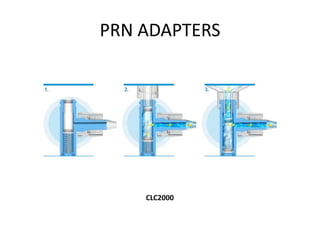
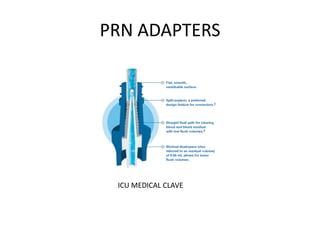
Negative Fluid Displacement
- Baxter Healthcare Interlink
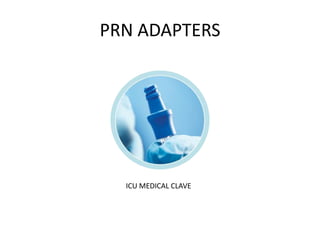
- ICU Medical Clave
Positive Fluid Displacement
- ICU Medical CLC 2000
Neutral Fluid Displacement
PRN ADAPTERS
Baxter Interlink
PRN ADAPTERS
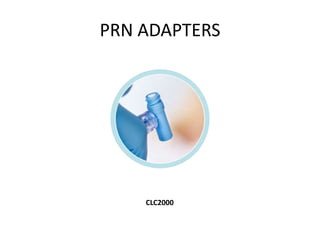
CLC2000
PRN ADAPTERS
CLC2000
PRN ADAPTERS
ICU MEDICAL CLAVE
PRN ADAPTERS
ICU MEDICAL CLAVE
PRN ADAPTERS
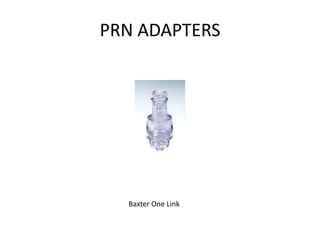
Baxter One Link
PICC CARE FLUSHING
The Infusion Nursing Standards of Practice establishes the national standard for
all infusion therapy.
This standard on flushing emphasizes the goals of maintaining patency and preventing
contact between heparin and incompatible solutions.
The standard incorporates the concepts of catheter flushing and locking. Flushing
assesses catheter patency and functionality and removes the previously infused
medication. Locking the catheter creates a closed column of fluid inside the catheter
lumen intended to prevent blood from moving into the lumen. (IV)
SASH Saline Admixture Saline Heparin
Lock non-valved catheters with positive pressure.
PICC CARE FLUSHING
45.1 Vascular access devices shall be flushed prior
to each infusion as part of the steps to assess catheter
function.
45.2 Vascular access devices shall be flushed after each
infusion to clear the infused medication from the
catheter lumen, preventing contact between incompatible
medications.
45.3 Vascular access devices shall be locked after completion
of the final flush solution to decrease the risk of
occlusion. (IV)
SASH Saline Admixture Saline Heparin
COMPLICATIONS
Infection
Obstruction
Phlebitis
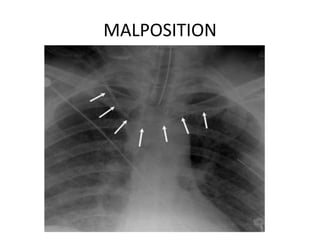
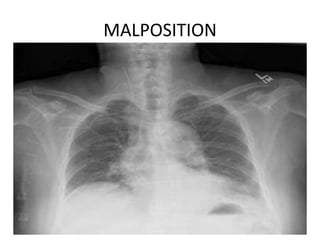
Malposition
Embolism Air/Catheter
OBSTRUCTION
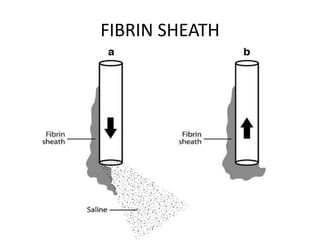
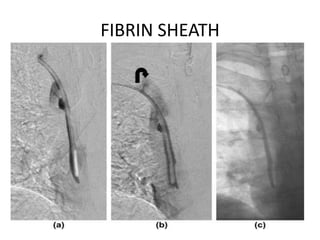
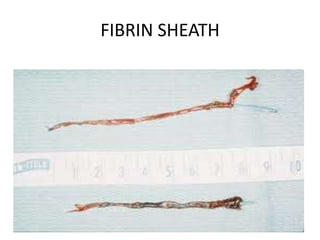
There are a number of causes for obstruction of a PICC.
Blood product or drug residue, fibrin sheath, and kinking or pinching off
of the catheter.
FIBRIN SHEATH
FIBRIN SHEATH
FIBRIN SHEATH
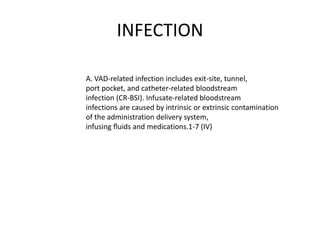
INFECTION
A. VAD-related infection includes exit-site, tunnel,
port pocket, and catheter-related bloodstream
infection (CR-BSI). Infusate-related bloodstream
infections are caused by intrinsic or extrinsic contamination
of the administration delivery system,
infusing fluids and medications.1-7 (IV)
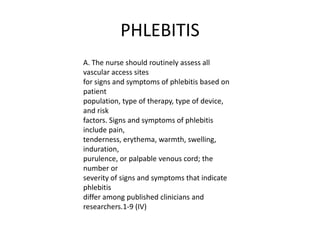
PHLEBITIS
A. The nurse should routinely assess all
vascular access sites
for signs and symptoms of phlebitis based on
patient
population, type of therapy, type of device,
and risk
factors. Signs and symptoms of phlebitis
include pain,
tenderness, erythema, warmth, swelling,
induration,
purulence, or palpable venous cord; the
number or
severity of signs and symptoms that indicate
phlebitis
differ among published clinicians and
researchers.1-9 (IV)
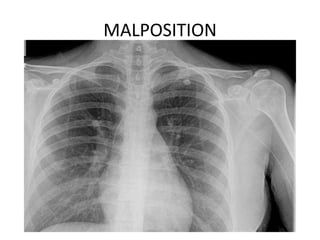
MALPOSITION
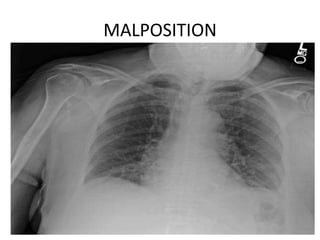
MALPOSITION
MALPOSITION
MALPOSITION
EMBOLISM AIR/CATHETER
50.1 The prevention, identification, and management of air
embolism during the insertion, care, and removal of vascular access devices
(VADs) shall be established in organizational policies, procedures, and/or
practice guidelines. (IV)
EMBOLISM AIR/CATHETER
The nurse should suspect air embolism with the sudden
onset of dyspnea, continued
coughing, breathlessness, chest
pain, hypotension, jugular venous
distension, tachyarrhythmias, wheezing, tachypnea,
altered mental status, altered speech, changes in
facial appearance, numbness, and paralysis. Clinical
events from air emboli produce cardiopulmonary
and neurological signs and symptoms.1,2 (V)
B. The nurse should immediately take the necessary
action to prevent more air from entering the
bloodstream by closing, folding, or clamping the
existing catheter or by occluding the puncture site (IV)
“ Prevention of air embolism is the goal and this can be
accomplished with all petroleum-based products including
a plain Vaseline gauze.”
DO NOT REMOVE A PICC
1. Air Embolism
2. Syncope
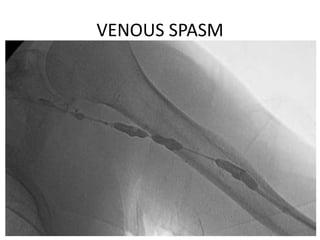
3. Venous Spasm
4. Catheter Fracture
VENOUS SPASM
MEMORY AID
1. Wash your hands first.
2. Use body fluid precautions.
3. Aseptic care of vascular access devices.
4. The fluid pathway must remain sterile.
5. All cleaning solutions must be allowed to dry
completely.
6. Catheters must be secured.
7. Do NOT remove a PICC.

Srt pic cs

  • 1.
  • 2.
    CENTRE FOR DISEASECONTROL Guidelines for the Prevention of Intravascular Catheter-Related Infections, 2011
  • 3.
    INFUSION NURSES SOCIETY 2011Infusion Nursing Standards of Practice
  • 4.
    MEMORY AID 1. Washyour hands first. 2. Use body fluid precautions. 3. Aseptic care of vascular access devices. 4. The fluid pathway must remain sterile. 5. All cleaning solutions must be allowed to dry completely. 6. Catheters must be secured. 7. Do NOT remove a PICC.
  • 5.
    WHAT IS APICC? A peripherally Inserted Central Catheter (PICC) is a long, thin, flexible tube that is used for giving intravenous fluids and medications. It is inserted through a peripheral vein, preferably in the upper arm and advanced until the tip of the catheter reaches a large vein above the heart.
  • 6.
    WHAT IS APICC?
  • 7.
    WHY INSERT APICC? PICC lines can remain in place for extended periods of time provided that there are no complications. PICCs placement in the SVC provides better hemodilution than shorter peripheral catheters and are therefore indicated for hypotonic, isotonic, hypertonic and vesicant therapy. Prolonged IV antibiotic treatment, TPN Nutrition, Chemotherapy Some PICCs are engineered to allow additional functions including high pressure injection (up to 300 psi).
  • 8.
    WHO INSERTS APICC? PICCs are usually inserted by physicians, nurse practitioners, or specially trained certified registered nurses and radiologic technologists using ultrasound, chest radiographs, fluoroscopy , and ECG to aid in their insertion and to confirm placement. PICC insertion is a sterile procedure, but does not require the use of an operating room. When done at bedside (that is, in the patient's room), a suitable sterile field must be established and maintained throughout the procedure.
  • 9.
    HOW IS APICC INSERTED? http://www.youtube.com/watch?feature=play er_embedded&v=sViSpYptjqk
  • 10.
    HOW DO PICCSDIFFER Single or Multi Lumen Valved or Non-Valved
  • 11.
    HOW DO PICCsDIFFER? The PICC may have single or multiple lumens. This depends on how many intravenous therapies are needed.
  • 12.
    HOW DO PICCsDIFFER Use a CVC with the minimum number of ports or lumens essential for the management of the patient [65–68]. Category IB (CDC )
  • 13.
    HOW DO PICCsDIFFER VALVED
  • 14.
    HOW DO PICCSDIFFER VALVED
  • 15.
    HOW DO PICCsDIFFER VALVED
  • 16.
    HOW DO PICCsDIFFER NONVALVED
  • 17.
    PICC SKIN CLEANINGSOLUTIONS - Prepare clean skin with a >0.5% chlorhexidine preparation with alcohol before central venous catheter and peripheral arterial catheter insertion and during dressing changes. If there is a contraindication to chlorhexidine, tincture of iodine, an iodophor, or 70% alcohol can be used as alternatives [82, 83]. Category IA - No comparison has been made between using chlorhexidine preparations with alcohol and povidone-iodine in alcohol to prepare clean skin. - Antiseptics should be allowed to dry according to the manufacturer’s recommendation. (CDC)
  • 18.
    PICC CARE DRESSING Weareither clean or sterile gloves when changing the dressing on intravascular catheters. Category IC (CDC)
  • 19.
    PICC CARE DRESSING Performhand hygiene procedures, either by washing hands with conventional soap and water or with alcohol-based hand rubs (ABHR). Hand hygiene should be performed before and after palpating catheter insertion sites as well as before and after inserting, replacing, accessing, repairing, or dressing an intravascular catheter. Palpation of the insertion site should not be performed after the application of antiseptic, unless aseptic technique is maintained [12, 77–79]. Category IB 2. Maintain aseptic technique for the insertion and care of intravascular catheters [37, 73] (CDC)
  • 20.
    PICC CARE DRESSING -Replace transparent dressings used on tunneled or implanted CVC sites no more than once per week (unless the dressing is soiled or loose), until the insertion site has healed. Category II - Replace catheter site dressing if the dressing becomes damp, loosened, or visibly soiled [84, 85]. Category IB - If the patient is diaphoretic or if the site is bleeding or oozing, use a gauze dressing until this is resolved [84–87]. Category II - Replace dressings used on short-term CVC sites every 2 days for gauze dressings. (CDC)
  • 21.
    PICC CARE DRESSING 36.1Vascular access device (VAD) stabilization shall be used to preserve the integrity of the access device, minimize catheter movement at the hub, and prevent catheter dislodgment and loss of access. 36.2 VADs shall be stabilized using a method that does not interfere with assessment and monitoring of the access site or impede vascular circulation or delivery of the prescribed therapy.
  • 22.
    PICC CARE DRESSING -Use a sutureless securement device to reduce the risk of infection for intravascular catheters [105]. Category II -
  • 23.
    PRN ADAPTERS Negative FluidDisplacement - Baxter Healthcare Interlink - ICU Medical Clave Positive Fluid Displacement - ICU Medical CLC 2000 Neutral Fluid Displacement
  • 24.
  • 25.
  • 26.
  • 27.
  • 28.
  • 29.
  • 30.
    PICC CARE FLUSHING TheInfusion Nursing Standards of Practice establishes the national standard for all infusion therapy. This standard on flushing emphasizes the goals of maintaining patency and preventing contact between heparin and incompatible solutions. The standard incorporates the concepts of catheter flushing and locking. Flushing assesses catheter patency and functionality and removes the previously infused medication. Locking the catheter creates a closed column of fluid inside the catheter lumen intended to prevent blood from moving into the lumen. (IV) SASH Saline Admixture Saline Heparin Lock non-valved catheters with positive pressure.
  • 31.
    PICC CARE FLUSHING 45.1Vascular access devices shall be flushed prior to each infusion as part of the steps to assess catheter function. 45.2 Vascular access devices shall be flushed after each infusion to clear the infused medication from the catheter lumen, preventing contact between incompatible medications. 45.3 Vascular access devices shall be locked after completion of the final flush solution to decrease the risk of occlusion. (IV) SASH Saline Admixture Saline Heparin
  • 32.
  • 33.
    OBSTRUCTION There are anumber of causes for obstruction of a PICC. Blood product or drug residue, fibrin sheath, and kinking or pinching off of the catheter.
  • 34.
  • 35.
  • 36.
  • 37.
    INFECTION A. VAD-related infectionincludes exit-site, tunnel, port pocket, and catheter-related bloodstream infection (CR-BSI). Infusate-related bloodstream infections are caused by intrinsic or extrinsic contamination of the administration delivery system, infusing fluids and medications.1-7 (IV)
  • 38.
    PHLEBITIS A. The nurseshould routinely assess all vascular access sites for signs and symptoms of phlebitis based on patient population, type of therapy, type of device, and risk factors. Signs and symptoms of phlebitis include pain, tenderness, erythema, warmth, swelling, induration, purulence, or palpable venous cord; the number or severity of signs and symptoms that indicate phlebitis differ among published clinicians and researchers.1-9 (IV)
  • 39.
  • 40.
  • 41.
  • 42.
  • 43.
    EMBOLISM AIR/CATHETER 50.1 Theprevention, identification, and management of air embolism during the insertion, care, and removal of vascular access devices (VADs) shall be established in organizational policies, procedures, and/or practice guidelines. (IV)
  • 44.
    EMBOLISM AIR/CATHETER The nurseshould suspect air embolism with the sudden onset of dyspnea, continued coughing, breathlessness, chest pain, hypotension, jugular venous distension, tachyarrhythmias, wheezing, tachypnea, altered mental status, altered speech, changes in facial appearance, numbness, and paralysis. Clinical events from air emboli produce cardiopulmonary and neurological signs and symptoms.1,2 (V) B. The nurse should immediately take the necessary action to prevent more air from entering the bloodstream by closing, folding, or clamping the existing catheter or by occluding the puncture site (IV) “ Prevention of air embolism is the goal and this can be accomplished with all petroleum-based products including a plain Vaseline gauze.”
  • 45.
    DO NOT REMOVEA PICC 1. Air Embolism 2. Syncope 3. Venous Spasm 4. Catheter Fracture
  • 46.
  • 47.
    MEMORY AID 1. Washyour hands first. 2. Use body fluid precautions. 3. Aseptic care of vascular access devices. 4. The fluid pathway must remain sterile. 5. All cleaning solutions must be allowed to dry completely. 6. Catheters must be secured. 7. Do NOT remove a PICC.

Editor's Notes

  • #13 Guidelines for the Prevention of Intravascular Catheter-Related Infections CDC
  • #14 Bard Access
  • #15 NavilystVaxcel
  • #16 Groshong Valve
  • #17 Cook
  • #20 Guidelines for the Prevention of Intravascular Catheter-Related Infections CDC
  • #22 INS 2011
  • #23 Statlock
  • #32 INS 2011