A comprehensive nutritional assessment should be
performed to determine the appropriateness of PN prior to
central line placement.
Goals of Nutritional Assessment
 Establish baseline subjective and objective nutrition
measurements
 Identify Nutrition deficits
 Determine Nutrition risk factors
 Identify any medical or psychosocial factors that may
influence nutritional support
 The main goal of Parenteral Nutrition is to achieve
adequate nutritional status and positive nitrogen
balance.
 Evaluating nutritional status and determining the
presence of, or risk of developing malnutrition is the
main goal of any nutritional assessment.
 It does not stop with the first evaluation, but must be as
ongoing process to monitor the adequacy and
effectiveness of nutritional support measures.
The four basic components of nutritional assessment
include:
 1. Anthropometrics
 2. Clinical Information
 3. Nutrition Intake History
 4. Biochemical Data
 The most common anthropometrics used in the hospital
setting are height and weight.
 Current body weight is compared with usual and ideal
body weight.
 Weight loss is a good indicator of nutritional status.
 Unintentional weight loss of more than 5% in 1 month or
10% in 6 months is clinically significant.
 BMI (Body Mass Index) = weight in kgs divided by height
in meters squared, used as index for both obesity and
malnutrition.
 Inspection of Body fat distribution via limb circumference
and skinfold thickness.
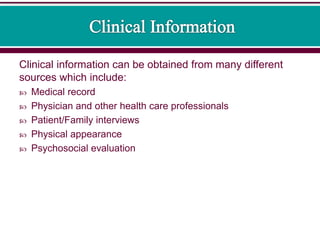
Clinical information can be obtained from many different
sources which include:
 Medical record
 Physician and other health care professionals
 Patient/Family interviews
 Physical appearance
 Psychosocial evaluation
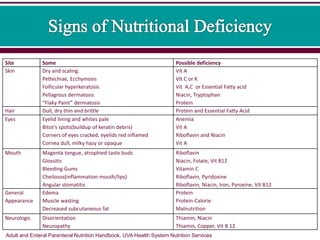
Site Some Possible deficiency
Skin Dry and scaling.
Pettechiae, Ecchymosis
Follicular hyperkeratosis
Pellagrous dermatosis
“Flaky Paint” dermatosis
Vit A
VIt C or K
Vit A,C or Essential Fatty acid
Niacin, Tryptophan
Protein
Hair Dull, dry thin and brittle Protein and Essential Fatty Acid
Eyes Eyelid lining and whites pale
Bitot’s spots(buildup of keratin debris)
Corners of eyes cracked, eyelids red inflamed
Cornea dull, milky hazy or opaque
Anemia
Vit A
Riboflavin and Niacin
Vit A
Mouth Magenta tongue, atrophied taste buds
Glossitis
Bleeding Gums
Cheilosos(inflammation mouth/lips)
Angular stomatitis
Riboflavin
Niacin, Folate, Vit B12
Vitamin C
Riboflavin, Pyridoxine
Riboflavin, Niacin, Iron, Pyroxine, Vit B12
General
Appearance
Edema
Muscle wasting
Decreased subcutaneous fat
Protein
Protein-Calorie
Malnutrition
Neurologic Disorientation
Neuropathy
Thiamin, Niacin
Thiamin, Copper, Vit B 12
Adult and Enteral Parenteral Nutrition Handbook, UVA Health System Nutrition Services
 Fecal Fat Test: Measures the amount of fat in the stool,
which helps estimate the percentage of dietary fat that
the body does not absorb. The amount of fat absorption
indicates how well the liver, gallbladder, pancreas, and
intestines are working.
 Esophagogastroduodenoscopy, EGD: An EGD may be
performed to diagnose structural or functional
abnormalities of the esophagus, stomach, and/or
duodenum.
 Gastric emptying scan: Method for measuring gastric
motility. It determines how fast the stomach empties food
into the small intestine after eating foods containing a
radioisotope.
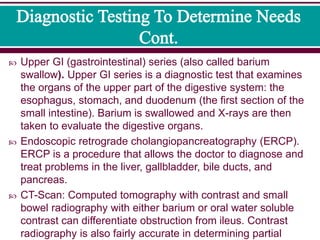
 Upper GI (gastrointestinal) series (also called barium
swallow). Upper GI series is a diagnostic test that examines
the organs of the upper part of the digestive system: the
esophagus, stomach, and duodenum (the first section of the
small intestine). Barium is swallowed and X-rays are then
taken to evaluate the digestive organs.
 Endoscopic retrograde cholangiopancreatography (ERCP).
ERCP is a procedure that allows the doctor to diagnose and
treat problems in the liver, gallbladder, bile ducts, and
pancreas.
 CT-Scan: Computed tomography with contrast and small
bowel radiography with either barium or oral water soluble
contrast can differentiate obstruction from ileus. Contrast
radiography is also fairly accurate in determining partial
 Religious and cultural preferences
 Patient and/or caregiver ability to learn and safely
manage PN in the home
 Home environment/safety (eg, running water,
cleanliness, storage, refrigeration, electricity)
 Compliance
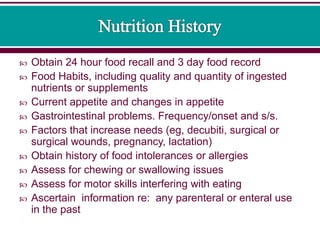
 Obtain 24 hour food recall and 3 day food record
 Food Habits, including quality and quantity of ingested
nutrients or supplements
 Current appetite and changes in appetite
 Gastrointestinal problems. Frequency/onset and s/s.
 Factors that increase needs (eg, decubiti, surgical or
surgical wounds, pregnancy, lactation)
 Obtain history of food intolerances or allergies
 Assess for chewing or swallowing issues
 Assess for motor skills interfering with eating
 Ascertain information re: any parenteral or enteral use
in the past
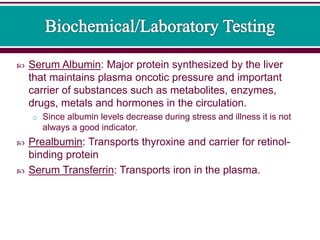
 Serum Albumin: Major protein synthesized by the liver
that maintains plasma oncotic pressure and important
carrier of substances such as metabolites, enzymes,
drugs, metals and hormones in the circulation.
o Since albumin levels decrease during stress and illness it is not
always a good indicator.
 Prealbumin: Transports thyroxine and carrier for retinol-
binding protein
 Serum Transferrin: Transports iron in the plasma.
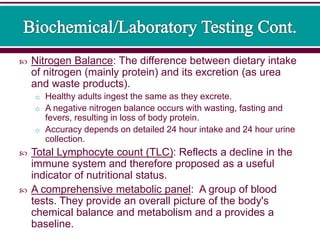
 Nitrogen Balance: The difference between dietary intake
of nitrogen (mainly protein) and its excretion (as urea
and waste products).
o Healthy adults ingest the same as they excrete.
o A negative nitrogen balance occurs with wasting, fasting and
fevers, resulting in loss of body protein.
o Accuracy depends on detailed 24 hour intake and 24 hour urine
collection.
 Total Lymphocyte count (TLC): Reflects a decline in the
immune system and therefore proposed as a useful
indicator of nutritional status.
 A comprehensive metabolic panel: A group of blood
tests. They provide an overall picture of the body's
chemical balance and metabolism and a provides a
baseline.
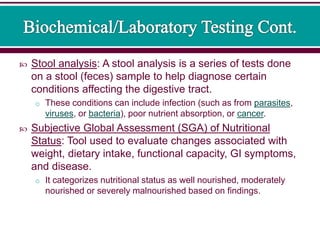
 Stool analysis: A stool analysis is a series of tests done
on a stool (feces) sample to help diagnose certain
conditions affecting the digestive tract.
o These conditions can include infection (such as from parasites,
viruses, or bacteria), poor nutrient absorption, or cancer.
 Subjective Global Assessment (SGA) of Nutritional
Status: Tool used to evaluate changes associated with
weight, dietary intake, functional capacity, GI symptoms,
and disease.
o It categorizes nutritional status as well nourished, moderately
nourished or severely malnourished based on findings.
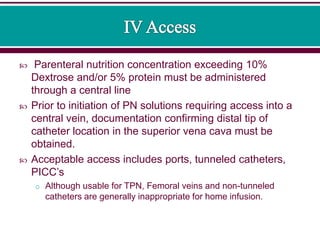
 Parenteral nutrition concentration exceeding 10%
Dextrose and/or 5% protein must be administered
through a central line
 Prior to initiation of PN solutions requiring access into a
central vein, documentation confirming distal tip of
catheter location in the superior vena cava must be
obtained.
 Acceptable access includes ports, tunneled catheters,
PICC’s
o Although usable for TPN, Femoral veins and non-tunneled
catheters are generally inappropriate for home infusion.
 It is generally recommended that access device be used
solely for TPN whenever possible to decrease potential
contamination. When multiple lumens are present,
designate 1 lumen for PN use only.
 PPN (peripheral parenteral nutrition with dextrose
concentration <10% and protein concentration <5%) is
sometimes used for patients requiring short term
nutrition support (7-10 days). It is rarely done in the
home and only on a case by case basis.

2. Assessing the need for tpn

  • 1.
    A comprehensive nutritionalassessment should be performed to determine the appropriateness of PN prior to central line placement. Goals of Nutritional Assessment  Establish baseline subjective and objective nutrition measurements  Identify Nutrition deficits  Determine Nutrition risk factors  Identify any medical or psychosocial factors that may influence nutritional support
  • 2.
     The maingoal of Parenteral Nutrition is to achieve adequate nutritional status and positive nitrogen balance.  Evaluating nutritional status and determining the presence of, or risk of developing malnutrition is the main goal of any nutritional assessment.  It does not stop with the first evaluation, but must be as ongoing process to monitor the adequacy and effectiveness of nutritional support measures.
  • 3.
    The four basiccomponents of nutritional assessment include:  1. Anthropometrics  2. Clinical Information  3. Nutrition Intake History  4. Biochemical Data
  • 4.
     The mostcommon anthropometrics used in the hospital setting are height and weight.  Current body weight is compared with usual and ideal body weight.  Weight loss is a good indicator of nutritional status.  Unintentional weight loss of more than 5% in 1 month or 10% in 6 months is clinically significant.  BMI (Body Mass Index) = weight in kgs divided by height in meters squared, used as index for both obesity and malnutrition.  Inspection of Body fat distribution via limb circumference and skinfold thickness.
  • 5.
    Clinical information canbe obtained from many different sources which include:  Medical record  Physician and other health care professionals  Patient/Family interviews  Physical appearance  Psychosocial evaluation
  • 6.
    Site Some Possibledeficiency Skin Dry and scaling. Pettechiae, Ecchymosis Follicular hyperkeratosis Pellagrous dermatosis “Flaky Paint” dermatosis Vit A VIt C or K Vit A,C or Essential Fatty acid Niacin, Tryptophan Protein Hair Dull, dry thin and brittle Protein and Essential Fatty Acid Eyes Eyelid lining and whites pale Bitot’s spots(buildup of keratin debris) Corners of eyes cracked, eyelids red inflamed Cornea dull, milky hazy or opaque Anemia Vit A Riboflavin and Niacin Vit A Mouth Magenta tongue, atrophied taste buds Glossitis Bleeding Gums Cheilosos(inflammation mouth/lips) Angular stomatitis Riboflavin Niacin, Folate, Vit B12 Vitamin C Riboflavin, Pyridoxine Riboflavin, Niacin, Iron, Pyroxine, Vit B12 General Appearance Edema Muscle wasting Decreased subcutaneous fat Protein Protein-Calorie Malnutrition Neurologic Disorientation Neuropathy Thiamin, Niacin Thiamin, Copper, Vit B 12 Adult and Enteral Parenteral Nutrition Handbook, UVA Health System Nutrition Services
  • 7.
     Fecal FatTest: Measures the amount of fat in the stool, which helps estimate the percentage of dietary fat that the body does not absorb. The amount of fat absorption indicates how well the liver, gallbladder, pancreas, and intestines are working.  Esophagogastroduodenoscopy, EGD: An EGD may be performed to diagnose structural or functional abnormalities of the esophagus, stomach, and/or duodenum.  Gastric emptying scan: Method for measuring gastric motility. It determines how fast the stomach empties food into the small intestine after eating foods containing a radioisotope.
  • 8.
     Upper GI(gastrointestinal) series (also called barium swallow). Upper GI series is a diagnostic test that examines the organs of the upper part of the digestive system: the esophagus, stomach, and duodenum (the first section of the small intestine). Barium is swallowed and X-rays are then taken to evaluate the digestive organs.  Endoscopic retrograde cholangiopancreatography (ERCP). ERCP is a procedure that allows the doctor to diagnose and treat problems in the liver, gallbladder, bile ducts, and pancreas.  CT-Scan: Computed tomography with contrast and small bowel radiography with either barium or oral water soluble contrast can differentiate obstruction from ileus. Contrast radiography is also fairly accurate in determining partial
  • 9.
     Religious andcultural preferences  Patient and/or caregiver ability to learn and safely manage PN in the home  Home environment/safety (eg, running water, cleanliness, storage, refrigeration, electricity)  Compliance
  • 10.
     Obtain 24hour food recall and 3 day food record  Food Habits, including quality and quantity of ingested nutrients or supplements  Current appetite and changes in appetite  Gastrointestinal problems. Frequency/onset and s/s.  Factors that increase needs (eg, decubiti, surgical or surgical wounds, pregnancy, lactation)  Obtain history of food intolerances or allergies  Assess for chewing or swallowing issues  Assess for motor skills interfering with eating  Ascertain information re: any parenteral or enteral use in the past
  • 11.
     Serum Albumin:Major protein synthesized by the liver that maintains plasma oncotic pressure and important carrier of substances such as metabolites, enzymes, drugs, metals and hormones in the circulation. o Since albumin levels decrease during stress and illness it is not always a good indicator.  Prealbumin: Transports thyroxine and carrier for retinol- binding protein  Serum Transferrin: Transports iron in the plasma.
  • 12.
     Nitrogen Balance:The difference between dietary intake of nitrogen (mainly protein) and its excretion (as urea and waste products). o Healthy adults ingest the same as they excrete. o A negative nitrogen balance occurs with wasting, fasting and fevers, resulting in loss of body protein. o Accuracy depends on detailed 24 hour intake and 24 hour urine collection.  Total Lymphocyte count (TLC): Reflects a decline in the immune system and therefore proposed as a useful indicator of nutritional status.  A comprehensive metabolic panel: A group of blood tests. They provide an overall picture of the body's chemical balance and metabolism and a provides a baseline.
  • 13.
     Stool analysis:A stool analysis is a series of tests done on a stool (feces) sample to help diagnose certain conditions affecting the digestive tract. o These conditions can include infection (such as from parasites, viruses, or bacteria), poor nutrient absorption, or cancer.  Subjective Global Assessment (SGA) of Nutritional Status: Tool used to evaluate changes associated with weight, dietary intake, functional capacity, GI symptoms, and disease. o It categorizes nutritional status as well nourished, moderately nourished or severely malnourished based on findings.
  • 14.
     Parenteral nutritionconcentration exceeding 10% Dextrose and/or 5% protein must be administered through a central line  Prior to initiation of PN solutions requiring access into a central vein, documentation confirming distal tip of catheter location in the superior vena cava must be obtained.  Acceptable access includes ports, tunneled catheters, PICC’s o Although usable for TPN, Femoral veins and non-tunneled catheters are generally inappropriate for home infusion.
  • 15.
     It isgenerally recommended that access device be used solely for TPN whenever possible to decrease potential contamination. When multiple lumens are present, designate 1 lumen for PN use only.  PPN (peripheral parenteral nutrition with dextrose concentration <10% and protein concentration <5%) is sometimes used for patients requiring short term nutrition support (7-10 days). It is rarely done in the home and only on a case by case basis.