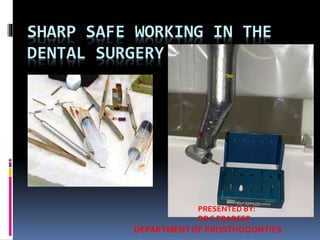
SHARP SAFE WORKING IN THE
DENTAL SURGERY
PRESENTED BY:
DR C PRADEEP
DEPARTMENTOF PROSTHODONTICS
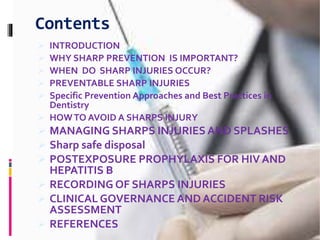
Contents
 INTRODUCTION
 WHY SHARP PREVENTION IS IMPORTANT?
 WHEN DO SHARP INJURIES OCCUR?
 PREVENTABLE SHARP INJURIES
 Specific Prevention Approaches and Best Practices in
Dentistry
 HOWTO AVOID A SHARPS INJURY
 MANAGING SHARPS INJURIES AND SPLASHES
 Sharp safe disposal
 POSTEXPOSURE PROPHYLAXIS FOR HIV AND
HEPATITIS B
 RECORDING OF SHARPS INJURIES
 CLINICAL GOVERNANCE AND ACCIDENT RISK
ASSESSMENT
 REFERENCES
Introduction
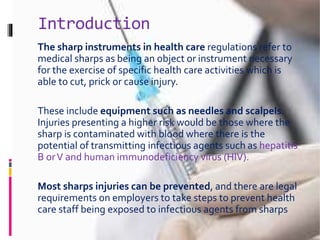
The sharp instruments in health care regulations refer to
medical sharps as being an object or instrument necessary
for the exercise of specific health care activities which is
able to cut, prick or cause injury.
These include equipment such as needles and scalpels.
Injuries presenting a higher risk would be those where the
sharp is contaminated with blood where there is the
potential of transmitting infectious agents such as hepatitis
B orV and human immunodeficiency virus (HIV).
Most sharps injuries can be prevented, and there are legal
requirements on employers to take steps to prevent health
care staff being exposed to infectious agents from sharps
WHY SHARPS PREVENTION IS
IMPORTANT
BBVs can enter the tissues and cause infection following
splashes into the eye, oral mucosa or on to broken skin (abrasions, cuts,
eczema,etc.);
however, the risk of transmission by these routes is considerably lower
than for sharps injuries. Intact skin forms a barrier to BBV transmission
and infection does not occur through inhalation or via the faecal–oral
route.
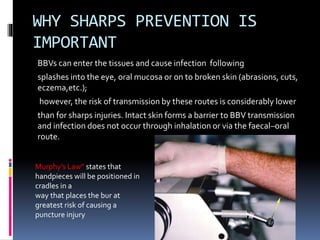
Murphy’s Law” states that
handpieces will be positioned in
cradles in a
way that places the bur at
greatest risk of causing a
puncture injury
In the dental surgery, the most common route
for transmission of a BBV infection is from an
infected patient to a clinician.
An infectious dental patient may not
necessarily be identified from their medical
history if they are an asymptomatic carrier.
Such people are often blissfully unaware of
their condition.
Infrequently, a BBV‐infected healthcare worker
will infect a patient, or very rarely transmission
occurs from patient to patient via contaminated
instruments or environmental surfaces.
Look‐back investigations of HBV outbreaks
revealed that transmission tended to occur when
the source person was highly contagious due to a
high viral load in their bloodstream,
coupled with a breakdown in standard infection
control precautions.
Following a single percutaneous injury, especially a
deep penetrating injury with a scalpel, a
hollow‐bore needle, aspirating syringe or a device
visibly contaminated with blood
This bracket table is not yet
safe for cleaning up at change-over.
Syringes of endodontic irrigants should
be placed directly into the sharps container
located at the chairside without
attempting recapping.
, the probability of seroconverting is estimated
at:
●● 1 in 3 for HBV
●● 1 in 30 for HCV
●● 1 in 300 for HIV
●● 1 in 1000 for HIV for mucocutaneous
(mucous membranes and skin) splashing
An alternative way of looking at these figures is
that hepatitis B is 100 times
and hepatitis C is 10 times more likely to be
transmitted than HIV in the dental setting
The actual risk of seroconversion is
dependent on:
●● prevalence of the infection in the local
population
●● how infectious the patient is (i.e. stage of
illness or current antiviraltreatment)
●● whether the dental treatment or task is
likely to result in a sharps injury or splash.
WHEN DO SHARPS INJURIES
OCCUR?
 A small proportion of documented injuries involve
 the use of increased force, bending needles or passing of
sharp instruments between the dentist and the nurse,
 whereas most intraoral needlestick and sharps injuries
occur accidentally during the course of routine treatment as
a result of sudden unexpected patient movements, closing
the mouth, or as a consequence of poor visibility.
 Such incidents are intrinsic to working in the confines of
the mouth.While they can be reduced to a degree by
training, behavioural changes and engineering innovations,
they cannot be completely eliminated
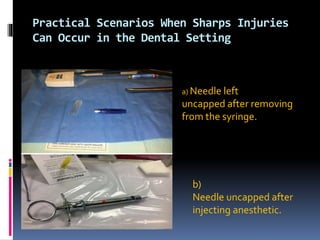
Practical Scenarios When Sharps Injuries
Can Occur in the Dental Setting
a) Needle left
uncapped after removing
from the syringe.
b)
Needle uncapped after
injecting anesthetic.
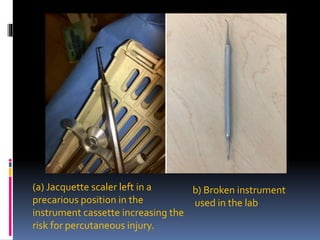
(a) Jacquette scaler left in a
precarious position in the
instrument cassette increasing the
risk for percutaneous injury.
b) Broken instrument
used in the lab
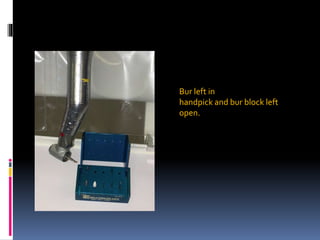
Bur left in
handpick and bur block left
open.
PREVENTABLE SHARPS INJURIES
 Most needle stick injuries happen outside the
mouth, during resheathing, dismantling or disposal
of needles.
 Such needlestick injuries are considered ‘avoidable’
with safe practice.
 Preventive measures such as the use of safety
 Sharps that incorporate an integral safety
mechanism within the design, such as a retractable
sheath, were demonstrated to significantly reduce
extraoral injuries.
 ‘Sharp‐less surgical techniques’ that use electric
scalpels, glues and clips are advocated as a safer
alternative to sutures and scalpels.
Specific Prevention Approaches and
Best Practices in Dentistry
 When addressing sharps injury prevention, there are
three categories of action:
 1. Eliminate the use of the sharp whenever possible.
 2. Apply engineering controls.
 3. Apply workflow controls
 The CDC recommends that engineering controls
should be the primary method to reduce the
exposure to blood-borne pathogens via sharps
exposure.
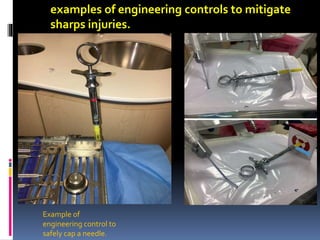
 Self-sheathing needles, needle recapping devices,
safety scalpels, and needless IV ports are examples
Example of
engineering control to
safely cap a needle.
examples of engineering controls to mitigate
sharps injuries.
•Work-practice controls are the complement to
engineering controls when they are not available or appropriate.
This behavior-based approach changes the risk of blood-borne pathogen
exposure via sharps injury by changing the way the dental health- care
personnel performs tasks
Examples of work-practice controls are:
One-handed scoop technique for recapping a needle.
• Not bend or break a needle.
• Not passing a syringe unsheathed by hand.
• Removing burs before disassembling the handpiece from
the dental unit.
• Using instruments instead of fingers for tissue retraction
or palpation during suturing or administration of
anesthesia.
• Placing all disposable syringes, needles, scalpel blades,
and other sharps in the appropriate puncture-resistant
container
HOW TO AVOID A SHARPS INJURY
 Safe handling of sharps
 Injuries associated with handling and disposal of
sharps and clinical sharps
 waste can be minimized by adhering to accepted
good practice
 Good practice guide: sharp safe dental treatment
 ●● Use an instrument (mirror/cheek retractor) rather
than fingers to retract
 tongue and cheeks when using sharp implements.
This has the added advantage of enhancing visibility
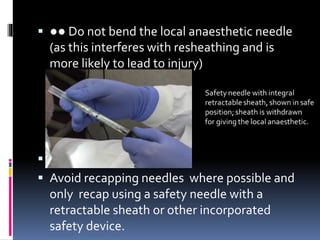
 ●● Do not bend the local anaesthetic needle
(as this interferes with resheathing and is
more likely to lead to injury)
 (Figure 4.1).
 Avoid recapping needles where possible and
only recap using a safety needle with a
retractable sheath or other incorporated
safety device.
 If these are unavailable,
 use a needle block or needle guard
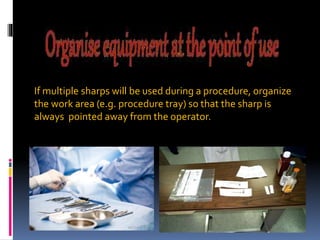
If multiple sharps will be used during a procedure, organize
the work area (e.g. procedure tray) so that the sharp is
always pointed away from the operator.
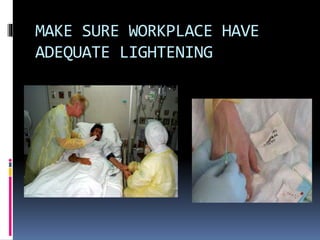
MAKE SURE WORKPLACE HAVE
ADEQUATE LIGHTENING
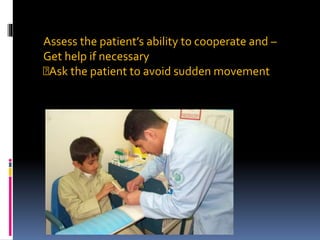
Assess the patient’s ability to cooperate and –
Get help if necessary
Ask the patient to avoid sudden movement
 ●● Never resheath needles using an unprotected
hand.
 ●● Avoid passing sharp instruments from hand
to hand during dental treatment.
 The same sharp instrument should not be
touched by more than one person at the same
time.
 Place the sharp in a neutral zone in the tray or
bracket table from where it can safely be picked
up by the second person.
 Alert the other person that you are putting a
sharp instrument into the neutral zone.
Use of safety sharps
 Dentistry is unique in its continuing deployment of
reusable metal syringes rather than plastic
disposable syringes.
 They are potentially dangerous devices as
resheathing and needle disassembly are
undertaken at a time when the needle is
contaminated with blood.
 Recent innovations in the design of syringes and
other sharps aim to minimize both clinical and
‘downstream’ injuries associated with cleaning and
disposing of sharps that affect nurses and cleaners.
 Safety needles with integrated retractable
sheath – the sheath can be retracted
whenever the needle is required to give an
injection and is then slid down over the
needle, protecting the operator between use
and during dismantling and disposal .
 Some syringe and needle devices are fully
disposable as a single unit, which minimizes
the degree of handling
Sharp safe disposal
 Good practice guide: safe disposal of sharps and needles
 ●● Single‐use sharps should be discarded immediately after use by
the user.
 ●● Never leave sharps on the bracket table to be disposed of by
someone else as this is when accidents occur.
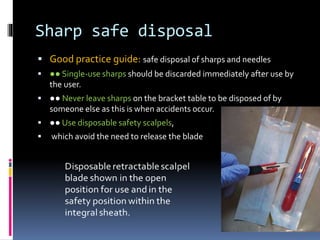
 ●● Use disposable safety scalpels,
 which avoid the need to release the blade
 ●● Do not leave burs in the handpiece at the
end of treatment as they can catch on skin and
clothing.
 The clinician should remove them immediately
after use and then the handpiece can be
dismantled from the connector and cleaned
without the risk of injury to the nurse.
 ●● Place disposable sharps directly into a rigid
puncture‐proof yellow‐lidded waste receptacle
(bin).
 ●●When using a disposable syringe and needle,
discard as one unit directly into a sharps bin.
SHARP CONTAINERS
 should either be color-coded yellow and/or
labeled with the universal biohazard symbol and
the word “biohazard.”
 Use closable, leakproof puncture resistant
containers.
 Place the sharps container close to the point-of-
use and maintain it in an upright position wall
mounted
 Replace the container routinely when its ¾ full
and do not allow it to become overfull.
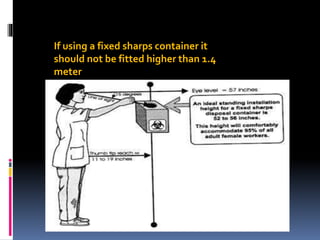
If using a fixed sharps container it
should not be fitted higher than 1.4
meter
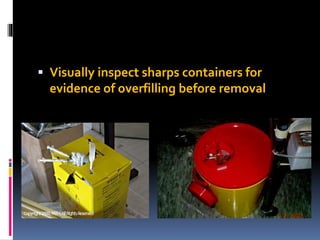
 Visually inspect sharps containers for
evidence of overfilling before removal
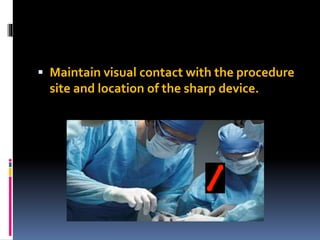
 Maintain visual contact with the procedure
site and location of the sharp device.
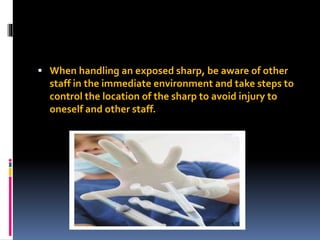
 When handling an exposed sharp, be aware of other
staff in the immediate environment and take steps to
control the location of the sharp to avoid injury to
oneself and other staff.
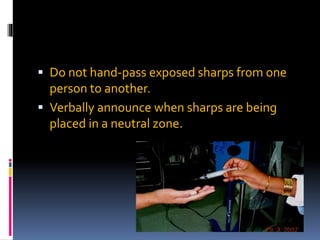
 Do not hand-pass exposed sharps from one
person to another.
 Verbally announce when sharps are being
placed in a neutral zone.
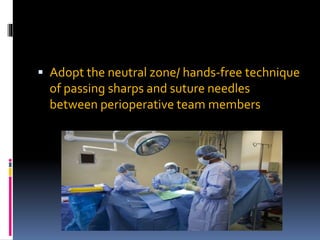
 Adopt the neutral zone/ hands-free technique
of passing sharps and suture needles
between perioperative team members
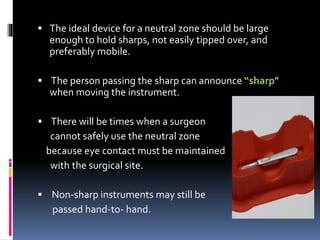
 The ideal device for a neutral zone should be large
enough to hold sharps, not easily tipped over, and
preferably mobile.
 The person passing the sharp can announce “sharp”
when moving the instrument.
 There will be times when a surgeon
cannot safely use the neutral zone
because eye contact must be maintained
with the surgical site.
 Non-sharp instruments may still be
passed hand-to- hand.
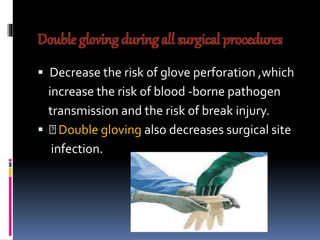
 Decrease the risk of glove perforation ,which
increase the risk of blood -borne pathogen
transmission and the risk of break injury.
 Double gloving also decreases surgical site
infection.
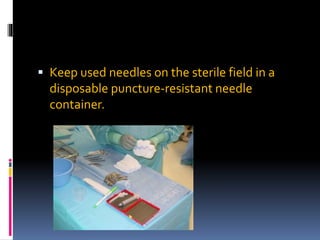
 Keep used needles on the sterile field in a
disposable puncture-resistant needle
container.
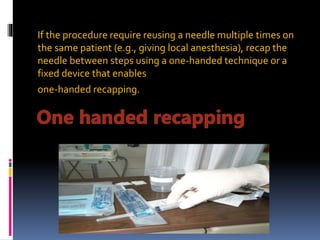
If the procedure require reusing a needle multiple times on
the same patient (e.g., giving local anesthesia), recap the
needle between steps using a one-handed technique or a
fixed device that enables
one-handed recapping.
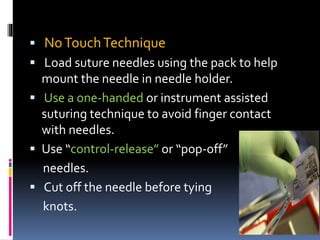
 NoTouchTechnique
 Load suture needles using the pack to help
mount the needle in needle holder.
 Use a one-handed or instrument assisted
suturing technique to avoid finger contact
with needles.
 Use “control-release” or “pop-off”
needles.
 Cut off the needle before tying
knots.
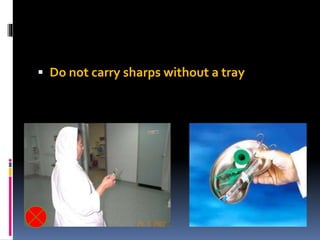
 Do not carry sharps without a tray
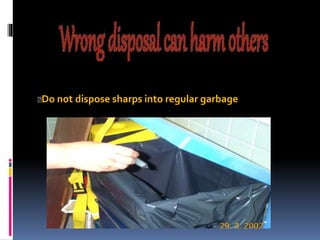
Do not dispose sharps into regular garbage
 Good practice guide: assembly and
use of sharps receptacles
 ●● Ensure that the sharps bin is correctly
assembled and that the lid is securely
fastened before commencing use.
 ●● Place bins conveniently close to the point of
use.Wall mount or insert into sturdy non‐tip
base plate.
 ●● Do not place sharps bins on the floor, on an
unstable surface or above shoulder height.
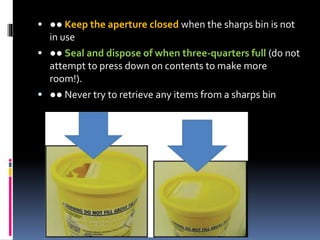
 ●● Keep the aperture closed when the sharps bin is not
in use
 ●● Seal and dispose of when three‐quarters full (do not
attempt to press down on contents to make more
room!).
 ●● Never try to retrieve any items from a sharps bin
MANAGING SHARPS INJURIES AND
SPLASHES
Occupational injury assessment is provided either by the local
occupational health department or, if this service is unavailable, by the nearest
accident and emergency department.
In order to avoid unnecessary delays, the telephone number and name of the
appropriate contact person should be made known to all the staff working at
the practice.
Under the COSHH(the control of substances hazardous to health regulations )
regulations, employers must ensure that all their staff are aware of the action to
be taken following a sharps or splash incident.
This includes immediate first aid, reporting procedures and further
management
The procedure will vary depending on whether or not the source
patient can be identified.
 Percutaneous sharps injury: encourage puncture site to bleed by
applying pressure (do not suck).
 Wash site liberally with soap and running water for several
minutes
 Do not scrub as this may inoculate
 Splash to eyes: thoroughly wash eye with running water or eye
washsolution (remove contact lens prior to washing eyes)
Splash exposure of oral mucous membranes:
Rinse vigorously with water and spit out
Report incident immediately
Recheck patient's medical history and ask about risk
behaviours for BBV
Arrange for blood sample to be taken from donor for
testing
 Promptly contact (local Occupational Health
Department / Accident &
 Emergency Department) for urgent risk assessment of
injury, information and counselling
 Administer post exposure prophylaxis according to
risk assessment
Complete an Accident Report
form
OCCUPATIONAL HEALTH RISK ASSESSMENT
FOR BBV EXPOSURE
If the source patient is known, then inform the source patient and
ask them to wait in surgery, in order that the patient’s medical
history and risk behaviours for BBV can be reviewed, and the person
in charge can make arrangements with the donor’s general medical
practitioner for a blood sample to be taken and tested
To ensure the patient’s co‐operation, it is important that the
infection control lead registered provider/manager (preferably not
the exposed person) should explain about the incident and why the
additional enquiries and blood tests are being sought.
The patient should be reassured that strict confidentiality will be
maintained throughout the process.
 The source patient should receive a pretest discussion
(occupational and personal implications of a positive test) and
give informed consent for a blood sample to be taken for HIV,
HBV and HCV testing.
 In some instances, additional serological testing may be
required, for example for HTLV‐1.
 However, outside a dental hospital setting it may be
difficult to arrange for a blood sample to be taken on the
same day.
 In such cases, the staff member should not delay in
contacting the occupational health service for advice.
 The risk assessment is then based on the available
information, including patient’s history, type of injury,
presence of blood on the instrument and the background
rate of infection in the local community.
MANAGEMENT OF HEPATITIS C
EXPOSURES
 At the present time there is no effective
prophylaxis or vaccine available against
hepatitis C.
 Most sharps exposures are likely to involve
patients who are chronic carriers of the
disease as up to 85% of HCV infections are
asymptomatic.
 Only HCV RNA‐positive patients pose a risk
for HCV transmission
Protocols for hepatitis C testing of healthcare personnel
exposed to a known HCV‐positive source are as follows.
●● Initial baseline antibody test to HCV (to determine if the
healthcare worker is an existing carrier of HCV).
●● Obtain serum/EDTA for genome 1 detection at six and 12
weeks.
●● Obtain serum for anti‐HCV antibodies at 12 and 24 weeks.
●● If antibody positive then a confirmatory HCV RNA
detection test (polymerase chain reaction) is performed.
●● If the individual is going to receive antiviral treatment,
then genotyping, viral load estimate and liver function tests
(LFTs) are undertaken.
 If the source of the blood is unknown then the
recipient’s antibody levels are retested at six
months, which allows time for viral incubation
and antibody formation to occur.
 The subsequent results will inform the decision
on whether or not to commence antiviral
therapy.
 There is usually no need to stop performing
invasive dental procedures whilst waiting for the
test results.
 Epidemiological surveys have shown that risk of
transmission of infection from a healthcare
worker to a patient during an invasive
procedure is small if standard precautions are
followed.
POSTEXPOSURE PROPHYLAXIS FOR
HIV AND HEPATITIS B
After a sharps injury, studies indicate that there may be a ‘window of
opportunity’ to avert HIV or HBV infection by inhibiting viral replication
following an exposure.
Once HIV crosses a mucosal barrier, it may take up to 48–72 hours
before HIV can be detected within regional lymph nodes and up to five
days before it can be detected in blood.
Initiation of combination antiretroviral therapy
(cART) has been shown to reduce dissemination and replication of HIV
virus in all tissues if initiated early after inoculation in animal studies.
Inhibition of HBV viral replication is achieved by stimulation of the
protective immune response to hepatitis B with a HBV vaccine or
anti‐HBV immunoglobulin.
 HIV postexposure prophylaxis (PEP) is prescribed
based on a case‐by‐caserisk assessment
undertaken by the physician in conjunction with
the wishes of the staff member.
 PEP will not normally be offered if the source
case is HIV negative or following a risk
assessment that indicates the risk of HIV
infectionis unlikely..
 The dates and results of the source’s last viral
load tests should be verified with their clinic for
a minimum of the last six months, and recorded
in the PEP assessment.
If there is any doubt about the source’s viral
load or adherence to cART
then PEP should be given as a precaution
following occupational exposure. However, the
healthcare worker can request HIV PEP
Note that blood from an HIV‐positive source
coming into contact with intact skin is not a
transmission risk.
In some countries, HIV PEP is offered after all
occupational percutaneous exposure injuries
and mucosal exposures to blood when the HIV
status of the source is positive or unknown.
HBV postexposure prophylaxis
regimen
● Hepatitis B vaccine is highly effective at preventing
infection if given shortly after exposure.
●● Ideally, immunization should commence within 48 hours,
although it should still be considered up to a week after
exposure.
●● The vaccine is not effective in patients with acute hepatitis
B and is not necessary for individuals known to have markers
of current (HBsAg) or past (anti‐HB) infection.
However, immunization should not be delayed whilst waiting
for test results
Specific hepatitis B immunoglobulin (HBIG)
●● Use of HBIG in addition to hepatitis B vaccine is recommended only
in high‐risk situations or in a known non‐responder to hepatitis B
vaccine.
●● Gives immediate but temporary protection after accidental
inoculation or contamination with hepatitis B‐infected blood.
It will not affect the development of vaccine‐induced long‐term active
immunity.
●● HBIG should be given as soon as possible; ideally it is given
concurrently with the first dose of hepatitis B vaccine but at a different
site.
●● HBIG should be considered up to a week after exposure as although
virus multiplication may not be completely inhibited at this stage, it
may prevent severe illness and development of a chronic carrier state.
●● At six months, the person is monitored for symptoms of a
seroconversion illness
RECORDING OF SHARPS INJURIES
All sharps injuries and significant splashes, however minor, must be
recorded in an accident logbook. Include a full description of the
incident, who was involved (both patient and staff member) and
how it was managed.
Data protection regulations require that confidentiality is
maintained and the information stored securely (e.g. in a lockable,
fire‐retardant filing cabinet) and retained for a minimum of three
years.
Therefore, accidents must be recorded on separate forms marked
with an identification system for chronological
record keeping.
Sharps incidents with a sharp known to be contaminated with a BBV
are reported as a ‘dangerous occurrence
CLINICAL GOVERNANCE AND ACCIDENT RISK
ASSESSMENT
Reviewing clinical procedures for preventing sharps injuries
and undertaking risk assessments are important components
of clinical governance and a requirement of the Health and
Safety (Sharp Instruments in Healthcare) Regulations and
COSHH Regulations.
So do not ‘waste’ accidents and near misses; use them for staff
training.
It is important that the dentist creates an environment in
which team members feel confident to inform them that
something might go wrong or has already done so.
The circumstances that lead up to the incident should be
identified and analysed and appropriate steps taken
to prevent a future recurrence of the incident.
References
1 ExpertAdvisory Group on AIDS (EAGA). EAGAGuidance on HIV Post‐Exposure
Prophylaxis. Available at: www.gov.uk/government/publications/eaga‐guidance‐onhiv‐
post‐exposure‐prophylaxis (accessed 28 October 2016).
2 Hadler SC, Sorley DL,Acree KH et al. (1981) An outbreak of hepatitis B in a dental
practice. Annals of Internal Medicine, 95, 133–138.
3 Health & Safety Executive (2013) Health and Safety (Sharp Instruments in Healthcare)
Regulations,Guidance for Employers and Employees. Available at: www.hse.gov.uk/
pubns/hsis7.pdf (accessed 28 October 2016).
4 Centers for DiseaseControl and Prevention: workbook for designing, implementing and evaluating
a sharps injury prevention program. http://www.cdc.gov/sharpssafety/pdf/sharpsworkbook_
2008.pdf. Accessed Sep 2018.
5 https://www.ishn.com/articles/97373-000-sharps-injuries-a-year-among-us-health-careworkers.
Accessed 26 Sep 2018.
. https://www.bd.com/europe/safety/en/facts.asp. Accessed 26 Sep 2018
THANK YOU

Sharp safe working in the dental

  • 1.
    SHARP SAFE WORKINGIN THE DENTAL SURGERY PRESENTED BY: DR C PRADEEP DEPARTMENTOF PROSTHODONTICS
  • 2.
    Contents  INTRODUCTION  WHYSHARP PREVENTION IS IMPORTANT?  WHEN DO SHARP INJURIES OCCUR?  PREVENTABLE SHARP INJURIES  Specific Prevention Approaches and Best Practices in Dentistry  HOWTO AVOID A SHARPS INJURY  MANAGING SHARPS INJURIES AND SPLASHES  Sharp safe disposal  POSTEXPOSURE PROPHYLAXIS FOR HIV AND HEPATITIS B  RECORDING OF SHARPS INJURIES  CLINICAL GOVERNANCE AND ACCIDENT RISK ASSESSMENT  REFERENCES
  • 3.
    Introduction The sharp instrumentsin health care regulations refer to medical sharps as being an object or instrument necessary for the exercise of specific health care activities which is able to cut, prick or cause injury. These include equipment such as needles and scalpels. Injuries presenting a higher risk would be those where the sharp is contaminated with blood where there is the potential of transmitting infectious agents such as hepatitis B orV and human immunodeficiency virus (HIV). Most sharps injuries can be prevented, and there are legal requirements on employers to take steps to prevent health care staff being exposed to infectious agents from sharps
  • 4.
    WHY SHARPS PREVENTIONIS IMPORTANT BBVs can enter the tissues and cause infection following splashes into the eye, oral mucosa or on to broken skin (abrasions, cuts, eczema,etc.); however, the risk of transmission by these routes is considerably lower than for sharps injuries. Intact skin forms a barrier to BBV transmission and infection does not occur through inhalation or via the faecal–oral route. Murphy’s Law” states that handpieces will be positioned in cradles in a way that places the bur at greatest risk of causing a puncture injury
  • 5.
    In the dentalsurgery, the most common route for transmission of a BBV infection is from an infected patient to a clinician. An infectious dental patient may not necessarily be identified from their medical history if they are an asymptomatic carrier. Such people are often blissfully unaware of their condition. Infrequently, a BBV‐infected healthcare worker will infect a patient, or very rarely transmission occurs from patient to patient via contaminated instruments or environmental surfaces.
  • 6.
    Look‐back investigations ofHBV outbreaks revealed that transmission tended to occur when the source person was highly contagious due to a high viral load in their bloodstream, coupled with a breakdown in standard infection control precautions. Following a single percutaneous injury, especially a deep penetrating injury with a scalpel, a hollow‐bore needle, aspirating syringe or a device visibly contaminated with blood This bracket table is not yet safe for cleaning up at change-over. Syringes of endodontic irrigants should be placed directly into the sharps container located at the chairside without attempting recapping.
  • 7.
    , the probabilityof seroconverting is estimated at: ●● 1 in 3 for HBV ●● 1 in 30 for HCV ●● 1 in 300 for HIV ●● 1 in 1000 for HIV for mucocutaneous (mucous membranes and skin) splashing An alternative way of looking at these figures is that hepatitis B is 100 times and hepatitis C is 10 times more likely to be transmitted than HIV in the dental setting
  • 8.
    The actual riskof seroconversion is dependent on: ●● prevalence of the infection in the local population ●● how infectious the patient is (i.e. stage of illness or current antiviraltreatment) ●● whether the dental treatment or task is likely to result in a sharps injury or splash.
  • 9.
    WHEN DO SHARPSINJURIES OCCUR?  A small proportion of documented injuries involve  the use of increased force, bending needles or passing of sharp instruments between the dentist and the nurse,  whereas most intraoral needlestick and sharps injuries occur accidentally during the course of routine treatment as a result of sudden unexpected patient movements, closing the mouth, or as a consequence of poor visibility.  Such incidents are intrinsic to working in the confines of the mouth.While they can be reduced to a degree by training, behavioural changes and engineering innovations, they cannot be completely eliminated
  • 10.
    Practical Scenarios WhenSharps Injuries Can Occur in the Dental Setting a) Needle left uncapped after removing from the syringe. b) Needle uncapped after injecting anesthetic.
  • 11.
    (a) Jacquette scalerleft in a precarious position in the instrument cassette increasing the risk for percutaneous injury. b) Broken instrument used in the lab
  • 12.
    Bur left in handpickand bur block left open.
  • 13.
    PREVENTABLE SHARPS INJURIES Most needle stick injuries happen outside the mouth, during resheathing, dismantling or disposal of needles.  Such needlestick injuries are considered ‘avoidable’ with safe practice.  Preventive measures such as the use of safety  Sharps that incorporate an integral safety mechanism within the design, such as a retractable sheath, were demonstrated to significantly reduce extraoral injuries.  ‘Sharp‐less surgical techniques’ that use electric scalpels, glues and clips are advocated as a safer alternative to sutures and scalpels.
  • 14.
    Specific Prevention Approachesand Best Practices in Dentistry  When addressing sharps injury prevention, there are three categories of action:  1. Eliminate the use of the sharp whenever possible.  2. Apply engineering controls.  3. Apply workflow controls  The CDC recommends that engineering controls should be the primary method to reduce the exposure to blood-borne pathogens via sharps exposure.  Self-sheathing needles, needle recapping devices, safety scalpels, and needless IV ports are examples
  • 15.
    Example of engineering controlto safely cap a needle. examples of engineering controls to mitigate sharps injuries.
  • 16.
    •Work-practice controls arethe complement to engineering controls when they are not available or appropriate. This behavior-based approach changes the risk of blood-borne pathogen exposure via sharps injury by changing the way the dental health- care personnel performs tasks Examples of work-practice controls are: One-handed scoop technique for recapping a needle. • Not bend or break a needle. • Not passing a syringe unsheathed by hand. • Removing burs before disassembling the handpiece from the dental unit. • Using instruments instead of fingers for tissue retraction or palpation during suturing or administration of anesthesia. • Placing all disposable syringes, needles, scalpel blades, and other sharps in the appropriate puncture-resistant container
  • 17.
    HOW TO AVOIDA SHARPS INJURY  Safe handling of sharps  Injuries associated with handling and disposal of sharps and clinical sharps  waste can be minimized by adhering to accepted good practice  Good practice guide: sharp safe dental treatment  ●● Use an instrument (mirror/cheek retractor) rather than fingers to retract  tongue and cheeks when using sharp implements. This has the added advantage of enhancing visibility
  • 18.
     ●● Donot bend the local anaesthetic needle (as this interferes with resheathing and is more likely to lead to injury)  (Figure 4.1).  Avoid recapping needles where possible and only recap using a safety needle with a retractable sheath or other incorporated safety device.
  • 19.
     If theseare unavailable,  use a needle block or needle guard
  • 20.
    If multiple sharpswill be used during a procedure, organize the work area (e.g. procedure tray) so that the sharp is always pointed away from the operator.
  • 21.
    MAKE SURE WORKPLACEHAVE ADEQUATE LIGHTENING
  • 22.
    Assess the patient’sability to cooperate and – Get help if necessary Ask the patient to avoid sudden movement
  • 23.
     ●● Neverresheath needles using an unprotected hand.  ●● Avoid passing sharp instruments from hand to hand during dental treatment.  The same sharp instrument should not be touched by more than one person at the same time.  Place the sharp in a neutral zone in the tray or bracket table from where it can safely be picked up by the second person.  Alert the other person that you are putting a sharp instrument into the neutral zone.
  • 24.
    Use of safetysharps  Dentistry is unique in its continuing deployment of reusable metal syringes rather than plastic disposable syringes.  They are potentially dangerous devices as resheathing and needle disassembly are undertaken at a time when the needle is contaminated with blood.  Recent innovations in the design of syringes and other sharps aim to minimize both clinical and ‘downstream’ injuries associated with cleaning and disposing of sharps that affect nurses and cleaners.
  • 25.
     Safety needleswith integrated retractable sheath – the sheath can be retracted whenever the needle is required to give an injection and is then slid down over the needle, protecting the operator between use and during dismantling and disposal .  Some syringe and needle devices are fully disposable as a single unit, which minimizes the degree of handling
  • 26.
    Sharp safe disposal Good practice guide: safe disposal of sharps and needles  ●● Single‐use sharps should be discarded immediately after use by the user.  ●● Never leave sharps on the bracket table to be disposed of by someone else as this is when accidents occur.  ●● Use disposable safety scalpels,  which avoid the need to release the blade
  • 27.
     ●● Donot leave burs in the handpiece at the end of treatment as they can catch on skin and clothing.  The clinician should remove them immediately after use and then the handpiece can be dismantled from the connector and cleaned without the risk of injury to the nurse.  ●● Place disposable sharps directly into a rigid puncture‐proof yellow‐lidded waste receptacle (bin).  ●●When using a disposable syringe and needle, discard as one unit directly into a sharps bin.
  • 28.
    SHARP CONTAINERS  shouldeither be color-coded yellow and/or labeled with the universal biohazard symbol and the word “biohazard.”  Use closable, leakproof puncture resistant containers.  Place the sharps container close to the point-of- use and maintain it in an upright position wall mounted  Replace the container routinely when its ¾ full and do not allow it to become overfull.
  • 29.
    If using afixed sharps container it should not be fitted higher than 1.4 meter
  • 30.
     Visually inspectsharps containers for evidence of overfilling before removal
  • 31.
     Maintain visualcontact with the procedure site and location of the sharp device.
  • 32.
     When handlingan exposed sharp, be aware of other staff in the immediate environment and take steps to control the location of the sharp to avoid injury to oneself and other staff.
  • 33.
     Do nothand-pass exposed sharps from one person to another.  Verbally announce when sharps are being placed in a neutral zone.
  • 34.
     Adopt theneutral zone/ hands-free technique of passing sharps and suture needles between perioperative team members
  • 35.
     The idealdevice for a neutral zone should be large enough to hold sharps, not easily tipped over, and preferably mobile.  The person passing the sharp can announce “sharp” when moving the instrument.  There will be times when a surgeon cannot safely use the neutral zone because eye contact must be maintained with the surgical site.  Non-sharp instruments may still be passed hand-to- hand.
  • 36.
     Decrease therisk of glove perforation ,which increase the risk of blood -borne pathogen transmission and the risk of break injury.  Double gloving also decreases surgical site infection.
  • 37.
     Keep usedneedles on the sterile field in a disposable puncture-resistant needle container.
  • 38.
    If the procedurerequire reusing a needle multiple times on the same patient (e.g., giving local anesthesia), recap the needle between steps using a one-handed technique or a fixed device that enables one-handed recapping.
  • 39.
     NoTouchTechnique  Loadsuture needles using the pack to help mount the needle in needle holder.  Use a one-handed or instrument assisted suturing technique to avoid finger contact with needles.  Use “control-release” or “pop-off” needles.  Cut off the needle before tying knots.
  • 40.
     Do notcarry sharps without a tray
  • 41.
    Do not disposesharps into regular garbage
  • 42.
     Good practiceguide: assembly and use of sharps receptacles  ●● Ensure that the sharps bin is correctly assembled and that the lid is securely fastened before commencing use.  ●● Place bins conveniently close to the point of use.Wall mount or insert into sturdy non‐tip base plate.  ●● Do not place sharps bins on the floor, on an unstable surface or above shoulder height.
  • 43.
     ●● Keepthe aperture closed when the sharps bin is not in use  ●● Seal and dispose of when three‐quarters full (do not attempt to press down on contents to make more room!).  ●● Never try to retrieve any items from a sharps bin
  • 44.
    MANAGING SHARPS INJURIESAND SPLASHES Occupational injury assessment is provided either by the local occupational health department or, if this service is unavailable, by the nearest accident and emergency department. In order to avoid unnecessary delays, the telephone number and name of the appropriate contact person should be made known to all the staff working at the practice. Under the COSHH(the control of substances hazardous to health regulations ) regulations, employers must ensure that all their staff are aware of the action to be taken following a sharps or splash incident. This includes immediate first aid, reporting procedures and further management The procedure will vary depending on whether or not the source patient can be identified.
  • 45.
     Percutaneous sharpsinjury: encourage puncture site to bleed by applying pressure (do not suck).  Wash site liberally with soap and running water for several minutes  Do not scrub as this may inoculate  Splash to eyes: thoroughly wash eye with running water or eye washsolution (remove contact lens prior to washing eyes) Splash exposure of oral mucous membranes: Rinse vigorously with water and spit out Report incident immediately Recheck patient's medical history and ask about risk behaviours for BBV Arrange for blood sample to be taken from donor for testing
  • 46.
     Promptly contact(local Occupational Health Department / Accident &  Emergency Department) for urgent risk assessment of injury, information and counselling  Administer post exposure prophylaxis according to risk assessment Complete an Accident Report form
  • 47.
    OCCUPATIONAL HEALTH RISKASSESSMENT FOR BBV EXPOSURE If the source patient is known, then inform the source patient and ask them to wait in surgery, in order that the patient’s medical history and risk behaviours for BBV can be reviewed, and the person in charge can make arrangements with the donor’s general medical practitioner for a blood sample to be taken and tested To ensure the patient’s co‐operation, it is important that the infection control lead registered provider/manager (preferably not the exposed person) should explain about the incident and why the additional enquiries and blood tests are being sought. The patient should be reassured that strict confidentiality will be maintained throughout the process.
  • 48.
     The sourcepatient should receive a pretest discussion (occupational and personal implications of a positive test) and give informed consent for a blood sample to be taken for HIV, HBV and HCV testing.  In some instances, additional serological testing may be required, for example for HTLV‐1.  However, outside a dental hospital setting it may be difficult to arrange for a blood sample to be taken on the same day.  In such cases, the staff member should not delay in contacting the occupational health service for advice.  The risk assessment is then based on the available information, including patient’s history, type of injury, presence of blood on the instrument and the background rate of infection in the local community.
  • 49.
    MANAGEMENT OF HEPATITISC EXPOSURES  At the present time there is no effective prophylaxis or vaccine available against hepatitis C.  Most sharps exposures are likely to involve patients who are chronic carriers of the disease as up to 85% of HCV infections are asymptomatic.  Only HCV RNA‐positive patients pose a risk for HCV transmission
  • 50.
    Protocols for hepatitisC testing of healthcare personnel exposed to a known HCV‐positive source are as follows. ●● Initial baseline antibody test to HCV (to determine if the healthcare worker is an existing carrier of HCV). ●● Obtain serum/EDTA for genome 1 detection at six and 12 weeks. ●● Obtain serum for anti‐HCV antibodies at 12 and 24 weeks. ●● If antibody positive then a confirmatory HCV RNA detection test (polymerase chain reaction) is performed. ●● If the individual is going to receive antiviral treatment, then genotyping, viral load estimate and liver function tests (LFTs) are undertaken.
  • 51.
     If thesource of the blood is unknown then the recipient’s antibody levels are retested at six months, which allows time for viral incubation and antibody formation to occur.  The subsequent results will inform the decision on whether or not to commence antiviral therapy.  There is usually no need to stop performing invasive dental procedures whilst waiting for the test results.  Epidemiological surveys have shown that risk of transmission of infection from a healthcare worker to a patient during an invasive procedure is small if standard precautions are followed.
  • 52.
    POSTEXPOSURE PROPHYLAXIS FOR HIVAND HEPATITIS B After a sharps injury, studies indicate that there may be a ‘window of opportunity’ to avert HIV or HBV infection by inhibiting viral replication following an exposure. Once HIV crosses a mucosal barrier, it may take up to 48–72 hours before HIV can be detected within regional lymph nodes and up to five days before it can be detected in blood. Initiation of combination antiretroviral therapy (cART) has been shown to reduce dissemination and replication of HIV virus in all tissues if initiated early after inoculation in animal studies. Inhibition of HBV viral replication is achieved by stimulation of the protective immune response to hepatitis B with a HBV vaccine or anti‐HBV immunoglobulin.
  • 53.
     HIV postexposureprophylaxis (PEP) is prescribed based on a case‐by‐caserisk assessment undertaken by the physician in conjunction with the wishes of the staff member.  PEP will not normally be offered if the source case is HIV negative or following a risk assessment that indicates the risk of HIV infectionis unlikely..  The dates and results of the source’s last viral load tests should be verified with their clinic for a minimum of the last six months, and recorded in the PEP assessment. If there is any doubt about the source’s viral load or adherence to cART
  • 54.
    then PEP shouldbe given as a precaution following occupational exposure. However, the healthcare worker can request HIV PEP Note that blood from an HIV‐positive source coming into contact with intact skin is not a transmission risk. In some countries, HIV PEP is offered after all occupational percutaneous exposure injuries and mucosal exposures to blood when the HIV status of the source is positive or unknown.
  • 55.
    HBV postexposure prophylaxis regimen ●Hepatitis B vaccine is highly effective at preventing infection if given shortly after exposure. ●● Ideally, immunization should commence within 48 hours, although it should still be considered up to a week after exposure. ●● The vaccine is not effective in patients with acute hepatitis B and is not necessary for individuals known to have markers of current (HBsAg) or past (anti‐HB) infection. However, immunization should not be delayed whilst waiting for test results
  • 56.
    Specific hepatitis Bimmunoglobulin (HBIG) ●● Use of HBIG in addition to hepatitis B vaccine is recommended only in high‐risk situations or in a known non‐responder to hepatitis B vaccine. ●● Gives immediate but temporary protection after accidental inoculation or contamination with hepatitis B‐infected blood. It will not affect the development of vaccine‐induced long‐term active immunity. ●● HBIG should be given as soon as possible; ideally it is given concurrently with the first dose of hepatitis B vaccine but at a different site. ●● HBIG should be considered up to a week after exposure as although virus multiplication may not be completely inhibited at this stage, it may prevent severe illness and development of a chronic carrier state. ●● At six months, the person is monitored for symptoms of a seroconversion illness
  • 57.
    RECORDING OF SHARPSINJURIES All sharps injuries and significant splashes, however minor, must be recorded in an accident logbook. Include a full description of the incident, who was involved (both patient and staff member) and how it was managed. Data protection regulations require that confidentiality is maintained and the information stored securely (e.g. in a lockable, fire‐retardant filing cabinet) and retained for a minimum of three years. Therefore, accidents must be recorded on separate forms marked with an identification system for chronological record keeping. Sharps incidents with a sharp known to be contaminated with a BBV are reported as a ‘dangerous occurrence
  • 58.
    CLINICAL GOVERNANCE ANDACCIDENT RISK ASSESSMENT Reviewing clinical procedures for preventing sharps injuries and undertaking risk assessments are important components of clinical governance and a requirement of the Health and Safety (Sharp Instruments in Healthcare) Regulations and COSHH Regulations. So do not ‘waste’ accidents and near misses; use them for staff training. It is important that the dentist creates an environment in which team members feel confident to inform them that something might go wrong or has already done so. The circumstances that lead up to the incident should be identified and analysed and appropriate steps taken to prevent a future recurrence of the incident.
  • 59.
    References 1 ExpertAdvisory Groupon AIDS (EAGA). EAGAGuidance on HIV Post‐Exposure Prophylaxis. Available at: www.gov.uk/government/publications/eaga‐guidance‐onhiv‐ post‐exposure‐prophylaxis (accessed 28 October 2016). 2 Hadler SC, Sorley DL,Acree KH et al. (1981) An outbreak of hepatitis B in a dental practice. Annals of Internal Medicine, 95, 133–138. 3 Health & Safety Executive (2013) Health and Safety (Sharp Instruments in Healthcare) Regulations,Guidance for Employers and Employees. Available at: www.hse.gov.uk/ pubns/hsis7.pdf (accessed 28 October 2016). 4 Centers for DiseaseControl and Prevention: workbook for designing, implementing and evaluating a sharps injury prevention program. http://www.cdc.gov/sharpssafety/pdf/sharpsworkbook_ 2008.pdf. Accessed Sep 2018. 5 https://www.ishn.com/articles/97373-000-sharps-injuries-a-year-among-us-health-careworkers. Accessed 26 Sep 2018. . https://www.bd.com/europe/safety/en/facts.asp. Accessed 26 Sep 2018
  • 60.