‫هههه‬ ‫ههه‬
‫هههههه‬
‫هههههه‬
Professor Abdulwahab Al-kholani
1. Background
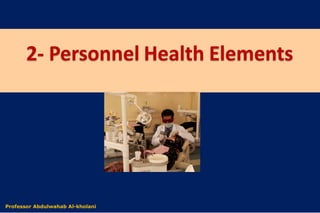
2. Personnel Health Elements
3. Bloodborne Pathogens
4. Hand Hygiene
5. Personal Protective Equipment (PPE)
6. Latex Hypersensitivity/Contact Dermatitis
7. Sterilization and Disinfection
8. Environmental Infection Control
9. Dental Unit Waterlines
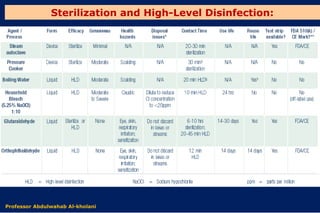
10. Sterilization and High-Level Disinfection (summary)
11. Processing of Instruments
12. Sterilization Failure
Dr. Abdulwahab Al-kholaniProfessor Abdulwahab Al-kholani
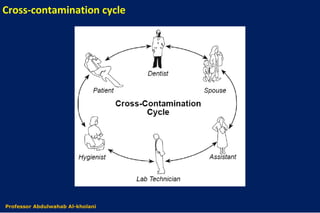
Cross-contamination cycle
Dr. Abdulwahab Al-kholaniProfessor Abdulwahab Al-kholani
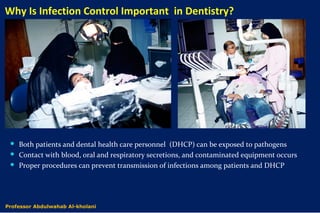
Why Is Infection Control Important in Dentistry?
Dr. Abdulwahab Al-kholani
 Both patients and dental health care personnel (DHCP) can be exposed to pathogens
 Contact with blood, oral and respiratory secretions, and contaminated equipment occurs
 Proper procedures can prevent transmission of infections among patients and DHCP
Professor Abdulwahab Al-kholani
Dr. Abdulwahab Al-kholani
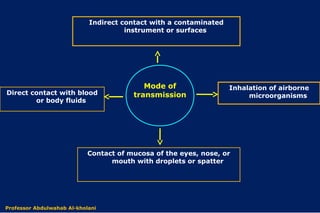
Direct contact with blood
or body fluids
Contact of mucosa of the eyes, nose, or
mouth with droplets or spatter
Indirect contact with a contaminated
instrument or surfaces
Inhalation of airborne
microorganisms
Mode of
transmission
Professor Abdulwahab Al-kholani
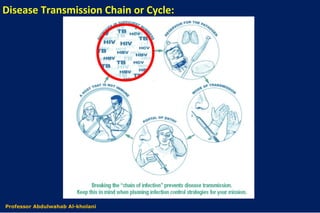
Disease Transmission Chain or Cycle:
Dr. Abdulwahab Al-kholaniProfessor Abdulwahab Al-kholani
Professor Abdulwahab Al-kholani
How to Break the Chain of InfectionHow to Break the Chain of Infection
Professor Abdulwahab Al-kholani
Personnel Health Elements of an
Infection Control Program
Education and training
Immunizations (vaccination)
Exposure prevention and postexposure management
Medical condition management and work-related illnesses
and restrictions
Health record maintenance
Professor Abdulwahab Al-kholani
Dr. Abdulwahab Al-kholaniProfessor Abdulwahab Al-kholani
Preventing Transmission of
Bloodborne Pathogens
Are transmissible in health care settings
Can produce chronic infection
Are often carried by persons unaware of their infection
Bloodborne viruses such as hepatitis B virus (HBV),
hepatitis C virus (HCV), and human
immunodeficiency virus (HIV):
Dr. Abdulwahab Al-kholaniProfessor Abdulwahab Al-kholani
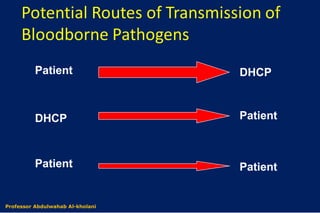
Patient DHCP
DHCP Patient
Patient Patient
Dr. Abdulwahab Al-kholaniProfessor Abdulwahab Al-kholani
Dr. Abdulwahab Al-kholani
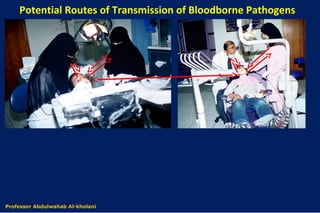
Potential Routes of Transmission of Bloodborne Pathogens
Professor Abdulwahab Al-kholani
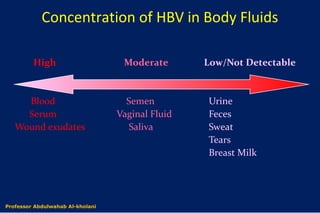
Concentration of HBV in Body Fluids
High Moderate Low/Not Detectable
Blood Semen Urine
Serum Vaginal Fluid Feces
Wound exudates Saliva Sweat
Tears
Breast Milk
Dr. Abdulwahab Al-kholaniProfessor Abdulwahab Al-kholani
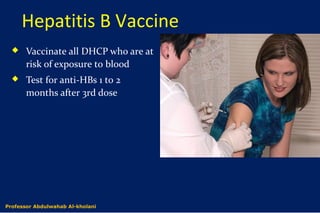
Hepatitis B Vaccine
 Vaccinate all DHCP who are at
risk of exposure to blood
 Test for anti-HBs 1 to 2
months after 3rd dose
Dr. Abdulwahab Al-kholaniProfessor Abdulwahab Al-kholani
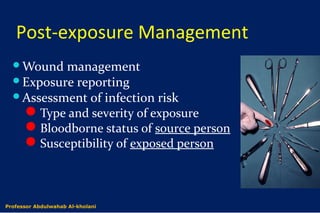
Post-exposure Management
Wound management
Exposure reporting
Assessment of infection risk
Type and severity of exposure
Bloodborne status of source person
Susceptibility of exposed person
Dr. Abdulwahab Al-kholaniProfessor Abdulwahab Al-kholani
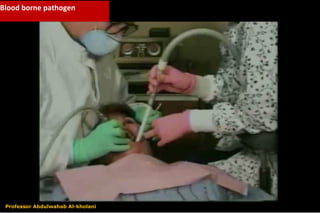
Blood borne pathogen
Professor Abdulwahab Al-kholani
Dr. Abdulwahab Al-kholaniProfessor Abdulwahab Al-kholani
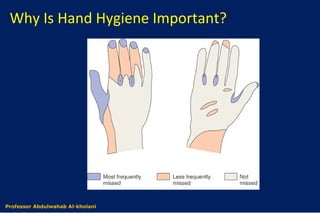
Why Is Hand Hygiene Important?
Hands are the most common mode of pathogen
transmission
Reduce spread of antimicrobial resistance
Dr. Abdulwahab Al-kholaniProfessor Abdulwahab Al-kholani
Why Is Hand Hygiene Important?
Dr. Abdulwahab Al-kholaniProfessor Abdulwahab Al-kholani
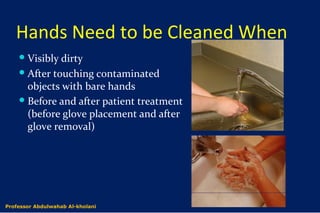
Hands Need to be Cleaned When
Visibly dirty
After touching contaminated
objects with bare hands
Before and after patient treatment
(before glove placement and after
glove removal)
Dr. Abdulwahab Al-kholaniProfessor Abdulwahab Al-kholani
Hand Hygiene Definitions
Handwashing
Washing hands with plain soap and water
Antiseptic handwash
Washing hands with water and soap or other detergents
containing an antiseptic agent
Alcohol-based handrub
Rubbing hands with an alcohol-containing preparation
Surgical antisepsis
Handwashing with an antiseptic soap or an alcohol-based
handrub before operations
Dr. Abdulwahab Al-kholaniProfessor Abdulwahab Al-kholani
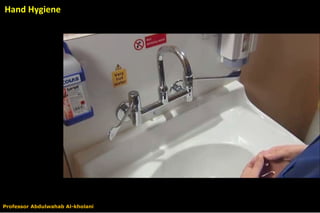
Hand Hygiene
Professor Abdulwahab Al-kholani
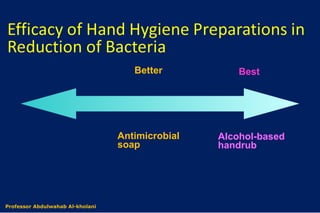
Good Better Best
Plain Soap Antimicrobial
soap
Alcohol-based
handrub
Dr. Abdulwahab Al-kholaniProfessor Abdulwahab Al-kholani
Special Hand Hygiene Considerations
Use hand lotions to prevent skin dryness
Consider compatibility of hand care products with
gloves (e.g., mineral oils and petroleum bases may
cause early glove failure)
Keep fingernails short
Avoid artificial nails
Avoid hand jewelry that may tear gloves
Dr. Abdulwahab Al-kholaniProfessor Abdulwahab Al-kholani
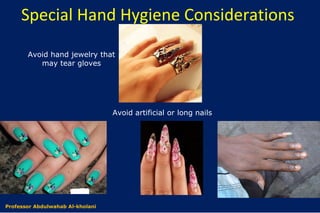
Special Hand Hygiene Considerations
Dr. Abdulwahab Al-kholani
Avoid artificial or long nails
Avoid hand jewelry that
may tear gloves
Professor Abdulwahab Al-kholani
Dr. Abdulwahab Al-kholaniProfessor Abdulwahab Al-kholani
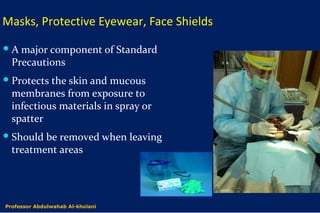
A major component of Standard
Precautions
Protects the skin and mucous
membranes from exposure to
infectious materials in spray or
spatter
Should be removed when leaving
treatment areas
Dr. Abdulwahab Al-kholani
Masks, Protective Eyewear, Face Shields
Professor Abdulwahab Al-kholani
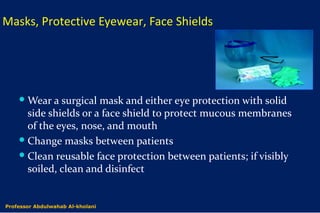
Masks, Protective Eyewear, Face Shields
Wear a surgical mask and either eye protection with solid
side shields or a face shield to protect mucous membranes
of the eyes, nose, and mouth
Change masks between patients
Clean reusable face protection between patients; if visibly
soiled, clean and disinfect
Dr. Abdulwahab Al-kholaniProfessor Abdulwahab Al-kholani
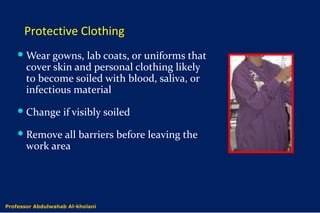
Protective Clothing
Wear gowns, lab coats, or uniforms that
cover skin and personal clothing likely
to become soiled with blood, saliva, or
infectious material
Change if visibly soiled
Remove all barriers before leaving the
work area
Dr. Abdulwahab Al-kholaniProfessor Abdulwahab Al-kholani
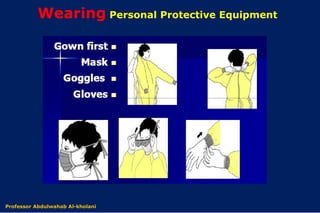
Wearing Personal Protective Equipment
Dr. Abdulwahab Al-kholaniProfessor Abdulwahab Al-kholani
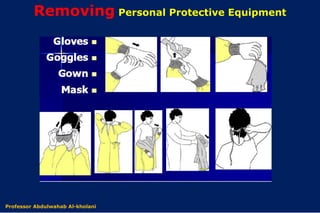
Removing Personal Protective Equipment
Dr. Abdulwahab Al-kholaniProfessor Abdulwahab Al-kholani
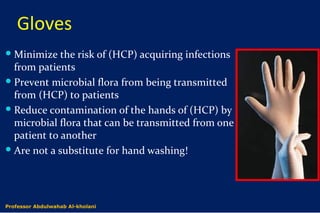
Gloves
Minimize the risk of (HCP) acquiring infections
from patients
Prevent microbial flora from being transmitted
from (HCP) to patients
Reduce contamination of the hands of (HCP) by
microbial flora that can be transmitted from one
patient to another
Are not a substitute for hand washing!
Dr. Abdulwahab Al-kholaniProfessor Abdulwahab Al-kholani
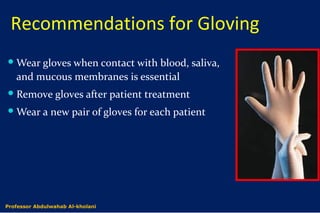
Recommendations for Gloving
Wear gloves when contact with blood, saliva,
and mucous membranes is essential
Remove gloves after patient treatment
Wear a new pair of gloves for each patient
Dr. Abdulwahab Al-kholaniProfessor Abdulwahab Al-kholani
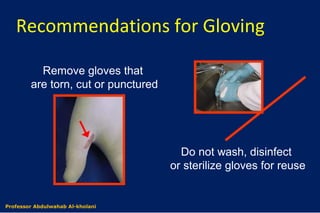
Recommendations for Gloving
Remove gloves that
are torn, cut or punctured
Do not wash, disinfect
or sterilize gloves for reuse
Dr. Abdulwahab Al-kholaniProfessor Abdulwahab Al-kholani
Professor Abdulwahab Al-kholani
Personal Protective Equipment (PPE)
Dr. Abdulwahab Al-kholaniProfessor Abdulwahab Al-kholani
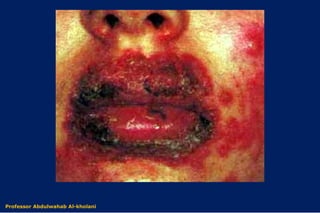
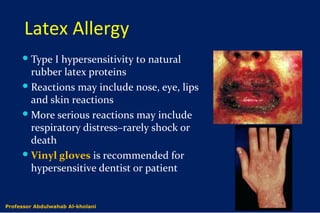
Latex Allergy
Type I hypersensitivity to natural
rubber latex proteins
Reactions may include nose, eye, lips
and skin reactions
More serious reactions may include
respiratory distress–rarely shock or
death
Vinyl gloves is recommended for
hypersensitive dentist or patient
Dr. Abdulwahab Al-kholaniProfessor Abdulwahab Al-kholani
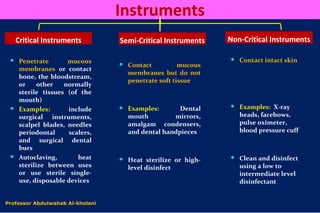
Instruments
Critical Instruments Semi-Critical Instruments Non-Critical Instruments
 Penetrate mucous
membranes or contact
bone, the bloodstream,
or other normally
sterile tissues (of the
mouth)
 Examples: include
surgical instruments,
scalpel blades, needles
periodontal scalers,
and surgical dental
burs
 Autoclaving, heat
sterilize between uses
or use sterile single-
use, disposable devices
 Contact mucous
membranes but do not
penetrate soft tissue
 Examples: Dental
mouth mirrors,
amalgam condensers,
and dental handpieces
 Heat sterilize or high-
level disinfect
 Contact intact skin
 Examples: X-ray
heads, facebows,
pulse oximeter,
blood pressure cuff
 Clean and disinfect
using a low to
intermediate level
disinfectant
Professor Abdulwahab Al-kholani
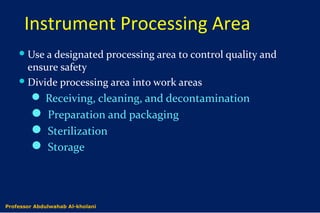
Instrument Processing Area
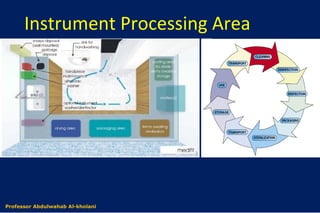
Use a designated processing area to control quality and
ensure safety
Divide processing area into work areas
 Receiving, cleaning, and decontamination
 Preparation and packaging
 Sterilization
 Storage
Dr. Abdulwahab Al-kholaniProfessor Abdulwahab Al-kholani
Instrument Processing Area
Dr. Abdulwahab Al-kholaniProfessor Abdulwahab Al-kholani
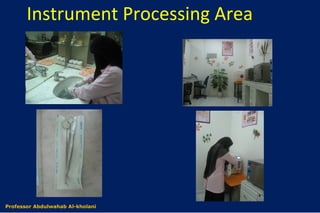
Instrument Processing Area
Dr. Abdulwahab Al-kholaniProfessor Abdulwahab Al-kholani
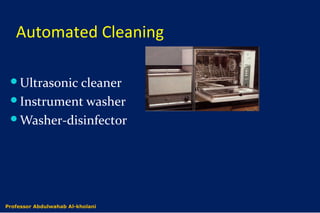
Automated Cleaning
Ultrasonic cleaner
Instrument washer
Washer-disinfector
Dr. Abdulwahab Al-kholaniProfessor Abdulwahab Al-kholani
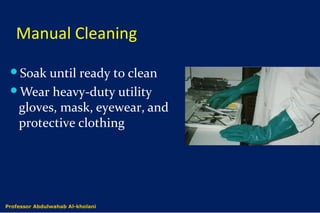
Manual Cleaning
Soak until ready to clean
Wear heavy-duty utility
gloves, mask, eyewear, and
protective clothing
Dr. Abdulwahab Al-kholaniProfessor Abdulwahab Al-kholani
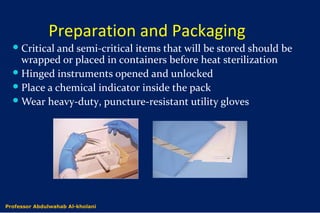
Preparation and Packaging
Critical and semi-critical items that will be stored should be
wrapped or placed in containers before heat sterilization
Hinged instruments opened and unlocked
Place a chemical indicator inside the pack
Wear heavy-duty, puncture-resistant utility gloves
Dr. Abdulwahab Al-kholaniProfessor Abdulwahab Al-kholani
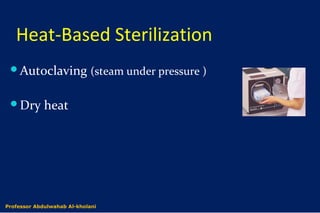
Heat-Based Sterilization
Autoclaving (steam under pressure )
Dry heat
Dr. Abdulwahab Al-kholaniProfessor Abdulwahab Al-kholani
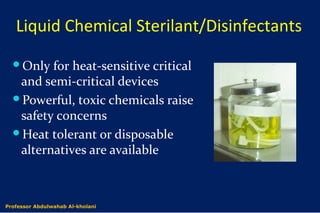
Liquid Chemical Sterilant/Disinfectants
Only for heat-sensitive critical
and semi-critical devices
Powerful, toxic chemicals raise
safety concerns
Heat tolerant or disposable
alternatives are available
Dr. Abdulwahab Al-kholaniProfessor Abdulwahab Al-kholani
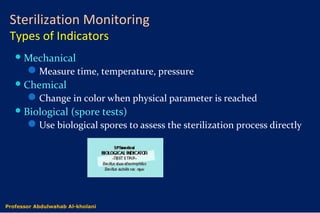
Sterilization Monitoring
Types of Indicators
Mechanical
Measure time, temperature, pressure
Chemical
Change in color when physical parameter is reached
Biological (spore tests)
Use biological spores to assess the sterilization process directly
Dr. Abdulwahab Al-kholaniProfessor Abdulwahab Al-kholani
Storage of Sterile and Clean Items and Supplies
Use date- or event-related shelf-life practices
Examine wrapped items carefully prior to use
When packaging of sterile items is damaged, re-
clean, re-wrap, and re-sterilize
Store clean items in dry, closed, or covered
containment
Dr. Abdulwahab Al-kholaniProfessor Abdulwahab Al-kholani
Categories of Environmental Surfaces
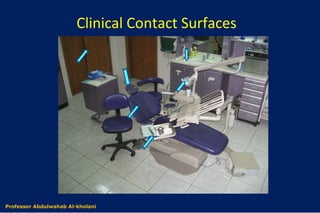
 Clinical contact surfaces
High potential for direct
contamination from spray or
spatter or by contact with DHCP’s
gloved hand
Dr. Abdulwahab Al-kholani
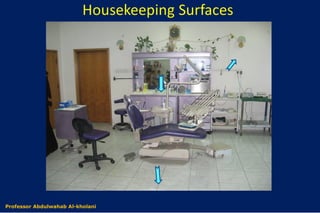
 Housekeeping surfaces
Do not come into contact with
patients or devices
Limited risk of disease transmission
Professor Abdulwahab Al-kholani
Dr. Abdulwahab Al-kholani
Clinical Contact Surfaces
Professor Abdulwahab Al-kholani
Dr. Abdulwahab Al-kholaniProfessor Abdulwahab Al-kholani
General Cleaning Recommendations
 Use barrier precautions (e.g., heavy-duty utility gloves, masks,
protective eyewear) when cleaning and disinfecting
environmental surfaces
 Physical removal of microorganisms by cleaning is as
important as the disinfection process
 Follow manufacturer’s instructions for proper use of
disinfectants
 Do not use sterilant/high-level disinfectants on
environmental surfaces
Dr. Abdulwahab Al-kholaniProfessor Abdulwahab Al-kholani
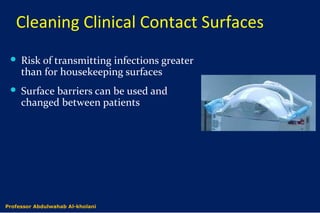
Cleaning Clinical Contact Surfaces
 Risk of transmitting infections greater
than for housekeeping surfaces
 Surface barriers can be used and
changed between patients
Dr. Abdulwahab Al-kholaniProfessor Abdulwahab Al-kholani
Cleaning Housekeeping Surfaces
 Routinely clean with soap and water or disinfectant
routinely
 Clean mops and cloths and allow to dry thoroughly before
re-using
 Prepare fresh cleaning and disinfecting solutions daily and
per manufacturer recommendations
Dr. Abdulwahab Al-kholaniProfessor Abdulwahab Al-kholani
Medical Waste
Medical Waste: Not considered infectious,
thus can be discarded in regular trash
Regulated Medical Waste: Poses a
potential risk of infection during handling
and disposal
Dr. Abdulwahab Al-kholaniProfessor Abdulwahab Al-kholani
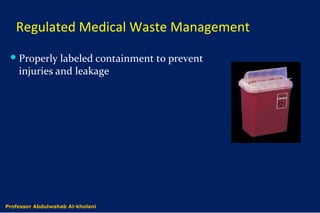
Regulated Medical Waste Management
Properly labeled containment to prevent
injuries and leakage
Dr. Abdulwahab Al-kholaniProfessor Abdulwahab Al-kholani
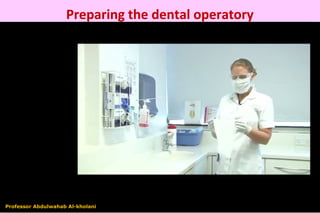
Preparing the dental operatory
Professor Abdulwahab Al-kholani
Dr. Abdulwahab Al-kholaniProfessor Abdulwahab Al-kholani
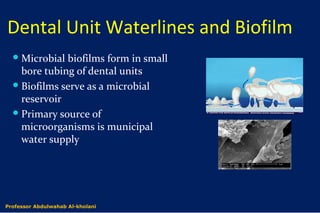
Dental Unit Waterlines and Biofilm
Microbial biofilms form in small
bore tubing of dental units
Biofilms serve as a microbial
reservoir
Primary source of
microorganisms is municipal
water supply
Dr. Abdulwahab Al-kholaniProfessor Abdulwahab Al-kholani
Dental Unit Water Quality
 Using water of uncertain quality is
inconsistent with infection control
principles
 Untreated dental units cannot reliably
produce water that meets drinking
water standards
Dr. Abdulwahab Al-kholaniProfessor Abdulwahab Al-kholani
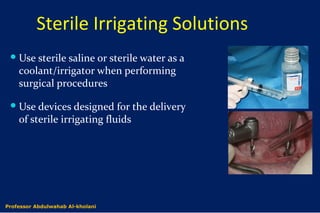
Sterile Irrigating Solutions
Use sterile saline or sterile water as a
coolant/irrigator when performing
surgical procedures
Use devices designed for the delivery
of sterile irrigating fluids
Dr. Abdulwahab Al-kholaniProfessor Abdulwahab Al-kholani
Instruments must be cleaned well before
sterilization
Dr. Abdulwahab Al-kholaniProfessor Abdulwahab Al-kholani
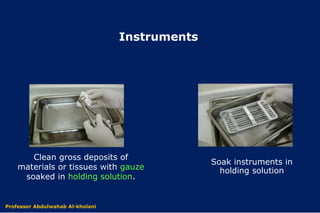
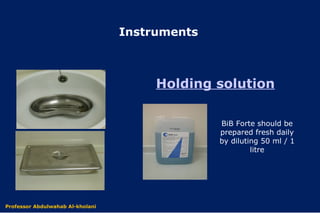
Clean gross deposits of
materials or tissues with gauze
soaked in holding solution.
Soak instruments in
holding solution
Instruments
Dr. Abdulwahab Al-kholaniProfessor Abdulwahab Al-kholani
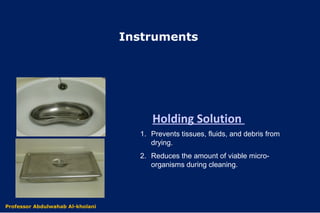
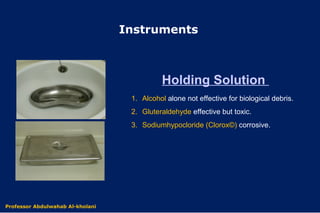
Holding Solution
1. Prevents tissues, fluids, and debris from
drying.
2. Reduces the amount of viable micro-
organisms during cleaning.
Dr. Abdulwahab Al-kholani
Instruments
Professor Abdulwahab Al-kholani
BiB Forte should be
prepared fresh daily
by diluting 50 ml / 1
litre
Holding solution
Dr. Abdulwahab Al-kholani
Instruments
Professor Abdulwahab Al-kholani
1. Alcohol alone not effective for biological debris.
2. Gluteraldehyde effective but toxic.
3. Sodiumhypocloride (Clorox©) corrosive.
Holding Solution
Dr. Abdulwahab Al-kholani
Instruments
Professor Abdulwahab Al-kholani
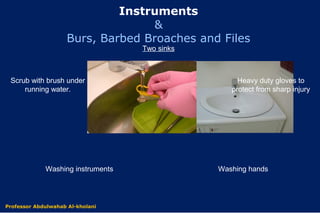
Scrub with brush under
running water.
Washing instruments Washing hands
Two sinks
Heavy duty gloves to
protect from sharp injury
Dr. Abdulwahab Al-kholani
Instruments
&
Burs, Barbed Broaches and Files
Professor Abdulwahab Al-kholani
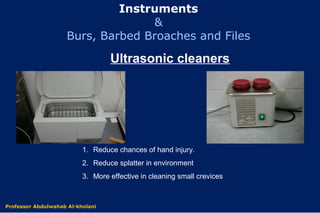
Ultrasonic cleaners
1. Reduce chances of hand injury.
2. Reduce splatter in environment
3. More effective in cleaning small crevices
Dr. Abdulwahab Al-kholani
Instruments
&
Burs, Barbed Broaches and Files
Professor Abdulwahab Al-kholani
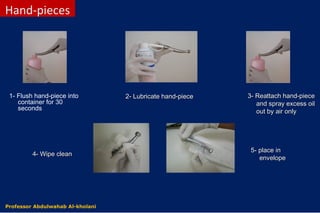
1- Flush hand-piece into
container for 30
seconds
2- Lubricate hand-piece2- Lubricate hand-piece 3- Reattach hand-piece3- Reattach hand-piece
and spray excess oiland spray excess oil
out by air onlyout by air only
4- Wipe clean4- Wipe clean
5- place in5- place in
envelopeenvelope
Dr. Abdulwahab Al-kholaniProfessor Abdulwahab Al-kholani
Hand-pieces
Hand-pieces
Dr. Abdulwahab Al-kholaniProfessor Abdulwahab Al-kholani
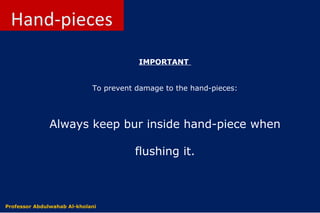
IMPORTANT
To prevent damage to the hand-pieces:
Always keep bur inside hand-piece when
flushing it.
Dr. Abdulwahab Al-kholaniProfessor Abdulwahab Al-kholani
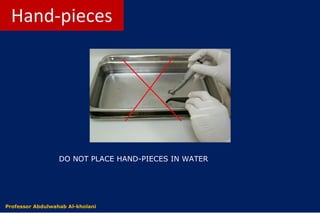
DO NOT PLACE HAND-PIECES IN WATER
Dr. Abdulwahab Al-kholani
Hand-pieces
Professor Abdulwahab Al-kholani
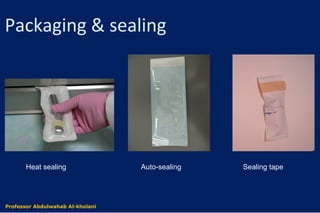
Heat sealing Auto-sealing Sealing tape
Packaging & sealing
Dr. Abdulwahab Al-kholaniProfessor Abdulwahab Al-kholani
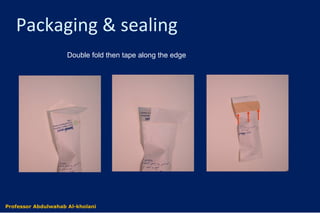
Double fold then tape along the edge
Packaging & sealing
Dr. Abdulwahab Al-kholaniProfessor Abdulwahab Al-kholani
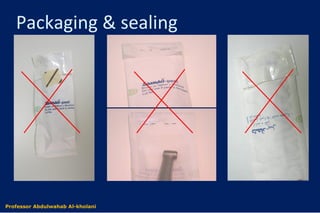
Packaging & sealing
Dr. Abdulwahab Al-kholaniProfessor Abdulwahab Al-kholani
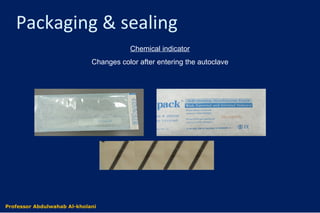
Chemical indicator
Changes color after entering the autoclave
Packaging & sealing
Dr. Abdulwahab Al-kholaniProfessor Abdulwahab Al-kholani
Dr. Abdulwahab Al-kholani
Sterilization Failure
Improper Cleaning of Instruments
Improper Packaging Materials
Improper Sterilization Parameters
Time
Temperature
And/or pressure
Improper Selection of Sterilization Method
Professor Abdulwahab Al-kholani
Dr. Abdulwahab Al-kholani
Sterilization and High-Level Disinfection:
Professor Abdulwahab Al-kholani
Questions?

Infection control in dental practice

  • 1.
  • 2.
  • 3.
    1. Background 2. PersonnelHealth Elements 3. Bloodborne Pathogens 4. Hand Hygiene 5. Personal Protective Equipment (PPE) 6. Latex Hypersensitivity/Contact Dermatitis 7. Sterilization and Disinfection 8. Environmental Infection Control 9. Dental Unit Waterlines 10. Sterilization and High-Level Disinfection (summary) 11. Processing of Instruments 12. Sterilization Failure Dr. Abdulwahab Al-kholaniProfessor Abdulwahab Al-kholani
  • 4.
  • 5.
    Cross-contamination cycle Dr. AbdulwahabAl-kholaniProfessor Abdulwahab Al-kholani
  • 6.
    Why Is InfectionControl Important in Dentistry? Dr. Abdulwahab Al-kholani  Both patients and dental health care personnel (DHCP) can be exposed to pathogens  Contact with blood, oral and respiratory secretions, and contaminated equipment occurs  Proper procedures can prevent transmission of infections among patients and DHCP Professor Abdulwahab Al-kholani
  • 7.
    Dr. Abdulwahab Al-kholani Directcontact with blood or body fluids Contact of mucosa of the eyes, nose, or mouth with droplets or spatter Indirect contact with a contaminated instrument or surfaces Inhalation of airborne microorganisms Mode of transmission Professor Abdulwahab Al-kholani
  • 8.
    Disease Transmission Chainor Cycle: Dr. Abdulwahab Al-kholaniProfessor Abdulwahab Al-kholani
  • 9.
    Professor Abdulwahab Al-kholani Howto Break the Chain of InfectionHow to Break the Chain of Infection
  • 10.
  • 11.
    Personnel Health Elementsof an Infection Control Program Education and training Immunizations (vaccination) Exposure prevention and postexposure management Medical condition management and work-related illnesses and restrictions Health record maintenance Professor Abdulwahab Al-kholani
  • 12.
  • 13.
    Preventing Transmission of BloodbornePathogens Are transmissible in health care settings Can produce chronic infection Are often carried by persons unaware of their infection Bloodborne viruses such as hepatitis B virus (HBV), hepatitis C virus (HCV), and human immunodeficiency virus (HIV): Dr. Abdulwahab Al-kholaniProfessor Abdulwahab Al-kholani
  • 14.
    Patient DHCP DHCP Patient PatientPatient Dr. Abdulwahab Al-kholaniProfessor Abdulwahab Al-kholani
  • 15.
    Dr. Abdulwahab Al-kholani PotentialRoutes of Transmission of Bloodborne Pathogens Professor Abdulwahab Al-kholani
  • 16.
    Concentration of HBVin Body Fluids High Moderate Low/Not Detectable Blood Semen Urine Serum Vaginal Fluid Feces Wound exudates Saliva Sweat Tears Breast Milk Dr. Abdulwahab Al-kholaniProfessor Abdulwahab Al-kholani
  • 17.
    Hepatitis B Vaccine Vaccinate all DHCP who are at risk of exposure to blood  Test for anti-HBs 1 to 2 months after 3rd dose Dr. Abdulwahab Al-kholaniProfessor Abdulwahab Al-kholani
  • 18.
    Post-exposure Management Wound management Exposurereporting Assessment of infection risk Type and severity of exposure Bloodborne status of source person Susceptibility of exposed person Dr. Abdulwahab Al-kholaniProfessor Abdulwahab Al-kholani
  • 19.
    Blood borne pathogen ProfessorAbdulwahab Al-kholani
  • 20.
  • 21.
    Why Is HandHygiene Important? Hands are the most common mode of pathogen transmission Reduce spread of antimicrobial resistance Dr. Abdulwahab Al-kholaniProfessor Abdulwahab Al-kholani
  • 22.
    Why Is HandHygiene Important? Dr. Abdulwahab Al-kholaniProfessor Abdulwahab Al-kholani
  • 23.
    Hands Need tobe Cleaned When Visibly dirty After touching contaminated objects with bare hands Before and after patient treatment (before glove placement and after glove removal) Dr. Abdulwahab Al-kholaniProfessor Abdulwahab Al-kholani
  • 24.
    Hand Hygiene Definitions Handwashing Washinghands with plain soap and water Antiseptic handwash Washing hands with water and soap or other detergents containing an antiseptic agent Alcohol-based handrub Rubbing hands with an alcohol-containing preparation Surgical antisepsis Handwashing with an antiseptic soap or an alcohol-based handrub before operations Dr. Abdulwahab Al-kholaniProfessor Abdulwahab Al-kholani
  • 25.
  • 26.
    Good Better Best PlainSoap Antimicrobial soap Alcohol-based handrub Dr. Abdulwahab Al-kholaniProfessor Abdulwahab Al-kholani
  • 27.
    Special Hand HygieneConsiderations Use hand lotions to prevent skin dryness Consider compatibility of hand care products with gloves (e.g., mineral oils and petroleum bases may cause early glove failure) Keep fingernails short Avoid artificial nails Avoid hand jewelry that may tear gloves Dr. Abdulwahab Al-kholaniProfessor Abdulwahab Al-kholani
  • 28.
    Special Hand HygieneConsiderations Dr. Abdulwahab Al-kholani Avoid artificial or long nails Avoid hand jewelry that may tear gloves Professor Abdulwahab Al-kholani
  • 29.
  • 30.
    A major componentof Standard Precautions Protects the skin and mucous membranes from exposure to infectious materials in spray or spatter Should be removed when leaving treatment areas Dr. Abdulwahab Al-kholani Masks, Protective Eyewear, Face Shields Professor Abdulwahab Al-kholani
  • 31.
    Masks, Protective Eyewear,Face Shields Wear a surgical mask and either eye protection with solid side shields or a face shield to protect mucous membranes of the eyes, nose, and mouth Change masks between patients Clean reusable face protection between patients; if visibly soiled, clean and disinfect Dr. Abdulwahab Al-kholaniProfessor Abdulwahab Al-kholani
  • 32.
    Protective Clothing Wear gowns,lab coats, or uniforms that cover skin and personal clothing likely to become soiled with blood, saliva, or infectious material Change if visibly soiled Remove all barriers before leaving the work area Dr. Abdulwahab Al-kholaniProfessor Abdulwahab Al-kholani
  • 33.
    Wearing Personal ProtectiveEquipment Dr. Abdulwahab Al-kholaniProfessor Abdulwahab Al-kholani
  • 34.
    Removing Personal ProtectiveEquipment Dr. Abdulwahab Al-kholaniProfessor Abdulwahab Al-kholani
  • 35.
    Gloves Minimize the riskof (HCP) acquiring infections from patients Prevent microbial flora from being transmitted from (HCP) to patients Reduce contamination of the hands of (HCP) by microbial flora that can be transmitted from one patient to another Are not a substitute for hand washing! Dr. Abdulwahab Al-kholaniProfessor Abdulwahab Al-kholani
  • 36.
    Recommendations for Gloving Weargloves when contact with blood, saliva, and mucous membranes is essential Remove gloves after patient treatment Wear a new pair of gloves for each patient Dr. Abdulwahab Al-kholaniProfessor Abdulwahab Al-kholani
  • 37.
    Recommendations for Gloving Removegloves that are torn, cut or punctured Do not wash, disinfect or sterilize gloves for reuse Dr. Abdulwahab Al-kholaniProfessor Abdulwahab Al-kholani
  • 38.
    Professor Abdulwahab Al-kholani PersonalProtective Equipment (PPE)
  • 39.
  • 40.
  • 41.
    Latex Allergy Type Ihypersensitivity to natural rubber latex proteins Reactions may include nose, eye, lips and skin reactions More serious reactions may include respiratory distress–rarely shock or death Vinyl gloves is recommended for hypersensitive dentist or patient Dr. Abdulwahab Al-kholaniProfessor Abdulwahab Al-kholani
  • 42.
  • 43.
    Instruments Critical Instruments Semi-CriticalInstruments Non-Critical Instruments  Penetrate mucous membranes or contact bone, the bloodstream, or other normally sterile tissues (of the mouth)  Examples: include surgical instruments, scalpel blades, needles periodontal scalers, and surgical dental burs  Autoclaving, heat sterilize between uses or use sterile single- use, disposable devices  Contact mucous membranes but do not penetrate soft tissue  Examples: Dental mouth mirrors, amalgam condensers, and dental handpieces  Heat sterilize or high- level disinfect  Contact intact skin  Examples: X-ray heads, facebows, pulse oximeter, blood pressure cuff  Clean and disinfect using a low to intermediate level disinfectant Professor Abdulwahab Al-kholani
  • 44.
    Instrument Processing Area Usea designated processing area to control quality and ensure safety Divide processing area into work areas  Receiving, cleaning, and decontamination  Preparation and packaging  Sterilization  Storage Dr. Abdulwahab Al-kholaniProfessor Abdulwahab Al-kholani
  • 45.
    Instrument Processing Area Dr.Abdulwahab Al-kholaniProfessor Abdulwahab Al-kholani
  • 46.
    Instrument Processing Area Dr.Abdulwahab Al-kholaniProfessor Abdulwahab Al-kholani
  • 47.
    Automated Cleaning Ultrasonic cleaner Instrumentwasher Washer-disinfector Dr. Abdulwahab Al-kholaniProfessor Abdulwahab Al-kholani
  • 48.
    Manual Cleaning Soak untilready to clean Wear heavy-duty utility gloves, mask, eyewear, and protective clothing Dr. Abdulwahab Al-kholaniProfessor Abdulwahab Al-kholani
  • 49.
    Preparation and Packaging Criticaland semi-critical items that will be stored should be wrapped or placed in containers before heat sterilization Hinged instruments opened and unlocked Place a chemical indicator inside the pack Wear heavy-duty, puncture-resistant utility gloves Dr. Abdulwahab Al-kholaniProfessor Abdulwahab Al-kholani
  • 50.
    Heat-Based Sterilization Autoclaving (steamunder pressure ) Dry heat Dr. Abdulwahab Al-kholaniProfessor Abdulwahab Al-kholani
  • 51.
    Liquid Chemical Sterilant/Disinfectants Onlyfor heat-sensitive critical and semi-critical devices Powerful, toxic chemicals raise safety concerns Heat tolerant or disposable alternatives are available Dr. Abdulwahab Al-kholaniProfessor Abdulwahab Al-kholani
  • 52.
    Sterilization Monitoring Types ofIndicators Mechanical Measure time, temperature, pressure Chemical Change in color when physical parameter is reached Biological (spore tests) Use biological spores to assess the sterilization process directly Dr. Abdulwahab Al-kholaniProfessor Abdulwahab Al-kholani
  • 53.
    Storage of Sterileand Clean Items and Supplies Use date- or event-related shelf-life practices Examine wrapped items carefully prior to use When packaging of sterile items is damaged, re- clean, re-wrap, and re-sterilize Store clean items in dry, closed, or covered containment Dr. Abdulwahab Al-kholaniProfessor Abdulwahab Al-kholani
  • 54.
  • 55.
    Categories of EnvironmentalSurfaces  Clinical contact surfaces High potential for direct contamination from spray or spatter or by contact with DHCP’s gloved hand Dr. Abdulwahab Al-kholani  Housekeeping surfaces Do not come into contact with patients or devices Limited risk of disease transmission Professor Abdulwahab Al-kholani
  • 56.
    Dr. Abdulwahab Al-kholani ClinicalContact Surfaces Professor Abdulwahab Al-kholani
  • 57.
  • 58.
    General Cleaning Recommendations Use barrier precautions (e.g., heavy-duty utility gloves, masks, protective eyewear) when cleaning and disinfecting environmental surfaces  Physical removal of microorganisms by cleaning is as important as the disinfection process  Follow manufacturer’s instructions for proper use of disinfectants  Do not use sterilant/high-level disinfectants on environmental surfaces Dr. Abdulwahab Al-kholaniProfessor Abdulwahab Al-kholani
  • 59.
    Cleaning Clinical ContactSurfaces  Risk of transmitting infections greater than for housekeeping surfaces  Surface barriers can be used and changed between patients Dr. Abdulwahab Al-kholaniProfessor Abdulwahab Al-kholani
  • 60.
    Cleaning Housekeeping Surfaces Routinely clean with soap and water or disinfectant routinely  Clean mops and cloths and allow to dry thoroughly before re-using  Prepare fresh cleaning and disinfecting solutions daily and per manufacturer recommendations Dr. Abdulwahab Al-kholaniProfessor Abdulwahab Al-kholani
  • 61.
    Medical Waste Medical Waste:Not considered infectious, thus can be discarded in regular trash Regulated Medical Waste: Poses a potential risk of infection during handling and disposal Dr. Abdulwahab Al-kholaniProfessor Abdulwahab Al-kholani
  • 62.
    Regulated Medical WasteManagement Properly labeled containment to prevent injuries and leakage Dr. Abdulwahab Al-kholaniProfessor Abdulwahab Al-kholani
  • 63.
    Preparing the dentaloperatory Professor Abdulwahab Al-kholani
  • 64.
  • 65.
    Dental Unit Waterlinesand Biofilm Microbial biofilms form in small bore tubing of dental units Biofilms serve as a microbial reservoir Primary source of microorganisms is municipal water supply Dr. Abdulwahab Al-kholaniProfessor Abdulwahab Al-kholani
  • 66.
    Dental Unit WaterQuality  Using water of uncertain quality is inconsistent with infection control principles  Untreated dental units cannot reliably produce water that meets drinking water standards Dr. Abdulwahab Al-kholaniProfessor Abdulwahab Al-kholani
  • 67.
    Sterile Irrigating Solutions Usesterile saline or sterile water as a coolant/irrigator when performing surgical procedures Use devices designed for the delivery of sterile irrigating fluids Dr. Abdulwahab Al-kholaniProfessor Abdulwahab Al-kholani
  • 68.
  • 69.
    Instruments must becleaned well before sterilization Dr. Abdulwahab Al-kholaniProfessor Abdulwahab Al-kholani
  • 70.
    Clean gross depositsof materials or tissues with gauze soaked in holding solution. Soak instruments in holding solution Instruments Dr. Abdulwahab Al-kholaniProfessor Abdulwahab Al-kholani
  • 71.
    Holding Solution 1. Preventstissues, fluids, and debris from drying. 2. Reduces the amount of viable micro- organisms during cleaning. Dr. Abdulwahab Al-kholani Instruments Professor Abdulwahab Al-kholani
  • 72.
    BiB Forte shouldbe prepared fresh daily by diluting 50 ml / 1 litre Holding solution Dr. Abdulwahab Al-kholani Instruments Professor Abdulwahab Al-kholani
  • 73.
    1. Alcohol alonenot effective for biological debris. 2. Gluteraldehyde effective but toxic. 3. Sodiumhypocloride (Clorox©) corrosive. Holding Solution Dr. Abdulwahab Al-kholani Instruments Professor Abdulwahab Al-kholani
  • 74.
    Scrub with brushunder running water. Washing instruments Washing hands Two sinks Heavy duty gloves to protect from sharp injury Dr. Abdulwahab Al-kholani Instruments & Burs, Barbed Broaches and Files Professor Abdulwahab Al-kholani
  • 75.
    Ultrasonic cleaners 1. Reducechances of hand injury. 2. Reduce splatter in environment 3. More effective in cleaning small crevices Dr. Abdulwahab Al-kholani Instruments & Burs, Barbed Broaches and Files Professor Abdulwahab Al-kholani
  • 76.
    1- Flush hand-pieceinto container for 30 seconds 2- Lubricate hand-piece2- Lubricate hand-piece 3- Reattach hand-piece3- Reattach hand-piece and spray excess oiland spray excess oil out by air onlyout by air only 4- Wipe clean4- Wipe clean 5- place in5- place in envelopeenvelope Dr. Abdulwahab Al-kholaniProfessor Abdulwahab Al-kholani Hand-pieces
  • 77.
  • 78.
    IMPORTANT To prevent damageto the hand-pieces: Always keep bur inside hand-piece when flushing it. Dr. Abdulwahab Al-kholaniProfessor Abdulwahab Al-kholani
  • 79.
    DO NOT PLACEHAND-PIECES IN WATER Dr. Abdulwahab Al-kholani Hand-pieces Professor Abdulwahab Al-kholani
  • 80.
    Heat sealing Auto-sealingSealing tape Packaging & sealing Dr. Abdulwahab Al-kholaniProfessor Abdulwahab Al-kholani
  • 81.
    Double fold thentape along the edge Packaging & sealing Dr. Abdulwahab Al-kholaniProfessor Abdulwahab Al-kholani
  • 82.
    Packaging & sealing Dr.Abdulwahab Al-kholaniProfessor Abdulwahab Al-kholani
  • 83.
    Chemical indicator Changes colorafter entering the autoclave Packaging & sealing Dr. Abdulwahab Al-kholaniProfessor Abdulwahab Al-kholani
  • 84.
    Dr. Abdulwahab Al-kholani SterilizationFailure Improper Cleaning of Instruments Improper Packaging Materials Improper Sterilization Parameters Time Temperature And/or pressure Improper Selection of Sterilization Method Professor Abdulwahab Al-kholani
  • 85.
    Dr. Abdulwahab Al-kholani Sterilizationand High-Level Disinfection: Professor Abdulwahab Al-kholani
  • 86.

Editor's Notes

  • #7 During the provision of dental treatment, both patients and dental health care personnel (DHCP) can be exposed to pathogens through contact with blood, oral and respiratory secretions, and contaminated equipment. Following recommended infection control procedures can prevent transmission of infectious organisms among patients and dental health care personnel.
  • #22 Next we turn to the subject of Hand Hygiene. So, is hand hygiene the single most important factor in preventing the spread of pathogens in health care settings? First, hands are the most common mode of pathogen transmission. Hand washing can reduce the spread of antibiotic resistance in health care settings and the likelihood of health care-associated infections. [Additional comments: CDC estimates that each year nearly 2 million patients in the United States acquire infections in hospitals, and about 90,000 of these patients die as a result.]
  • #23 Next we turn to the subject of Hand Hygiene. So, is hand hygiene the single most important factor in preventing the spread of pathogens in health care settings? First, hands are the most common mode of pathogen transmission. Hand washing can reduce the spread of antibiotic resistance in health care settings and the likelihood of health care-associated infections. [Additional comments: CDC estimates that each year nearly 2 million patients in the United States acquire infections in hospitals, and about 90,000 of these patients die as a result.]
  • #25 Hand hygiene is a general term that applies to either handwashing, antiseptic handwash, alcohol-based handrub, or surgical hand hygiene/antisepsis. Handwashing refers to washing hands with plain soap and water. Antiseptic handwash refers to washing hands with water and soap or other detergents containing an antiseptic agent, such as triclosan or chlorhexidine. Using a waterless agent containing 60%–95% ethanol or isopropanol alcohol-containing preparation is referred to as an alcohol handrub. These agents are a new addition to the dental guidelines and have become more frequently used in the United States to improve compliance with handwashing in hospitals. In dental practices, however, sinks are readily available and the need for alcohol preparations is not as great. Surgical antisepsis refers to an antiseptic handwash or alcohol-based handrub* performed preoperatively by surgical personnel to eliminate microorganisms on hands. Antiseptic preparations for surgical hand hygiene should have persistent (long-lasting) antimicrobial activity. * If using an alcohol-based handrub the hands should first be washed with soap and water.
  • #26 Hand hygiene is a general term that applies to either handwashing, antiseptic handwash, alcohol-based handrub, or surgical hand hygiene/antisepsis. Handwashing refers to washing hands with plain soap and water. Antiseptic handwash refers to washing hands with water and soap or other detergents containing an antiseptic agent, such as triclosan or chlorhexidine. Using a waterless agent containing 60%–95% ethanol or isopropanol alcohol-containing preparation is referred to as an alcohol handrub. These agents are a new addition to the dental guidelines and have become more frequently used in the United States to improve compliance with handwashing in hospitals. In dental practices, however, sinks are readily available and the need for alcohol preparations is not as great. Surgical antisepsis refers to an antiseptic handwash or alcohol-based handrub* performed preoperatively by surgical personnel to eliminate microorganisms on hands. Antiseptic preparations for surgical hand hygiene should have persistent (long-lasting) antimicrobial activity. * If using an alcohol-based handrub the hands should first be washed with soap and water.
  • #54 DHCP have a choice about how they maintain their instrument storage area — either date- or event-related shelf-life practices. In date-related packing, every sterilized package is expiration-dated and the instruments are used on a “first in, first out” basis. In event-related practice, the contents of a sterilized package should remain sterile indefinitely unless some event, for example, torn or wet packaging material, causes it to become potentially contaminated. It is still useful to place the date of sterilization and identify the sterilizer used if multiple sterilizers are utilized in the office. In case of sterilization failure, this information would facilitate retrieval of processed items. Examine each package. If it is damaged in any way, items should be re-cleaned, re-wrapped, and re-sterilized. Even if an event-related approach is used, all packages should be labeled with the date of sterilization and which sterilizer was used, should a sterilization failure occur. Store all sterile and clean items and supplies in dry, closed, or covered cabinets.
  • #57 During the provision of dental treatment, both patients and dental health care personnel (DHCP) can be exposed to pathogens through contact with blood, oral and respiratory secretions, and contaminated equipment. Following recommended infection control procedures can prevent transmission of infectious organisms among patients and dental health care personnel.
  • #58 Examples of housekeeping surfaces are walls, sinks, and floors (shown by arrows).
  • #59 Use appropriate protective barriers such as heavy-duty utility gloves, masks, and protective eyewear when cleaning and disinfecting surfaces. In general, cleaning and removal of microorganisms is as important as the disinfection process itself. Blood or other patient materials left on surfaces can interfere with the disinfecting process. Follow the manufacturer’s instructions for proper storage, dilution, and use of hospital disinfectants. Because of their toxic nature, the use of sterilants or high-level disinfectants on environmental surfaces is NOT recommended.
  • #60 Because clinical contact surfaces come into direct contact with contaminated gloves, instruments, spray or spatter, their risk of transmitting infection is greater than for housekeeping surfaces. These surfaces can subsequently contaminate other instruments, devices, hands, or gloves. Surface barriers can be used to protect clinical contact surfaces and changed between patients. Surface barriers are particularly useful for surfaces that are hard to clean, such as switches on dental chairs. This practice will also reduce exposure to harmful chemical disinfectants. If surface barriers cannot be used, clean and then disinfect the surface with an EPA-registered hospital disinfectant effective against HIV and HBV (low-level disinfectant). If the surface is visibly contaminated with blood or other patient material, clean and then disinfect the surface with an EPA-registered hospital disinfectant with a tuberculocidal claim (intermediate-level disinfectant).
  • #61 Housekeeping surfaces carry the least risk for transmitting infections in dental settings. On a routine basis, these surfaces should be either cleaned with soap and water or an EPA-registered detergent/hospital disinfectant. Wet mops and cloths may become contaminated with microorganisms, so clean the mop and cloths after use and allow them to dry thoroughly before re-using. Prepare fresh cleaning and disinfecting solutions daily and per manufacturer recommendations.
  • #62 There is no evidence that traditional medical waste management has contributed to increased levels of disease in the community or among health care personnel. The majority of waste generated in a medical or dental office (~98%–99%) is not considered infectious and can be discarded in the regular trash. Examples include used gloves, masks, and lightly bloodied gauze. Some waste, such as used needles, extracted teeth, and gauze soaked in blood, may pose a potential risk of infection, however, and warrants special precautions during handling and disposal. Follow federal, state, and local regulations for proper treatment and disposal.
  • #65 Dental Unit Waterlines (DUWL), Biofilm, and Water Quality.
  • #66 Studies have shown that colonies of microorganisms, or biofilms, can form on the inside of the small-bore plastic tubing that transports water within the dental unit to handpieces and air-water syringes. Once formed, a biofilm serves as a reservoir that may dramatically increase the number of free-floating microorganisms in water used for dental treatment. Most organisms isolated from dental water systems originate from the public water supply and do not pose a high risk of disease for healthy persons. Although a few pathogenic organisms, such as Legionella spp. and Pseudomonas sp., have been found, adverse public health threats have not been documented. Photo credit, top: CDC Image library. This Scanning Electron Micrograph depicts an E. coli (ATCC 11775) biofilm grown on PC (polycarbonate) coupons using a CDC biofilm reactor.Photo credit, bottom: Illustration from the Center for Biofilm Engineering, Bozeman MT.
  • #67 Despite a lack of documented adverse health effects, using water of uncertain microbiological quality is inconsistent with infection control principles. Levels of contamination in water from untreated systems can exceed 1 million colony forming units per milliliter (mL) of water. Untreated dental units cannot reliably produce water that meets drinking water standards (fewer than 500 CFU/mL of heterotrophic water bacteria). Even using source water containing ≤500 CFU/mL of bacteria (e.g., tap, distilled, or sterile water) in a self-contained system will not eliminate bacterial contamination in treatment water if biofilms in the water system are not controlled. Removal or inactivation of dental waterline biofilms requires use of chemical germicides.
  • #68 During oral surgical procedures, microorganisms may enter the bloodstream and other normally sterile areas of the oral cavity (e.g., bone or subcutaneous tissue). For this reason, sterile solutions (e.g., sterile saline or sterile water) should be used as a coolant/irrigator when performing surgical procedures. Because the tubing cannot be reliably sterilized, conventional dental units cannot reliably deliver sterile water even when equipped with independent water reservoirs. Sterile water delivery devices, such as sterile irrigating syringes, shown here, or bulb syringes should be used to deliver sterile water. Sterile water systems, such as those used with surgical handpieces, bypass the dental unit and use sterile disposable or autoclavable tubing. Photo credit, top: Lt. Col. Jennifer Harte, U.S.A.F. Dental Investigation Service, Great Lakes, IL. Photo credit, bottom: Eve Cuny, University of the Pacific School of Dentistry, San Francisco, CA.
  • #70 This is to prevent spray and splatter which is increased due to the small size of the sinks.
  • #71 Area with tray and kidney containers of holding solution and instruments should have a paper lining under them Must make sure you have at least three holding containers- order from store. Cleaning important because proteinaceous material inactivates the active agent in the solution. If no BiB is available, may use detergent.