Gradients and differentiation an
introduction to calculus
LEARNING OBJECTIVES

To work out the gradient of a curve at a given
point

To differentiate from first principles
Esbolov Baurzhan
CALCULUS(исчисление)
© Boardworks Ltd 20053 of 45
Rates of change
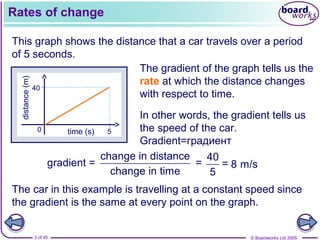
This graph shows the distance that a car travels over a period
of 5 seconds.
The gradient of the graph tells us the
rate at which the distance changes
with respect to time.
In other words, the gradient tells us
the speed of the car.
Gradient=градиент
change in distance
gradient = =
change in time
40
=
5
8 m/s
The car in this example is travelling at a constant speed since
the gradient is the same at every point on the graph.
time (s)
distance(m)
0 5
40
© Boardworks Ltd 20054 of 45
x
y
(x1, y1)
(x2, y2)
0
Finding the gradient from two given points
If we are given any two points (x1, y1) and (x2, y2) on a
line we can calculate the gradient of the line as follows:
the gradient =
change in y
change in x
x2 – x1
y2 – y1
Draw a right-angled
triangle between the two
points on the line as
follows:
y y
m
x x
−
−
2 1
2 1
the gradient, =
© Boardworks Ltd 20055 of 45
© Boardworks Ltd 20056 of 45
Differentiation from first principles
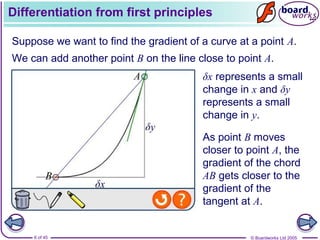
Suppose we want to find the gradient of a curve at a point A.
We can add another point B on the line close to point A.
As point B moves
closer to point A, the
gradient of the chord
AB gets closer to the
gradient of the
tangent at A.
δx represents a small
change in x and δy
represents a small
change in y.
© Boardworks Ltd 20057 of 45
Differentiation from first principles
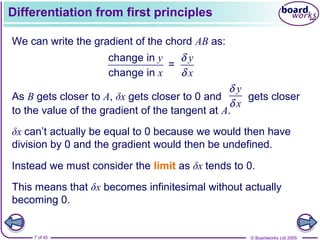
We can write the gradient of the chord AB as:
change in
=
change in
y
x
y
x
δ
δ
As B gets closer to A, δx gets closer to 0 and gets closer
y
x
δ
δ
to the value of the gradient of the tangent at A.
δx can’t actually be equal to 0 because we would then have
division by 0 and the gradient would then be undefined.
Instead we must consider the limit as δx tends to 0.
This means that δx becomes infinitesimal without actually
becoming 0.
© Boardworks Ltd 20058 of 45
Differentiation from first principles
Let’s apply this method to a general point on the curve y = x2
.
If we let the x-coordinate of a general point A on the curve
y = x2
be x, then the y-coordinate will be x2
.
So, A is the point (x, x2
).
If B is another point close to A(x, x2
) on the curve, we can
write the coordinates of B as (x + δx, (x + δx)2
).
© Boardworks Ltd 20059 of 45
Differentiation from first principles
The gradient of chord AB is:
2 2
( )
=
( )
y x x x
x x x x
δ δ
δ δ
+ −
+ −
δx
δy
2 2 2
2 ( )
=
x x x x x
x
δ δ
δ
+ + −
2
2 ( )
=
x x x
x
δ δ
δ
+
(2 )
=
x x x
x
δ δ
δ
+
2
0
So for = , lim = 2
x
y
y x x
xδ
δ
δ→
= 2 +x xδ
A(x, x2
)
B(x + δx, (x + δx)2
)
© Boardworks Ltd 200510 of 45
The gradient function
So the gradient of the tangent to the curve y = x2
at the general
point (x, y) is 2x.
2x is often called the derived function(полученные
функции) of y = x2
.
If the curve is written using function notation as y = f(x), then
the derived function can be written as f ′(x).
So, if: f(x) = x2
This notation is useful if we want to find the gradient of f(x) at a
particular point.
For example, the gradient of f(x) = x2
at the point (5, 25) is:
f ′(5) = 2 × 5 = 10
f ′(x) = 2xThen:
© Boardworks Ltd 200511 of 45
Differentiating y = x3
from first principles
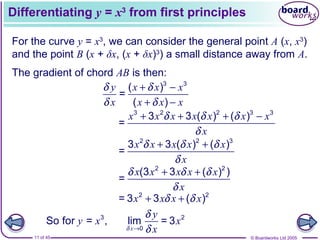
For the curve y = x3
, we can consider the general point A (x, x3
)
and the point B (x + δx, (x + δx)3
) a small distance away from A.
The gradient of chord AB is then:
3 3
( )
=
( )
y x x x
x x x x
δ δ
δ δ
+ −
+ −
3 2 2 3 3
3 3 ( ) ( )
=
x x x x x x x
x
δ δ δ
δ
+ + + −
2 2 3
3 3 ( ) ( )
=
x x x x x
x
δ δ δ
δ
+ +
2 2
(3 3 ( ) )
=
x x x x x
x
δ δ δ
δ
+ +
2 2
= 3 3 ( )x x x xδ δ+ +
3 2
0
So for = , lim = 3
x
y
y x x
xδ
δ
δ→
© Boardworks Ltd 200512 of 45
The gradient of y = x3
So, the gradient of the tangent to the curve y = x3
at the
general point (x, y) is 3x2
.
So if, f(x) = x3
What is the gradient of the tangent to the
curve f(x) = x3
at the point (–2, –8)?
f ′(x) = 3x2
f ′(–2) = 3(–2)2
= 12
Explain why the gradient of f(x) = x3
will always be positive.
f ′(x) = 3x2
Then:
© Boardworks Ltd 200513 of 45
Using the notation
We have shown that for y = x3
dy
dx
represents the derivative of y with respect to x.
dy
dx
2
0
lim = 3
x
y
x
xδ
δ
δ→
0
lim
x
y
xδ
δ
δ→
is usually written as .
dy
dx
So if y = x3
of the tangent.
Remember, is the gradient of a chord, while is the gradient
y
x
δ
δ
dy
dx
2
= 3
dy
x
dx
then:
© Boardworks Ltd 200514 of 45
Using the notation dy
dx
This notation can be adapted for other variables so, for
example:
Also, if we want to differentiate 2x4
with respect to x, for
example, we can write:
represents the derivative of s with respect to t.
ds
dt
We could work this out by differentiating from first principles,
but in practice this is unusual.
4
(2 )
d
x
dx
If s is distance and t is time then we can interpret this as the
rate of change in distance with respect to time. In other words,
the speed.
© Boardworks Ltd 200515 of 45
Contents
© Boardworks Ltd 200515 of 45
Rates of change
The gradient of the tangent at a point
The gradient of the tangent as a limit
Differentiation of polynomials
Second order derivatives
Tangents and normals
Examination-style questions
Differentiation of polynomials
© Boardworks Ltd 200516 of 45
Differentiation
If we continued the process of differentiating from first
principles we would obtain the following results:
y
dy
dx
x x2
x3
x4
x5
x6
What pattern do you notice?
In general:
1
If thenn ndy
y x nx
dx
−
= =
and when xn
is preceded by a constant multiplier a we have:
1 2x 3x2
4x3
5x4
6x5
1
If = then =n ndy
y ax anx
dx
−
© Boardworks Ltd 200517 of 45
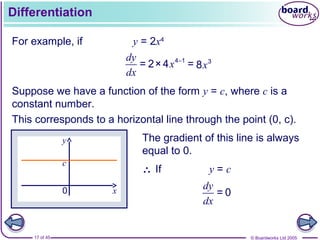
y
x0
Differentiation
For example, if y = 2x4
4 1
= 2×4 =
dy
x
dx
− 3
8x
Suppose we have a function of the form y = c, where c is a
constant number.
This corresponds to a horizontal line through the point (0, c).
c
The gradient of this line is always
equal to 0.
∴ If y = c
= 0
dy
dx
© Boardworks Ltd 200518 of 45
Differentiation
Find the gradient of the curve
y = 3x4
at the point (–2, 48).
Differentiating:
3
=12
dy
x
dx
At the point (–2, 48) x = –2 so:
3
=12( 2)
dy
dx
−
=12 × 8−
= 96−
The gradient of the curve y = 3x4
at the point (–2, 48) is –96.
© Boardworks Ltd 200519 of 45
Differentiating polynomials
Suppose we want to differentiate a polynomial function.
For example:
If = ( )± ( ) then = '( )± '( )
dy
y f x g x f x g x
dx
Differentiate y = x4
+ 3x2
– 5x + 2 with respect to x.
In general, if y is made up of the sum or difference of any given
number of functions, its derivative will be made up of the
derivative of each of the functions.
We can differentiate each term in the function to give .
dy
dx
4x3
+ 6x – 5=
dy
dx
So:
© Boardworks Ltd 200520 of 45
Differentiating polynomials
Find the point on y = 4x2
– x – 5 where the gradient is 15.
= 8 1
dy
x
dx
−
=15
dy
dx
when 8x – 1 = 15
8x = 16
x = 2
We now substitute this value into the equation y = 4x2
– x – 5
to find the value of y when x = 2
y = 4(2)2
– 2 – 5
The gradient of y = 4x2
– x – 5 is 15 at the point (2, 9).
= 9
© Boardworks Ltd 200521 of 45
Differentiating polynomials
In some cases, a function will have to be written as separate
terms containing powers of x before differentiating.
For example:
Given that f(x) = (2x – 3)(x2
– 5) find f ′(x).
Expanding: f(x) = 2x3
– 3x2
– 10x + 15
f ′(x) = 6x2
– 6x –10
Find the gradient of f(x) at the point (–3, –36).
When x = –3 we have f ′(–3) = 6(–3)2
– 6(–3) –10
= 54 + 18 – 10
= 62
© Boardworks Ltd 200522 of 45
Differentiating polynomials
312
2= + 2
dy
x
dx
= 6x3
+ 2
5 2
3 + 4 8
Differentiate = with respect to .
2
x x x
y x
x
−
5 2
3 4 8
= +
2 2 2
x x x
y
x x x
−
43
2= + 2 4y x x −
We can now differentiate:
= 2(3x3
+ 1)
© Boardworks Ltd 200523 of 45
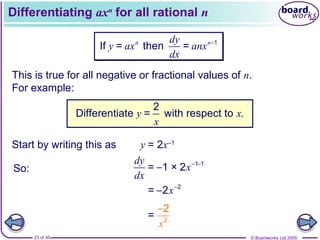
Differentiating axn
for all rational n
This is true for all negative or fractional values of n.
For example:
1
If = then =n ndy
y ax anx
dx
−
2
Differentiate = with respect to .y x
x
Start by writing this as y = 2x–1
So:
1 1
= 1 × 2
dy
x
dx
− −
−
2
= 2x−
−
2
=
2
x
−
© Boardworks Ltd 200524 of 45
Differentiating axn
for all rational n
Differentiate = 4 with respect to .y x x
So:
1
2
11
2= × 4
dy
x
dx
−
1
2
= 2x
−
=
2
x
Start by writing this as
1
2
= 4y x
Remember, in some cases, a function will have to be written as
separate terms containing powers of x before differentiating.
© Boardworks Ltd 200525 of 45
Differentiating axn
for all rational n
2
Given that ( ) = (1+ ) find '( ).f x x f x
( ) = (1+ )(1+ )f x x x
=1+ 2 +x x
1
2
=1+ 2 +x x
1
2
'( ) = +1f x x
−
=
1
+1
x
© Boardworks Ltd 200526 of 45
Contents
© Boardworks Ltd 200526 of 45
Rates of change
The gradient of the tangent at a point
The gradient of the tangent as a limit
Differentiation of polynomials
Second order derivatives
Tangents and normals
Examination-style questions
Second order derivatives
© Boardworks Ltd 200527 of 45
Second order derivatives
Differentiating a function y = f(x) gives us the derivative
dy
dx
or f ′(x)
Differentiating the function a second time gives us the second
order derivative. This can be written as
2
2
d y
dx
or f ′′(x)
The second order derivative gives us the rate of change of the
gradient of a function.
We can think of it as the gradient of the gradient.
© Boardworks Ltd 200528 of 45
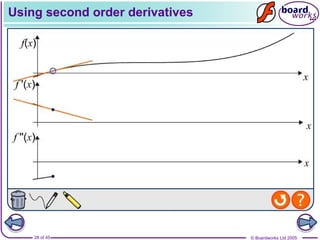
Using second order derivatives
© Boardworks Ltd 200529 of 45
Contents
© Boardworks Ltd 200529 of 45
Rates of change
The gradient of the tangent at a point
The gradient of the tangent as a limit
Differentiation of polynomials
Second order derivatives
Tangents and normals
Examination-style questions
Tangents and normals
© Boardworks Ltd 200530 of 45
Tangents and normals
Remember, the tangent to a curve at a point is a straight line
that just touches the curve at that point.
The normal to a curve at a point is a straight line that is
perpendicular to the tangent at that point.
We can use differentiation to find the equation of the tangent
or the normal to a curve at a given point. For example:
Find the equation of the tangent and the normal
to the curve y = x2
– 5x + 8 at the point P(3, 2).
© Boardworks Ltd 200531 of 45
Tangents and normals
y = x2
– 5x + 8
= 2 5
dy
x
dx
−
At the point P(3, 2) x = 3 so:
= 2(3) 5 =
dy
dx
− 1
The gradient of the tangent at P is therefore 1.
Using y – y1 = m(x – x1), give the equation of the tangent at the
point P(3, 2):
y – 2 = x – 3
y = x – 1
© Boardworks Ltd 200532 of 45
Tangents and normals
The normal to the curve at the point P(3, 2) is perpendicular to
the tangent at that point.
Using y – y1 = m(x – x1) give the equation of the tangent at the
point P(3, 2):
The gradient of the tangent at P is 1 and so the gradient of the
normal is –1.
2 = ( 3)y x− − −
+ 5 = 0y x −
© Boardworks Ltd 200533 of 45
Contents
© Boardworks Ltd 200533 of 45
Rates of change
The gradient of the tangent at a point
The gradient of the tangent as a limit
Differentiation of polynomials
Second order derivatives
Tangents and normals
Examination-style questions
© Boardworks Ltd 200534 of 45
Examination-style question
The curve f(x) = x2
+ 2x – 8 cuts the x-axes at the points A(–a,
0) and B(b, 0) where a and b are positive integers.
a) Find the coordinates of points A and B.
b) Find the gradient function of the curve.
c) Find the equations of the normals to the curve at points A
and B.
d) Given that these normals intersect at the point C, find the
coordinates of C.
a) The equation of the curve can be written in factorized form
as y = (x + 4)(x – 2) so the coordinates of A are (–4, 0) and
the coordinates of B are (2, 0).
© Boardworks Ltd 200535 of 45
Examination-style question
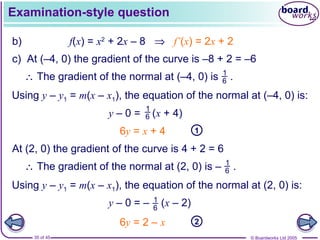
b) f(x) = x2
+ 2x – 8 ⇒ f’(x) = 2x + 2
c) At (–4, 0) the gradient of the curve is –8 + 2 = –6
Using y – y1 = m(x – x1), the equation of the normal at (–4, 0) is:
∴ The gradient of the normal at (–4, 0) is .1
6
y – 0 = (x + 4)
1
6
16y = x + 4
At (2, 0) the gradient of the curve is 4 + 2 = 6
Using y – y1 = m(x – x1), the equation of the normal at (2, 0) is:
∴ The gradient of the normal at (2, 0) is – .1
6
y – 0 = – (x – 2)1
6
26y = 2 – x
© Boardworks Ltd 200536 of 45
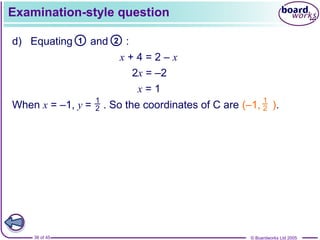
Examination-style question
x + 4 = 2 – x
d) Equating and :1 2
2x = –2
x = 1
When x = –1, y = . So the coordinates of C are (–1, ).
1
2
1
2

Nis differentiation1

  • 1.
    Gradients and differentiationan introduction to calculus LEARNING OBJECTIVES  To work out the gradient of a curve at a given point  To differentiate from first principles Esbolov Baurzhan
  • 2.
  • 3.
    © Boardworks Ltd20053 of 45 Rates of change This graph shows the distance that a car travels over a period of 5 seconds. The gradient of the graph tells us the rate at which the distance changes with respect to time. In other words, the gradient tells us the speed of the car. Gradient=градиент change in distance gradient = = change in time 40 = 5 8 m/s The car in this example is travelling at a constant speed since the gradient is the same at every point on the graph. time (s) distance(m) 0 5 40
  • 4.
    © Boardworks Ltd20054 of 45 x y (x1, y1) (x2, y2) 0 Finding the gradient from two given points If we are given any two points (x1, y1) and (x2, y2) on a line we can calculate the gradient of the line as follows: the gradient = change in y change in x x2 – x1 y2 – y1 Draw a right-angled triangle between the two points on the line as follows: y y m x x − − 2 1 2 1 the gradient, =
  • 5.
    © Boardworks Ltd20055 of 45
  • 6.
    © Boardworks Ltd20056 of 45 Differentiation from first principles Suppose we want to find the gradient of a curve at a point A. We can add another point B on the line close to point A. As point B moves closer to point A, the gradient of the chord AB gets closer to the gradient of the tangent at A. δx represents a small change in x and δy represents a small change in y.
  • 7.
    © Boardworks Ltd20057 of 45 Differentiation from first principles We can write the gradient of the chord AB as: change in = change in y x y x δ δ As B gets closer to A, δx gets closer to 0 and gets closer y x δ δ to the value of the gradient of the tangent at A. δx can’t actually be equal to 0 because we would then have division by 0 and the gradient would then be undefined. Instead we must consider the limit as δx tends to 0. This means that δx becomes infinitesimal without actually becoming 0.
  • 8.
    © Boardworks Ltd20058 of 45 Differentiation from first principles Let’s apply this method to a general point on the curve y = x2 . If we let the x-coordinate of a general point A on the curve y = x2 be x, then the y-coordinate will be x2 . So, A is the point (x, x2 ). If B is another point close to A(x, x2 ) on the curve, we can write the coordinates of B as (x + δx, (x + δx)2 ).
  • 9.
    © Boardworks Ltd20059 of 45 Differentiation from first principles The gradient of chord AB is: 2 2 ( ) = ( ) y x x x x x x x δ δ δ δ + − + − δx δy 2 2 2 2 ( ) = x x x x x x δ δ δ + + − 2 2 ( ) = x x x x δ δ δ + (2 ) = x x x x δ δ δ + 2 0 So for = , lim = 2 x y y x x xδ δ δ→ = 2 +x xδ A(x, x2 ) B(x + δx, (x + δx)2 )
  • 10.
    © Boardworks Ltd200510 of 45 The gradient function So the gradient of the tangent to the curve y = x2 at the general point (x, y) is 2x. 2x is often called the derived function(полученные функции) of y = x2 . If the curve is written using function notation as y = f(x), then the derived function can be written as f ′(x). So, if: f(x) = x2 This notation is useful if we want to find the gradient of f(x) at a particular point. For example, the gradient of f(x) = x2 at the point (5, 25) is: f ′(5) = 2 × 5 = 10 f ′(x) = 2xThen:
  • 11.
    © Boardworks Ltd200511 of 45 Differentiating y = x3 from first principles For the curve y = x3 , we can consider the general point A (x, x3 ) and the point B (x + δx, (x + δx)3 ) a small distance away from A. The gradient of chord AB is then: 3 3 ( ) = ( ) y x x x x x x x δ δ δ δ + − + − 3 2 2 3 3 3 3 ( ) ( ) = x x x x x x x x δ δ δ δ + + + − 2 2 3 3 3 ( ) ( ) = x x x x x x δ δ δ δ + + 2 2 (3 3 ( ) ) = x x x x x x δ δ δ δ + + 2 2 = 3 3 ( )x x x xδ δ+ + 3 2 0 So for = , lim = 3 x y y x x xδ δ δ→
  • 12.
    © Boardworks Ltd200512 of 45 The gradient of y = x3 So, the gradient of the tangent to the curve y = x3 at the general point (x, y) is 3x2 . So if, f(x) = x3 What is the gradient of the tangent to the curve f(x) = x3 at the point (–2, –8)? f ′(x) = 3x2 f ′(–2) = 3(–2)2 = 12 Explain why the gradient of f(x) = x3 will always be positive. f ′(x) = 3x2 Then:
  • 13.
    © Boardworks Ltd200513 of 45 Using the notation We have shown that for y = x3 dy dx represents the derivative of y with respect to x. dy dx 2 0 lim = 3 x y x xδ δ δ→ 0 lim x y xδ δ δ→ is usually written as . dy dx So if y = x3 of the tangent. Remember, is the gradient of a chord, while is the gradient y x δ δ dy dx 2 = 3 dy x dx then:
  • 14.
    © Boardworks Ltd200514 of 45 Using the notation dy dx This notation can be adapted for other variables so, for example: Also, if we want to differentiate 2x4 with respect to x, for example, we can write: represents the derivative of s with respect to t. ds dt We could work this out by differentiating from first principles, but in practice this is unusual. 4 (2 ) d x dx If s is distance and t is time then we can interpret this as the rate of change in distance with respect to time. In other words, the speed.
  • 15.
    © Boardworks Ltd200515 of 45 Contents © Boardworks Ltd 200515 of 45 Rates of change The gradient of the tangent at a point The gradient of the tangent as a limit Differentiation of polynomials Second order derivatives Tangents and normals Examination-style questions Differentiation of polynomials
  • 16.
    © Boardworks Ltd200516 of 45 Differentiation If we continued the process of differentiating from first principles we would obtain the following results: y dy dx x x2 x3 x4 x5 x6 What pattern do you notice? In general: 1 If thenn ndy y x nx dx − = = and when xn is preceded by a constant multiplier a we have: 1 2x 3x2 4x3 5x4 6x5 1 If = then =n ndy y ax anx dx −
  • 17.
    © Boardworks Ltd200517 of 45 y x0 Differentiation For example, if y = 2x4 4 1 = 2×4 = dy x dx − 3 8x Suppose we have a function of the form y = c, where c is a constant number. This corresponds to a horizontal line through the point (0, c). c The gradient of this line is always equal to 0. ∴ If y = c = 0 dy dx
  • 18.
    © Boardworks Ltd200518 of 45 Differentiation Find the gradient of the curve y = 3x4 at the point (–2, 48). Differentiating: 3 =12 dy x dx At the point (–2, 48) x = –2 so: 3 =12( 2) dy dx − =12 × 8− = 96− The gradient of the curve y = 3x4 at the point (–2, 48) is –96.
  • 19.
    © Boardworks Ltd200519 of 45 Differentiating polynomials Suppose we want to differentiate a polynomial function. For example: If = ( )± ( ) then = '( )± '( ) dy y f x g x f x g x dx Differentiate y = x4 + 3x2 – 5x + 2 with respect to x. In general, if y is made up of the sum or difference of any given number of functions, its derivative will be made up of the derivative of each of the functions. We can differentiate each term in the function to give . dy dx 4x3 + 6x – 5= dy dx So:
  • 20.
    © Boardworks Ltd200520 of 45 Differentiating polynomials Find the point on y = 4x2 – x – 5 where the gradient is 15. = 8 1 dy x dx − =15 dy dx when 8x – 1 = 15 8x = 16 x = 2 We now substitute this value into the equation y = 4x2 – x – 5 to find the value of y when x = 2 y = 4(2)2 – 2 – 5 The gradient of y = 4x2 – x – 5 is 15 at the point (2, 9). = 9
  • 21.
    © Boardworks Ltd200521 of 45 Differentiating polynomials In some cases, a function will have to be written as separate terms containing powers of x before differentiating. For example: Given that f(x) = (2x – 3)(x2 – 5) find f ′(x). Expanding: f(x) = 2x3 – 3x2 – 10x + 15 f ′(x) = 6x2 – 6x –10 Find the gradient of f(x) at the point (–3, –36). When x = –3 we have f ′(–3) = 6(–3)2 – 6(–3) –10 = 54 + 18 – 10 = 62
  • 22.
    © Boardworks Ltd200522 of 45 Differentiating polynomials 312 2= + 2 dy x dx = 6x3 + 2 5 2 3 + 4 8 Differentiate = with respect to . 2 x x x y x x − 5 2 3 4 8 = + 2 2 2 x x x y x x x − 43 2= + 2 4y x x − We can now differentiate: = 2(3x3 + 1)
  • 23.
    © Boardworks Ltd200523 of 45 Differentiating axn for all rational n This is true for all negative or fractional values of n. For example: 1 If = then =n ndy y ax anx dx − 2 Differentiate = with respect to .y x x Start by writing this as y = 2x–1 So: 1 1 = 1 × 2 dy x dx − − − 2 = 2x− − 2 = 2 x −
  • 24.
    © Boardworks Ltd200524 of 45 Differentiating axn for all rational n Differentiate = 4 with respect to .y x x So: 1 2 11 2= × 4 dy x dx − 1 2 = 2x − = 2 x Start by writing this as 1 2 = 4y x Remember, in some cases, a function will have to be written as separate terms containing powers of x before differentiating.
  • 25.
    © Boardworks Ltd200525 of 45 Differentiating axn for all rational n 2 Given that ( ) = (1+ ) find '( ).f x x f x ( ) = (1+ )(1+ )f x x x =1+ 2 +x x 1 2 =1+ 2 +x x 1 2 '( ) = +1f x x − = 1 +1 x
  • 26.
    © Boardworks Ltd200526 of 45 Contents © Boardworks Ltd 200526 of 45 Rates of change The gradient of the tangent at a point The gradient of the tangent as a limit Differentiation of polynomials Second order derivatives Tangents and normals Examination-style questions Second order derivatives
  • 27.
    © Boardworks Ltd200527 of 45 Second order derivatives Differentiating a function y = f(x) gives us the derivative dy dx or f ′(x) Differentiating the function a second time gives us the second order derivative. This can be written as 2 2 d y dx or f ′′(x) The second order derivative gives us the rate of change of the gradient of a function. We can think of it as the gradient of the gradient.
  • 28.
    © Boardworks Ltd200528 of 45 Using second order derivatives
  • 29.
    © Boardworks Ltd200529 of 45 Contents © Boardworks Ltd 200529 of 45 Rates of change The gradient of the tangent at a point The gradient of the tangent as a limit Differentiation of polynomials Second order derivatives Tangents and normals Examination-style questions Tangents and normals
  • 30.
    © Boardworks Ltd200530 of 45 Tangents and normals Remember, the tangent to a curve at a point is a straight line that just touches the curve at that point. The normal to a curve at a point is a straight line that is perpendicular to the tangent at that point. We can use differentiation to find the equation of the tangent or the normal to a curve at a given point. For example: Find the equation of the tangent and the normal to the curve y = x2 – 5x + 8 at the point P(3, 2).
  • 31.
    © Boardworks Ltd200531 of 45 Tangents and normals y = x2 – 5x + 8 = 2 5 dy x dx − At the point P(3, 2) x = 3 so: = 2(3) 5 = dy dx − 1 The gradient of the tangent at P is therefore 1. Using y – y1 = m(x – x1), give the equation of the tangent at the point P(3, 2): y – 2 = x – 3 y = x – 1
  • 32.
    © Boardworks Ltd200532 of 45 Tangents and normals The normal to the curve at the point P(3, 2) is perpendicular to the tangent at that point. Using y – y1 = m(x – x1) give the equation of the tangent at the point P(3, 2): The gradient of the tangent at P is 1 and so the gradient of the normal is –1. 2 = ( 3)y x− − − + 5 = 0y x −
  • 33.
    © Boardworks Ltd200533 of 45 Contents © Boardworks Ltd 200533 of 45 Rates of change The gradient of the tangent at a point The gradient of the tangent as a limit Differentiation of polynomials Second order derivatives Tangents and normals Examination-style questions Examination-style questions
  • 34.
    © Boardworks Ltd200534 of 45 Examination-style question The curve f(x) = x2 + 2x – 8 cuts the x-axes at the points A(–a, 0) and B(b, 0) where a and b are positive integers. a) Find the coordinates of points A and B. b) Find the gradient function of the curve. c) Find the equations of the normals to the curve at points A and B. d) Given that these normals intersect at the point C, find the coordinates of C. a) The equation of the curve can be written in factorized form as y = (x + 4)(x – 2) so the coordinates of A are (–4, 0) and the coordinates of B are (2, 0).
  • 35.
    © Boardworks Ltd200535 of 45 Examination-style question b) f(x) = x2 + 2x – 8 ⇒ f’(x) = 2x + 2 c) At (–4, 0) the gradient of the curve is –8 + 2 = –6 Using y – y1 = m(x – x1), the equation of the normal at (–4, 0) is: ∴ The gradient of the normal at (–4, 0) is .1 6 y – 0 = (x + 4) 1 6 16y = x + 4 At (2, 0) the gradient of the curve is 4 + 2 = 6 Using y – y1 = m(x – x1), the equation of the normal at (2, 0) is: ∴ The gradient of the normal at (2, 0) is – .1 6 y – 0 = – (x – 2)1 6 26y = 2 – x
  • 36.
    © Boardworks Ltd200536 of 45 Examination-style question x + 4 = 2 – x d) Equating and :1 2 2x = –2 x = 1 When x = –1, y = . So the coordinates of C are (–1, ). 1 2 1 2

Editor's Notes

  • #7 Explain that the small letter delta, δ , is used to represent a small change in the variable. A capital delta, Δ , can also be used.
  • #8 It is important that students are clear that delta is used to represent a small change in the variable. It is not itself a variable and certainly cannot be cancelled out. You may need to explain the meaning of infinitesimal, perhaps by referring to the infinite. Explain that at the limit, the gradient of the chord will actually be equal to the gradient of the tangent. As the chord approaches the gradient, δ x approaches 0, so that we can treat it as zero. The idea of a limit can be a difficult one to grasp. It is, however, central to the understanding of the principles of differential calculus. Differentiation from first principles is not examined in this module and so it is enough for students to understand the basic concept.
  • #10 This result tells us that the gradient of any point on the curve y = x 2 is 2 times the x -coordinate.
  • #12 The steps of the expansion of ( x + δ x ) 3 are not shown here. Students could expand this as a separate exercise if required.
  • #13 Establish that because the gradient function of f ( x ) = x 3 is of the form f ′ ( x ) = 3 x 2 the gradient will always be positive. (Whatever value x takes 3 x 2 will always be positive). f ( x ) = x 3 is an example of an increasing function.
  • #14 You may wish to point out that many other notations are employed to represent derivatives. However, the notations f ′ ( x ) and dy / dy are the only ones used at this level. Stress that dy / dy is the rate of change in y with respect to x .
  • #17 Establish that to differentiate a power of x we multiply by the power and subtract 1 from the original power. These results are expected to be used without proof at this stage.
  • #18 We could also differentiate y = c by thinking of it as y = cx 0 . Multiplying by the power of x in this case gives us a derivative that is equal to 0. It is particularly helpful for students to be aware that the gradient of a horizontal line is 0 when considering the gradient of a curve at a turning point.
  • #20 Note that the constant term has disappeared because the derivative of a constant is always equal to 0.
  • #29 Move the point through the maximum point and explain that moving through a positive gradient to 0 to a negative gradient means that the gradient is decreasing. The second derivative (the gradient of the gradient) will therefore be negative (below the x -axis) for a maximum turning point. Similarly, by moving the point through the minimum point we can see that moving through a negative gradient to 0 to a positive gradient means that the gradient is increasing. The second derivative (the gradient of the gradient) will therefore be positive (above the x -axis) for a minimum turning point.
  • #31 You may wish to ask students how we can verify that the curve y = x 2 – 5 x + 8 passes through the point (3, 2). Substituting x = 3 into y = x 2 – 5 x + 8 gives y = 2 as required.