SUBMITTED TO : DR.SABA RIAZ
Submitted by :Asma Gul -34
TYPES OF PCR
What is PCR?
• PCR is a technique that takes specific
sequence of DNA and amplifies it to be
used for further testing.
• In vitro technique
Principle of PCR
Purpose
• to analyze a short sequence of DNA (or RNA) even in
samples containing only minute quantities of DNA or
RNA. PCR is used to amplify selected sections of DNA
or RNA with same (identical) size and sequence by
enzymatic method and cycling condition.
CONDITION
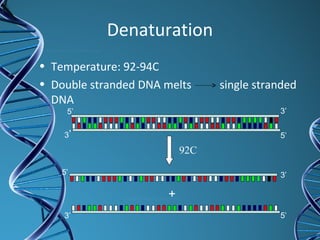
Denaturation
• Temperature: 92-94C
• Double stranded DNA melts single stranded
DNA
92C
3’5’
3’ 5’
+
5’3’
5’ 3’
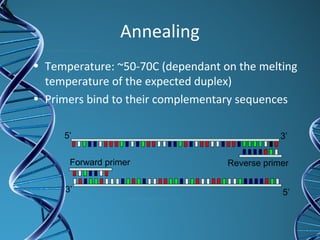
Annealing
• Temperature: ~50-70C (dependant on the melting
temperature of the expected duplex)
• Primers bind to their complementary sequences
5’3’
5’ 3’
Forward primer Reverse primer
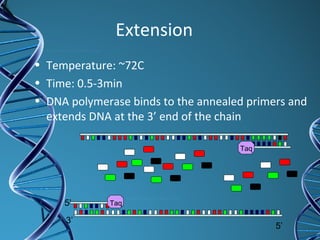
Extension
• Temperature: ~72C
• Time: 0.5-3min
• DNA polymerase binds to the annealed primers and
extends DNA at the 3’ end of the chain
Taq
5’
3’
Taq5’
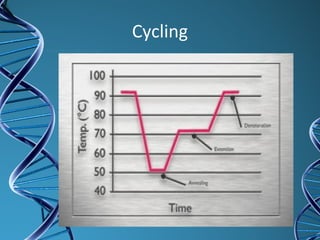
Cycling
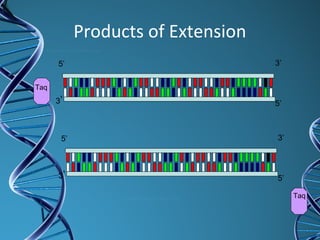
Products of Extension
3’5’
3’ 5’
3’5’
3’ 5’
Taq
Taq
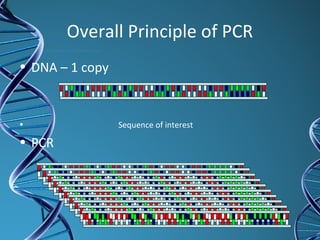
Overall Principle of PCR
• DNA – 1 copy
• Sequence of interest
• PCR
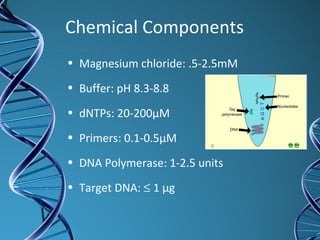
Chemical Components
• Magnesium chloride: .5-2.5mM
• Buffer: pH 8.3-8.8
• dNTPs: 20-200µM
• Primers: 0.1-0.5µM
• DNA Polymerase: 1-2.5 units
• Target DNA: ≤ 1 µg
Variants of PCR
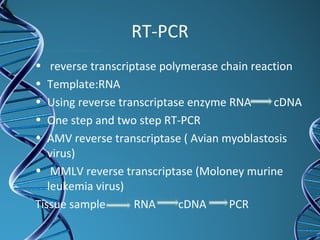
RT-PCR
• reverse transcriptase polymerase chain reaction
• Template:RNA
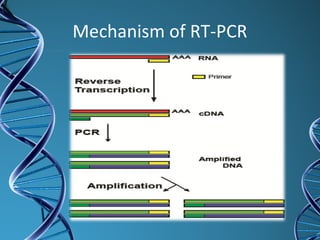
• Using reverse transcriptase enzyme RNA cDNA
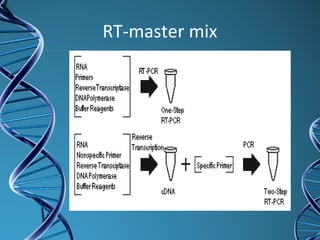
• One step and two step RT-PCR
• AMV reverse transcriptase ( Avian myoblastosis
virus)
• MMLV reverse transcriptase (Moloney murine
leukemia virus)
Tissue sample RNA cDNA PCR
RT-master mix
Mechanism of RT-PCR
Real time PCR
• Beside normal amplification process
performed by normal PCR, Real Time PCR can
perform detection, analysis and quantification
of the sample.
• Detection: Find out the presence of targeted gene
sequence which is assured by the presence of the
amplification curve.
• Quantification: Quantification of targeted DNA in a
sample can be done by using the cycle no. needed
to obtain the threshold value of detector and PCR
efficiency.
• Analysis: Analysis of the variants can be done by
studying the melting curve or comparing the
melting temperature with the sequences of the
database.
Working procedure
• The working procedure of Real Time PCR can be
divided in two steps:
Amplification (Same like normal PCR)
Detection
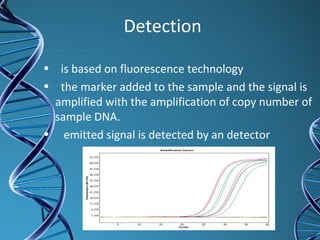
Detection
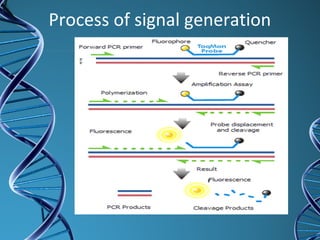
• is based on fluorescence technology
• the marker added to the sample and the signal is
amplified with the amplification of copy number of
sample DNA.
• emitted signal is detected by an detector
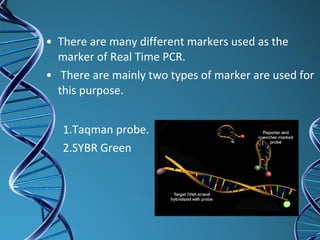
• There are many different markers used as the
marker of Real Time PCR.
• There are mainly two types of marker are used for
this purpose.
1.Taqman probe.
2.SYBR Green
Process of signal generation
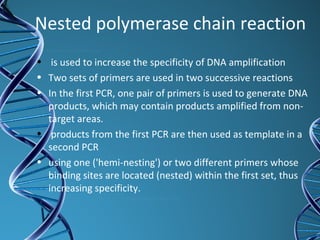
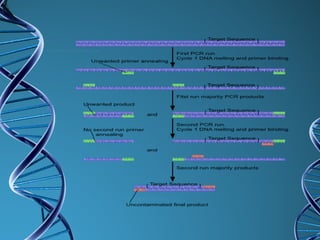
Nested polymerase chain reaction
• is used to increase the specificity of DNA amplification
• Two sets of primers are used in two successive reactions
• In the first PCR, one pair of primers is used to generate DNA
products, which may contain products amplified from non-
target areas.
• products from the first PCR are then used as template in a
second PCR
• using one ('hemi-nesting') or two different primers whose
binding sites are located (nested) within the first set, thus
increasing specificity.
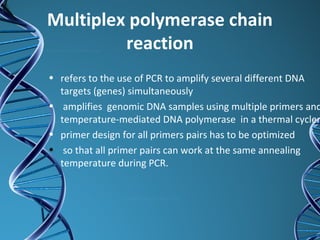
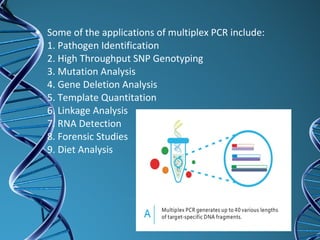
Multiplex polymerase chain
reaction
• refers to the use of PCR to amplify several different DNA
targets (genes) simultaneously
• amplifies genomic DNA samples using multiple primers and
temperature-mediated DNA polymerase in a thermal cycler
• primer design for all primers pairs has to be optimized
• so that all primer pairs can work at the same annealing
temperature during PCR.
• Some of the applications of multiplex PCR include:
1. Pathogen Identification
2. High Throughput SNP Genotyping
3. Mutation Analysis
4. Gene Deletion Analysis
5. Template Quantitation
6. Linkage Analysis
7. RNA Detection
8. Forensic Studies
9. Diet Analysis
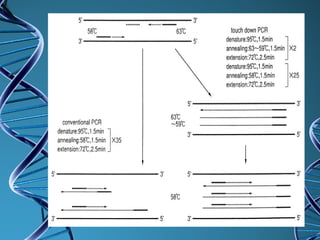
Touchdown polymerase chain
reaction
• the annealing temperature is gradually decreased in later
cycles.
• annealing temperature in the early cycles is usually 3-5 °C
above the standard Tm of the primers
• while in the later cycles it is a similar amount below the Tm
• initial higher annealing temperature leads to greater
specificity for primer binding
• while the lower temperatures permit more efficient
amplification at the end
• Primers will avoid amplifying nonspecific sequences
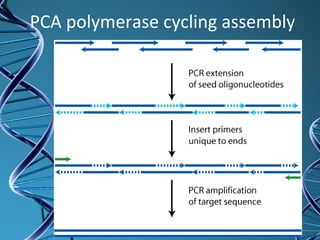
Assembly PCR
• also known as Polymerase Cycling Assembly or PCA
• is a method for the assembly of large DNA
oligonucleotides from shorter fragments.
• uses the same technology as PCR, but takes advantage of
DNA hybridization and annealing
• as well as DNA polymerase to amplify a complete sequence
of DNA in a precise order based on the single stranded
oligonucleotides
• allows for the production of synthetic genes and even entire
synthetic genomes
PCA polymerase cycling assembly
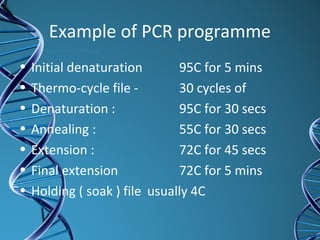
Example of PCR programme
• Initial denaturation 95C for 5 mins
• Thermo-cycle file - 30 cycles of
• Denaturation : 95C for 30 secs
• Annealing : 55C for 30 secs
• Extension : 72C for 45 secs
• Final extension 72C for 5 mins
• Holding ( soak ) file usually 4C
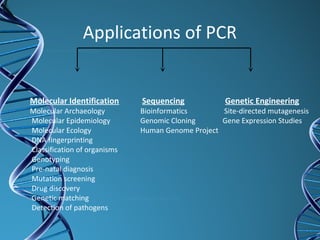
Applications of PCR
Molecular Identification Sequencing Genetic Engineering
Molecular Archaeology Bioinformatics Site-directed mutagenesis
Molecular Epidemiology Genomic Cloning Gene Expression Studies
Molecular Ecology Human Genome Project
DNA fingerprinting
Classification of organisms
Genotyping
Pre-natal diagnosis
Mutation screening
Drug discovery
Genetic matching
Detection of pathogens
Types of pcr

Types of pcr

  • 2.
    SUBMITTED TO :DR.SABA RIAZ Submitted by :Asma Gul -34
  • 3.
  • 4.
    What is PCR? •PCR is a technique that takes specific sequence of DNA and amplifies it to be used for further testing. • In vitro technique
  • 5.
  • 6.
    Purpose • to analyzea short sequence of DNA (or RNA) even in samples containing only minute quantities of DNA or RNA. PCR is used to amplify selected sections of DNA or RNA with same (identical) size and sequence by enzymatic method and cycling condition.
  • 7.
  • 8.
    Denaturation • Temperature: 92-94C •Double stranded DNA melts single stranded DNA 92C 3’5’ 3’ 5’ + 5’3’ 5’ 3’
  • 9.
    Annealing • Temperature: ~50-70C(dependant on the melting temperature of the expected duplex) • Primers bind to their complementary sequences 5’3’ 5’ 3’ Forward primer Reverse primer
  • 10.
    Extension • Temperature: ~72C •Time: 0.5-3min • DNA polymerase binds to the annealed primers and extends DNA at the 3’ end of the chain Taq 5’ 3’ Taq5’
  • 11.
  • 12.
    Products of Extension 3’5’ 3’5’ 3’5’ 3’ 5’ Taq Taq
  • 13.
    Overall Principle ofPCR • DNA – 1 copy • Sequence of interest • PCR
  • 14.
    Chemical Components • Magnesiumchloride: .5-2.5mM • Buffer: pH 8.3-8.8 • dNTPs: 20-200µM • Primers: 0.1-0.5µM • DNA Polymerase: 1-2.5 units • Target DNA: ≤ 1 µg
  • 15.
  • 16.
    RT-PCR • reverse transcriptasepolymerase chain reaction • Template:RNA • Using reverse transcriptase enzyme RNA cDNA • One step and two step RT-PCR • AMV reverse transcriptase ( Avian myoblastosis virus) • MMLV reverse transcriptase (Moloney murine leukemia virus) Tissue sample RNA cDNA PCR
  • 17.
  • 18.
  • 19.
    Real time PCR •Beside normal amplification process performed by normal PCR, Real Time PCR can perform detection, analysis and quantification of the sample.
  • 20.
    • Detection: Findout the presence of targeted gene sequence which is assured by the presence of the amplification curve. • Quantification: Quantification of targeted DNA in a sample can be done by using the cycle no. needed to obtain the threshold value of detector and PCR efficiency. • Analysis: Analysis of the variants can be done by studying the melting curve or comparing the melting temperature with the sequences of the database.
  • 21.
    Working procedure • Theworking procedure of Real Time PCR can be divided in two steps: Amplification (Same like normal PCR) Detection
  • 22.
    Detection • is basedon fluorescence technology • the marker added to the sample and the signal is amplified with the amplification of copy number of sample DNA. • emitted signal is detected by an detector
  • 23.
    • There aremany different markers used as the marker of Real Time PCR. • There are mainly two types of marker are used for this purpose. 1.Taqman probe. 2.SYBR Green
  • 24.
  • 25.
    Nested polymerase chainreaction • is used to increase the specificity of DNA amplification • Two sets of primers are used in two successive reactions • In the first PCR, one pair of primers is used to generate DNA products, which may contain products amplified from non- target areas. • products from the first PCR are then used as template in a second PCR • using one ('hemi-nesting') or two different primers whose binding sites are located (nested) within the first set, thus increasing specificity.
  • 27.
    Multiplex polymerase chain reaction •refers to the use of PCR to amplify several different DNA targets (genes) simultaneously • amplifies genomic DNA samples using multiple primers and temperature-mediated DNA polymerase in a thermal cycler • primer design for all primers pairs has to be optimized • so that all primer pairs can work at the same annealing temperature during PCR.
  • 28.
    • Some ofthe applications of multiplex PCR include: 1. Pathogen Identification 2. High Throughput SNP Genotyping 3. Mutation Analysis 4. Gene Deletion Analysis 5. Template Quantitation 6. Linkage Analysis 7. RNA Detection 8. Forensic Studies 9. Diet Analysis
  • 29.
    Touchdown polymerase chain reaction •the annealing temperature is gradually decreased in later cycles. • annealing temperature in the early cycles is usually 3-5 °C above the standard Tm of the primers • while in the later cycles it is a similar amount below the Tm • initial higher annealing temperature leads to greater specificity for primer binding • while the lower temperatures permit more efficient amplification at the end • Primers will avoid amplifying nonspecific sequences
  • 31.
    Assembly PCR • alsoknown as Polymerase Cycling Assembly or PCA • is a method for the assembly of large DNA oligonucleotides from shorter fragments. • uses the same technology as PCR, but takes advantage of DNA hybridization and annealing • as well as DNA polymerase to amplify a complete sequence of DNA in a precise order based on the single stranded oligonucleotides • allows for the production of synthetic genes and even entire synthetic genomes
  • 32.
  • 33.
    Example of PCRprogramme • Initial denaturation 95C for 5 mins • Thermo-cycle file - 30 cycles of • Denaturation : 95C for 30 secs • Annealing : 55C for 30 secs • Extension : 72C for 45 secs • Final extension 72C for 5 mins • Holding ( soak ) file usually 4C
  • 34.
    Applications of PCR MolecularIdentification Sequencing Genetic Engineering Molecular Archaeology Bioinformatics Site-directed mutagenesis Molecular Epidemiology Genomic Cloning Gene Expression Studies Molecular Ecology Human Genome Project DNA fingerprinting Classification of organisms Genotyping Pre-natal diagnosis Mutation screening Drug discovery Genetic matching Detection of pathogens