ABNORMAL FINDINGS IN
PULSE
Abnormality can be in the:
 Rate
 Rhythm
 Volume
 Character
 Condition of vessel wall
 Radiofemoral delay
ABNORMAL FINDINGS IN
PULSE RATE
1.Tachycardia(Pulse Rate>100 bpm)
2.Bradycardia(Pulse Rate<60 bpm)
TACHYCARDIA
Sinus rhythm Arrhythmia
Exercise Atrial Fibrillation
Infants Atrial flutter
Excitement/Anxiety VentricularTachycardia
Pheochromocytoma
Fever
Hyperthyroidism
MEDICATION:
Ca channel blockers(Nifedipine)
Sympathomimetics(e.g. salbutamol)
Vasodilators
BRADYCARDIA
Sinus rhythm Arrhythmia
Sleep Carotid Sinus hypersensitivity
Athletic training Sick Sinus Syndrome
Hypothyroidism Second-Degree heart block
MEDICATION: Complete heart block
Beta-blockers
Digoxin
Verapamil, Diltiazem
ABNORMAL FINDINGS IN RHYTHM
If Irregular:
Occasionally irregular
Regularly Irregular
Irregularly Irregular
CAUSES OF AN IRREGULAR PULSE
Occassionally Irregular Pulse
• Extrasystole
Regularly Irregular Pulse
• Ectopic beat occuring at a regular interval
• Second degree atrioventricular block
• Sinus arrhythmia
Irregularly Irregular Pulse
• Atrial Fibrillation
• Multiple ectopics
PULSE APEX DEFICIT
Difference in heart rate and
pulse rate
Atrial Fibrillation (>10/min)
Multiple ectopics (<10/min)
ABNORMALITIES IN PULSE VOLUME
HighVolume Pulse
LowVolume Pulse
VaryingVolume
High Volume Pulse
Physiological causes:
Exercise
Pregnancy
Advanced Age
Increased Environmental
Temperature
Pathological causes
• Arteriosclerosis
• Aortic regurgitation
• PDA
• Arteriovenous fistula
• Fever
• Thyrotoxicosis
• Anaemia
• Beri-Beri
• Complete heart block
• Cirrhosis liver
Low Volume Pulse
Causes:
 LeftVentricular Failure
 Hypovolemia
 Peripheral arterial disease
 Shock
 Severe Aortic Stenosis
 Pericardial Effusion
Varying Volume
 Combination of low, normal or high
volume pulse in varying manner
 Seen in:
Atrial fibrillation
VentricularTachycardia
CONDITION OF VESSEL WALL
Can be:
Normal-Soft
Thickened-firm to hard and cord-like
Elderly due to artherosclerosis
CHARACTER OF PULSE
 Collapsing pulse
 Slow rising pulse
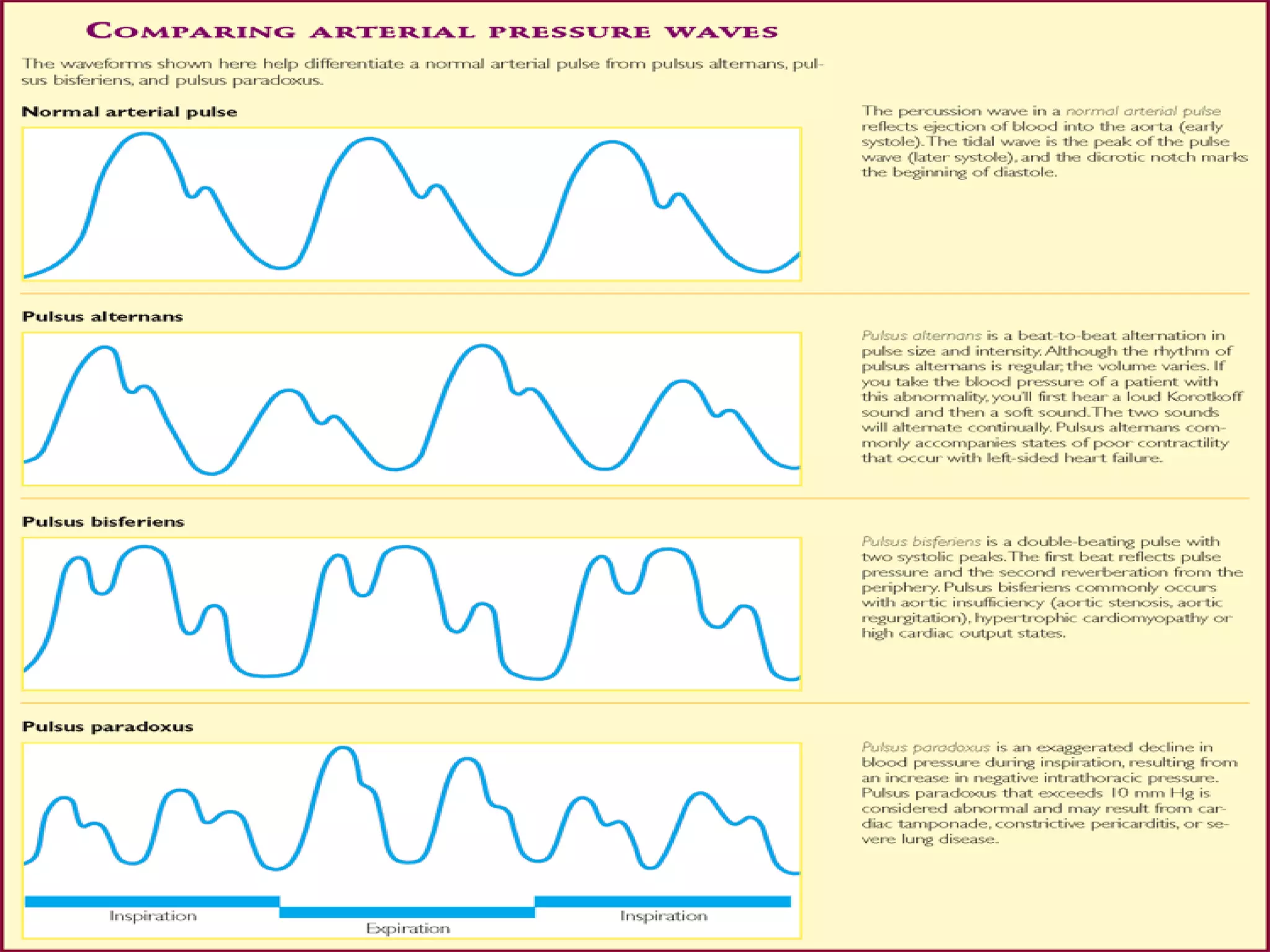
 Pulsus bisferiens
 Pulsus parvus et tardus
 Pulsus bigeminus
 Pulsus alternans
 Pulsus paradoxus
 Anacrotic pulse
 Dicrotic pulse
Collapsing pulse/Water-hammer
pulse/Corrigan’s pulse
Collapsing pulse
 Sharp rise
 Ill-sustained
 Sharp fall
 Wide pulse pressure(>80mmHg)
High volume collapsing pulse in:
Aortic regurgitation
PDA
Normal volume collapsing pulse in:
Mitral Regurgitation
Mechanism
 In aortic regurgitation, during diastole:
Left ventricle receives
normal pulmonary venous return+portion of blood
ejected into the aorta => large stroke volume-
vigorously ejected=> rapidly rising carotid pulse
Collapses in early diastole – backflow through
aortic valve
Exaggerated at the radial artery by liftng the
arm.
Slow Rising Pulse
 Gradual upstroke with a reduced peak
 Occur late in systole
 Seen in severe aortic stenosis
Mechanism
Fixed obstruction restricts the rate at which
blood can be ejected from the left ventricle.
Pulsus Bisferiens
 Increased pulse with double systolic peak
seperated by a distinct mid-systolic dip.
 Causes:
Aortic regurgitation
Concomitant aortic stenois and regurgitation
Pulsus Parvus et Tardus
 Weak and delayed pulse
 Seen in conditions with:
 diminished left ventricular stroke volume
Narrow pulse pressure
Increased peripheral vascular resistance
Aortic stenosis
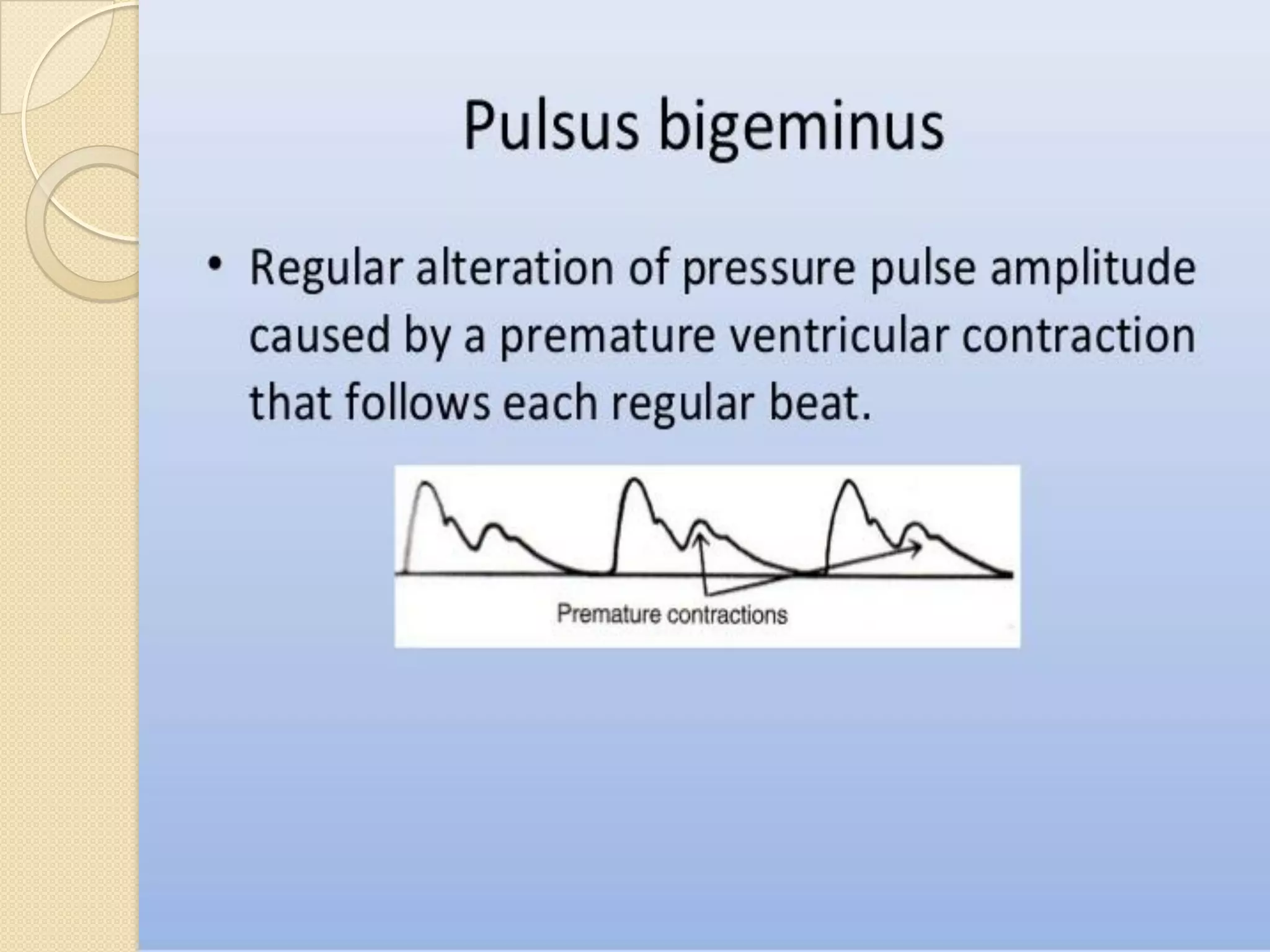
Pulsus bigeminus
 Regular alteration of pulse pressure
amplitude.
 Caused by premature ventricular
contraction that follows each regular beat
 Occurs in:
AV block
Sinoatrial block withVentricular Escape
Pulsus alternans
 Beat-to-beat variation in pulse volume with a
normal rhythm.
 Rare
 Occurs in :
Advanced heart failure
Toxic myocarditis
ParoxysmalTachycardias
Following Premature beat
Pulsus Paradoxus
 Exaggeration of the normal variability of
pulse volume with breathing.
 Inspiratory decline in systolic pressure
greater than 10mm Hg.
 Occurs in:
Cardiac tamponade
Constrictive pericarditis
Percardial effusion
Anacrotic Pulse
 Slow rising
 Double beating pulse
 Both waves felt in systole
Seen in Aortic Stenosis
Dicrotic Pulse
 Twice beating
 First wave in systole, second wave in
diastole
 Seen when PR and DP is low
 Felt due to hypotonia of vessel wall
 Seen in:
Fever (e.g. typhoid fever)
CCF
Cardiac Tamponade
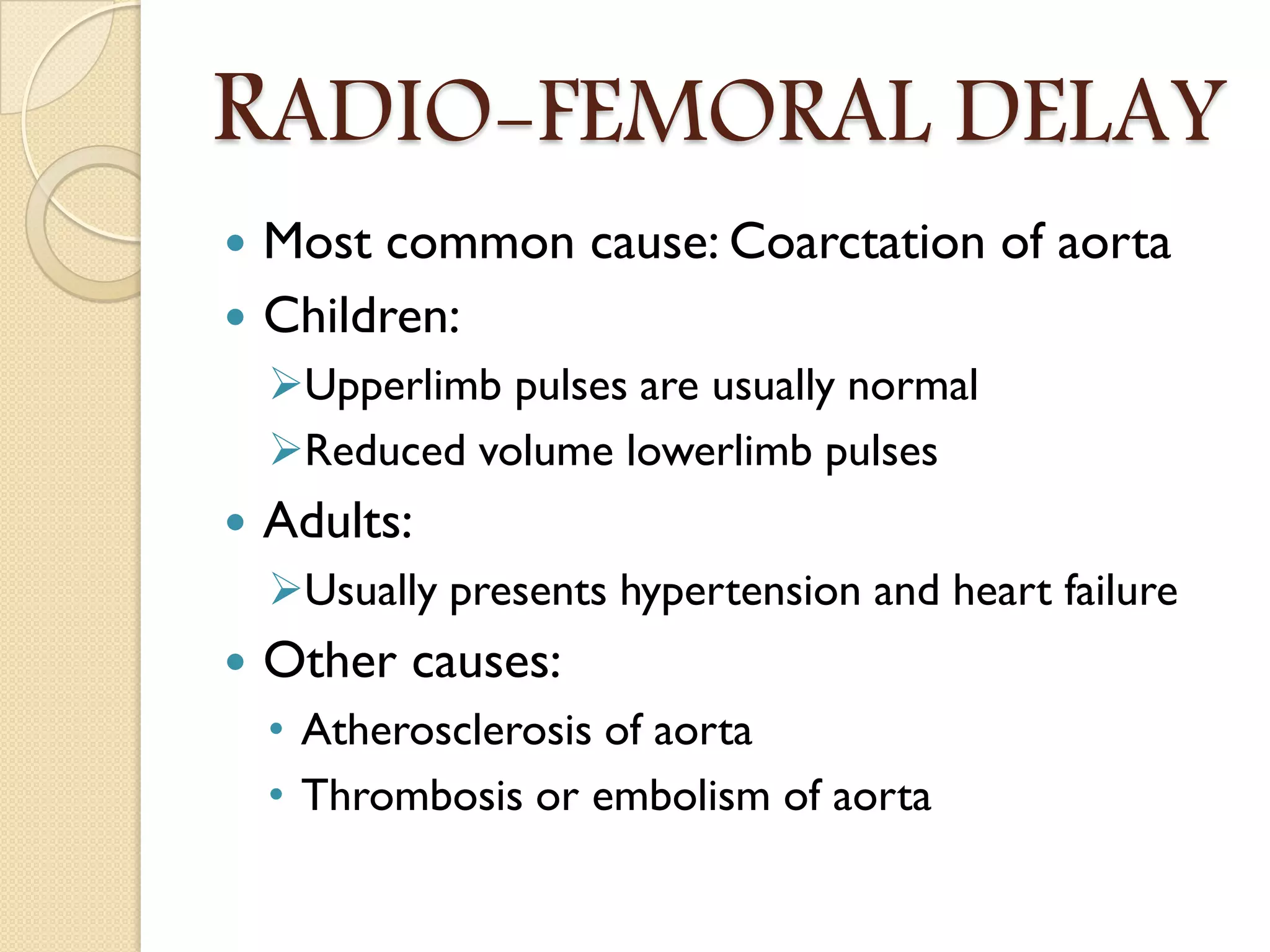
RADIO-FEMORAL DELAY
 Most common cause: Coarctation of aorta
 Children:
Upperlimb pulses are usually normal
Reduced volume lowerlimb pulses
 Adults:
Usually presents hypertension and heart failure
 Other causes:
• Atherosclerosis of aorta
• Thrombosis or embolism of aorta
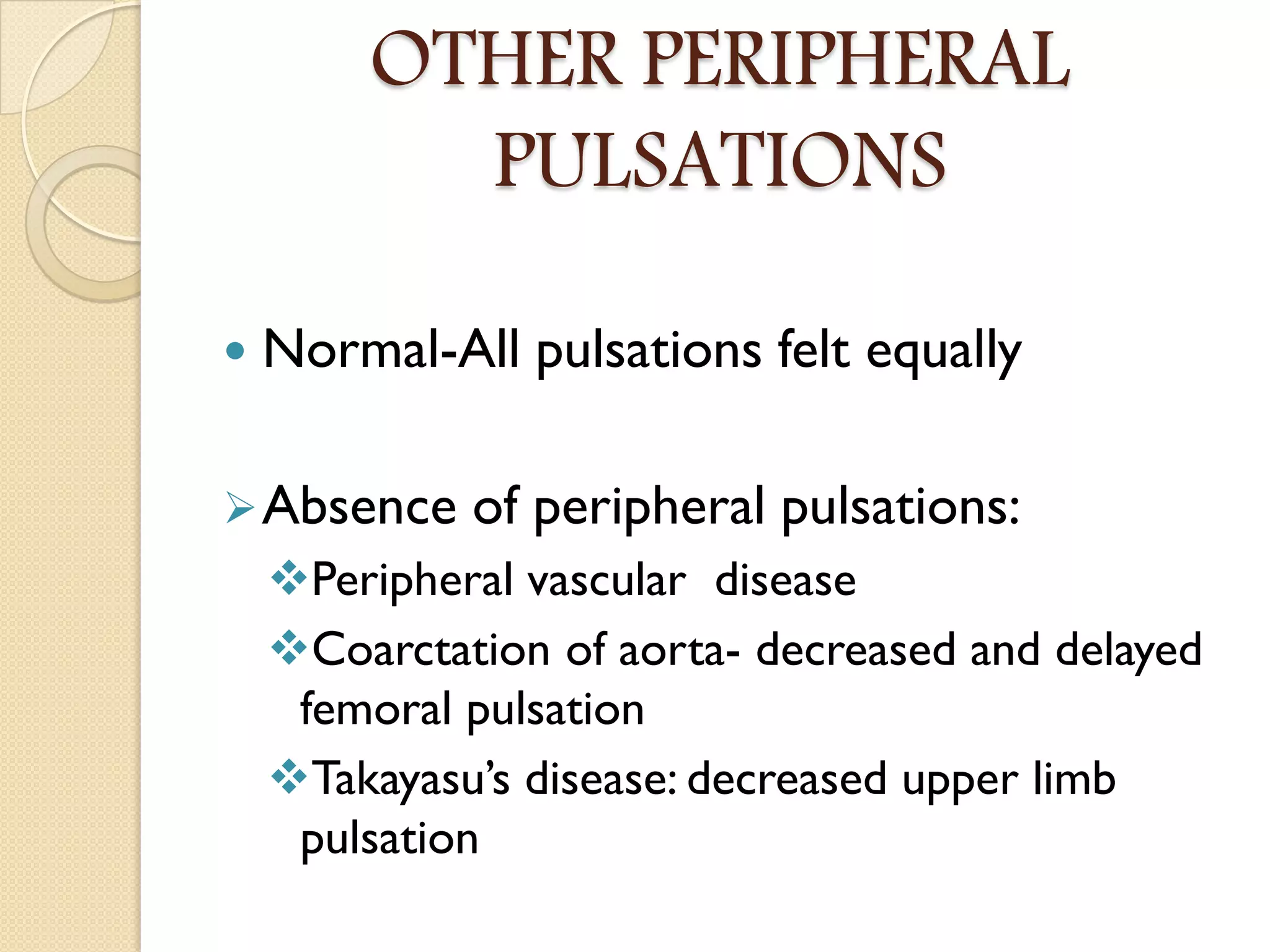
OTHER PERIPHERAL
PULSATIONS
 Normal-All pulsations felt equally
Absence of peripheral pulsations:
Peripheral vascular disease
Coarctation of aorta- decreased and delayed
femoral pulsation
Takayasu’s disease: decreased upper limb
pulsation
CAUSES OF ABSENT RADIAL
PULSE
 Anatomical abnormality
 Severe atherosclerosis
 Takayasu arteritis (Pulseless disease)
 Embolism in radial artery
 Death
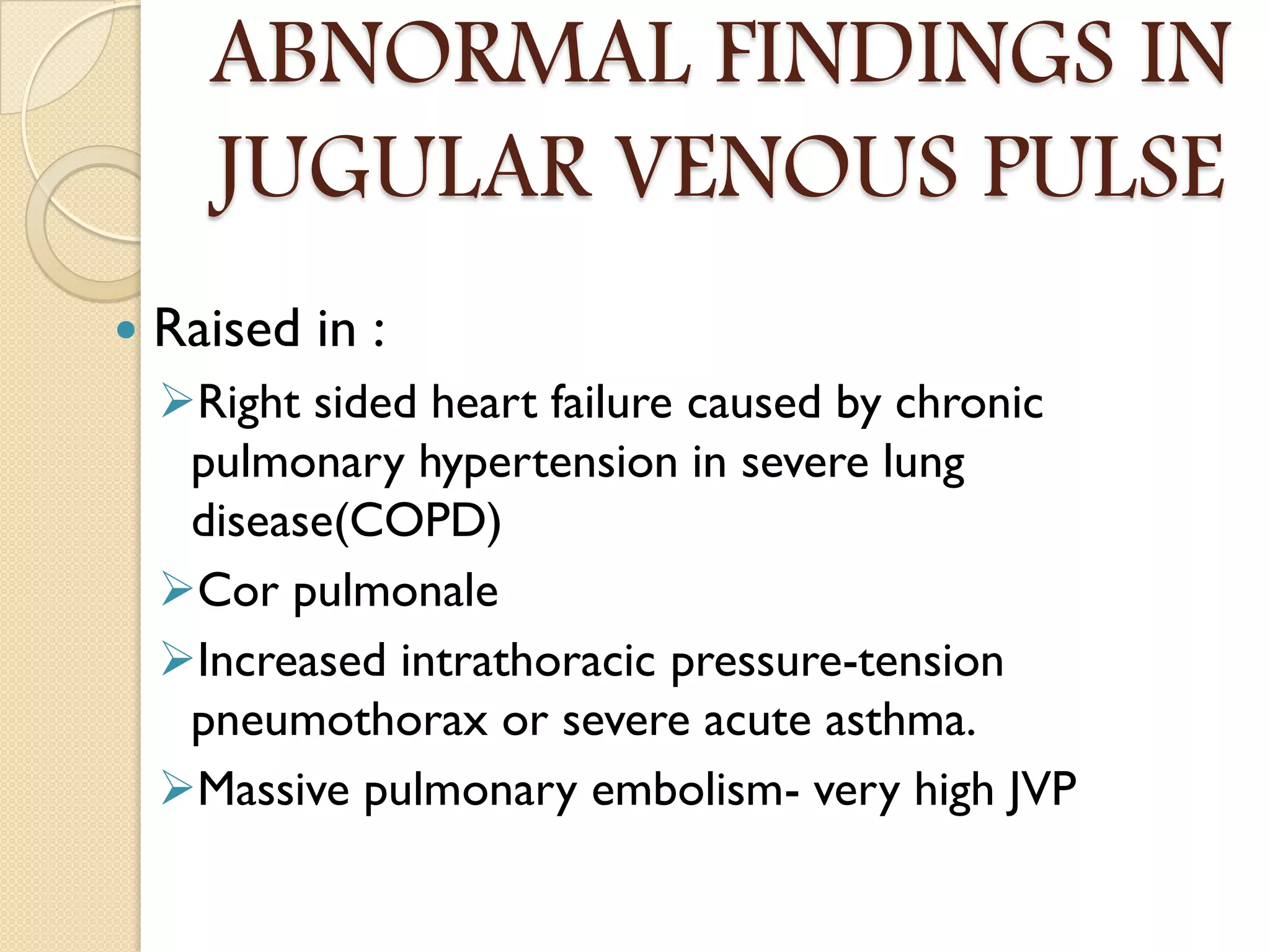
ABNORMAL FINDINGS IN
JUGULAR VENOUS PULSE
 Raised in :
Right sided heart failure caused by chronic
pulmonary hypertension in severe lung
disease(COPD)
Cor pulmonale
Increased intrathoracic pressure-tension
pneumothorax or severe acute asthma.
Massive pulmonary embolism- very high JVP
Giant ‘a’ wave:Tricuspid valve stenosis
Cannon ‘a’ wave: Complete heart block &
Ventricular tachycardia
Giant ‘v’ wave:Tricuspid Regurgitation
Prominent ‘x’ and ‘y’ descents:
Constrictive pericarditis
THANK YOU

Pulse- Abnormal Findings

  • 2.
    ABNORMAL FINDINGS IN PULSE Abnormalitycan be in the:  Rate  Rhythm  Volume  Character  Condition of vessel wall  Radiofemoral delay
  • 3.
    ABNORMAL FINDINGS IN PULSERATE 1.Tachycardia(Pulse Rate>100 bpm) 2.Bradycardia(Pulse Rate<60 bpm)
  • 4.
    TACHYCARDIA Sinus rhythm Arrhythmia ExerciseAtrial Fibrillation Infants Atrial flutter Excitement/Anxiety VentricularTachycardia Pheochromocytoma Fever Hyperthyroidism MEDICATION: Ca channel blockers(Nifedipine) Sympathomimetics(e.g. salbutamol) Vasodilators
  • 5.
    BRADYCARDIA Sinus rhythm Arrhythmia SleepCarotid Sinus hypersensitivity Athletic training Sick Sinus Syndrome Hypothyroidism Second-Degree heart block MEDICATION: Complete heart block Beta-blockers Digoxin Verapamil, Diltiazem
  • 6.
    ABNORMAL FINDINGS INRHYTHM If Irregular: Occasionally irregular Regularly Irregular Irregularly Irregular
  • 7.
    CAUSES OF ANIRREGULAR PULSE Occassionally Irregular Pulse • Extrasystole Regularly Irregular Pulse • Ectopic beat occuring at a regular interval • Second degree atrioventricular block • Sinus arrhythmia Irregularly Irregular Pulse • Atrial Fibrillation • Multiple ectopics
  • 8.
    PULSE APEX DEFICIT Differencein heart rate and pulse rate Atrial Fibrillation (>10/min) Multiple ectopics (<10/min)
  • 9.
    ABNORMALITIES IN PULSEVOLUME HighVolume Pulse LowVolume Pulse VaryingVolume
  • 10.
    High Volume Pulse Physiologicalcauses: Exercise Pregnancy Advanced Age Increased Environmental Temperature
  • 11.
    Pathological causes • Arteriosclerosis •Aortic regurgitation • PDA • Arteriovenous fistula • Fever • Thyrotoxicosis • Anaemia • Beri-Beri • Complete heart block • Cirrhosis liver
  • 12.
    Low Volume Pulse Causes: LeftVentricular Failure  Hypovolemia  Peripheral arterial disease  Shock  Severe Aortic Stenosis  Pericardial Effusion
  • 13.
    Varying Volume  Combinationof low, normal or high volume pulse in varying manner  Seen in: Atrial fibrillation VentricularTachycardia
  • 14.
    CONDITION OF VESSELWALL Can be: Normal-Soft Thickened-firm to hard and cord-like Elderly due to artherosclerosis
  • 15.
    CHARACTER OF PULSE Collapsing pulse  Slow rising pulse  Pulsus bisferiens  Pulsus parvus et tardus  Pulsus bigeminus  Pulsus alternans  Pulsus paradoxus  Anacrotic pulse  Dicrotic pulse
  • 16.
  • 17.
    Collapsing pulse  Sharprise  Ill-sustained  Sharp fall  Wide pulse pressure(>80mmHg) High volume collapsing pulse in: Aortic regurgitation PDA Normal volume collapsing pulse in: Mitral Regurgitation
  • 18.
    Mechanism  In aorticregurgitation, during diastole: Left ventricle receives normal pulmonary venous return+portion of blood ejected into the aorta => large stroke volume- vigorously ejected=> rapidly rising carotid pulse
  • 19.
    Collapses in earlydiastole – backflow through aortic valve Exaggerated at the radial artery by liftng the arm.
  • 21.
    Slow Rising Pulse Gradual upstroke with a reduced peak  Occur late in systole  Seen in severe aortic stenosis
  • 22.
    Mechanism Fixed obstruction restrictsthe rate at which blood can be ejected from the left ventricle.
  • 23.
    Pulsus Bisferiens  Increasedpulse with double systolic peak seperated by a distinct mid-systolic dip.  Causes: Aortic regurgitation Concomitant aortic stenois and regurgitation
  • 25.
    Pulsus Parvus etTardus  Weak and delayed pulse  Seen in conditions with:  diminished left ventricular stroke volume Narrow pulse pressure Increased peripheral vascular resistance Aortic stenosis
  • 27.
    Pulsus bigeminus  Regularalteration of pulse pressure amplitude.  Caused by premature ventricular contraction that follows each regular beat  Occurs in: AV block Sinoatrial block withVentricular Escape
  • 29.
    Pulsus alternans  Beat-to-beatvariation in pulse volume with a normal rhythm.  Rare  Occurs in : Advanced heart failure Toxic myocarditis ParoxysmalTachycardias Following Premature beat
  • 31.
    Pulsus Paradoxus  Exaggerationof the normal variability of pulse volume with breathing.  Inspiratory decline in systolic pressure greater than 10mm Hg.  Occurs in: Cardiac tamponade Constrictive pericarditis Percardial effusion
  • 33.
    Anacrotic Pulse  Slowrising  Double beating pulse  Both waves felt in systole Seen in Aortic Stenosis
  • 35.
    Dicrotic Pulse  Twicebeating  First wave in systole, second wave in diastole  Seen when PR and DP is low  Felt due to hypotonia of vessel wall  Seen in: Fever (e.g. typhoid fever) CCF Cardiac Tamponade
  • 37.
    RADIO-FEMORAL DELAY  Mostcommon cause: Coarctation of aorta  Children: Upperlimb pulses are usually normal Reduced volume lowerlimb pulses  Adults: Usually presents hypertension and heart failure  Other causes: • Atherosclerosis of aorta • Thrombosis or embolism of aorta
  • 38.
    OTHER PERIPHERAL PULSATIONS  Normal-Allpulsations felt equally Absence of peripheral pulsations: Peripheral vascular disease Coarctation of aorta- decreased and delayed femoral pulsation Takayasu’s disease: decreased upper limb pulsation
  • 39.
    CAUSES OF ABSENTRADIAL PULSE  Anatomical abnormality  Severe atherosclerosis  Takayasu arteritis (Pulseless disease)  Embolism in radial artery  Death
  • 40.
    ABNORMAL FINDINGS IN JUGULARVENOUS PULSE  Raised in : Right sided heart failure caused by chronic pulmonary hypertension in severe lung disease(COPD) Cor pulmonale Increased intrathoracic pressure-tension pneumothorax or severe acute asthma. Massive pulmonary embolism- very high JVP
  • 41.
    Giant ‘a’ wave:Tricuspidvalve stenosis Cannon ‘a’ wave: Complete heart block & Ventricular tachycardia Giant ‘v’ wave:Tricuspid Regurgitation Prominent ‘x’ and ‘y’ descents: Constrictive pericarditis
  • 43.