What is, How to, and Formats.

DEBATE
What is Debate?


is a method of interactive and
representational argument.



Debate is a broader form of argument
than deductive reasoning, which only
examines whether a conclusion is a
consequence of premises, and
factual argument, which only
examines what is or isn't the case, or
rhetoric, which is a technique of
persuasion.
Why Debate?


Is essential to our survival as a
civilized world. Talking about issues
and trying to figure out how to solve
them.



It allows

both sides of an issue
to be considered, and reveals a
large number of facts about a topic.
4 COMMON
TYPES OF
DEBATE
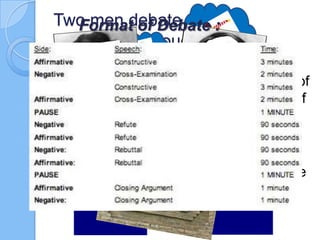
Two men debate or :
Format of Debate
The Lincoln-Douglas Type


there is only one speaker in the side of
the affirmative as well as in the side of
the negative.



The speaker in the affirmative side
opens the debate then followed by the
negative speech.
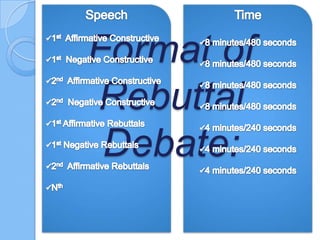
Rebuttal Type
Where each team from the affirmative and
the negative side is composed of about two
or three members. As the debate starts, the
affirmative speaker opens the constructive
speech and the negative speaker starts the
rebuttal.
 (rebuttal “a refutation or contradiction.")




Every speaker is allowed to deliver a rebuttal
speech. The debate is closed with

the affirmative side delivering the
last rebuttal.
Format of
Rebuttal
Debate:
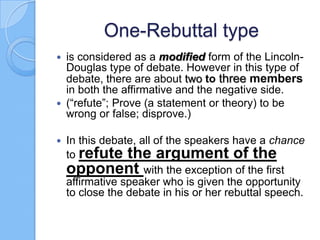
One-Rebuttal type
is considered as a modified form of the LincolnDouglas type of debate. However in this type of
debate, there are about two to three members
in both the affirmative and the negative side.
 (“refute”; Prove (a statement or theory) to be
wrong or false; disprove.)




In this debate, all of the speakers have a chance
to refute the argument of the
opponent with the exception of the first
affirmative speaker who is given the opportunity
to close the debate in his or her rebuttal speech.
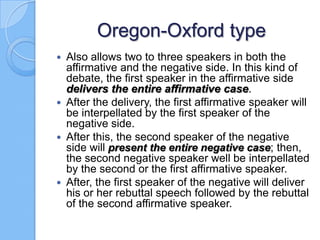
Oregon-Oxford type
Also allows two to three speakers in both the
affirmative and the negative side. In this kind of
debate, the first speaker in the affirmative side
delivers the entire affirmative case.
 After the delivery, the first affirmative speaker will
be interpellated by the first speaker of the
negative side.
 After this, the second speaker of the negative
side will present the entire negative case; then,
the second negative speaker well be interpellated
by the second or the first affirmative speaker.
 After, the first speaker of the negative will deliver
his or her rebuttal speech followed by the rebuttal
of the second affirmative speaker.

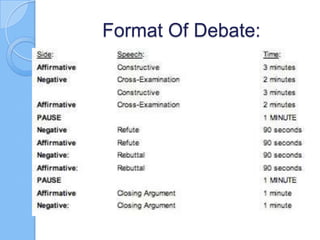
Format Of Debate:
What is and How to

PANEL DISCUSSION.
Panel Discussion


discussion of a subject of public interest by a
group of persons forming a panel usually
before an audience.



A panel discussion is designed to provide an
opportunity for a group to hear several
people knowledgeable about a specific
issue or topic present information and
discuss personal views. A panel discussion
may help the audience further clarify and
evaluate their positions regarding specific
issues or topics being discussed and
increase their understanding of the positions
of others.
How to conduct
a Panel
Discussion.
Step 1:
Identify the goal and purpose of
your panel discussion.
 Establish what you want to achieve by
conducting the discussion, and what
general questions will be answered.
Focus on 1 or 2 main topics to direct
the panel discussion in an organized
way.

Step II: Invite experts to
become panelists.
Choose knowledgeable, well-educated
experts or individuals involved in the
focus of your panel discussion. Invite
local coordinators and community
partners to participate in panel
discussions that involve projects within
your community. A panelist does not
have to have an impressive degree or
years of experience to offer insightful
discussion during the presentation.
 Invite panelists at least 3 or 3 weeks
prior to the discussion to allow them time
to prepare.

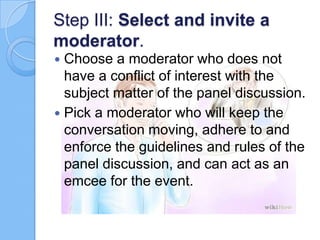
Step III: Select and invite a
moderator.
Choose a moderator who does not
have a conflict of interest with the
subject matter of the panel discussion.
 Pick a moderator who will keep the
conversation moving, adhere to and
enforce the guidelines and rules of the
panel discussion, and can act as an
emcee for the event.

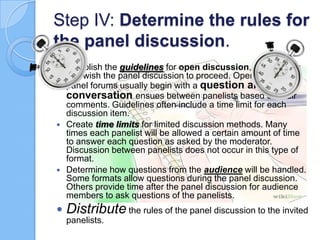
Step IV: Determine the rules for
the panel discussion.








Establish the guidelines for open discussion, if that's how
you wish the panel discussion to proceed. Open discussion
panel forums usually begin with a question and
conversation ensues between panelists based on their
comments. Guidelines often include a time limit for each
discussion item.
Create time limits for limited discussion methods. Many
times each panelist will be allowed a certain amount of time
to answer each question as asked by the moderator.
Discussion between panelists does not occur in this type of
format.
Determine how questions from the audience will be handled.
Some formats allow questions during the panel discussion.
Others provide time after the panel discussion for audience
members to ask questions of the panelists.

Distribute the rules of the panel discussion to the invited
panelists.
Step V: Write questions for the
panelists.


Questions should be open-ended and
require more than "yes" or "no"
answers. Create more questions than
you think you will need in case the
panel discussion proceeds more
quickly than anticipated.
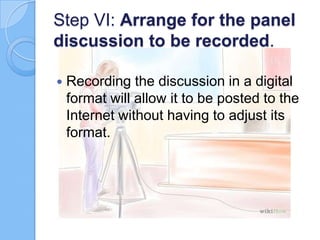
Step VI: Arrange for the panel
discussion to be recorded.


Recording the discussion in a digital
format will allow it to be posted to the
Internet without having to adjust its
format.
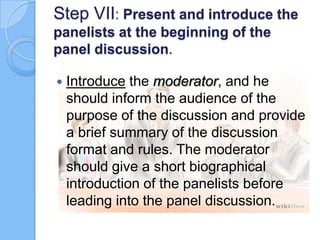
Step VII: Present and introduce the
panelists at the beginning of the
panel discussion.


Introduce the moderator, and he
should inform the audience of the
purpose of the discussion and provide
a brief summary of the discussion
format and rules. The moderator
should give a short biographical
introduction of the panelists before
leading into the panel discussion.
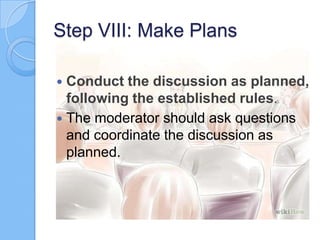
Step VIII: Make Plans
Conduct the discussion as planned,
following the established rules.
 The moderator should ask questions
and coordinate the discussion as
planned.

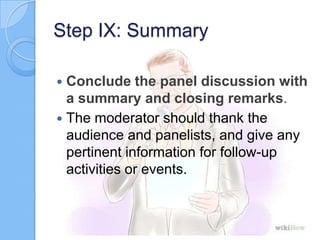
Step IX: Summary
Conclude the panel discussion with
a summary and closing remarks.
 The moderator should thank the
audience and panelists, and give any
pertinent information for follow-up
activities or events.

Step X: Courtesy


Send thank you notes to the
panelists and moderator for their
participation.
Difference between Debate and
Panel Discussion
In debating one side must ultimately
win. So any point of disagreement is a
form of attack or contradiction. Such
attacks or contradiction must be
vehemently defended,
because you're trying to win in the
debate and to prove the other side is
wrong.
While on Panel Discussions everyone
participates on a somewhat equal
footing, even when they disagree.
Points of difference aren't necessarily
attacks/contradictions; they're just points
of difference.
And to make a point of difference doesn't
imply that the other side is wrong - only
that you disagree with it.
Debate = One sided
Panel Discussion = For general
information
Thanks.

Debate and Panel discussion

  • 2.
    What is, Howto, and Formats. DEBATE
  • 3.
    What is Debate?  isa method of interactive and representational argument.  Debate is a broader form of argument than deductive reasoning, which only examines whether a conclusion is a consequence of premises, and factual argument, which only examines what is or isn't the case, or rhetoric, which is a technique of persuasion.
  • 4.
    Why Debate?  Is essentialto our survival as a civilized world. Talking about issues and trying to figure out how to solve them.  It allows both sides of an issue to be considered, and reveals a large number of facts about a topic.
  • 5.
  • 6.
    Two men debateor : Format of Debate The Lincoln-Douglas Type  there is only one speaker in the side of the affirmative as well as in the side of the negative.  The speaker in the affirmative side opens the debate then followed by the negative speech.
  • 7.
    Rebuttal Type Where eachteam from the affirmative and the negative side is composed of about two or three members. As the debate starts, the affirmative speaker opens the constructive speech and the negative speaker starts the rebuttal.  (rebuttal “a refutation or contradiction.")   Every speaker is allowed to deliver a rebuttal speech. The debate is closed with the affirmative side delivering the last rebuttal.
  • 8.
  • 9.
    One-Rebuttal type is consideredas a modified form of the LincolnDouglas type of debate. However in this type of debate, there are about two to three members in both the affirmative and the negative side.  (“refute”; Prove (a statement or theory) to be wrong or false; disprove.)   In this debate, all of the speakers have a chance to refute the argument of the opponent with the exception of the first affirmative speaker who is given the opportunity to close the debate in his or her rebuttal speech.
  • 10.
    Oregon-Oxford type Also allowstwo to three speakers in both the affirmative and the negative side. In this kind of debate, the first speaker in the affirmative side delivers the entire affirmative case.  After the delivery, the first affirmative speaker will be interpellated by the first speaker of the negative side.  After this, the second speaker of the negative side will present the entire negative case; then, the second negative speaker well be interpellated by the second or the first affirmative speaker.  After, the first speaker of the negative will deliver his or her rebuttal speech followed by the rebuttal of the second affirmative speaker. 
  • 11.
  • 12.
    What is andHow to PANEL DISCUSSION.
  • 13.
    Panel Discussion  discussion ofa subject of public interest by a group of persons forming a panel usually before an audience.  A panel discussion is designed to provide an opportunity for a group to hear several people knowledgeable about a specific issue or topic present information and discuss personal views. A panel discussion may help the audience further clarify and evaluate their positions regarding specific issues or topics being discussed and increase their understanding of the positions of others.
  • 14.
    How to conduct aPanel Discussion.
  • 15.
    Step 1: Identify thegoal and purpose of your panel discussion.  Establish what you want to achieve by conducting the discussion, and what general questions will be answered. Focus on 1 or 2 main topics to direct the panel discussion in an organized way. 
  • 16.
    Step II: Inviteexperts to become panelists. Choose knowledgeable, well-educated experts or individuals involved in the focus of your panel discussion. Invite local coordinators and community partners to participate in panel discussions that involve projects within your community. A panelist does not have to have an impressive degree or years of experience to offer insightful discussion during the presentation.  Invite panelists at least 3 or 3 weeks prior to the discussion to allow them time to prepare. 
  • 17.
    Step III: Selectand invite a moderator. Choose a moderator who does not have a conflict of interest with the subject matter of the panel discussion.  Pick a moderator who will keep the conversation moving, adhere to and enforce the guidelines and rules of the panel discussion, and can act as an emcee for the event. 
  • 18.
    Step IV: Determinethe rules for the panel discussion.     Establish the guidelines for open discussion, if that's how you wish the panel discussion to proceed. Open discussion panel forums usually begin with a question and conversation ensues between panelists based on their comments. Guidelines often include a time limit for each discussion item. Create time limits for limited discussion methods. Many times each panelist will be allowed a certain amount of time to answer each question as asked by the moderator. Discussion between panelists does not occur in this type of format. Determine how questions from the audience will be handled. Some formats allow questions during the panel discussion. Others provide time after the panel discussion for audience members to ask questions of the panelists. Distribute the rules of the panel discussion to the invited panelists.
  • 19.
    Step V: Writequestions for the panelists.  Questions should be open-ended and require more than "yes" or "no" answers. Create more questions than you think you will need in case the panel discussion proceeds more quickly than anticipated.
  • 20.
    Step VI: Arrangefor the panel discussion to be recorded.  Recording the discussion in a digital format will allow it to be posted to the Internet without having to adjust its format.
  • 21.
    Step VII: Presentand introduce the panelists at the beginning of the panel discussion.  Introduce the moderator, and he should inform the audience of the purpose of the discussion and provide a brief summary of the discussion format and rules. The moderator should give a short biographical introduction of the panelists before leading into the panel discussion.
  • 22.
    Step VIII: MakePlans Conduct the discussion as planned, following the established rules.  The moderator should ask questions and coordinate the discussion as planned. 
  • 23.
    Step IX: Summary Concludethe panel discussion with a summary and closing remarks.  The moderator should thank the audience and panelists, and give any pertinent information for follow-up activities or events. 
  • 24.
    Step X: Courtesy  Sendthank you notes to the panelists and moderator for their participation.
  • 25.
    Difference between Debateand Panel Discussion In debating one side must ultimately win. So any point of disagreement is a form of attack or contradiction. Such attacks or contradiction must be vehemently defended, because you're trying to win in the debate and to prove the other side is wrong.
  • 26.
    While on PanelDiscussions everyone participates on a somewhat equal footing, even when they disagree. Points of difference aren't necessarily attacks/contradictions; they're just points of difference. And to make a point of difference doesn't imply that the other side is wrong - only that you disagree with it. Debate = One sided Panel Discussion = For general information
  • 27.